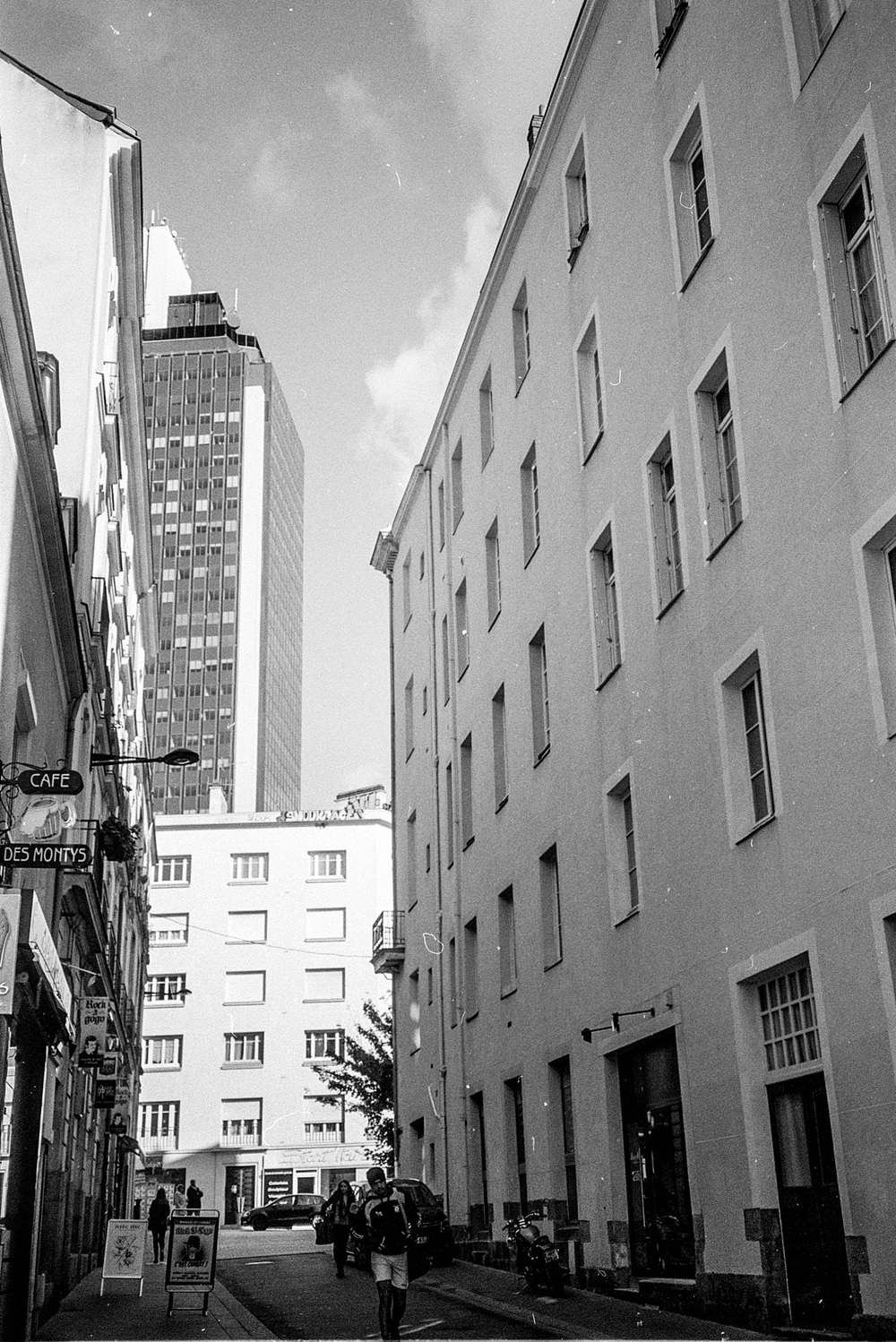
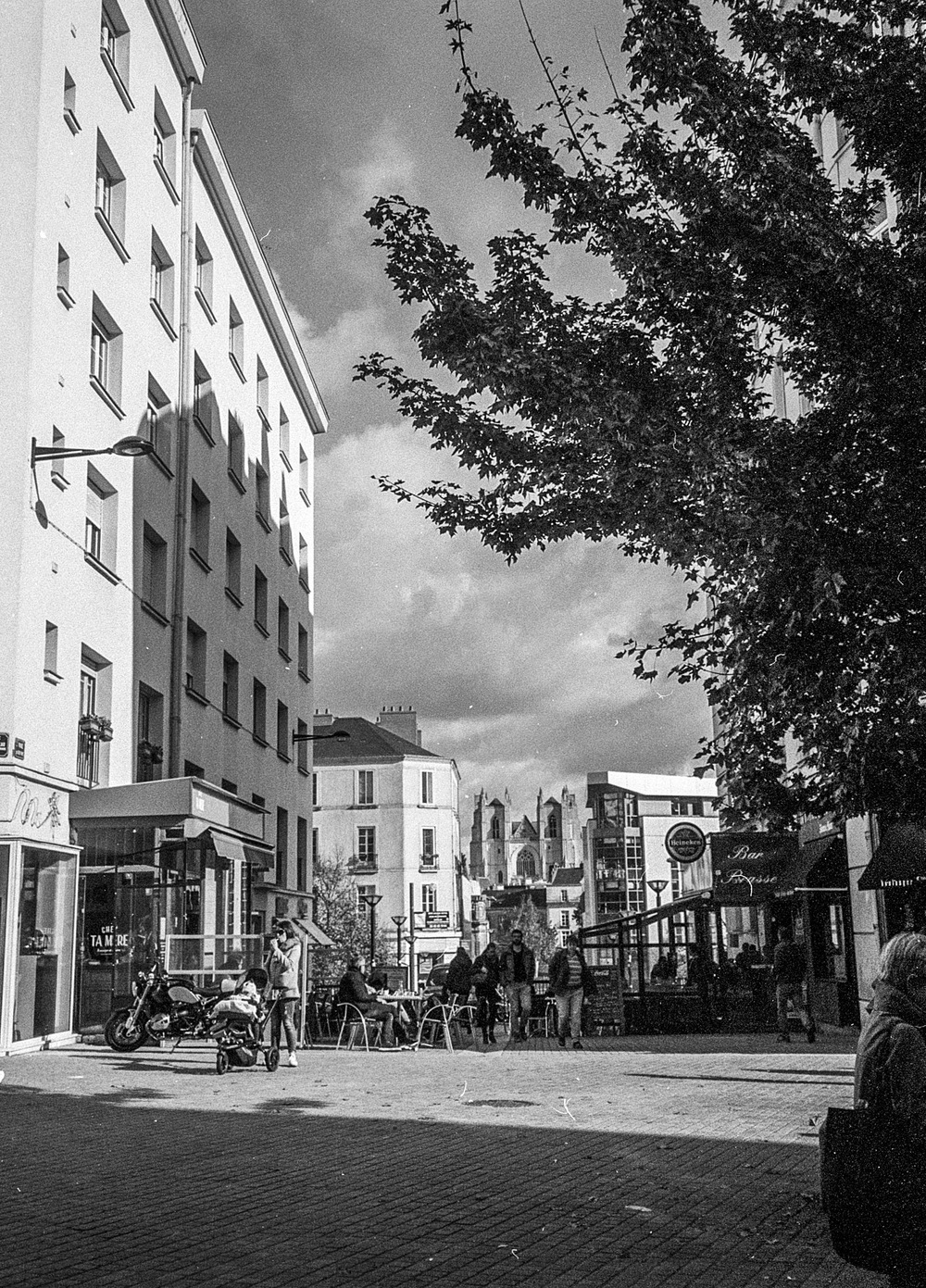
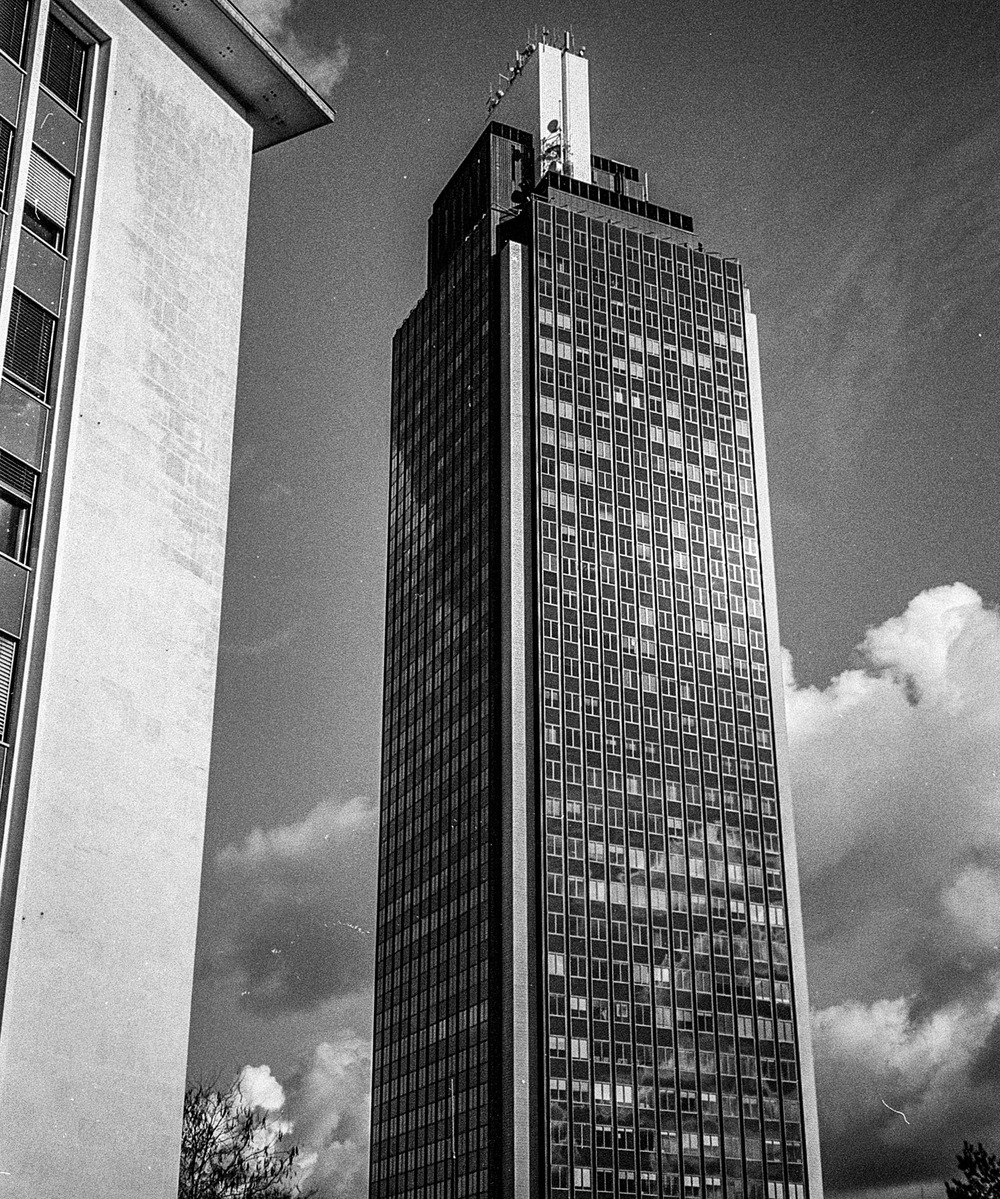
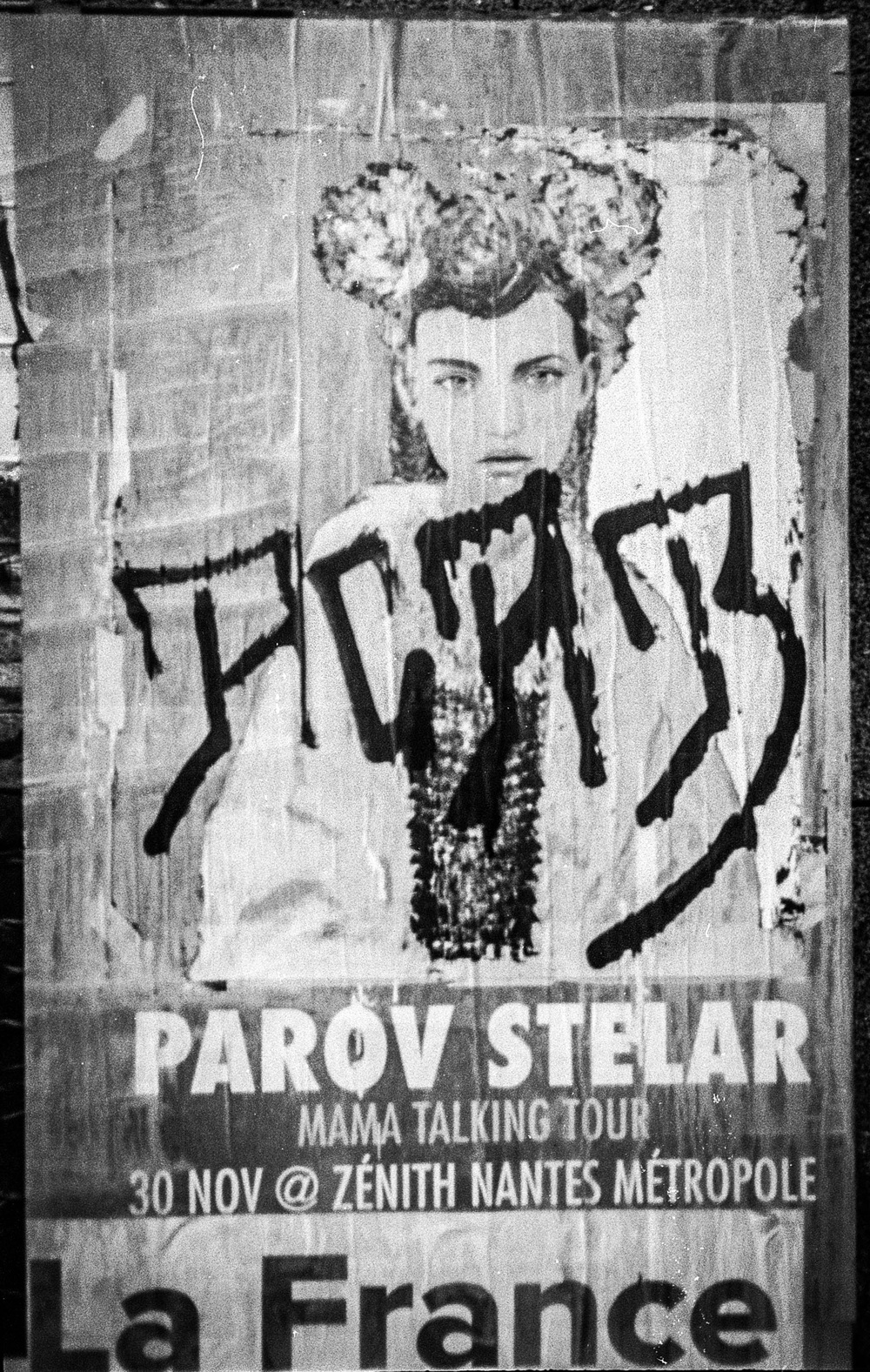
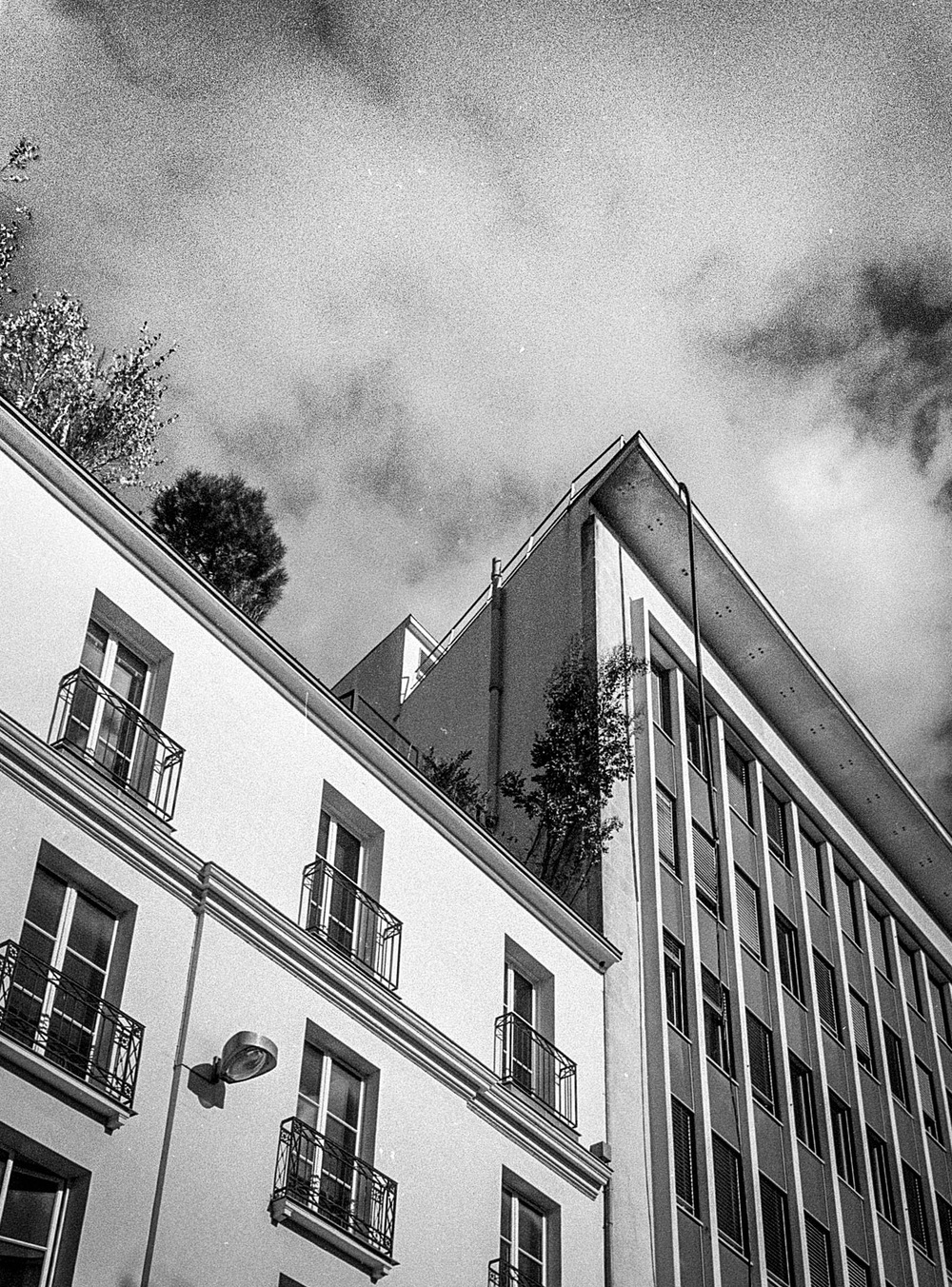
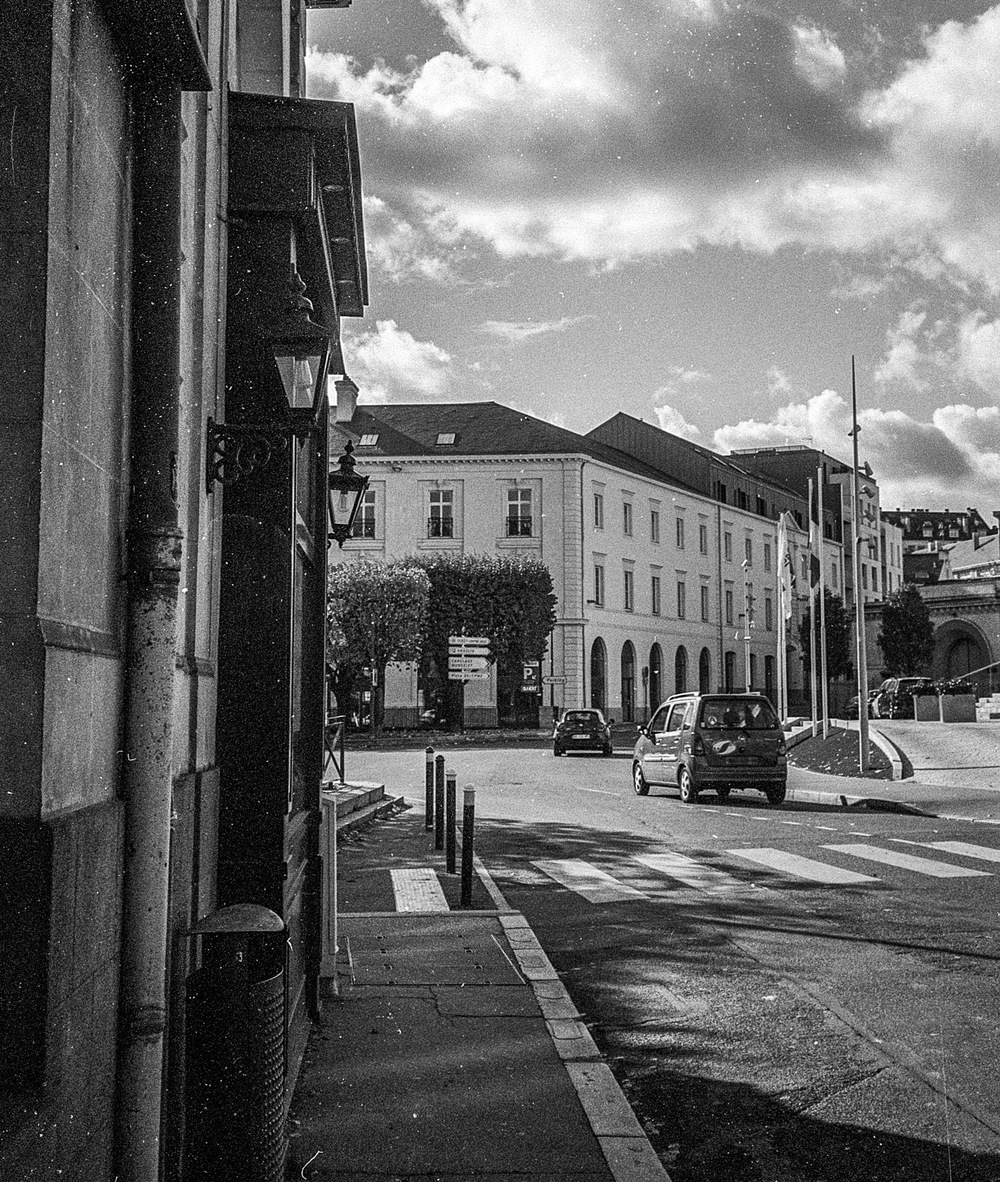
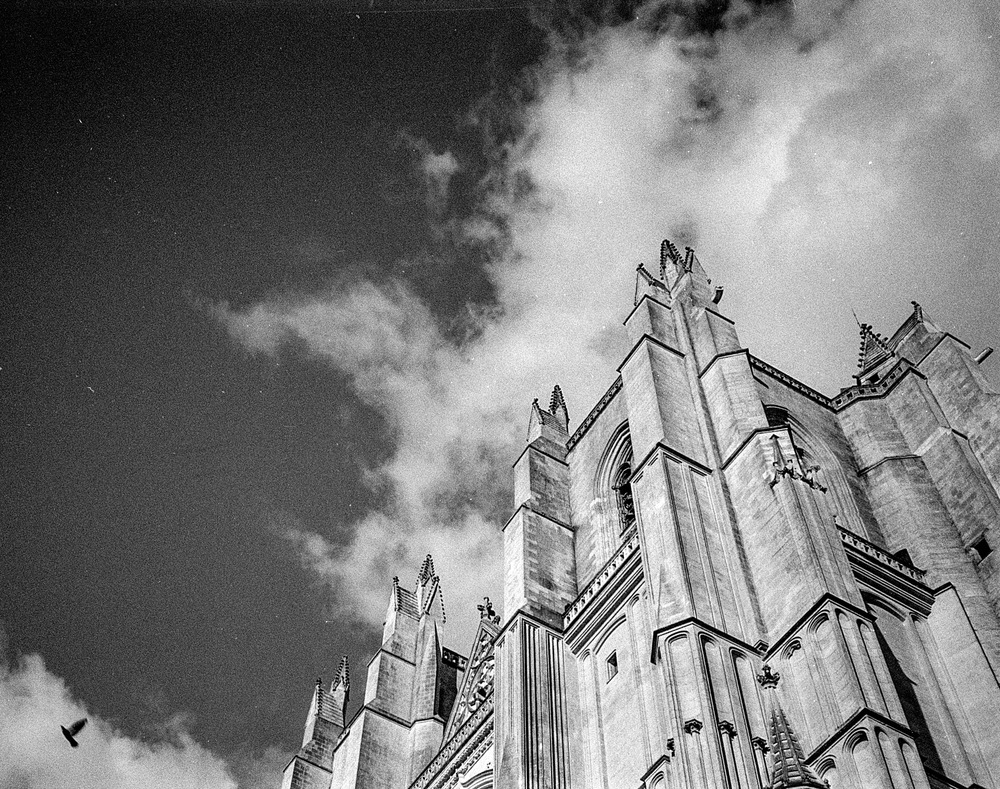
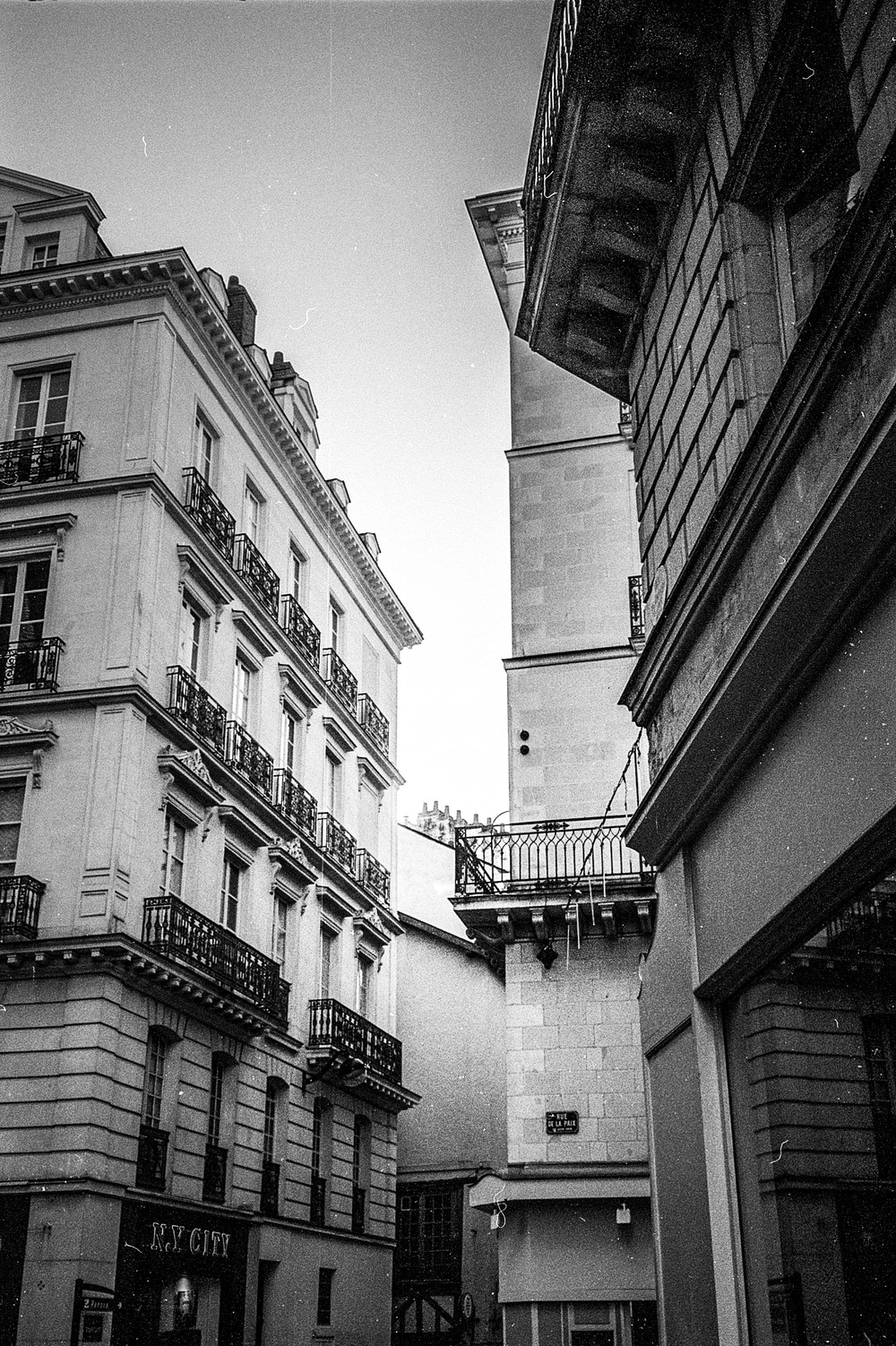
Following our last trip to Carnac, the film archive now has a look at Nantes in the autumn of 2016. These photos offer a glimpse into how I approached photographing a city back then, and if I’m being totally honest with you, still do. I treat the city much like a model on a photoshoot. The goal is to capture not just the physical landscape, but the essence and atmosphere of a place, allowing viewers to get a feel for the city simply by looking at the images. In this series of pictures, Nantes reveals herself and her architecture, resplendent in the autumnal sunshine.
Over time, I have come to know the city and appreciate her architecture. Buildings are not only a reflection of the architect but also of the people who live in them. They add character to the city, allowing her personality to shine through. I enjoy looking at the lines, and the shapes of them. They inspire me. They tell the story of the people who, either work, or live in them. They are not just mere edifices.
You will notice as we go through the archives, I might not respect the timeline slavishly. My aim is to give you an aperçu of my world at the time through film. I know you will be able to take this affront in your stride and not hate me!
We’ll go from the bains douches municipales, through to the Sainte Croix church, to the Stalinian 1950’s architecture of the Social Security building, passing by the odd shop, Hausmanian architecture, and even a shot looking towards the Cathedral.
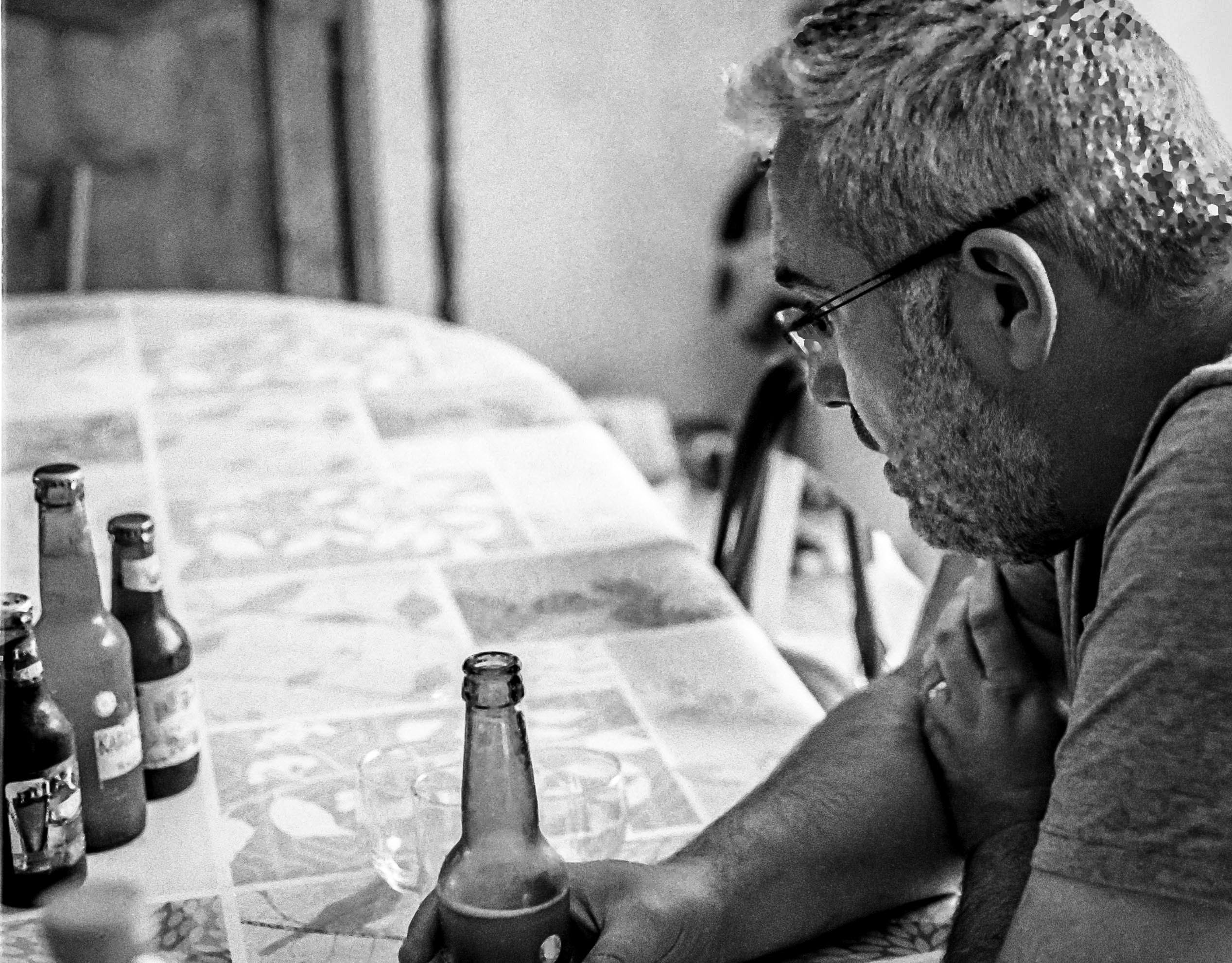
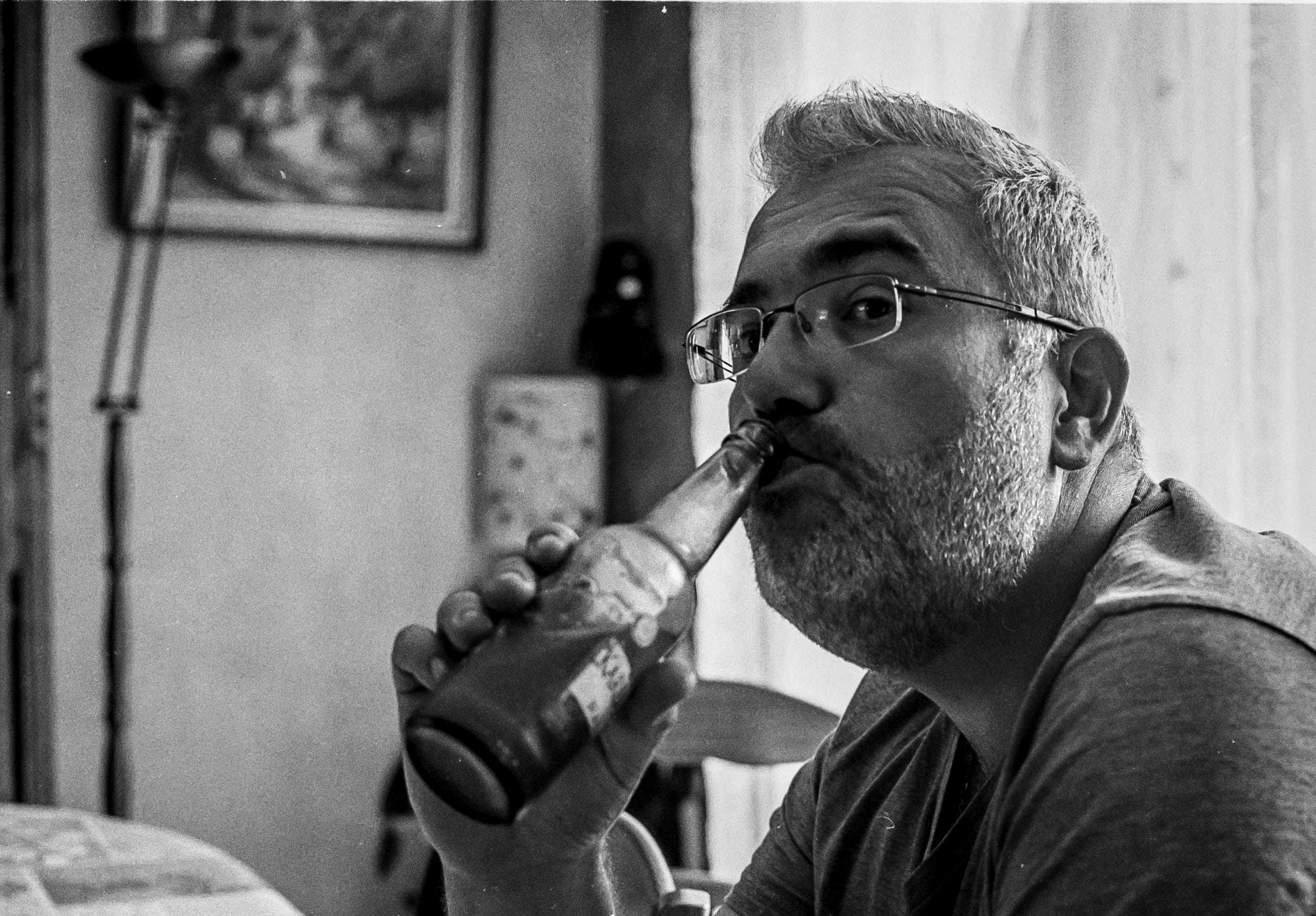
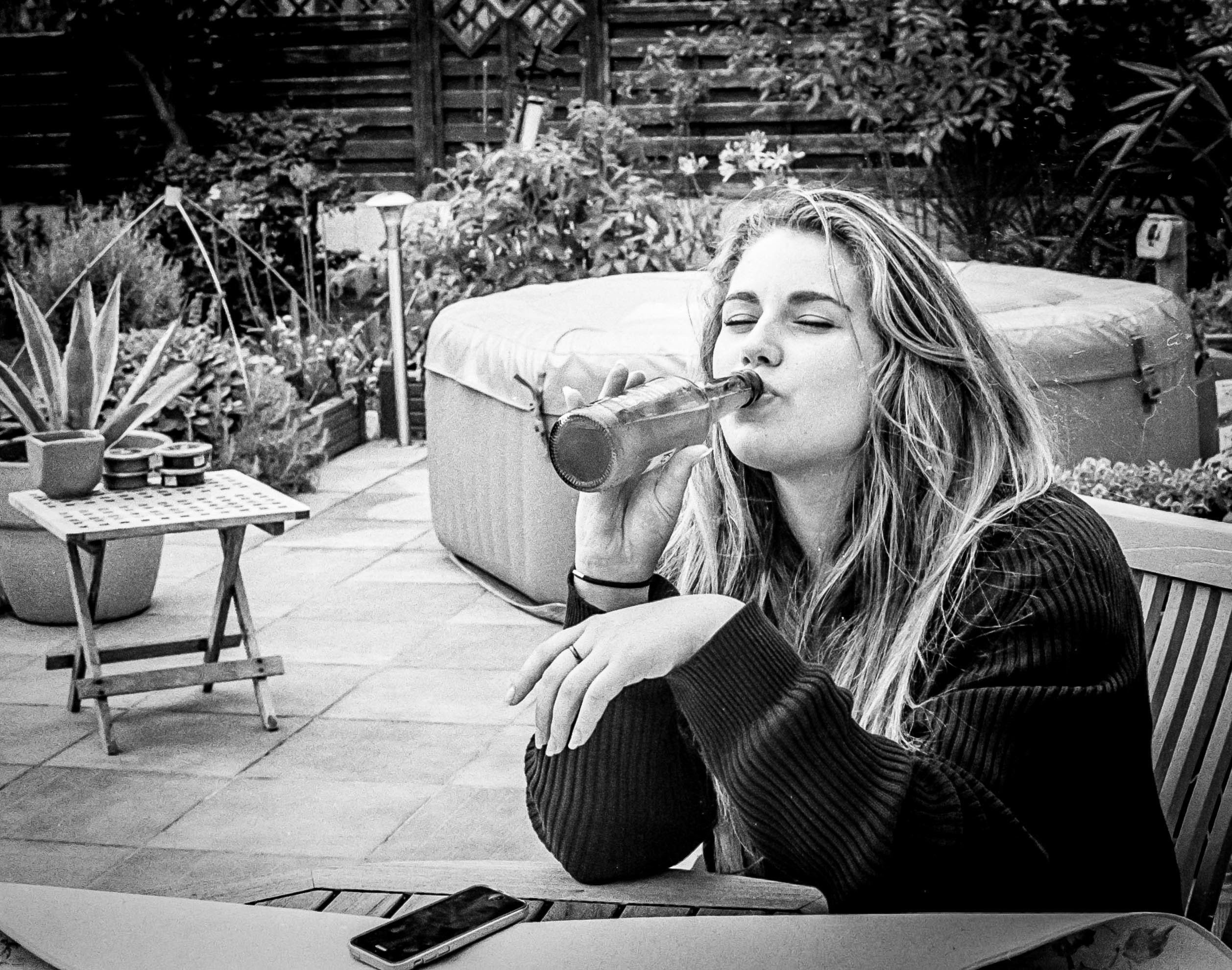
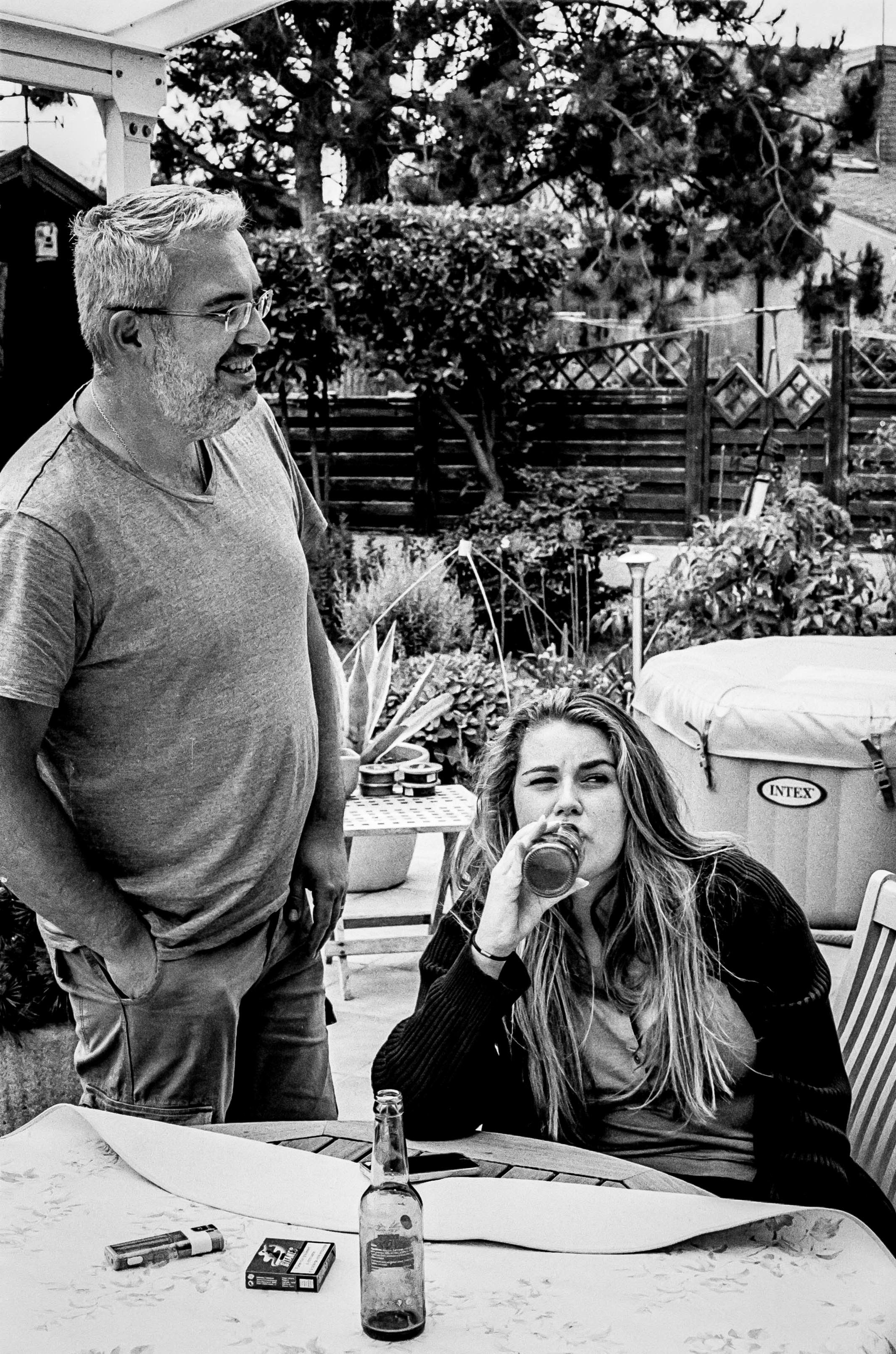
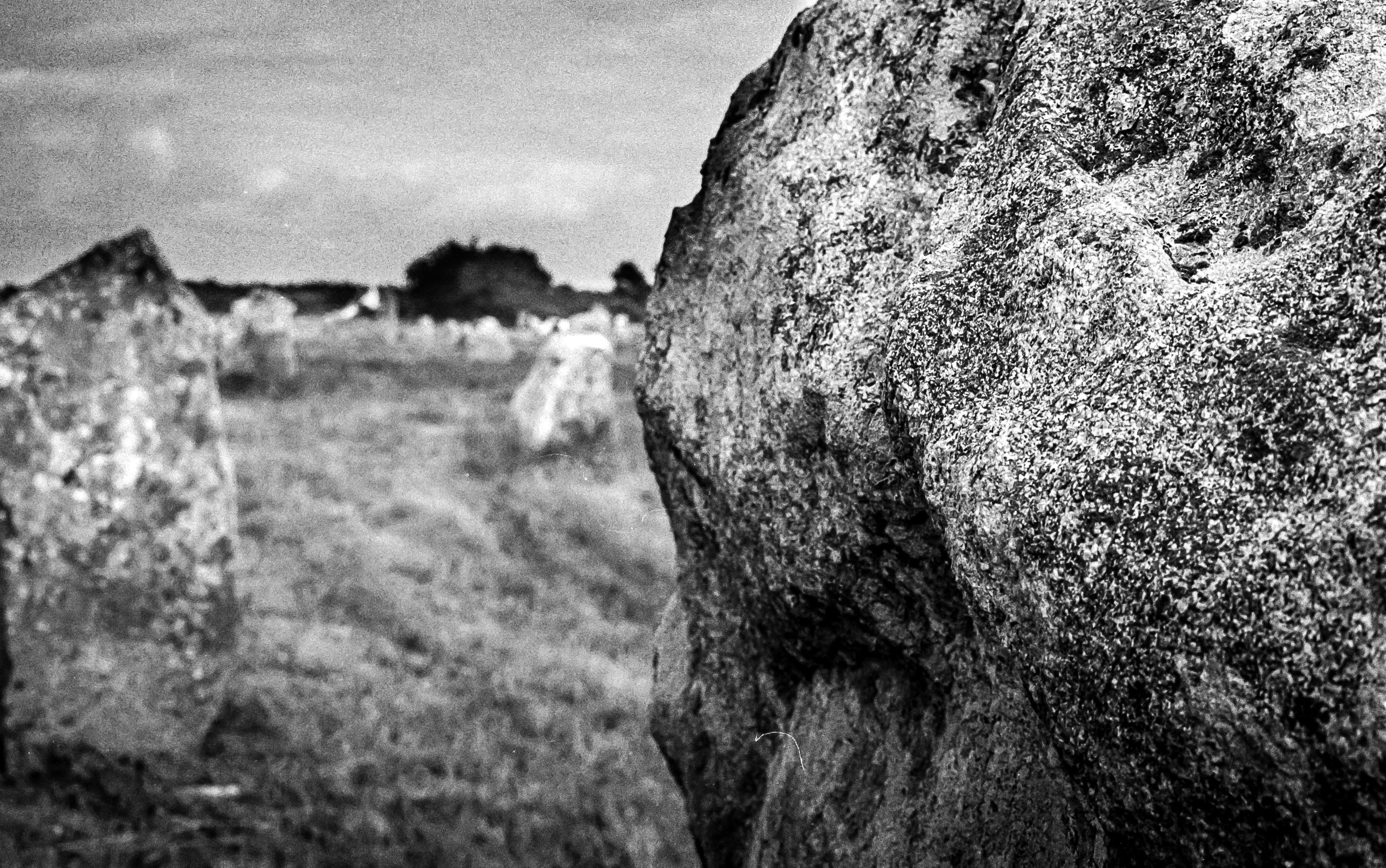
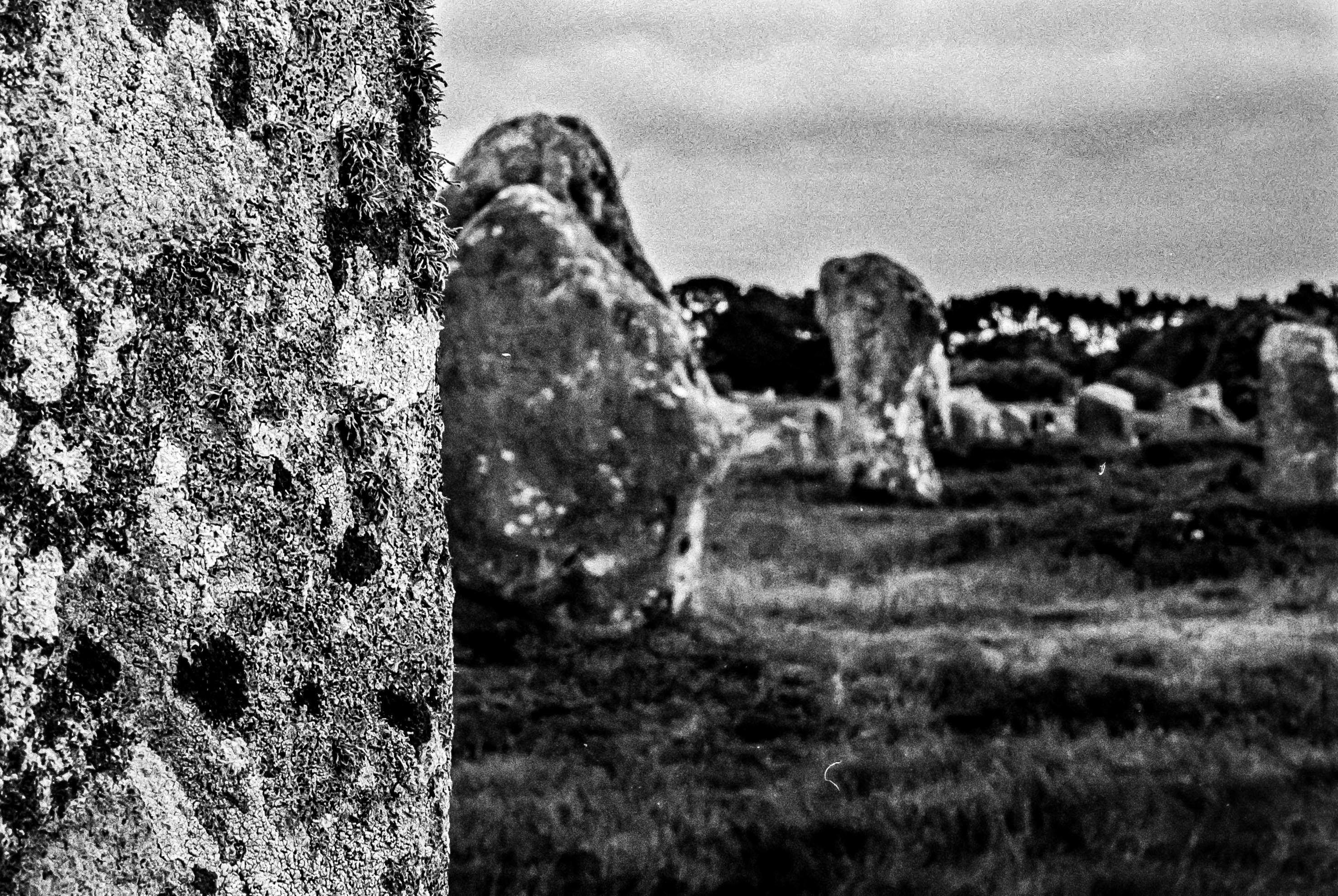
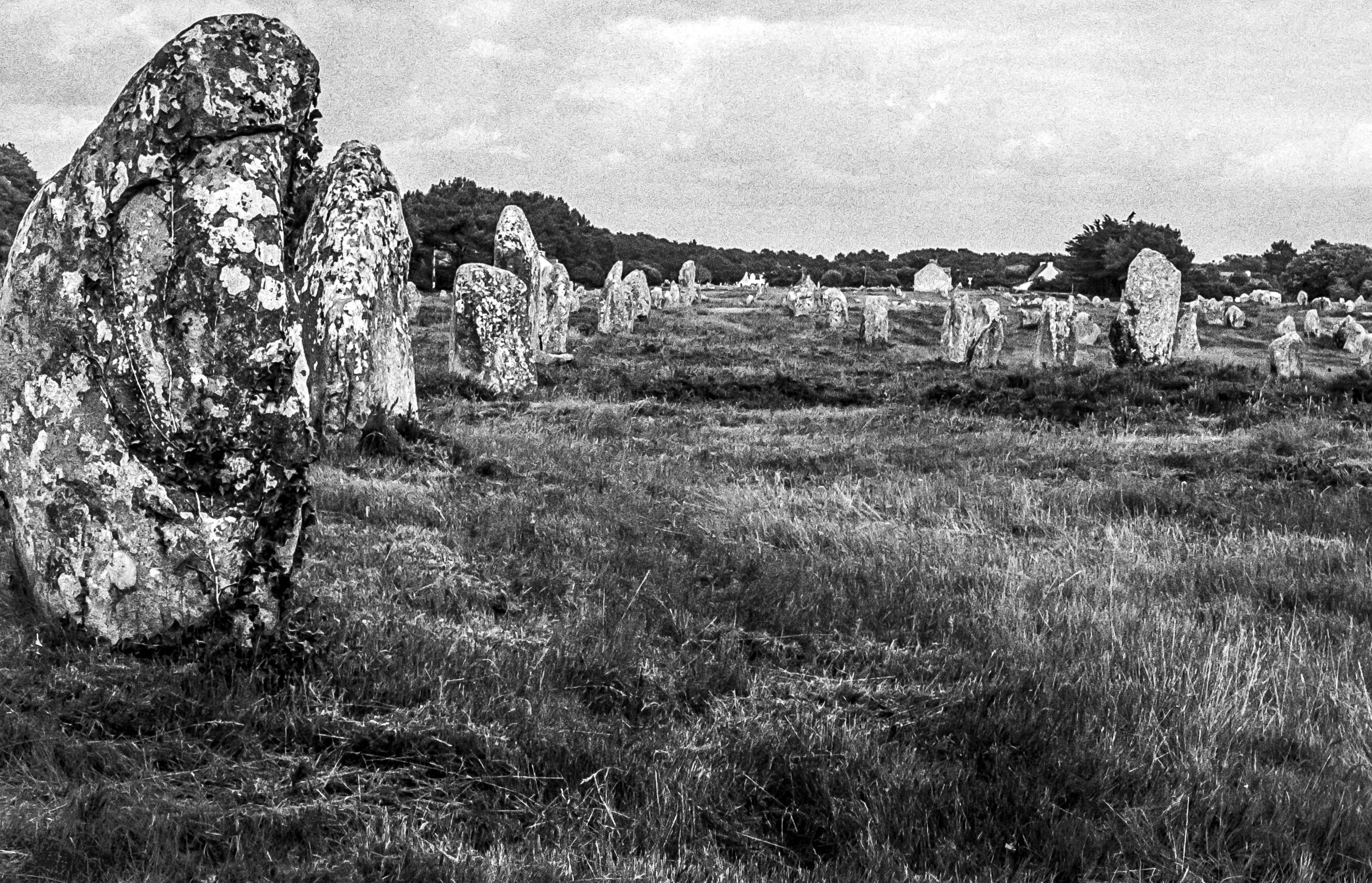
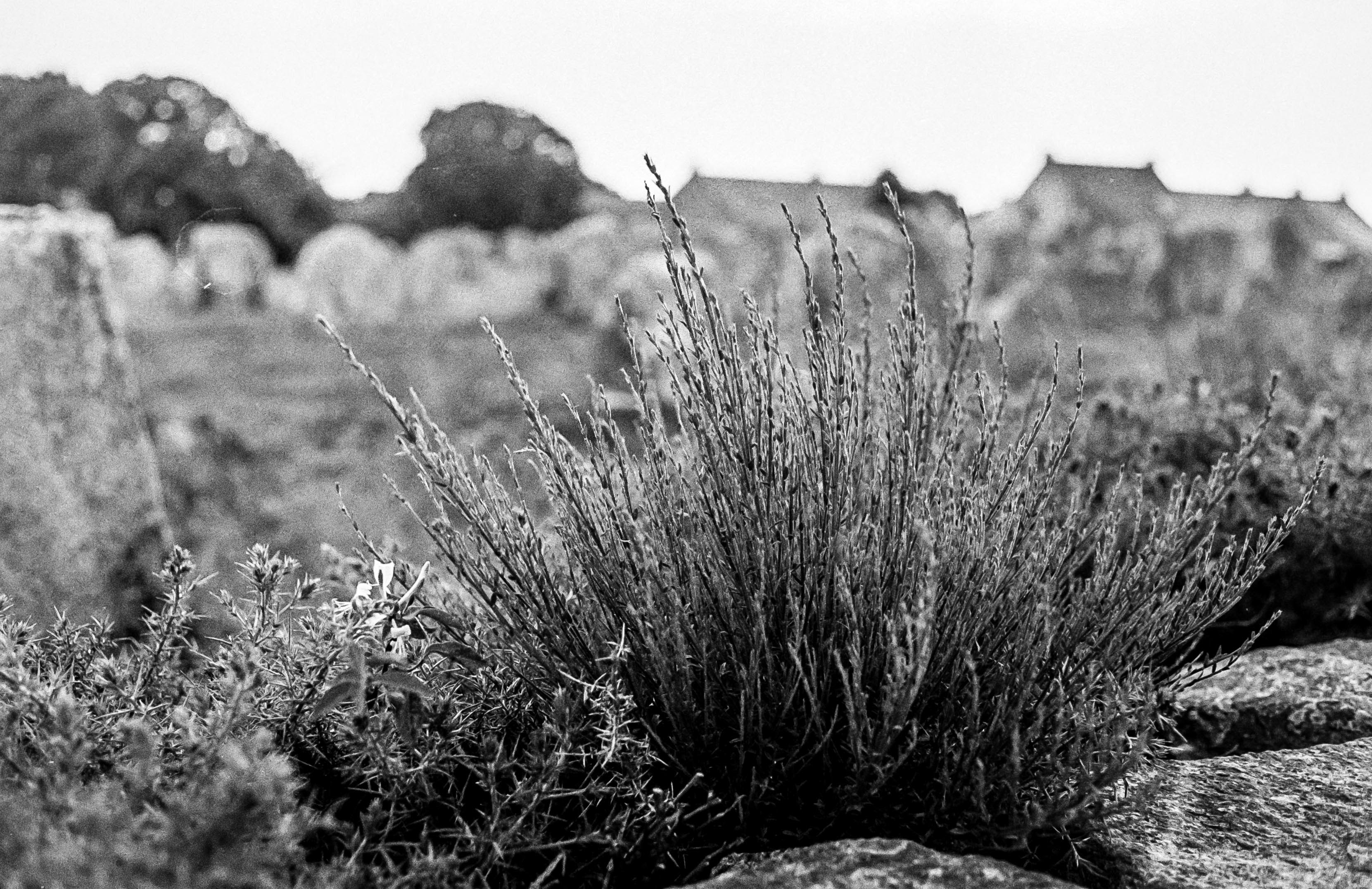
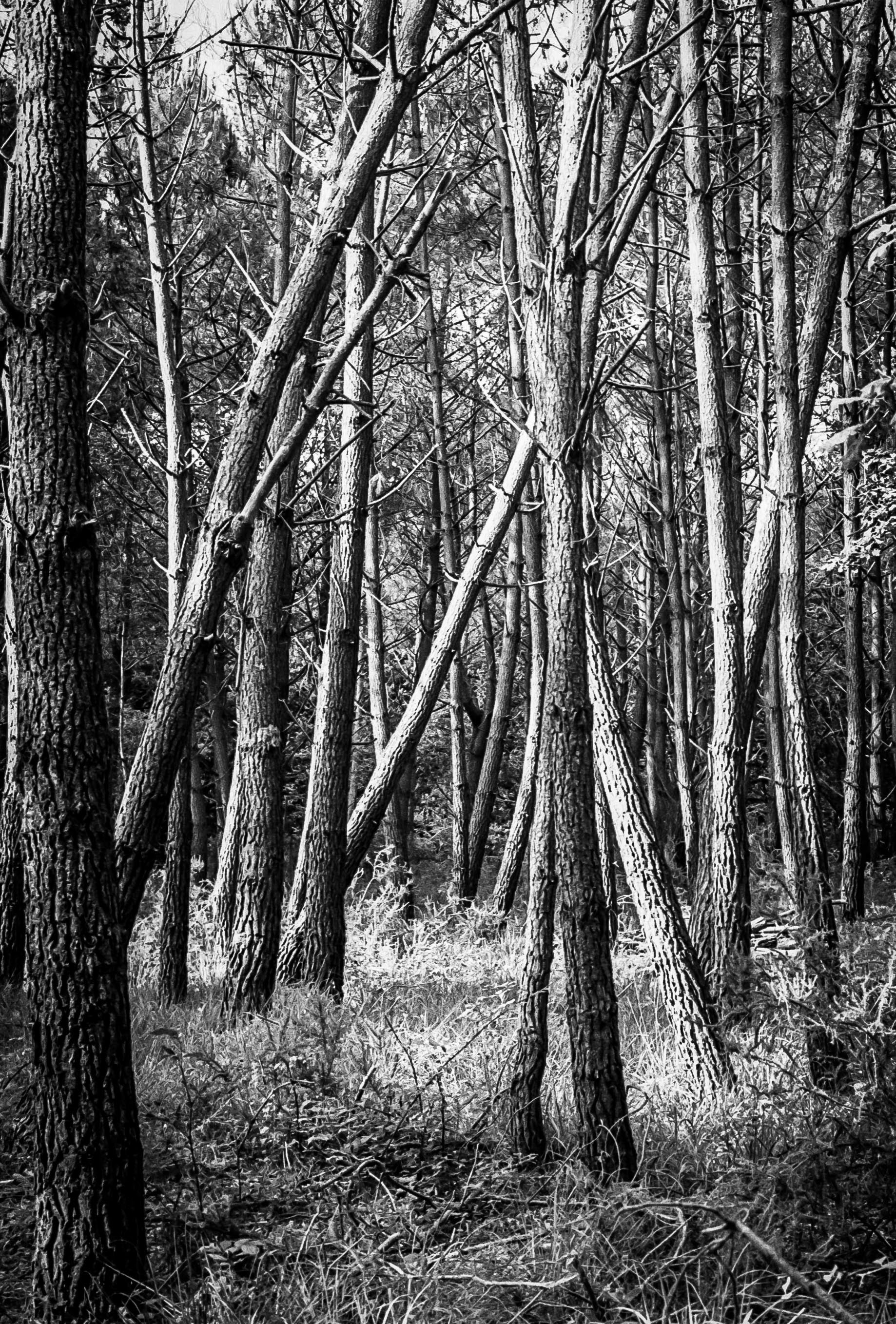
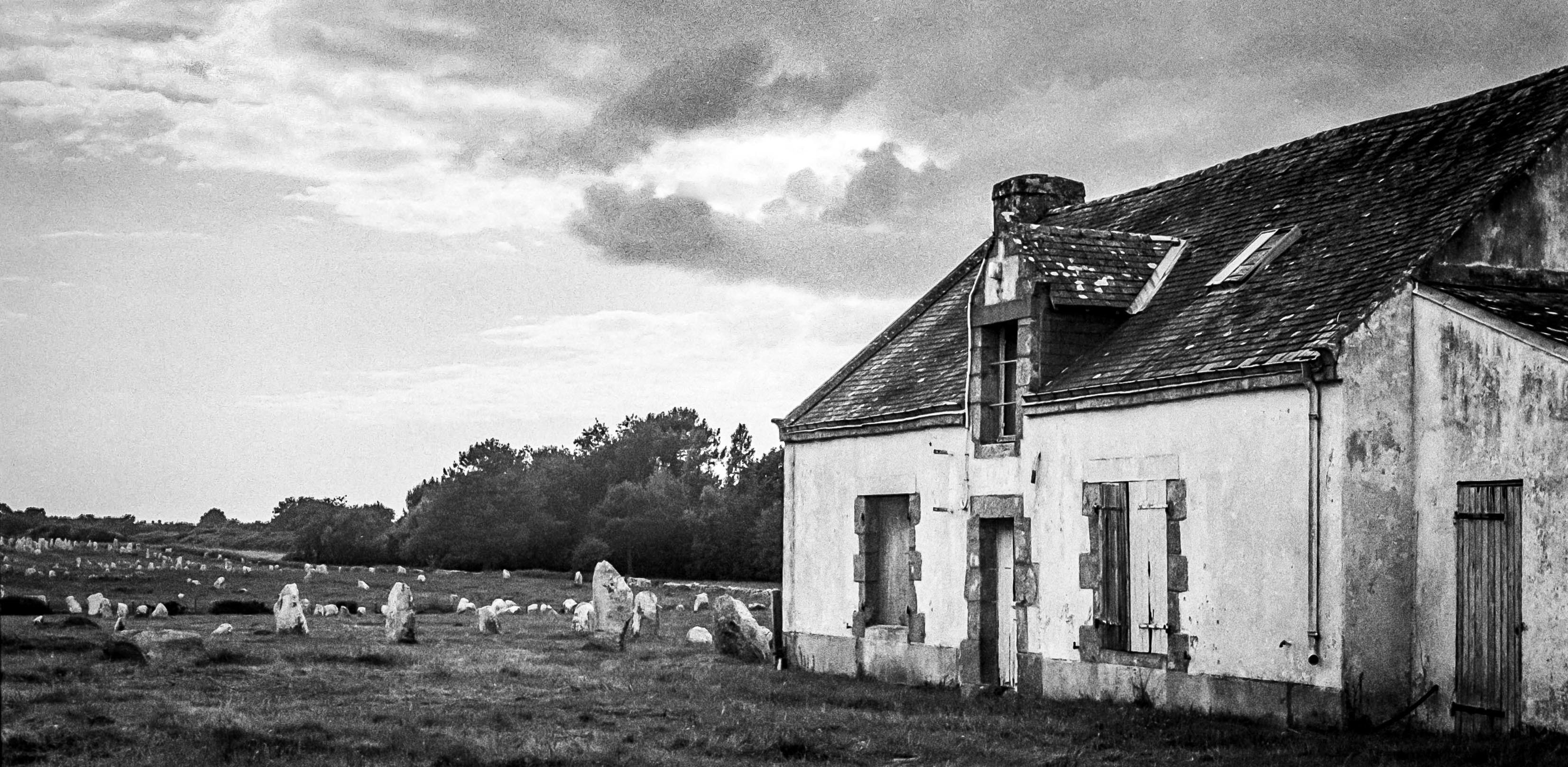
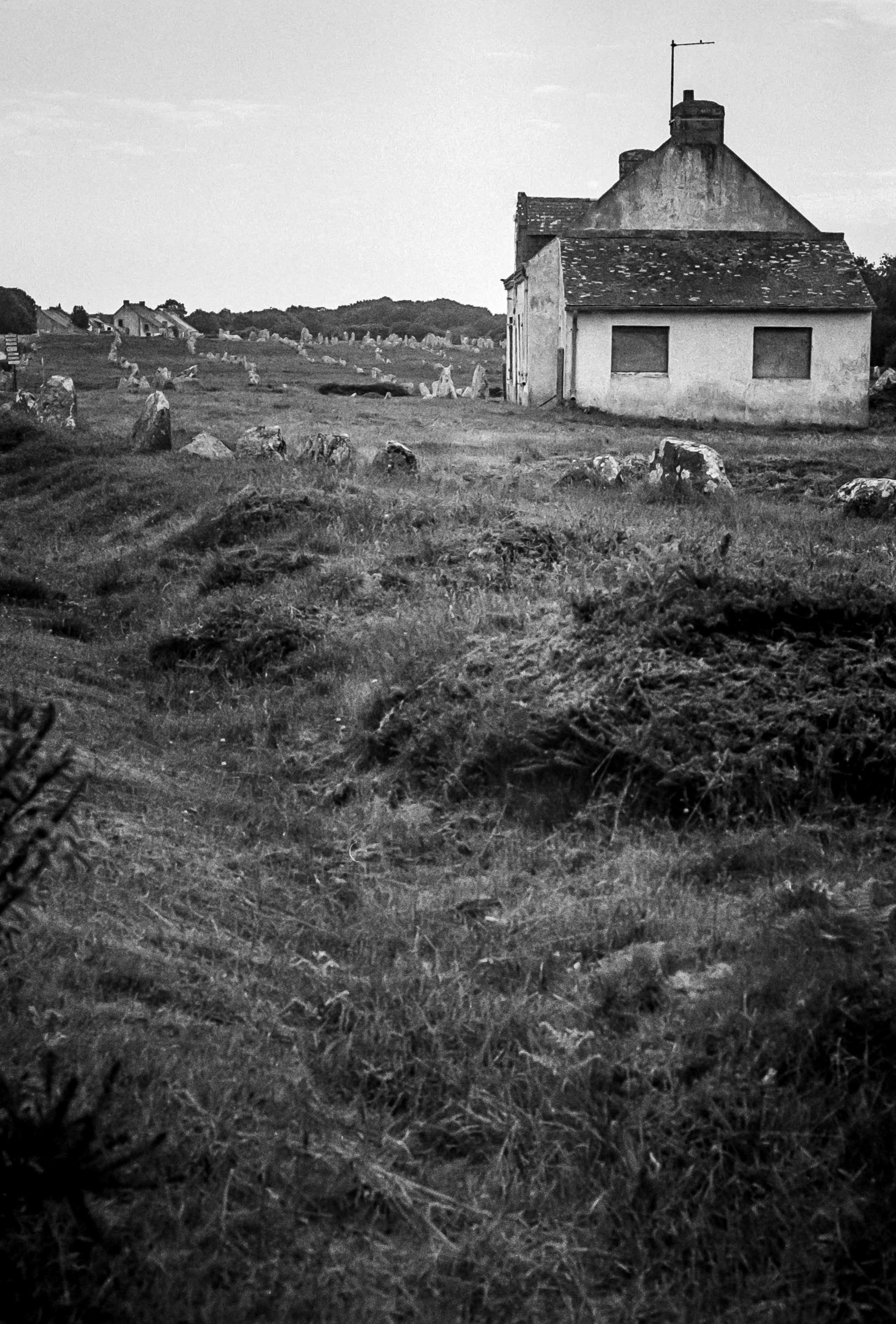
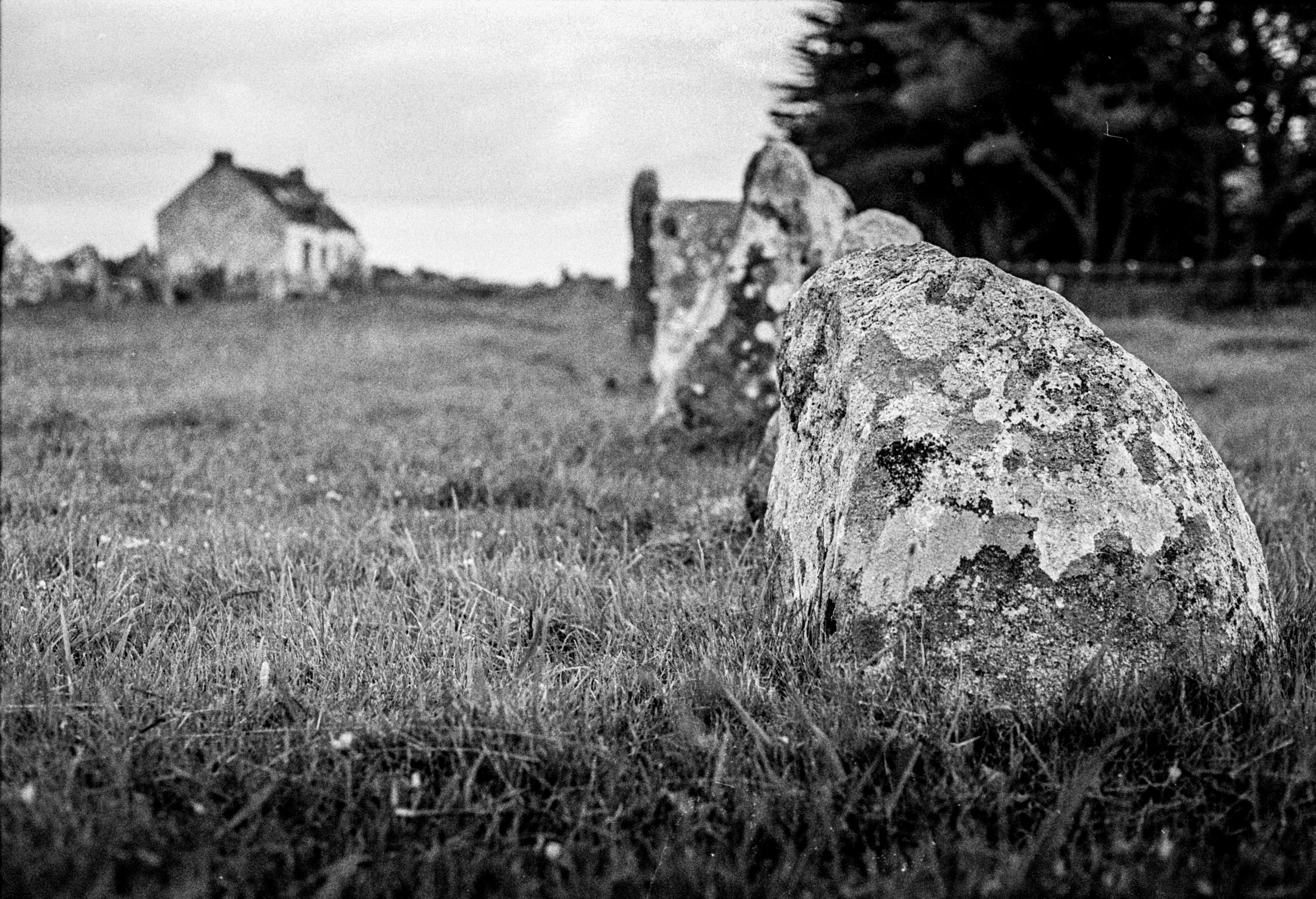
The photos in this article, from the famous film archive, were taken eight years ago almost to the day, during a weekend visiting my mother-in-law near Carnac, and near where my father-in-law lives. They’re divorced, and as usual, I stayed with her, not him. The photos feature my brother-in-law, who bears a striking resemblance to a beefy Dominic Farrugia, and my niece – not my favourite, but likeable enough (and those who claim not to have favourites are just liars!).
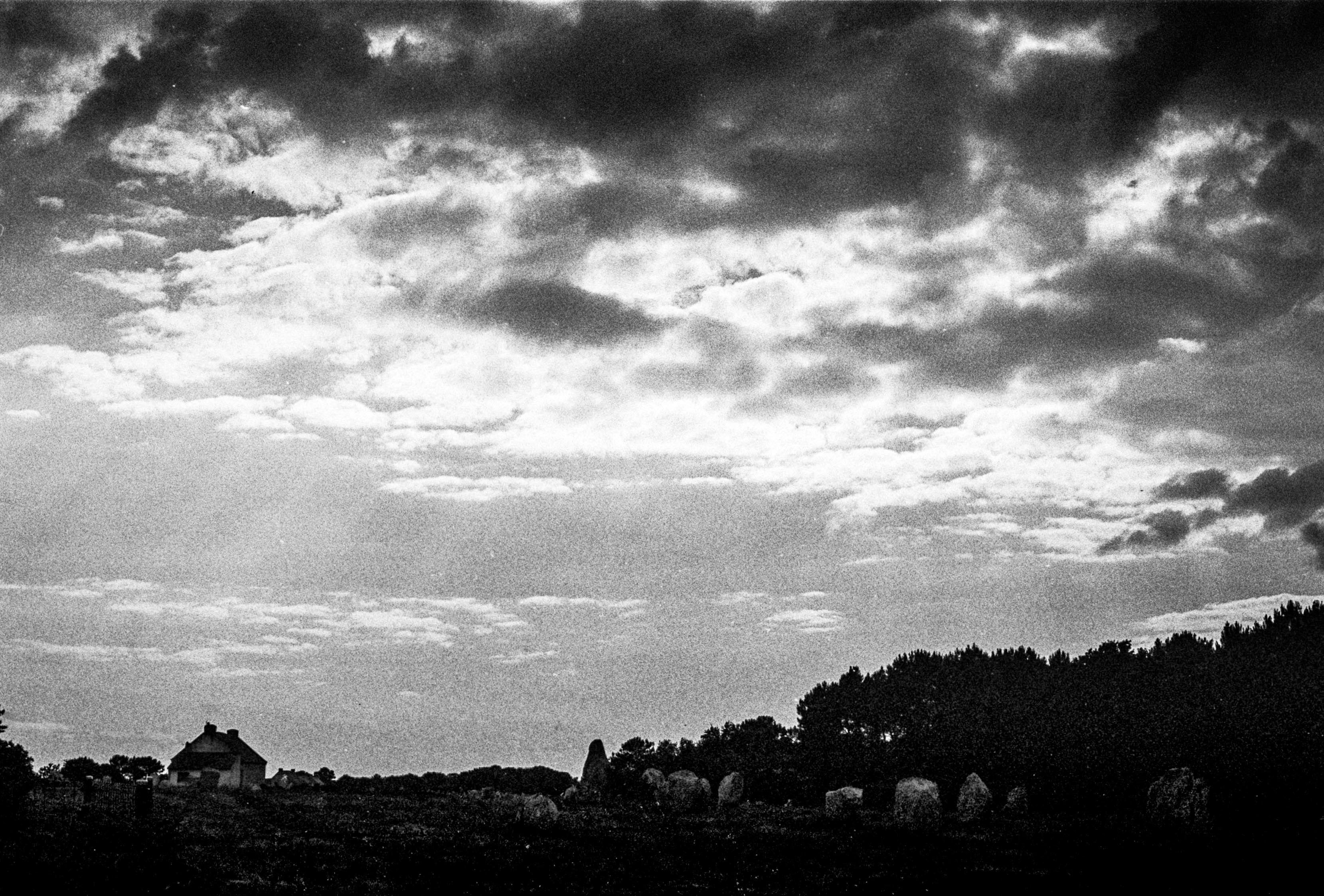
I shot these with my Canon AE1, a camera that saw a lot of action back then. Loaded with Ilford HP5 Plus and developed in Rodinal, they turned out a bit grainier than I expected, even for HP5 at box speed. I blame my overly enthusiastic agitation during development – I’ve always been a bit of a stirrer! Even back then, I had this habit of sneaking off to “do some photography,” a habit that hasn’t changed much, it seems.
Funny thing is, this wasn’t my first time in Carnac. As a kid, plagued by ear infections, flying was out of the question, so we had many a family holiday in France. One such trip was to Carnac, in the Morbihan region. Who would have thought that over 30 years later, I’d be back here so often?
Now, 30 years ago, you could wander freely around those mysterious Carnac stones. My mother, bless her imaginative soul, convinced me they were people caught dancing on the Sabbath and turned to stone as punishment. Ever since, I’ve had a healthy aversion to Sunday line dancing! Sadly, you can’t get close to the stones anymore – they’re cordoned off, perhaps a warning to those Breton folk dancers not to get too carried away.
Back then, HP5 was my go-to film. I wanted to know it inside out. Visiting the stones was a welcome escape from the lively, shall we say, family gatherings. Don’t get me wrong, I love my in-laws, but their intensity can be a bit much for this introvert. The stones, silently standing there, offered a tranquil contrast.
Years later, I watched a film, “The Fablemans,” about Steven Spielberg. The advice at the end, to keep horizons high or low in your images for more interest, struck a chord. Unbeknownst to me, I was already doing this! When I first started out, I meticulously documented every shot in a notebook – aperture, speed, film, camera, the lot. I kept this up for over a year before finally giving it up. These days, all that info is tucked away in your image file’s metadata, but not with film. There’s a certain freedom in that, wouldn’t you agree?
Reflecting on these old photos from Carnac, I am reminded of the enduring allure of photography and the quiet majesty of ancient stones. Each visit to Carnac, captured through the lens of my Canon AE1 and HP5 film, evokes memories of childhood holidays and solitary moments amidst family gatherings. The evolution from meticulous note-taking to embracing the simplicity of film photography has taught me to approach each shot with intention and mindfulness.
In the digital age, where metadata stores the technical details of our images, there remains a certain freedom in the analog process. It encourages a deeper connection with the art form, requiring us to engage fully in the moment of capture. The stones of Carnac stand as timeless witnesses to history, echoing the evolution of photography itself – ever-present, ever-evolving.
As I continue to explore new landscapes and subjects through my lens, I carry with me the lessons learned amidst the stones of Carnac: to capture not just images, but stories; not just moments, but emotions frozen in time. Photography, in its simplest form, remains a profound journey of discovery and expression, rooted in a rich tradition that continues to inspire.
Good evening Dear Reader. You may have noticed, and then again, you may not have noticed, that I have created a couple of new pages. Instead of adding article categories to my site in the menus, I have created pages with a carousel showing collections of articles in one specific category. This started with Photography Tutorials, which is a collection of, surprise surprise, photography tutorials. Another one for Travel Photography, one for Camera information, and a final one for articles featuring Film Photography. The idea behind this rather brash move on my part, was to help you find what you wanted to read or discover more easily.
This Meisterwerk of a blog is a work in constant evolution, as I think you may have gathered, especially for those of you that have been with me since the beginning. But what does this have to do with Film photography I hear you ask. Well, when creating the film photography page I realised that there are fewer articles than I first thought. This struck me as a little odd, because at one stage I had a little bit of a reputation as a film photographer, and at one stage was purely a film photographer. This was, of course, before the start of this blog lark in 2019. Between 2009 and 2019 I did a huge amount of film photography that I realised I have not shared with you. Even more so since 2016, when I started developing and scanning my negatives at home.
The beginning of the blog also tied in with the X100F and the Canon 6D Mark II coming into my photography, and since lockdown, I have done only small amounts of film photography. Time to reveal more of myself to you. At least if that’s alright… But this isn’t just about me dusting off old memories. By sharing these photos, I hope to spark a conversation, ignite a passion for film, and maybe even inspire you to dig out your old camera and give it a whirl. Who knows what treasures you might find in your own archives?
Taken on the Praktica MTL3 probably with the 50mm Pentacon F1.8 lens on HP5 Plus at box speed in the Quartier Bouffay in Nantes.
So bearing all this in mind, I have a proposal for you. Let’s open the vaults and let’s have a look at the “film archive”. This could be in the form of a series of articles complementing the weekly outpouring of anecdotes or advice, as an addition, or it could be the content for the upcoming weeks. I haven’t decided yet. Let me know in the comments which option you prefer, or if you have any other ideas for how you’d like to see the film archive content. There’ll be shots of Nantes, the UK, England, and Scotland and maybe even Spain, and Portugal. There will be colour and black and white photography too. I don’t know yet. I might not have yet taken into account the magnitude of the task ahead. Everything is open.
On the way to Otterburn in Northumberland with the Pentax ME Super using Portra 160. It was another good day out.
But whatever you decide, I hope you come along for the ride. It’ll be worth it!
In my last article we explored the prime lenses in my collection and how and why I use them concentrating on my own experience with each one. I started ultra wide and am now going to head towards a narrower field of view. We’ll start with the nifty fifty, go through the Helios 44-2 58mm f2, on to the 85mm f1.8, and end on the Helios 135mm f2.8.
50mm f1.8 – the nifty fifty
Be it a digital lens or one for a film camera, this focal length is considered to be the “standard” to which all the others are compared to. I have already mentioned my initial set from 1987 where the Pentacon 50mm f1.8 was fitted onto my Praktica MTL3. It is the lens with which I learnt photography. Why is it considered the “standard?” Conventional wisdom would suggest that the view offered by the lens is the closest to the human eye. This explains why Robert Doisneau used it extensively in his documentary photography. Henri Cartier-Bresson is known for his ability to capture decisive moments in street photography. The 50mm focal length, with its natural perspective and good depth of field, was perfectly suited to this approach. It is also one of the more simply constructed lenses and yet still offers a great shooting experience be that digital or film shooting.
Helios 44-2 58mm f2.0
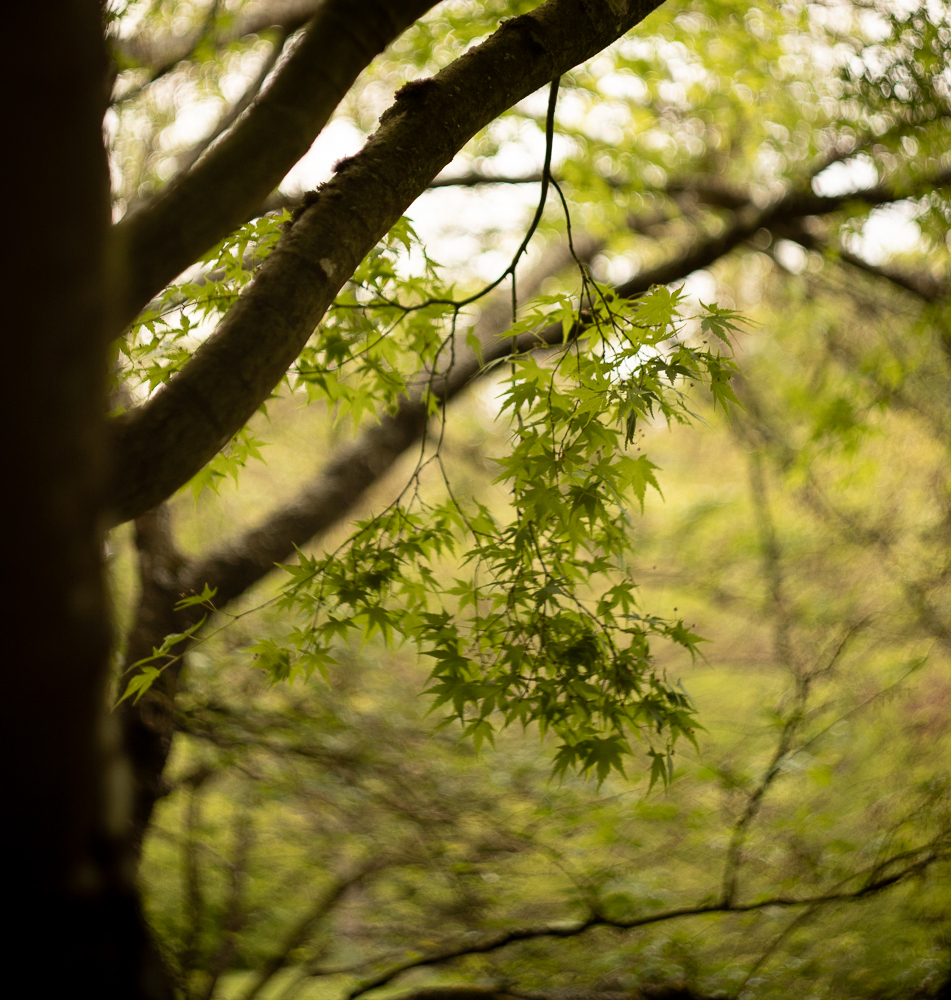
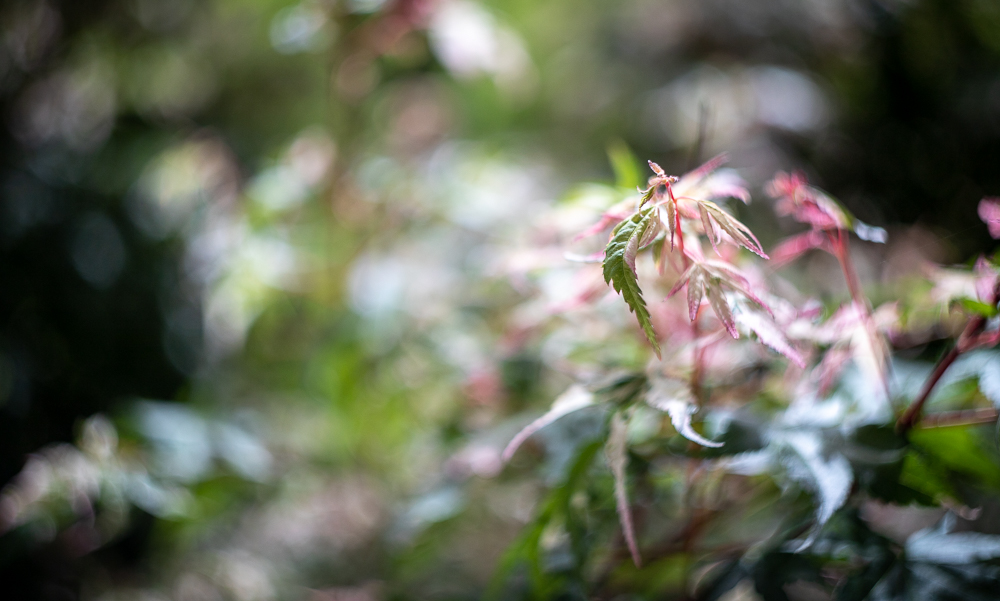
This is one of those lenses that one hears about and has a certain mythology. It is known most for its swirly bokeh which you can see in the images in the slideshow below. I think mine must have cost around 50 Euros so in my mind I was thinking, you can’t go far wrong. This swirliness adds interest to any photograph be it in an oriental garden, on in portraits. Just enough to make the viewer have a closer look and fall even further in love with your capture. It’s an old soviet lens and fairly solid as you can read in the article I wrote about the Helios and the Canon 6D mark II. It is the first of my “portrait” lenses.
We’ve done the bokeh bit, now let’s talk about the focal length. When in the studio I will start using my 50mm, but this is always ready in my bag. But it’s not just a portrait studio lens, and I have used it on outings in Nantes. As all “telephoto” lenses, it separates the background from the subject, and brings forward the subject to the fore. I haven’t used it on my Praktica film camera yet and should probably do so very quickly. It would be a shame not to after all. As it stands I have to use an adapter for my Canon and another adapter for my Fuji XT2. With the crop sensor on the Fuji it magically turns into an 85mm equivalent.
Canon 85mm f1.8
This is the most classic portrait lens and allows me to take a step back compared to using the 50mm. Again, the bokeh on this lens is lovely and so creamy that it could give a rotund older gentleman a heart attack if it were cake. But it’s not cake, so everything is fine. When I’m in the studio I can concentrate on the eyes and by the time the portrait gets to the ears we’re in creamy bokeh territory.
However, some photographers will take this lens into the street for street portraits. It’s not a huge lens, and thus less creepy, and allows the photographer to take a step back and still feel close to his subject. This distance between photographer and subject contributes to a more natural interaction between photographer and model, reduces the feeling of being cramped or intrusive, and leads to a more natural interaction, which in turn leads to more natural posing and a more relaxing experience for everyone.
Helios 135mm f2.0
This is the largest of my “everyday” primes and back in 1987 it was in my bag to bring the world even closer than I could with the nifty fifty. I was a beginner back then. And didn’t realise the potential of telephoto lenses. The approach is much the same as for the 85mm but allows even more distance, and is great for those intimate shots that can capture the alluring side look. In landscape it can help you pick out details in the landscape that you can’t get closer to for practical reasons, and bringst that background that much closer to the foreground. For those of you who don’t like manual focussing, you might want to give this one a miss. This was a lens from an age before autofocus came along. However on my Fujifilm XT2 this transforms into a rather snazzy 200mm lens due to it’s APSC sensor and 1.5 crop factor, which would be a lot cheaper than a more modern equivalent, and with the focus peaking on mirrorless cameras, this can be a very convincing argument.
Conclusion.
Primes can generally be considered to be a higher quality option. With their simpler constructions, they can offer sharper images They generally have larger apertures, allowing for ease of use in lower light, and providing that creamy, sexy bokeh that everyone keeps mentioning. By adding a limitation to the creative process they can help the photographer become a more deliberate and mindful craftsman, and concentrate more on composition.
However, even though individually lighter than most zooms, their collective mass may be more important if you constantly want to have every single option available in your bag. You will be changing lenses more often, when having more to choose from. Never forget that you are the person carrying them around. So choose carefully, be deliberate, and plan ahead. The results will be worth it!
Medium format photography with the Mamiya C220 is a journey into a world that’s quite different from using “ordinary” film cameras. It’s an experience that opens up new possibilities and allows you to capture images with remarkable details and depth.
The Mamiya C220 is a beast of a camera. It’s big, heavy, and built like a tank. But it’s also a joy to use. The viewfinder is bright and clear, and the lenses are sharp. The camera is easy to use, even for beginners.
A Closer Look at the Lenses
One of the best things about the Mamiya C220 is its interchangeable lens system—a rarity among twin-lens reflex cameras. The full lineup spans seven focal lengths: the 55mm f/4.5 wide-angle, the 65mm f/3.5, the classic 80mm f/2.8 standard, the 105mm f/3.5 short telephoto (available in both 4-element Tessar-type and 5-element Heliar/Dynar optical formulas, with some variants featuring depth-of-field scales on the viewing lens), the 135mm f/4.5, the 180mm f/4.5, and the 250mm f/6.3 telephoto. All of these Sekor lenses are remarkably sharp and render beautiful, characterful images. The 80mm f/2.8 remains my favorite for the C220; it’s a versatile all-around lens that excels at portraiture, landscape, and street photography.
Metering and Focusing
The Mamiya C220 doesn’t have a built-in light meter, so you’ll need to use an external meter if you want to meter your exposures. This can be a bit of a pain, but it’s not a deal-breaker. You can use a handheld light meter, or you can use a smartphone app.
The Mamiya C220 is a manual focus camera, so you’ll need to learn how to focus manually. This can be a bit tricky at first, but it’s not too difficult to learn. The viewfinder provides a unique 3D-like experience that helps you focus with precision.
In My Experience
Now, let me share some of my personal experiences with the Mamiya C220. I found that despite its bulk, the camera feels great in the hand. The viewfinder remains bright and clear, even in low light conditions. The lenses consistently deliver sharp and beautiful images. Plus, it’s easy to use, even if you’re new to film photography.
Sample Photos and Comparisons
To help you visualize the camera’s potential, I recommend checking out some sample photos taken with the Mamiya C220. They showcase the camera’s unique aesthetic and image quality. In comparison to other TLR cameras, the Mamiya C220 stands out in terms of its lens options and build quality. You will notice that this particular model takes square format pictures so bear that in mind when thing about acquiring one.
Enhancements and Care
If you’re looking to enhance your Mamiya C220 experience, consider exploring compatible accessories like different viewfinders, focusing screens, or other accessories to improve your shooting comfort.
While there are no alternative film backs for the Mamiya C220, it’s important to note that the camera is versatile when it comes to film formats. You can use both 120 and 220 format films by simply indicating your choice when loading the film. This flexibility allows you to adapt to different shooting situations with ease.
A Unique Statement Piece
The Mamiya C220 can be best described as a statement piece. When you’re out taking photographs with this camera, you’ll undoubtedly attract curious passersby who can’t resist approaching you to ask about it. They’ll often share nostalgic stories about how their grandparents had a camera just like it, igniting a sense of shared history and fascination.
The Mamiya C220 oozes vintage appeal, making it a conversation starter wherever you go. Despite its vintage charm, it’s a resolutely modern camera, dating back to the 1980s, which, in the world of classic film photography, is considered relatively recent. For many, including myself at aged 51, this era doesn’t feel old at all.
Medium Format Magic
Medium format photography, in particular, is a game-changer. The negatives produced are significantly larger than those from “ordinary” film cameras, resulting in breathtaking details and unparalleled depth in your images. This quality is what truly sets the Mamiya C220 apart and makes it a preferred choice for photographers seeking extraordinary clarity and definition in their work.
Community and Conclusion
Lastly, join the vibrant community of Mamiya C220 enthusiasts online. You can find forums, groups, and communities where you can share experiences and get valuable tips from fellow photographers. In conclusion, if you’re in search of a classic medium format TLR that consistently produces high-quality images, the Mamiya C220 is a strong contender. Just be prepared to embrace its substantial size and weight while enjoying the fantastic results it delivers.
Tech Specs and Pricing
Here are some technical specifications of the Mamiya C220:
Introduction In the world of film photography, the choice of film format can significantly impact the results you achieve. Whether you’re an aspiring street photographer or simply an enthusiast looking to explore the world of analog photography, the decision between 35mm and medium format can be crucial. This article explores the major differences between these two formats, helping you along on your photographic journey. As we dive into this discussion, it’s essential to understand how the choice of format can influence your work.
1. Understanding the Basics Let’s start by establishing a foundation. 35mm photography is the more common format, known for its accessibility, ease of use, and widespread availability. It is the standard format of film. However, medium format photography offers distinct advantages worth exploring.
2. The Key Differences
Image Quality and Resolution: The most noticeable difference between medium format and 35mm photography lies in image quality and resolution. Medium format film, with its significantly larger negative size, captures an significant level of detail and clarity. The larger negatives provide ample room for precise rendering of textures, fine lines, and intricate patterns. This translates to stunningly sharp and highly detailed images, ideal for both professional work and fine art photography. If you’re aiming for prints that capture every nuance, medium format is the way to go.
Aspect Ratio: Another significant difference is the aspect ratio. 35mm film typically yields images with a 3:2 aspect ratio, while medium format cameras typically offer a square 1:1 aspect ratio. The square format can be a creative boon, pushing photographers to rethink composition. It forces a balance between the vertical and horizontal aspects of your subject, a characteristic reminiscent of the iconic street photographer Vivian Maier, who frequently used a TLR camera. The square format encourages unique framing and adds an artistic challenge to your photography.
Depth of Field: Medium format allows for a shallower depth of field compared to 35mm. This means that it’s easier to achieve that sought-after background blur or bokeh, perfect for portrait and street photography. With a well-executed composition, your subject can pop against a beautifully blurred backdrop, making them the focal point of the image.
Size and Weight of Equipment: In terms of portability, 35mm cameras have the upper hand. They are compact, lightweight, and ideal for street photography where you need to be quick on your feet. Medium format cameras, on the other hand, tend to be bulkier and heavier due to the larger film format and the associated optics. This makes them better suited for planned shoots where image quality takes precedence over convenience.
Cost of Film and Development: While 35mm film and development are more budget-friendly, medium format film comes at a higher cost. When using the 6×6 format you will only have 12 images per roll of film. This of course makes every shot count. If you are stressed out about messing up a shot on 35mm film then your anxiety will shoot up to lunar levels with only 12 shots. But remember what I have said earlier, no shot is wasted and every shot is a learning experience. The enhanced image quality, detail, and artistic potential make medium format film worth the investment for those who prioritize the final result over the upfront cost. If you’re planning to produce gallery-worthy prints or pursue a professional career, the expense can be justified.
Flexibility and Convenience: 35mm cameras are known for their flexibility and convenience, making them well-suited for capturing quick shots or candid moments. They’re also readily available, and film processing is more accessible. In contrast, medium format cameras require a more methodical approach, ideal for planned and deliberate photography. The process is slower, encouraging you to carefully consider each shot and compose it meticulously. This added effort can lead to more thoughtful and deliberate photographs.
3. Street Photography with the Pentax ME Super and TLR Influence Vivian Maier, a renowned street photographer, serves as an inspiring example of how camera choice can shape your photographic style. Maier favored the TLR camera, a medium format model known for its distinctive qualities. Her use of the square format and unique perspective have left an indelible mark on street photography.
I want you to think about the fact that a TLR is hanging around your neck at tummy level or even waist level, so the way of looking at your subject will automatically affected too.
If you’re looking to explore street photography with a Pentax ME Super, remember that the compact 35mm format offers its advantages for candid, on-the-go shots. However, Maier’s work reminds us that the choice of equipment is a personal one, and there’s no one-size-fits-all answer.
4. The Mamiya C220 Review: A Medium Format Marvel As we venture further into the world of medium format, the Mamiya C220 beckons. Just as Vivian Maier chose a TLR for her street photography, other photographers have found success with medium format cameras like the Mamiya C220. In my upcoming review, I’ll explore the features, benefits, and considerations of this remarkable medium format camera, guiding you towards your next photography adventure.
The Induction to a Higher Level of Photography When you make the transition from 35mm to medium format, you’re stepping into a higher echelon of photography. If you think that 35mm film is great, you’ll be enthralled when you see your images taken by a medium format camera. The level of detail and depth of field that medium format offers is simply unmatched. It’s like upgrading from a standard screen to 4K resolution for your photography. Every detail comes to life, and the depth of field adds a whole new dimension to your work. It’s a revelation that will leave you wondering why you didn’t make the leap sooner.
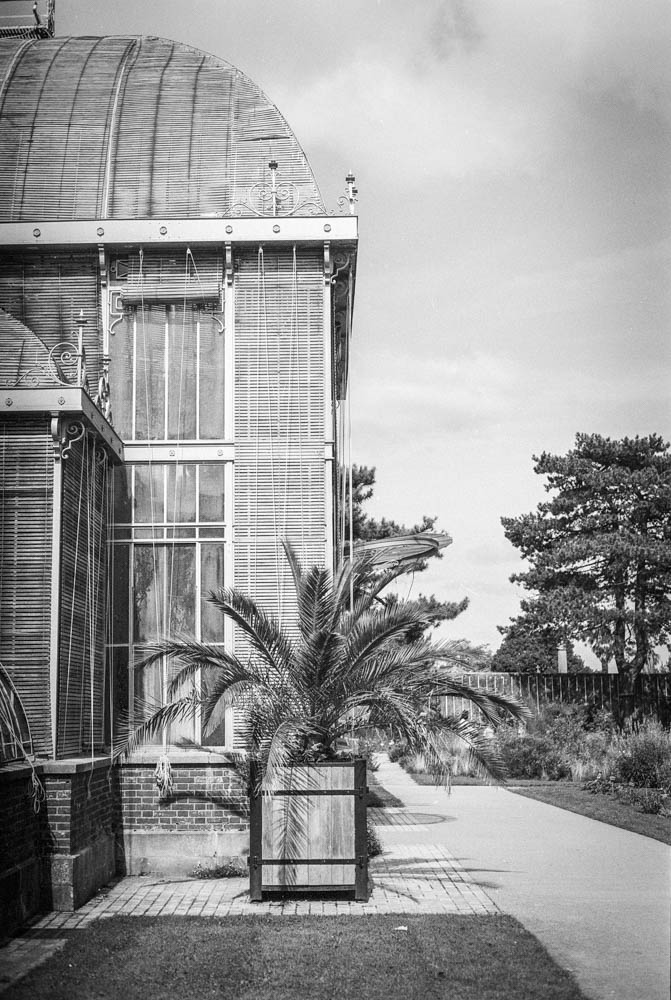
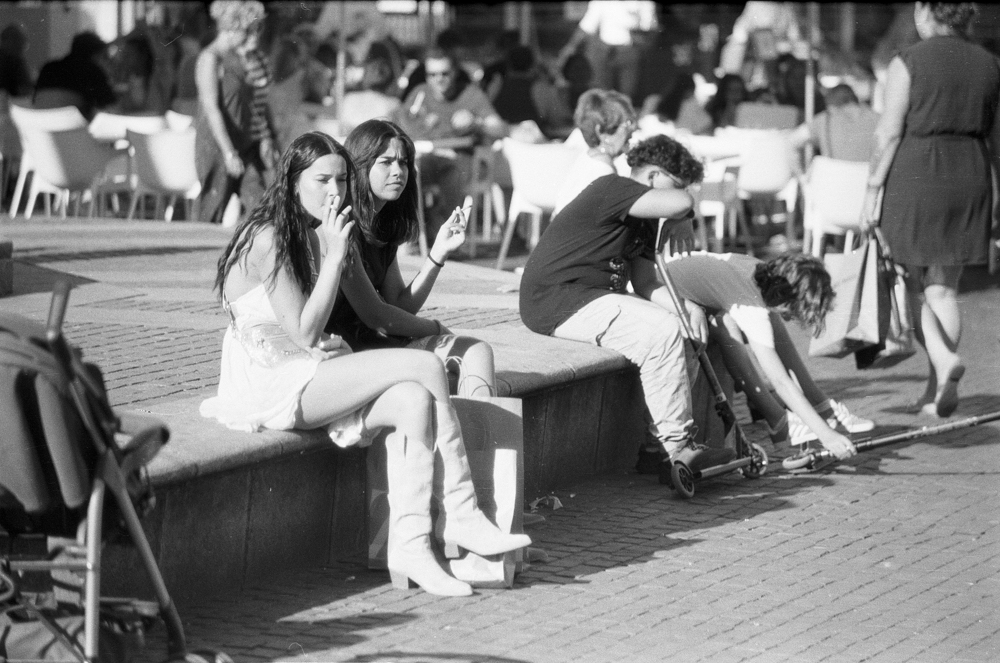
The 35mm format photo captured on the Pentax MS Super. The “standard” format of film photography. The one we all know.
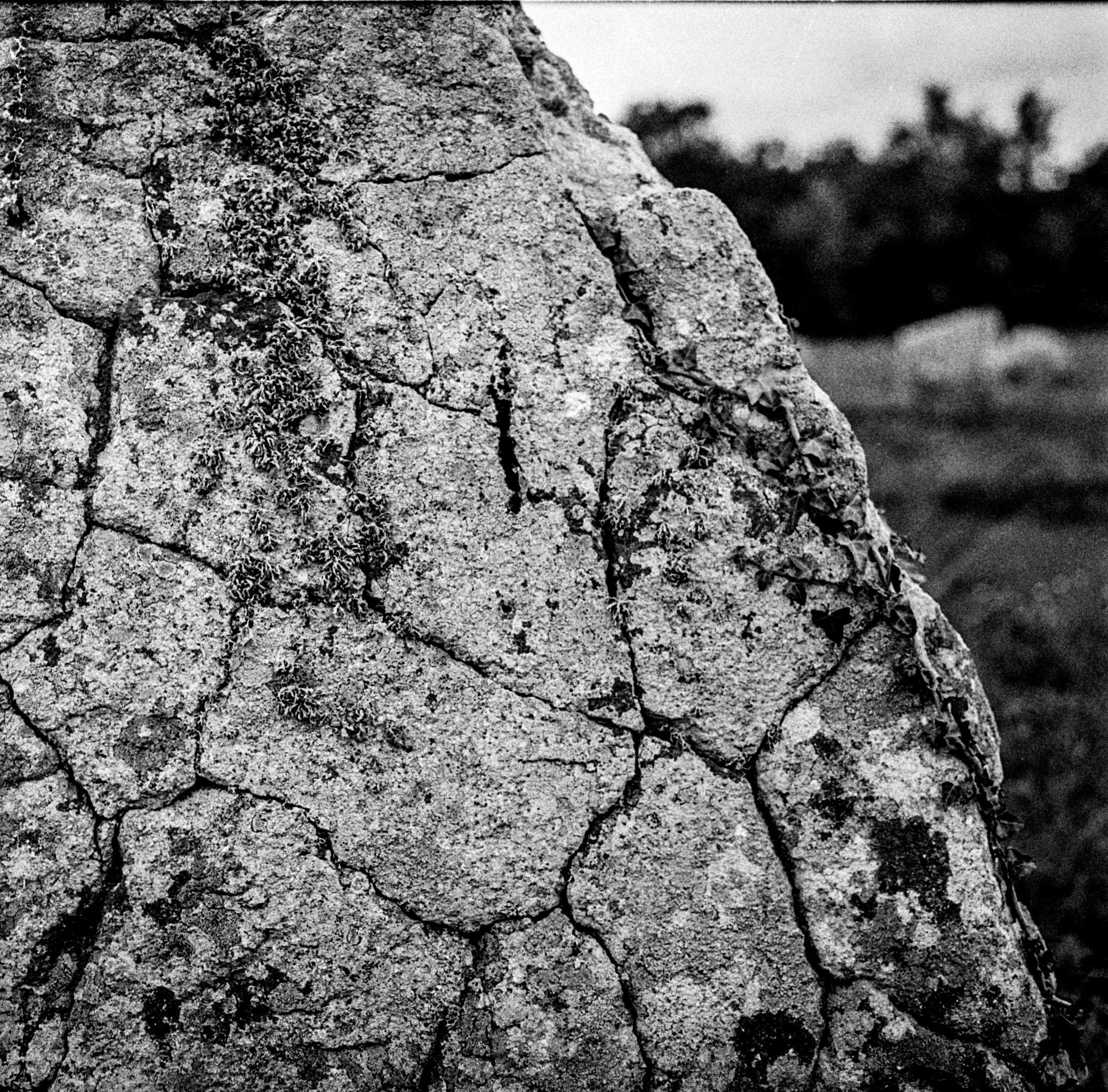
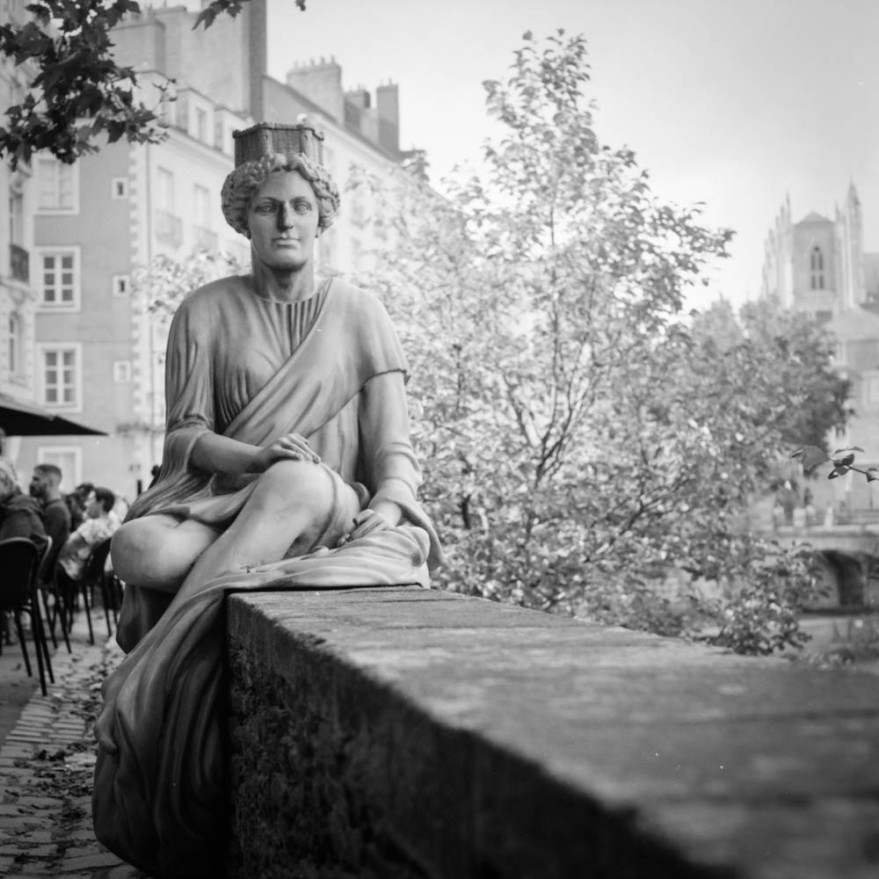
The square format common to much medium format photography with a 6×6 format. I’ll let you look at the differences for yourself.
The lenses for each shot was a 50mm lens for the 35mm format film photo, and the 80mm mm lens for the medium format photo. However, both lenses are equivalents.
Conclusion In closing, remember that there’s no definitive answer to the question of 35mm vs. medium format. It’s a matter of personal preference and artistic vision. Both formats have their merits, and your choice should align with your goals and the style of photography you wish to pursue.
Stay tuned for the Mamiya C220 review, where I’ll delve deeper into the world of medium format photography, and consider the impact of the TLR on your creative journey.
The journey of film photography is full of exciting choices, from your film format to your camera model. Vivian Maier’s legacy reminds us that every camera has its unique personality and that your creative vision should be the driving force behind your choices. Whether you decide on 35mm or medium format, your camera is your artistic tool, and the world of film photography is yours to explore.






































 IJM Photography