NORTHUMBRIAN SUMMER PART II

Craster 2025

It was getting close to lunchtime.  I was enjoying this father-son day and dared to ask if we could go out to Craster.  I really wanted a picture of Dunstanbrough Castle,something I had seen in a YouTube video by Thomas Heaton but it wasn’t to be.  Just take the images you can and enjoy the process.

We would visit Craster.  But first food.  Despite the blueberry muffin we had shared earlier, I was going to indulge us in one of my other UK rituals – The Marks and Spencer sandwich.  I have a great fondness for the feeling of being home and returning to my youth.  The French are a wonderful people and make so much top notch food, but you can’t get a decent Cheese sandwich anywhere.  Wonderful cheese, and marvelous bread, but the idea of putting both together, has totally escaped them.  

The French make glorious food. But they’ve never quite grasped the sacred simplicity of a cheese sandwich. Or the sublime elegance of a prawn sandwich—peeled pink shrimp, mayonnaise, in a relatively grainy brown bread full of goodness. A British delicacy, perfected.

So I bought three: the Ploughman’s, the Wensleydale with carrot chutney, the Ultimate Prawn—nothing but the best for my father. And a bottle of sparkling water.

Food fit for a king. Or at least, for a man who’s earned his rest.

Guided first to the car park, and then to the village by my father going against the wisdom of the GPS Sat Nav we had arrived.   We passed the smoke house—thick plumes curling into the breeze, the air thick with oak and salt. The kind of smell that clings to your sensorial memory. I didn’t take a photo. But I inhaled it, sweet as any incense at mass.  Smoking local fish for local people. 

At the end of the street was the Jolly fisherman, who is not a happy angler, but the local pub.  Well, it would be rude not to… We both fought to pay for the pints of Guinness, but I won and we sat down at a table to drink them.  I think we have a duty to support local pubs as they’re closing at a rapid rate of knots in the UK. This “core” of British and Irish society must be kept alive! 

My  mother had tried to phone us but in vain.  Messages and calls couldn’t pierce the pub walls.  I suggested my Dad go outside to try and call my mother just to reassure her.  It still didn’t work.  I tried on my phone, but didn’t have any luck.  We both decided that my mother suspected that I might lead my father astray and take him to a watering hole.  Ooops!

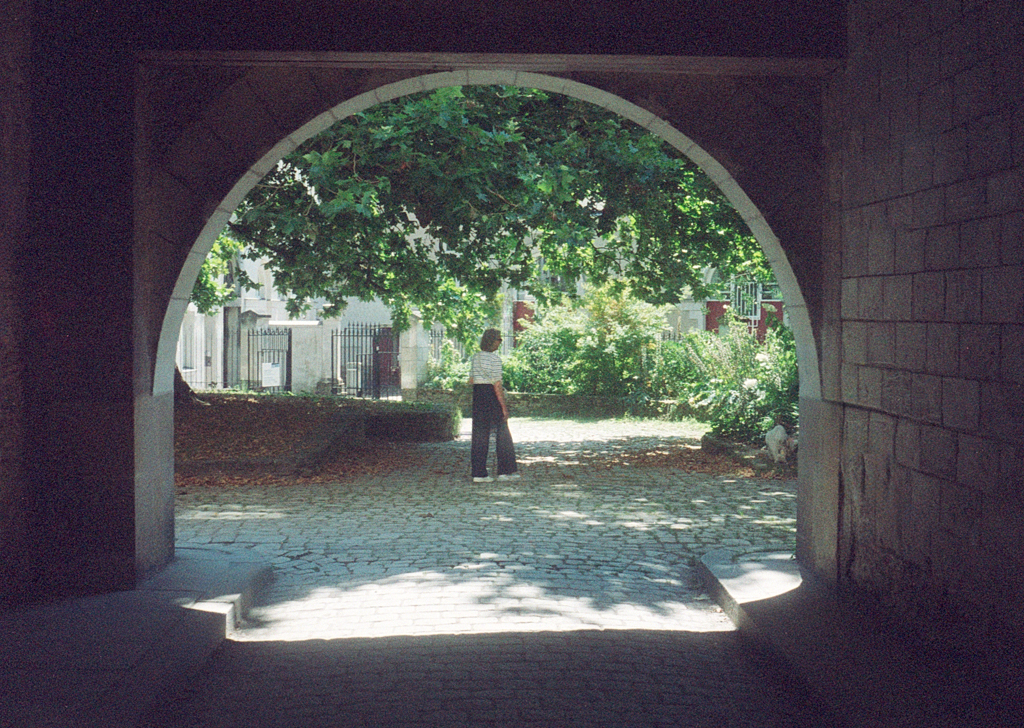
In for a penny, in for a pund! The harbour, the lobster pots, the salt on the breeze—Northumbrian summer in its purest form. You’ll see it in the images below.


Also in this series: Preface  ·  Lesbury  ·  Alnmouth  ·  Bamburgh  ·  Alnwick  ·  Rothbury  ·  Hepple  ·  Chesters  ·  Return  ·  B&W Footnote  ·  Summer I  ·  Summer II  ·  Summer III  ·  Summer IV

NORTHUMBRIAN SUMMER PART 1

Alnmouth 2025

I came back to Alnmouth not just to see my parents, but because the place has become part of me and maybe in some very small way we had become part of Alnmouth.

Each visit is different. Sometimes I’m chasing “the” image. Sometimes, like this year, I’m just learning how to sit still.  This is the tale of the other part of Summer.  The UK part of Summer.  The Northumberland part of Summer.  Going home to visit my parents, and show them the children.  It was a Tuesday, I know this because I checked the metadata on my phone.  My mother had decreed that she would go with Virginie (my wife) and the children to Morpeth to do some clothes shopping.  I would have a day with my father.  

It was to be a quiet day with a father and his son catching up and putting the world to rights as we often do during our weekly telephone calls. Which reminds me, I must call on the way home from work. He often talks about walking around the village and always bumping into people he knows. A hello here, a hello there…

More than anything it was a day out with my father.  Which is rare, so I decided to take advantage of his company and ever present wisdom.  Whatever was to happen I had my X100F with me to capture everything.

He decided that we were going to go for a walk in the village as he is wont to do.  I wanted to pay my respects to Scotts of Alnmouth as I do every time I come to Alnmouth.  We follow each other on Instagram and always say hello when I’m “in town.”  It costs nothing to say hello and you never know, it might make that person’s day.  It may even make your day!  With an espresso and black currant muffin, I bade farewell to Scotts of Alnmouth for the year telling them “See you next year.”  

Dad just wanted to drop into the village shop to say hello too.  Why?  Because he’s a lovely man and saying hello costs nothing.  Just a small gesture.  Am I repeating myself?  Ah well…  My father had a spot that he wanted to show me.  This spot overlooked the golf course, the beach, and out to sea we could make out Coquet Island and its lighthouse.  

When I was younger,

the idea of sitting on a park bench,

just sitting there,

would have been impossible.

Yet the man I am at 53?

I revel in it.

When you only get back once a year,

you realise you might have only weeks left

with your father.

And those moments—

silent, shared, ordinary—

become sacred.

There’s no need to talk.

Even when we do.

Just being next to this man is enough.

I see myself in him too.

The way we walk.

What we pause to see.

Just those small things.

My future? 


Also in this series: Preface  ·  Lesbury  ·  Alnmouth  ·  Bamburgh  ·  Alnwick  ·  Rothbury  ·  Hepple  ·  Chesters  ·  Return  ·  B&W Footnote  ·  Summer I  ·  Summer II  ·  Summer III  ·  Summer IV

Classic Chrome Meets Portra 160: Evaluating the Pentax ME Super and Fujifilm X100F

Let’s talk about two of my favorite cameras—the Fujifilm X100F and the Pentax ME Super. While these cameras belong to entirely different eras of photography, they share a surprising similarity in size and portability. I’ve used both extensively, and today, I want to compare their unique qualities without turning it into a clichéd “film vs. digital” debate.

Photography enthusiasts often find themselves in one of two camps: those who champion the convenience and immediacy of digital, and the purists who swear by the timelessness of film. But if you’ve followed this blog for a while, you’ll know I don’t see things that way. Instead, I value what each format brings to the table, and more importantly, how both contribute to the experience of photography.

A Tale of Two Cameras

For me, photography is more than just the final image—it’s about the journey of capturing it. Any Lomography fan will agree: the process is as important as the outcome. When I shoot with the Fujifilm X100F, I appreciate the immediate feedback of seeing the image on the screen and knowing right away what I’ve captured. But with the Pentax ME Super, it’s a different experience. I have a rough idea of what the film will deliver, but the magic isn’t fully revealed until the film is developed. That anticipation is part of the charm.

For this comparison, I’ve chosen photographs from Northumberland. Its moody, windswept landscapes—places like Alnmouth and the Northumbrian moors—present the perfect canvas for both film and digital. The X100F’s Classic Chrome simulation delivers a retro, muted look, while Kodak Portra 160 film, shot through the Pentax, brings warmth and richness to the tones.

The Fujifilm X100F

he X100F has often been called a bridge between the analogue and digital worlds, and I tend to agree. It’s packed with modern features like autofocus and an electronic viewfinder (EVF), but the controls are refreshingly tactile, with dedicated dials for aperture, shutter speed, and ISO. For anyone with a background in film photography, this setup feels familiar and intuitive.

What sets the X100F apart for me, though, is its Classic Chrome film simulation. It offers a subdued color palette that echoes old film stock, perfect when I want a slightly desaturated, vintage aesthetic. Unlike some over-the-top digital filters, Classic Chrome feels organic and subtle—bringing out details in the shadows without overwhelming the shot with contrast.

The X100F Photos

The Pentax ME Super

On the other hand, the Pentax ME Super is all about slowing down. There’s no EVF, no digital screen, and definitely no autofocus. Instead, you rely on a split-prism focusing system and aperture-priority mode. It forces you to be deliberate with each shot, a process that I find incredibly satisfying.

You’ll often hear film photographers talk about being more “in the moment” when shooting on film, and that’s exactly how I feel with the ME Super. The process of carefully composing each shot, setting exposure manually, and waiting for the film to be developed encourages patience and thoughtfulness.

For this outing, I paired the ME Super with Kodak Portra 160, a film that’s become known for its natural skin tones and soft, warm colors. Paired with the 50mm f/1.7 lens, this combination creates images with that unmistakable film character—shallow depth of field, soft highlights, and rich colors.

Lenses and Sensor Size

One of the most noticeable technical differences between these two cameras is their lenses and sensor sizes. The X100F features a 35mm equivalent f/2.0 fixed lens, while I usually use the 50mm f/1.7 on the Pentax. On the sensor front, the X100F has an APS-C crop sensor, giving it a narrower field of view compared to the full-frame 35mm film in the Pentax.

This technical difference goes beyond field of view. The Pentax ME Super has fixed ISO based on the film I choose, so I need to plan ahead for the lighting conditions I’ll be working in. In contrast, the X100F allows me to adjust ISO on the fly, providing flexibility in rapidly changing environments. This is something digital photographers have come to rely on, and it’s undeniably convenient when shooting in variable light.

The Pentax ME Super photos

Comparing the Images

Now, the big question: which is better, the Pentax ME Super or the Fujifilm X100F? Honestly, neither. They’re different tools for different purposes. Whether you’re drawn to the organic feel of film or the convenience of digital, both formats offer something unique. And that’s the beauty of photography—there’s no one-size-fits-all approach.

The sideshow feature shots from both cameras. As you look at them, you might favour one look over the other. The film shots have a warmth and texture that digital sometimes struggles to replicate, while the digital photos are sharp, detailed, and offer instant gratification. But ultimately, this comes down to personal preference, not a matter of one being objectively better.

Final Thoughts

At the end of the day, a camera is just a tool for capturing a scene in a particular way. As long as the final image is pleasing to the eye, I’d say the job is done. So don’t limit yourself to just one format—if you haven’t tried shooting film, give it a go. If you’re a film photographer who’s hesitant to try digital, maybe the X100F will ease that transition with its analogue-like feel.

More than anything, I encourage you to enjoy the process, whether it’s with film, digital, or both. Get out there, take your time, and remember that photography isn’t just about the images you capture—it’s about the experience.


If you’d like to go deeper on the Pentax ME Super specifically, I’ve written a full dedicated review: Why the Pentax ME Super Is the Perfect First Film Camera (Even in 2026).

Post Scriptum:
For those of you new to my blog, welcome! I cover everything from camera reviews to photography tips and techniques. Whether you’re a seasoned photographer or just starting out, there’s something here for you. Feel free to leave your thoughts or questions in the comments below—I’d love to hear from you!

The UK Chronicles: A Black and White Footnote

My usual approach to black and white photography is to shoot directly in black and white, either using black and white film or the Acros film simulation with my X100F. When using the X100F on this UK trip, my EVF displayed the black and white shot using Acros with a red filter—my go-to simulation. This method puts me in a black-and-white “frame of mind” from the outset.

However, this time I decided to break from my usual practice and experiment. I did something I normally advise against—starting with the intention to create color images and only considering black and white later. I chose the Classic Chrome film simulation instead of Acros, focusing on capturing the vibrant colors of the Northumbrian countryside. It was all about breaking free from my black-and-white routine. Both color and black-and-white photography have their place, but for this trip, I wanted to prioritize one over the other. Still, wouldn’t it be intriguing to compare both approaches?

Back in France, as I prepared the images for my black-and-white Instagram feed, I began to wonder if some of the colorful shots might also work in black and white. Initially hesitant—given my emphasis on shooting with intention and purpose—I decided to embrace the experiment. I was breaking one of my own rules, yet the idea intrigued me.

Reviewing the color shots, I considered which might translate well into black and white. I look for images with texture and varying tones rather than just color. My composition is usually solid since I’ve already edited my color images, including reframing and straightening as needed. With digital RAW files, converting to black and white and producing different versions is straightforward. As they say, the goal is to produce images that reflect how they made you feel, not just how you saw them. This is why I convert my images to black and white—they capture more of the emotional essence.

Opening Adobe Lightroom on my PC, I saw the familiar images on my screen. My editing approach may seem finicky, but it’s effective. While the simplest way to convert an image to black and white is to slide the “saturation” slider to the left, this often results in a flat, lifeless image. Instead, I use a more nuanced approach to control various color tones in the black-and-white image. This technique helps preserve depth and character, ensuring that each image maintains its visual impact even without color.

Here’s how I approach black-and-white conversion in Lightroom:

  • Black and White Profile: Sets the overall tone and mood of the image.
  • Clarity: Enhances texture and detail for a more dynamic appearance.
  • Contrast: Adjusts the range between light and dark areas, adding visual interest.
  • Color Sliders: Modifies the luminance of specific colors to bring out different tones in the black-and-white image.
  • Highlight Tool: Adds subtle vignetting and balances highlights for a polished finish.

So, why convert to black and white after shooting in color? For me, it offers a classic, timeless aesthetic, and challenges me to create a “better” image by focusing on composition and texture without the distraction of color. This approach pushes me to craft photographs that rely on fundamental elements, enhancing their overall impact.

Impact is at the heart of photography. While I cherish the colors of the Northumbrian countryside and am eager to learn how to use color more effectively, I also deeply value the strengths of black-and-white photography. It’s about transcending color to create images that resonate through composition and texture.

But there’s something more personal about these black-and-white conversions. Perhaps it’s because I broke my own rules this time around, allowing color to take center stage and letting the black-and-white images emerge later. These images weren’t planned with black and white in mind—yet, despite that, or perhaps because of it, they feel even more special to me. Sometimes, going against what you think you know leads to unexpected results. And, in this case, those results resonate even more deeply.

Isn’t impact what we strive for in our photography? Don’t get me wrong—I love the colors of the Northumbrian countryside and am on a quest to learn how to use color more effectively. But I do believe in the strength of the fundamentals offered by black-and-white photography. Sometimes, breaking your own routine brings surprising rewards.


Also in this series: Preface  ·  Lesbury  ·  Alnmouth  ·  Bamburgh  ·  Alnwick  ·  Rothbury  ·  Hepple  ·  Chesters  ·  Return  ·  B&W Footnote  ·  Summer I  ·  Summer II  ·  Summer III  ·  Summer IV

The UK Chronicles Part VIII: From Chesters, to Rothbury, to Lesbury

Thank you for following this series of UK Chronicles, and I would just like to say that this is the last one. It had been a long day, but a good day, despite the disappointment in Otterburn. You overcome and adapt. Killian was still sad not to have some Roman armour though.

So, despite not rocking the Roman look, we still had to get back to Lesbury because that evening we would be eating with my parents in a pub in Boulmer, which was just down the road from Lesbury and on the coast. Boulmer is one of those little fishing villages that still has a small fleet of fishing boats that would have caught the fish and chips that we would be eating that night.

To get back home, I could take the more direct route, or I could go via the scenic route. Luckily for you, Dear Reader, we had enough time to take the scenic route. My driving was leisurely, or even slow, as we meandered through the bendy country roads. Again, just taking in the rural views and loving every minute of it. We wanted to go back to Rothbury to get another of those yummy sandwiches in the breadcakes that you only seem to be able to get in the UK.

We found the same parking spot as we did that very morning and crossed the road to go back to that morning’s bakery. It had just shut! Please don’t worry for us though; our lives still had some meaning. We visited the ironmongers that hadn’t yet opened that morning. It was one of those places that had everything that one could need, from bird feeders to butter dishes. Killian decided that I needed a new walking stick. He had seen me leaning with my old one, which, in his mind, was too small for me. I think he really had his eye on a shepherd’s crook, but we settled on a nice wooden walking stick that is just a tiny bit taller than my French ones, and it’s propped up against my desk as I write—a little reminder of home.

Killian suggested we walk to a particular shop and then return, now with my new walking stick in hand. Leisurely was definitely the word of the day and summed up our attitude to it so well. We strolled down to the RSPCA charity shop. I thought I might just be able to get Killian a jacket to help smarten him up a bit, but failed. Ah well. We walked past the toy shop, which you could tell was for rural folk. The amount of toy tractors and all the farming machinery was awe-inspiring. Somebody somewhere had obviously been frustrated as a child…

We passed the Queen’s Head pub, and surprise surprise, we went in. I ordered the drinks and the crisps, made sure Killian had a place to sit, and went to the loo. The bar was full of locals, I presume farmers, judging by the size and musculature of the men. It would appear that their Friday evening sesh was just beginning. There was a couple of walkers with their dog, and a water bowl had been provided, and the dog was enjoying some of the treats from the complimentary dog treat jar. While some find the Northumbrian accent incomprehensible, to me, it’s music to my ears. I get every word of it. Killian, although fully bilingual in English, was struggling, praying that nobody would come up to him and try talking to him. Poor lad. And that was despite a pint of creamy, silky John Smith’s Bitter!

We left Rothbury behind us, feeling as if all were good in this world. Leisurely and peaceful, which felt amazing. We would head back towards Alnwick and have another look at the scenery in a new light compared with that morning. I have taken this route a few times and in the valley have always noticed a castle, and this time I thought, you know what? I’m going to have a look at that place. We saw the sign to the village of Edlingham and its 14th-century castle and turned left. You park just in front of the church, and you can go and see the ruins. We went into the church and saw somebody taking photographs with an old film camera. This guy had a vintage Nikon, and it looked beautiful. As photographers will do, we started talking shop. We talked about the films we used and how my X100F, although not a film camera, was the nearest thing I had found to a film camera in its feel and use. The photographer mentioned that the castle ruins were propped up with large iron beams, which seemed to detract from their historical charm. So, we decided to skip the visit. We parted ways and left the church after having managed to capture a couple of photos. Killian came running back in to ask the guy if he had a Nissan. He did. Well, in that case, it was his car that had just smashed into the church gate. Killian lifted the damaged gate to put it against the wall, and the driver was convinced that he had put his handbrake on. The gentleman called the number on the church notice board to try and tell the vicar about what had happened, but there was no answer. We never did find out if the driver managed to reach the vicar, but it was an unexpected end to our day of exploration.


Also in this series: Preface  ·  Lesbury  ·  Alnmouth  ·  Bamburgh  ·  Alnwick  ·  Rothbury  ·  Hepple  ·  Chesters  ·  Return  ·  B&W Footnote  ·  Summer I  ·  Summer II  ·  Summer III  ·  Summer IV

The UK Chronicles Part VII: Chesters Roman Fort

Welcome, Dear Reader, to the very edge of the Roman Empire, and by implication, civilisation. You might be wondering why there’s a carving of a phallus as the cover photo for this article. Well, don’t forget that soldiers will be soldiers, even when they’re part of a Spanish Cavalry regiment stationed here. Some things never change—except these soldiers were caught by archaeologists centuries later!

Chesters Roman Fort was constructed along Hadrian’s Wall to keep out the “uncivilised” Picts and Scots. This impressive wall stretches across the country from East to West, ending at Wallsend in Tyneside. It was a massive undertaking, and I’m still amazed by this feat of engineering.

Killian, my dear son and heir, whom you might recall from the previous article about his misadventures at Otterburn, was slightly less impressed. “Ce n’est pas le Mur d’Hadrian, mais le muret d’Hadiran,” he quipped—translating to, “Not Hadrian’s wall, but Hadrian’s little tiny miniature wall.” Some people are just impossible to please!

Despite his initial skepticism, Killian was genuinely impressed by the quality of the stonemasonry, even after nearly 2,000 years. With his background in plumbing, he quickly noticed the Roman plumbing and underfloor heating, which makes you realise how little we’ve actually invented since then.

When we visited the cavalry lines and saw where the horses were kept, he was astonished to learn that three men and three horses lived in the same building, with the horses at one end and the soldiers at the other.

Even though he was flippant at the start of the visit, he took a keen interest in everything and enjoyed explaining each building to me. Maybe he’s a closet intellectual after all…

As we continued our tour, my knee was giving me trouble, and Killian showed his concern, asking if I really wanted to go down to the river to see where the bridge once stood. I insisted we go, so we made our way slowly towards the river and the soldiers’ baths. And by baths, I mean a fully-fledged hammam complete with sauna and dry heat—the very latest technology to provide the frontier soldiers with some home comforts. If those baths were still operational, they might have been perfect for soothing my arthritic knee!

We walked slowly towards the west gate and could only imagine the civilian buildings buried beneath the fields in front of us. This site wasn’t just a series of building outlines but a thriving Roman community on the very edge of civilisation.

Speaking of civilisation, I felt it might just be time for a cup of tea. As we strolled through the site towards the car, we spotted a tea shop. A cup of tea and a slice of cake were just what I needed—I was in heaven! Good old National Trust! No wonder they’re an institution. Our conversation shifted to the gift shop, where I was trying to convince Killian that, despite how cool owning a replica Roman helmet and armour might be, it could be a tad impractical and he might not have many occasions to wear such Roman regalia. Mind you he would be very dashing!

If you want to, you can even play a game of “Where’s Waldo” or “Where’s Wally,” for the British readers. Note I didn’t say “Where’s the Wally…” Keep an eye out for the photos of Killian…


Also in this series: Preface  ·  Lesbury  ·  Alnmouth  ·  Bamburgh  ·  Alnwick  ·  Rothbury  ·  Hepple  ·  Chesters  ·  Return  ·  B&W Footnote  ·  Summer I  ·  Summer II  ·  Summer III  ·  Summer IV

The UK Chronicles Part VI: Hepple to Otterburn

Otterburn was the original destination of this little outing into the Northumbrian countryside. As a younger boy, I had been with Killian to the Mill in Otterburn that used to make beautiful rugs from the wool of the local sheep. That mill stopped producing them a few years ago, but Killian had this memory in his mind.

But we weren’t there yet… The drive from Hepple to Otterburn takes us through yet more landscape. We passed by Cragside, the first house in England to have electricity, powered by a waterfall. Green before green was no longer just a colour. We had visited the huge house when Killian was about 13 and hadn’t been back since. But this story isn’t about Cragside. Not this time. It wasn’t open as we drove by, so that was that.

As in the previous sections of our father-son drive, there were plenty of places to park along the side of the road to take in the scenery. And that we did. I remembered that time two years ago when I was there connecting with my father. And here I was, connecting with my son.

Otterburn means different things to different people. It is not just an area of outstanding natural beauty, but also a training area and live firing range for the Infantry of the British Army. I remember playing for an Officer’s mess night once when I used to wear green for a living. Although you can still wander around when the Infantry isn’t training, you’re constantly reminded not to touch any military debris—it might explode and help you become an integral part of the landscape.

The landscape shifted from the wild moorlands of Hepple to more farming country. Think sheep, hemmed in by century-old dry stone walls. Signs warned you to keep dogs on leads and informed you that any dog found attacking—or even just worrying—sheep would be shot on sight. A sobering thought. I jokingly warned Killian not to do the same, just in case.

At the top of the hill, I parked up and surveyed the patchwork landscape, scissored by those dry stone walls. Killian pushed on one and you could feel it giving way. I told the feckin’ eejit to stop right now. These walls were old and not to be messed with. His French side came out—he wasn’t impressed by this stalwart of the British countryside. I told him these walls had stood for years and it wasn’t going to be a bloody Frenchman that was going to change that.

But this story is about Otterburn. I’d warned Killian that Otterburn wasn’t as he remembered. He had this dream of buying a rug, but I wasn’t even sure they still sold them. My latest recollection of the place was that it had become more of a “country style retail outlet.” The signs still said the rugs were made in the UK, but the magic was gone.

It was the low point of the day. Killian stood there, staring at the overpriced rugs, his expression shifting from excitement to quiet disappointment. “This wasn’t how I remembered it,” he muttered. I could see the years of imagined nostalgia fading in real-time. We looked at what was on offer, checked the prices, and it just wasn’t worth it. The small café had a sort of mini-museum feel, but all we bought was a double espresso, a sausage roll, and a small cake. Killian ate; I didn’t touch it.

As we sat there, the conversation drifted to how Killian could see himself living in the area. I had to let him down gently. “We’re on holiday, son. Living here isn’t the same.” I knew what I was talking about, especially after living in France for over thirty years. The economic decline in the area was as stark as the difference between summer and winter in Northumberland. Both beautiful in their own way, but I know I have a penchant for summers. Winters are dark, rainy, snowy, cold, and thoroughly depressing. Beautiful—but still depressing.

It was all such an anti-climax. This had been one of the places Killian had been dreaming about for years.

I was at a loss for what to do. Then, out of nowhere, I had one of those genius ideas we only dream about. I wanted the day to end on a high note. “You know, son, we’re not too far from Hadrian’s Wall. Do you fancy it?”

His eyes lit up. He did fancy it, so off we went, a certain spring in our step.


Also in this series: Preface  ·  Lesbury  ·  Alnmouth  ·  Bamburgh  ·  Alnwick  ·  Rothbury  ·  Hepple  ·  Chesters  ·  Return  ·  B&W Footnote  ·  Summer I  ·  Summer II  ·  Summer III  ·  Summer IV

The UK Chronicles, Part V: Rothbury to Hepple

Do you have a place, be it real or imaginary, that just haunts your mind?  You think of it, and you are transported there instantly.  The smells of the grass, the sounds of the river, and the odd car driving past you wondering what the heck you are doing?  Hepple is my special place.  It is a place where I feel at peace and that all is right with the world.

I’m thinking back to an article I wrote a couple of years ago called Hepple for Photos, Not Gin. I was with my father and had my Canon 6D Mark II with the 16-35mm F4.0 lens and the 70-300mm zoom lens. This year, however, I had my X100F with just the 35mm f2.0 equivalent lens, and I was with Killian, who, surprisingly, was a little tired and decided to curl up on the back seat for a snooze. His loss…

This is the place, this stretch of road, that I have been looking forward to for 2 years. The weather was clement, and I can assure you that the place is still as beautiful as ever. I wasn’t going to have the choice of lenses this time; I would have to see the scene in 35mm and make do with it. No zooming, no switching lenses—just a little constraint. And you know what? I was fine with that!

The lack of zooming and my sleeping son allowed me to walk around the area a little more, exploring under the tree at the end of the road and at the bottom of the hill.  These were views that I had not seen before.  It only goes to show that we might think we know a place, even in our memories, but it still has so much more to offer us.

I parked just before the bridge, as I usually do. Everything was still in place: the stiles, the trees, the river—just as I had pictured it in my mind. It’s when looking at the countryside like this that I am convinced there is a creator behind all this creation. The beauty of it didn’t just happen by chance.

The noises were made by the flowing of the river and the breeze in the trees.  I had this feeling of calm.  I could take photos of that place every day and not get tired of it all.  I might even go so far as to say I could have died here and died a happy death.  I had found my peace.

Killian had found his peace too and was still asleep in the car.  A micro sieste, he said.  He might be 25, but he reminded me of the small boy who was once my son. 

I can’t be the only person on this earth to feel this?


Also in this series: Preface  ·  Lesbury  ·  Alnmouth  ·  Bamburgh  ·  Alnwick  ·  Rothbury  ·  Hepple  ·  Chesters  ·  Return  ·  B&W Footnote  ·  Summer I  ·  Summer II  ·  Summer III  ·  Summer IV

The UK Chronicles, Part IV: Alnwick to Rothbury

The Scenic Drive: A Journey Through the Northumberland Moors

The road from Alnwick to Rothbury takes you over the Northumberland moors and through steep valleys, giving you real taste of the British countryside.  It is not only magnificent in the early morning light, but it has this way of taking your breath away at each bend in the road.

You might just have gathered by now that I was in the UK this summer, visiting my Parents in Northumberland.  You may also have gathered that I wasn’t having the best of sleeps and was thus up a little earlier than most.  You may also have gathered that I decided to go light on photography equipment this trip compared to last year, only taking my X100F with me to take photos.  You may also have gathered that this trip was not just about photography but spending some quality time with the children, especially my son, who hadn’t been to the UK for a while.  You may also have gathered that my son joined me on a couple of these photography jaunts. Right!  I think we may have set the scene.

Photography on the Go: Minimalist Gear and Techniques

We were both in the car by 6am, having breakfasted and taken our collagen in yorkshire tea to make it at least a little palatable.  This is an epic drive that I try to do at least once when I’m over.  When you see the photographs, you’ll understand why.  Like Bamburgh, I had to meter for the highlights knowing that I would be able to get back details in the shadows back home in Lightroom.  The 35mm F2.0 equivalent lens of the X100F was fine to capture enough of the scene, and if I wanted to zoom, then it would mean zooming with my feet. 

Capturing the Landscape: Heather in Bloom and Morning Light

Fortunately, there are plenty of places to stop by the side of the road on this route, which is a good job because at each turn everything changes.  The sun was coming up on our left and filling the valley with light, and the top of the hill cast a shadow that I would have to compensate for later.

The road continues with views of the heather, which was in bloom and the pink added a wonderful contrast to the warm colours of the morning reflected on the landscape.  It certainly felt a real privilege to be there and take it all in.  We passed Cragside but decided to continue on to Rothbury.

A Taste of Rothbury: Discovering the Local Flavours

We managed to find a space to park in Rothbury, and out of the corner of our eye, we saw a bakery.  An English bakery, but a proper bakery.  No pain au chocolat or croissants, but sausage rolls, meat pies, even a haggis pie.  We settled on sandwiches in proper bread cakes and millionaire’s shortbread as a sweet treat.  Next, we just had to find a bench to sit on and eat our picnic.  There’s just something about eating a sandwich in an English village in the sun.   I daren’t imagine what the winters are like!  Possibly a bit nippy…

Looking Ahead: Plans for Otterburn and Beyond

But there we sat, the two of us, munching away, deciding to go to Otterburn for more photos and possibly a rug, but that, Dear Reader, is a story for another day…


Also in this series: Preface  ·  Lesbury  ·  Alnmouth  ·  Bamburgh  ·  Alnwick  ·  Rothbury  ·  Hepple  ·  Chesters  ·  Return  ·  B&W Footnote  ·  Summer I  ·  Summer II  ·  Summer III  ·  Summer IV

The UK Chronicles Part III: Bamburgh

Memories of Bamburgh: A Personal Connection

I’ve been going to Bamborourgh since I was a little boy. Fifty years later, it still affects me in a way that not many places do. Growing up, there was a painting of the castle in my mother’s bathroom, and ever since I learned photography, I’ve wanted to capture my own photo of the place. Patience, my dear boy, patience…

The last time I was there, I was with my wife and daughter. We explored the castle—a gurt big affair that overlooks the coast and the Farne Islands. This time, I was with my son. It’s all about passing on the experiences we’ve had to future generations. To be honest, this whole trip was about creating memories for the children and spending quality time with them. Ever wary of spending too much, we decided to visit just the village and the beach.

Exploring the Beach: A Walk through the Dunes

To get to the beach, you have to go through the dunes, following the paths, because wandering around the dunes willy-nilly is not the done thing—conservation of the local flora and fauna and all that. The castle towers above the beach, giving a sense of protection. By the time we got there, the beach was fairly full of people, dog walkers, and their dogs, all just enjoying the summer. A British, Northumbrian summer, but summer nonetheless.

I don’t know if you know, but I have a gammy knee and arthritis. I’ve also been taking collagen every day, and although it seems to be doing me good, it’s a bit early to see real effects. Killian was very kind, looking after me and making sure I was keeping up. He’s a good man, and it’s nice spending time with him. After walking on the beach for a while and letting me take my pictures, we found a log to sit on before heading back into the village.

A Stroll Back to the Village: Nostalgia and New Discoveries

As we headed back to the car, we came up the side of the castle and walked along the cricket ground. Dogs and their walkers were still out in force, with the owners throwing balls for the aforementioned dogs. All of a sudden, I missed Molly, our dog, and thought how much she would have loved coming with us, but she’s an old girl, and it wouldn’t have been feasible.

I thought about going up to the church to pay my respects to the local heroine, Grace Darling, who was the Lighthouse Keeper’s daughter in the 19th century. During an epic storm in 1838, a ship was wrecked on the Farne Islands, and Grace and her father went out in a rowing boat to pick up the survivors, as it was considered too rough a sea for the Seahouses lifeboat. They saved 9 out of the 62 passengers and had to shelter in the lighthouse for a further 3 days until the storm calmed down.

A Pub Lunch at The Lord Crewe: A Culinary Interlude

I didn’t manage to get that far. Killian, much like myself, has a weakness for pub lunches. And look, a pub! The Lord Crewe! One of those posh pubs that tries to hit above its station… We went straight to the bar and tried to order two pints of Guinness, while letting them know that we wanted to eat too. “Oh, in that case, just go up to the restaurant, and they’ll deal with you…” I was ready to leave the place and go somewhere else, but Killian was hungry, so we didn’t. However, we did enjoy being rude about the two barmen in French.

Killian decided on fish and chips, or “cod fillet with a beer batter”, and I went for the prawn cocktail. As you can see in the picture, even as Frenchmen, we couldn’t fault the presentation of the dishes. The taste was pretty good too! Eating a meal like that just takes you back to a place of joy and nostalgia. It takes you back to a place of calm and reflection. It takes you back to a place where everything is just the way it should be. It almost helped us forget the two barmen. Almost…

A rather delicious and impeccably presented prawn cocktail..

Continuing the Adventure: More Pints and Ice Cream

We paid and left, still joking at the barmen’s expense. We continued up the road and found the other pub. Ah well, another pint of Guinness. We never got to the church, but that was fine, as I already had the photos I wanted. The beach, the castle, and the dog walkers. We headed back towards the car and had that ice cream that we had noticed while walking up to pub number two. What a sound decision. It was very good ice cream and helped us forget the two rude barmen from the other place… Almost…

Capturing Bamburgh: A Photographer’s Reflections

Anyway, back to the car, and back to Lesbury to go and see the girls. I had the photograph I wanted. I wanted the castle, on top of its hill overlooking the beach and the dunes. The other photos were just a bonus. Yes, I went to a place for just one photo, but it was a photo I had been eager to get for some time. The next time I might just have to go at sunset to get the good light…

Photography Insights: Challenges and Techniques

Let’s conclude by talking about the photography from the day. The main technical difficulty was my camera’s metering of the scenes. I had to really expose for my highlights to compensate for the bright sky and the reflection of this light on the sand. I was actually worried about not being able to retrieve the information in the shadows. Luckily, Lightroom was a champion with photo editing and showed itself to be a top-notch app. For me, Bamburgh is all about the castle. It’s about the castle and the sea. It’s about the castle, the sea, the sand, and the dunes. If you can capture all that, then you’re well on your way to getting some pretty good photos.


Also in this series: Preface  ·  Lesbury  ·  Alnmouth  ·  Bamburgh  ·  Alnwick  ·  Rothbury  ·  Hepple  ·  Chesters  ·  Return  ·  B&W Footnote  ·  Summer I  ·  Summer II  ·  Summer III  ·  Summer IV

The UK Chronicles, Part II: Alnmouth

A Rare Visit to Alnmouth: Making the Most of It

Little did I know this would be my only visit to the beach and village of Alnmouth this year, so I decided to make the most of it. I had my X100F around my neck, as usual. I was up at the crack of dawn, chasing that perfect light once again.

The morning routine was pretty much the same as my first day in Lesbury: early rising, early breakfast, and an early cup of tea. The weather was gorgeous, and the light was amazing. What could go wrong?

Arriving in Alnmouth: The Beauty of Early Morning Light

I hopped in the car and headed to Alnmouth, just a short drive down the road. As I came around the roundabout in Hipsburn, Alnmouth and the River Aln came into view, bathed in golden light. The reflections on the water were breathtaking. It was early enough to find a parking space without any trouble. If you’d like to see more photos of Alnmouth, I can add a link for you.

Exploring Alnmouth: A Village with a Rich History

As the name suggests, Alnmouth is a village at the mouth of the River Aln. It was once a bustling port, playing a significant role in 17th-century Northumbrian trade. I’ll let you read up on that on Wikipedia, and I’ll be here when you’re done.

The village was still asleep as I made my way past the golf club and down to the beach. The only people around were a few dog walkers and me, enjoying the morning’s fresh air. The orange hues in the sky were perfectly reflected on the sand.

Discovering Color in Photography: A Shift in Perspective

For those interested in color theory, the use of complementary colors was striking—blue skies contrasted beautifully with the oranges in both the sky and the sand. I’m on a quest to explore my colorful side. While I still love black-and-white photography, this trip made me eager to embrace color.

My knee wasn’t even hurting; I felt fantastic. Maybe there’s something to be said about the sun’s healing powers. I made my way back to the car, carrying a lump of coal I’d found on the beach. It was too good a find to keep to myself. Surely, Killian would be up by now. Lesbury was only five minutes away. Oh, what the heck? I’ll go wake him up!

Father-Son Bonding: Revisiting Alnmouth Together

Killian was fine getting up and out with me. I only had to bribe him with a sandwich and some chocolate. We went back to Alnmouth together, and I took more pictures of the village. It was a very pleasant father-son bonding moment. He wanted to go to the post office or general store. They didn’t take cash, and for once, I was able to pay with my card for him.

Switching Editing Tools: From Snapseed to Mobile Lightroom

I recently talked about Snapseed and had been using it to edit my photos, but this time, I wasn’t happy with the results. The photos had so much potential, and I didn’t want to waste them. Some friends had recommended Lightroom Mobile, so I decided to give it a try. I already knew my way around Lightroom on the PC, and I felt right at home with the mobile version. It was very intuitive—almost as much as Snapseed. What a pleasant surprise!

So, I went back with Killian and took more pictures of the village. It turned into a wonderful father-son bonding moment. He wanted to visit the post office or the general store, but they didn’t accept cash. Luckily, I could pay with my card for him.

A Missed Opportunity: Scotts of Alnmouth

I was hoping to visit Scotts of Alnmouth, but they were closed. As we walked back to the car, I saw the owners heading to work and was invited to come back when they were open. Unfortunately, I never managed to return to taste their wonderful coffee and cakes. That was the only low point of the holiday. But as that Austrian strongman and actor famously said, “I’ll be back!” It’s good to be home.


Also in this series: Preface  ·  Lesbury  ·  Alnmouth  ·  Bamburgh  ·  Alnwick  ·  Rothbury  ·  Hepple  ·  Chesters  ·  Return  ·  B&W Footnote  ·  Summer I  ·  Summer II  ·  Summer III  ·  Summer IV

The UK Chronicles Part I – Lesbury

Introduction: A Journey to the UK

Good evening, Dear Reader.  Welcome to the UK.  I couldn’t not go to the UK without writing about it and taking the odd photo.  I wrote about the anticipation leading up to this trip in the Off to the UK article and talked about the cameras I might take with me in the Olympus Pen EE S review article.

The Road to Lesbury: A Cross-Country Adventure

The drive up from the Vendée up to Calais went surprisingly well.  As we passed through Rouen, we started seeing UK registered cars driving in the same direction.  As we drove up through the north of France, we saw more and more UK cars.  So getting used to UK driving, the closer we got.

We arrived at Calais and respected the bi-national family with our two UK passports and our two French passports, except the guys got their passports stamped and the girls were stampless.  Thank you, Brexit.

First Stop: Dover and the Journey to Lesbury

We spent the night in Dover and started the trip to Lesbury after a breakfast of champions.  I do like a full English breakfast.  We were already looking forward to stopping off for our sandwiches at Peterborough service station.  On a long trip like this, we all have our landmarks.  

The breakfast of champions, and only ever so slightly filling…

The Camera Dilemma: Choosing the Right Gear

The choice of camera was important, as I talked about in the previous articles.  I ended up just taking the X100F, praying that I would be able to get the shots I needed to record everything.

As any Internet user, I read articles and watch YouTube, and let this guide me.  I had read one article about a travel photographer, with the author talking about how he was the Dad travelling with his family and getting up before everyone else to go out to take photos.  I could always have a snooze in the afternoon.  YouTube tried to  convince me to keep things minimal, talking about how the 35mm lens was the best for travel photography on the road.  With the X100F, I have exactly what I was after.

Arriving in Lesbury: Settling In

We arrived at my parents’ house to say hello, go to the loo, and show them that we were still alive and kicking and that despite the odd moment of stress and intensity on the road, we hadn’t killed each other.  We followed my Dad in the car to the rental in the Old Vicarage in the next village of Lesbury.

The house was amazing and felt very luxurious.  My parents had prepared a starter pack with the essentials so we could survive until we did our shopping.  Yorkshire tea was in that pack, so I knew I was home.  We had our first night’s meal with my parents at their house, so I didn’t have to worry about anything.  What a great way to start our holiday.

Early Mornings and First Impressions

I’ll be honest with you.  I didn’t sleep very well and was always awake early.  When I say early, I mean early.  We’re talking about 5am wakeups.  But this was also part of the plan.  Get out early and get the good light.  

My first breakfast in the house was Yorkshire tea, muesli, and fruit.  Start eating healthily and starting the way you mean to go on.  As I looked out of the conservatory, I could see rabbits grazing on the lawn and the robot mowing the lawn.   It was going to be a good day, and I was going to wander around the village taking the first photos of the trip. 


Also in this series: Preface  ·  Lesbury  ·  Alnmouth  ·  Bamburgh  ·  Alnwick  ·  Rothbury  ·  Hepple  ·  Chesters  ·  Return  ·  B&W Footnote  ·  Summer I  ·  Summer II  ·  Summer III  ·  Summer IV