Navigating the Digital Abyss: Unmasking the Devil’s Tactics in Online Discourse


In the vast expanse of the digital landscape, where opinions clash and egos collide, a subtle malevolence seems to linger—the devil finds a home in the chaos of internet comment sections. This virtual realm, often hailed as a marketplace of ideas, reveals a darker side where the battle for truth is marred by the cacophony of raw emotion and the absence of reasoned discourse.

The Temptation of Raw Emotion

Engaging in these comment sections is akin to stepping onto a battlefield without body armor, where every keystroke can be a weapon, and reason is the first casualty. As I ventured into a discussion on the joys and challenges of parenthood, the vitriol that followed made me question not just generational differences but the very nature of dialogue in our digital age.

I expressed my own personal experience of fatherhood and the joy that it has brought me. However, when I dared to offer my opposing perspective, emphasizing the personal and societal benefits of fatherhood, I was met with a barrage of hostility, misrepresentation, and accusations of being “evil.” These individuals, shielded by the anonymity of the internet, felt emboldened to lash out with vitriolic remarks, dismissing my views as irrelevant and even harmful.

For example, I was called a “dinosaur” and a “boomer” for expressing my support for traditional values. I was also accused of being “out of touch” and “selfish” for wanting to have children. I was told to “shut the fcuk up,” and “did you take your meds today?” I was told that I was senile and suffering from Alzheimer’s disease.

These personal attacks were hurtful, but more importantly they also served to try to silence my voice and prevent me from engaging in a meaningful dialogue. The devil, it seemed, had found a way to weaponize the internet , using it to sow discord and discourage open-mindedness.

The Echoes of Selfishness and Malhonnête Intellectuelle

In the realm of pixels and screens, one encounters not only differing perspectives but also a stubborn refusal to entertain dissenting opinions. It is a breeding ground for selfishness, where personal preferences override empathy and thoughtful consideration. The accusation of wanting to control others, merely for expressing a different viewpoint, echoes the selfishness that permeates our society.

The devil’s influence is further amplified by the prevalence of “malhonnêteté intellectuelle,” a French term that roughly translates to “intellectual dishonesty.” In the world of internet comment sections, this takes the form of misrepresenting or distorting opposing viewpoints, cherry-picking evidence to support one’s own argument, and engaging in ad hominem attacks. These tactics create an atmosphere of distrust and suspicion, making it even more difficult to have productive conversations.

For instance, when I highlighted the positive impact of fatherhood on society, I was met with claims that overpopulation was a more pressing issue and that personal freedom should trump the call to embrace the responsibilities of family life. These arguments were not only based on flawed logic but also served to dismiss the value of fatherhood and the importance of raising children in a stable and loving home.

The devil takes advantage of this self-absorbed mindset by encouraging people to dismiss opposing viewpoints as irrelevant or insignificant. This creates an echo chamber effect, where individuals are only exposed to information that confirms their existing beliefs, further entrenching them in their worldview and making it harder for them to engage in meaningful dialogue.

The Age of Navel Gazing

The reluctance to welcome diverse perspectives reflects a society increasingly prone to navel gazing—fixated on individual desires and comfort, dismissing the collective wisdom that arises from shared experiences. As I extolled the virtues of fatherhood, it was met with such dismissive responses as, “Who cares what you think?” and “Mind your own business.”

The devil takes advantage of this self-absorbed mindset by encouraging people to dismiss opposing viewpoints as irrelevant or insignificant. This creates an echo chamber effect, where individuals are only exposed to information that confirms their existing beliefs, further entrenching them in their worldview and making it harder for them to engage in meaningful dialogue.

The Church’s Wisdom: A Beacon in the Digital Abyss

In the teachings of the Catholic Church, one finds a call to discernment, humility, and the pursuit of truth. In the face of emotional onslaughts, the Church encourages us to be steadfast in reason, guided by love, and unyielding in our commitment to fostering a culture of life. As Pope Francis aptly noted, “We were created to love, and love demands an open heart, open to God.”

The Church’s teachings provide a valuable framework for navigating the digital abyss. They remind us that we are not merely individuals, but members of a larger community with a shared responsibility for creating a more just and compassionate society. They also encourage us to engage in dialogue with others, even when we disagree, with respect and open-mindedness.

Conclusion: The Path to Renewal

In our journey through the virtual abyss, we must don the armor of reason and the cloak of empathy. The devil, it seems, thrives on the breakdown of dialogue and the rejection of diverse viewpoints. Let us resist the temptation to succumb to raw emotion, and instead, strive for a digital discourse that reflects the grace and wisdom found in genuine human connection.

As we confront the devil in the comment sections, let our responses be guided not by the fleeting winds of emotion but by the enduring light of reason, compassion, and the timeless teachings that remind us of our shared humanity. Together, we can create a digital space that is more inclusive, respectful, and conducive to meaningful dialogue.

We must remember that the internet is not just a place for expressing our opinions; it is also a place for learning, understanding, and building relationships. By engaging in dialogue, we can transform the digital landscape into a space that fosters not only individual growth but also a more just and compassionate society. Let us reclaim the internet as a tool for good and use it to build bridges, not burn them.

Happy New Year


It would appear to be that time of year when everyone greets each other with the quasi obligatory Bonne Année. Usually followed by some generic wish such as Santé, Bonheur, and even Prospérité. Some have even dared to reduce it too Bonne et Heureuse… But let’s not talk about them.
A Message of Hope and Peace

I wish you a very Happy New Year. I wish you what you need to get through 2024, and what you need to affront the difficulties that you may face. But most of all, I wish you Peace. I wish you the peace that is said when Jesus said Peace be with you, or Shalom, or As-salamu alaykum. That inner Peace that we receive from our creator. This peace will bring you much more joy than mere health, happiness, and success. I think it goes much further than this “worldly” greeting.

Finding Peace in Solitude and Family

Over the Christmas period I have been on holiday, and have managed to find some of this more deeper notion of peace. I greatly appreciate my colleagues, but it was lovely just being with my family. And like with the Covid lockdowns, it gave me space, and rest, but most importantly, it gave me time. Time to be with my wife and children. Time to just be in their presence and feel the joy that they give out.

The Joy of Ironing and Shoe Shining

It also gave me time to complete my ironing and get that pile “done”. There were things that had been waiting so patiently. Even my cotton handkerchiefs which are a joy to iron. Humanity seems to fall into two groups, no, not male and female, but those who iron and those who don’t. I am in the former and my wife is in the latter.
I met my wife back in 1992 and I used to wear green for a living. That poor girl once tried ironing my uniform, and I was stupid, foolish, a bit rash, a complete eejit, and declared don’t touch things that you know nothing about.
I had been taught to iron firstly by my mother and became adept at ironing cotton hankies. We all have to start somewhere. My training continued with those gentlemen who wear green for a living and therefore have to be immaculately dressed at every hour of the day or night. They would explain how to iron everything from A to Z and then we would do the same. We were then expected to execute the same task to the same high standard. I still have nightmares about tramlines. If you know, you know. And if you don’t know, then that’s one less traumatic event to have to share with your therapist.
Needless to say, my Dear wife has not ironed since 1992, and that task has fallen to me. I learnt my lesson and now keep my mouth shut.
I also learnt how to shine shoes, taught by those same men in green. So I took the time to go through every single pair in the house, shining them and making them like new and being complimented by my wife who had the impression of having new shoes. Some could be repaired but the repair costs would have been more than the shoes were worth. Those loved shoes are now in a better place.

A Rejuvenating Holiday with Loved Ones

Time, time, and more time. You wondrous thing. The kitchen needed attention, and is now looking loved as well as lived in. My children cooked the Christmas Eve meal for us and they did themselves proud. I said that I was available if needed and they only asked me to do a tartare sauce. So I did.

Grateful for Family and Faith

Time, time again. On Christmas Day I always put my foot down and insist they come to church with me. So, they were spared Midnight mass, Dawn Mass, and even morning mass, but they were with me for the evening mass. I’ve talked about this before, but again, this is so important to me and it always feels wonderful.
Happy New Year Dear Reader, I wish you Peace for 2024, and may your God bless you.

Frame It Right: The Art of Composition in Photography Part IV


In my previous articles, we’ve embarked on a journey to understand the basics in photography. I have talked about exposure, set out some of the “rules” of composition, and even delved into the world of colour theory. Today, I’d like to introduce you to the rule of odds and the rules of space, two fundamental elements that will take your photography to the next level.

Before we talk about these new concepts, let me reiterate the importance of building a solid foundation. Just as we did with framing, negative space, and colour theory, it’s crucial to master each concept before moving on to the next. Take your time to learn and apply these principles in your photography journey. The other four articles will stay up, and you can read them at your leisure.

The Rule of Odds in Photography

The rule of odds is a composition guideline that suggests using an odd number of subjects or elements in your frame, typically three or five, rather than even numbers. Why? Because odd numbers tend to create a more balanced and visually pleasing composition.

When you use the rule of odds, you create a natural focal point within your photograph. Our eyes are drawn to the centre subject, and the uneven arrangement adds a sense of harmony and intrigue to the image. The result? A more captivating and dynamic photo that engages your viewers. It’s all about balance.


Rules of Space: Balance and Direction

Now, let’s look at the rules of space. This concept involves how you position elements and subjects within your frame to achieve balance and direct the viewer’s gaze. It leaves space for the subject and can be used in multiple ways as a storytelling tool. It can also be used in conjunction with the other composition techniques that I have talked about in my previous articles.

Tips

Think outside the frame. What is going on outside the frame becomes as important as what is oing on inside the frame. Let’ take the picture of the guitarist. Who is he looking at? What’s going on outside the frame? Is there an audience? Where is the audience? Using rules of space the viewer will more curious and be more engaged in the photo.

Conclusion

One can talk about composition and the effect it has on photography till the cow come home. People will always bring up “composition” and will always tell you how “they” would have done it differently. In these four articles you will now know what they are talking about and be able to decide for yourself. In absolute terms, “your” photographs are about what “you” saw, and only “you” can see that. But keep the rules that we have discussed in the back of your mind, and take your photograph with purpose and being conscious about what you are doing. Mindfulness is the key.

My next article will talk about the differences between 35mm film photography and medium format photography. For film enthusiasts or anyone else who is curious you will be entering into a new world. There are, of course, trade offs between each format, and we will discover them. Maybe you’ll be bitten by the Medium Format bug too… As always Dear Reader, I appreciate your enthusiasm, and I look forward to our next exploration together. Until then, happy shooting!

Frame It Right: The Art of Composition in Photography Part II


In my last article, we talked about three of the rules of composition, rule of thirds, leading lines, and symmetry.  We talked about the origins in classical art, as well of how to use them in our photography.  We also explored the implementation of these rules “or guides” and how we should practice each one, master it, and then move on to the next one.  You will still have your photos for the “Gram,” but more importantly, you will be growing as a photographer, gaining experience, and building a body of work.  You will, by definition start becoming more deliberate in capturing your shots, and will be more mindful than somebody just shooting blindly and praying that they get at least on shot!

In this article we will continue to explore certain concepts that be used to make our photographs even more engaging and interesting.  We will explore framing, i.e. using frames with in frames, and the use of negative space, used to isolate of emphasize our subject, and go minimalist.

Framing

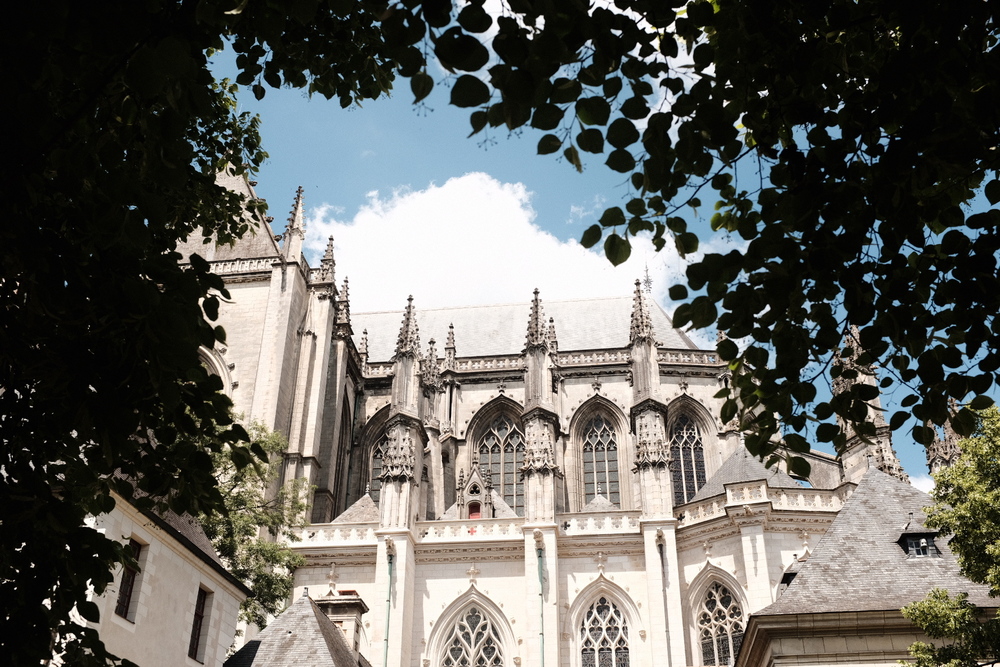
When I say the word framing, I’m not talking about the gilded golden frame that you will use to frame your photography to give as gifts to your mother-in-law, but using visual frames inside your image to “frame” your subject…

These examples illustrate how framing can be a powerful tool in photography, guiding the viewer into the image and providing depth and context to the subject or scene being captured. A technique that can make your photos more engaging and immersive.  You can use trees, windows, element on the ground, buildings.  Go out and explore the world around you and try and “frame” your shots.

Negative space

Negative space is the space that surrounds our subject, this empty space or unoccupied space is almost as important as the subject itself.  It’s role is to create balance in the image and adds to the importance of the subject.

Key points

This negative “space” around the subject gives the subject room to breath, and takes away the clutter so we can concentrate on our subject.  It emphasizes the subject and leaves no doubt where the subject is to be found.  For those of you who want a “minimalist” approach to photography, it is one of the best ways to do this.  Less is more after all.  Think of simplicity, tranquillity, and elegance.  It can be used to create mood and atmosphere, and in landscape photography can portray ideas of solitude or freedom.  Think of a vast empty sky and rolling hills.  Negative space doesn’t have to be completely devoid of detail. It can be an area of uniform colour or texture that complements the subject and adds visual interest, or we can use depth of field to emphasize our subject

When using negative space, it’s essential to pay attention to the balance between the subject and the surrounding empty areas. The goal is to create a harmonious composition where the negative space complements and enhances the subject, rather than overpowering it. This technique can lead to powerful and emotionally resonant photographs, adding depth and impact to your work.

When you look at my photos of the girl against the colourful walls in Trentemoult in Nantes, think about how placing the model on the left or right of the frame makes you feel.  Looking forwards or looking backwords… 

Colour Theory

Colour theory is not just for those trendy designers in those advertising agencies.  If you go onto my Instagram feed, you will see that most of my work is predominantly black and white.  “So no colour,” I hear you say.  Well, yes and no.  Black and white photography concentrates on tones, but we can look at colour in the same way and seek balance in our colours.  So what’s this colour wheel then?  Well, it’s a way of looking at colours that go together, like green and red (think of Christmas cards), blue and orange, yellow and purple, all these colour are opposite on the colour wheel. Also, think about complimentary colours that are next to each other on the wheel, such as yellow, light green and dark green.  You will find yourself becoming aware of colours in nature and how they complement each other.  There will be some photographs that depend on this colour for their artistic value, and that won’t work in black and white photography.

Think about the portraits in the previous section and the natural colour in the photos in the country side.

Conclusion

We’ve continued our journey into composition by exploring how to use elements in our photos to frame our subjects. We’ve delved into the concept of negative space, emphasizing our subjects in our images. To conclude, we’ve begun to consider how colour can add harmony to our compositions. My advice is to incorporate these elements into your photography one step at a time. Don’t rush; there’s no need to feel overwhelmed. It’s a lot of information to take in, but as you explore each aspect mindfully, you’ll witness an evolution in your approach. Keep up the excellent work, and I look forward to our next session where we will talk about pattern and repetition, scale and proportion, and depth and layering.

Frame It Right: The Art of Composition in Photography Part I


In my last article we talked about exposure, and balancing the elements that form the “exposure triangle”, i.e. the sensitivity of the film that we’re using, of the ISO setting on our camera sensor, the shutter speed, i.e. how long we let the light hit the film, or camera sensor, and aperture, i.e. the size of the hole that light comes through measured in F-Stops.  When these elements are in perfect osmosis, we should get a decently exposed photograph. 

Introduction to composition principles

Now we shall take this knowledge and build upon it with notions of composition, i.e. how we will organise the elements in our photograph.  Sometimes we have control of where these elements are, for example when creating a still life image.  Other times we have no control whatsoever and just have to move ourselves instead.  The way we do this is by thinking about our “Composition.”

As humans we are all guided by rules, some universally moral, some defined by the country we live in (like in France where they seem to be forbidden to make a decent up of tea), and Art is no exception.  There are rules in Art that make an image pleasing naturally to the eye, and, believe it or not, these “rules” have been around for a long time.  Now I hear you little rebels sat at the back of the classroom near the radiator saying how you don’t live by rules, and that you break every rule in the book.  And I have no problem with that.  I would however suggest you learn the “rules of composition” first and then, and only then break them knowingly.

Photography is art made with light, and the first photographers were heavily influenced by the art and paintings in the local Art Galleries.  They therefore had a very “classical” notion of composition.  I want you to imagine those massive oil paintings in a gold frame showing a Victorian gentleman looking over the top of a waterfall, framed by the forests, and still looking so dapper.

The Rule of thirds

This is one the first things that people will talk about when talking about composition.  The idea, as the name suggests is to divide a photo equally into thirds horizontally and vertically, and put the point of interest (subject) where the lines intersect.  Or you could have a landscape photo where sky will take up two thirds of the photograph and the foreground the other third.  In editing software, when framing you shot they will put a three by three grid on your photo automatically.  Some digital cameras allow the use of this grid inside the viewfinder.  When taking a portrait you would ideally have the eye where the lines cross.  Yes Ian, but this has been done, done, and done again, and has become a cliché I hear you say.  Possibly, but it works mate!  Don’t knock it.  As I said earlier, learn the rule, master using the rule, and then you might consider breaking the rule, but it will be a conscious decision and above all, deliberate.  But it will permit a pleasing and natural result.

Leading Lines and Perspective

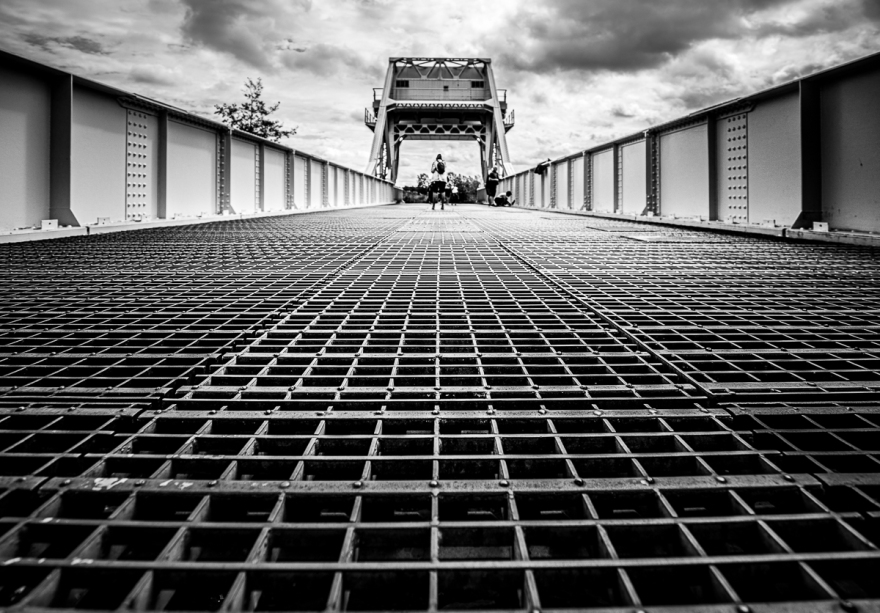
Leading lines are lines that lead the eye into the photograph, turning it into something dynamic.  The lines will converge on a certain point in the image, which, if you want, can be on the grid that I described in the last section.  This point is the vanishing point, and give geometrical forms to your image, and can lead to the subject of you photo.  When using straight lines,you can emphasis to shapes in architecture and acquire a very “graphic” image.  Using a wide angled lens or even a fish eye lens will emphasize these line even further and the distortion of these lenses will add even more interest to your image.  I will talk about the most common lenses in a future article.  We’re not there yet. The lines don’t have to be straight, they can be curved or S shaped.  Think of a winding road in the countryside.  Whichever version you use, there will be a feeling of being drawn in to the scene. 

In the first photograph of the original Pegasus Bridge all the lines converge to a central point with a person standing which gives us an idea of the scale of the bridge.  These straight geometrical lines give a feeling of stability and solidity. 

In the second photograph, we can see an image that uses an S curve, and as you can see, the effect is totally different.  More subtle, but they eye is still drawn in to the image.

 Leading lines can appear in nature and in the landscape.  Look at the way that the tree line and lines in the mountains converge on a specific part of the photograph and show the different layers of the photograph. 

I seem to use them in quite a few of my photos, and with time, you won’t even have to seek them out.  You will be lead…

Symmetry in photography

In last week’s article we talked about exposure and how it is a balancing act between the three elements: film sensitivity, aperture, and shutter speed. We can find this symmetry in our compositions too. 

Symmetry in photography is a fundamental principle that enhances the visual impact of images. It involves balancing elements on both sides of a central axis or point. There are various types of symmetry, including horizontal, vertical, radial, and bilateral, each offering unique opportunities for creating appealing compositions. Symmetry naturally draws the viewer’s eye, adds stability, and is particularly useful in architectural, landscape, and macro photography. However, breaking symmetry with a contrasting element can introduce tension and creativity. By framing subjects thoughtfully, adjusting camera angles, and recognizing symmetry in both natural and man-made subjects, photographers can master this powerful tool for captivating compositions.

In summary, symmetry in photography is about creating balance and harmony through the arrangement of elements within the frame. It provides a sense of order, highlights patterns, and engages viewers, while also allowing for creative deviations when necessary to convey a specific message or emotion.

Conclusion

Firstly let’s not be fixated by these rules. I was right to describe them as “guides” to composition.  Talking about them is fine, but we have to put them into action.  Don’t try to do them all at once.  Take one rule.  Look at it closely.  Think how can I use this one rule?  How can I master it, or at least take it on board.  When you think that is is engrained into your mind, then start using a different concept.  I can’t stress that when learning, take your time.  Let the concept become second nature.   

There will be occasions when you feel that you are no longer advancing in your composition, but stick at it.  You will not obtain mastery after just one outing.  I’ve been doing this for 40 years and am still learning something new each time I go out with my camera.  People talk about being on a photographic journey, and that is a very good way of looking at it.  You can’t run before you can walk.  Don’t let yourself be overwhelmed by what you might see on Instagram, or even on this blog.  We are all at different places on this path.

In next week’s episode we will explore framing, negative space, colour theory, texture.  There will be a third article to cover pattern and repetition, scale and proportion, depth and layering.  There are so many points to talk about in composition that we may even have a fourth article but we’re not there yet! 

See you next week.  Until then, keep shooting!

Photography 101: Mastering the Fundamentals


Why Photography?

Hello, Dear Reader,

I’ve decided to take some advice and start a series of articles focused purely on photography. You may already know how photography has impacted my life, and perhaps you’re hoping to discover something similar for yourself. This isn’t a formal course, and the advice I share comes from my own experiences over the years. My aim here is to offer you a useful reference point as you begin or continue your own photographic journey.

Let’s assume you’re new to photography and want to move beyond using your phone’s camera. You’re ready for a “real” camera. Does that sound about right?

From time to time, people approach me and say, “Ian, what’s the deal with photography? How do I get photos like yours?” That’s when my imposter syndrome likes to make an appearance. But despite that, I’m here to share what I know.

To begin, you’ll need a camera. I know it can feel overwhelming, especially if you’ve glanced at the price of a Leica and wondered if it’s worth selling a kidney. (Pro tip: hold off on that.) Leicas are beautiful, but you don’t need to break the bank to get started.

Any camera within your budget is a good starting point, especially if it allows you to control settings manually. Whether you choose film or digital, the fundamentals remain the same. Do you want the retro charm of a Canon AE1, the compact style of a Fujifilm X100F, or perhaps a more professional DSLR? The choice is yours, but remember: the camera is just a tool. It’s how you use it that matters. I’ve written some camera reviews you can check out, and I plan to add more in the future.

Now, let’s talk about the basics.

Exposure Basics

Photography is essentially about light—how much of it reaches your camera’s sensor (or film) and how it interacts with your subject. Too much light, and your image will be “overexposed” (too bright). Too little light, and it will be “underexposed” (too dark). You can, of course, play with these elements intentionally, using over- or underexposure to highlight specific areas of your shot. Photographers often talk about exposing for the highlights or shadows to get the right balance. In film photography we will expose for the shadows and in digital photography we expose for the highlights.

How do I control the light?

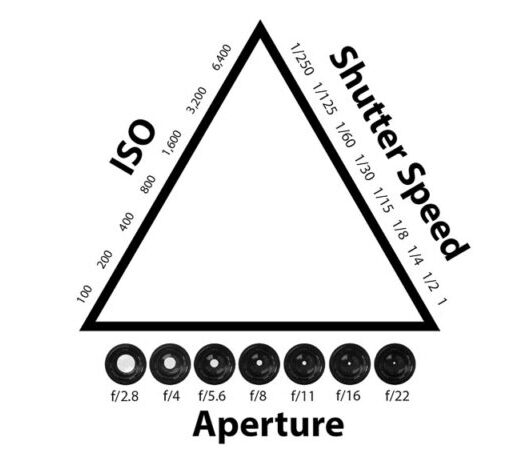
It all comes down to balancing three key elements, often called the “Exposure Triangle”: ISO, shutter speed, and aperture. Adjust one, and you’ll need to compensate with the others. Let’s go through each of these in turn.

Exposure triangle, showing the effects of aperture, shutter speed and ISO

Understanding ISO

ISO controls your camera’s sensitivity to light, crucial for getting the right exposure in your photographs. In film photography, it’s referred to as ASA, but the principle remains the same.

  • Lower ISO Settings (100-400): Ideal for bright conditions, such as sunny days, as they produce images with minimal grain or “noise.” For example, using ISO 100 outdoors on a clear day will give you crisp, clear shots.
  • Moderate ISO Settings (400-800): These settings are suitable for cloudy days or indoor lighting. Using ISO 400 allows you to capture good quality images without excessive grain, but expect some visibility of noise when using ISO 800 in dimmer conditions.
  • Higher ISO Settings (1600 and above): Perfect for low-light situations, such as indoors or nighttime photography. While ISO 1600 can help you capture images without a flash, be prepared for more noticeable grain. ISO 3200 can be used for very low light, but expect significant grain in the final image.

Modern digital cameras handle higher ISO settings much better than older film cameras did, significantly reducing noise even at higher values. The key takeaway is to experiment with different ISO settings to see how they affect your shots. Don’t hesitate to adjust your ISO based on the lighting conditions—higher sensitivity can make a big difference in capturing those special moments.

Shutter Speed

Shutter speed determines how long the sensor (or film) is exposed to light. A fast shutter speed—like 1/500th or 1/2000th of a second—will freeze motion, but it lets in less light, so you may need to increase your ISO to compensate. Slower shutter speeds (1/60th of a second or lower) let in more light but can cause motion blur or camera shake. If you’re handholding the camera, try to stay above 1/60th of a second. If you’re using a longer lens, say 85mm, you may want to use 1/100th of a second or faster to avoid shake.

For stability with slower shutter speeds, a tripod is your friend. Just bear in mind that vintage cameras often have lower maximum shutter speeds, but those quirks deserve their own chapter.


Aperture and depth of field

Aperture controls how wide the lens opens to let light in, and it’s measured in f-stops. A smaller f-stop number (like f/2.0) means a wider aperture, which lets in more light and creates a shallower depth of field—ideal for those portraits with a soft, blurry background. A higher f-stop (like f/16) means a smaller aperture, which lets in less light but keeps more of the scene in focus—perfect for landscapes.

Aperture not only affects the amount of light coming through but also how much of your image appears sharp. The trick is finding the right balance for the look you’re aiming to achieve.

Conclusion

One of the great things about digital cameras is that you can experiment with these settings without worrying about the cost of film. You can see the results immediately and make adjustments on the fly. Most digital cameras offer different modes to help you control the exposure. For example, “Shutter Priority” lets you set the shutter speed while the camera adjusts the other settings. “Aperture Priority” does the same for aperture. If you’re more experienced, you can take full control with manual mode.

This is just the first in a series of articles designed for beginners, but it’s always helpful for even the more seasoned among us to revisit the fundamentals. If you have questions, feel free to leave a comment. No question is too simple, and I’ll do my best to respond.

Until next time, Dear Reader.

Post Scriptum

I’ve noticed many of you arrive at this site through this page (probably from Google), so welcome! This is just the first in a broader series on photography. If you found this article helpful, there’s more where this came from. I also cover topics like composition, gear choices such as the Pentax ME Super, which as its name suggests is rather Super, the differences between 35mm and medium format, and my approach to street photography.

My aim is to demystify photography. It doesn’t have to be complicated. Whether you’re just starting out or already have some experience, I hope you’ll find something useful here. Thanks for reading, and don’t hesitate to ask questions or leave a comment. I look forward to hearing from you.