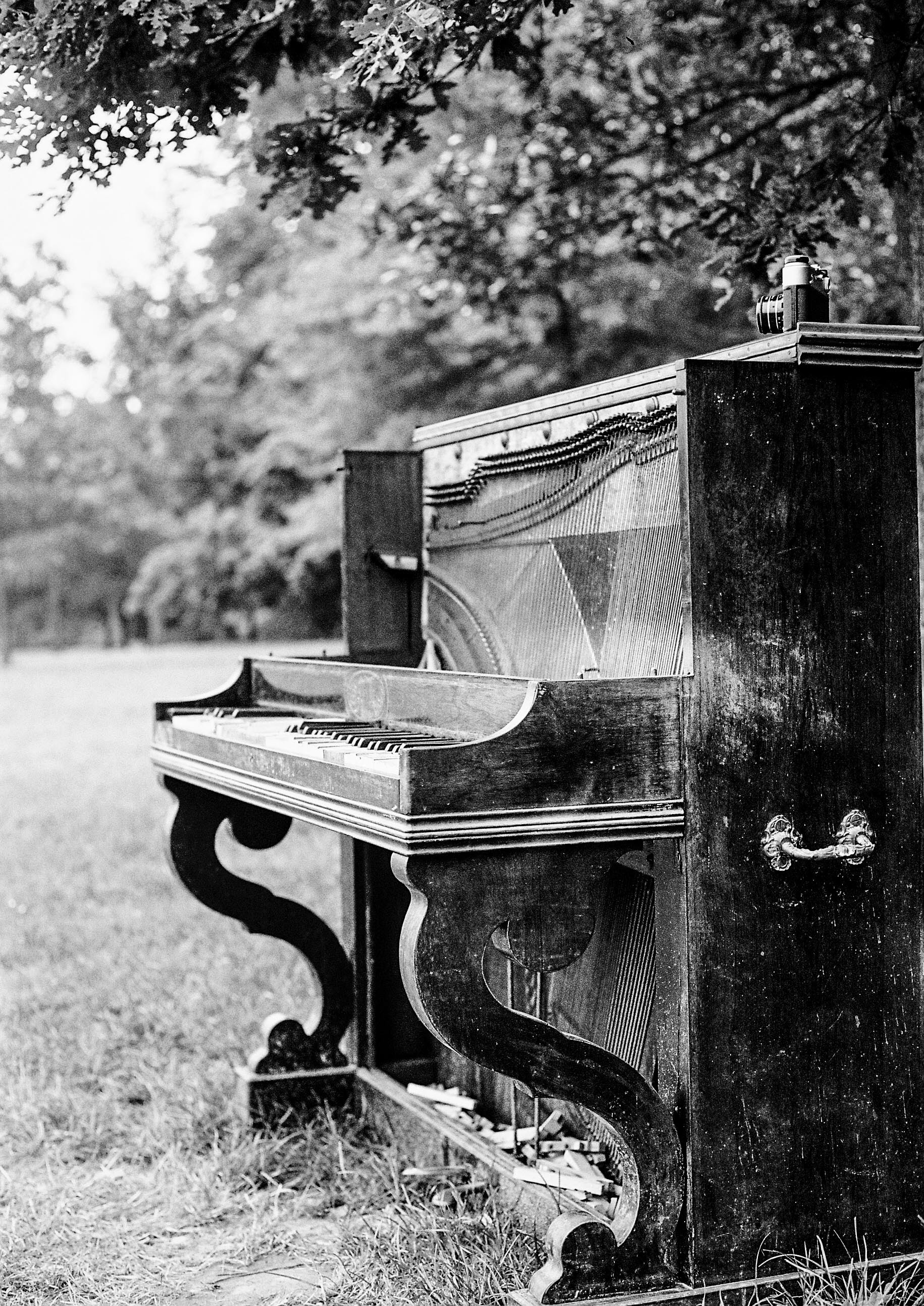
Nikon FE Review: Features and User Experience


Hello Dear Reader. I know you are an astute fellow, and that you never miss a trick. You will have noticed me talking about the Nikon FE. I will share something with you. I actually bought one at the end of last year from my HR director, but wanted to have the right time and places to start using it. One can’t rush this kind of thing.

Some of you might even say, “I thought you were a Fuji guy, or a Canon guy, or even a Pentax guy.” I hate to disappoint all those of you attached to a particular brand, but I am above all “a guy.” Mind you, this was my first venture into Nikon-world. Not a Nikon D something…. I went slightly more old school as I have been known to go before.

Why the FE and not the FE2, or even F3? The guy was selling an FE, that is why. Now that is out of the way, let’s have a look at this camera. First and foremost, it’s a really sexy camera reminiscent of those used in the 60’s by National Geographic photographers. It’s not, but that’s by the by. It actually came out in 1978. Secondly, this particular one was in full working order, always a plus; the price was fair for the camera’s excellent condition. I may be a collectionneur, but a camera is there to be used. Did I say it was a very sexy camera? I did. Oh good.

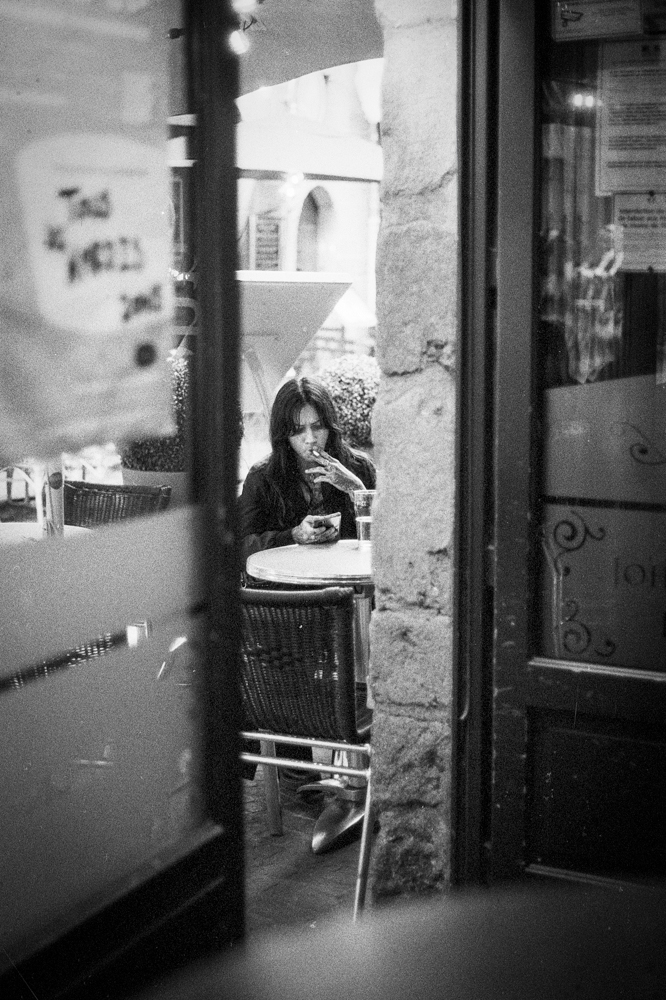
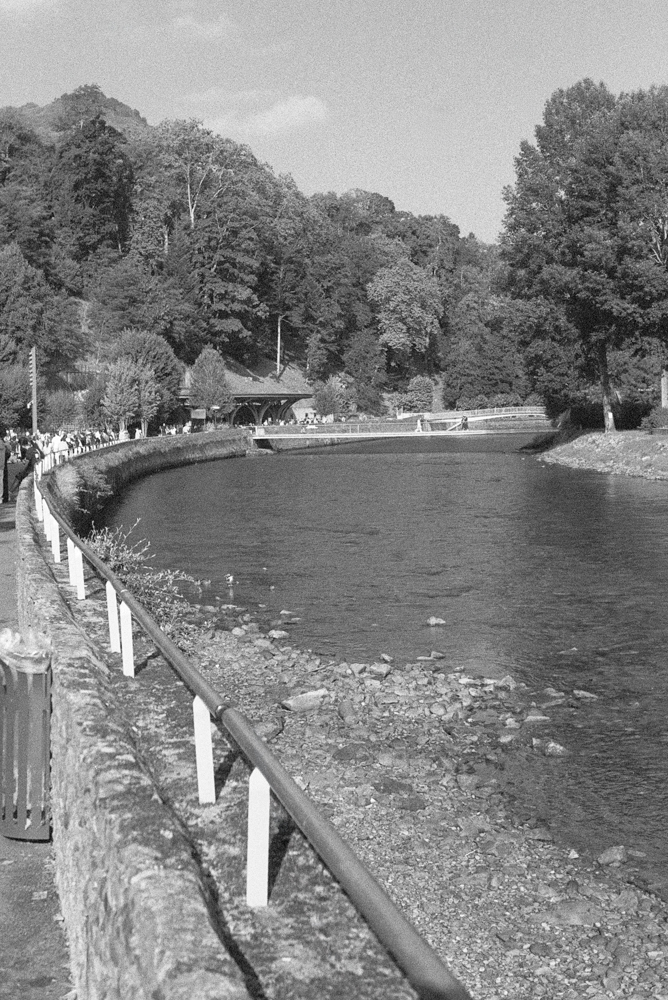
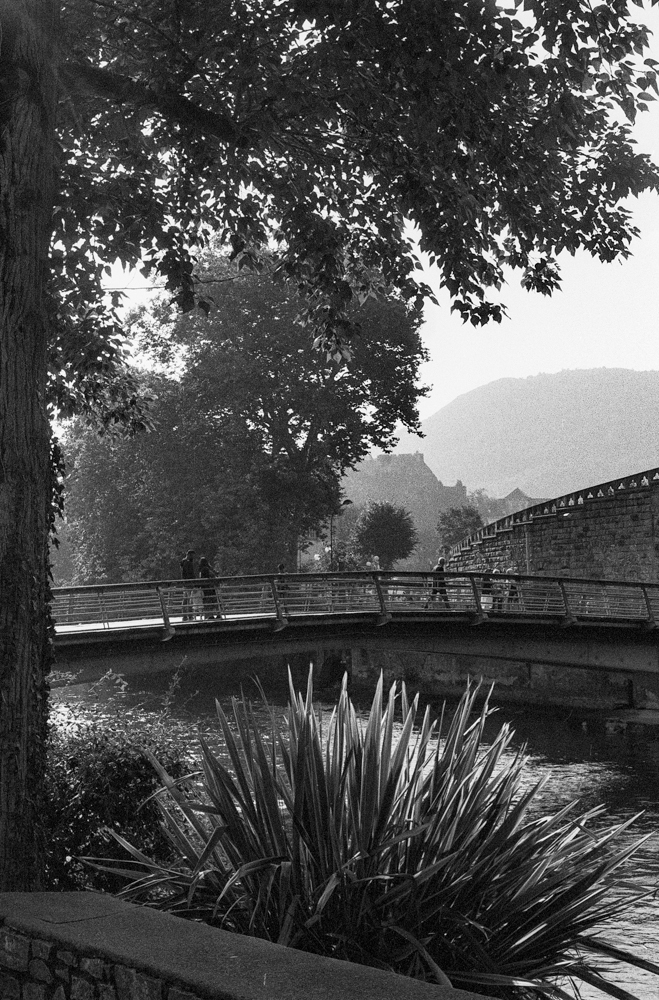
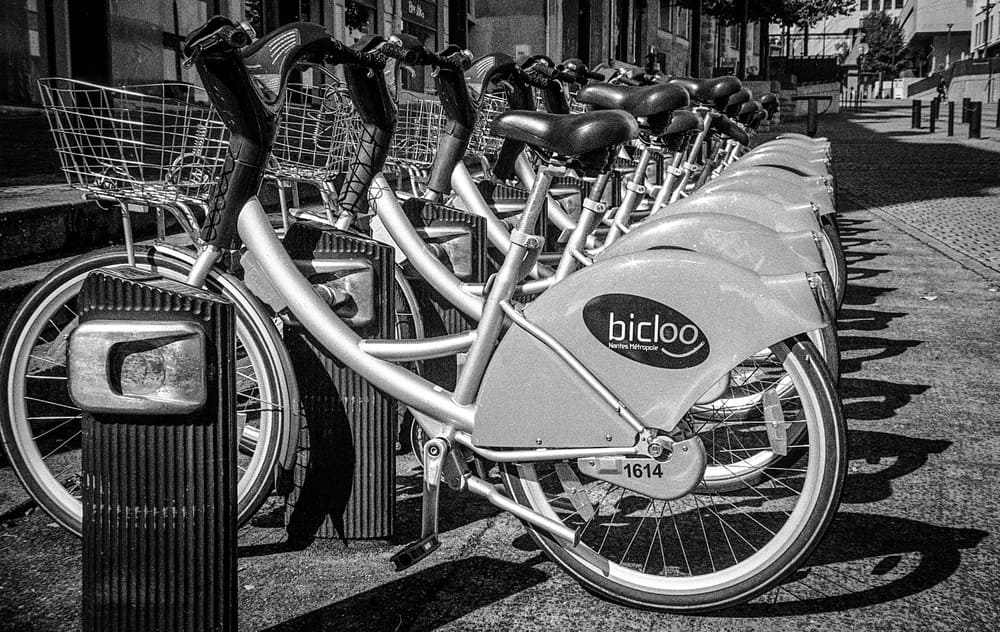
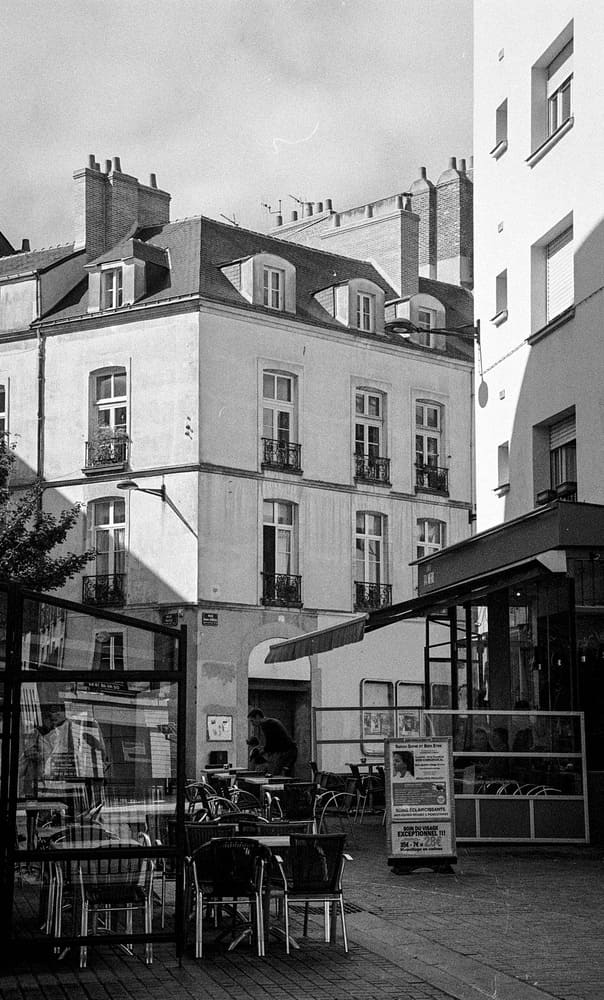
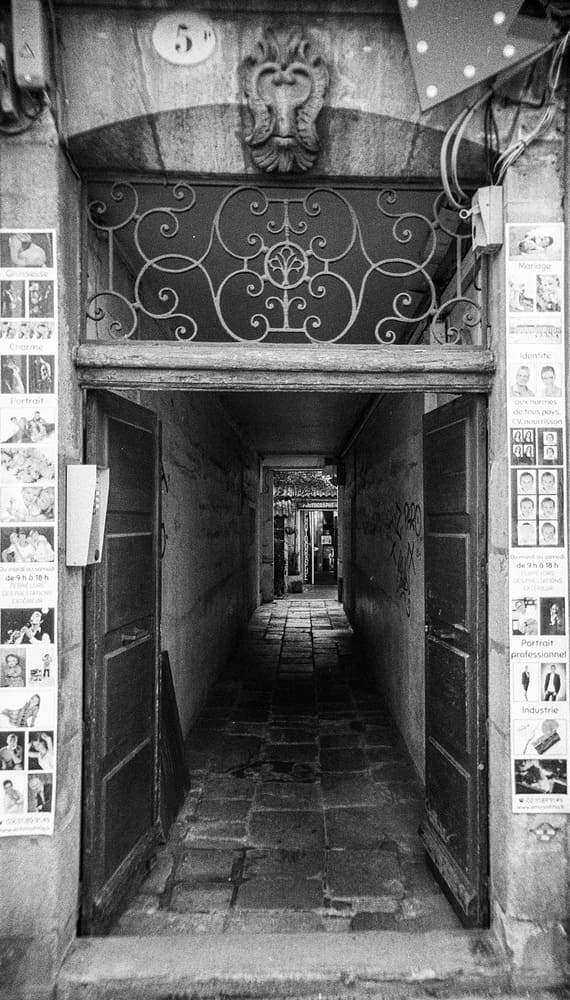
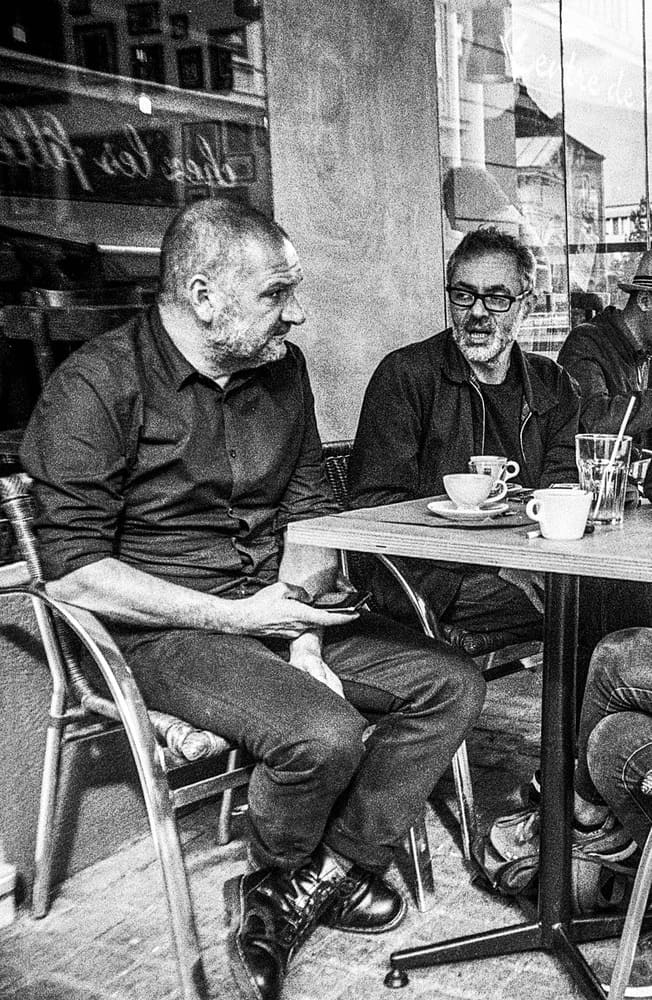
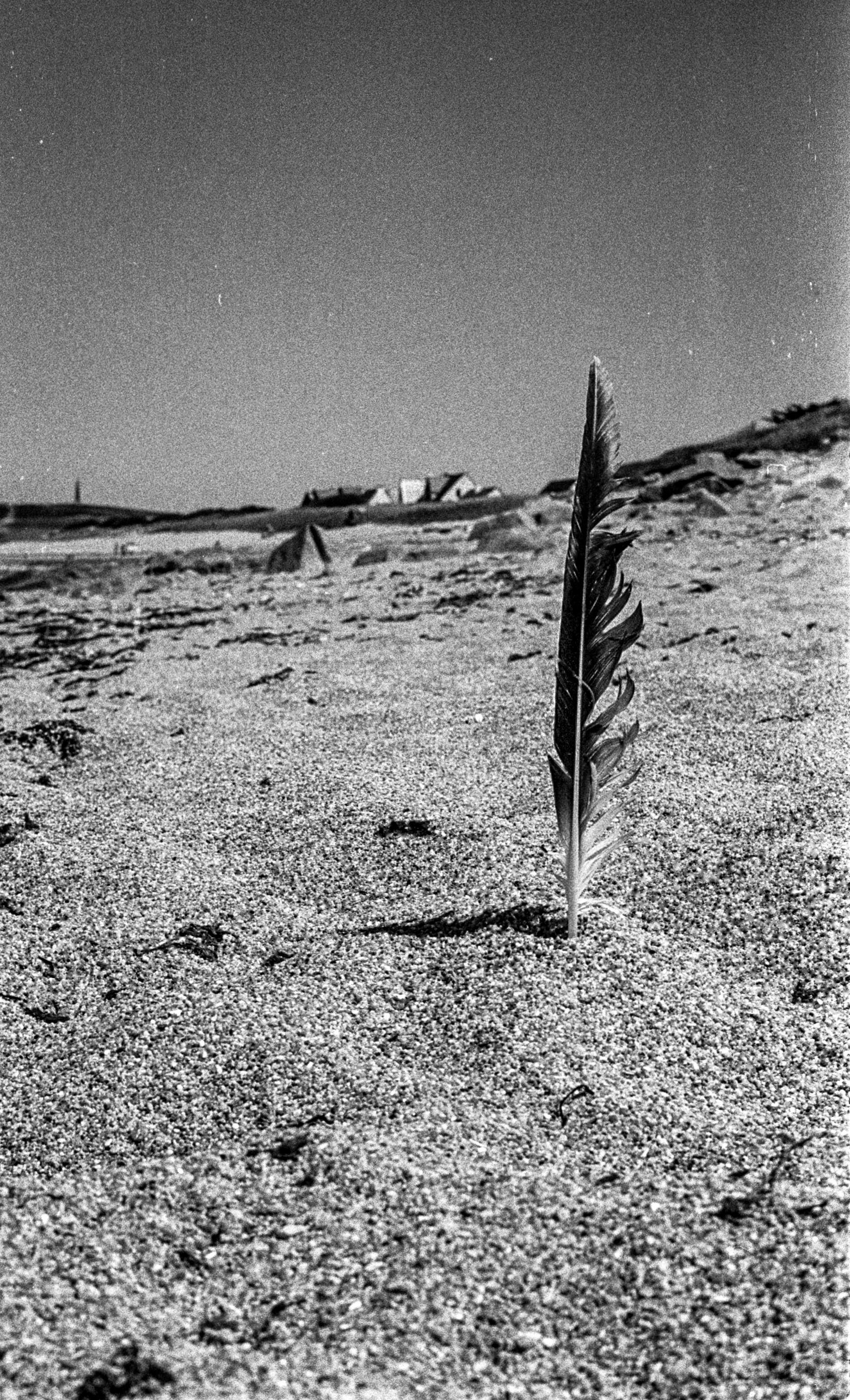
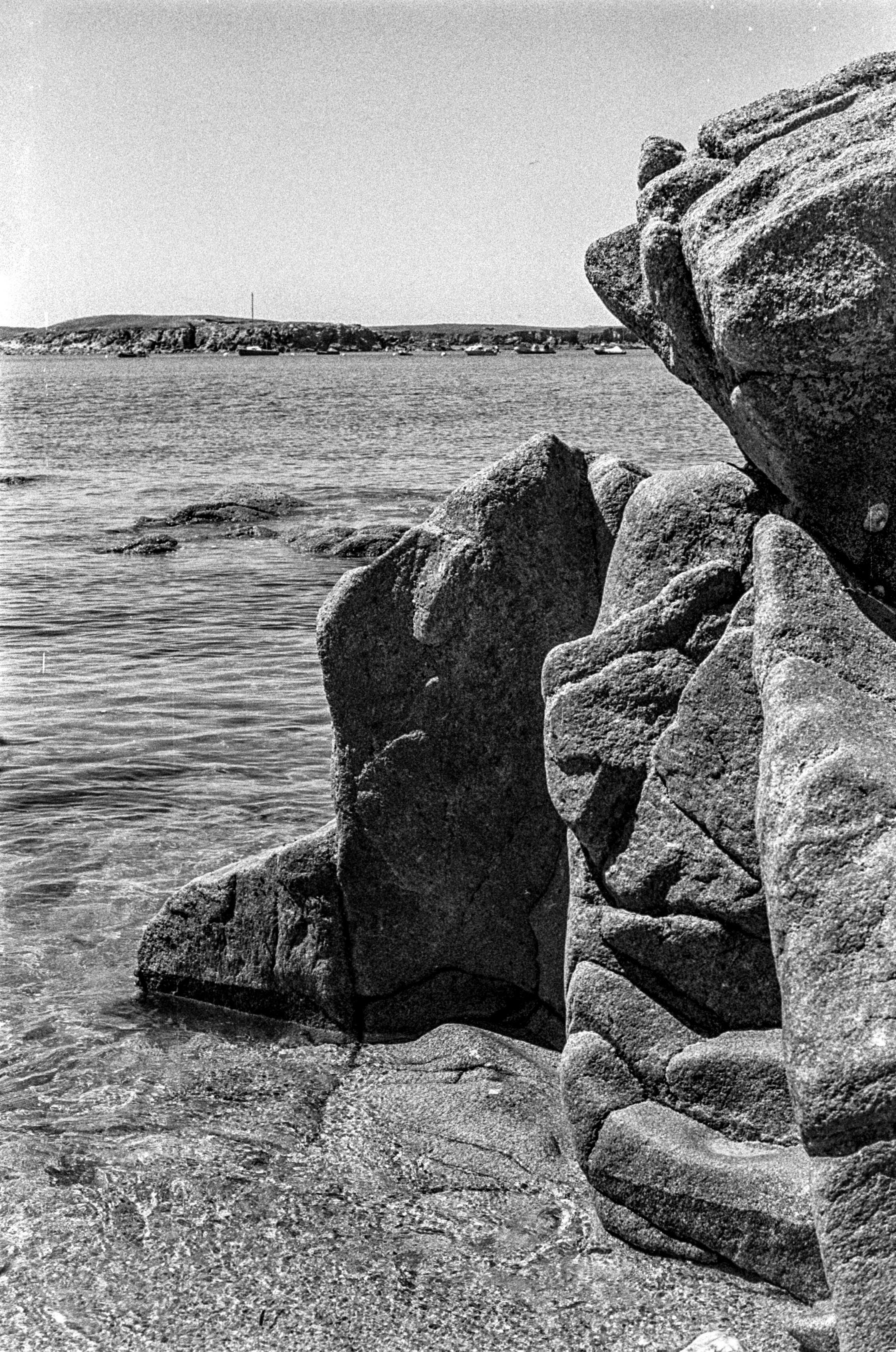
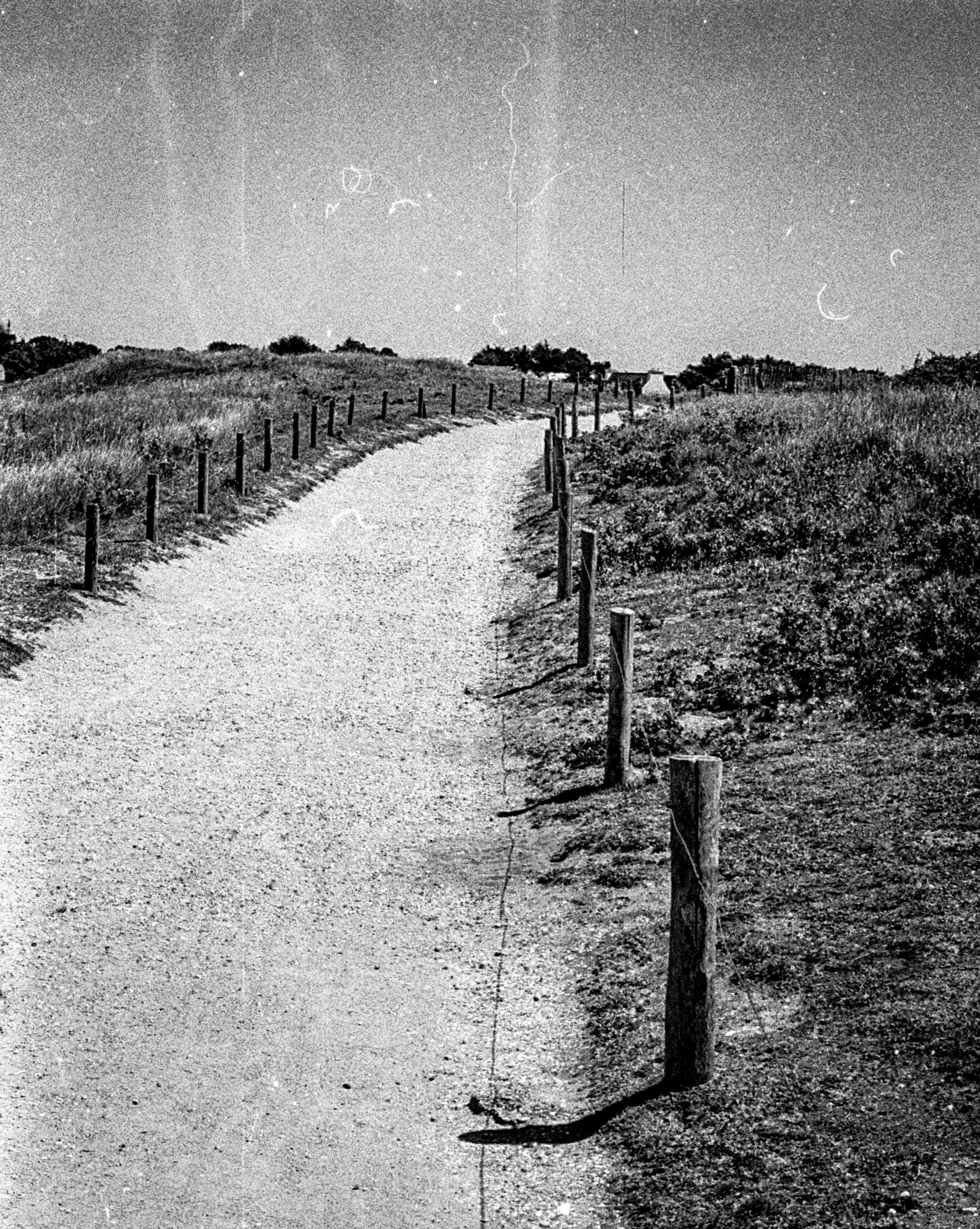
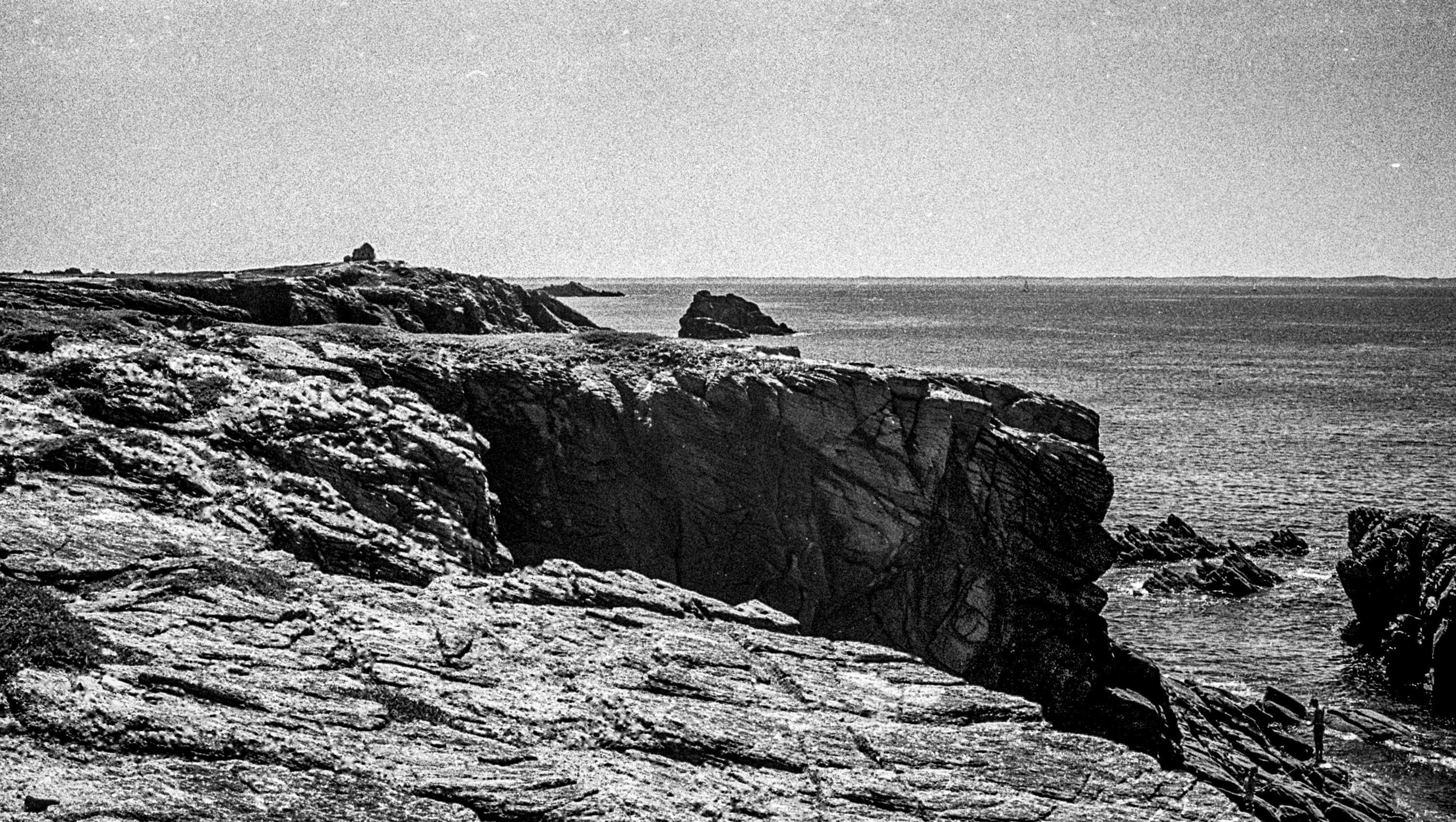
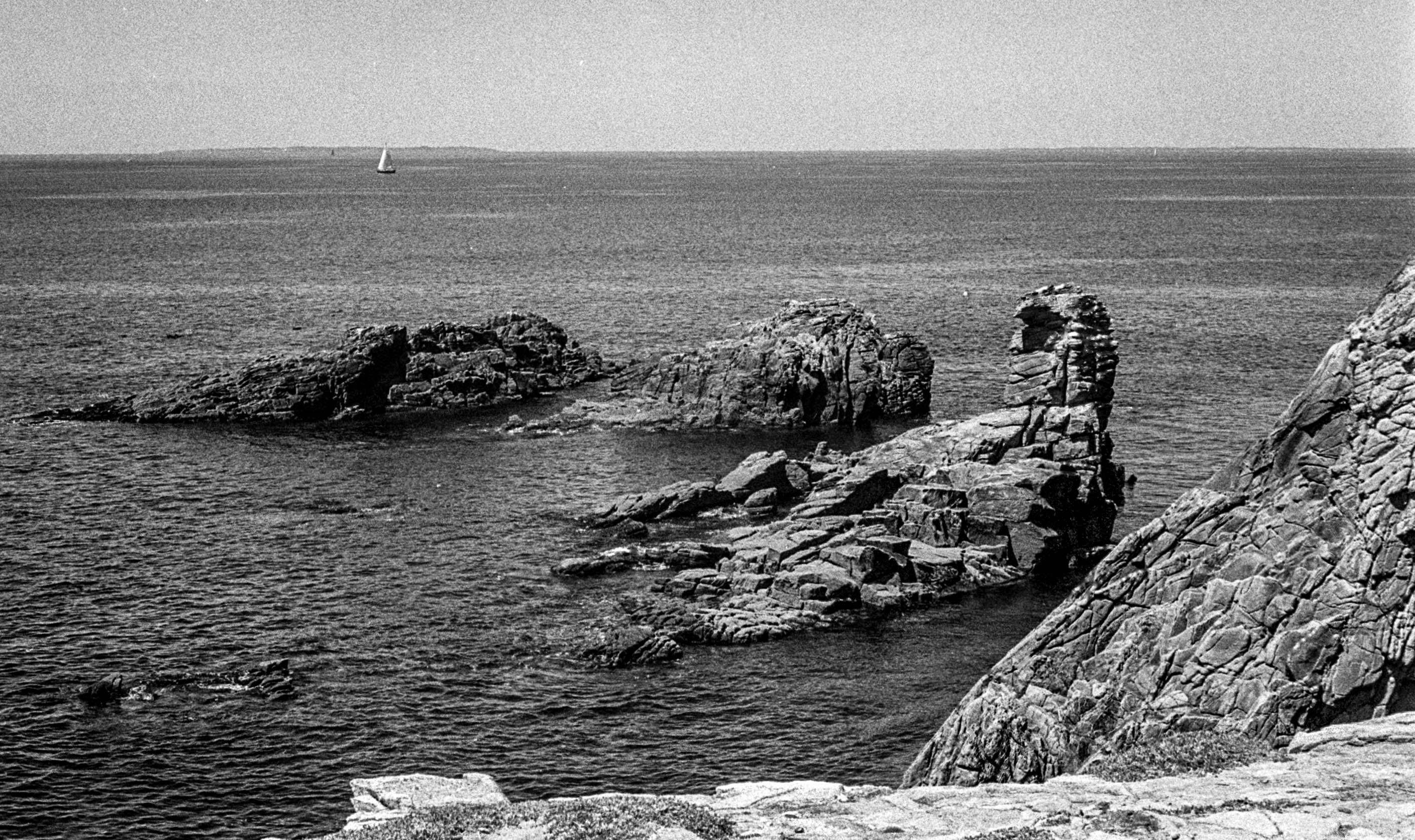
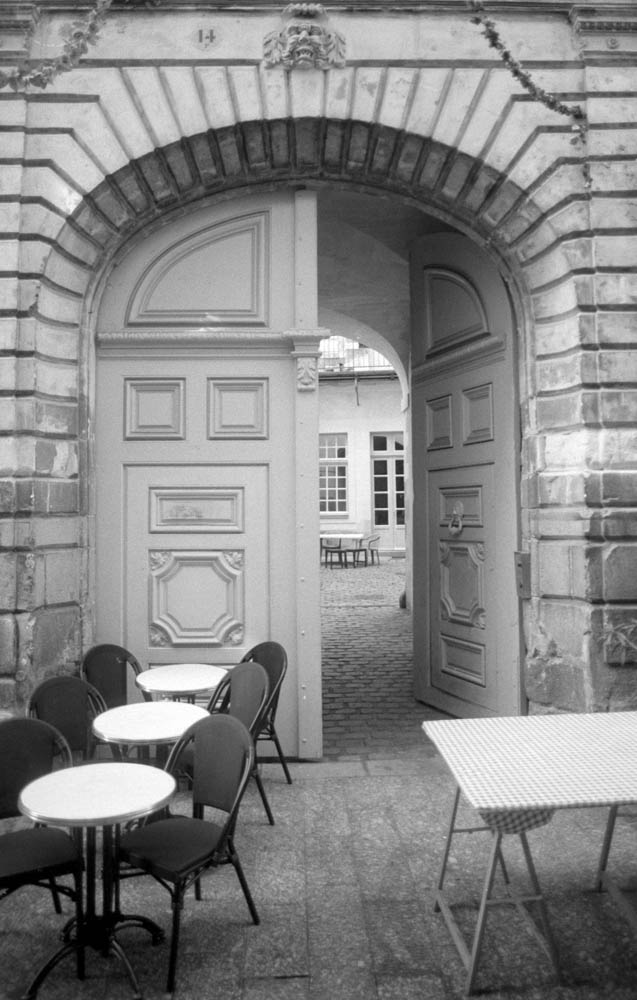
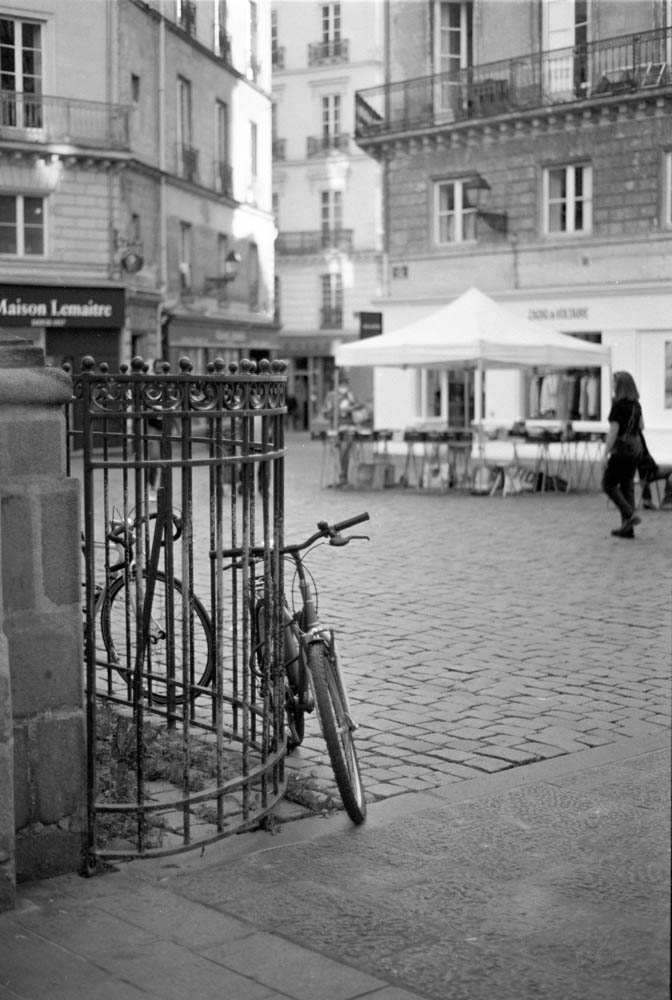
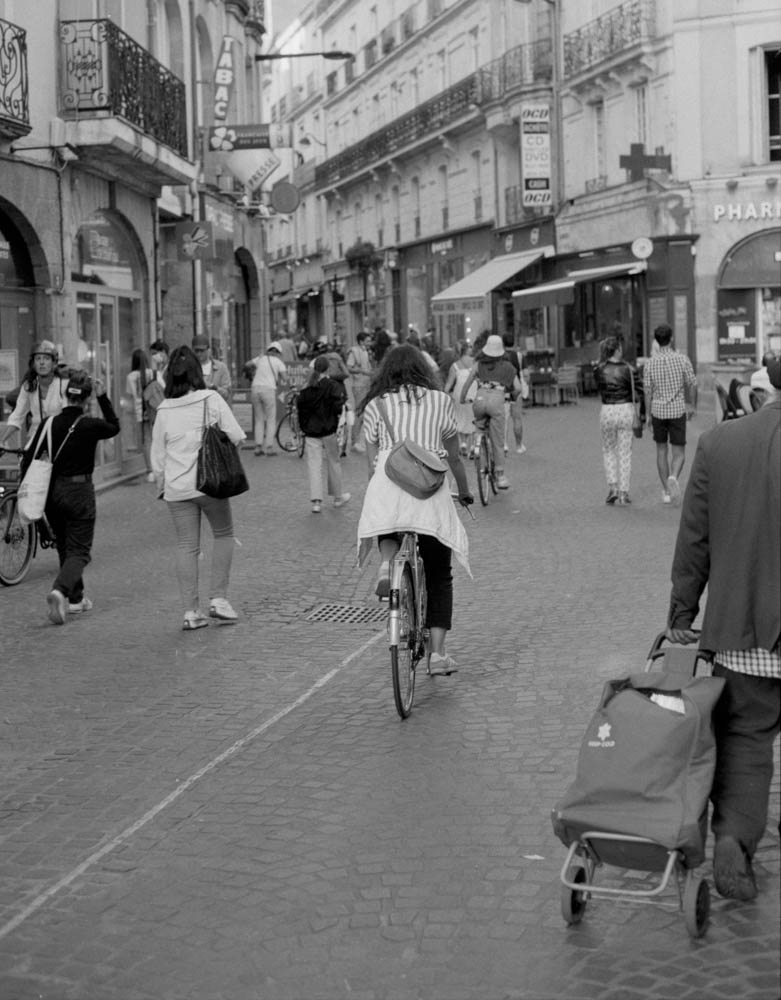
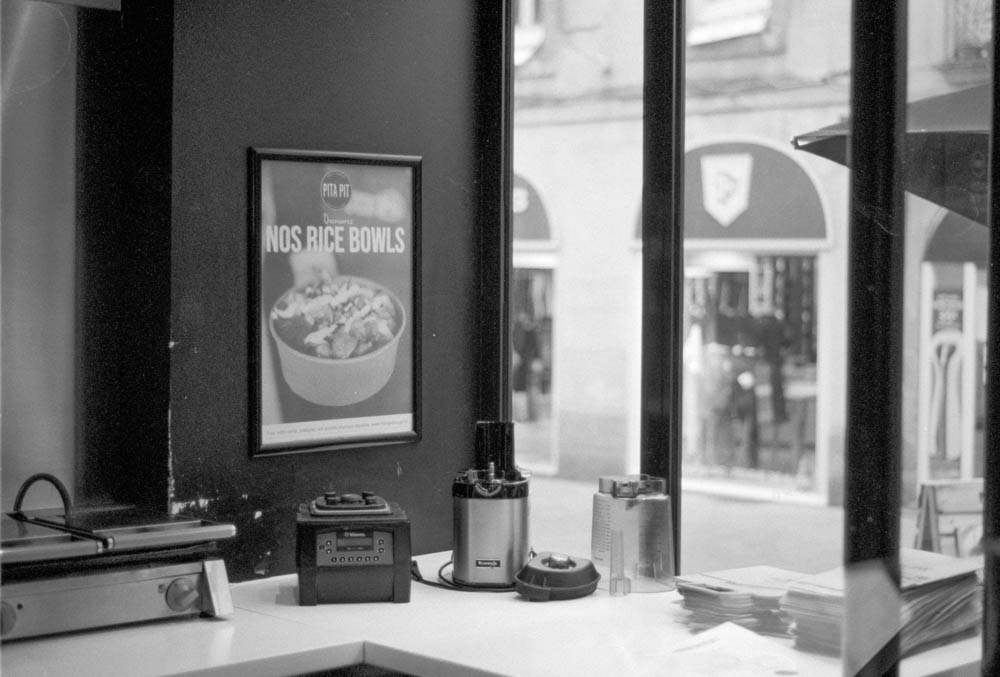
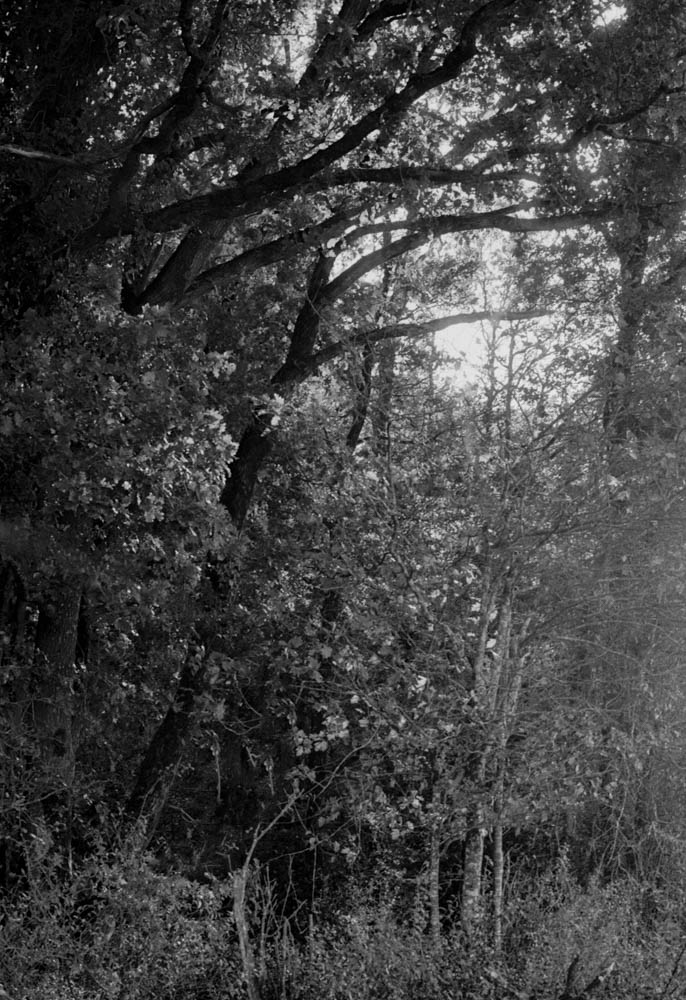
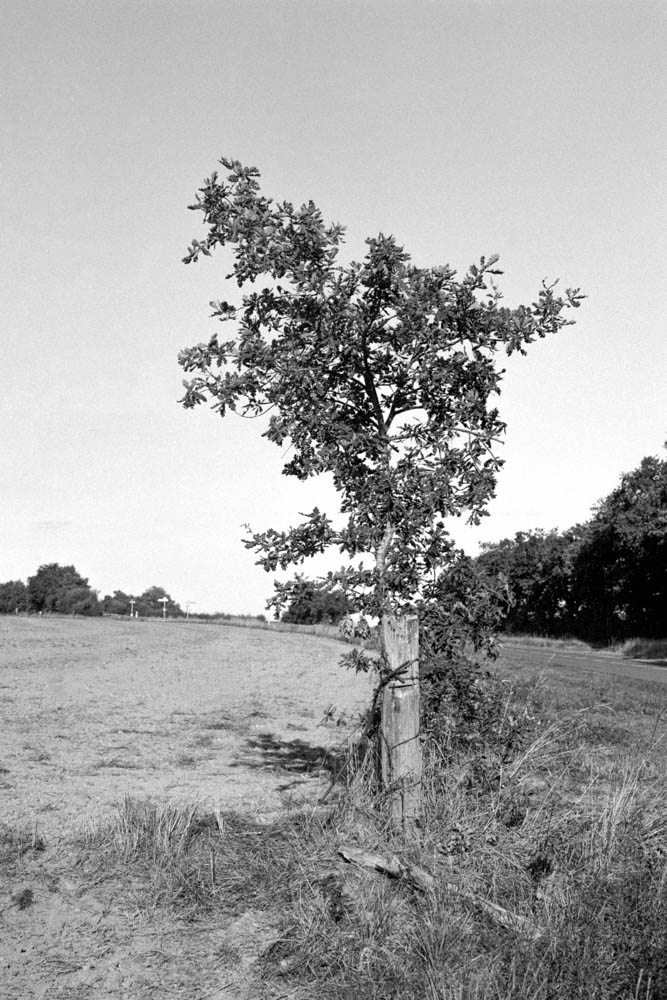
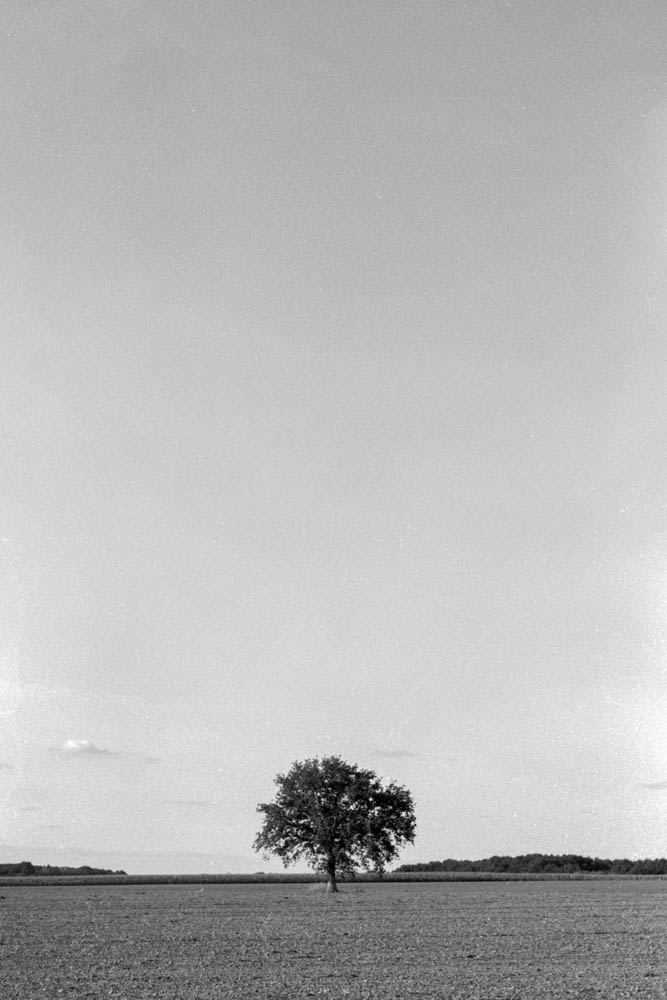
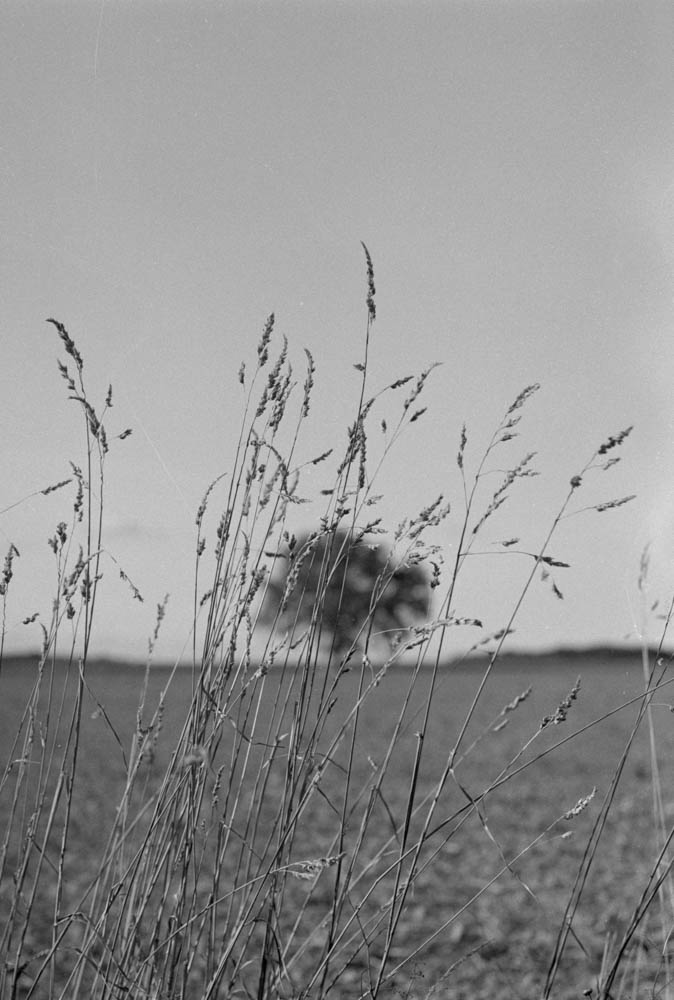
As I am wont to do, I took it out for a test drive to Nantes, and took it round Bouffay. And the pub… just enough to get a feel for the wee beastie. A roll of Ilford HP5 at box speed and I was ready to go. Verdict? So far so good. I must have done just 10 shots that day, and came back to it later, much later, to finish the roll. The feel in the hand was fine, and what I’m used to. The lens I have is a 50mm f/1.8, aka the nifty fifty. Usability? Aperture priority, which I enjoy. And the one thing that tickled me pink was being able to see the aperture ring through the viewfinder. Very useful…  It’s since journeyed to Lourdes, the mountains, even Northumberland—never once feeling like a limitation.

Does it have auto focus? No. It doesn’t. It has manual focus, which I find easier to use. I prefer to choose myself rather than have modern technology do everything for me. Yes, I use it on my DSLR, but I don’t use that the way I do when doing film photography. Here’s a surprise for you: I am not built for speed. I am built for comfort and won’t be hurried. This kind of SLR suits me to a T.

I know some of you little techies out there need specs about a camera, so for you lovely people, here you are:

Nikon FE – Quick Specs

  • Production: 1978–1983
  • Type: 35mm manual-focus SLR
  • Exposure: Aperture-priority AE + full manual
  • Metering: Centre-weighted TTL (match-needle in viewfinder)
  • Shutter: 1–1/1000s + B, electronically controlled (requires battery)
  • Viewfinder: Fixed eye-level pentaprism (~93% coverage) with aperture & shutter speed display
  • Lens mount: Nikon F (AI/AI-S compatible)
  • Battery: 2× SR44 (or 1× CR1/3N) – note: the camera can operate at 1/90s (M90 mode) without a battery
  • Weight: ~590 g (body only)
  • Fun fact: One of the smallest and lightest Nikon SLRs with full AE.

Is it ‘better’ than the Pentax ME Super? Not objectively—but it fits me. I prefer Nikon’s take-up spool, and that viewfinder aperture display? That’s the clincher. Pentax glass is glorious, no doubt. But this? This is my beastie.

I’m over the moon to have this addition to the working collection, and I have to go and finish the film that’s still inside it. So yes, I enjoyed using it; yes, it wasn’t foreign enough to scare me. Do I have any regrets? Absolutely not! It works just the way I need it to, and when it comes to cameras, isn’t that all we need?

Balancing Film and Digital: A Photographer’s Journey


Introduction

Have you ever had to make a difficult decision that you really had to think long and hard about, one that would have real-world consequences for you and your creative process? I have, and I’m going to share this first-world problem with you. Now, I know first-world problems are a joke, but this problem became very real to me during the run-up to the China Orchestra Tour: film or digital?

You all know about my fondness for the analogue process and the results I’ve been able to acquire. Judging by my recent stats and pages visited, this might just interest you.

The Allure of Film Photography

I’m not saying this was causing me the traditional anxiety that I have been known to suffer from in the past. But… I had to decide how I was going to record my trip and, therefore, what to take with me. I’ll give you a list of my ideal kit, and it might help you to understand my dilemma.

  • Camera 1
    A recently acquired Nikon FE (my first ever Nikon) and black-and-white film, ranging from Fomapan 100 ASA right through to Ilford HP5 Plus, whose box speed is 400 ASA but can be pushed up to 1600 ASA and still provide great images.
  • Camera 2
    A Mamiya C220, which is a beautiful piece of kit with various 120 format black-and-white films, HP5 Plus, Portra 400, with the addition of Kodak Tri-X.
  • Camera 3 (maybe 4)
    My Olympus Trip or even the Olympus Pen EE S half-frame camera, for those informal colour shots with some Kodak Ultra and even a roll of Portra 160 for that gorgeous vintage style.

So, you have my film cameras with the film that goes with them. They provide a photographic experience unlike any other. The slowing down of the process, the reflection on each shot taken, the satisfying sound they make when you press the shutter release button. And so much more. They also look pretty damned sexy just hanging there around your neck, and people will think you are a “real” photographer, and that old-school vibe just adds tonnes to your sartorial elegance. Yes, you become a real poser, but do I care? Absolutely not!

The Practicality of Digital
  • Camera 5
    My much-loved Canon 6D Mark II, with a couple of zoom lenses – 24-70mm F4.0, and my 16-35mm F4.0 lens, and maybe even my nifty 50.
  • Camera 6
    Fujifilm X100F, the travel photographer’s ideal camera with the 35mm equivalent F2.0 lens for that sexy bokeh. It’s the Internet that said it, not me.

Now moving into the digital world. Convenience, convenience, and in case you hadn’t realised, convenience. I love them both for the variety of shots they allow me to take, and as I learnt photography “back in the day,” I have still conserved the same approach that I had in analogue photography, i.e., not spraying and praying like I have seen some colleagues do.

It is easier to use a flash, and you have an image that can be transferred to your phone, edited in Lightroom CC, and rapidly shared in the China Orchestra Tour WhatsApp group. And people can see what a great photographer you are. Couple the Canon colours and the Fuji film simulations, and you can have all the creativity fixes you might need at your fingertips.

The film cameras were there to satisfy my love of the analogue process and the nostalgic film look that only film can give. The digital cameras for their practicality, lens effects of going really wide, and having the possibility of going right up to 70mm. Choices, choices, choices.

Reality Check

Now let’s get back to reality and look at the ever-growing list of constraints. First of all, I am going on tour as a musician and not as a photographer. One really has to make this important distinction, as it gives a sense of purpose to the trip as well as the implication of priorities.

I would be flying across half the world, and therefore have to follow the demands of the air travel industry and airline rules. That meant no more than two lithium batteries, and one in the camera, and not in your suitcase but in your hand luggage, or on your person. They don’t like the idea of these batteries exploding or causing fires mid-flight. And because we are respecting the zero BS rule here, I don’t fancy that either. I would be limited by weight for my suitcase: 23kg and 20kg for flights inside China. My priority was to be a musician first and not a photographer, if ever I needed reminding…

If I were going to the UK, I would just have to annoy my family in the car with it being loaded up with camera gear, but this is China we’re talking about. Not a jaunt across the Channel.

In my suitcase, I will need my clothes for two weeks, my suit for concerts, shoes for concerts, wash bag with all my toiletries, as well as my CPAP machine for my sleep apnoea (I have to think about my quality of sleep as well as not snoring for my unsuspecting roommate Corentin). My hand luggage would be my instrument, and as we didn’t need mutes, I might be able to get away with stuffing things up the end of my horn’s bell. Please note that I didn’t try to get a cheap laugh by using the word bell-end…

So here I am back at the beginning of this article, and yet now you might better understand my dilemma.

Tell us what you decided then!

Alright then, I will.  Welcome inside my mind and my thought processes. The sheer weight of all the kit would have made tking everything completely impractical.  I knew this and had come to terms with it.  I really wanted to analogical, but then had to come to terms with the fact that airport scanners can damage undeveloped film.  Also the Mamiya weighs a tonne and would have been impractical to lug around China, despite the wonderful images it provides.  Carmer 2 out!  Now for security check I had bought a metal film box for my films so that those charming people at airport security could check my films, making sure that I would not blow up the plane.  Not really my style…

That would leave me with Camera1, 3, and 4.  Cameras 3 and 4 are particularly sexy and Carmera 4 being a half frame camera, gives you double the amount of shots for your film.  However it uses zone focussing, and the ISO setting only go up to 200ASA so you need lots of light.  Camera 3 is similar in the fact that it goes only up to 400ASA so not good for lowlight shooting.  Cameras 3 and 4 out.

That leaves me with Camera 2.  Which is of course uber sexy and Aperture priotity, which I like, and has a larger ISO range, and one that I can focus accurately with.  I had black and white film for it which I enjoy using and know how it reacts and what kind of shots I can get out of it.  Very satisfying shots.  It also doesn’t need lithium batteries to work, so that helps rule that danger out.  But I would still have to contend with the possibility of annoying security staff, and annoying Chinese security staff, and as I speak no Chinese, that would be challenging. And yet it still had a chance of staying in the race.

Now lets explore the digital realm. Camera 5: The Canon 6D Mark II is a beast of a camera and one I enjoy using.  It’s lenses are beyond compare, and it would offer me lots of choice in choosing my subjects.  However it would be heavy, especially with those lenses, and despite being able to have my images straight away, would it really be worth that added weight.  Camera 5 out.

Camera 6.  The Fujifilm X100F.  Probably my favourite digital camera, and the one I took to the UK this summer as a test for this Chinese trip.  It’s small.  Compact and silent.  And yet despite being a digital camera, it has an analogue feel to it, and is also very sexy, so I can still pose with it and it will give that serious photographer look, and make make people wonder is he using digital of analogue…  Hmmm.  Sounds like a good choice.  It’s downfall lies in its power consumption. I would need three batteries in total.  Which would mean that I would have to entrust a battery to a friend..

The two cameras left in the race are the Nikon FE analogue camera with it’s 50mm F1.8 lens which doesn’t need batteries.  50mm was the lens I learnt photography on and would allow me to get some decent portrait shots.  However with the Fujifilm, I could change ISO setting without the hassle of changing my film, create scenic shots, as well as environmental portraits, and I could transfer the photos directly to my phone and share them straight after editing.  

The X100F: Why It Was the Right Choice

The X100F became the clear winner for several reasons. It’s compact and lightweight, which was essential for travel, yet it produces sharp, detailed images. The 35mm equivalent F2.0 lens allowed me to shoot wide-open for beautiful bokeh in portraiture and environmental shots. The range of film simulations, from classic Chrome to Acros, allowed me to quickly achieve the look I desired without extra post-processing.

Its hybrid viewfinder provided both optical and electronic options, letting me choose the right method depending on the shooting conditions. The controls are direct, giving me full control over exposure and depth of field, without the need to dig through menus. And though it’s a digital camera, it retains that analogue charm that makes shooting feel personal and intentional.

The only downside was battery life, but I managed to bring a few extra batteries, which wasn’t too much of an issue for the flexibility the X100F offered.

Conclusion

In the end, the Fujifilm X100F was the perfect balance between practicality and creativity. Its digital conveniences, combined with its classic photographic feel, made it the ideal camera for the China Orchestra Tour. The images you’ve seen in my latest China Series article were all taken with the X100F, and I’m happy with the decision I made and I hope you might be too…

The Opening of the Film Archives: An October Saturday in Town with Killian, 2016


Welcome back to another look at the film archives. This time, I’m sharing a few black-and-white street shots from an October Saturday in Nantes, likely taken with the Praktica MTL3 and HP5 Plus film. These outings with my son Killian, which we called ‘Ian and Killian days,’ became a cherished routine, a time for us to reconnect amidst the busyness of life.

He was 17 then, a weekly boarder at his lycée in La Roche sur Yon. On the weekends, we’d often head into Nantes, following the same familiar programme: a visit to the barbershop, a meal at the Sugar Blue café, and finally, a drink at the John Mc Byrne Irish Pub. In the photo, that handsome chap in the barber’s seat is Killian—a little reminder that it wasn’t always Kate joining me on these trips. These outings were a way to stay connected, despite his growing independence. Even with him being only 17, I still felt that sense of responsibility. Once a Dad, always a Dad.

As we went through our usual routine, I found myself facing the familiar challenge of capturing these moments on film. The low light inside the barbershop always made me second-guess whether I could get a decent shot without using a flash. But over time, I learned to trust the Praktica and the HP5 Plus film. There’s a rawness to film photography, especially with Ilford’s HP5. It adds a certain grit and texture to the image, something that digital just can’t replicate.

That’s what I love about film—the imperfections. The grain gives it character, a certain honesty that smooth, polished digital photos lack. It’s not about creating something flawless but about preserving the authenticity of the moment. This shot of Killian in the barbershop, for example, may not be technically perfect, but it’s real. It’s us, it’s Nantes, it’s one of those ‘Ian and Killian days.’

Looking back at these photos, I’m reminded that sometimes, it’s the imperfections that make an image truly memorable. Quite the day, right?

The Opening of the Film Archives – Penthièvres July 2016


I don’t know about you, but I’m really getting into this Film Archive business. It’s great sharing these archives with you all, and it’s certainly bringing back lots of memories to me. Maybe less for you because I haven’t published them here yet. But I know you’ll like them as much as I do.

This particular set of photos was taken on Penthièvres beach, located on the Quiberon Peninsula in the Morbihan. It has a special place in my heart. Not just because I like the sea, but the smell of the sea, and the feel of the sea air on my face. It’s a place I often escape to for a bit of tranquillity especially with the chaotic nature of family visits.

In some respects it’s strange going to the beach to “relax” as it’s something I usually hate.  The idea of the outing to beach with the family and putting towels down, with rocks on each corner of the towel, and having to watch over children going to swim and bathe, making sure they don’t drown because you’ll get shouted at.  The shouting of the children, and worse other people’s children.   Getting sand in between your toes and then getting back to the car and having the impression you’ve brought back the whole beach…
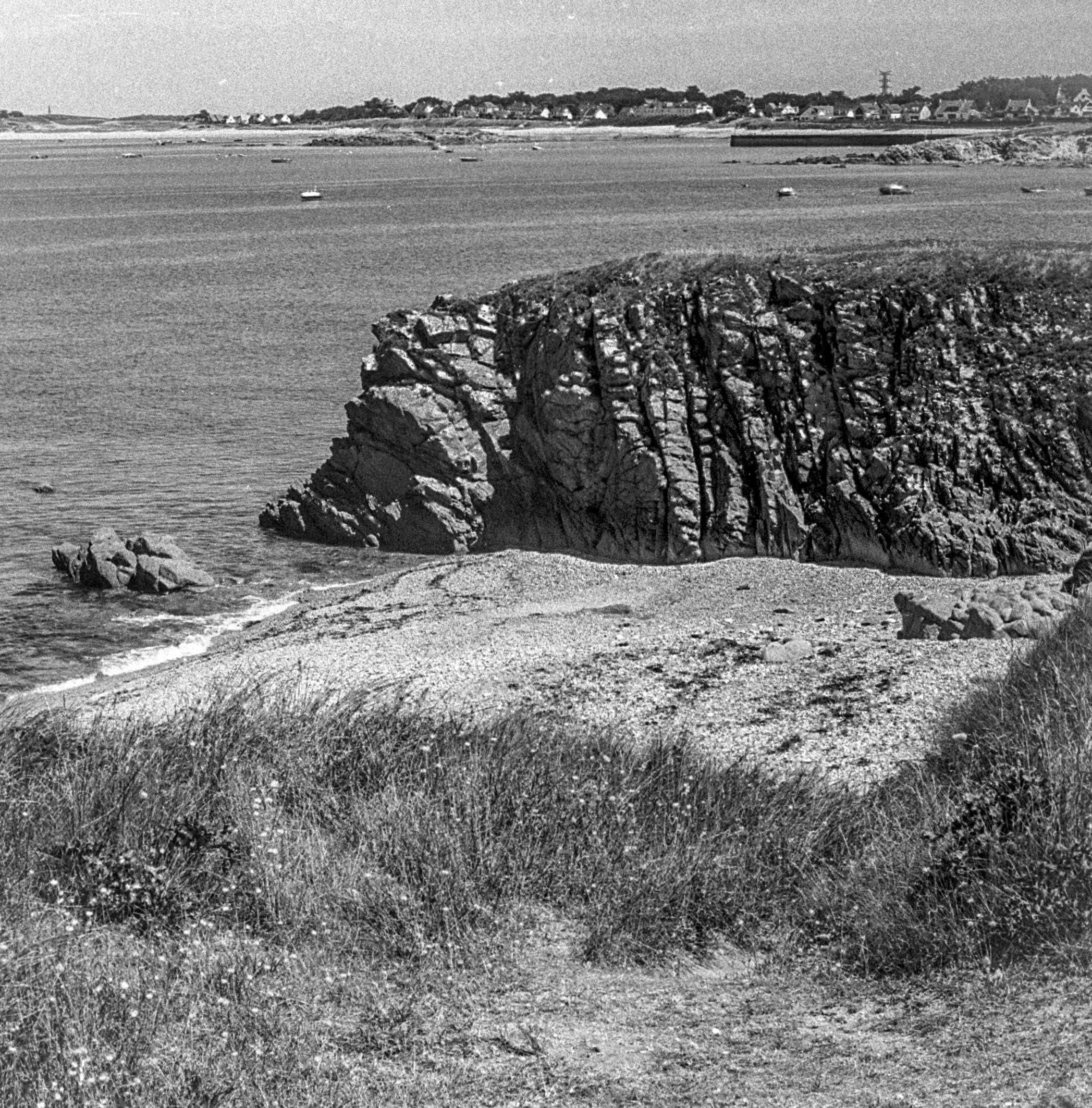
But here it was different.  Boots stayed on.  No screaming children.  Just the wind, the heat of the sun, just being an observer and not having to chat with anyone.  Being able to capture the beach on film.  Pure, solitary bliss.

So, now that you know where we are, let’s look at the camera and film du jour. The film stock that day was the usual Ilford HP5 that I always used at the time, a classic choice for its versatility and ability to capture the subtle nuances of light and shadow. The camera was the Ukrainian made rangefinder, FED 5 manufactured during the Soviet era. Loading the film with this camera is done by unscrewing the base plate, similar to the way one does with a Leica. The focusing with the “ghost” image is spot on and it’s a joy to use. I still love the smell of the leather case too. As in much of my film photography it’s as much about the experience of shooting as the final images.

In the end, Penthièvres became more than just a backdrop for my photographs. It became a sanctuary, a place where I could reconnect with my love for photography and find solace in the beauty of the natural world. These images are a testament to that experience, a reminder of the power of film to capture not just the physical landscape, but the emotions and memories that are woven into every frame.

The FED 5


Back in 2009 I had a camera that died on me.  It might only be a camera to you but to me it was everything.  It was my first camera.  I was heartbroken.  To those of you mocking me, just think back to your first car and to your first accident in that car.  Alright, you may not be shedding a tear you unemotive bastard, but you might just have the smallest of inklings about my loss.  It was my fist camera that had taught me the basics of photography, and since 1987 had been a relatively constant companion, and part of me.  My son now has it on a shelf looking pretty damn cool on one of his shelves.

It was at that time that I had come back to film from digital.  Why bother using filters that would emulate film photography when you could get the same thing straight out of camera without going through the rigmaroles of messing around in Photoshop to get that result?  At that time, although digital gave me a lot, there was something missing.  Like most of us I was looking for something authentic. 

I went to the camera shop to see if anything could be done to repair my camera and bring it back to life.  With hope I entered the shop that would become a familiar haunt, and had to face the brutal truth.  My Praktica MTL3 was dead.  It had passed on, this camera was no more. It had ceased to be. It had expired and gone to meet its maker.  It was a stiff.  Bereft of photographic life.  It was resting in peace.  It was pushing up daisies.  Its metabolic processes were now history.  It was off the twig.  It had kicked the bucket.  It had shuffled off its mortal coil, run down the curtain and joined the bloody choir invisible. IT WAS AN EX Praktica MTL 3!  Any similarity to a Norwegian Blue parrot pining for the Fjords is a mere coincidence!  So I asked him if I could buy the one in the display cabinet and he said of course I could and that yes it was a little expensive, it came with a 6 month guarantee, and here was a film for it, and no mention of Bolton or Ipswitch.  Although not exactly the same it was a purchase that set me off on a series of events that lead me to “collecting” a certain quantity of cameras.  It was either that or becoming a lumberjack. 

Through YouTube, articles on the net, and my own research, I learnt about some of the iconic cameras that I never had, and at that stage, the hipsters hadn’t bought up everything on EBay and you could still get something very decent for un £50, which now of course might set you back between £150 to £200!  So I was very fortunate to start collecting when I did.

On the famous YouTube, and its infamous photography videos that I still seem to watch on a regular basis, I went down the rabbit hole of specialising in film cameras.  There was one guy, called Matt Day, who waxed lyrical about his Leica M6, and how much he loved using it to take images from his everyday life.  I started thinking, could this be my next acquisition.  And then I started looking at the prices that these things cost.  Megabucks, which is something that I don’t have and even if I did, such a purchase would be grounds for divorce.  It’s cheaper to keep her, as the classic Rhythm and Blues (before it became R’nB) so wisely reminded us. 

Therefore, what is the difference between my new old Praktica MTL3 and a Leica M6 I hear you say. Well, both are German.  One is a classic camera from a West German manufacturer, and was the gold standard of 35mm cameras from pre war times right up to the modern day, and was a rangefinder, the other one being a relatively cheap and yet very solid SLR from the old East Germany.

So both were made by the Boche, one further to the left that the other.  They say a picture is worth a thousand words, so a video  must be worth two thousand words! Earlier I talked about a certain Matt Day, well here is a video of his from last year talking about the differences.  I’ll let you watch it, and then we will be both on the same page!  I can tell you’re impressed.

Soooooo, I wanted to learn about a rangefinder and see how they worked out in real life.  But, as I said earlier it’s cheaper to keep her, so I was going to have to find another way of doing things.  As many photographers on a budget but wanting to get some half decent materiel, I looked East, towards Mother Russia.  Communism is messed up, but it did leave some rather solid cameras, and to the rangefinder aficionados, the names Zorky, and FED will be familiar.  The Zorky looks very vintage, rather sexy and exclusive with its Cyrillic writing on the top of the body, but I was not comfortable about using a camera without a light meter.  The Sunny 16 rule should be easy enough to follow, and with the latitude that black and white film photography gives you, you shouldn’t go too far wrong, but I was being stubborn, which is so out of character for me. 

I moved on to looking at the FED 5, especially since I had found one for only 15€ imported directly from the Ukraine, which at the time was not at war or hadn’t been annexed either by Mother Russia.  Oh you naughty boy Vladimir!!

Let’s get the boring stuff out of the way first.  The FED 5 was produced in the Ukrainian city of Kharkov from 1977 until 1990.  It is a 35mm format rangefinder camera, with interchangeable lenses with a Leica M39 screw thread, (mine has a 35mm f2.8 lens, which is great for street photography).  It has a focal plane shutter, shutter speeds of 1 second to 1/500th of a second, bulb mode, and the flash sync speed is 1/30th of a second.  What more could you ask for.  The film loading is similar to the Leica where you remove the base of the camera, load your film etc. and then put that base back on.  Because you know that it’s about the bass, ‘bout that bass no treble…

To do the metering you have to put your faith in the selenium cell light meter, on the top right of the front of the camera.  This will give you a reading on an EV meter on top of the camera next to the “calculation wheel”.  One dial is for the speed of you your film.  Now don’t go looking for Din, ISO, or ASA, but look for GOCT, or GOST. 90 GOST is 100ASA, 180 being 200ASA etc.  For 400ASA I just turn the little dot to the S in GOCT.  It’s one of those Soviet things that is just a quirk of this camera. This will give me a reading on the outer dial with my shutter speeds and F Stops combinations to nail that exposure! 

As with other Soviet-era rangefinders, the shutter-speed selector rotates when the shutter is released, and this should not be changed “until after” the shutter has been cocked. If you change the shutter speed before you cock the shutter first, the setting pin can be broken when you advance the film and cock the shutter!  Don’t even bother trying.  I never have, and it still works today!

Focussing is easy which is always something that catches my eye, no zone focussing, and it’s slightly different to the SLR.  As you saw in the video, there is a ghost image in the middle of the viewfinder and as soon as that ghost image disappears, it means that you have focussed successfully. 

Anyway, I paid my 15 Euros and a Ukrainian camera arrived two weeks later in an original box which is still in a display cabinet in my hallway.  The leather case still smells of leather! So I tried the damn thing out.  Worked out how to load the film which as completely foreign to me but still doable and not too demanding even for me.  It is supposed to be the street photography camera par excellence for a few reasons.  Firstly it looks pretty sexy around my neck and the leather is top notch without necessarily having a leather fetish, but each to his own!  You can use zone focussing with the lens as you can see at such and such an F-stop, the part of your photo which will be in focus is shown on the lens.  There is no mirror that slaps up, and the camera is relatively silent, and can be used to close to your subject and get that trendy and yet timeless street portrait.  Shooting from the hip. 

I can hear you saying, well thank you Ian for all this information.  Really great, and almost useful.  But pray tell, is it any good?  What’s it like to shoot with?  Is it worth me looking into? Can I buy you a Leica M6 for your birthday? 

Well Dear Reader, let me address your interrogations.  Firstly is it any good?  It is definitely slightly sexy and certainly looks the part! I wasn’t used to the focussing of a rangefinder but found the focussing to be spot on.  I’ll let you have a look at the photos and let you judge!  What’s it like to shoot with?  Once you get used to the way a Soviet camera functions it’s actually pretty neat!  What I do like is being able to get my exposition without having to look through the viewfinder.  You know that you’re going to be spot on, and indeed I was.  That’s half the battle won, which is what we’re all about.  It works mate, it works!  You need to be able to get that sot that you want and I think that’s pretty simple to do.  Is it worth me looking into?  All depends on what you’re looking for.  If you can get one for a relatively cheap price then get one just to try out; you can always sell on.  I certainly have no regrets and it’s still in my collection which just goes to show you!  Can I buy you a Leica M6 for your birthday?  Who am I to refuse such generosity?

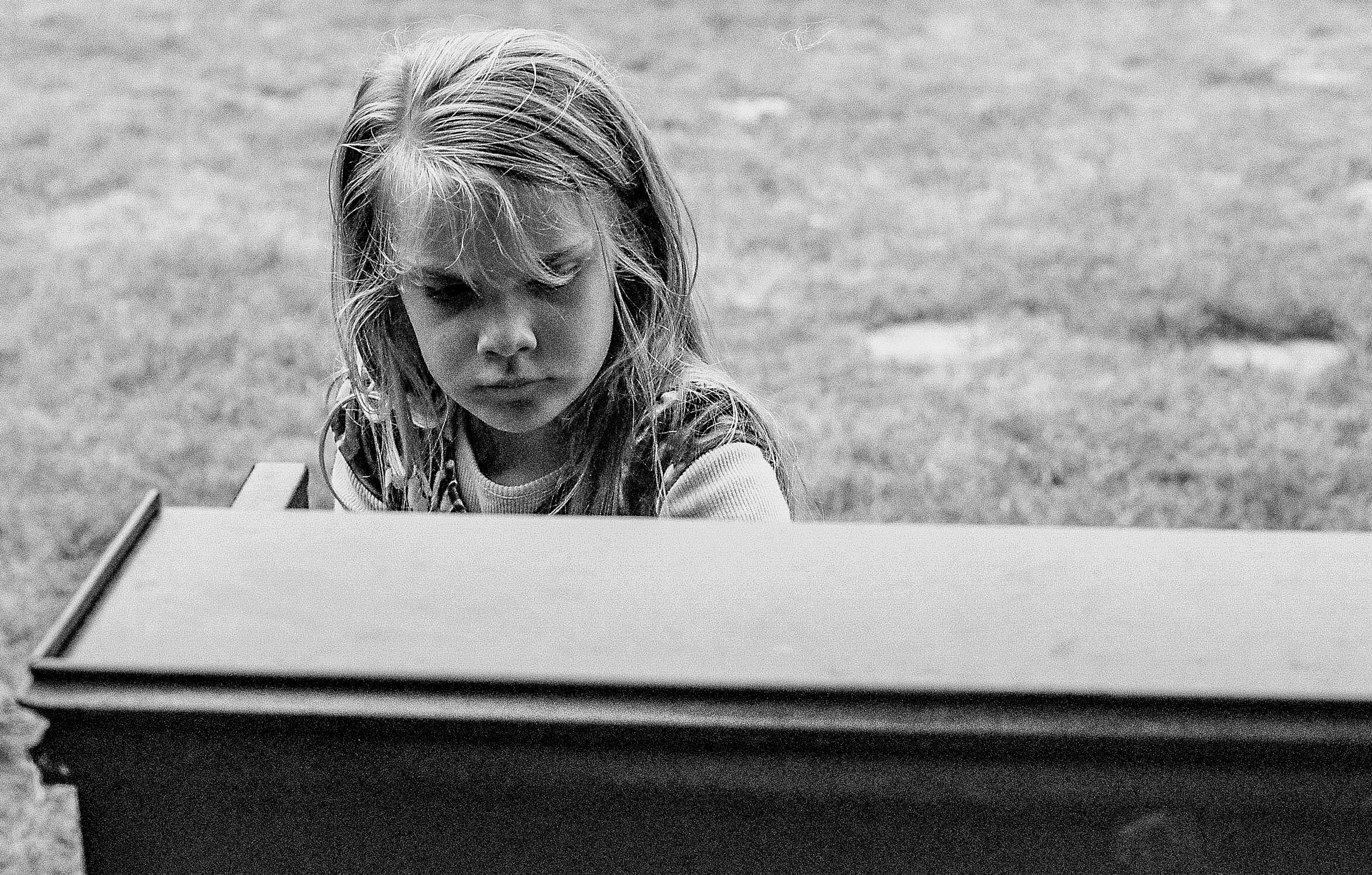
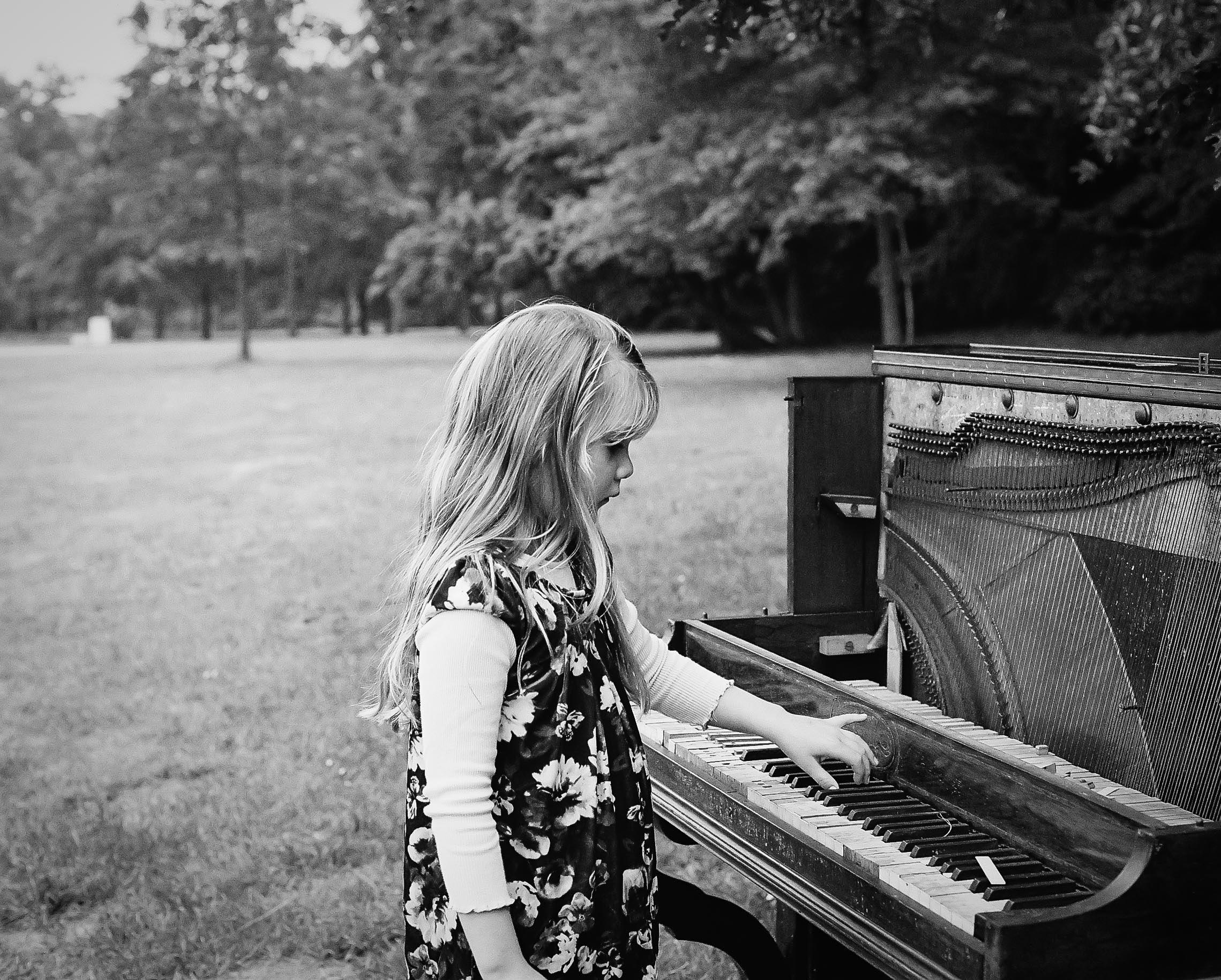
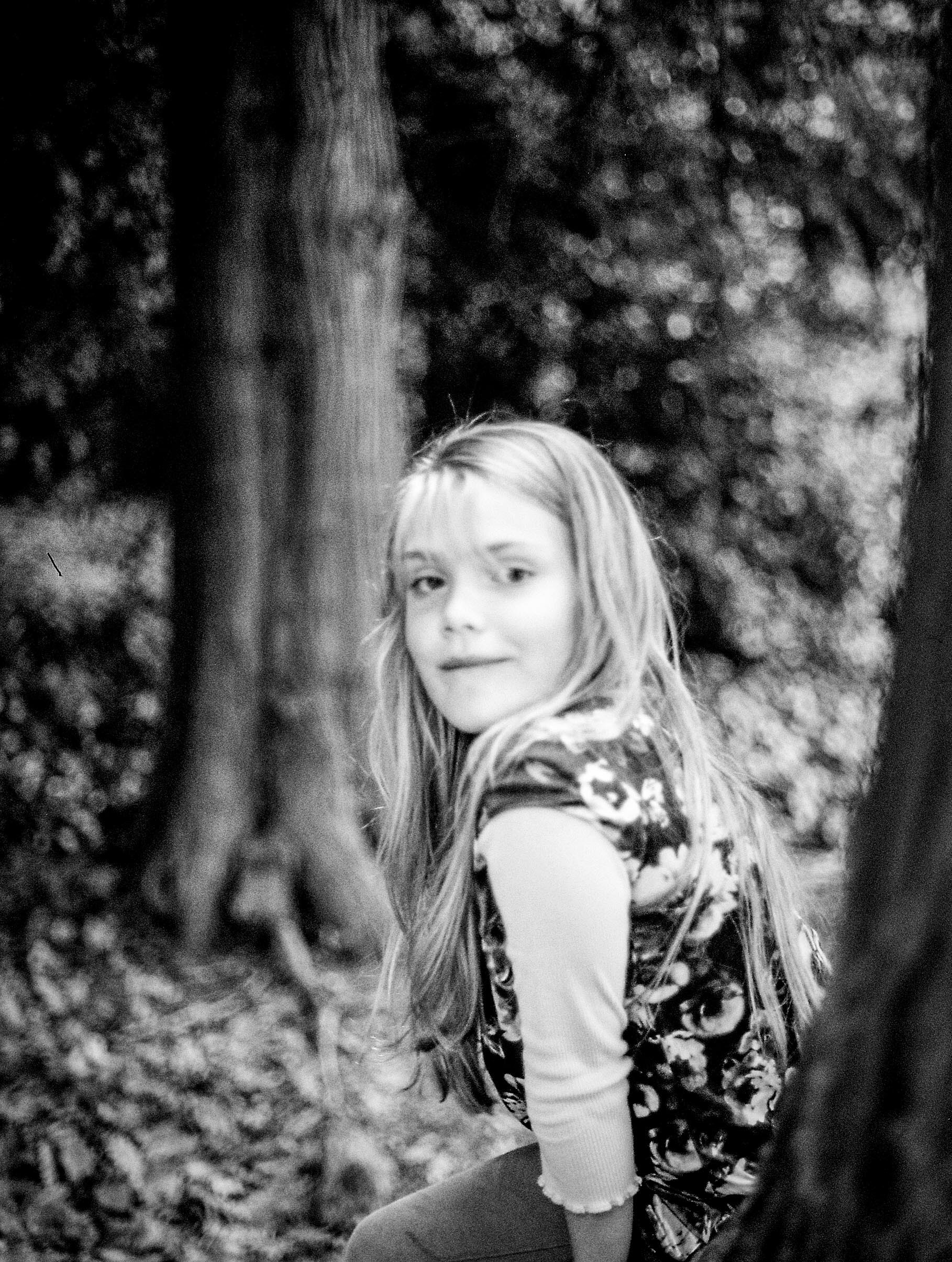
The photos in this article were taken in Montaigu, Vendée  in 2016 and feature my daughter.  The film is Illford XP, which is a black and white film that is developed with colour film chemicals and processes.  C41 for those in the know.  It’s always strange seeing photos from nearly 6 years ago and I remember that outing with my daughter as if it were yesterday.  It was one of the ways I used to cope with my depression.  I might not know what day it was but I remember taking each photo.  We all cope in our own individual ways I suppose…

The Contradictory Contradiction


I have a friend here who said that I am always contradicting myself and that it isn’t logical and how can I say two things at the same time, and I replied that the two things, although contradictory in appearance, are both as true.  That person is a production of French education with philosophy as the subject that all French teenagers go through to learn how to think the way the Education Nationale tells them to think, under the guise of learning all about freethinking and critical thinking.  I, however, am a lot less French despite what some people might like to think, and I will think any blooming way I desire, with or without contradictions.

I’m not talking about my mental state, for once, but photography.  I love both digital photography and analogic photography.  I am bewildered by modern technology and could be classed as a geek, and yet the experience of using old technology that is obsolete for some gets me all excited as a small child waiting for Father Christmas, but being told by their mother to go to bed, otherwise, he won’t come.  It didn’t stop me from waking up at the crack of dawn, and I think my parents might have regretted the decision to buy me a guitar for Christmas and hearing me playing at some ungodly hour of the morning.  As a 49, fat middle-aged gentleman, I can understand them, but my 6 or 7-year-old self didn’t and couldn’t imagine the disturbance that I had caused them.

Oh, how times change!  While I’m on the nostalgia train going to the “good” old days, I have vivid memories of a drawer at my grandparents’ house, where my mother was brought up, and in whose room I would be staying.  Inside this drawer, many “old” things just fascinated me.  It could be my grandfather’s old plumbing ruler or golf tees.  It could be anything but it was an entrance into another world for me.  My grandmother’s kitchen, because at that time, my Grandfather wouldn’t be in the kitchen, was a place where everything was from the 1930s and it all just fitted together.   There was the Anderson shelter, which had been turned into a proper pantry, was a relic from the Second World War where they would have sheltered from German bombs falling on the town and trying to stop my Great Uncle’s shipyards from operating correctly.  My Great Aunt would drive around in an ambulance taking care of casualties.  Amazing people from an amazing time. 

What does this have to do with photography?  Not a huge amount, but is that a problem?  Oh yes, it tells you about my fascination for the old and very new.  I have “a number” of cameras, the eldest being from the 1940s and the newest from 2021, with nearly every decade being represented in-between the two dates.

So I was going somewhere with all this.  Ah yes, lately I seem to be getting back into film again.  In the last but one article, you may have seen the photos from the Mamiya, which is a relatively modern camera being from the early ’80s.  Well, this time, I’m still using a camera from the 1980s, the Pentax ME Super.  For once, I wasn’t using Ilford HP5, which is my “go-to” film.  No, I decided to be different and get out of my comfort zone, and use a new film.  I say new film, I mean Rollei has been around for donkey’s years, but this was a “new to me” film.  May I introduce you to Rollei RPX 100.  I never use 100ASA film, but was turned by Fomapan 100, which you can see in the photos from the Hangar à Bananes.  A fine-grain film, especially when you compare it to the grain from HP5 even when shot at box speed, let alone 800ASA or even 1600ASA.

The film was developed in ILFOSIL 3, and I thought it was great.  I tried in town and country and was thrilled.  The thing that pleased me the most was that it kept flat, which means a lot to somebody who has ever tried to scan film. The last time I bought a film I played wild cards, and it was also a lot cheaper than HP5 which is a very convincing argument.  I still dream of Kodak Portra 160, but it is getting more and more scarce, and therefore more expensive.  A beginning of the month kind of film.  Oh look at that, my pay has just gone in…

So yesterday evening I was scanning a film my son had shot on a 1960s Kodak camera, and thinking about how he has changed since 2016 when I picked up my Fuji XT2, a slightly more modern mirrorless digital camera. I hadn’t used a modern camera in quite a while and it almost felt foreign to me, and yet familiar at the same time. My fingers seemed to find the controls without looking very far, and it felt very natural.  Maybe my love of digital and analogue isn’t that contradictory after all?

Now it’s time to show you the results of the Rollei RPX 100.  I liked it and am happy I bought more than one roll.  The camera, as I think I said earlier, was the Pentax ME Super.