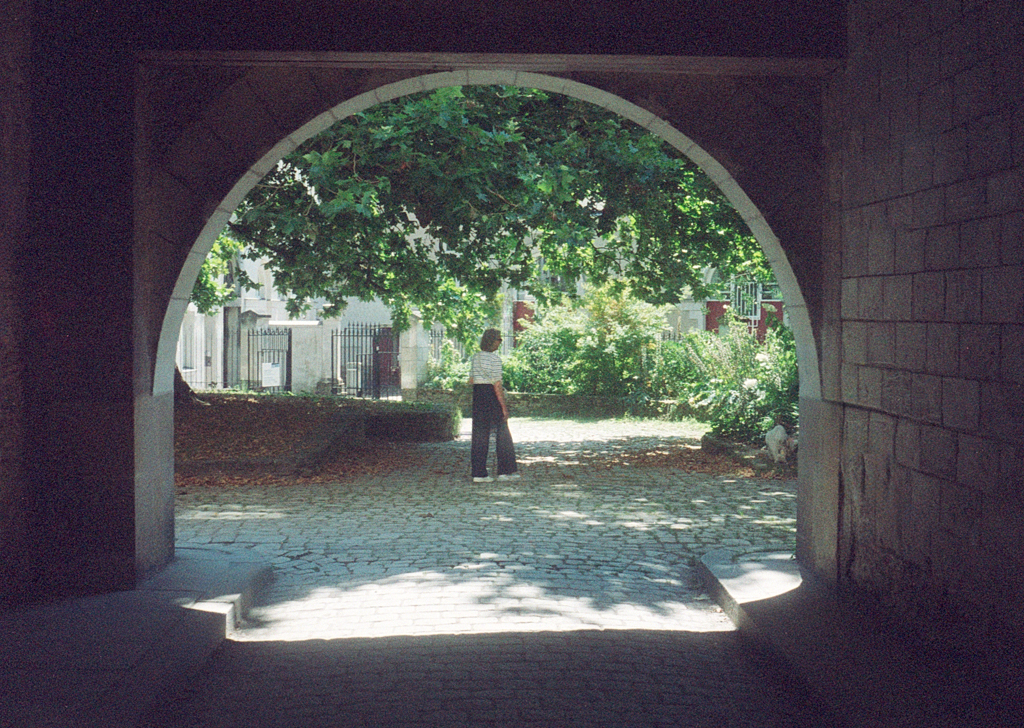
The Opening of the Film Archives – Noirmoutier September 2016

Welcome back, dear reader, to another delve into the Film Archive from before this wonderful blog that I know you enjoy reading so much. I appreciate being able to share these photos with you in the hope that they may not only please you but also offer insight into an older form of photography, one where concerns about overheating or battery life were minimal. I want to demonstrate how it is still possible to achieve great results with any camera and that the main quality in your photography comes from you, the photographer.

Earlier this year, I was there with my Canon 6D Mark II, but today, we’re revisiting my visit from September 2016. At that time, I didn’t have my Canon, but I did have the Olympus Trip 35 with HP5 Plus film from Ilford. I used that camera quite a lot that summer and continued to use it in September. I might just have to dig it out of my camera cupboard and use it again. Constraints and minimal kit often lead to more creative decisions—just think back to my UK trip, where I only had my X100F with me.

Let’s start with the camera. It’s a small but gorgeous camera designed for the mass market in the 1960s and was still being produced in the 1980s, which attests to its appeal among casual photographers. With relatively few controls, it’s pretty foolproof. I can adjust the film ASA setting, and the selenium cell housed with the lens takes care of the rest, whether it’s aperture or shutter speed. The famous red flag appears in the viewfinder when the camera senses insufficient light. All I need to do is set the focus zone.

I must have bought mine around 2015 or 2016, and it was quite affordable at the time—no more than 50€. It was an iconic camera then and still is today, but as the supply of these cameras dwindles, prices have increased. You can now expect to pay 100€ or more, with some models even reaching nearly 200€. It remains a great camera but might be a victim of its own success, along with sellers’ optimism and greed. Buyer beware—shop around, and you might still find more accessible prices.

As for film, prices have also risen, especially for Kodak film, but Ilford remains affordable, as do Kentmere, Fomapan, and Rollei.

I’ve travelled the same road numerous times, and it always brings me a certain sense of peace. I tend to stop off at familiar spots along the way, and those of you with an eagle eye will recognise some of these locations from other photos in this blog.

But why go to Noirmoutier? Firstly, why not? It’s just over an hour’s drive from my home and is a popular destination for many locals from the Vendée. The island now suffers from overtourism, which has certainly changed its character since 2016. Efforts have been made to manage the flow of tourists, with improvements such as parking, pedestrian zones, clearly marked hiking trails, and numerous bike lanes. It’s a beautiful part of the world, so typical of the Vendée Coast with its pinède and long beaches. However, not everything is about tourism. The island is also renowned for its salted butter made with salt from local salt marshes and the famous potatoes from Noirmoutier. Additionally, there’s a small fishing fleet, as well as the fleet from Le Port du Bec in the neighbouring Beauvoir-sur-Mer.

The UK Chronicles Part III: Bamburgh

Memories of Bamburgh: A Personal Connection

I’ve been going to Bamborourgh since I was a little boy. Fifty years later, it still affects me in a way that not many places do. Growing up, there was a painting of the castle in my mother’s bathroom, and ever since I learned photography, I’ve wanted to capture my own photo of the place. Patience, my dear boy, patience…

The last time I was there, I was with my wife and daughter. We explored the castle—a gurt big affair that overlooks the coast and the Farne Islands. This time, I was with my son. It’s all about passing on the experiences we’ve had to future generations. To be honest, this whole trip was about creating memories for the children and spending quality time with them. Ever wary of spending too much, we decided to visit just the village and the beach.

Exploring the Beach: A Walk through the Dunes

To get to the beach, you have to go through the dunes, following the paths, because wandering around the dunes willy-nilly is not the done thing—conservation of the local flora and fauna and all that. The castle towers above the beach, giving a sense of protection. By the time we got there, the beach was fairly full of people, dog walkers, and their dogs, all just enjoying the summer. A British, Northumbrian summer, but summer nonetheless.

I don’t know if you know, but I have a gammy knee and arthritis. I’ve also been taking collagen every day, and although it seems to be doing me good, it’s a bit early to see real effects. Killian was very kind, looking after me and making sure I was keeping up. He’s a good man, and it’s nice spending time with him. After walking on the beach for a while and letting me take my pictures, we found a log to sit on before heading back into the village.

A Stroll Back to the Village: Nostalgia and New Discoveries

As we headed back to the car, we came up the side of the castle and walked along the cricket ground. Dogs and their walkers were still out in force, with the owners throwing balls for the aforementioned dogs. All of a sudden, I missed Molly, our dog, and thought how much she would have loved coming with us, but she’s an old girl, and it wouldn’t have been feasible.

I thought about going up to the church to pay my respects to the local heroine, Grace Darling, who was the Lighthouse Keeper’s daughter in the 19th century. During an epic storm in 1838, a ship was wrecked on the Farne Islands, and Grace and her father went out in a rowing boat to pick up the survivors, as it was considered too rough a sea for the Seahouses lifeboat. They saved 9 out of the 62 passengers and had to shelter in the lighthouse for a further 3 days until the storm calmed down.

A Pub Lunch at The Lord Crewe: A Culinary Interlude

I didn’t manage to get that far. Killian, much like myself, has a weakness for pub lunches. And look, a pub! The Lord Crewe! One of those posh pubs that tries to hit above its station… We went straight to the bar and tried to order two pints of Guinness, while letting them know that we wanted to eat too. “Oh, in that case, just go up to the restaurant, and they’ll deal with you…” I was ready to leave the place and go somewhere else, but Killian was hungry, so we didn’t. However, we did enjoy being rude about the two barmen in French.

Killian decided on fish and chips, or “cod fillet with a beer batter”, and I went for the prawn cocktail. As you can see in the picture, even as Frenchmen, we couldn’t fault the presentation of the dishes. The taste was pretty good too! Eating a meal like that just takes you back to a place of joy and nostalgia. It takes you back to a place of calm and reflection. It takes you back to a place where everything is just the way it should be. It almost helped us forget the two barmen. Almost…

A rather delicious and impeccably presented prawn cocktail..

Continuing the Adventure: More Pints and Ice Cream

We paid and left, still joking at the barmen’s expense. We continued up the road and found the other pub. Ah well, another pint of Guinness. We never got to the church, but that was fine, as I already had the photos I wanted. The beach, the castle, and the dog walkers. We headed back towards the car and had that ice cream that we had noticed while walking up to pub number two. What a sound decision. It was very good ice cream and helped us forget the two rude barmen from the other place… Almost…

Capturing Bamburgh: A Photographer’s Reflections

Anyway, back to the car, and back to Lesbury to go and see the girls. I had the photograph I wanted. I wanted the castle, on top of its hill overlooking the beach and the dunes. The other photos were just a bonus. Yes, I went to a place for just one photo, but it was a photo I had been eager to get for some time. The next time I might just have to go at sunset to get the good light…

Photography Insights: Challenges and Techniques

Let’s conclude by talking about the photography from the day. The main technical difficulty was my camera’s metering of the scenes. I had to really expose for my highlights to compensate for the bright sky and the reflection of this light on the sand. I was actually worried about not being able to retrieve the information in the shadows. Luckily, Lightroom was a champion with photo editing and showed itself to be a top-notch app. For me, Bamburgh is all about the castle. It’s about the castle and the sea. It’s about the castle, the sea, the sand, and the dunes. If you can capture all that, then you’re well on your way to getting some pretty good photos.


Also in this series: Preface  ·  Lesbury  ·  Alnmouth  ·  Bamburgh  ·  Alnwick  ·  Rothbury  ·  Hepple  ·  Chesters  ·  Return  ·  B&W Footnote  ·  Summer I  ·  Summer II  ·  Summer III  ·  Summer IV

The Opening of the Film Archives, Lisbon, August 2016

Welcome back to the Film Archives, where I showcase my analogue photography from the period BB (before the blog). In this edition, we’re diving into a street photography session in Lisbon, captured using the Olympus Trip 35 paired with Ilford HP5 Plus film. This camera and film combination was my go-to at the time, and with the fantastic lighting conditions in Lisbon, I was confident in its ability to deliver excellent results.

Setting the Scene

Our cruise around the Canary Islands had one final stop in Lisbon before heading back to Southampton. After disembarking, we faced the usual checks—showing ID and ensuring we had no contraband. The docks were conveniently close to the city center, and I followed the crowd to the left as we exited. My family, however, decided to explore in a different direction and turned right.

Capturing Lisbon’s Essence

Lisbon is renowned for its distinctive tiles, and I was immediately drawn to their intricate patterns. My first shot aimed to capture these tiles, which were a striking shade of blue. Of course, the beauty of these tiles is somewhat lost in black-and-white photos, but the pattern’s appeal was undeniable. Perhaps a color photograph would have better showcased their vibrancy, but the monochrome shots still convey the city’s essence.

Having visited Lisbon before, I was eager to find the massive statue of a man on a horse located in the square. Finding it again brought back memories of my previous visit. The weather was quite warm—typical of that summer—but I sought refuge under the cool arches, which made for excellent photographic compositions. The leading lines and repetitive patterns of the arches created compelling visual elements in my photos.

One aspect I had forgotten about was the trolley buses. Their bright yellow color adds a unique touch to the city’s character. Although these buses are less striking in black and white, their presence adds to the city’s charm and energy.

Technical Insights

The Olympus Trip 35 is a straightforward, fully mechanical camera with a fixed lens and automatic exposure. It’s perfect for street photography due to its simplicity and reliability. The HP5 Plus film is known for its versatility and fine grain, which works well in various lighting conditions. On this bright day in Lisbon, the film’s wide exposure latitude allowed me to capture the city’s details with great clarity and depth.

Experiencing Lisbon

As I walked through Lisbon, it felt as if I had stepped back in time. The city’s mosaic pavements and vintage shop signs created a nostalgic atmosphere reminiscent of the 1960s. While I’m sure some areas are more modern, my exploration was limited to the historic parts I could reach on foot. In these moments, I felt detached from the “real” world, fully immersed in observing and photographing the city. This sense of liberation of being a stranger in a new place is incredibly freeing.

During my shoot, a German lady, who was a resident of Lisbon, approached me on Instagram and was surprised when I told her these photos were taken just 15 days ago. It’s fascinating how a fresh perspective can capture the timeless quality of a place.

Conclusion

In summary, Lisbon, at least in the areas I explored, possesses a timeless charm akin to that of a gentleman in a linen suit with a Panama hat. The city’s classical style and foreign allure were captivating. Although I don’t speak Portuguese, I chose to keep to myself, relying on the universal language of photography to connect with the city.

The Olympus Trip 35 was ideal for this day of exploration. Its simplicity, coupled with the bright light of Lisbon, allowed me to focus on capturing the city’s spirit without being bogged down by complex settings. The vintage camera, combined with the city’s classic charm, perhaps contributed to the nostalgic vibe of the photos, adding to the allure that intrigued even my German friend.

The UK Chronicles, Part II: Alnmouth

A Rare Visit to Alnmouth: Making the Most of It

Little did I know this would be my only visit to the beach and village of Alnmouth this year, so I decided to make the most of it. I had my X100F around my neck, as usual. I was up at the crack of dawn, chasing that perfect light once again.

The morning routine was pretty much the same as my first day in Lesbury: early rising, early breakfast, and an early cup of tea. The weather was gorgeous, and the light was amazing. What could go wrong?

Arriving in Alnmouth: The Beauty of Early Morning Light

I hopped in the car and headed to Alnmouth, just a short drive down the road. As I came around the roundabout in Hipsburn, Alnmouth and the River Aln came into view, bathed in golden light. The reflections on the water were breathtaking. It was early enough to find a parking space without any trouble. If you’d like to see more photos of Alnmouth, I can add a link for you.

Exploring Alnmouth: A Village with a Rich History

As the name suggests, Alnmouth is a village at the mouth of the River Aln. It was once a bustling port, playing a significant role in 17th-century Northumbrian trade. I’ll let you read up on that on Wikipedia, and I’ll be here when you’re done.

The village was still asleep as I made my way past the golf club and down to the beach. The only people around were a few dog walkers and me, enjoying the morning’s fresh air. The orange hues in the sky were perfectly reflected on the sand.

Discovering Color in Photography: A Shift in Perspective

For those interested in color theory, the use of complementary colors was striking—blue skies contrasted beautifully with the oranges in both the sky and the sand. I’m on a quest to explore my colorful side. While I still love black-and-white photography, this trip made me eager to embrace color.

My knee wasn’t even hurting; I felt fantastic. Maybe there’s something to be said about the sun’s healing powers. I made my way back to the car, carrying a lump of coal I’d found on the beach. It was too good a find to keep to myself. Surely, Killian would be up by now. Lesbury was only five minutes away. Oh, what the heck? I’ll go wake him up!

Father-Son Bonding: Revisiting Alnmouth Together

Killian was fine getting up and out with me. I only had to bribe him with a sandwich and some chocolate. We went back to Alnmouth together, and I took more pictures of the village. It was a very pleasant father-son bonding moment. He wanted to go to the post office or general store. They didn’t take cash, and for once, I was able to pay with my card for him.

Switching Editing Tools: From Snapseed to Mobile Lightroom

I recently talked about Snapseed and had been using it to edit my photos, but this time, I wasn’t happy with the results. The photos had so much potential, and I didn’t want to waste them. Some friends had recommended Lightroom Mobile, so I decided to give it a try. I already knew my way around Lightroom on the PC, and I felt right at home with the mobile version. It was very intuitive—almost as much as Snapseed. What a pleasant surprise!

So, I went back with Killian and took more pictures of the village. It turned into a wonderful father-son bonding moment. He wanted to visit the post office or the general store, but they didn’t accept cash. Luckily, I could pay with my card for him.

A Missed Opportunity: Scotts of Alnmouth

I was hoping to visit Scotts of Alnmouth, but they were closed. As we walked back to the car, I saw the owners heading to work and was invited to come back when they were open. Unfortunately, I never managed to return to taste their wonderful coffee and cakes. That was the only low point of the holiday. But as that Austrian strongman and actor famously said, “I’ll be back!” It’s good to be home.


Also in this series: Preface  ·  Lesbury  ·  Alnmouth  ·  Bamburgh  ·  Alnwick  ·  Rothbury  ·  Hepple  ·  Chesters  ·  Return  ·  B&W Footnote  ·  Summer I  ·  Summer II  ·  Summer III  ·  Summer IV

The Opening of the Film Archives – Stonehenge August 2016

Stonehenge is something different for most people.  For some it is a historical site in Wiltshire, and despite not being part of the 7 wonders of the ancient world, still remains pretty special.  For some more “alternative” folks, it’s an ancient spiritual centre, and just happens to be on converging energy lines.  For some it’s a day out with the children.

We had come back from a cruise that had taken us around the Canary islands, Lisbon, and Galicia in Spain.  Thank you Mummy, and thank you Daddy!  I think they felt guilty about us always coming up to see them in Northumberland, and wanted us to get a different holiday experience.  Well, different it was!  But that is a totally different story, and the photos can be found in the Olympus Trip 35 article.

So our ship docked at Southampton and we still were in the holiday mood.  I remember as a small boy visiting Stonehenge, and thought it was “the” opportunity to introduce my family to the site.  

It seemed slightly smaller than I remember it.  As do most things if I’m going to be honest with you, but the majesty of the stones remained.  As did the wonder at the fact that these stones had been dragged overland from Wales, and put into place, with the joints still being “rock solid” and down to the nearest millimetre.  I work in a factory that does industrial woodworking and I know what we can do with modern tools and technology and yet here, this massive construction was put together using basic tools.

The children were just taking in the whole experience, and rather bemused at the sight of Japanese tourists being shoved around the site and taking the obligatory selfie.  They also seem quite bemused by the amount of school groups being led around.  

I preferred, as often as I do, to just take my time and take it all in and get some photos of the place.  With the 40 mm zuiko lens I was getting some lovely environmental shots that you can see below.  

My wife, however, was in tears.  Crying her heart out.  She later confided in me telling me how she just felt overcome with emotion.  Maybe those lines of energy for those alternative folks might have something in them…

The UK Chronicles Part I – Lesbury

Introduction: A Journey to the UK

Good evening, Dear Reader.  Welcome to the UK.  I couldn’t not go to the UK without writing about it and taking the odd photo.  I wrote about the anticipation leading up to this trip in the Off to the UK article and talked about the cameras I might take with me in the Olympus Pen EE S review article.

The Road to Lesbury: A Cross-Country Adventure

The drive up from the Vendée up to Calais went surprisingly well.  As we passed through Rouen, we started seeing UK registered cars driving in the same direction.  As we drove up through the north of France, we saw more and more UK cars.  So getting used to UK driving, the closer we got.

We arrived at Calais and respected the bi-national family with our two UK passports and our two French passports, except the guys got their passports stamped and the girls were stampless.  Thank you, Brexit.

First Stop: Dover and the Journey to Lesbury

We spent the night in Dover and started the trip to Lesbury after a breakfast of champions.  I do like a full English breakfast.  We were already looking forward to stopping off for our sandwiches at Peterborough service station.  On a long trip like this, we all have our landmarks.  

The breakfast of champions, and only ever so slightly filling…

The Camera Dilemma: Choosing the Right Gear

The choice of camera was important, as I talked about in the previous articles.  I ended up just taking the X100F, praying that I would be able to get the shots I needed to record everything.

As any Internet user, I read articles and watch YouTube, and let this guide me.  I had read one article about a travel photographer, with the author talking about how he was the Dad travelling with his family and getting up before everyone else to go out to take photos.  I could always have a snooze in the afternoon.  YouTube tried to  convince me to keep things minimal, talking about how the 35mm lens was the best for travel photography on the road.  With the X100F, I have exactly what I was after.

Arriving in Lesbury: Settling In

We arrived at my parents’ house to say hello, go to the loo, and show them that we were still alive and kicking and that despite the odd moment of stress and intensity on the road, we hadn’t killed each other.  We followed my Dad in the car to the rental in the Old Vicarage in the next village of Lesbury.

The house was amazing and felt very luxurious.  My parents had prepared a starter pack with the essentials so we could survive until we did our shopping.  Yorkshire tea was in that pack, so I knew I was home.  We had our first night’s meal with my parents at their house, so I didn’t have to worry about anything.  What a great way to start our holiday.

Early Mornings and First Impressions

I’ll be honest with you.  I didn’t sleep very well and was always awake early.  When I say early, I mean early.  We’re talking about 5am wakeups.  But this was also part of the plan.  Get out early and get the good light.  

My first breakfast in the house was Yorkshire tea, muesli, and fruit.  Start eating healthily and starting the way you mean to go on.  As I looked out of the conservatory, I could see rabbits grazing on the lawn and the robot mowing the lawn.   It was going to be a good day, and I was going to wander around the village taking the first photos of the trip. 


Also in this series: Preface  ·  Lesbury  ·  Alnmouth  ·  Bamburgh  ·  Alnwick  ·  Rothbury  ·  Hepple  ·  Chesters  ·  Return  ·  B&W Footnote  ·  Summer I  ·  Summer II  ·  Summer III  ·  Summer IV

The Opening of the Film Archives—Jardin des Plantes August 2016

There was a time when my daughter wasn’t a teenager.  There was a time when she quite liked her Dad, and she would accompany me everywhere.  It was good being that child’s hero.  It was a more innocent time.  It was a time when she actively tried to spend time with me.  It was a time when she didn’t see me the way I see myself…

One of her favourite places in Nantes was the Jardin des Plantes, a huge botanical garden in the middle of Nantes just across the road from the station.  I could talk about the fact of it being a haven of peace in the bustling city.  I could talk about it being an oasis of green in a sea of concrete.  I could talk using clichés ‘til the cows come home…

These photographs are not clichés, but real attempts of capturing a specific moment in time allowing me to travel back through time.  And looking at these images, I’m definitely back in time.

Let me introduce you to my daughter from 2016.  She was a 7 year old that already knew what she wanted but was slightly more subtle about it.  She would suggest that we go into town.  That I could take my camera.  That we could go to such and such a place.  That we could do such and such a thing.  And all this as if it were completely natural.  And I was a very willing victim.   

This time she suggested going to the Jardin des Plantes.  She would take her camera (my old Sony bridge) and I would take my Olympus Trip 35.  I used the Olympus Trip quite a lot at that time and its ease of use, the zone focussing, and general lack of buttons to press, made it quite the fool proof piece of kit.    

As usual, I let her lead the way.  This was here outing after all, and kept a respectful distance, so I could photograph her and record her for posterity.  The Jardin des Plantes has not only plants, the clue is in the title, but also is the backdrop to the Voyage à Nantes, and certainly was that year.  

I think the images speak for themselves and I’ll let you peruse them at your leisure.  They were taken on Ilford HP5 Plus film shot at box speed.

Why the Olympus Pen EE-S Is the Best Budget Film Camera for Beginners

Why the Olympus Pen EE-S Is the Best Budget Film Camera for Beginners (Even in 2025)

Pentax 17 fever is sweeping the film photography world, and I’ll admit, I was tempted. Half-frame cameras, with their promise of double the shots per roll, sound pretty amazing. But with a price tag of 500€, the Pentax 17 isn’t exactly within my budget. That’s when I rediscovered a little gem tucked away in my camera collection: the Olympus Pen EE S.

This Japanese-made half-frame beauty hails from the 1960s, the same era as the beloved Olympus Trip 35. Like its sibling, the Pen EE S features zone focusing and a selenium cell meter for fuss-free shooting. The lens is an F2.8 22.5mm Zuiko lens. The ISO settings go up to 200 ASA, unlike the Olympus Trip which goes up to 400 ASA. So, despite everything else, it needs light. The half-frame format means you get a whopping 48 exposures on a standard 24-exposure roll. That’s double the shots for your buck, folks!

Now, the idea of twice as many photos for the same developing cost is pretty appealing. But does the Olympus Pen EE S deliver the goods in practice? Stay tuned as I put this vintage camera through its paces and share my findings. Could this be the perfect half-frame hero for those of us who can’t quite swing a Pentax 17? Let’s find out!

Well, for starters, it felt very much like using the Olympus Trip 35. It’s very slightly smaller and weighs next to nothing. The shutter button is almost identical as well. Instead of having four zones for focusing, you have three, but it’s fine, and when you turn the dial, you feel a click as you enter a new zone. You point, and then press. Simple!

Let’s talk about this half-frame shooting experience. When talking about the Pentax 17, “they” talk about how the images are great for sharing on social media. A little like using your phone… This is the mindset that I had when putting in my Kodak Gold 200 to capture those famous Kodak moments in Nantes.

I found it a challenge to get used to the half-frame. “They” say that you have to take your photos as diptychs and remember that the two photos in your full frames are related, not just simple images. The idea is that when the two half frames are put together, you create a story and a suite of ideas, instead of two separate photos. I tried, and the results will show you if I succeeded. I felt that “they” were pulling my leg!

I’ll be honest with you. The idea behind the outing was to test the camera, see how I felt using it, and have a look at the results. It took me out of my comfort zone, which is something rare in photography for me. I was thinking about taking it to the UK with me to record the trip. It takes up next to no space in a camera bag and would allow me to shoot some film while back home. The idea of getting twice as many shots by using just half the frame is attractive. I’m just getting used to the reduced coverage that you get with just using half the frame.

For this outing, I decided to head out towards the Cathedral, and takes some shots of the Voyage à Nantes.

I found myself thinking differently about framing my shots and using my phone as a mental template. As for the resolution of my images, they will be half as much as using my full frame, but were I to print my photos, then I would definitely see a difference. But if they’re just for sharing on social media, then the resolution will be perfectly satisfactory.

The million-dollar question is, will I take it on my trip, and will I use it? Yes, I will. Will it be my main camera? Possibly not. Will it be more like using a new toy? Possibly, even if the toy in question is a vintage 1966 toy…

Here’s what I’ll do. I’ll put some images taken on the X100F, my more modern toy, and let you see how they compare. You’ll see the diptychs and see how the different shooting styles change the outlook and how they change the framing.

These are the X100F photos with editing in Snapseed…

And these are the half frame images from the Pen EE S… with the editing done in Photoshop using the neural filters to get rid of the scratches on the film.

So what do you think? Worth taking?

The UK Chronicles – Preface

Off to the UK

Good Evening, Dear Reader. You might not be able to feel the same excitement and trepidation as me, but I can assure you it’s palpable. I’m not talking about the Olympics, or the opening ceremony, which was very, very French. I’m talking about my upcoming annual leave. I will be going home to the UK for 10 days. I will be going home. Home is where the heart is, and as my mate David Frank once reminded me, you can take the boy out of Hull, but not the Hull out of the boy. How right he is. Even after 30 years of living in a foreign country, and despite having become somewhat “continental,” the UK is, and always will be, home.

Heading Home: Embracing Nostalgia and Anticipation

The physical preparations are not underway yet, but the mental ones certainly are. We will be driving up to Calais from the Vendée. It is a drive that over the years has become vaguely familiar, and I have the images in my mind of the various stops along the way, and the signs that I will be looking out for. My wife is a professional driver, and I will be relegated to helping out when she becomes tired and needs a rest.

The Road to the North: Familiar Drives and Service Station Delights

I don’t know about you, but when I’m in my car, I’m in a familiar environment, and it feels a little like having a part of my home with me. The controls for driving are second nature, and I don’t have to think. As I have mentioned, I am a creature of habit, and despite not being alone whilst driving, and the possibility of a mad screaming harpie, I mean wife, sitting next to me, I’m still looking forward to the trip. For the first time in 4 ½ years, my son will be coming with us, so I’ll have some masculine back-up and will feel less dominated by my daughter and wife.

We will have a stopover in Dover, and take the now familiar road up to Northumberland to see my parents. I’m actually looking forward to the service stations in the UK, especially one near Peterborough, that has a kind of Food Court, which includes Marks and Spencer. I’m looking forward to biting down onto a prawn cocktail sandwich, and a Wensleydale and carrot chutney sandwich. I know it’s not the “gastronomie” that the French might talk about, but to me, it’s about the nostalgia of the thing. It’s part of coming home.

Home Away from Home: Comfort in the Driver’s Seat

But, I hear you say, Dear Reader, you haven’t talked about cameras or photography yet? And you would be right. Thank you for allowing my little trip to nostalgia land. So, let’s talk about cameras for this trip. There is, of course, the X100F, that is the travel photographer’s camera par excellence. It’s compact, it works, and gets the job done. It’s what I will probably be using nearly 80% of the time. The 35mm F2.0 lens has me covered for nearly all situations, and if I take the telephoto conversion lens, then I’ll be even more covered.

Capturing Northumberland’s Beauty: Gear and Location Plans

Do I already have plans for where to take photos? Mayyyybe…

I have already a largish selection of photos of the village of Alnmouth, that you should be able to find on this site, either by using the search bar, or looking at the tag list at the bottom of every article. But, believe it or not, Northumberland is not just about Alnmouth. I know. Mind blowing.

I would like to get some shots of Dunstanborough Castle (for which I might even have to take my Canon 6D Mark II and various lenses, but I’m not sure about that yet), Beadnell, Seahouses, the Farne Islands, Holy Island, Craster, Bambourgh Castle. There’ll be beaches, islands, birds, seals, boats, and harbours. I even thought of going down by Amble and maybe stopping off in Walkworth.

That might mean a Canon bag, with lenses and filters, and possibly even a tripod. Decisions, decisions. Do I need more room in the car, and will the family gang up on me if I take more photography kit with me? There is a difference in volume and weight, of course.

Weathering the Storm (Or Not): Temperature Contrasts and Photographic Possibilities

I suppose it all depends on the weather. One tends not to visit the UK for the great weather. Here in my little corner of France, it’s supposed to be getting up to 36°C today. Not in Northumberland, though. I’m expecting 20°C and maybe lows of 14°C. Much more comfortable, and almost human.

Conclusion

So “home is where the heart is” is still something that resonates with me.  Thirty years a foreigner, and yet as a lot of us immigrants, we’ll never be completely at home in our adopted country, we are condemned to never feel fully at home in our home country.  We will be “continental”.  Our very essence has changed. The nostalgia for a past that has moved on since we left is another of our penances.  Maybe that’s why I do so much black and white photography; a way of trying to capture this bygone time.


Also in this series: Preface  ·  Lesbury  ·  Alnmouth  ·  Bamburgh  ·  Alnwick  ·  Rothbury  ·  Hepple  ·  Chesters  ·  Return  ·  B&W Footnote  ·  Summer I  ·  Summer II  ·  Summer III  ·  Summer IV

The Opening of the Film Archives – Clisson May 2016

Introduction

Welcome back to the film archives.  Today I’m going to share some photos of the first reel from my “new” Canon AE1.  Well, not new, but certainly new to me.  The Canon AE1s were produced between 1976 and 1984.  It is one of those iconic cameras and at the time I must have paid about 50€.  When I say iconic, I really mean iconic.  It is a shutter speed priority camera using Canon’s FD lenses. I used it an awful lot that summer.  I liked it so much that I even bought a second one that I ended up giving to a photographer friend. 

Colour

To some people of my generation they represent their first cameras, and were so popular.  Talking of popular, the photographs from this part of the archive are from the very popular and photogenic town, Clisson.  Also you will have noticed that the photos are in colour.  Which only goes to show that not all film photography is black and white photography.

Clisson, as you can see in the photos, is one of those beautiful French villages that oozes Gallic charm.  It also exudes a certain Italian charm, and is known for its Italian style architecture.  

Canon AE1

I have both a Canon AE1 and AEI Program. The AE1 is the big brother of the AE1 Program, and doesn’t have a program mode, but as you can see from the photos it still works a treat.

FeatureCanon AE-1Canon AE-1 ProgramDifferences
Release Year19761981AE-1 Program released 5 years after AE-1
Exposure ModesShutter Priority AEShutter Priority AE, Program AEProgram AE added to AE-1 Program
MeteringCenter-weighted AverageCenter-weighted AverageNo difference
Shutter Speeds2s – 1/1000s2s – 1/1000sNo difference
Viewfinder DisplayLEDsLEDsNo difference
Film Speed SettingManualManualNo difference
Self-timerYesYesNo difference
Depth of Field PreviewYesYesNo difference
Motor Drive CompatibilityYesYesNo difference
Other NotesFirst Canon SLR with microprocessor; revolutionary for its timeSimplified controls for easier use; appealed to wider audienceAE-1 Program aimed at beginners and enthusiasts
As you can see there’s not a huge differece between the two. The major difference being the Program option, and the other allowing for easier changing of the ASA film sensitivity setting.

On the day in question I must have parked just next to the river and concentrated on this picturesque  area.  You can see the castle, the bridge, and the river, all making for a peaceful spring moment.

I think the film was Fuji Superia, and I just wanted to use colour.  Thetones are slightly muted and warm, and the flowers, trees and plants were just screaming out to be photographed.  I remember the excitement of loading the film into this “new” camera, and the novelty of simply using an iconic camera.

Here is what fuji tells us about the film:

FUJICOLOR SUPERIA X-TRA400

An all-round general purpose, high-performance, high speed color negative film delivering truly fine-grain. Superb for snapshots or action, in low light with flash, outdoors or indoors. Ideal for general use with compact zoom lens cameras.

  • Excellent skin tones
    For beautiful, clear people-shots.
  • Fine grain
    Great results even when enlarged.
  • High-speed
    Superb results, whatever the shooting conditions.
  • Sensitivity and Film Sizes
    ISO : 400
    Film Sizes : 135 : 36 exp.

 When using digital, it’s so difficult to get that particular film look, and using film and an older camera just changes your whole outlook.  The fact of not having your image straight away leaves you with that anticipation that we all used to feel when we sent off our films to the lab.

Give film a try.  There are still cheap film cameras out there, and your photography experience will be totally different.  I certainly appreciate it.

The Opening of the Film Archives – Saint Cado, Belz, Morbihan

Welcome back to the film archives, and welcome back to Brittany, that gorgeous corner of France where my in-laws live. I think I might have let it be known that my French family love camping. Yes, they’re so in tents… I’ll just let that joke sink in for a couple of seconds. In 2016 I had begun “collecting” cameras. The photos from this Breton outing in Saint Cado were taken with the Kodak Retinette 1B, a little gem of a camera from the 1960s, and HP5 Plus film.

We’ll start with Saint Cado. It’s one of those picture-perfect postcard places. It’s not easy to take a bad photo of the place. It’s photogenic. It’s quaint. It has all the clichés of a small Brittany island in the Ria d’Etel, which is an inland sea connected to the Atlantic at the Barre d’Etel… I’m thinking lobster pots, oyster beds, black and white houses with slate roofs, a local Saint, a chapel to this local saint, who was actually from Wales of all places, and a miraculous fountain that fills up with every incoming tide. Yes, it’s one of those places… Did I mention that the bridge that links the island to the mainland is a Devil’s bridge? It is said that the devil demanded the soul of the first creature to cross it. The story relates that Saint-Cado, who was a shrewd fellow, put a cat on it! It is just gorgeous!

Let’s talk about the Kodak Retinette 1B. As I said in the introduction, it is a camera from the 1960s that uses zone focusing, and the 1B as opposed to the 1A has a selenium light meter that works a treat. Zone focusing is where you focus by zones. Mind-blowing, right? If I look at my lens, I will see a distance measurement that I will use as a guesstimate. I will move my aperture dial and let’s say I’m at F8, well everything from one F8 to the other F8 will be in focus. A lot of cameras from this period used this system, and it works. If you want to open right up to F2.8, then there are little rangefinders that you can put on the hot shoe mount and there you will be able to get an exact reading for the distance from your subject. Up to you…

Why use a camera that is over 60 years old?  First of all, why not?  It works.  It’s simple to use.  It doesn’t need a battery.  You load your film and Bob’s your Uncle!  Off you go to shoot your 36 exposures.  It also looks pretty damned sexy hanging around your neck too…  It actually looks so sexy that my son nicked mine, and I had to go and get another one.  At the time of purchase I must have paid no more than £15, and even now it will cost you less than £50.  

So there you have it – a charming little island, a vintage camera, and a roll of trusty HP5 Plus. This trip to Saint Cado was a reminder that sometimes, the best photos come from the simplest tools and the most unexpected places. And who knows, maybe those old film cameras aren’t just gathering dust in the attic – they might just be waiting to capture your next adventure. (But if you happen to see my son with a Kodak Retinette slung around his neck, please tell him to bring it back!)

The Opening of the Film Archives – Penthièvres July 2016

I don’t know about you, but I’m really getting into this Film Archive business. It’s great sharing these archives with you all, and it’s certainly bringing back lots of memories to me. Maybe less for you because I haven’t published them here yet. But I know you’ll like them as much as I do.

This particular set of photos was taken on Penthièvres beach, located on the Quiberon Peninsula in the Morbihan. It has a special place in my heart. Not just because I like the sea, but the smell of the sea, and the feel of the sea air on my face. It’s a place I often escape to for a bit of tranquillity especially with the chaotic nature of family visits.

In some respects it’s strange going to the beach to “relax” as it’s something I usually hate.  The idea of the outing to beach with the family and putting towels down, with rocks on each corner of the towel, and having to watch over children going to swim and bathe, making sure they don’t drown because you’ll get shouted at.  The shouting of the children, and worse other people’s children.   Getting sand in between your toes and then getting back to the car and having the impression you’ve brought back the whole beach…

But here it was different.  Boots stayed on.  No screaming children.  Just the wind, the heat of the sun, just being an observer and not having to chat with anyone.  Being able to capture the beach on film.  Pure, solitary bliss.

So, now that you know where we are, let’s look at the camera and film du jour. The film stock that day was the usual Ilford HP5 that I always used at the time, a classic choice for its versatility and ability to capture the subtle nuances of light and shadow. The camera was the Ukrainian made rangefinder, FED 5 manufactured during the Soviet era. Loading the film with this camera is done by unscrewing the base plate, similar to the way one does with a Leica. The focusing with the “ghost” image is spot on and it’s a joy to use. I still love the smell of the leather case too. As in much of my film photography it’s as much about the experience of shooting as the final images.

In the end, Penthièvres became more than just a backdrop for my photographs. It became a sanctuary, a place where I could reconnect with my love for photography and find solace in the beauty of the natural world. These images are a testament to that experience, a reminder of the power of film to capture not just the physical landscape, but the emotions and memories that are woven into every frame.