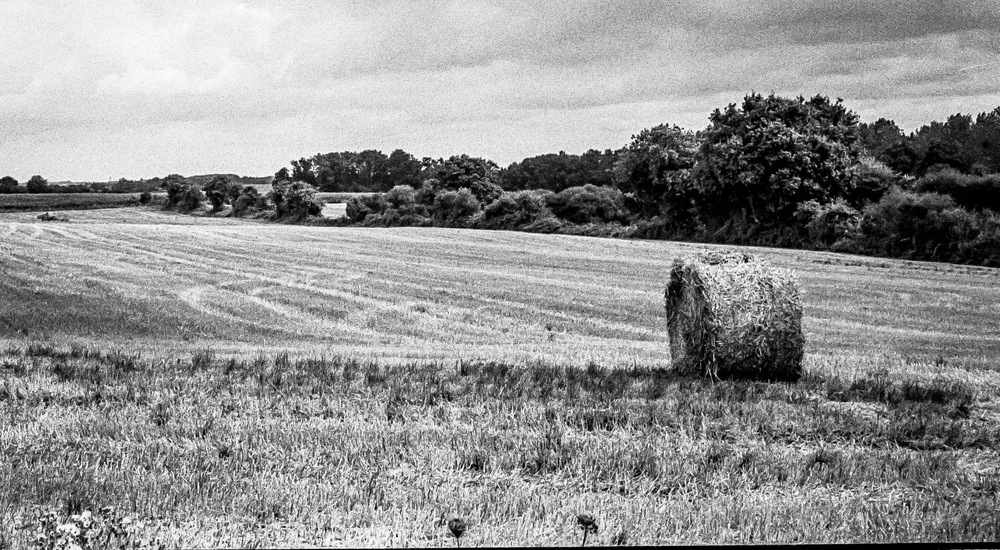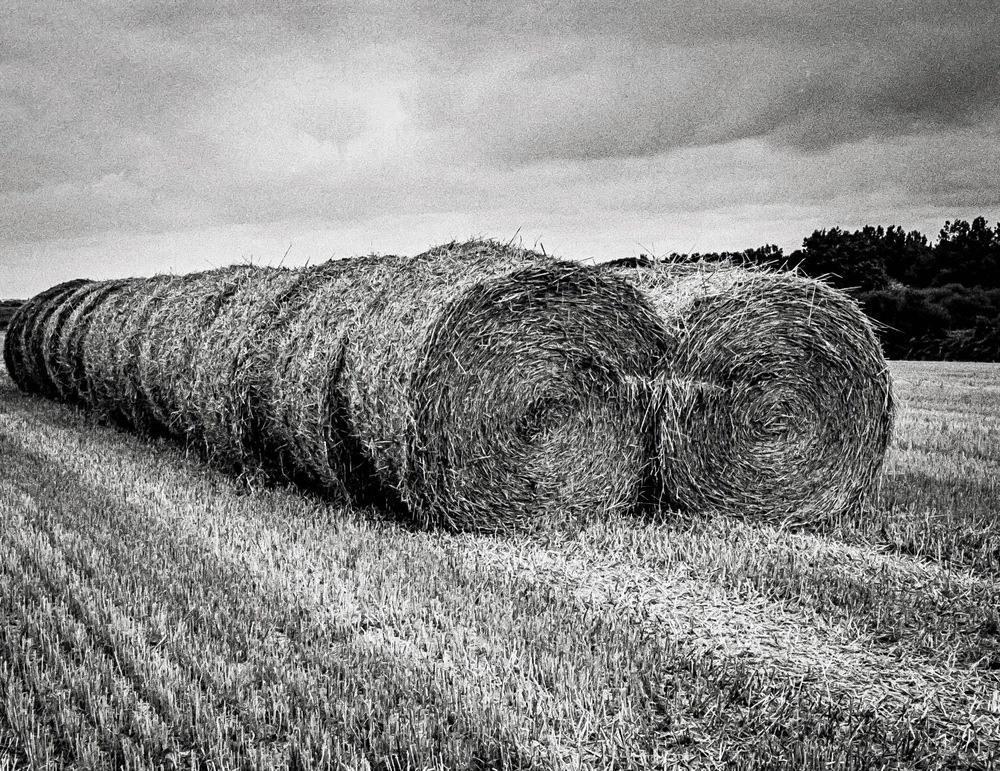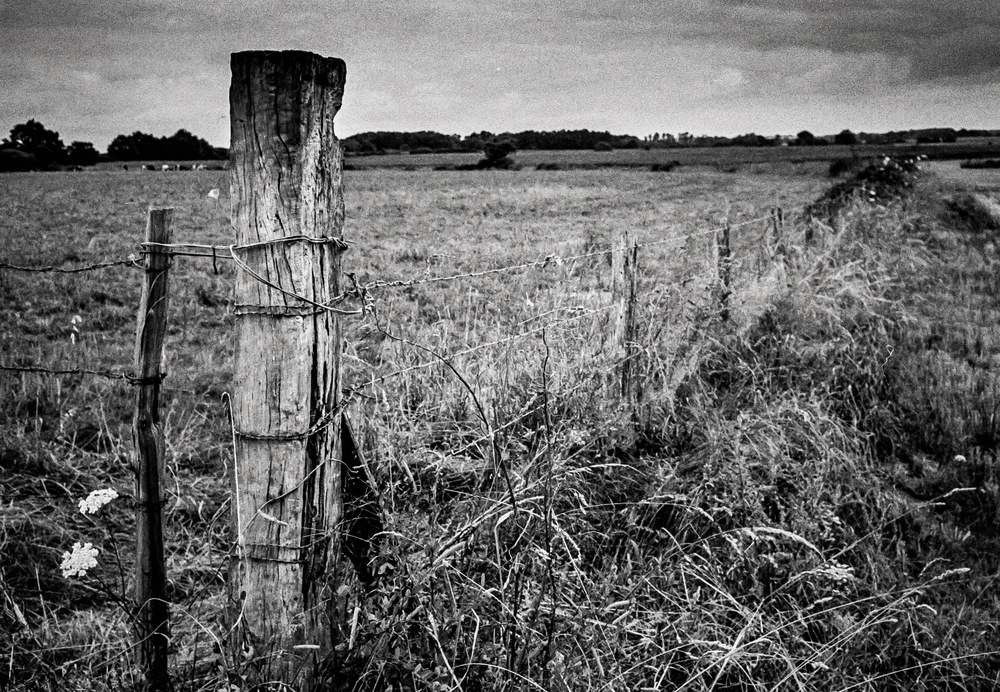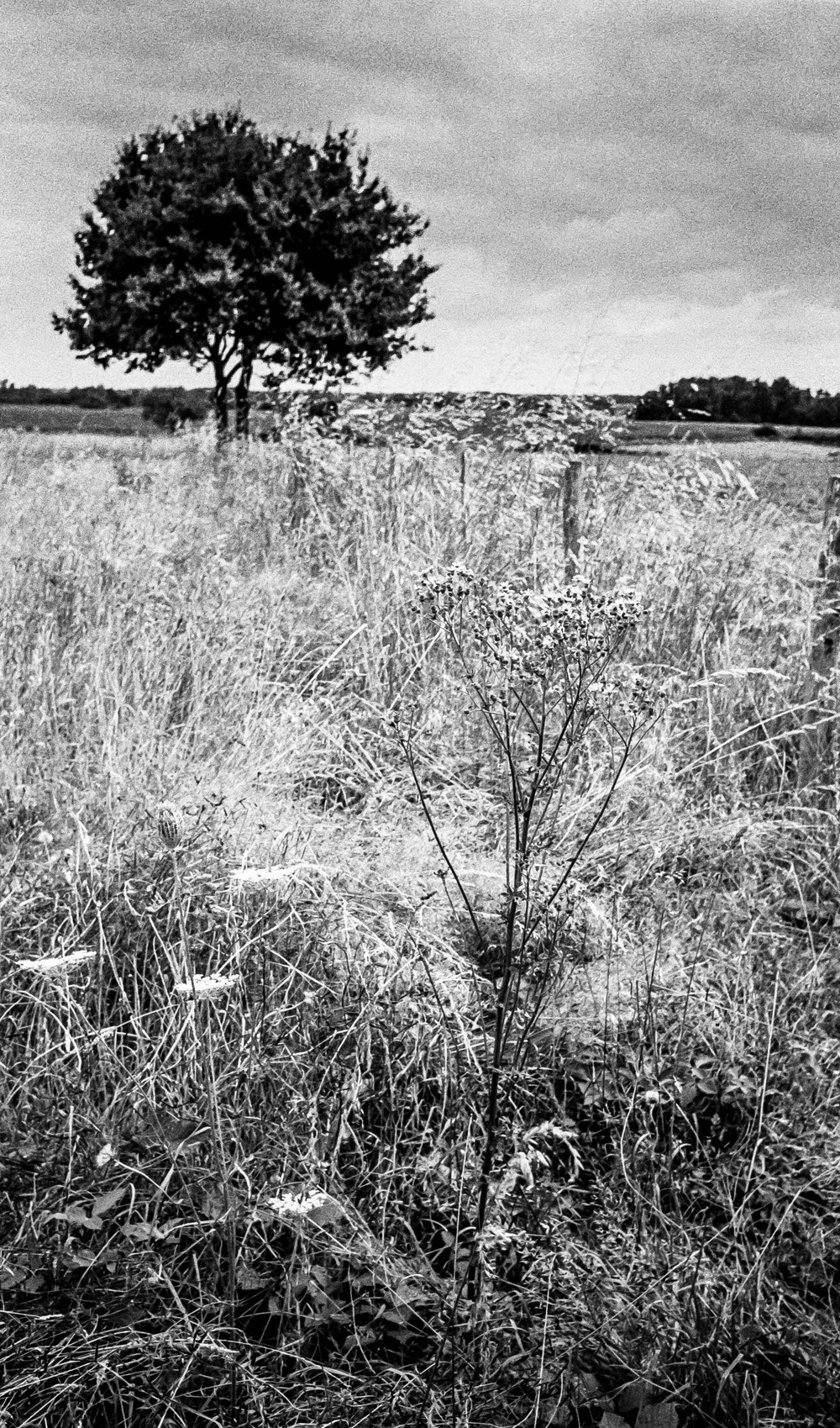
Making the Ordinary Less Ordinary: Rollei RPX 400 at Pont Caffino


Continuing on from my last article about shooting in sub-par lighting, I’ll introduce my next roll of film—RPX 400 from Rollei. I usually like this film. This roll also marked the first time I really tried to use the Tone Curve tool in Lightroom. I’m still getting used to it. But I thought that with RPX 400, I might be able to make some ordinary prints somewhat less ordinary.

After forty years of doing this, you’d think I’d have it all figured out. You’d think I’d have a fixed workflow, a set of rules, a way of knowing exactly what the result will be. But this roll reminded me otherwise. There’s always something new to learn, or something old to look at differently. And I’ve started to wonder if there’s something honest in admitting that, rather than pretending the process is ever truly finished.

Pont Caffino on a February afternoon is exactly that kind of place. I’d never visited before, though I’d heard about it from other photographers. The sky was uniform. The light was flat. Nothing was going to jump out and grab me. So I loaded the Rollei, walked down to the river, and started looking.


The River

The water level was low—noticeably so. I knew this because not long before, I’d been at the Maine in St Hilaire de Loulay where the river had broken its banks completely. You couldn’t even see the weir there, just water spreading across the landscape. Here at Pont Caffino, the opposite was true. More of the granite banks showed through. More of the weir structure was exposed. The river looked different, and I found myself photographing it differently.
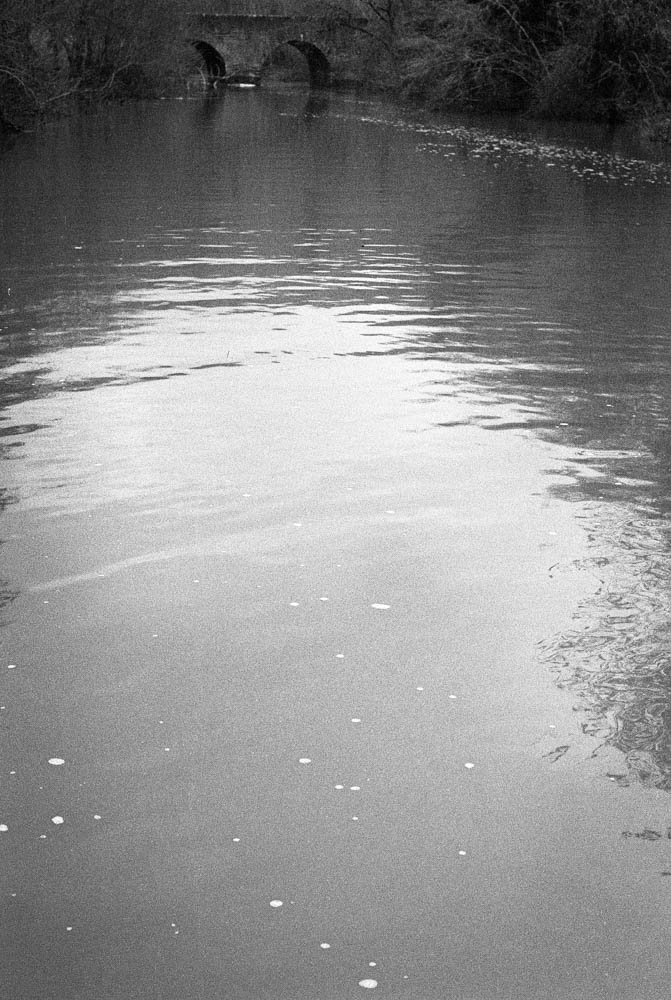
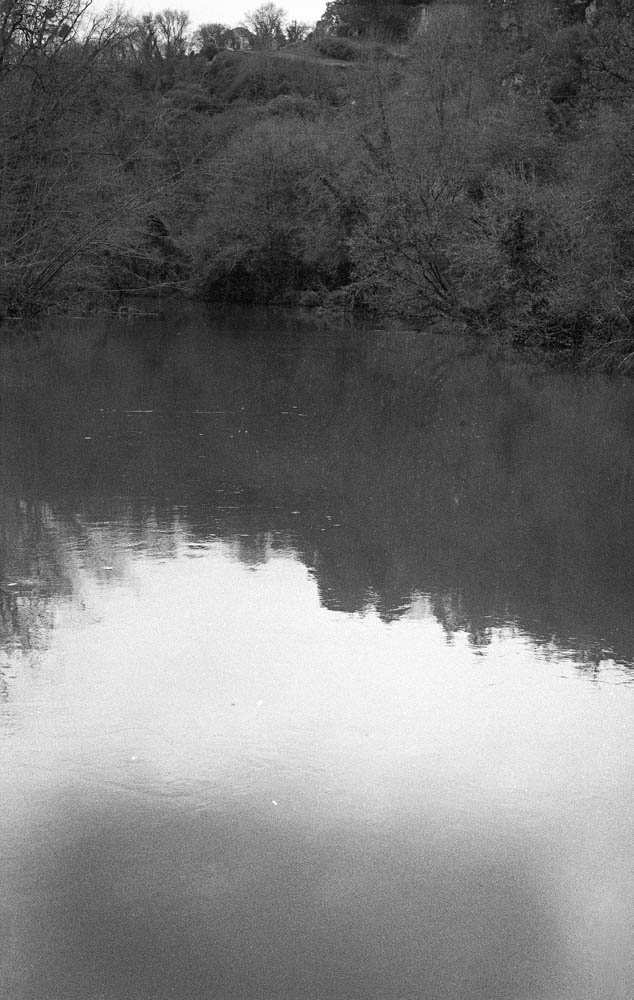
River surface with bridge in distance

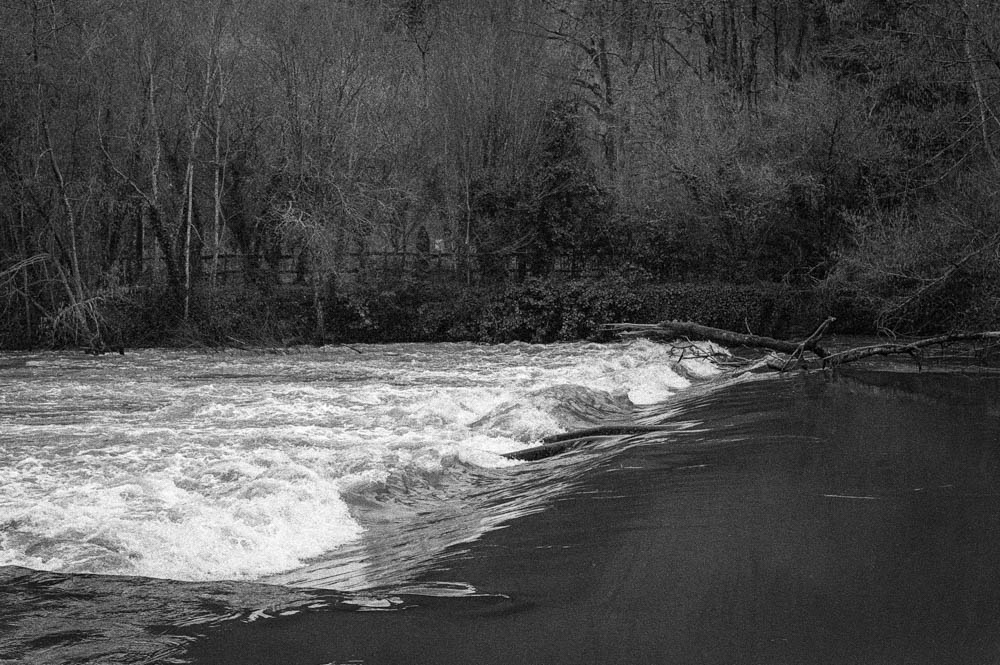
When the light is flat, water becomes less about reflection and more about texture. You notice the foam patterns, the subtle ripples, the way debris catches on submerged rocks. RPX 400 handled this beautifully—there’s a softness to the water that feels accurate to how it looked that day, not how I wished it looked.
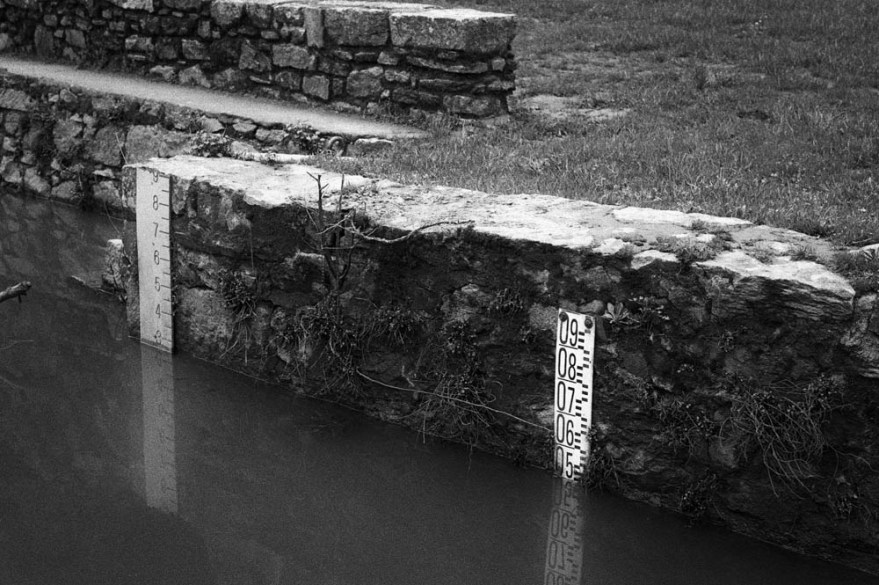
Water Level Gauges

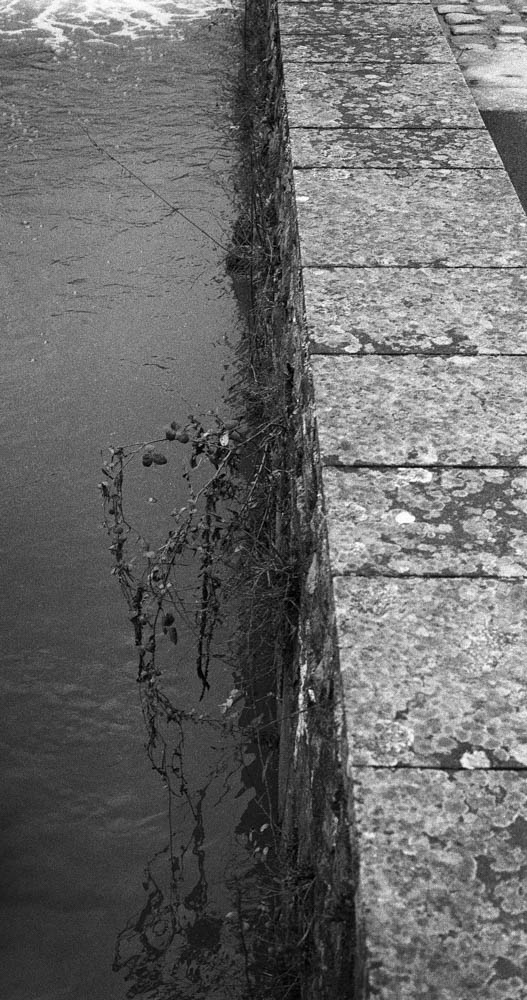
The gauges became an unexpected focal point. They’re functional objects, not particularly beautiful on their own, but they tell the story of this place better than any dramatic landscape could. The reflection of the numbers in the still water added a compositional echo I didn’t plan but gladly kept.
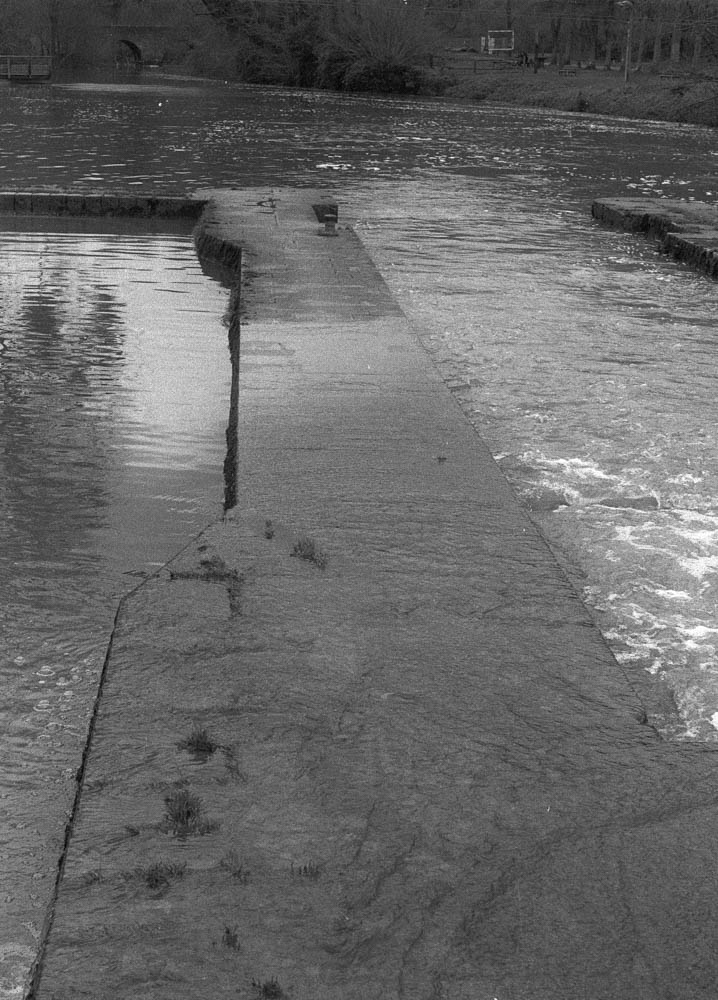
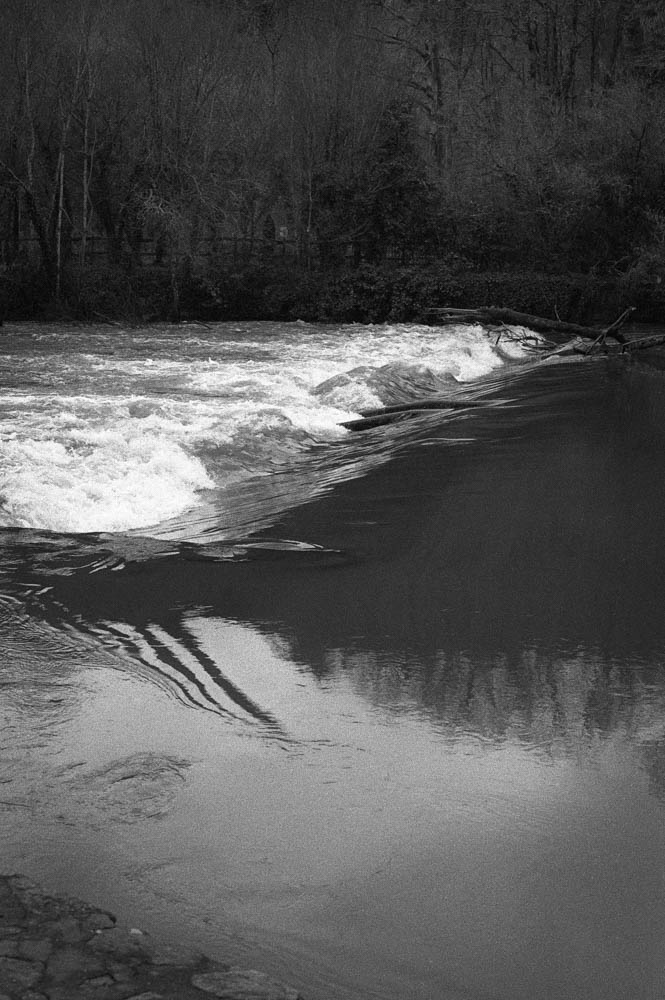
Weir Structure

Where the water quickened over the weir, I had to be careful with exposure. Film handles highlights more forgivingly than digital, but I still metered conservatively. The fallen branch caught my eye—it’s the kind of detail you miss when you’re looking for the big shot, but it adds a diagonal line that pulls the frame together.

On editing the water: The challenge here was separation. When both sky and water are grey, they tend to merge into one another. I used subtle dodging to lift the highlights on the water’s surface, just enough to ensure the reflections didn’t disappear. Nothing dramatic. Just enough to guide the eye.


The Cliff Face

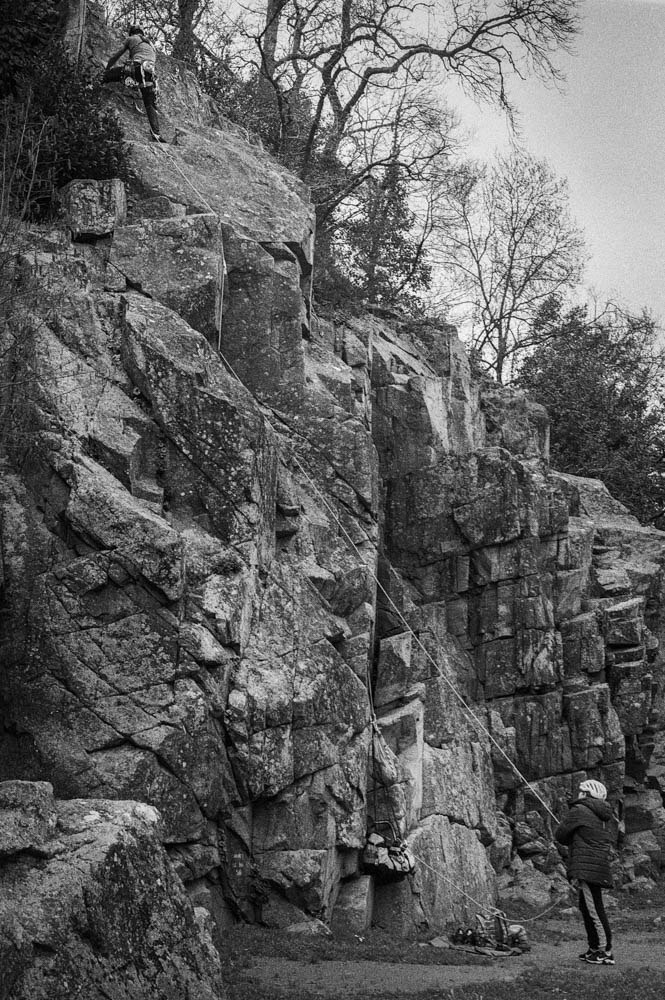
The granite cliffs that frame the Maine valley are dramatic even in bad light. They’re also popular with climbers, which adds a human element I hadn’t planned to capture but couldn’t ignore.
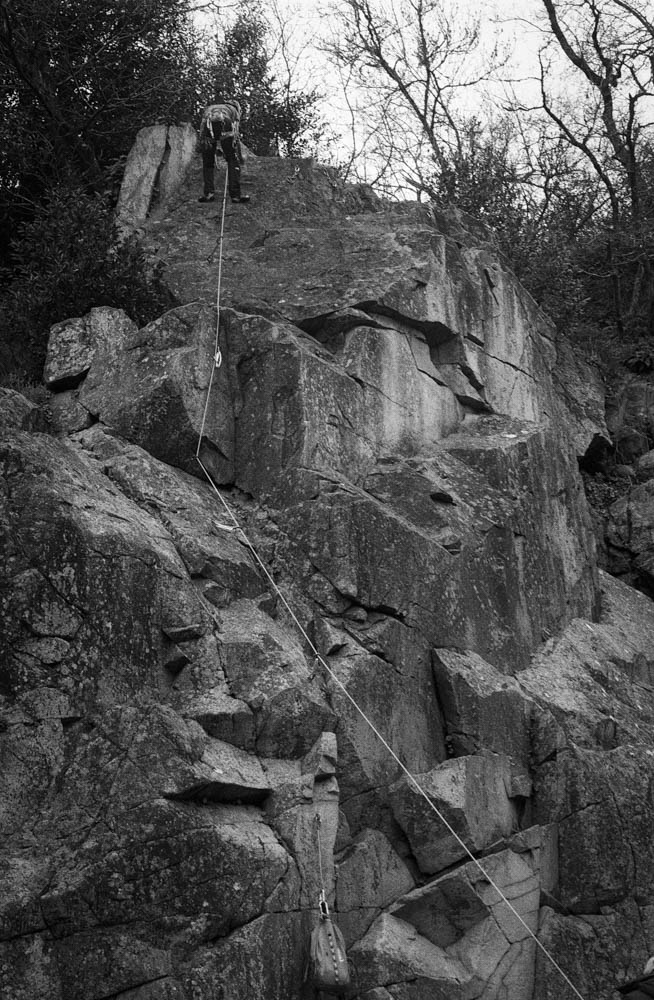
Climber on Granite Close-up

I haven’t shot rock faces like these on HP5+ before. The nearest I got to that was shooting in the Pyrenees mountains—different stone, different light, different everything. So I didn’t have a direct comparison to fall back on. What I noticed with RPX 400 is how it renders texture without aggression. Every crack and lichen patch comes through, but without the bite that HP5+ might have given. For this particular day, that suited the mood better.
Climbing Scene Wider

Seeing the climber and belayer together reminded me that landscapes aren’t empty. They’re used. They’re lived in. The rope creates a diagonal line through the frame, and suddenly there’s narrative—someone is trusting someone else, and both are trusting the rock.

On editing the cliffs: This is where dodging and burning did the most work. Flat light makes rock faces look two-dimensional, like cardboard cutouts. I spent time burning in the crevices and dodging the raised surfaces, essentially repainting the light that wasn’t there when I pressed the shutter. It’s not about creating drama that didn’t exist. It’s about revealing the dimension that the light flattened.


Details

I’ve learned to slow down on days like this. When the big vistas aren’t cooperating, the small things start to speak.
Catkins/Branches

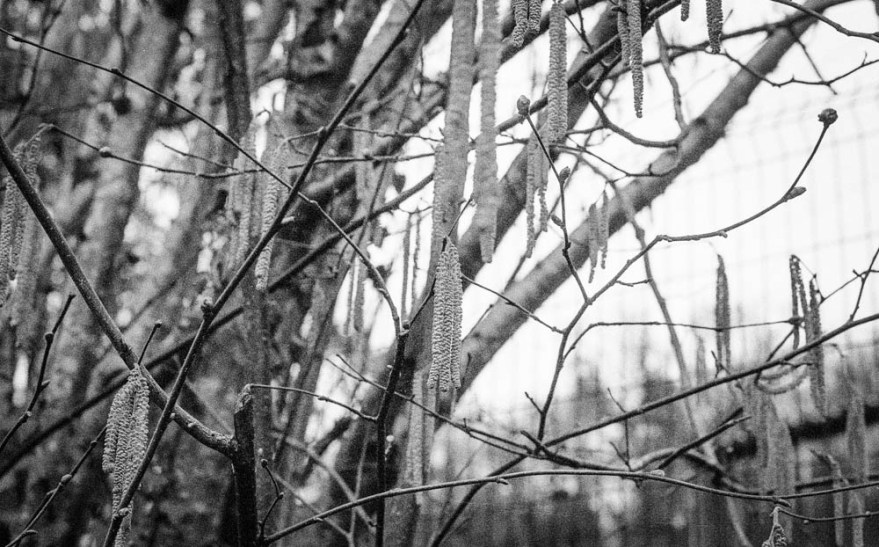
The catkins hanging from bare branches aren’t dramatic. They’re not even particularly interesting as a subject. But they caught the light in a way that felt worth capturing. The shallow depth of field creates a dreamy quality, and the grain—more noticeable here than in the landscapes—adds character rather than detracting from it.
Water Edge Vegetation
Mechanical Detail

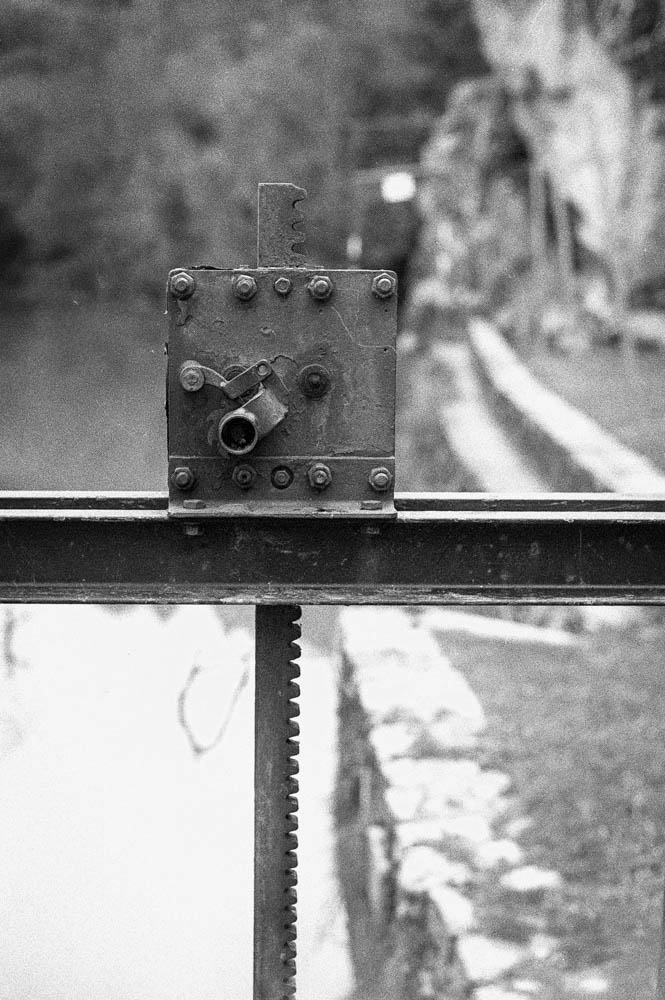
The mechanical detail—the lock gate mechanism, I think—was almost accidental. I was walking back from the viewpoint and noticed the bolts, the geared rack, the weathered metal. It’s the industrial counterpoint to all the natural elements. Sometimes you just stop and shoot because something looks like it has a story.

On editing the details: I was careful not to over-sharpen these. The natural grain of RPX 400 provided enough texture without needing digital enhancement. If anything, I pulled back on clarity rather than adding it. These images work because they’re soft, not in spite of it.


The Town & Viewing Platform

For the full perspective, I drove up to Château-Thébaud’s belvedere, “Le Porte-Vue.” It’s a striking piece of architecture—Corten steel extending 23 meters out at 45 meters above the river, designed by Emmanuel Ritz and inaugurated in 2020.
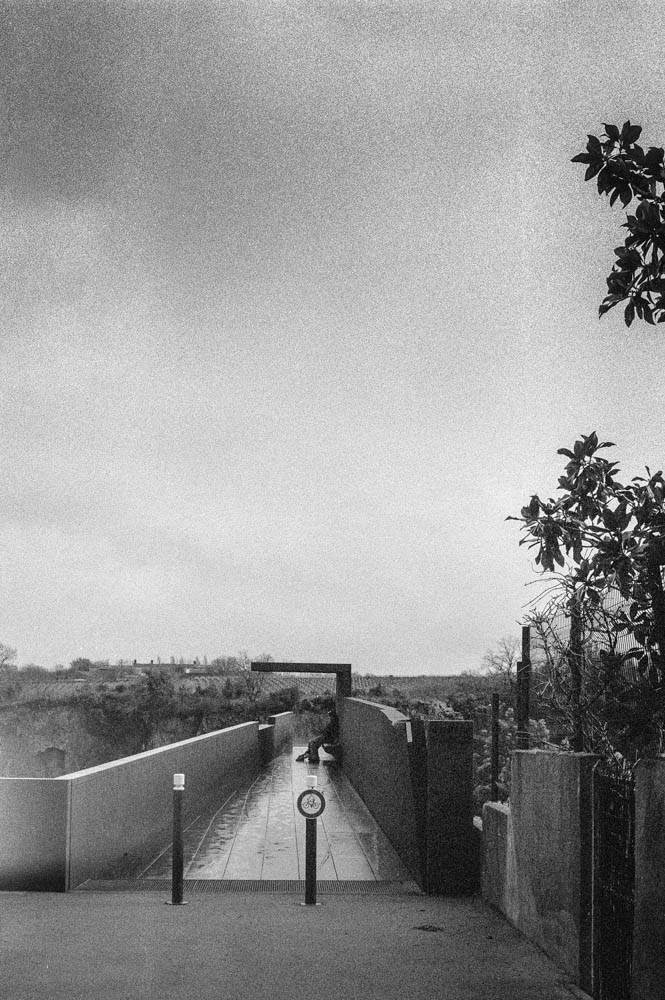
Walkway to Viewpoint

Walking out onto the platform, you feel the height. The steel underfoot, the railing at your side, the valley opening up below. There’s a figure in this shot—could be another photographer, could be anyone taking in the view. It adds scale and reminds you that you’re not alone in these places.
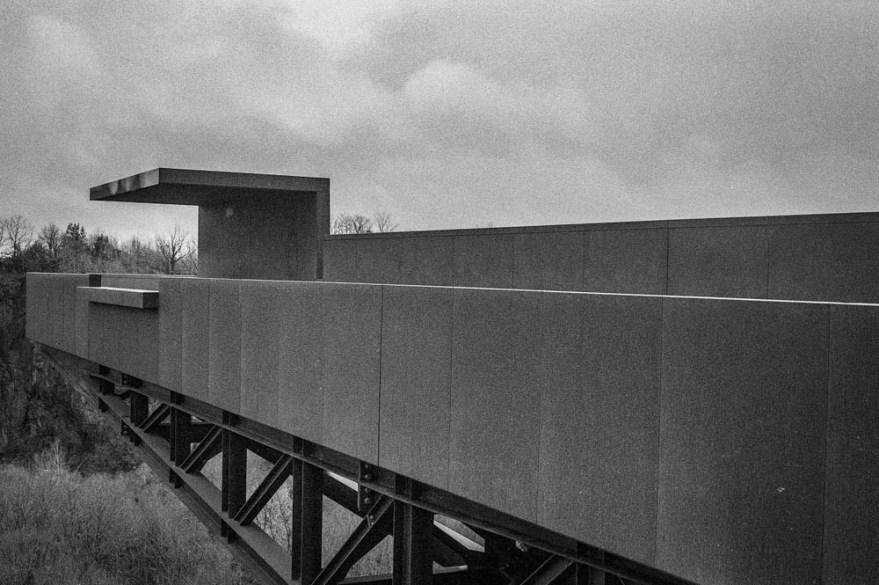
Le Porte-Vue Architecture
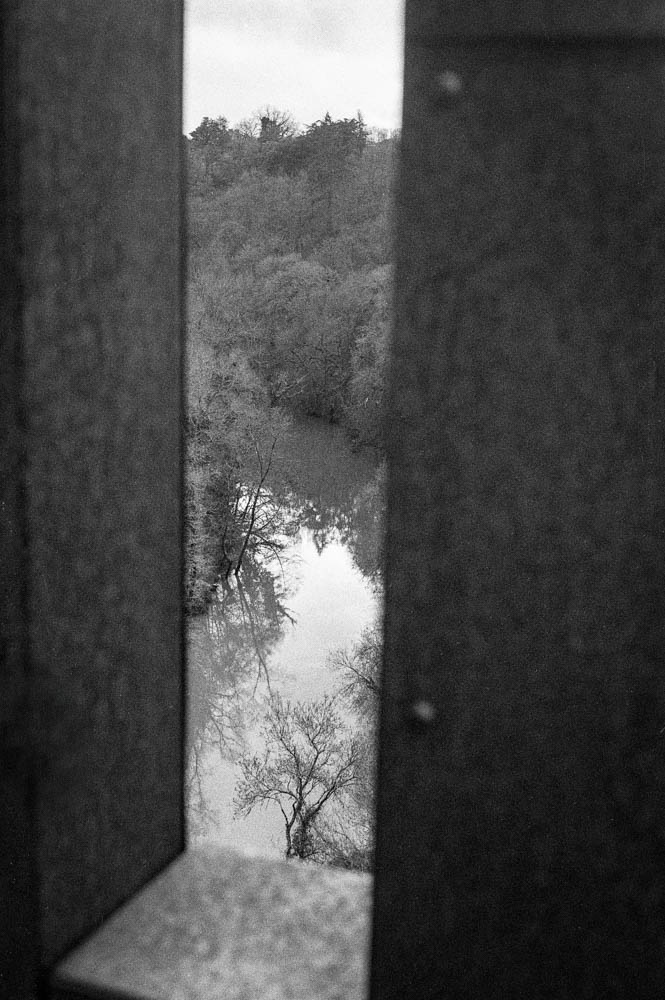
Framed View Through Steel

The Corten steel handled the flat light better than I expected. The weathered texture gave the film something to hold onto, and the geometric lines contrast nicely with the organic landscape beyond. The framed view through the steel structure became one of my favourite shots—it acknowledges that you’re looking from somewhere, not just capturing a scene.
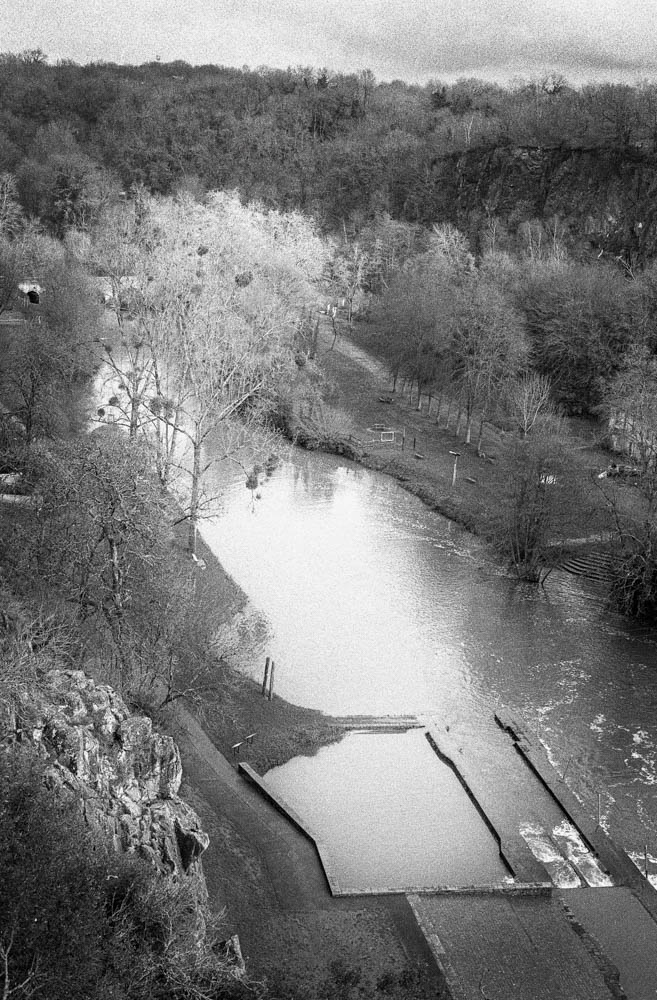
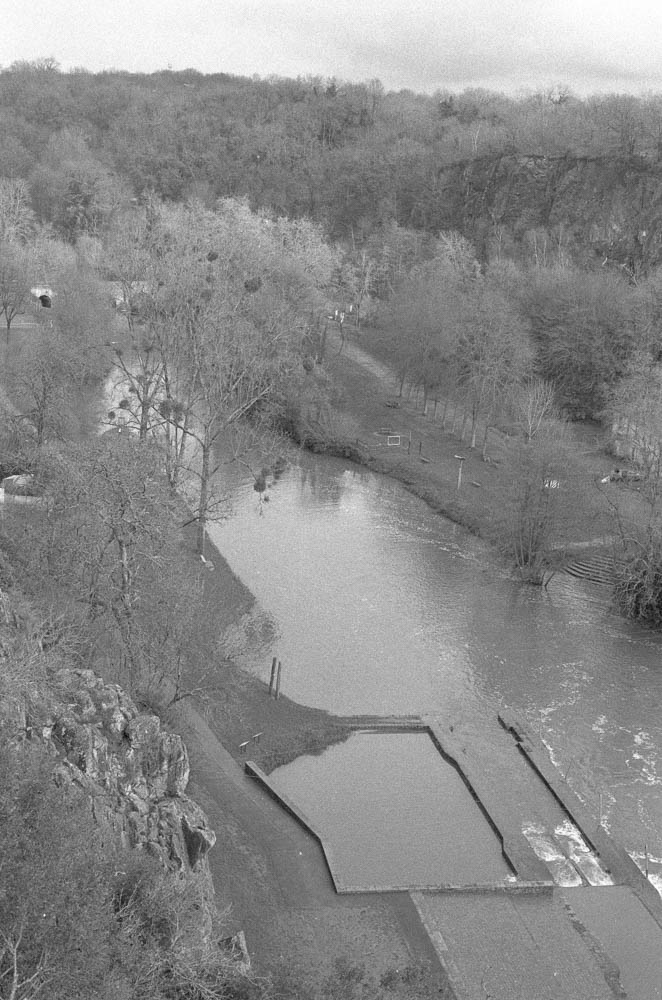
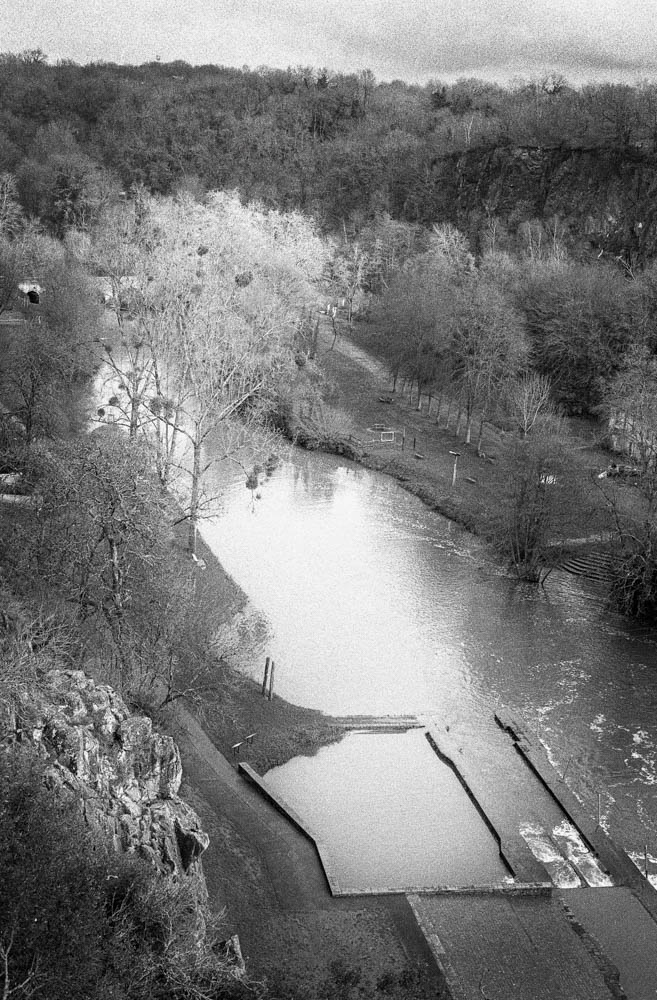
River Valley Overview

This is the establishing shot. The full Maine valley from above, all the elements visible at once. You can see the weir, the cliffs, the tree line. After seeing the Maine at St Hilaire de Loulay with water everywhere, this view felt almost spare. The lower levels exposed more of the structure than I’d imagined possible. It’s the image that ties everything together.
Church Steeple
Village Street

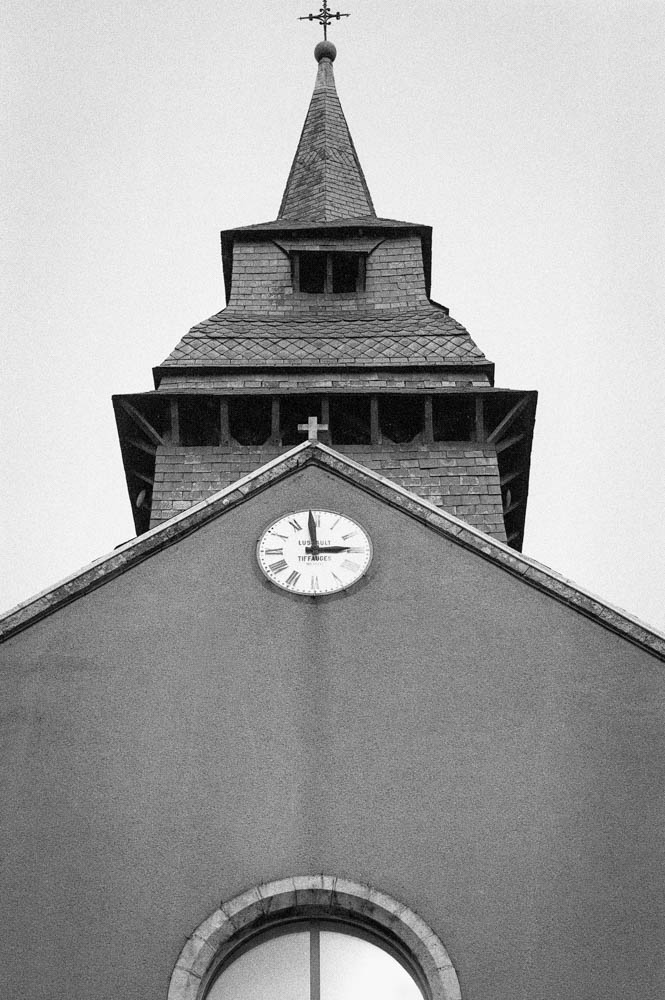
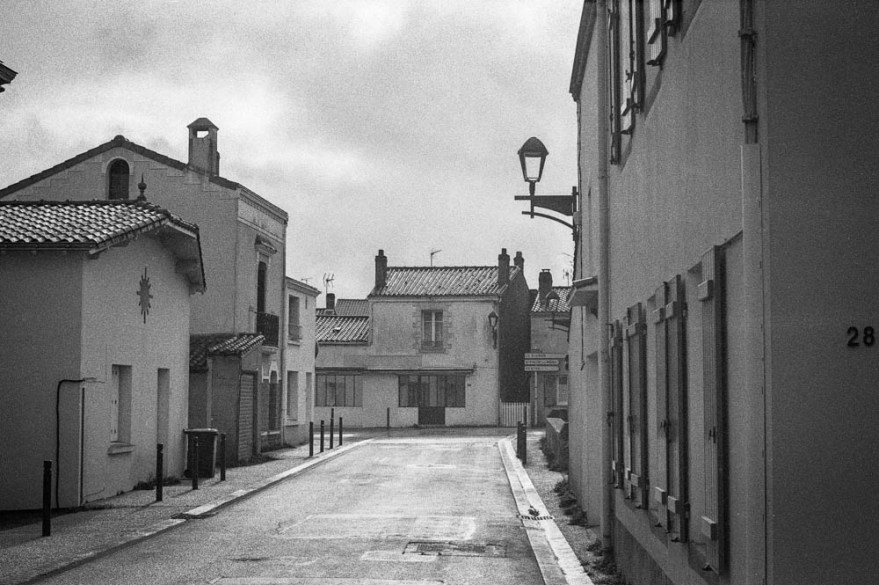
The village itself grounds the landscape. The church steeple adds a human landmark to the valley. The quiet street with its leading lines and the number “28” on the wall—these are accidental details that add authenticity. This isn’t a pristine wilderness. It’s a place where people live.

On editing the architecture: I focused on straightening lines and ensuring the steel texture didn’t look too smooth. The flat sky was retained intentionally. I could have blown it out or added artificial clouds, but that would have been dishonest. This is the light I had. This is the day I experienced.


On Making It Less Ordinary

Looking down at the river from Le Porte-Vue, I thought about what I was actually trying to do.

This was my first time at Pont Caffino, and I wasn’t sure what to expect. RPX 400 felt right for this quieter, more exposed version of the valley. But the film alone wasn’t enough. The scans came back flat—accurate, but lacking the dimension I remembered from being there. That’s where the work began.

In Lightroom, I used the Tone Curve to add a gentle S-shape, nothing aggressive. Just enough to add punch without crushing the blacks. I lifted the deepest shadows slightly to preserve the atmosphere. And then I spent time dodging and burning—manually painting light into the highlights of wet granite, holding back exposure in the shadows of riverbanks, guiding the viewer’s eye through texture and tone.

I’ve only started using the Tone Curve with this roll of film. I’m still getting used to it. But I’ve found it offers basic yet subtle controls, as does the dodging and burning. It’s easy to feel like this is cheating. Like you’re admitting the photograph wasn’t good enough straight from the scan. But I’ve started to think of it differently. Dodging and burning isn’t about fixing mistakes. It’s about translation. It’s about taking what you saw and felt and finding a way to communicate that to someone who wasn’t there.

There’s a danger in thinking you know everything. Usually, that’s when you stop seeing. When you assume the light will behave, or the film will respond the way it did last time, you miss what’s actually in front of you. I’d rather be the one still figuring out the Tone Curve after forty years than the one who thinks there’s nothing left to learn.

The result isn’t dramatic. It’s not the kind of image that stops you scrolling. But it felt honest—a quiet enhancement rather than a transformation. And on a grey February day at Pont Caffino, that’s exactly what I was after.


Technical Note

FilmRollei RPX 400
ISOShot at 400
CameraNikon FE
Lens50mm f/1.8 Nikkor
DevelopmentIlfosil 3 (1:9)
ScanningPlustek OpticFilm 8100

Lightroom Adjustments:

  • Tone Curve: Gentle S-curve, highlights lifted slightly, shadows preserved (First serious use of this tool for me)
  • Local Adjustments: Radial filters for dodging/burning on rock textures and water surfaces
  • Grain: No reduction applied
  • Sharpening: Minimal, applied selectively on details

Thanks for reading. If you’ve shot RPX 400 in similar conditions, I’d love to hear how you approached it.
A before and after shot

The Opening of the Film Archives – March 2017 with Kate in the Vines


Hello you! It’s great to have you back for another dive into the archives. Over the past few posts, you might have noticed a recurring star of the series: my Canon AE1. While it’s true I’ve leaned on this camera heavily for many of these moments, I promise there’s more variety to come—even some colour film photography! For now, though, let’s continue exploring these Canon snapshots together. Thank you for sticking with me—it means a lot to me.

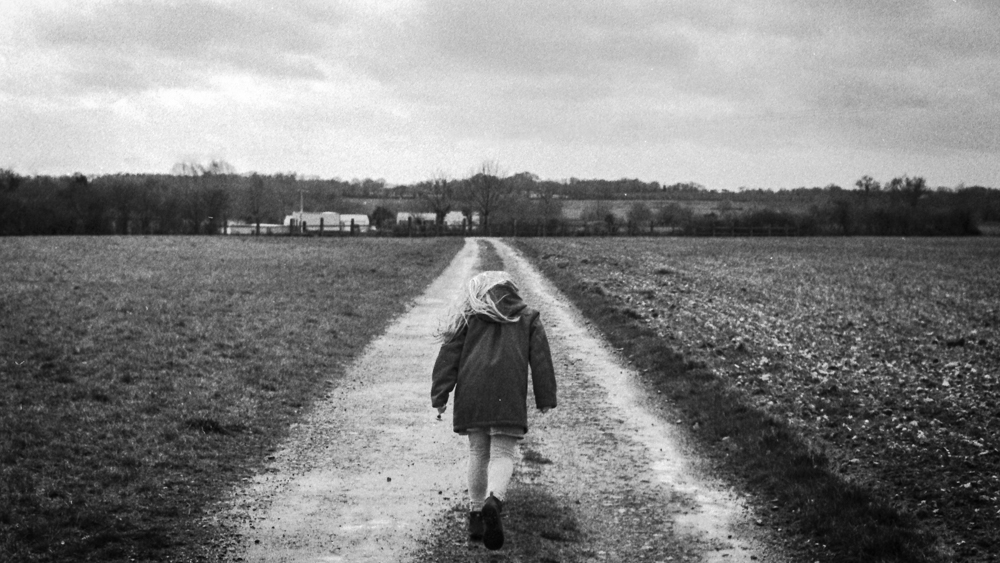
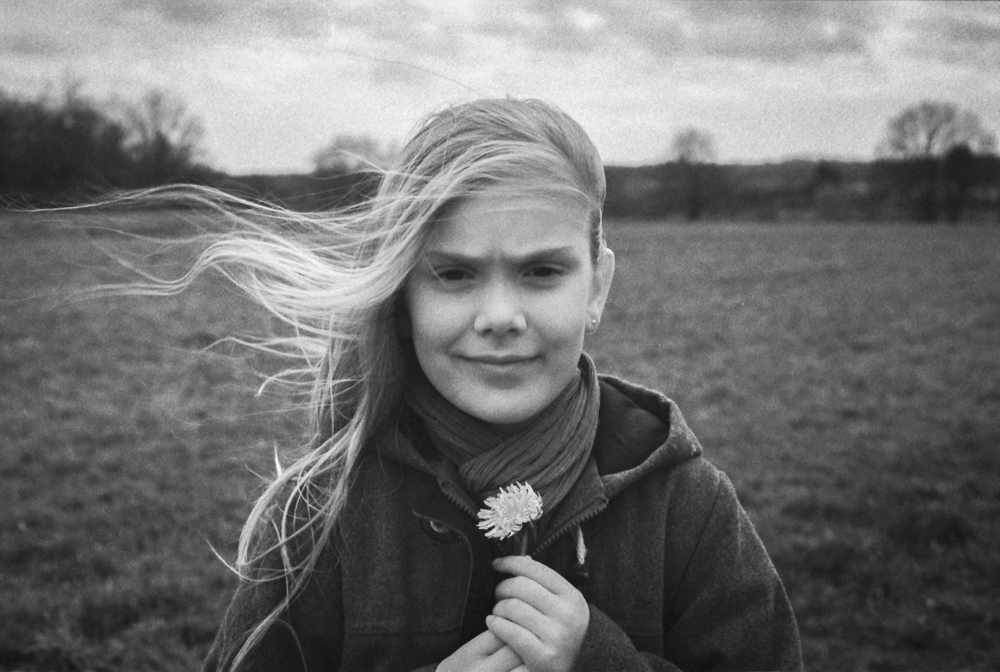
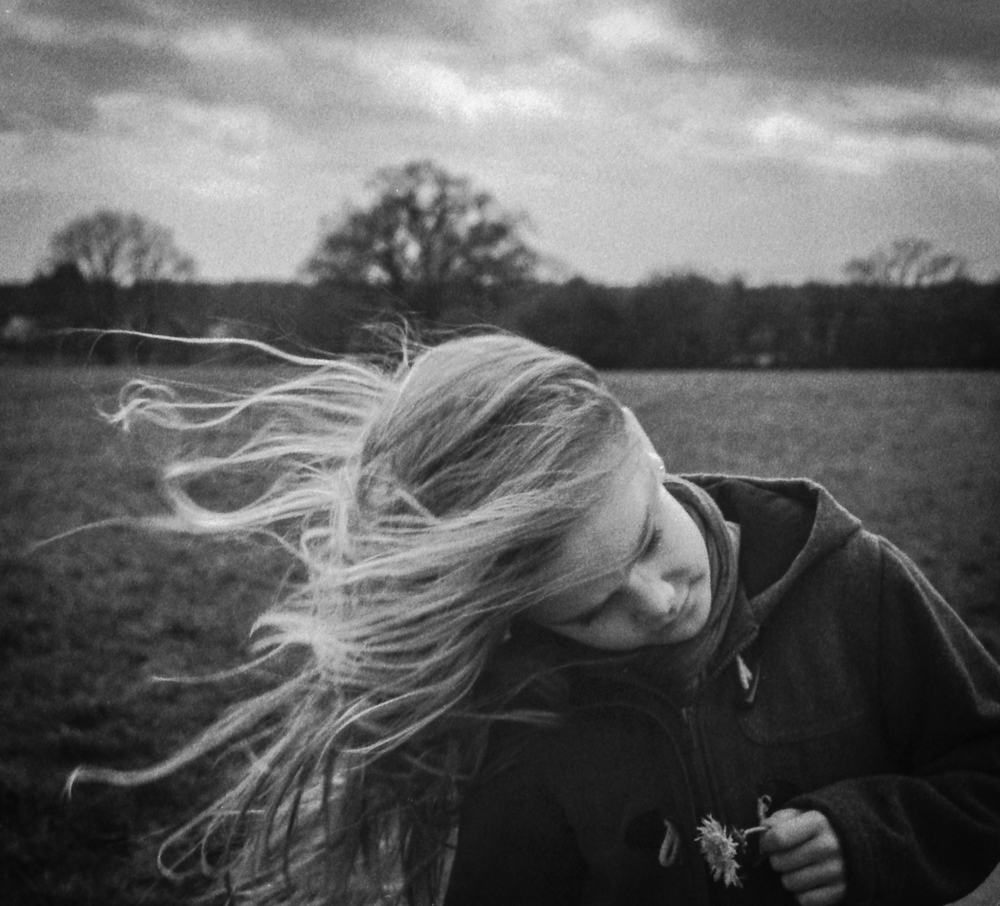
This time, I took my daughter Kate for a walk among the vines—a walk I used to do with Killian when he was about her age. Admittedly, it wasn’t the most creative choice for me, but for Kate, it was a brand-new adventure. That’s my excuse, and I’m sticking to it.

The day was all about Kate, the wind, and the way it danced through her hair. Unlike me, where the wind barely leaves a trace, it created a beautiful, dynamic subject in her. There’s something magical about how the movement of hair and clothing in the wind adds life to a photograph. I captured some truly memorable shots that I now treasure as priceless souvenirs of a fleeting moment.

Maybe they were some of those famous Kodak moments… Whatever the case, they bring back lovely memories of simpler times. Looking back, it reminds me how the simplest moments—like a walk through familiar vines—can hold so much meaning. Sometimes, what’s close to home can be just as captivating as far-off adventures.
It also reminds us that though we might be in familiar territory, that territory can look entirely different to someone seeing it for the first time. The soft, diffused light that day brought out rich textures in the vines, and Kate’s sense of wonder made even the most ordinary details come alive.

When you’re out with your camera, maybe, just maybe, that’s something to keep in mind. How might your everyday surroundings look through fresh eyes—or through the eyes of someone discovering them for the first time?

The Opening of the Film Archives – On the way to work


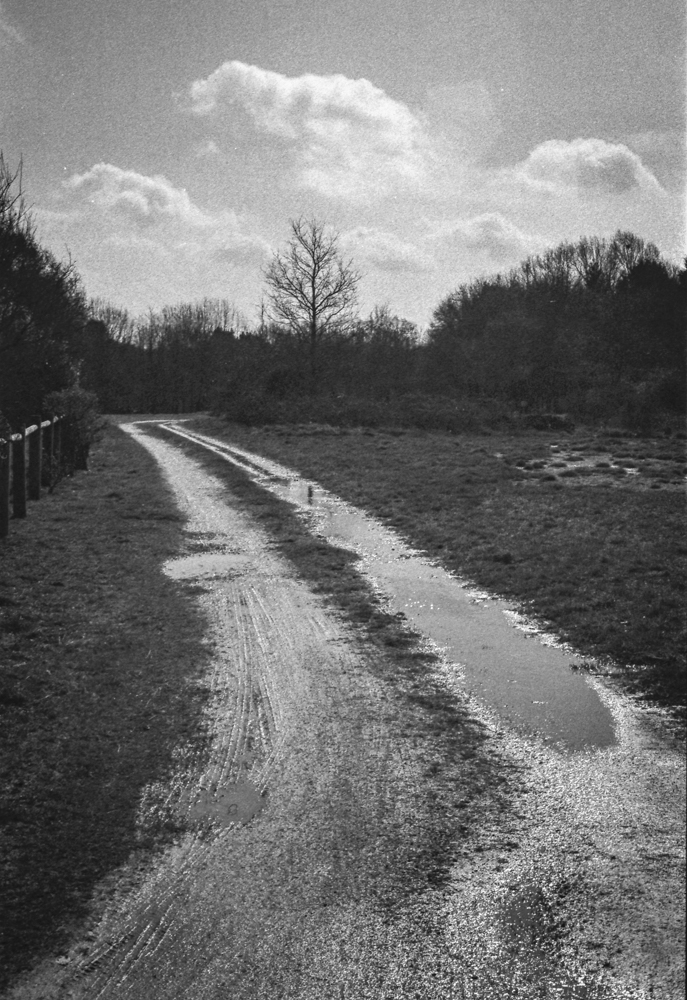
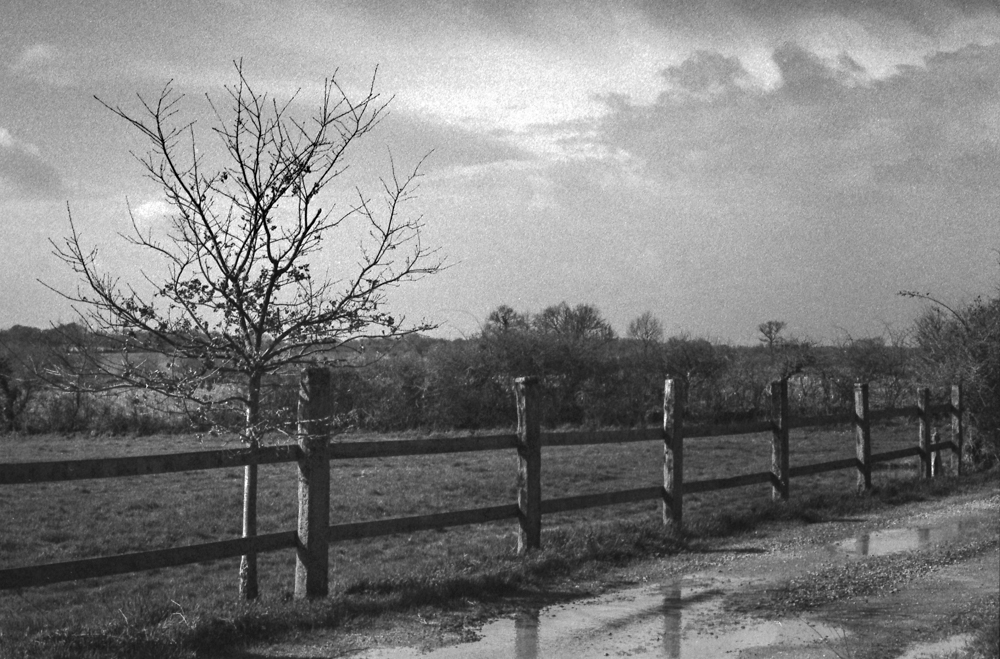
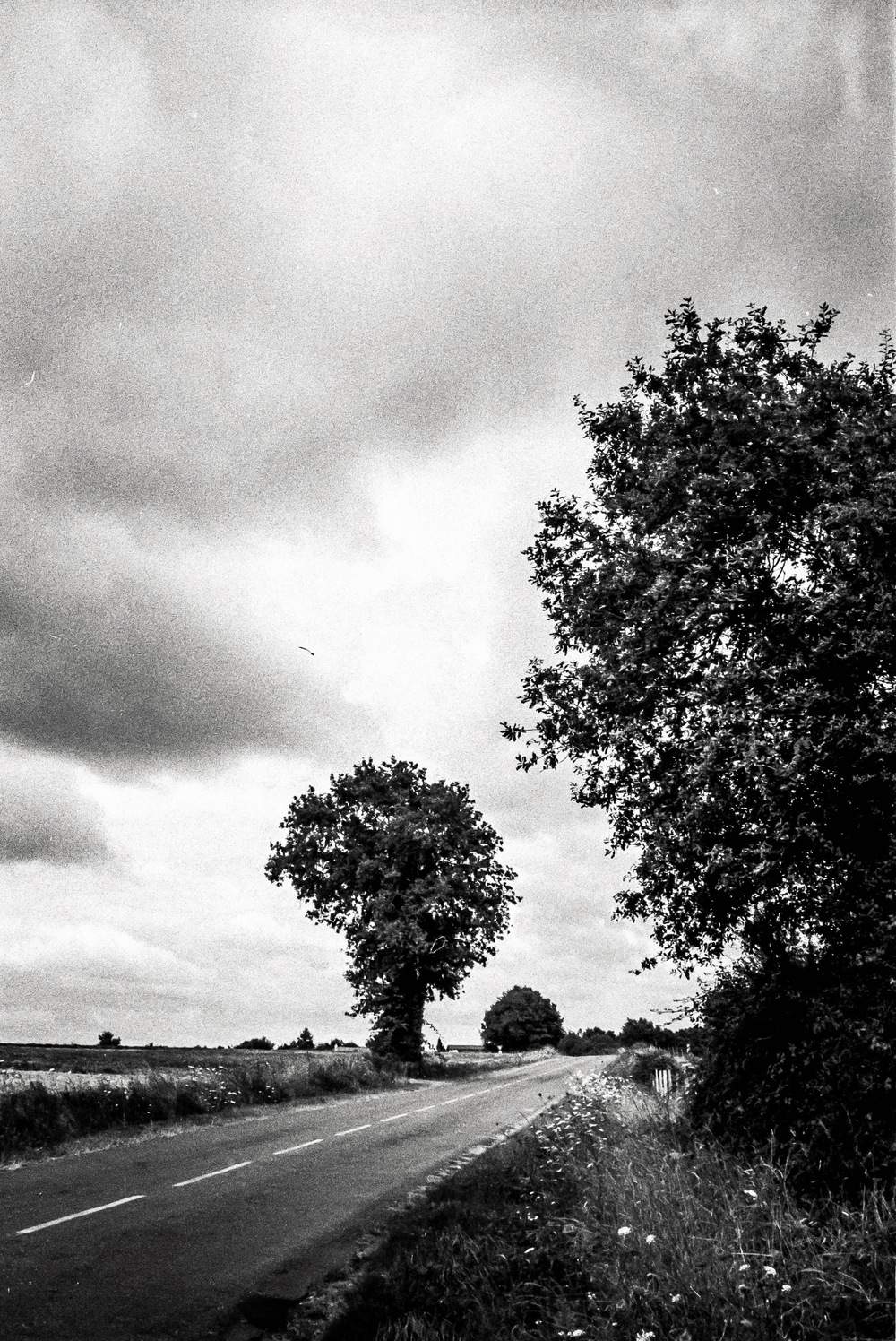
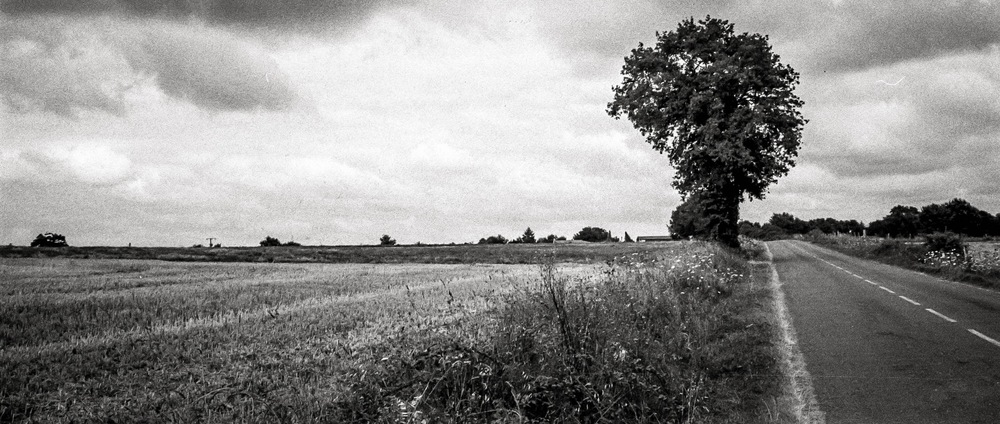
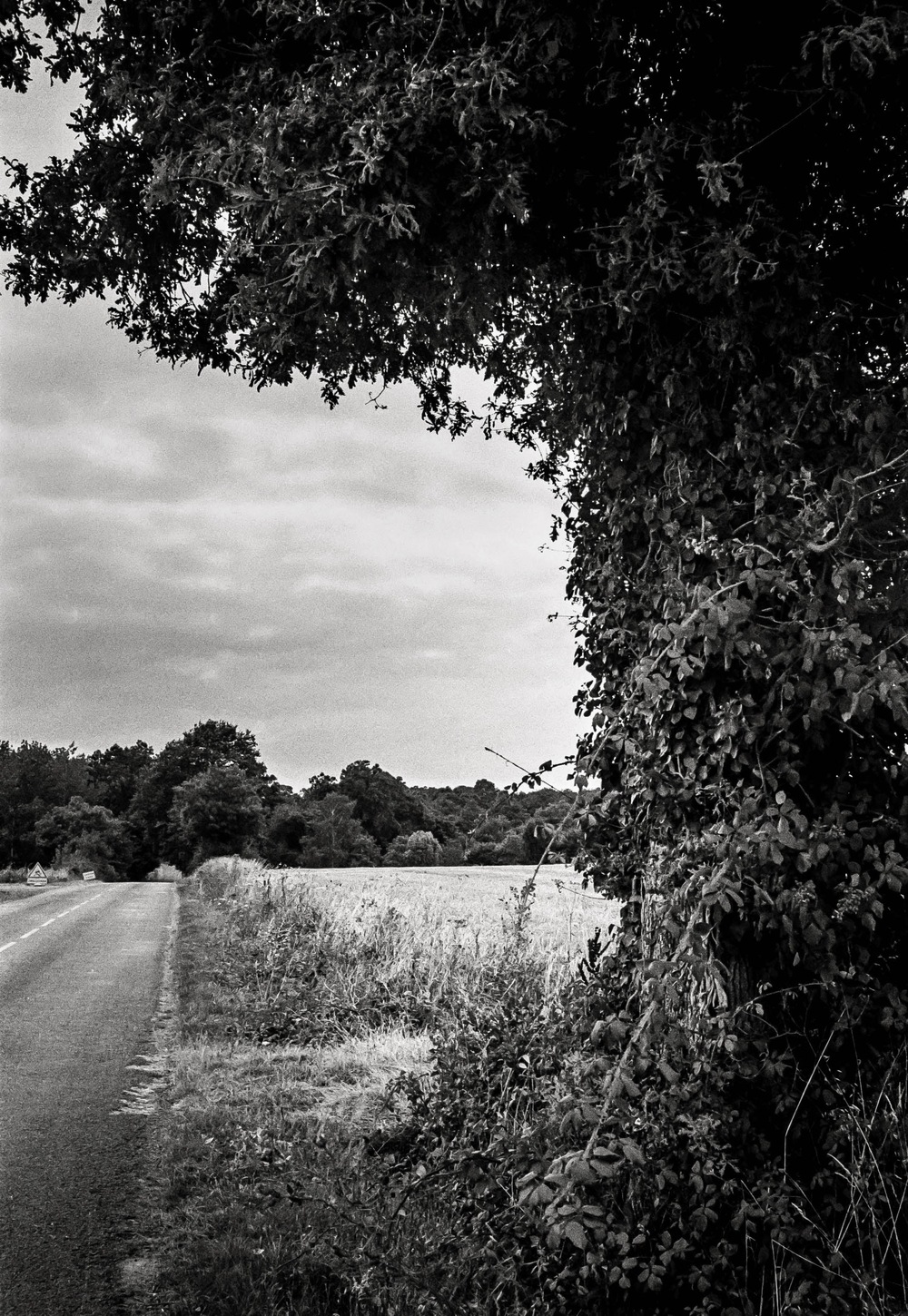
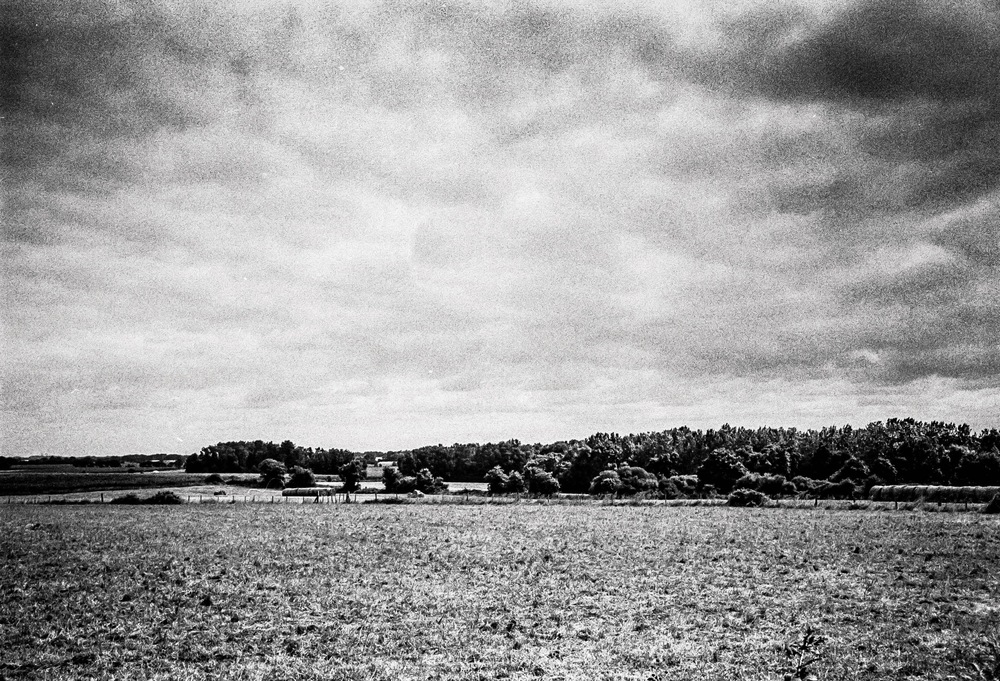
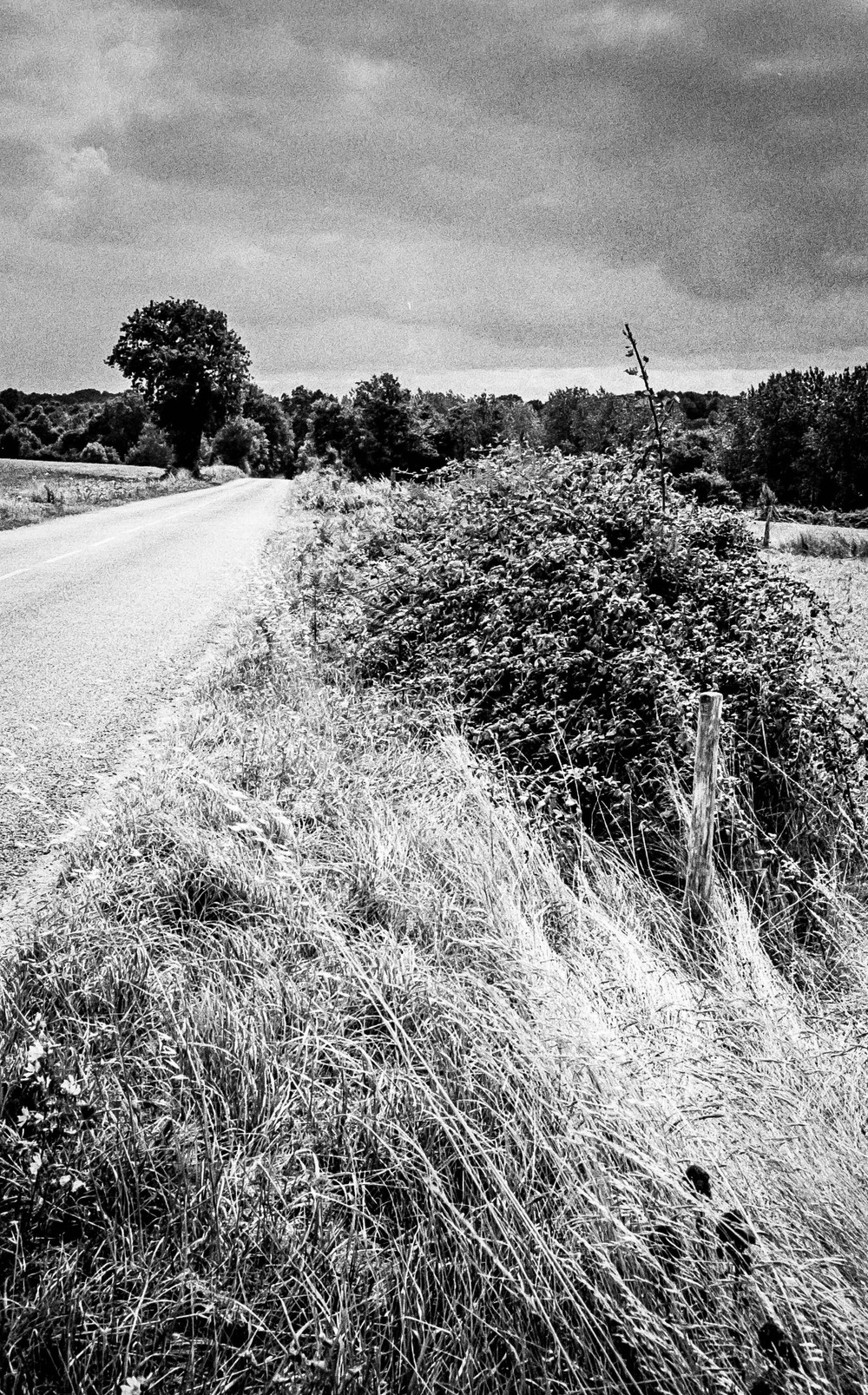
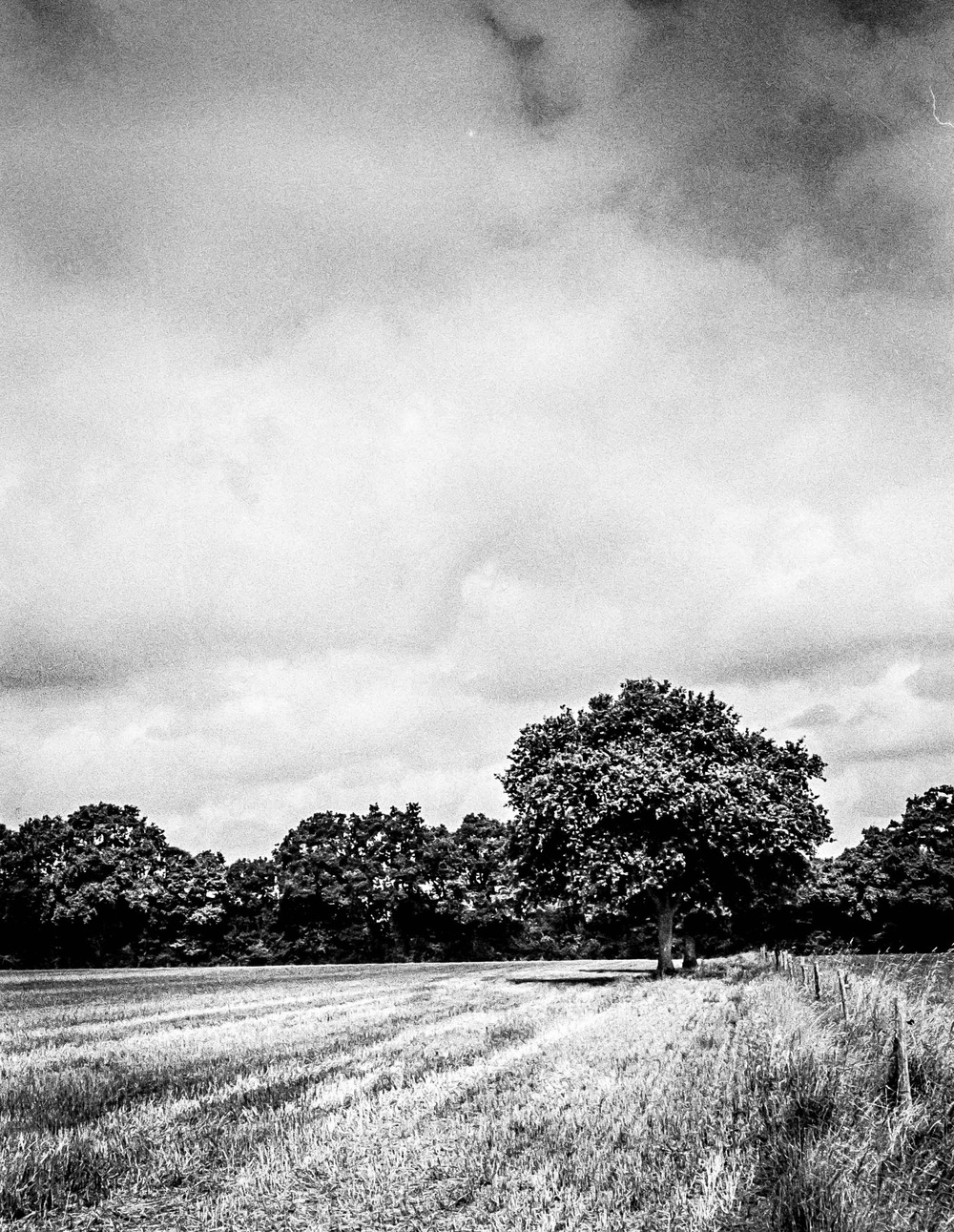
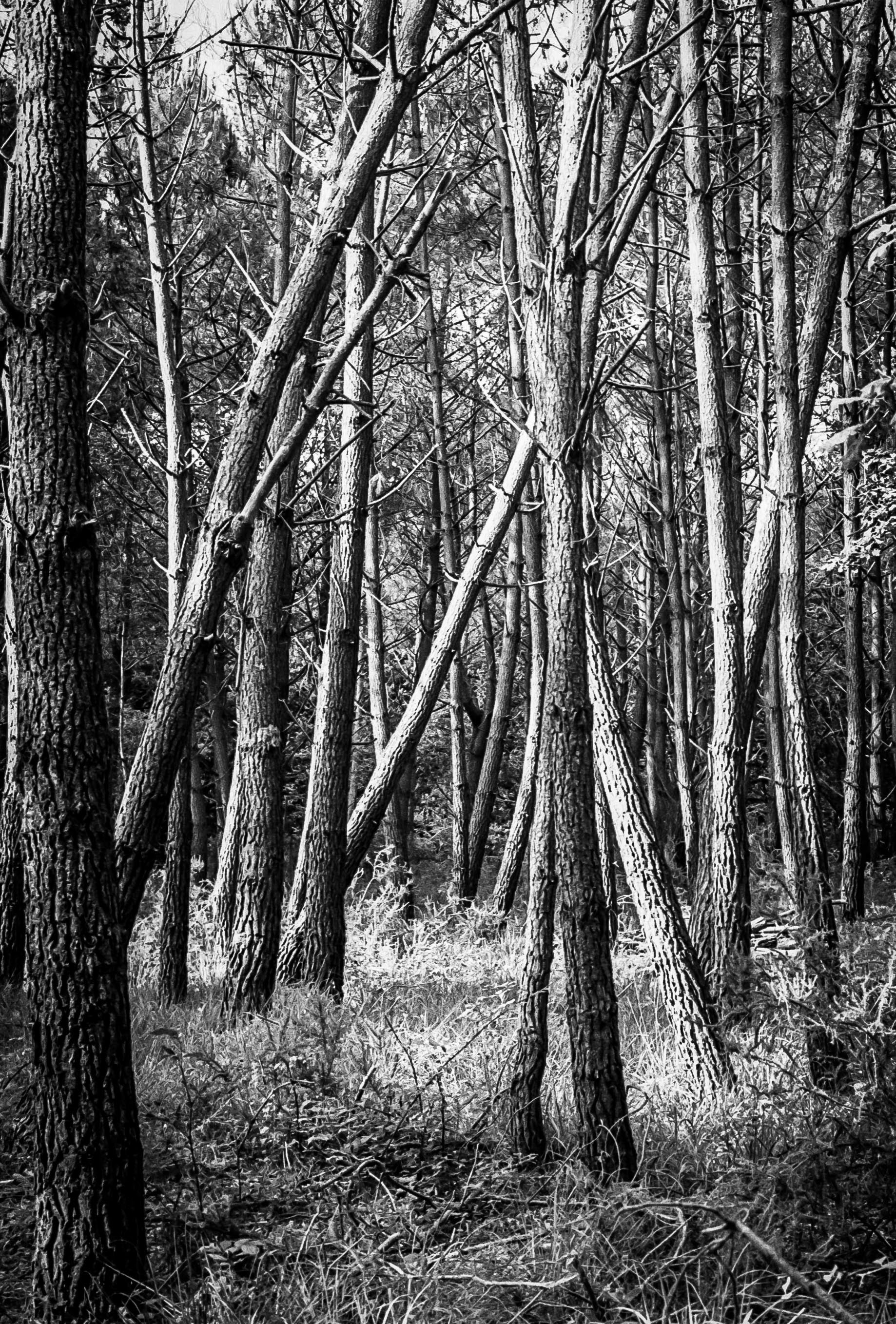
Sometimes we can have a tendency to ignore our habitual surroundings as photographers.  In this series of photos from the film archive, I’m going to show you part of the route I use to go to work.  What is ordinary to one person might be an pastoral idyl to somebody else.  It only goes to show that there is beauty everywhere in this world and one of our roles as photographers is to document it for future generations.

My wife, bless her, has always said that my black and white photos have a timeless feel to them, be they in the city or out here in the country.  I think that using film, especially this grainy HP5 Plus, even shot at box speed, adds to that sentiment.  The fact that I used Rodinal as my developer might have accentuated the grain too.  Also don’t forget that this is the beginning of my return to film development so I might have been a little vigorous in my “agitations” whilst developing the film.  I now use mostly Ilfosil 3 and lower grain film, and have brought a little more “calm” to my “agitations.”

The camera that day was the FED 5 rangefinder camera from Ukraine.  I’ve talked about it before, and although I mainly use SLRs, I still feel guilty about not using it more.  It’s a beautiful camera and I don’t want it to feel neglected.  I might just have to correct that soon.

I lived just outside Paris for 7 years before moving out to the country in 2001.  The change in ambiance was startling.  I went from blocks of flats to village life in the French countryside.  I went from riding the metro, and suburban Parisian trains, to learning to drive though this beautiful landscape.  Driving through this scenery still gets me every time I get into the car.  I wonder what I’ll see.  I see the changes in the fields and countryside through the seasons.

I want you to promise me, Dear Reader, that you will take a closer look at your route to work, and maybe I can convince you to record it too for prosperity.  Don’t worry about film or camera, even just using your phone will do the trick.

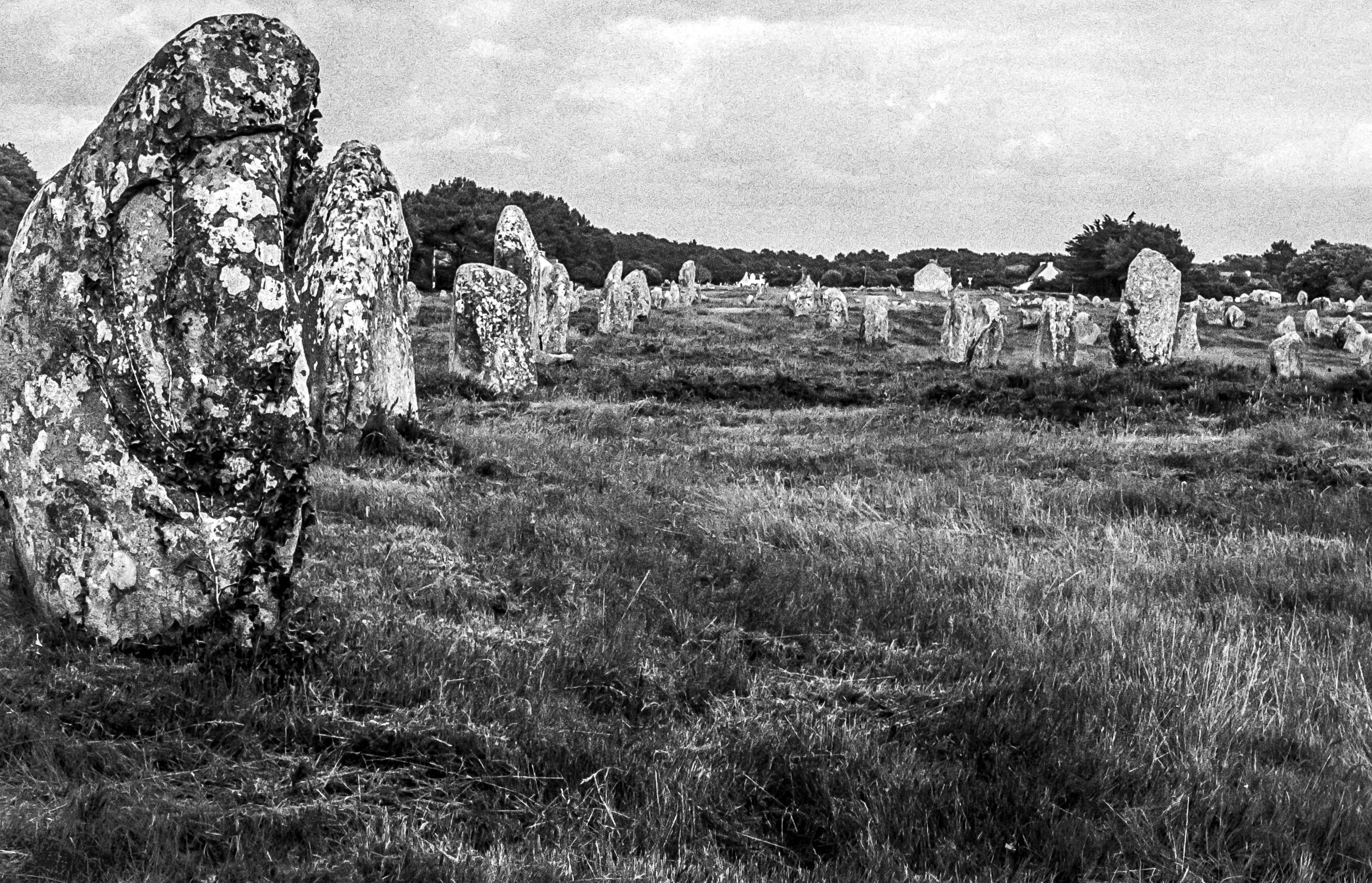
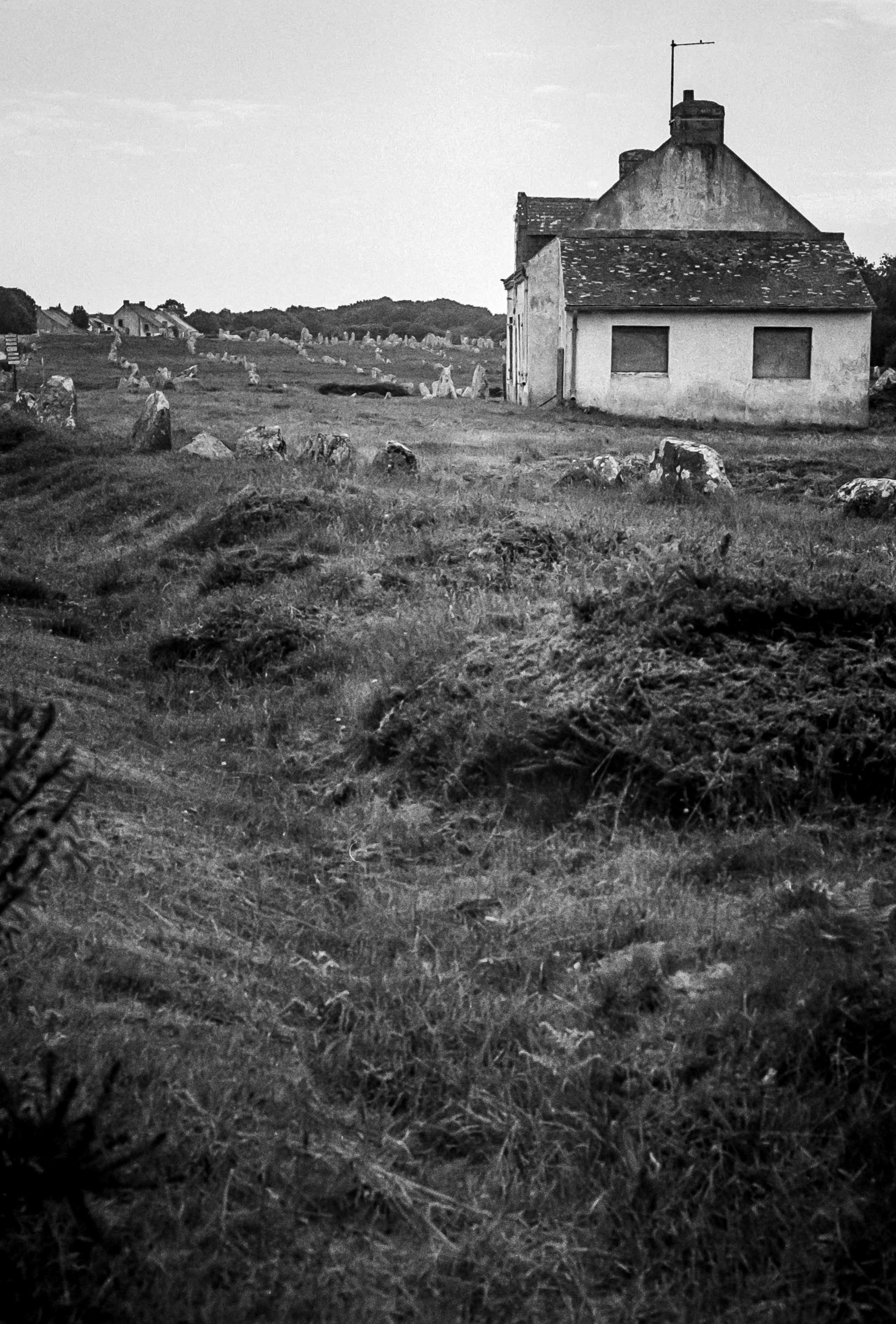
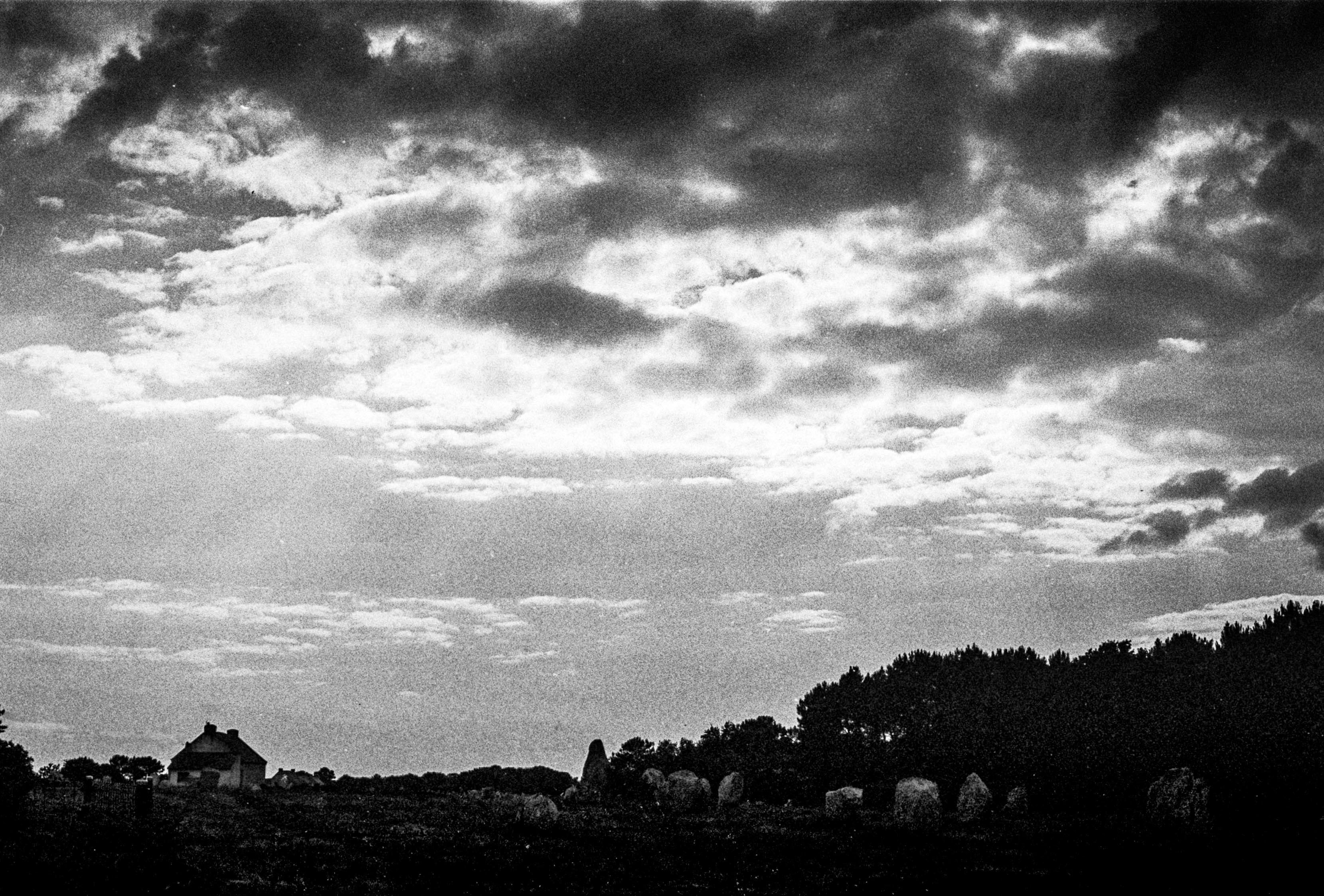
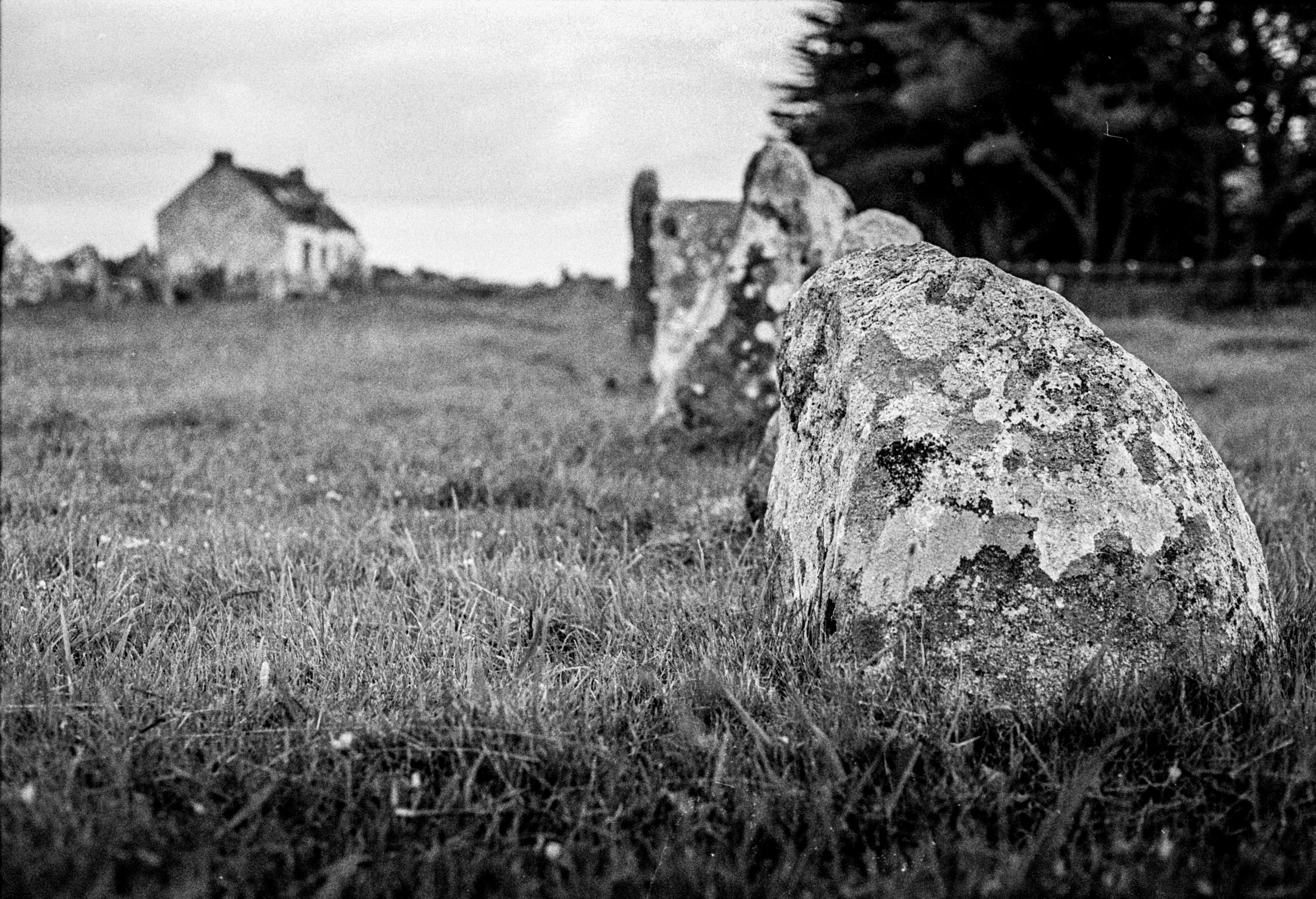
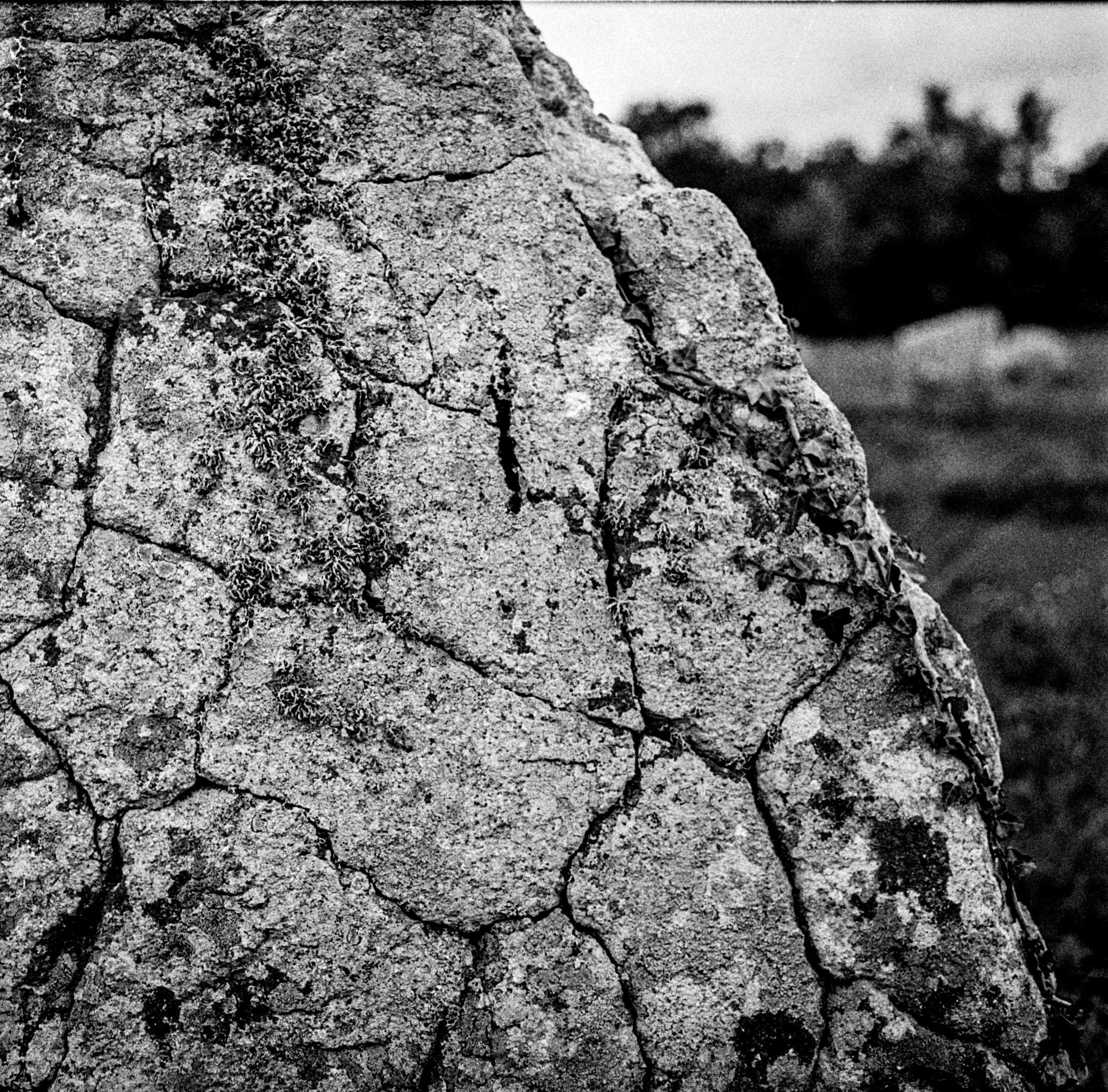
The Opening of the Film Archives – Carnac, 26/06/2016


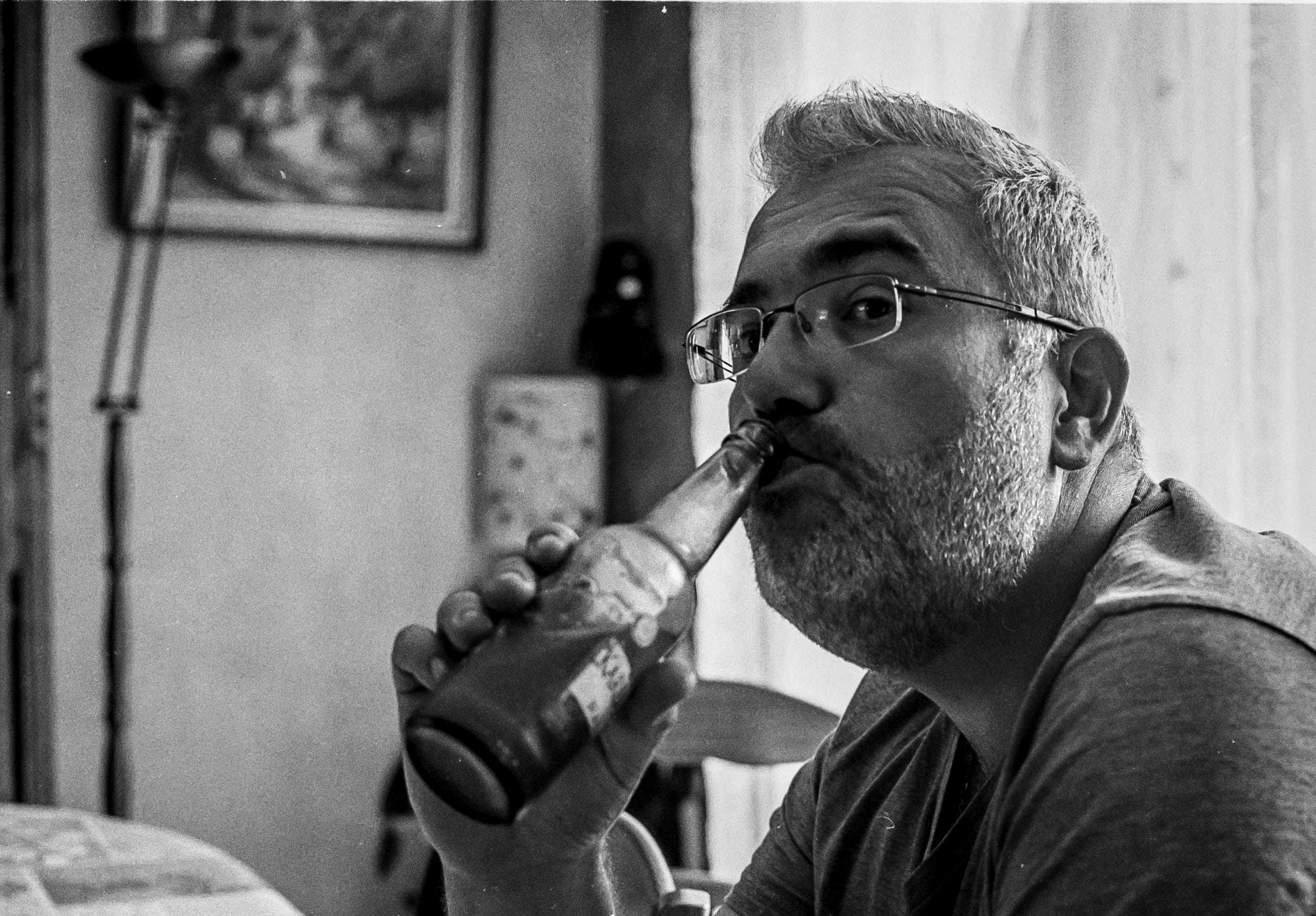
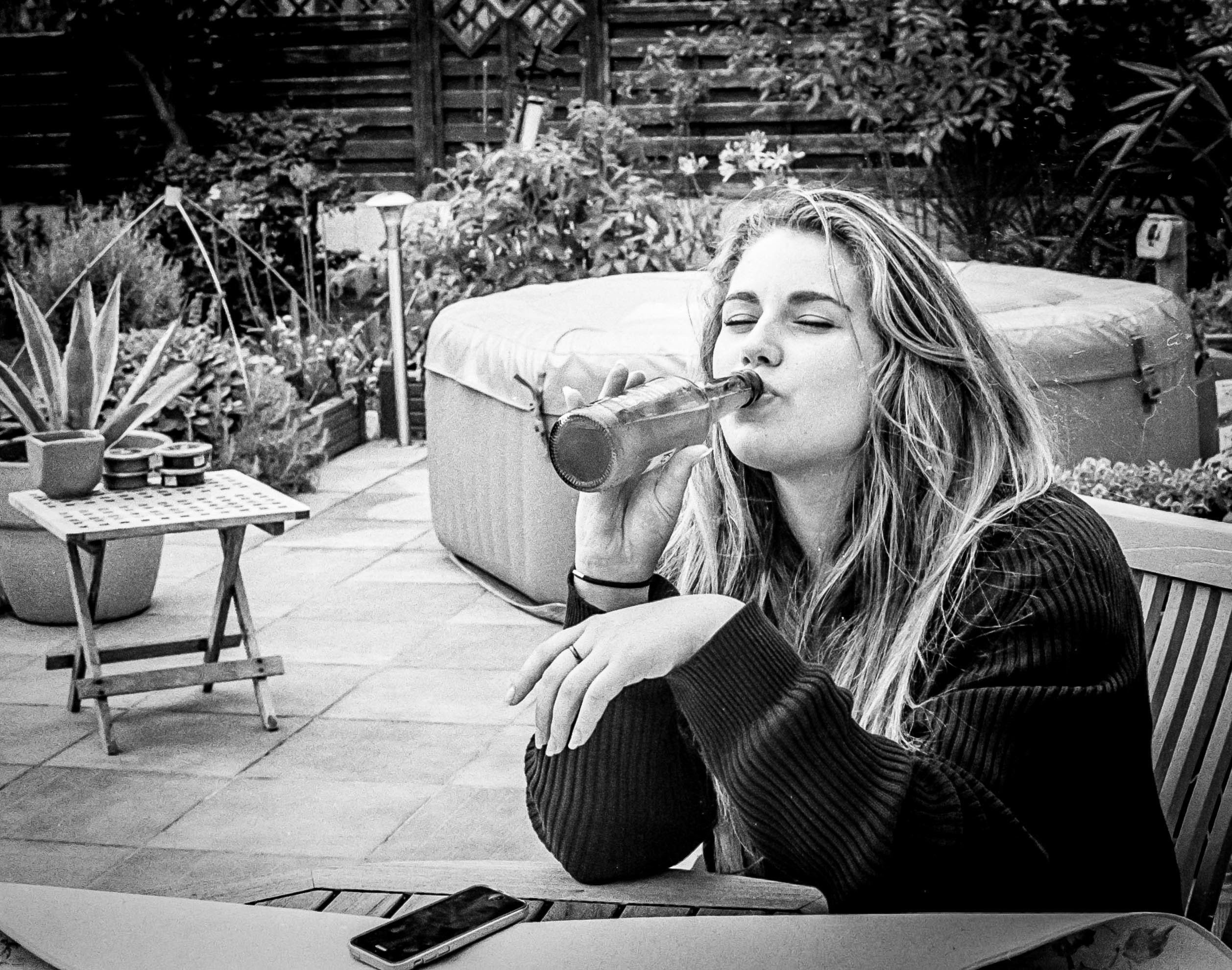
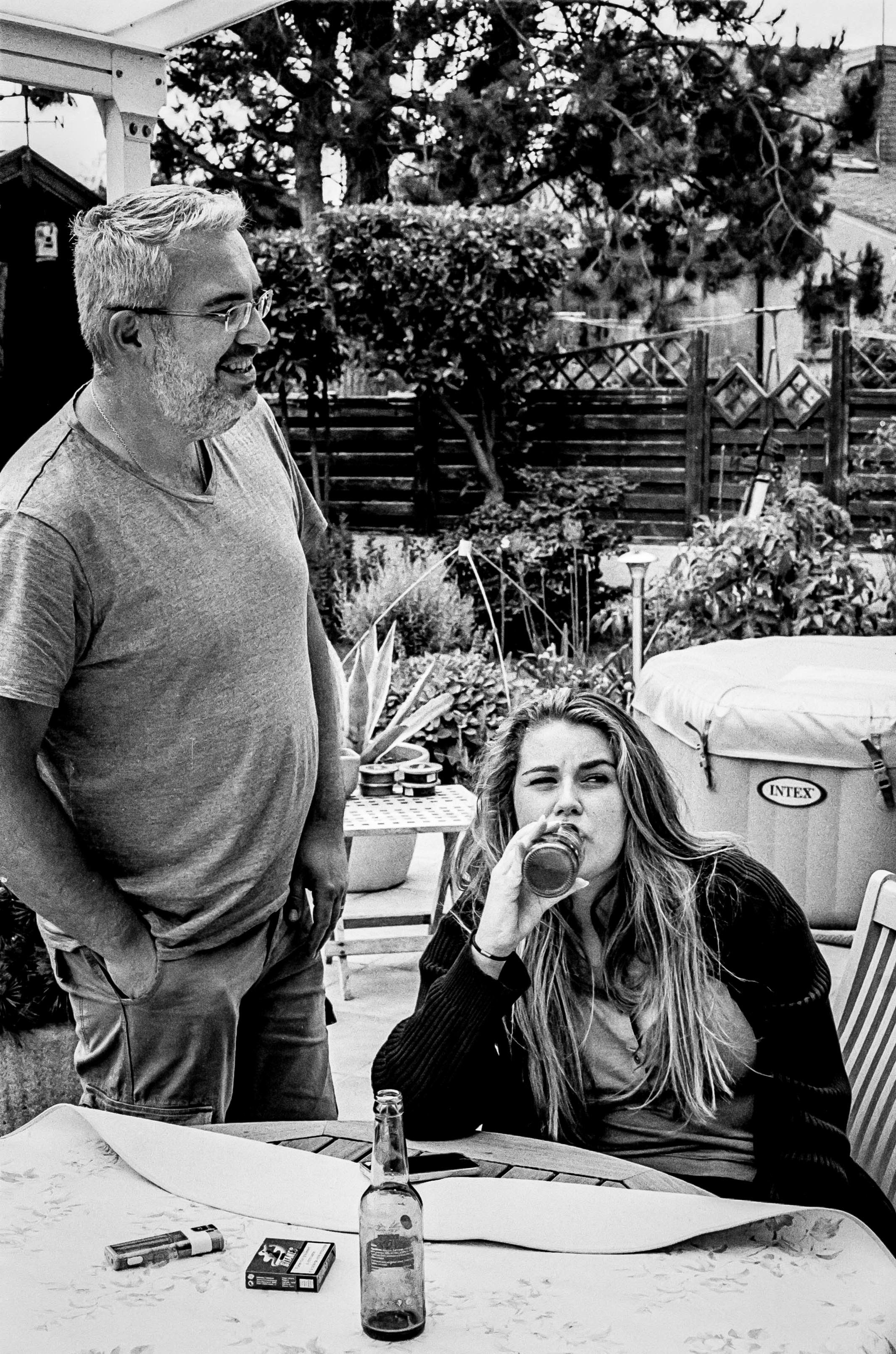
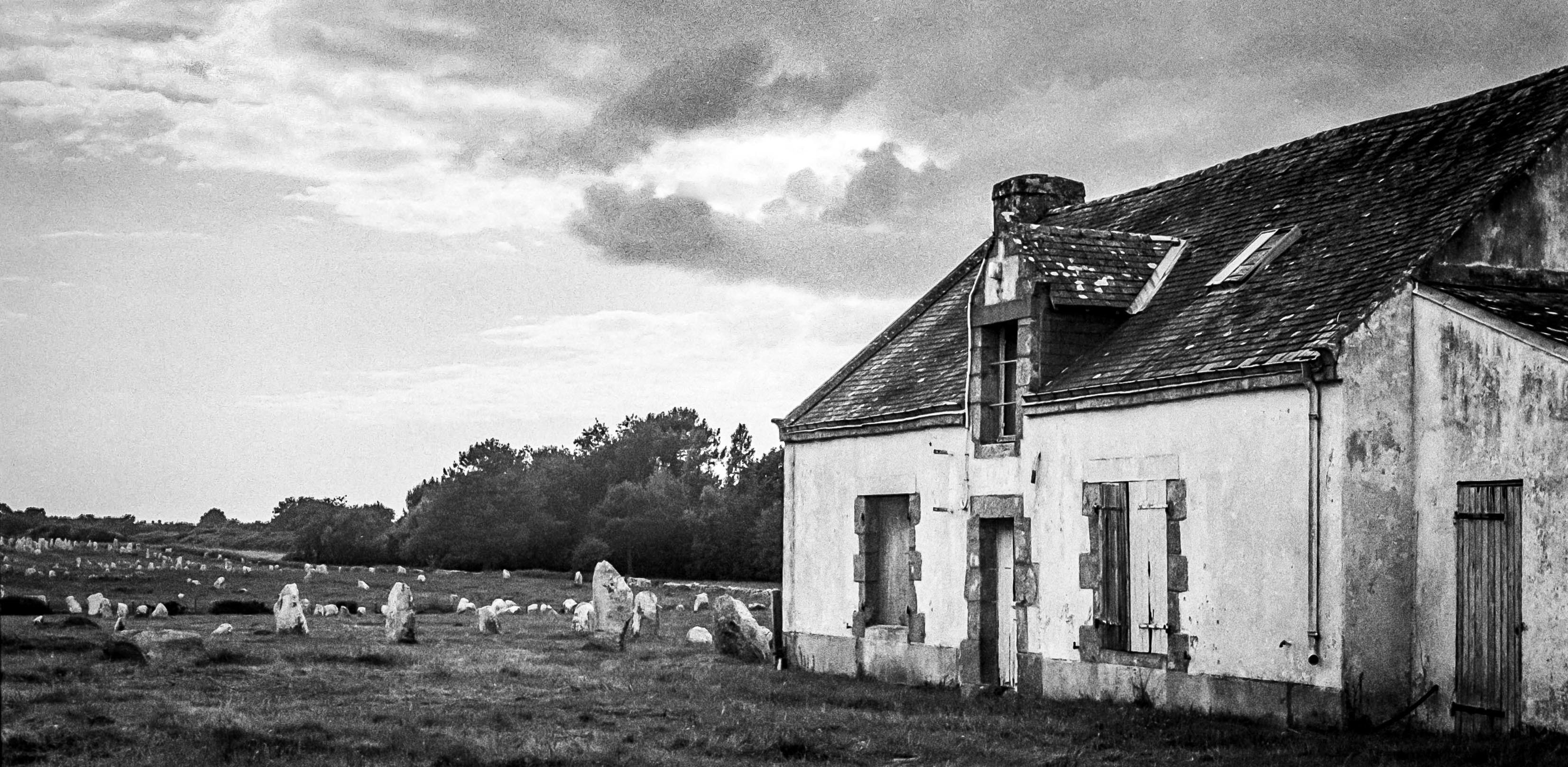
The photos in this article, from the famous film archive, were taken eight years ago almost to the day, during a weekend visiting my mother-in-law near Carnac, and near where my father-in-law lives. They’re divorced, and as usual, I stayed with her, not him. The photos feature my brother-in-law, who bears a striking resemblance to a beefy Dominic Farrugia, and my niece – not my favourite, but likeable enough (and those who claim not to have favourites are just liars!).

I shot these with my Canon AE1, a camera that saw a lot of action back then. Loaded with Ilford HP5 Plus and developed in Rodinal, they turned out a bit grainier than I expected, even for HP5 at box speed. I blame my overly enthusiastic agitation during development – I’ve always been a bit of a stirrer! Even back then, I had this habit of sneaking off to “do some photography,” a habit that hasn’t changed much, it seems.

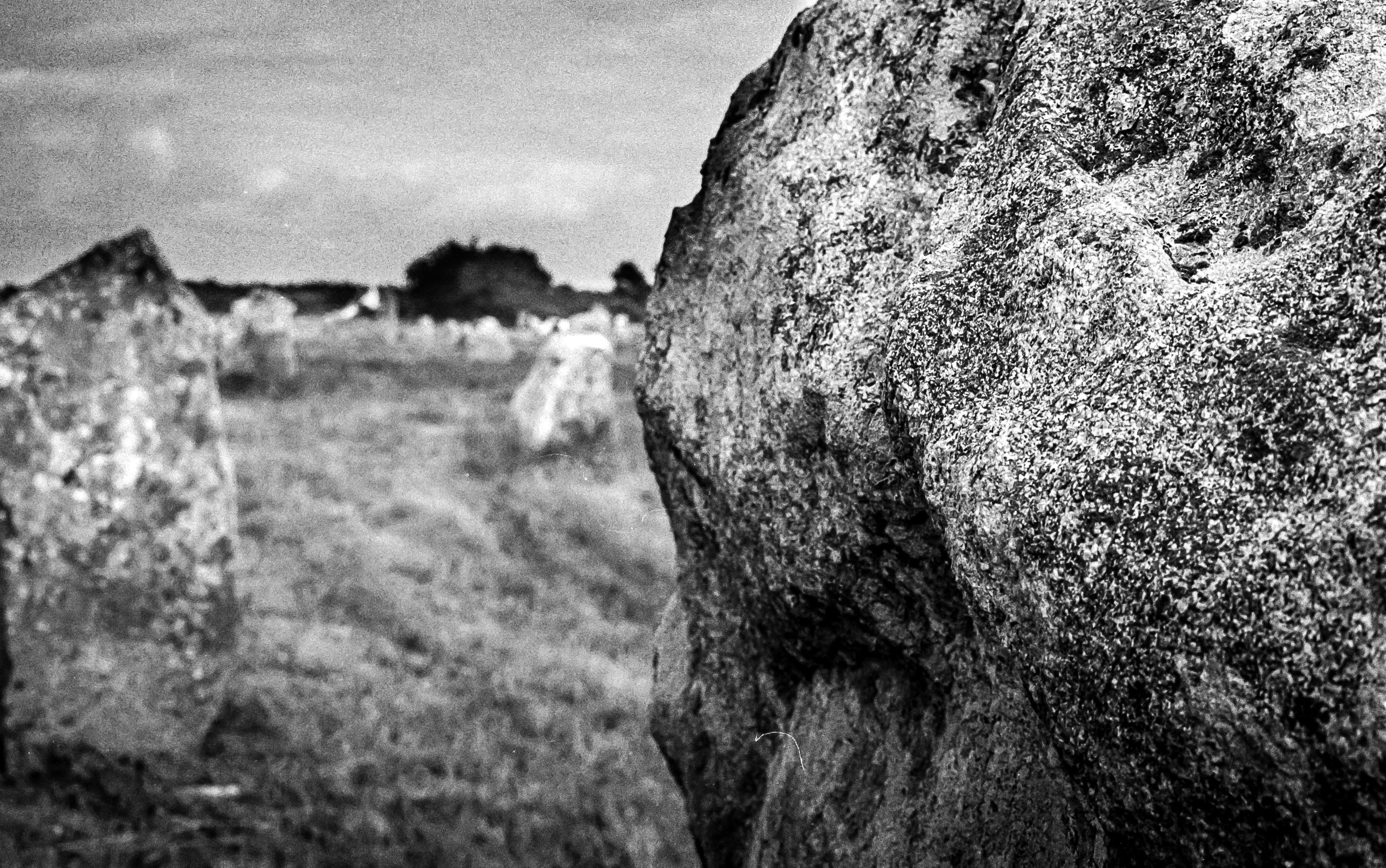
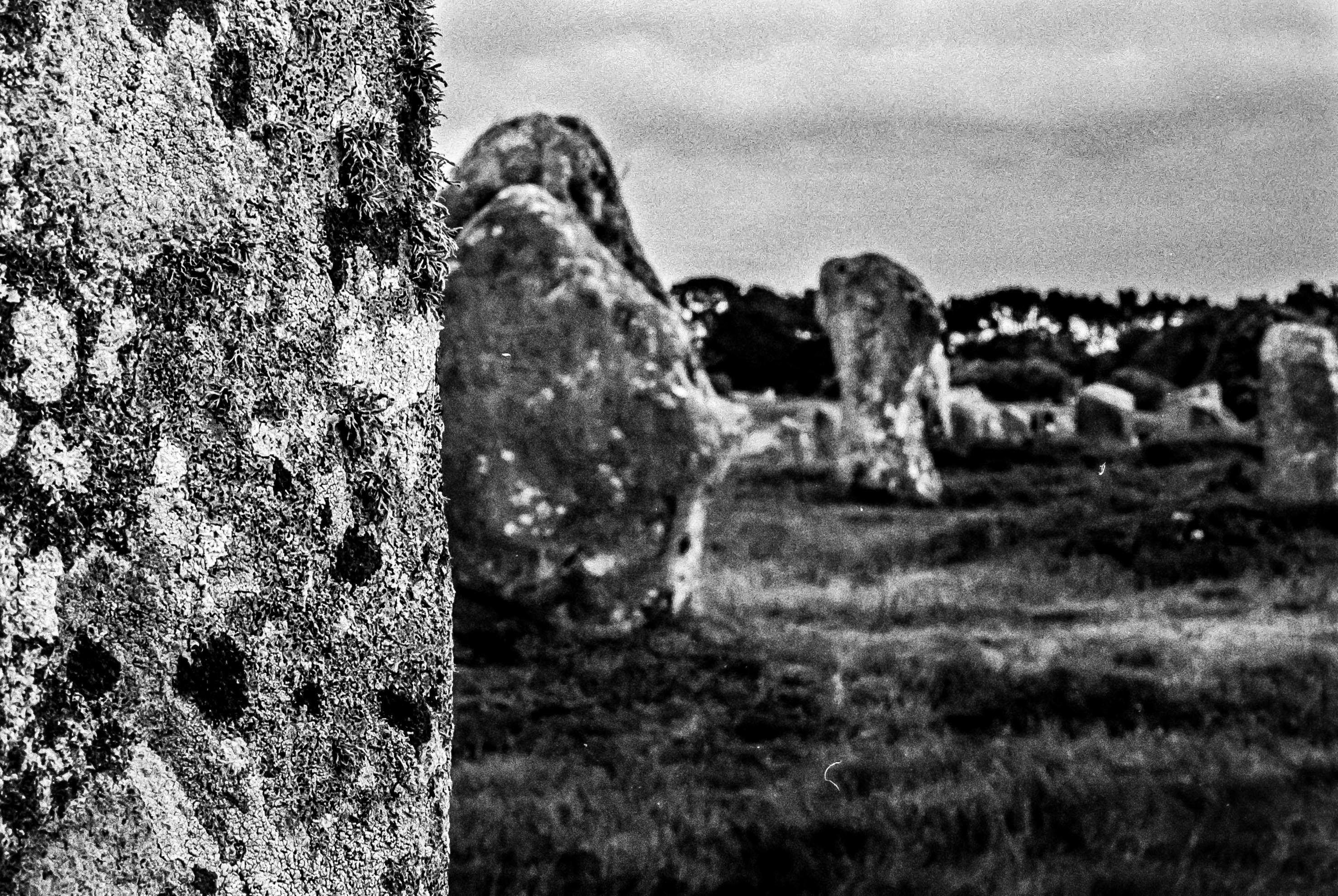
Funny thing is, this wasn’t my first time in Carnac. As a kid, plagued by ear infections, flying was out of the question, so we had many a family holiday in France. One such trip was to Carnac, in the Morbihan region. Who would have thought that over 30 years later, I’d be back here so often?

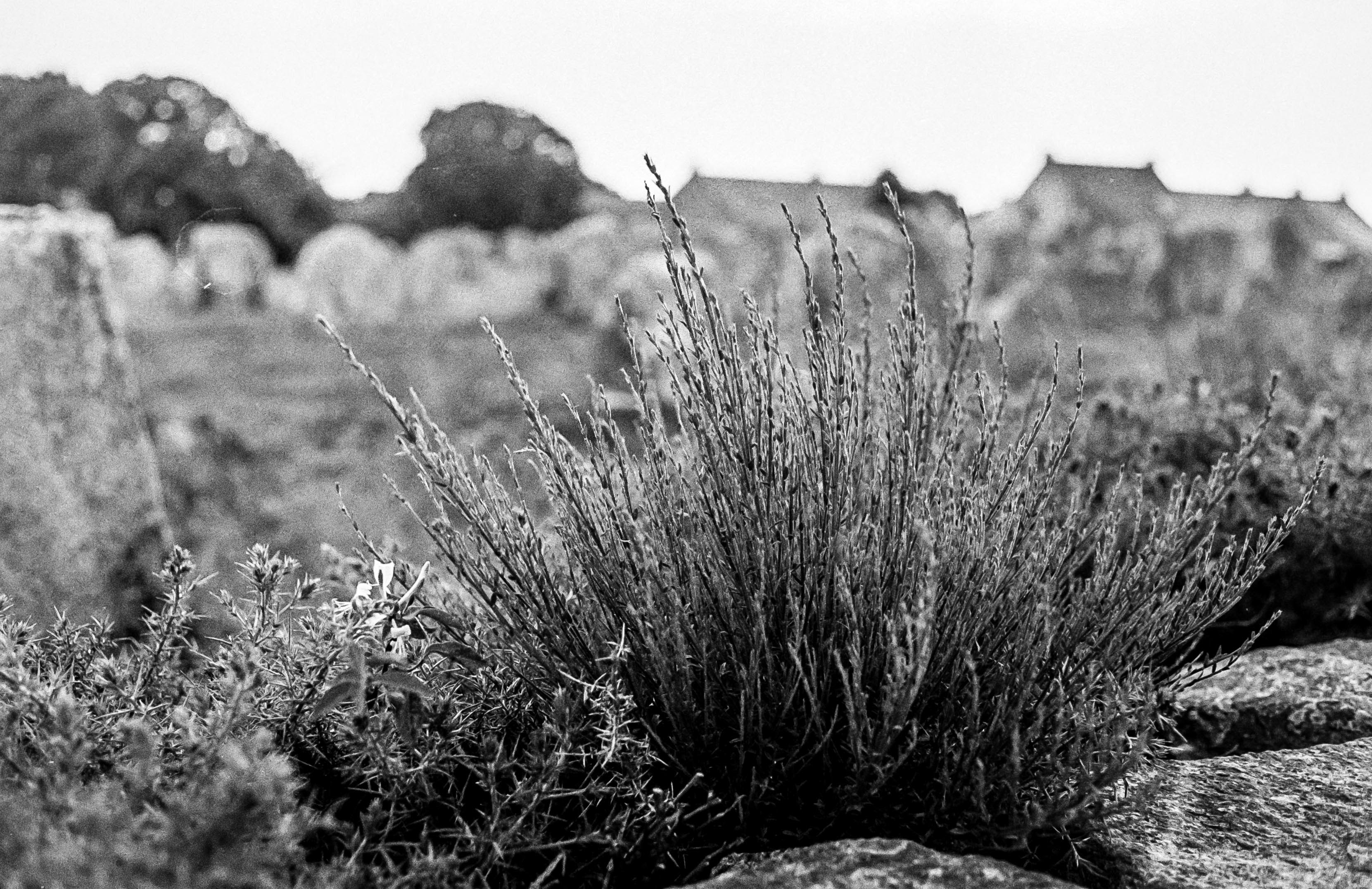
Now, 30 years ago, you could wander freely around those mysterious Carnac stones. My mother, bless her imaginative soul, convinced me they were people caught dancing on the Sabbath and turned to stone as punishment. Ever since, I’ve had a healthy aversion to Sunday line dancing! Sadly, you can’t get close to the stones anymore – they’re cordoned off, perhaps a warning to those Breton folk dancers not to get too carried away.

Back then, HP5 was my go-to film. I wanted to know it inside out. Visiting the stones was a welcome escape from the lively, shall we say, family gatherings. Don’t get me wrong, I love my in-laws, but their intensity can be a bit much for this introvert. The stones, silently standing there, offered a tranquil contrast.

Years later, I watched a film, “The Fablemans,” about Steven Spielberg. The advice at the end, to keep horizons high or low in your images for more interest, struck a chord. Unbeknownst to me, I was already doing this! When I first started out, I meticulously documented every shot in a notebook – aperture, speed, film, camera, the lot. I kept this up for over a year before finally giving it up. These days, all that info is tucked away in your image file’s metadata, but not with film. There’s a certain freedom in that, wouldn’t you agree?

Reflecting on these old photos from Carnac, I am reminded of the enduring allure of photography and the quiet majesty of ancient stones. Each visit to Carnac, captured through the lens of my Canon AE1 and HP5 film, evokes memories of childhood holidays and solitary moments amidst family gatherings. The evolution from meticulous note-taking to embracing the simplicity of film photography has taught me to approach each shot with intention and mindfulness.

In the digital age, where metadata stores the technical details of our images, there remains a certain freedom in the analog process. It encourages a deeper connection with the art form, requiring us to engage fully in the moment of capture. The stones of Carnac stand as timeless witnesses to history, echoing the evolution of photography itself – ever-present, ever-evolving.

As I continue to explore new landscapes and subjects through my lens, I carry with me the lessons learned amidst the stones of Carnac: to capture not just images, but stories; not just moments, but emotions frozen in time. Photography, in its simplest form, remains a profound journey of discovery and expression, rooted in a rich tradition that continues to inspire.

Film photography, the opening of the archives


Good evening Dear Reader. You may have noticed, and then again, you may not have noticed, that I have created a couple of new pages. Instead of adding article categories to my site in the menus, I have created pages with a carousel showing collections of articles in one specific category. This started with Photography Tutorials, which is a collection of, surprise surprise, photography tutorials. Another one for Travel Photography, one for Camera information, and a final one for articles featuring Film Photography. The idea behind this rather brash move on my part, was to help you find what you wanted to read or discover more easily.

This Meisterwerk of a blog is a work in constant evolution, as I think you may have gathered, especially for those of you that have been with me since the beginning. But what does this have to do with Film photography I hear you ask. Well, when creating the film photography page I realised that there are fewer articles than I first thought. This struck me as a little odd, because at one stage I had a little bit of a reputation as a film photographer, and at one stage was purely a film photographer. This was, of course, before the start of this blog lark in 2019. Between 2009 and 2019 I did a huge amount of film photography that I realised I have not shared with you. Even more so since 2016, when I started developing and scanning my negatives at home.

The beginning of the blog also tied in with the X100F and the Canon 6D Mark II coming into my photography, and since lockdown, I have done only small amounts of film photography. Time to reveal more of myself to you. At least if that’s alright… But this isn’t just about me dusting off old memories. By sharing these photos, I hope to spark a conversation, ignite a passion for film, and maybe even inspire you to dig out your old camera and give it a whirl. Who knows what treasures you might find in your own archives?

Moped with a Jameson whiskey box  as a baggage holder.  Looks very cool
Taken on the Praktica MTL3 probably with the 50mm Pentacon F1.8 lens on HP5 Plus at box speed in the Quartier Bouffay in Nantes.

So bearing all this in mind, I have a proposal for you. Let’s open the vaults and let’s have a look at the “film archive”. This could be in the form of a series of articles complementing the weekly outpouring of anecdotes or advice, as an addition, or it could be the content for the upcoming weeks. I haven’t decided yet. Let me know in the comments which option you prefer, or if you have any other ideas for how you’d like to see the film archive content. There’ll be shots of Nantes, the UK, England, and Scotland and maybe even Spain, and Portugal. There will be colour and black and white photography too. I don’t know yet. I might not have yet taken into account the magnitude of the task ahead. Everything is open.

On the way to Otterburn in Northumberland with the Pentax ME Super using Portra 160. It was another good day out.

But whatever you decide, I hope you come along for the ride. It’ll be worth it!