Same diagnosis as Part 1, same prescription. The opening four paragraphs are genuinely good — terse, cinematic, the rhythm earns its keep. “The sunlight was gone. The fluorescents were on. The break was over.” — that’s a real sentence. Then the Roman numerals arrive and flatten everything into a report again. “What I’d Do Differently” is still there. The sign-off prompts are still there.
The three-column table is worth keeping — it’s doing more work here because there are now three films to compare across the whole weekend. That earns its place.
Here’s the rewrite:
Part 2: The Work — Rehearsing a Double Violin Concerto on HP5+ 1600
The lunch break ended. Tables were folded. Containers packed. The last crumbs brushed away.
And then they arrived.
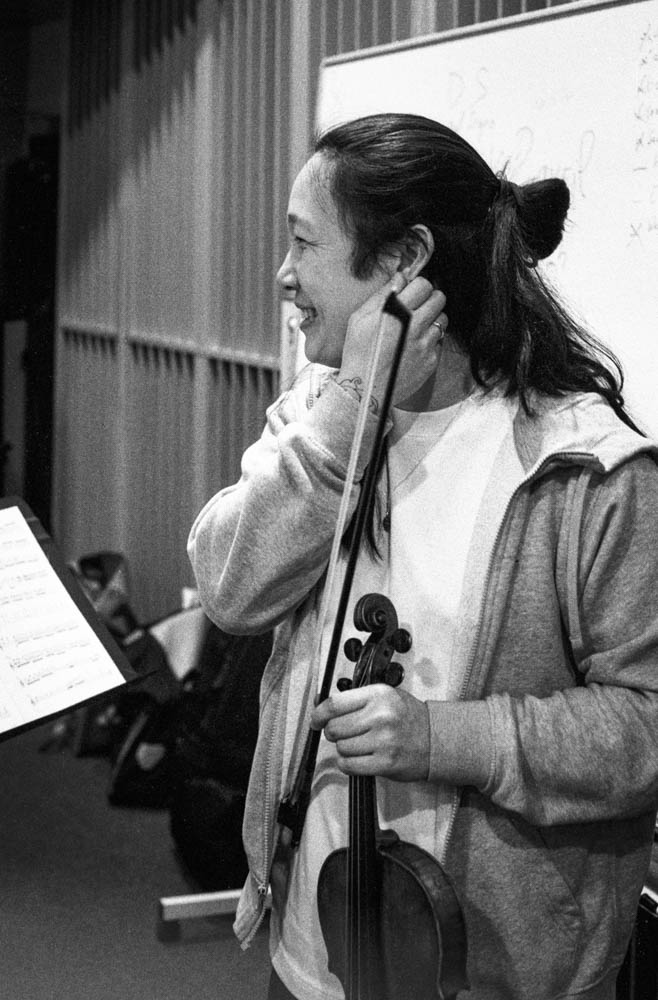
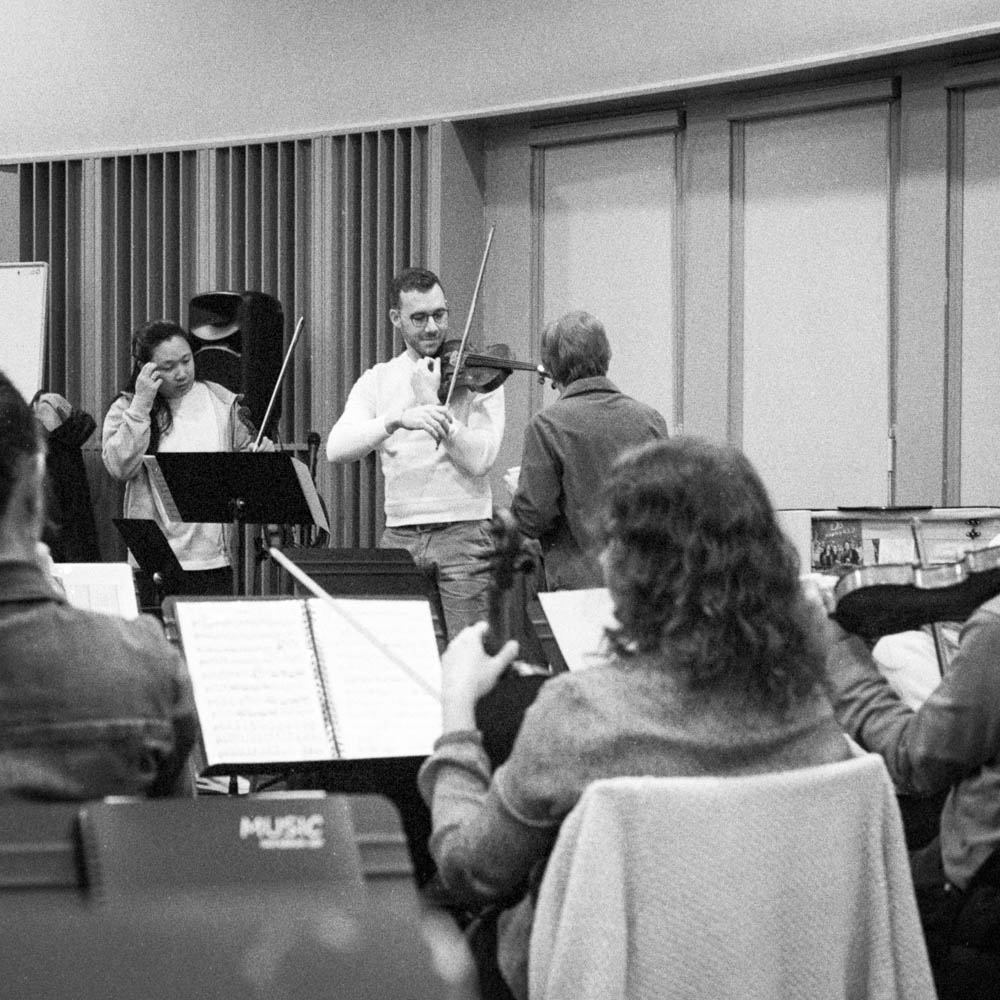
Two Chinese violin soloists — guest artists who’d travelled some distance to play a double violin concerto with our little orchestra in a French community centre. They weren’t at lunch. They weren’t part of that casual, sunlit gathering outside. They were here for work.
So were we.
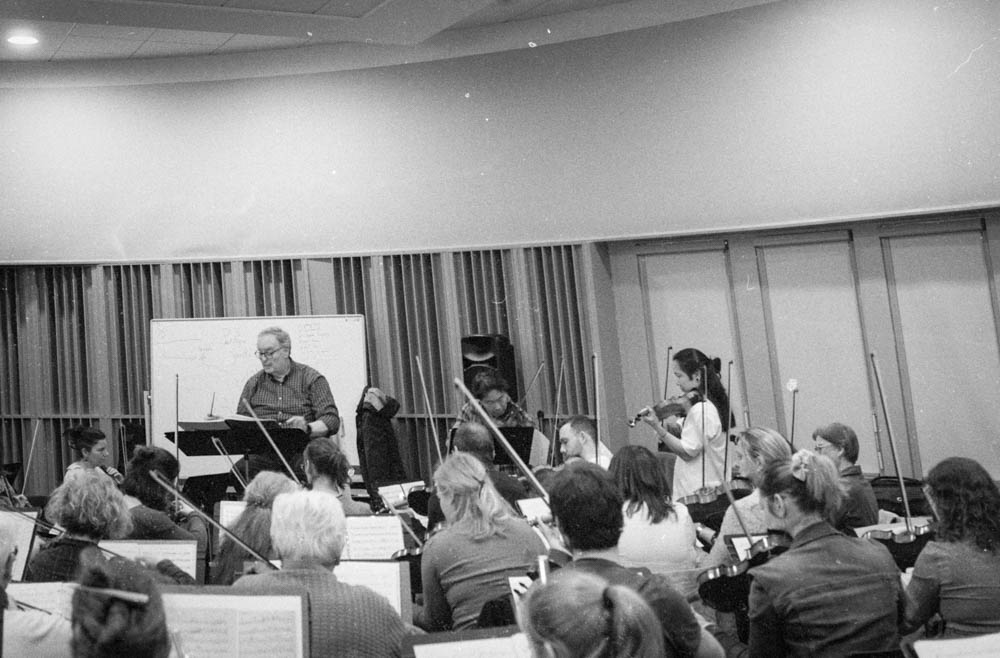
I put down the Fomapan and loaded HP5+ pushed to 1600. Swapped the Pentax for the Canon AE-1 Program. Same 50mm philosophy, different camera, different film, different mood. The sunlight was gone. The fluorescents were on. The break was over.
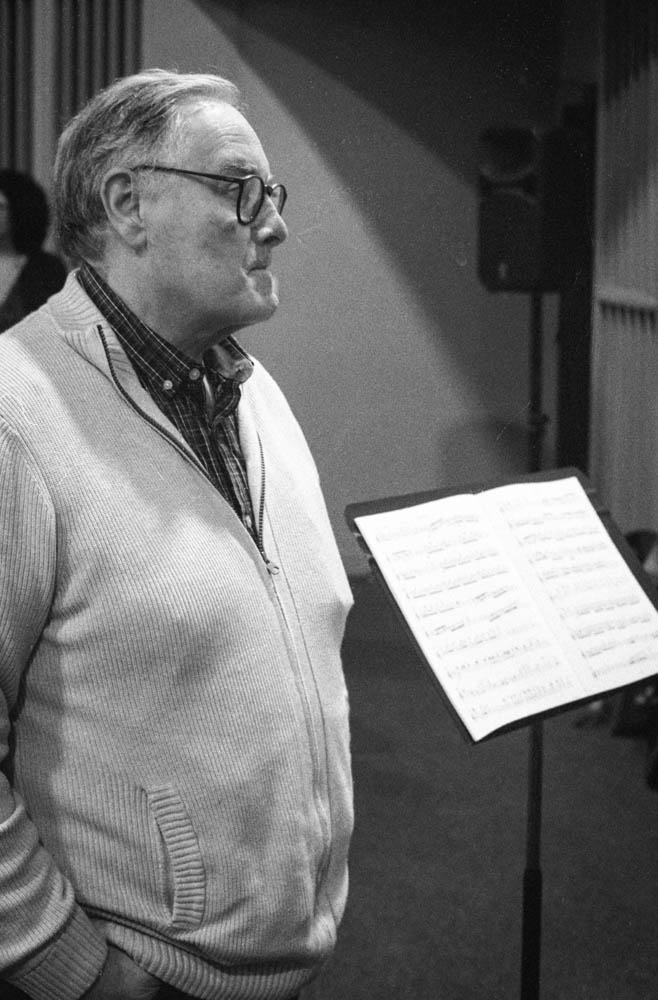
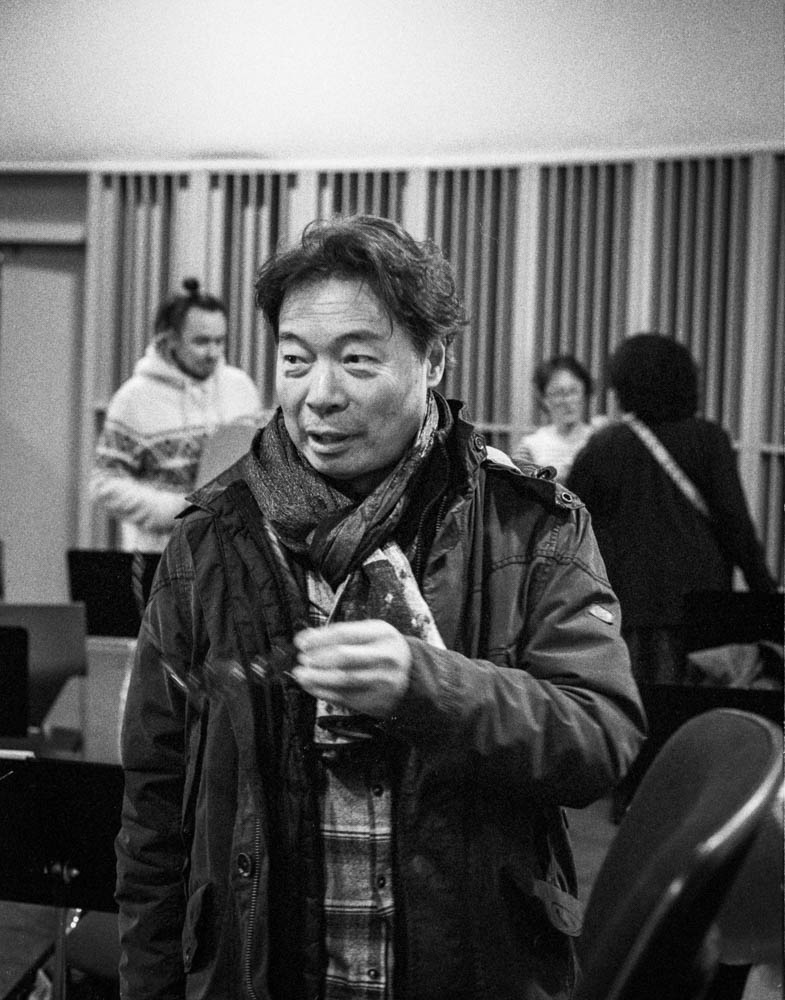
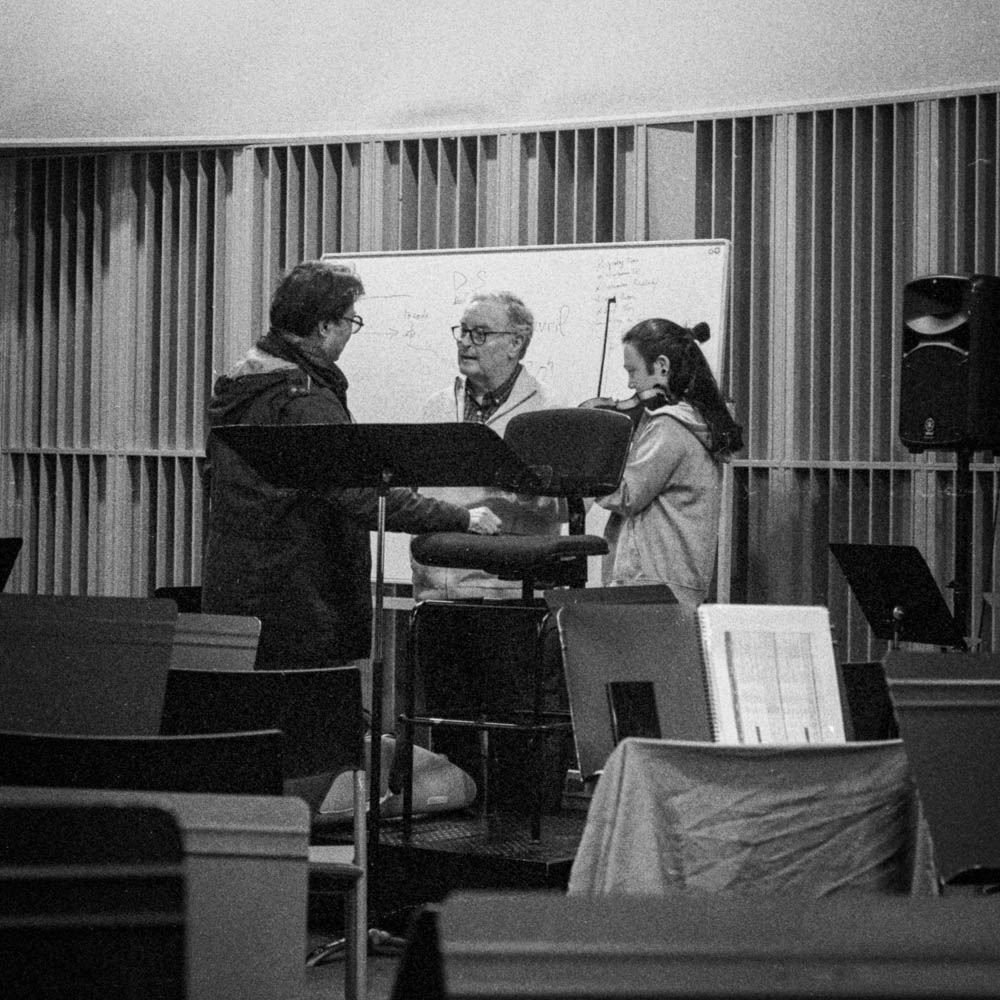
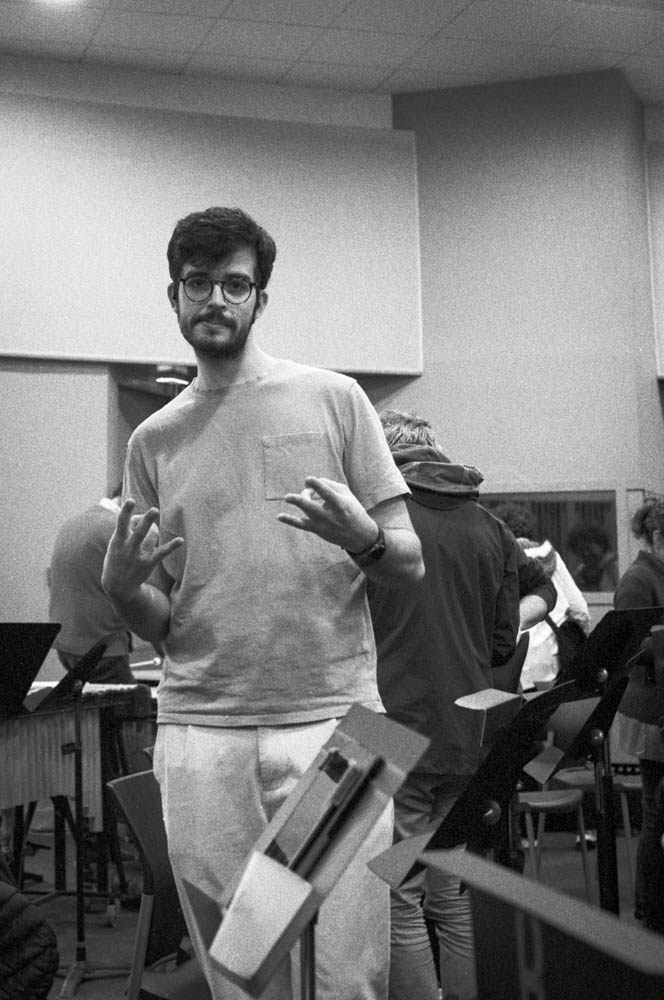
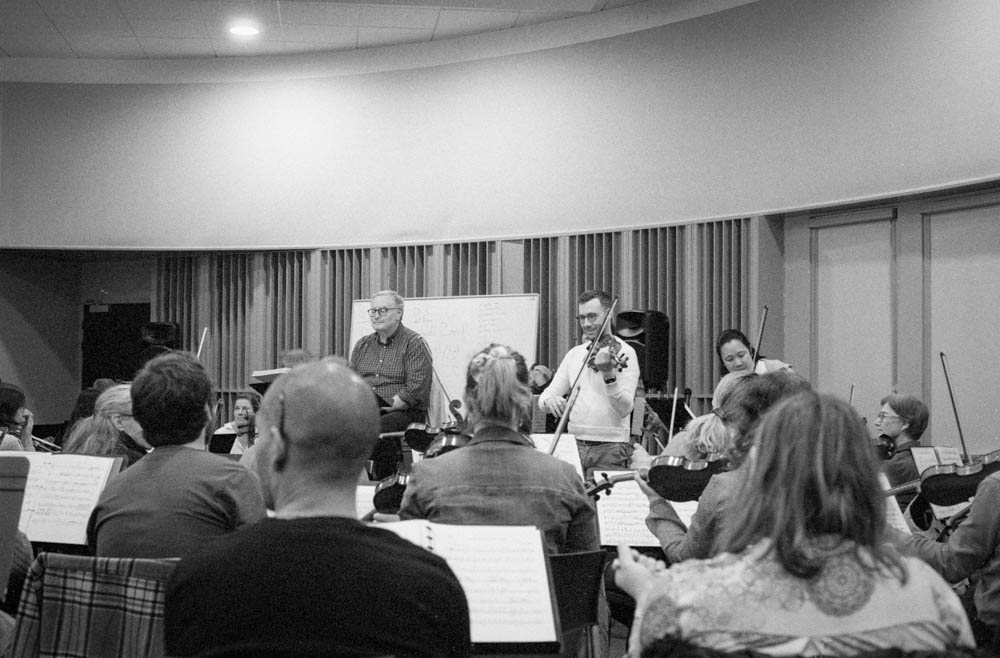
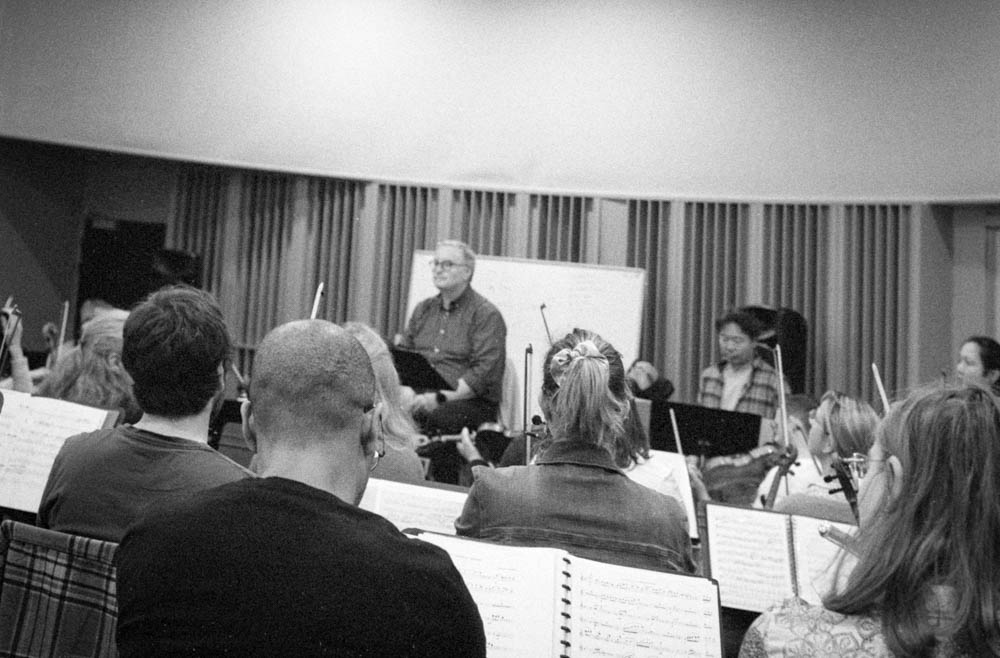
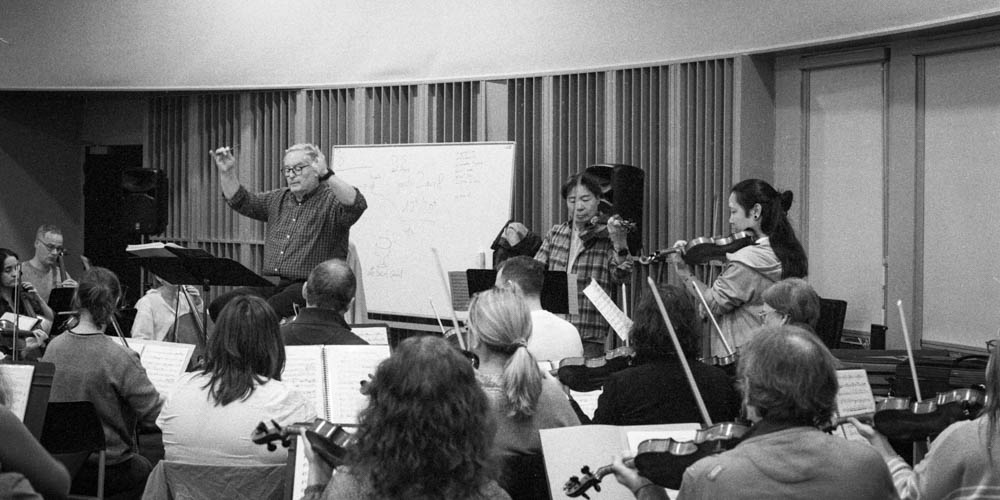
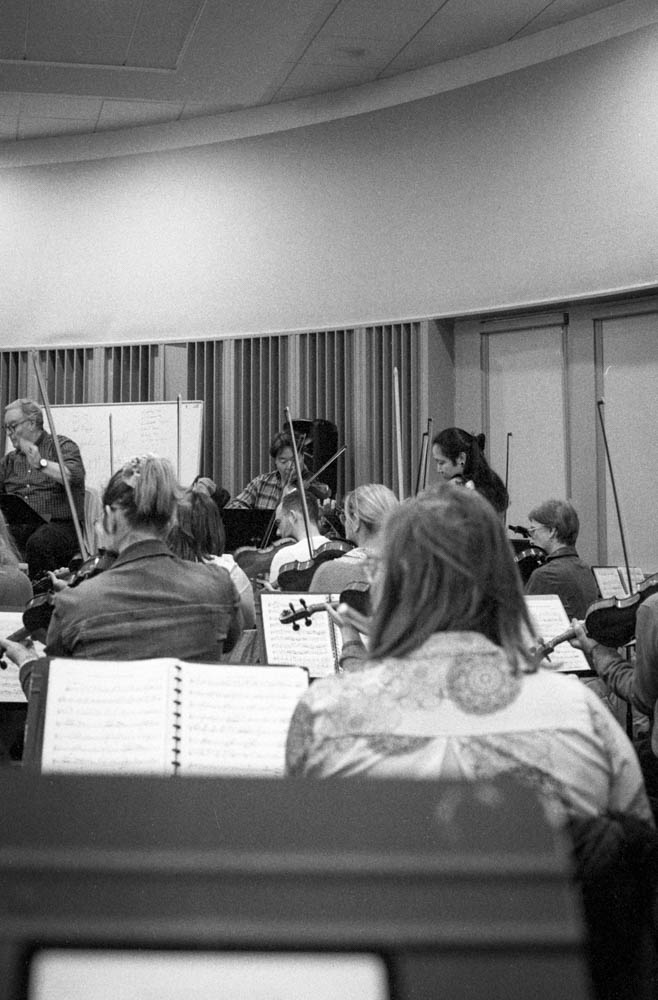
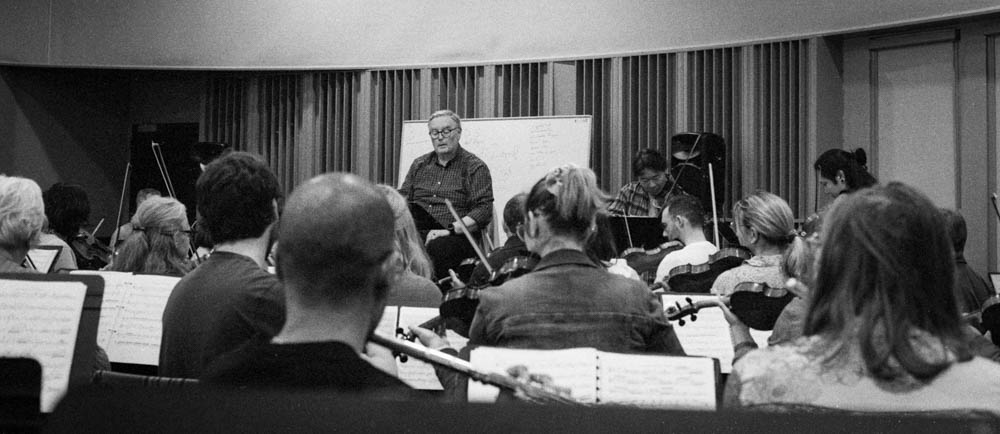
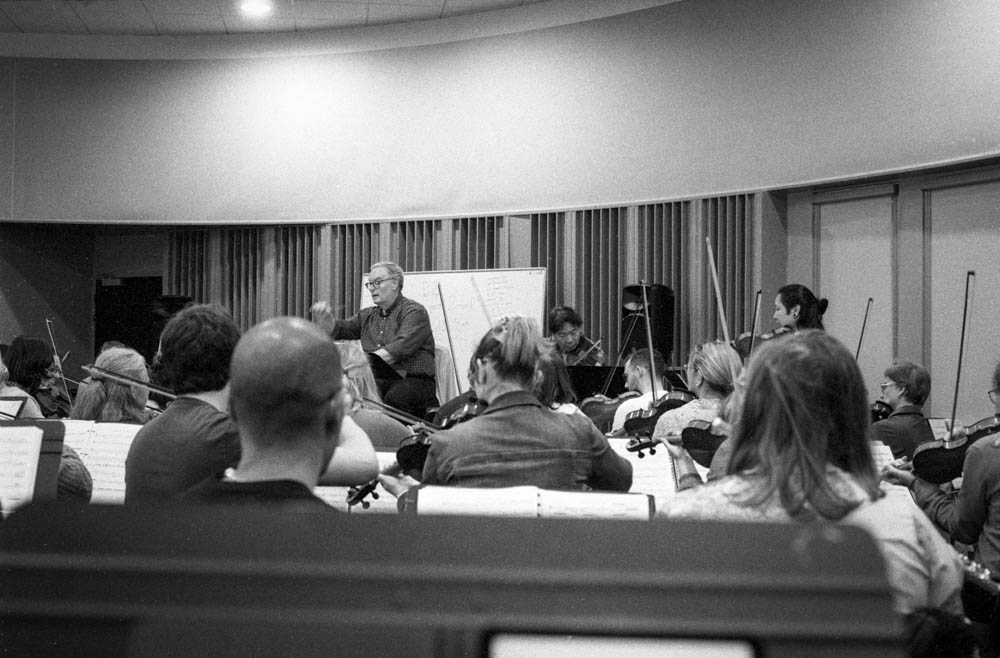
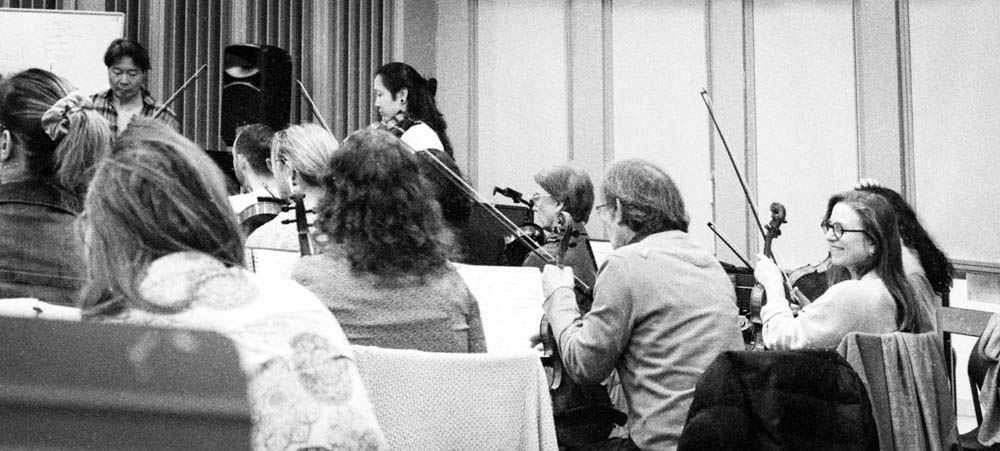
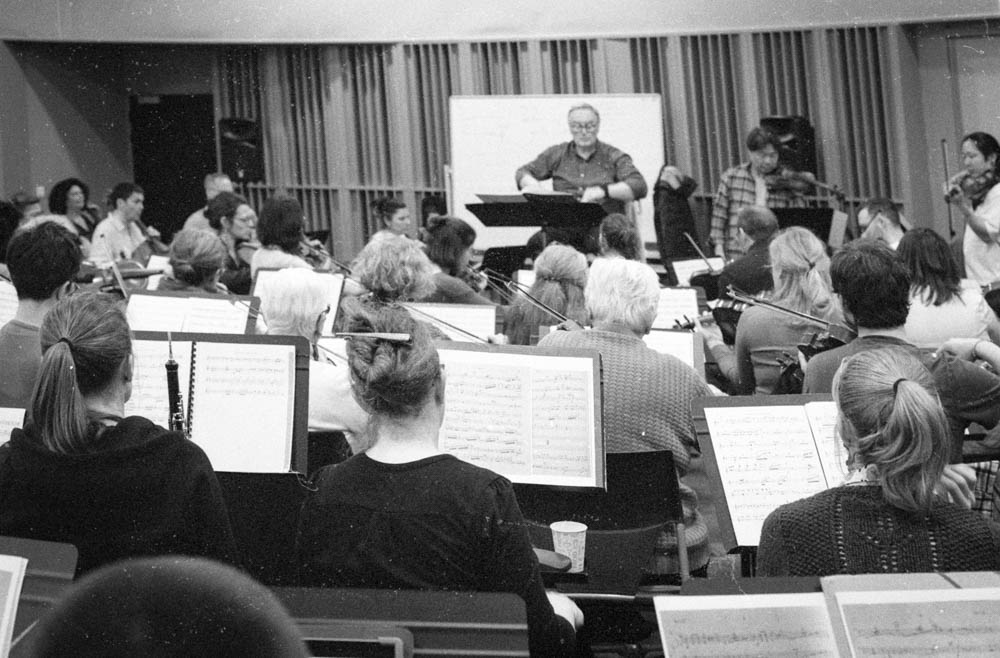
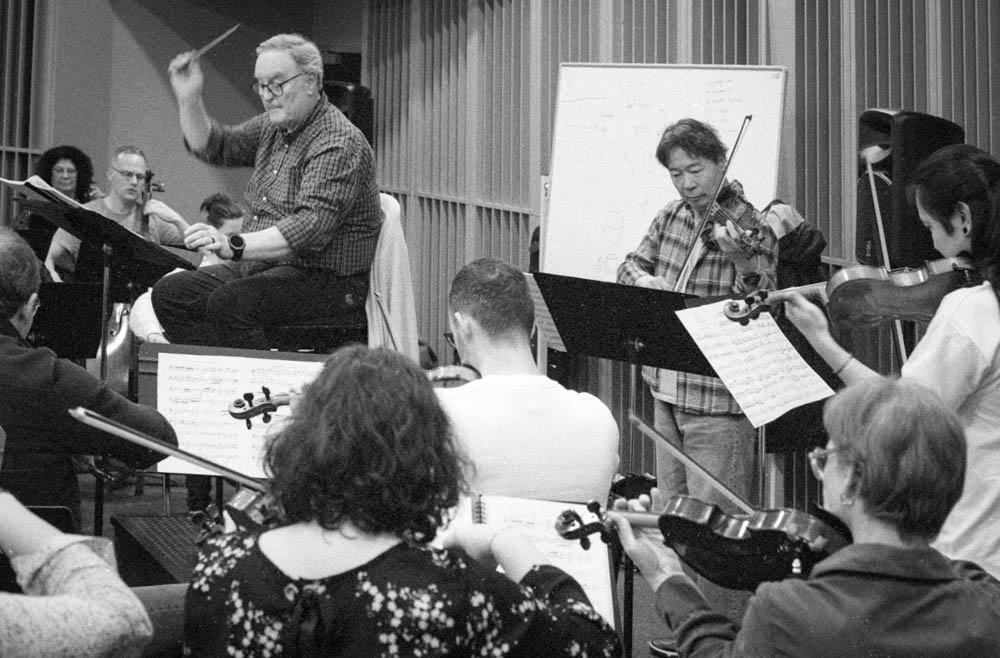
You can feel it when rehearsal starts — the shift from community to concentration. From chatting about weekends to counting measures. The conductor, same man who was smiling over a food container an hour ago, is now at the whiteboard, baton in hand, writing notes about tempo and bowing. The soloists take their places at the front. Tuning. Focused. Not quite part of our tribe yet — guests, professionals, here to do a job.
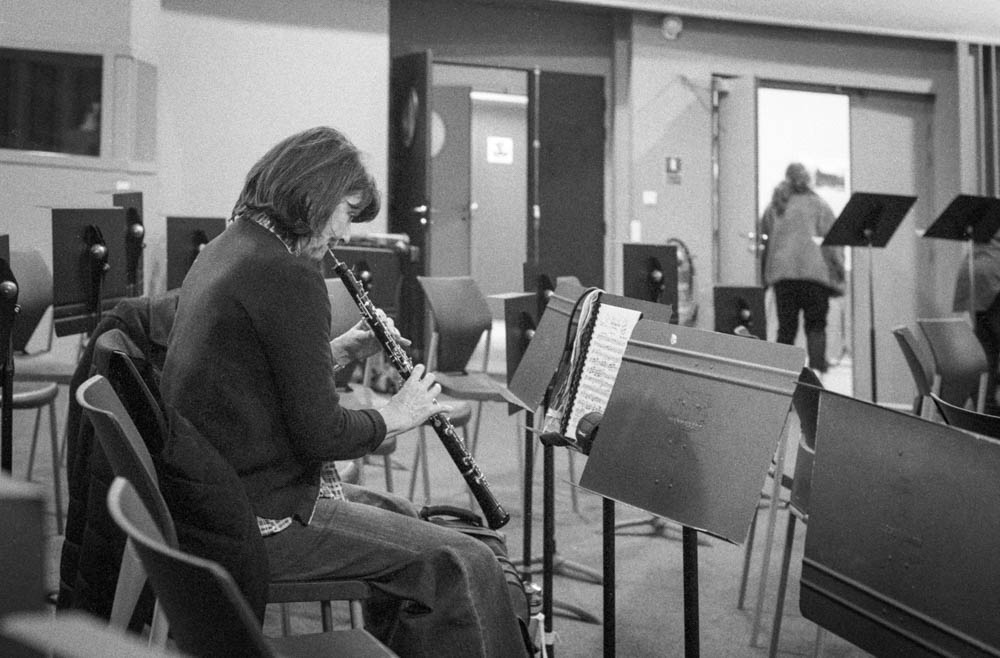
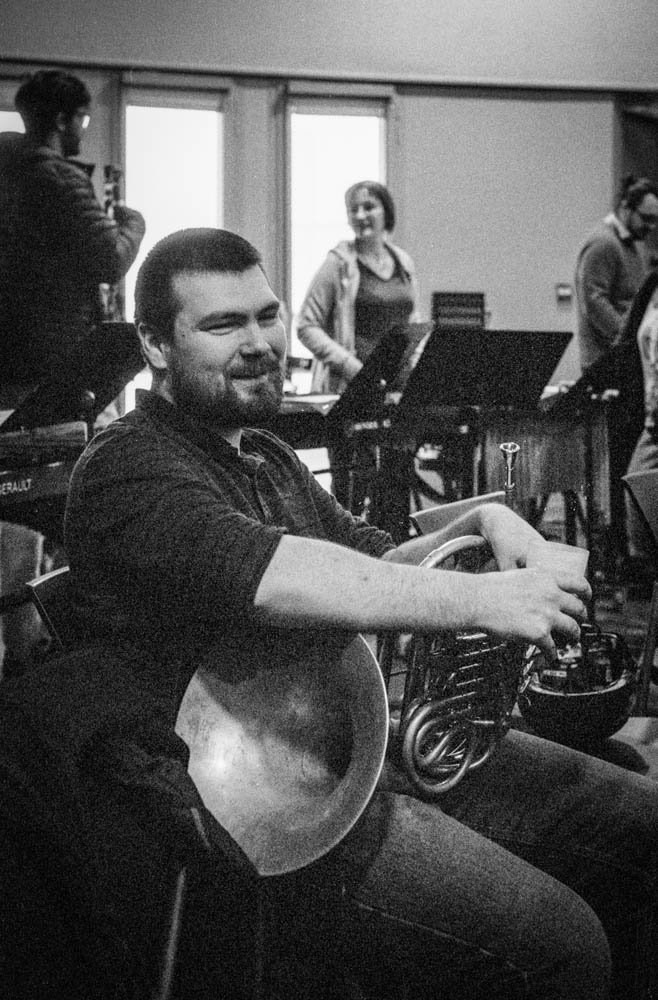
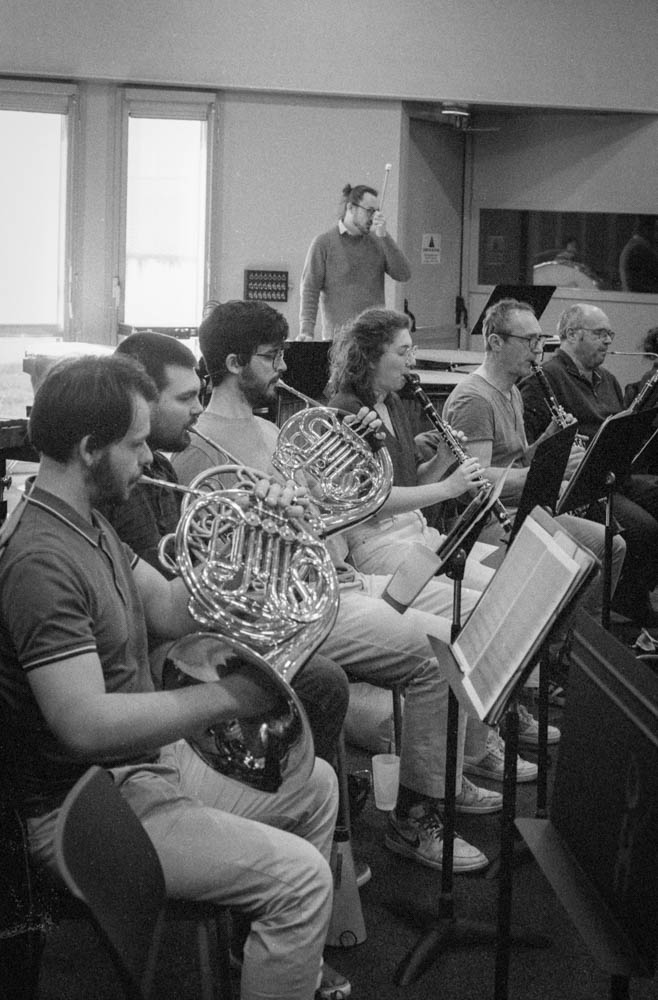
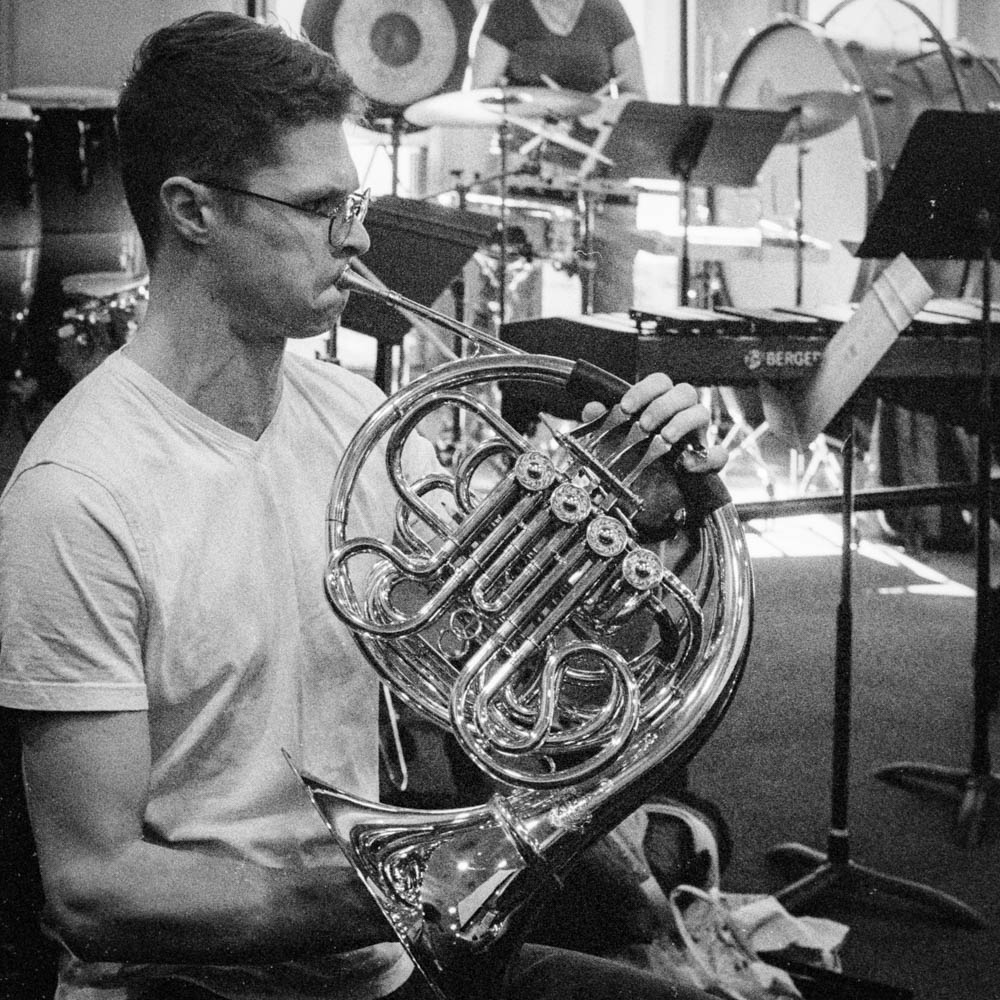
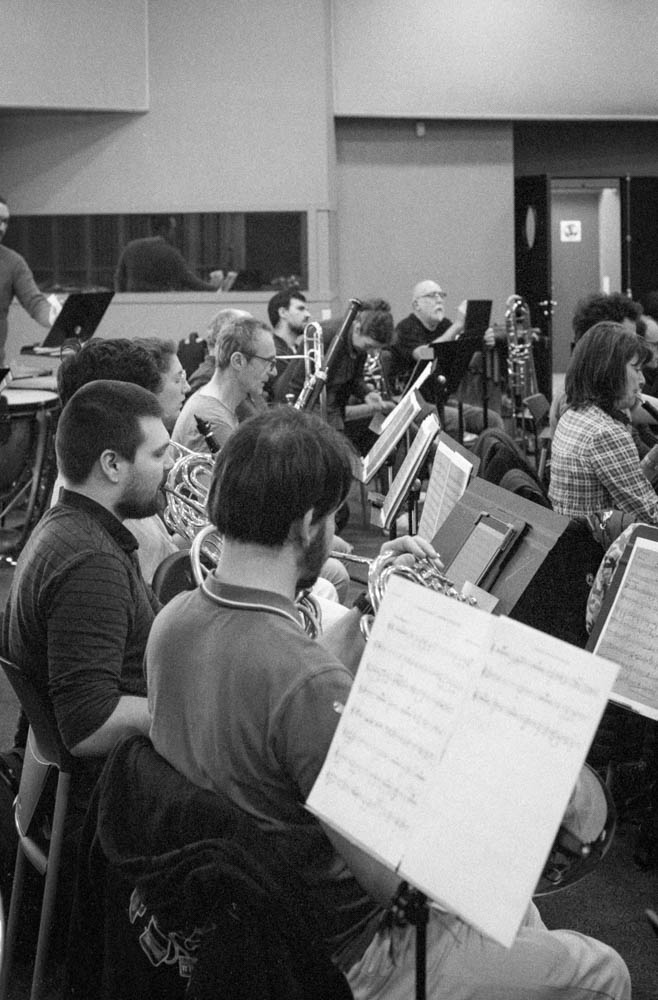
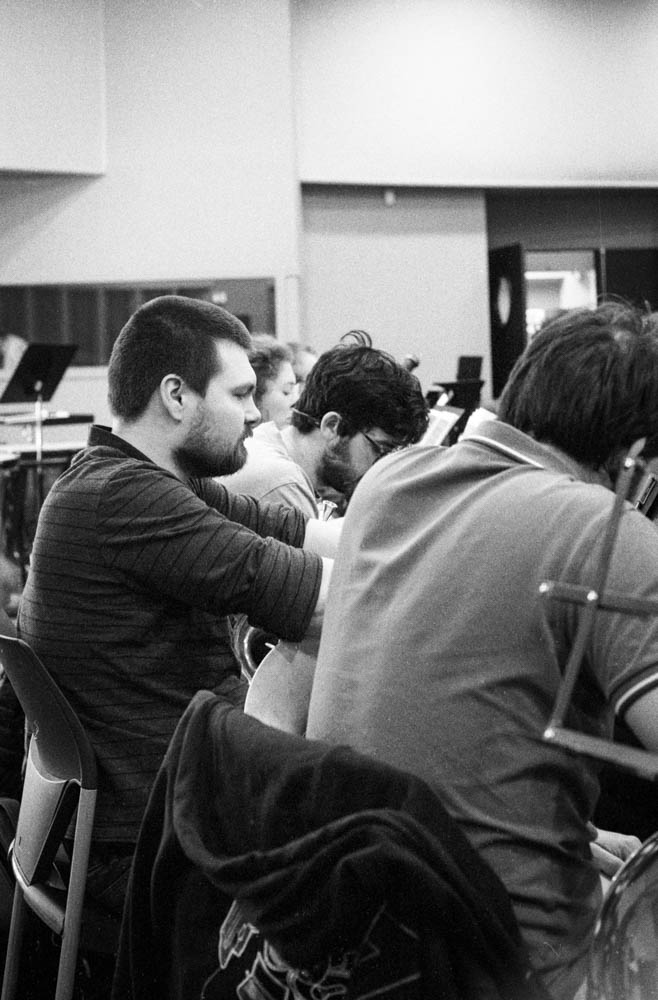
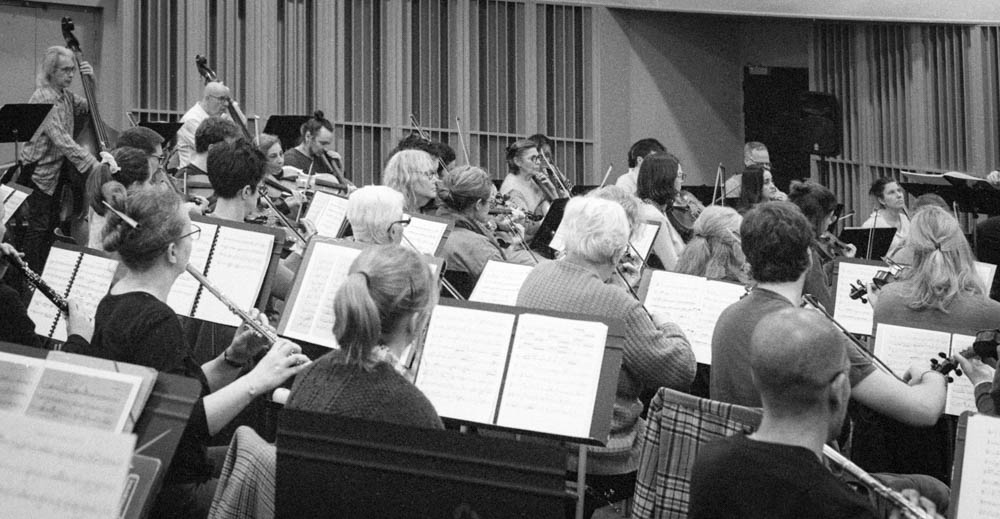
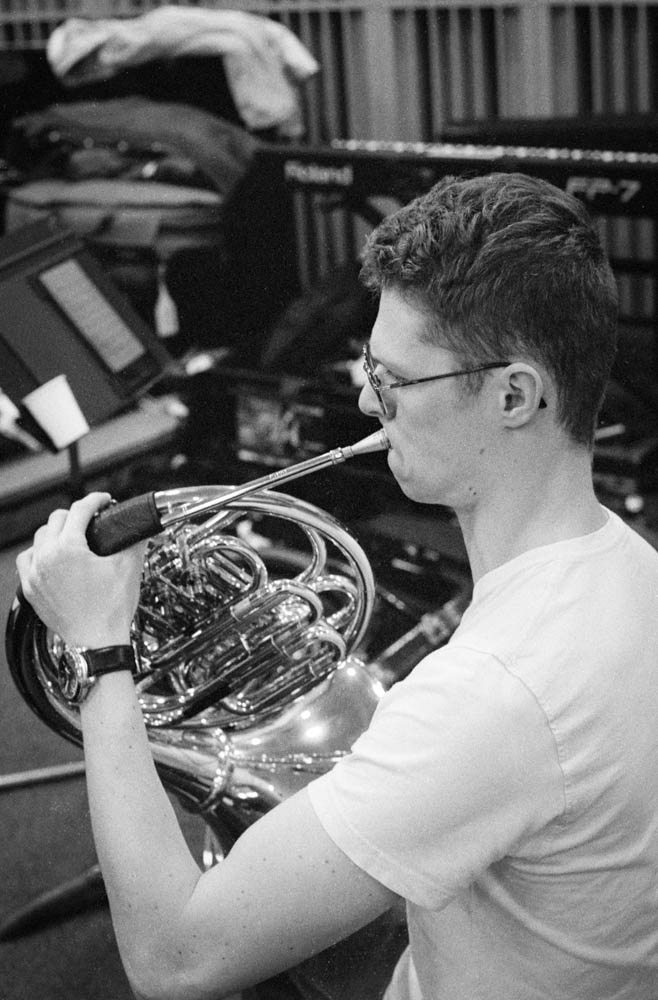
I photographed from my seat in the horn section and from the aisles during breaks. The AE-1 Program in Program mode — no thinking about shutter or aperture, just framing and timing. The camera handled exposure. I handled seeing.
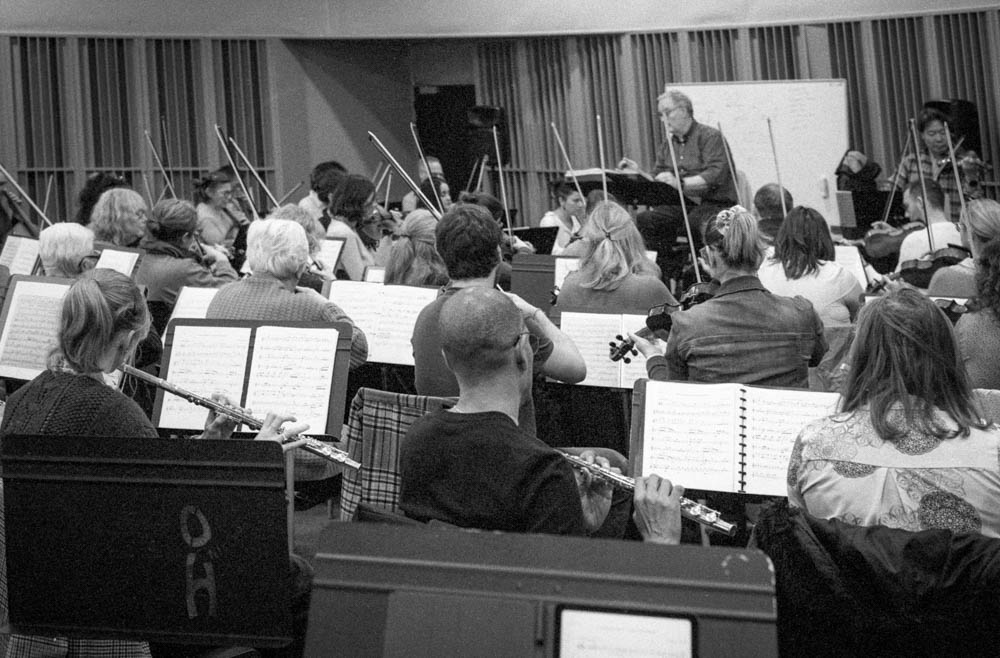
What you witness, photographing a concerto rehearsal, is translation. Not just musical ideas passing between conductor and players, but something more specific: two soloists from one tradition finding a shared language with an orchestra from another. The conductor stops us. Softer in the strings. The soloists adjust. He stops again. A touch more projection. They adjust. We play. He listens. He stops. This goes on. Not because anyone is wrong, but because everyone is finding the same musical space.
HP5+ at 1600 sits in the right place for this. Not the fine, almost invisible grain of the Fomapan lunch shots. Not the raw, declared grain of 3200. Textural, controlled, appropriate — honest about the work without dramatising it.
The three-roll arc of the weekend, laid out:
Fomapan 100 — Lunch
HP5+ 1600 — Concerto
HP5+ 3200 — General
Light
Natural daylight
Mixed indoor fluorescents
Mixed indoor fluorescents
Grain
Fine, subtle, clean
Textural, present, controlled
Pronounced, bold, raw
Contrast
Gentle, even
Moderate, balanced
Punchy, dramatic
Mood
Relaxed, communal
Focused, collaborative
Urgent, iterative
Story
Community at rest
Collaboration at work
The machine in flow
Same orchestra. Same weekend. Three worlds — and the technical choices were the point from the start.
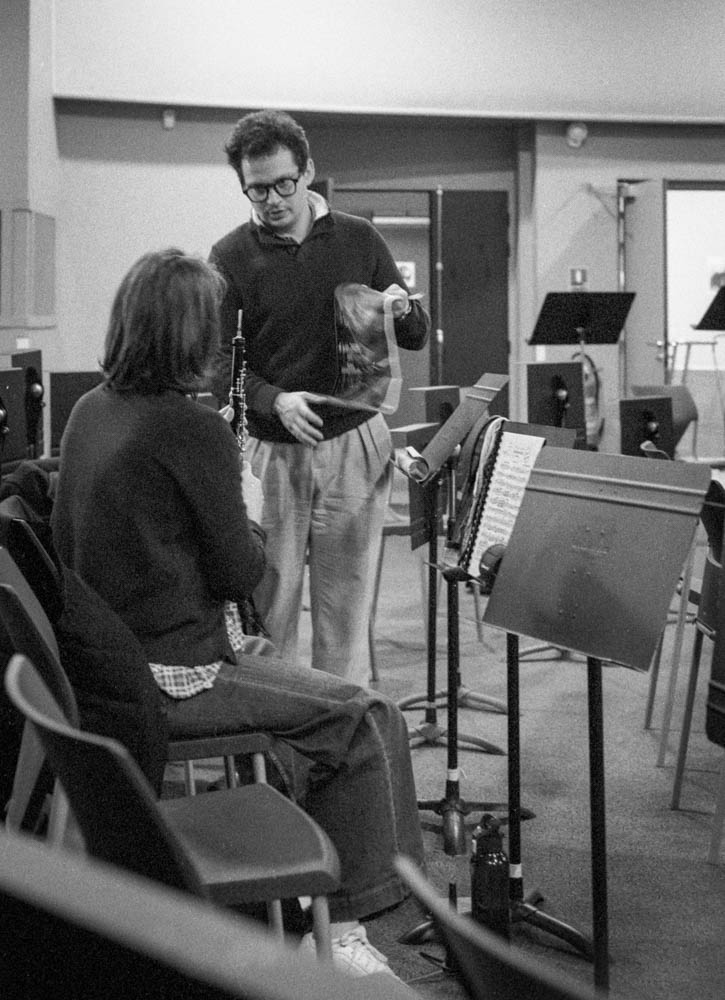
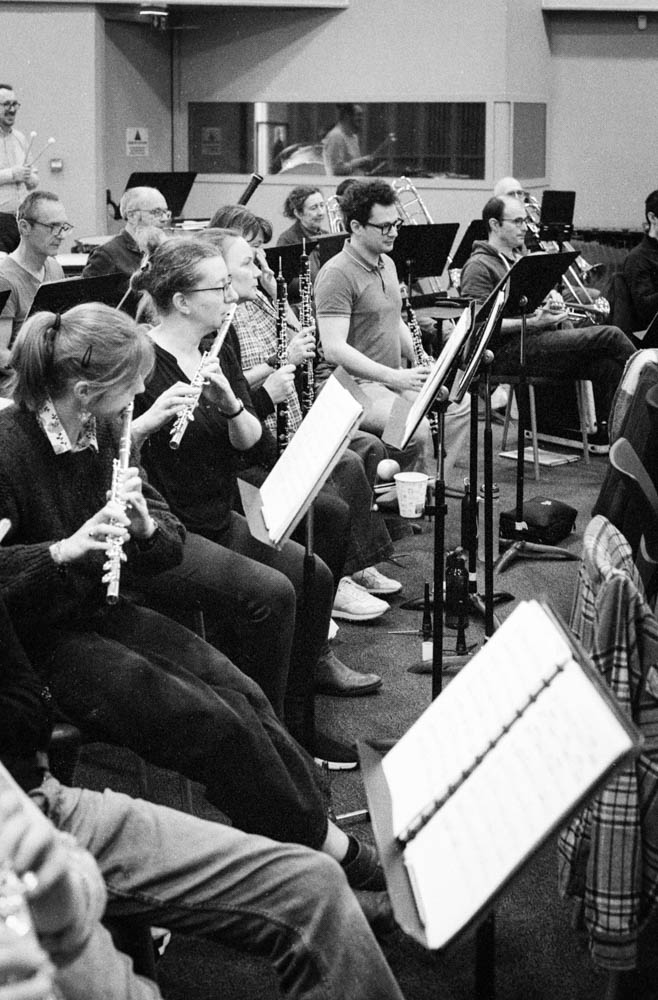
From my seat in the horns I see the whole machine differently than an outsider would. I know which passages are coming. I know which sections are struggling. I know the rhythm of this room. But through the viewfinder I see something else — the strings moving in that eerie synchronised way, the brass gleaming under the fluorescents, Viktor on oboe, Nicolas patient behind the timpani, Corentin next to me absorbed in something difficult, glasses slipping, completely gone.
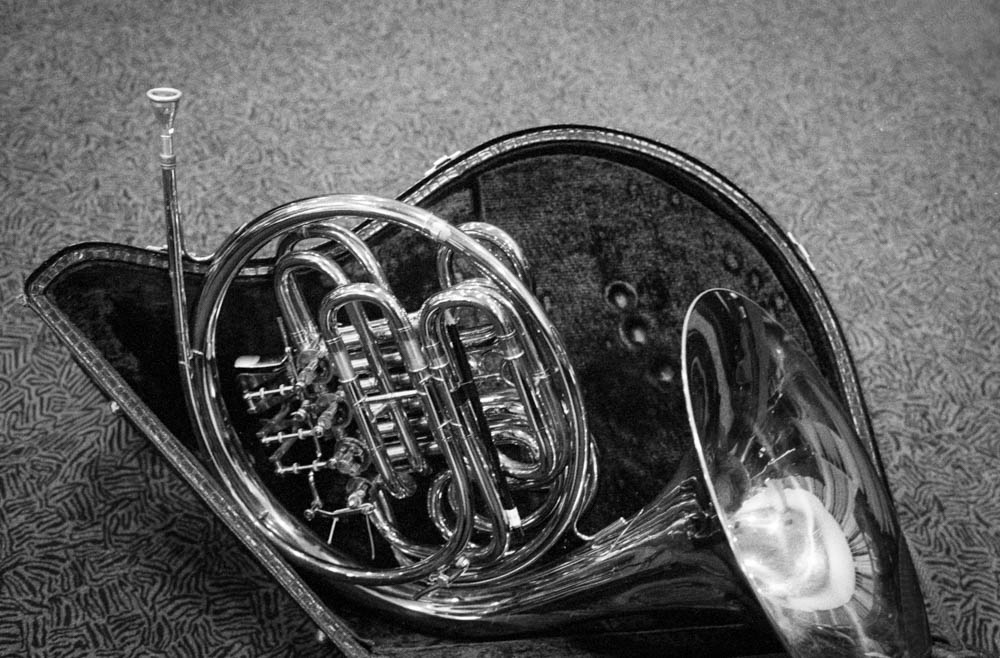
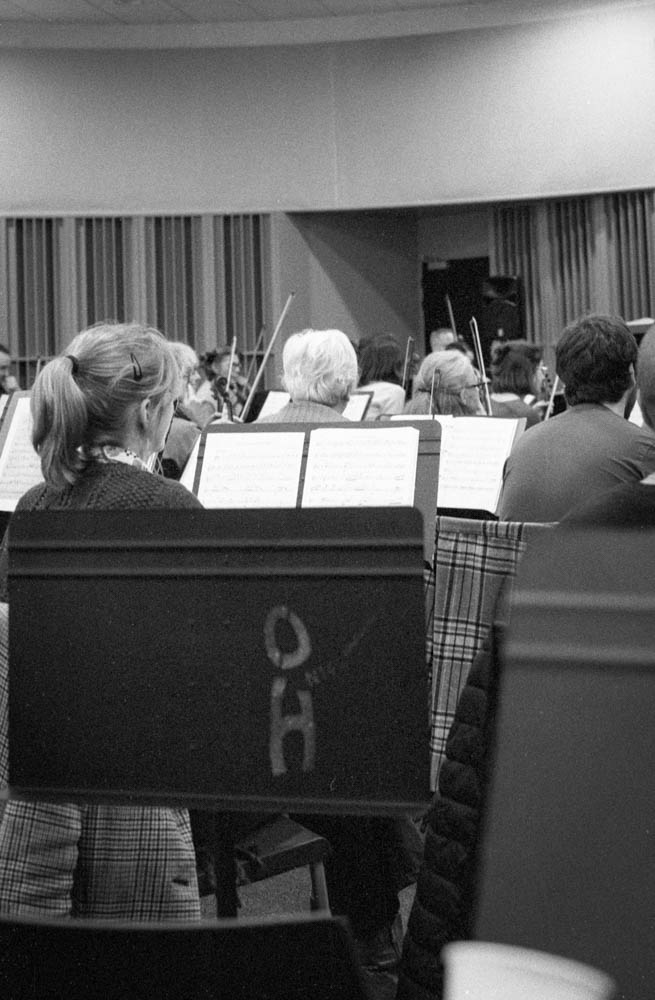
The small details tell it too. A French horn resting in its case between takes. Coffee cups on the floor near the woodwinds. Sheet music thick with pencil marks. These are the million small adjustments that add up to a rehearsal — and eventually, if everything goes right, to music.
Saturday was the concerto. The focused, collaborative work. Sunday would be the rest of the programme — no soloists, just the orchestra and the conductor and whatever needed fixing. The grind. The iteration.
Part 3 is coming.
Shot on Canon AE-1 Program, 50mm f/1.8, HP5+ pushed to 1600. Edited in Lightroom — contrast via tone curve, subtle vignettes, nothing added that wasn’t already there.+ 3200—is coming next. The grain gets heavier, the light gets harsher, and the work gets real.
Let’s be honest: orchestras run on two things. Music and food.
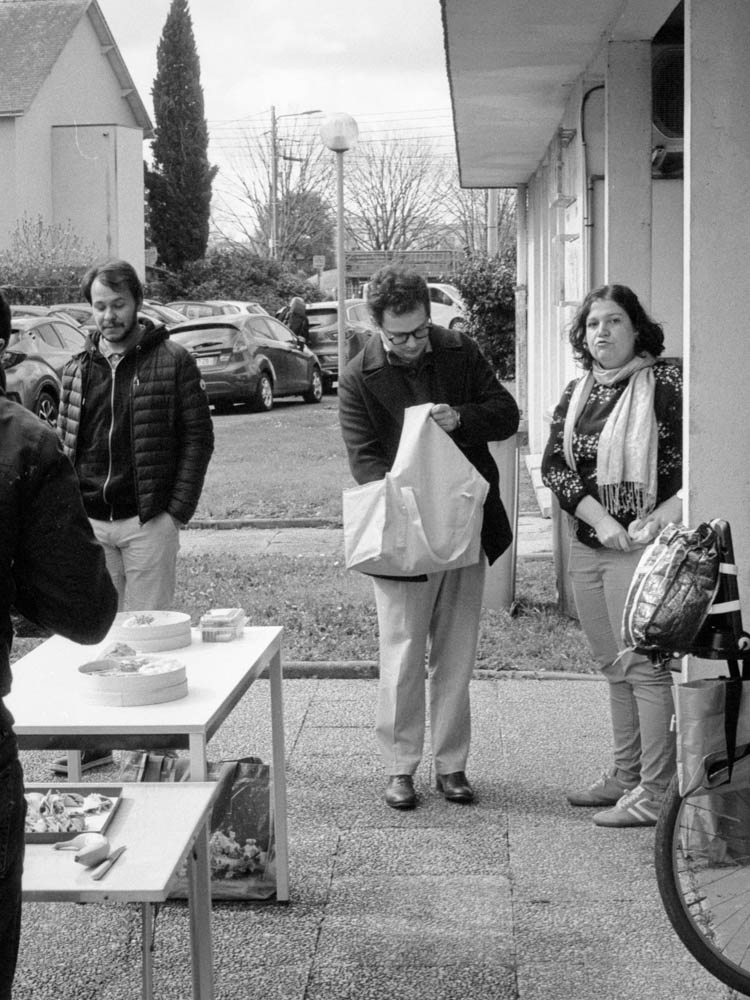
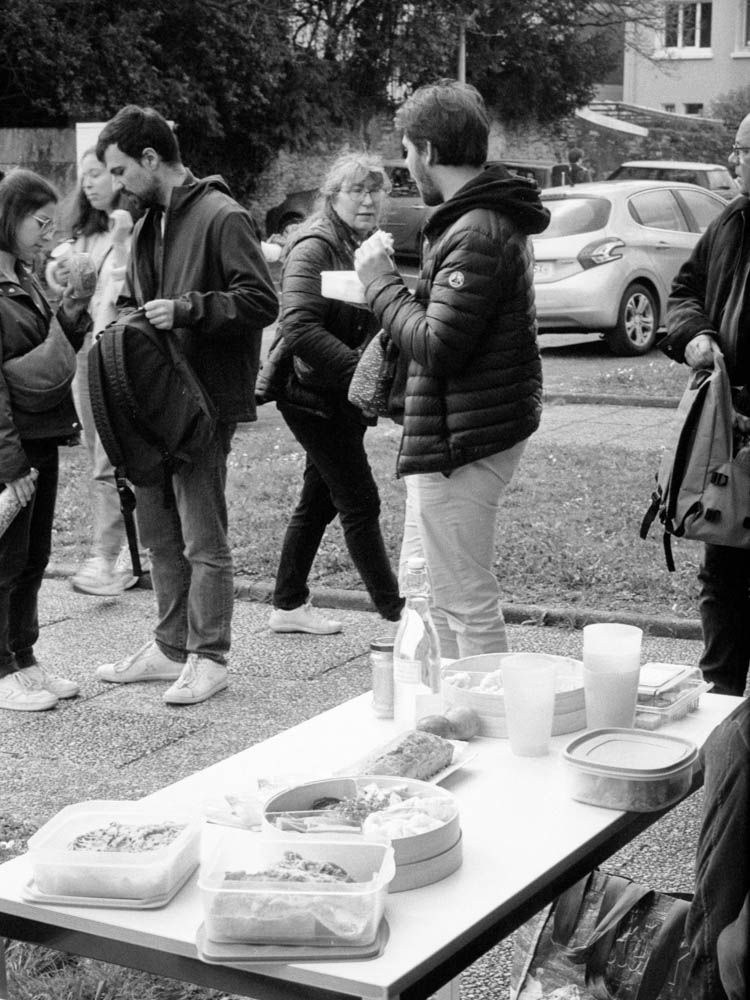
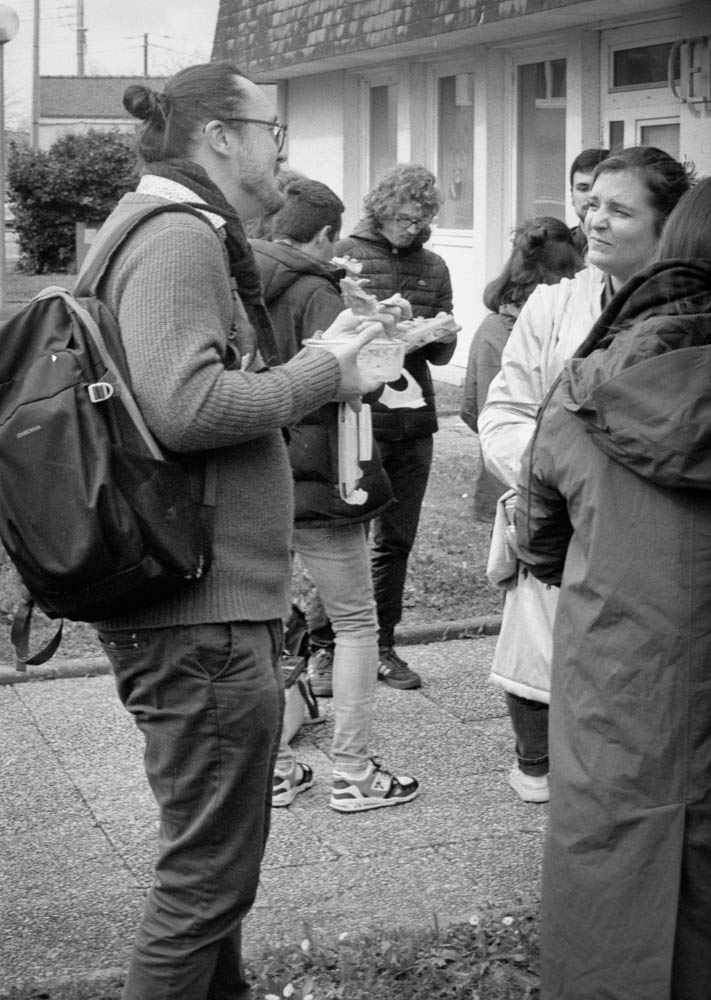
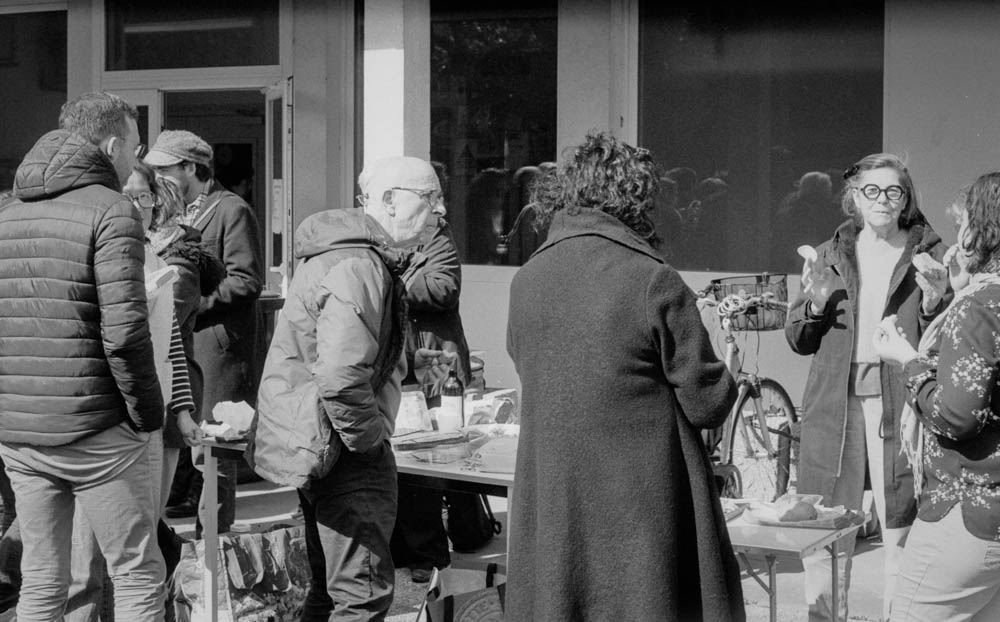
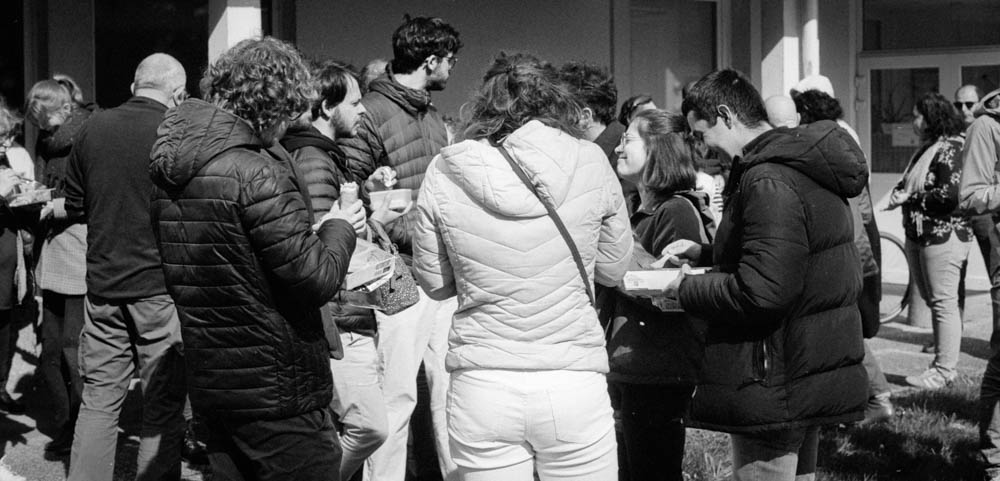
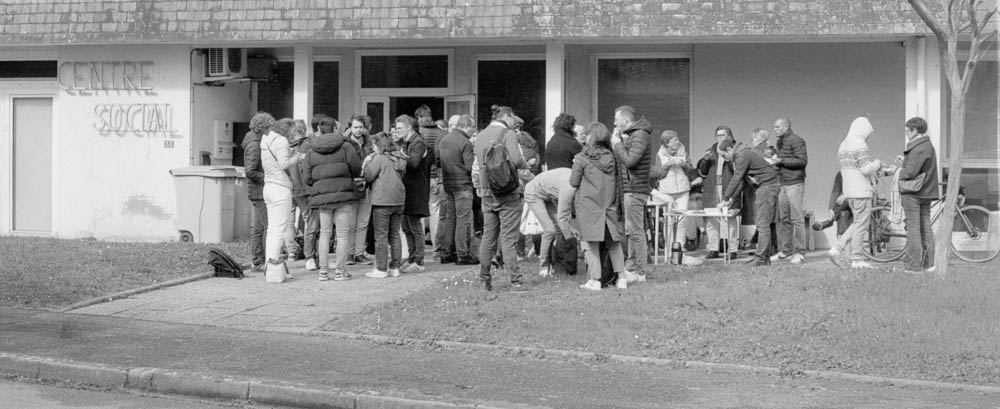
Most documentation skips the food. Concert halls, polished instruments, formal attire — that’s what ends up in the frame. But before any of that, there’s a lunch break in a car park outside a community centre, and that’s where I wanted to start.
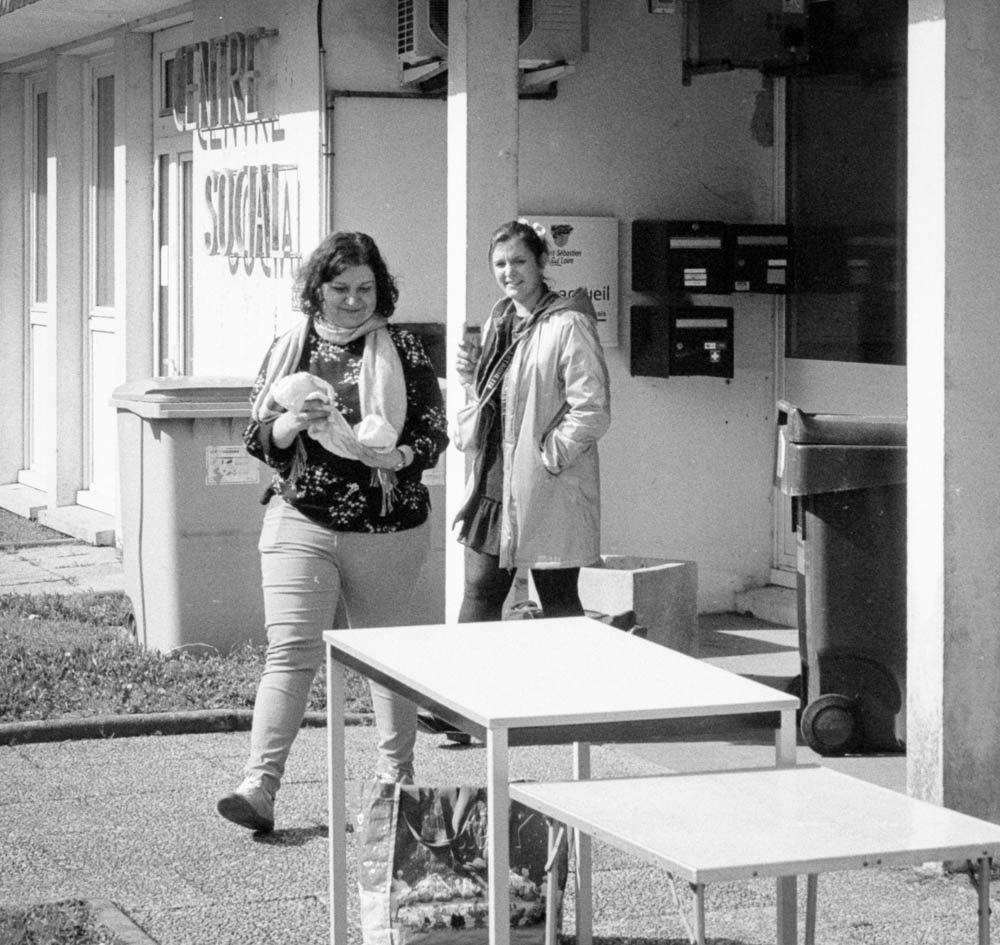
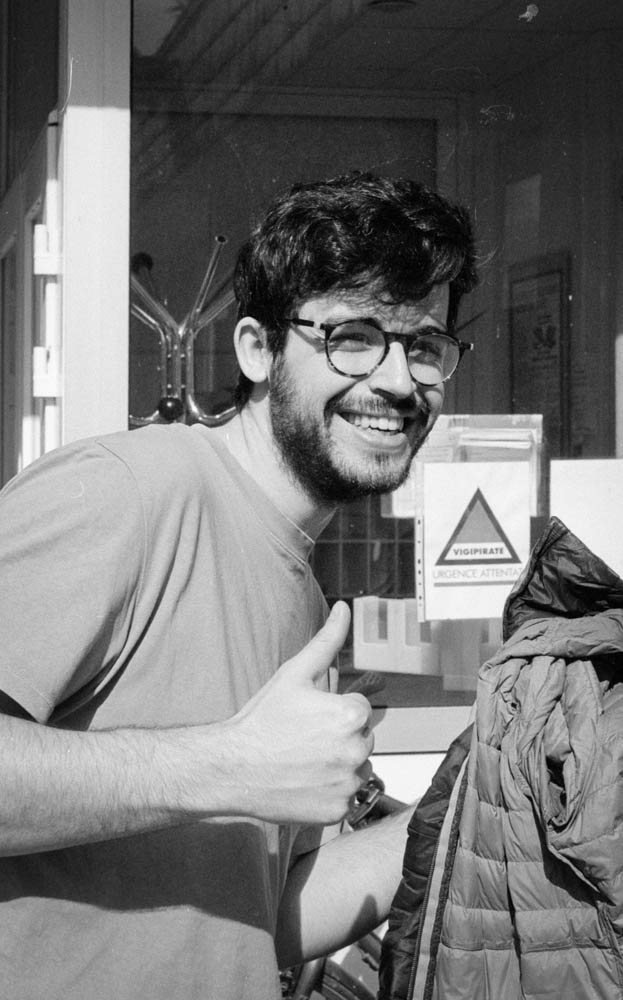
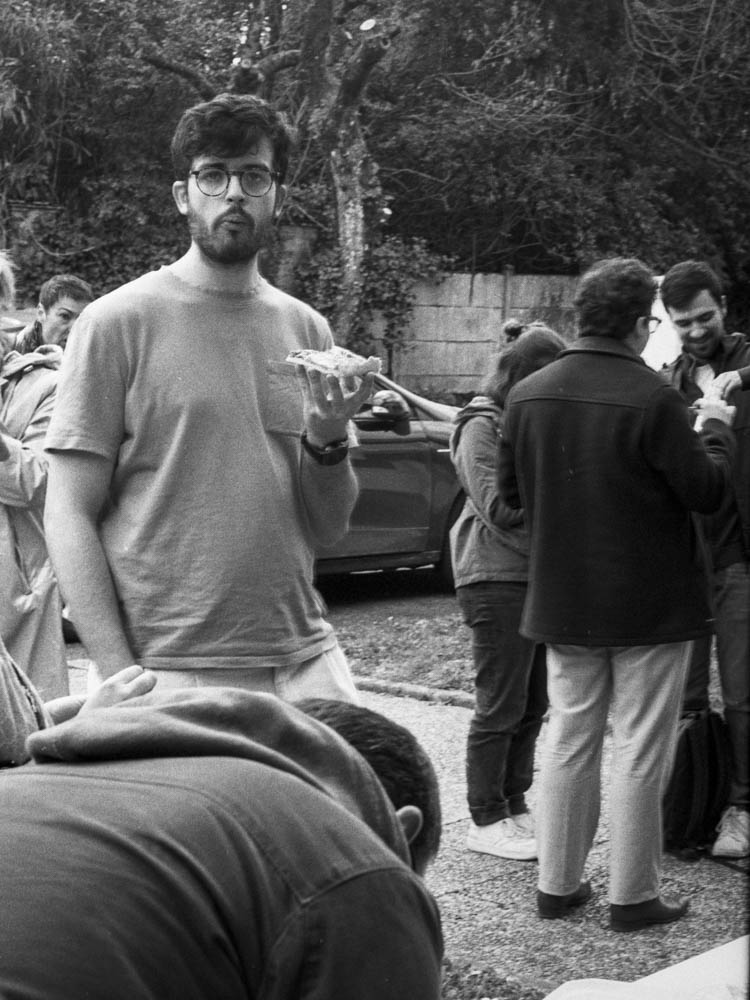
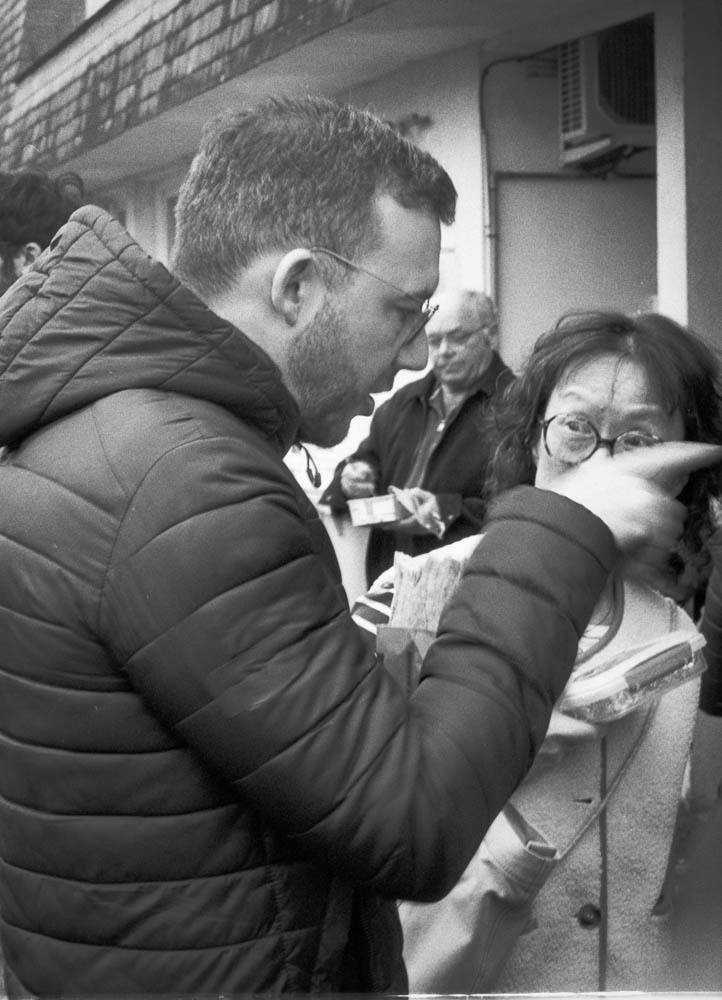
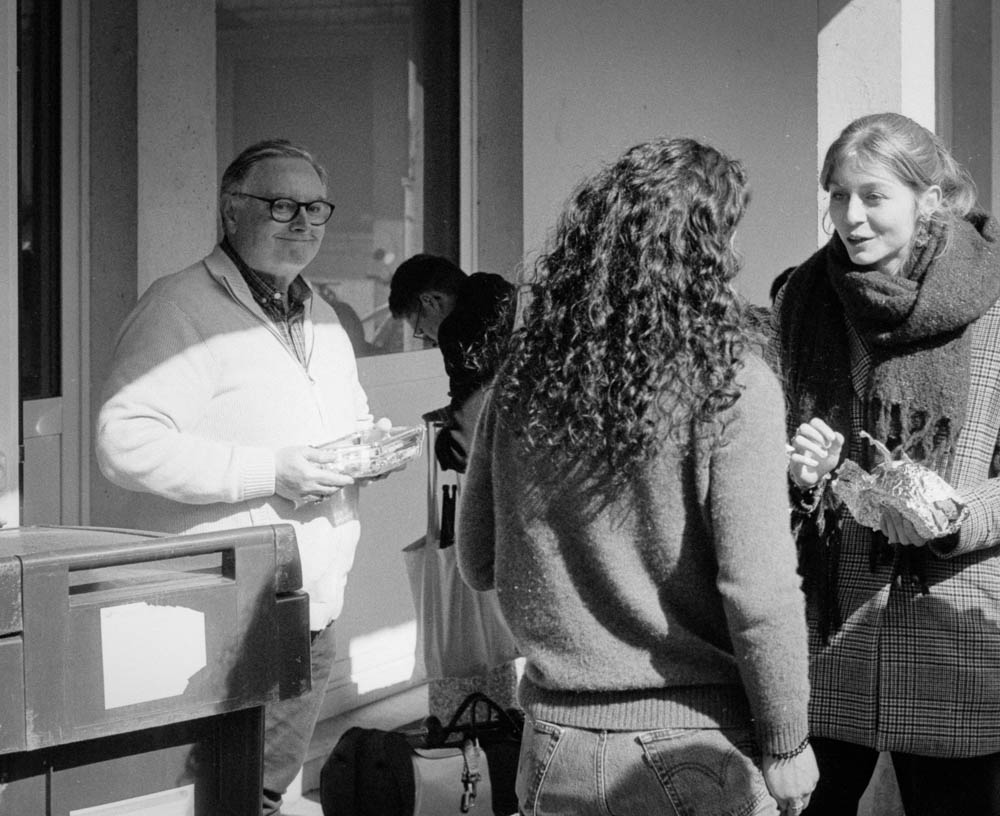
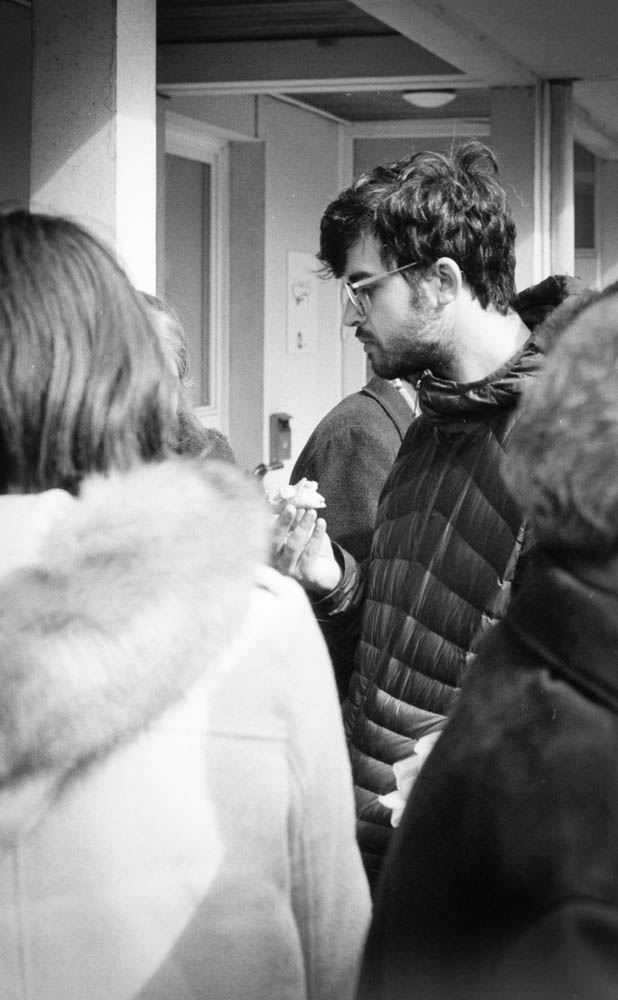
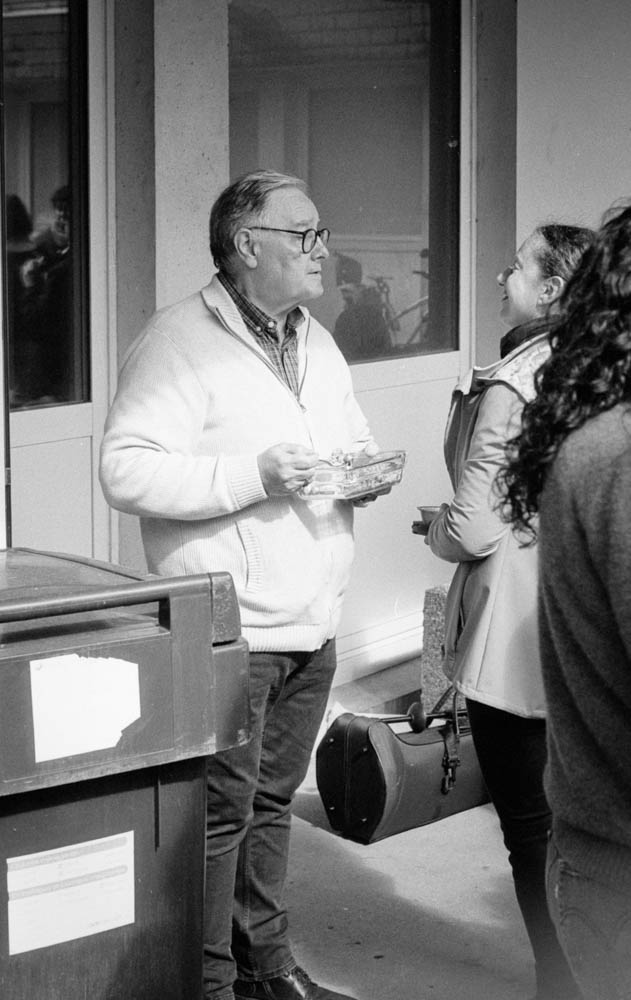
I’m the fourth horn in the Symphonique des bords de Loire. Which means I’m also inside the story, not observing it from a safe distance. I know these people. I count rests next to Corentin, our first horn. I watch Victor — oboe, cor anglais, and the man who quietly keeps the whole enterprise running — arrive with a tote bag full of provisions. I see the conductor holding a food container and chatting, no baton, no authority, just a man at lunch with his colleagues.
That’s what I wanted to photograph.
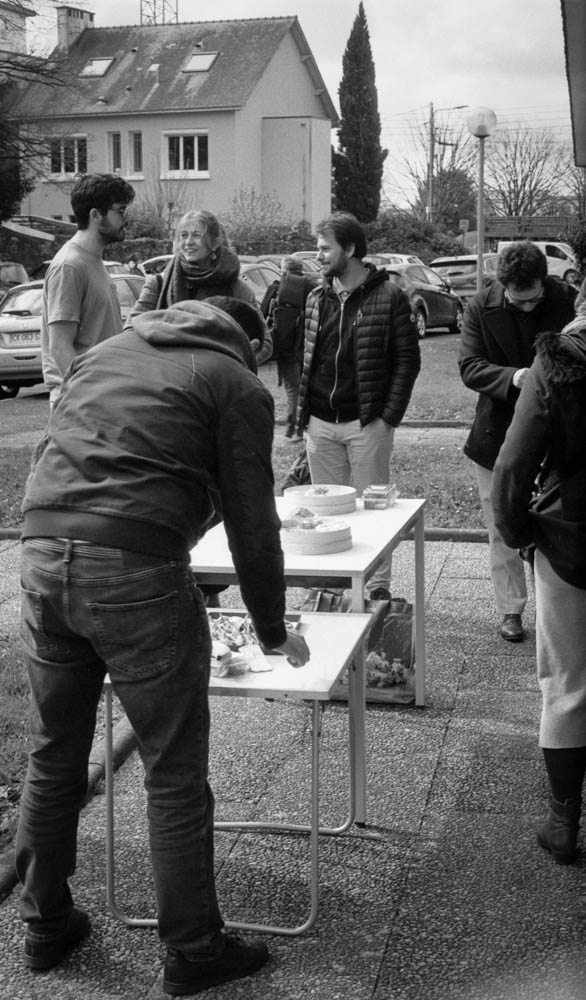
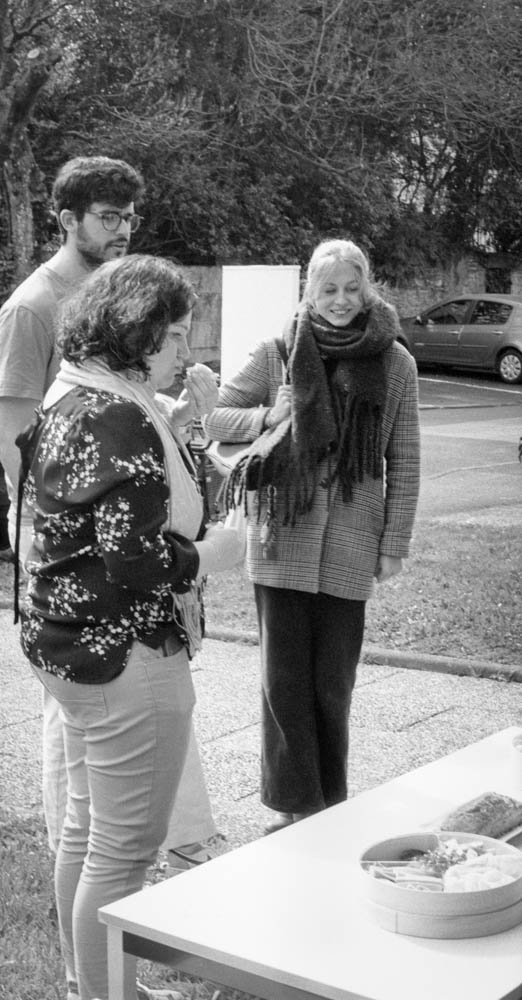
I loaded the Pentax ME Super with Fomapan 100 and spent the break outside. Aperture priority, natural light, film at box speed. No pushing, no games. The choice was deliberate — I knew I’d be shooting the rehearsal indoors on HP5+ pushed to 1600 and 3200. Those would be grainy, urgent, intense. This needed to feel different. Calmer. The breath before the dive.
The difference, when you put the two rolls side by side, is striking:
Fomapan 100 — Lunch
HP5+ 1600 — Rehearsal
Light
Natural daylight
Mixed indoor fluorescents
Grain
Fine, subtle, clean
Textural, present, moody
Contrast
Gentle, even
Punchy, dramatic
Mood
Relaxed, communal
Focused, intense
Story
Community at rest
Collaboration at work
Same orchestra. Same day. Different worlds — and that contrast was the point from the start.
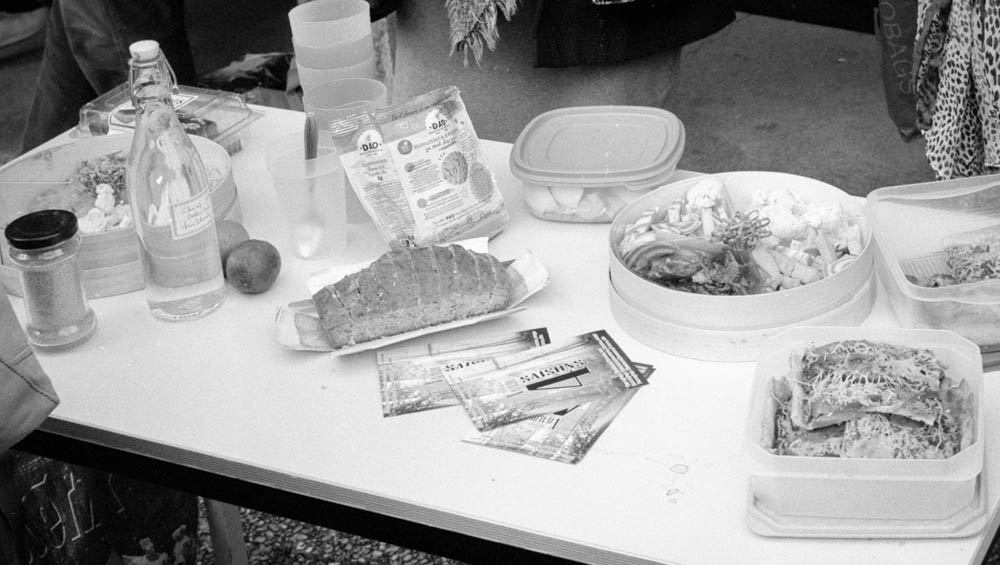
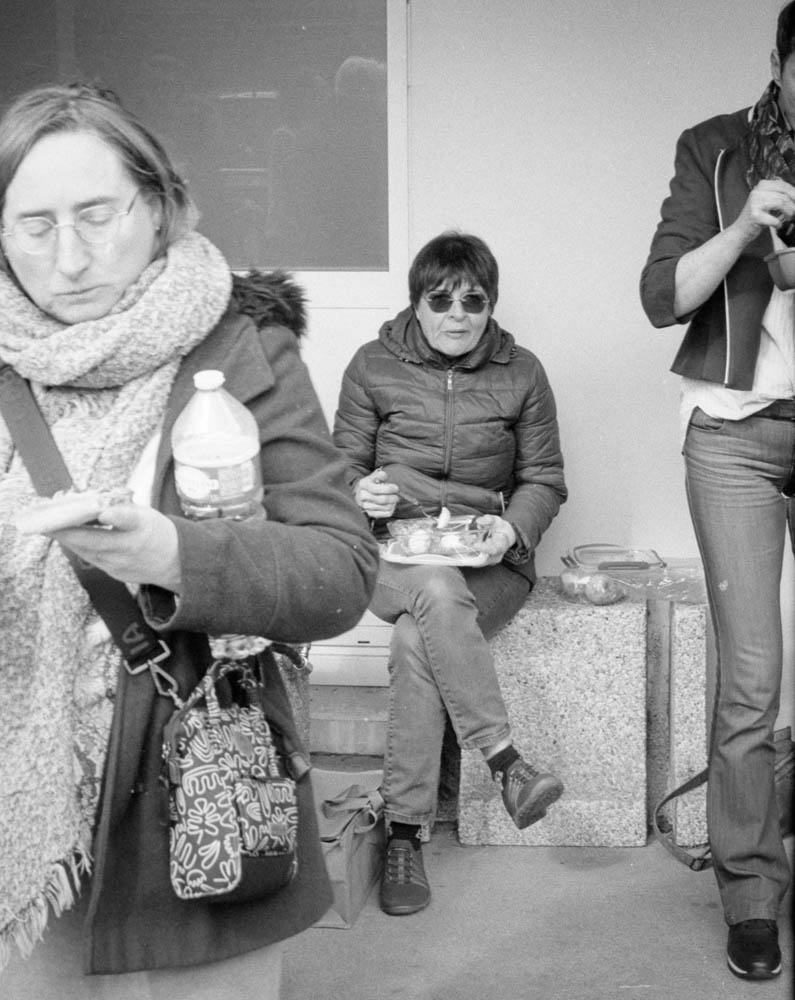
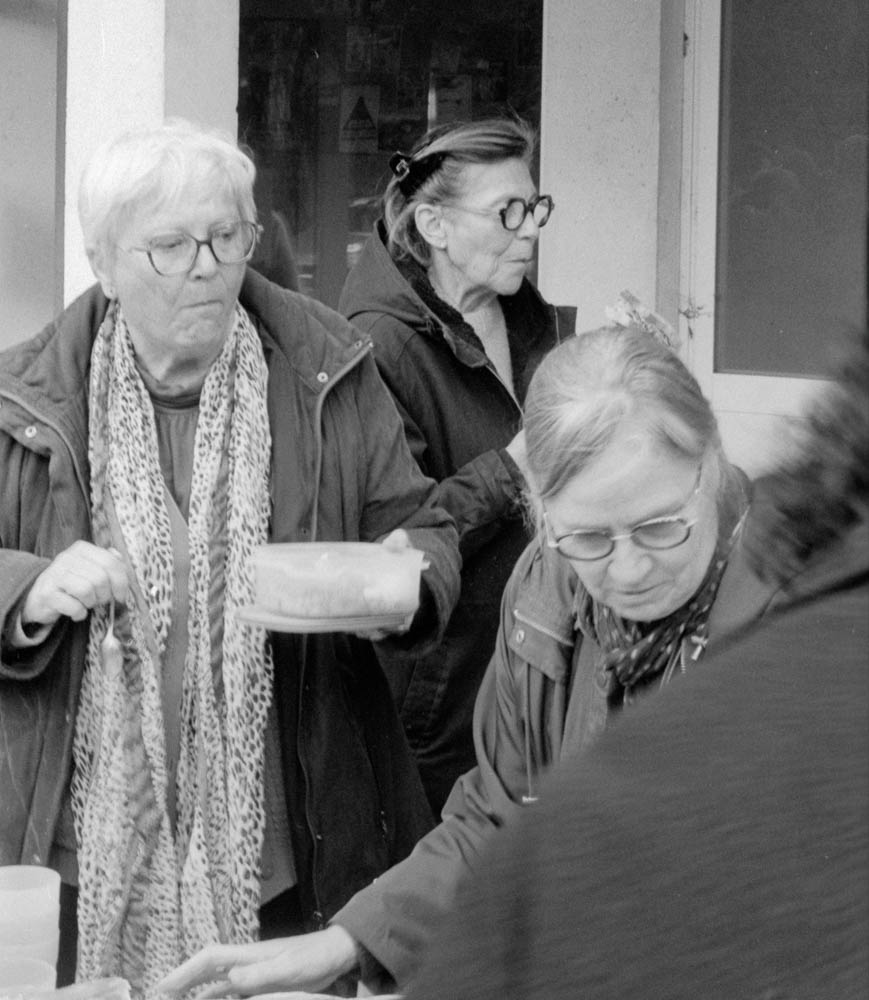
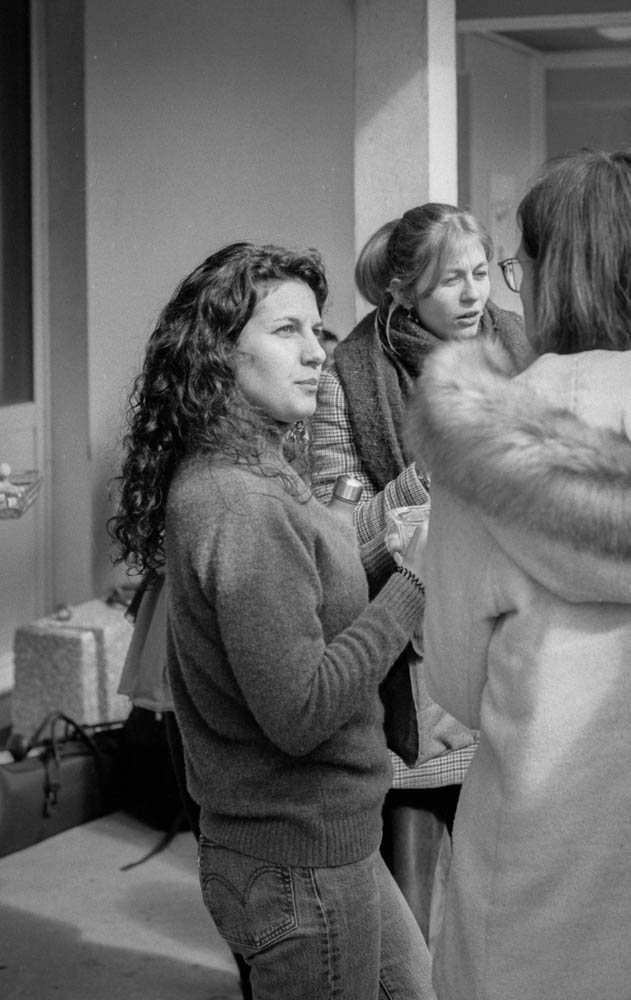
Fomapan 100 in good daylight gives you an honesty about the light that suits candid work. The faces, the bread, the containers of salad, the glass bottle catching the sun — none of it is staged, and the film doesn’t try to make it anything other than what it is.
The two Chinese violin soloists — the guest artists who’d be the focus of the afternoon — weren’t there for lunch. They’d arrive later, after the tables were packed away. For now it was just us: teachers, retirees, students, professionals, amateurs. All ages. The usual mix. Gathered outside a community centre with a faded sign, sharing food before three hours of work.
This isn’t a fancy conservatory. It never was. That’s rather the point.
After lunch, the tables come down. The last conversations finish. Someone rinses a container. And then, quietly, the same people who were just eating become musicians again. The conductor picks up his baton. Viktor picks up his oboe. Corentin finds his pitch. I put down my camera, pick up my horn, and count rests.
The soloists arrive. The work begins.
That’s Part 2.
Shot on Pentax ME Super, 50mm f/1.7, Fomapan 100 at box speed. Developed in Ilfosol 3. Edited in Lightroom
There’s a stock phrase about the journey being more important than the destination. Another one suggests that a journey can transform a man into something new—something he didn’t even suspect. As I look back at the man who left home, went to China on tour, and the one who came home, I can’t help but wonder if there’s truth in both. I’ve previously described China as a “foreign concept,” and now, having returned, it feels far less so. I’ve peeled back a layer of the country and gained a deeper understanding of its culture—musical, culinary, and otherwise.
This tour, too, has been a “parenthesis,” a break from real life, and a chance to be me—not just “Papa” or “husband.” No longer defined by my role in the family or at work, I could just exist as I am, whoever that is. Though I still feel some anxiety about how others perceive me, age has brought a certain self-awareness, self-knowledge, and—perhaps—a bit too much overthinking. For those two weeks, I was simply a guy on a bus, surrounded by French people, walking through new experiences, and discovering everything along the way.
China as a Totally Foreign Concept
Before I left, my idea of China was that of a far-off place, so completely different from anywhere I had lived before. Those ideas were formed in childhood, shaped by the media’s portrayal of this foreign land. I won’t deny it—I was terrified of the whole trip. Researching things online only added to my worries about not being able to read or speak the language. Growing up, I saw China as a Communist regime, almost oppressive like the Soviet Union, and as the enemy we had to defend against. I remember watching the handover of Hong Kong in 1997, feeling my stomach churn as I watched truckloads of PLA soldiers occupy our old colony.
I remember, too, older members of the band, where I wore green for a living, talking about Hong Kong as the dream posting—warm, sunny, and everything a soldier could need. But what was I really afraid of? The unknown. We all knew about China’s state security apparatus, without truly understanding it. The events of Covid only deepened that sense of fear and mystery.
I even worried about something as simple as eating with chopsticks, imagining I’d have to rely on forks or my fingers. Looking back, all of these fears now seem so silly. But they were real before I experienced the country for myself—and especially before I met its people.
The People Who Changed My View
Somehow, I managed to take each day as it came, simply bathing in the new experiences. And, strangely enough, China worked its magic on me. It didn’t just change my view of the place—it changed how I saw the people. They were charming, incredibly friendly, and in a way that made them seem so much more human.
I began to see myself in them, and I realized that, despite our differences, we are more alike than we might think. We all fall in love, become parents with grace, and share the same aspirations for our children—to be happy, to find love, and to repeat the cycle.
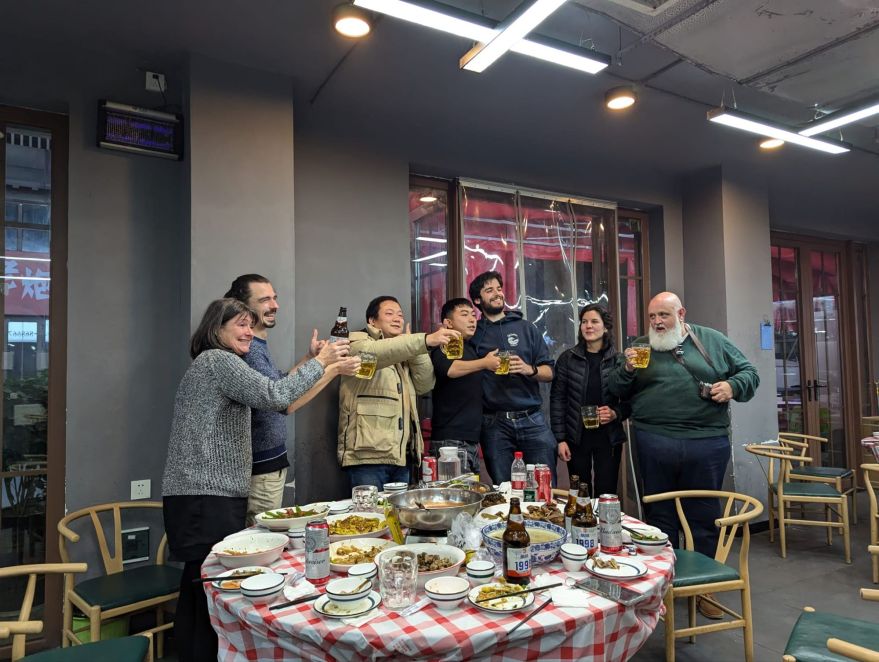
I think back to Christmas Day, when I made new friends. The simple “Merry Christmas” was enough to endear me to them. I also reflect on how beer, it seems, transcends barriers of language, creating a connection that only men seem to understand. I’m not trying to exclude women, of course—heaven forbid—but there’s something inherently masculine about it.
My Place in the Orchestra
Another transformation came in terms of my place in the orchestra—or rather, my perception of it. As the 4th horn, a position typically reserved for the least experienced player, I have always resented the remark. But now, I know my role to be the solid foundation of the section, guiding it through the music. At 53, I no longer feel the need to prove anything. I’m here for the music, content to plod along at the bottom. It’s not humility—it’s comfort, and a willingness to let the young bucks enjoy the spotlight.
Being on tour, though, inevitably brings people closer together. Take poor Corentin, who shared a room with me for two weeks. It’s one thing to get along during rehearsals or after a concert, but living in such close quarters really gives you a new perspective on someone. I knew Corentin was a good lad, but during those two weeks, I saw him in a different light. We talked, laughed, and endured the trials of close proximity.
I remember one drive home from a concert when my birth mother FaceTimed me with the news of her cancer diagnosis. Corentin, despite his limited English, understood more than he let on. He listened as I processed the information, and in that moment, we connected in a way that most people don’t. Maybe that’s what brought us even closer.
Sharing a room with him was like being back in the army. We worked hard, played hard, and celebrated with the kind of noises only a group of men could share. If you can fart in front of someone, you’re already on the next level of friendship.
One moment that stood out for me was when I helped Clement, the other horn player. I had offered him some coaching to help him out of his funk. During the concerts, he had some delicate parts, and although I could easily play his passages for him, I didn’t want to embarrass him. So, I didn’t change seats to play his part during the performance. Instead, I stayed where I was, and when it came to his turn, I played my part to the best of my ability. It was subtle but important—I didn’t want to take his place; I just wanted to give him the support he needed without making him feel like he couldn’t do it on his own.
Afterward, Clement spoke very kindly about me to the younger players in the group. He praised me in a way that felt both generous and sincere, and it left me feeling deeply grateful. His words were not just kind—they spoke to a level of respect and camaraderie I hadn’t anticipated. I hadn’t sought recognition; I just wanted to help. But his thoughtful comments—about my support without overshadowing him—meant more than I could have expected. It’s rare to find such generosity of spirit, and I appreciate him for that.
I nearly forgot to talk about my girls from my days in Cholet. It was Eléonore that suggested that I join the orchestra, and I’m so glad she did. I was about to leave my horn in its box and let it gather dust somewhere in my house where people wouldn’t trip over it. She has been a very good friend to me over the last 13 years, and I think she’s wonderful. Then of course I mustn’t forget Titaua and Mathilde. And they certainly didn’t forget to tall every one about my “kilt” days, where as fed up of being English, I would let people know that one can be from the UK without necessarily being English. My first adoptive father was Scottish, and his brother, Uncle Joe, was Professor Regis at Edinburgh University. People came up to them saying that Ian wasn’t like how they had imagined him, and was actually a decent chap and all-round good egg! Then Eléonore just reminded them that “they” didn’t know me the way she did…
During the tour, as you’ve seen, I took some photos—some of them very odd. But I wasn’t the only one sharing them in the infamous WhatsApp group. For the first time, people saw a different side of me—the artist, not just the beer-loving horn player. I even started sharing my blog posts in the group, and maybe I’ve earned a reputation as the writer. Who would’ve thought? A beer-drinking horn player who takes decent photos and has a way with words—still knows how to play, though.
Anything Else?
I think my approach to food has also shifted. I’ve always liked the idea of sitting around a big table with friends, and during the tour, I was reminded of that. The variety of dishes was astounding, and I saw some players more comfortable with what they knew, while others bravely ate silk worm chrysalids. Me? I just enjoyed whatever was put in front of me, from chicken and duck feet to tortoise.
I found myself stepping away from desserts, my sweet tooth growing calmer. Eating the Chinese way—deliberately, mindfully—was a revelation. Much like film photography, it slowed me down and made me more aware. I ate less, but I appreciated the variety. I even tried to emulate that at home—though, I didn’t put chillies in my dishes.
I’ve also become more accepting of my body. Despite still feeling like I have a long way to go, I’ve made peace with the body I’ve got. Corentin’s lack of judgment helped, and I’ve learned to be more at ease with the frame that carries me around.
How to Conclude?
What’s clear is that this journey, this “parenthesis,” hasn’t just been a break from the familiar—it’s been a period of quiet transformation. The familiar parts of myself have had space to evolve. And perhaps that’s the true beauty of any journey—not the destination, but the unfolding of a self you might not have fully known. In a way, I’ve returned not quite the same man who left. But then again, perhaps that’s the essence of travel: it allows us to become more fully who we truly are, even as we discover the world around us.
As the journey ended, I found myself thinking less about the places I’ve seen and more about the moments shared—those small, unexpected connections that shape an experience just as much as the landscapes we pass through. Travel isn’t only about what we take away from it; it’s also about what we bring to those we meet along the way.
Perhaps that’s what lingers most—the idea that stepping beyond our usual paths isn’t just an act of discovery but a quiet exchange. We put ourselves out there, not just as observers but as participants, leaving behind something of ourselves in the process. And in return, we find that the world, in all its vastness, feels just a little more connected.
Good evening Dear Reader. You may have noticed, and then again, you may not have noticed, that I have created a couple of new pages. Instead of adding article categories to my site in the menus, I have created pages with a carousel showing collections of articles in one specific category. This started with Photography Tutorials, which is a collection of, surprise surprise, photography tutorials. Another one for Travel Photography, one for Camera information, and a final one for articles featuring Film Photography. The idea behind this rather brash move on my part, was to help you find what you wanted to read or discover more easily.
This Meisterwerk of a blog is a work in constant evolution, as I think you may have gathered, especially for those of you that have been with me since the beginning. But what does this have to do with Film photography I hear you ask. Well, when creating the film photography page I realised that there are fewer articles than I first thought. This struck me as a little odd, because at one stage I had a little bit of a reputation as a film photographer, and at one stage was purely a film photographer. This was, of course, before the start of this blog lark in 2019. Between 2009 and 2019 I did a huge amount of film photography that I realised I have not shared with you. Even more so since 2016, when I started developing and scanning my negatives at home.
The beginning of the blog also tied in with the X100F and the Canon 6D Mark II coming into my photography, and since lockdown, I have done only small amounts of film photography. Time to reveal more of myself to you. At least if that’s alright… But this isn’t just about me dusting off old memories. By sharing these photos, I hope to spark a conversation, ignite a passion for film, and maybe even inspire you to dig out your old camera and give it a whirl. Who knows what treasures you might find in your own archives?
Taken on the Praktica MTL3 probably with the 50mm Pentacon F1.8 lens on HP5 Plus at box speed in the Quartier Bouffay in Nantes.
So bearing all this in mind, I have a proposal for you. Let’s open the vaults and let’s have a look at the “film archive”. This could be in the form of a series of articles complementing the weekly outpouring of anecdotes or advice, as an addition, or it could be the content for the upcoming weeks. I haven’t decided yet. Let me know in the comments which option you prefer, or if you have any other ideas for how you’d like to see the film archive content. There’ll be shots of Nantes, the UK, England, and Scotland and maybe even Spain, and Portugal. There will be colour and black and white photography too. I don’t know yet. I might not have yet taken into account the magnitude of the task ahead. Everything is open.
On the way to Otterburn in Northumberland with the Pentax ME Super using Portra 160. It was another good day out.
But whatever you decide, I hope you come along for the ride. It’ll be worth it!
Hepple. Even just saying it gives me a certain sensation of pleasure. Heh-pull. It just rolls of the tongue, and the pull sound at the end is tension that is let out and offers some relief. A bit like a fart, but less smelly. Amis de la poésie, bonsoir!
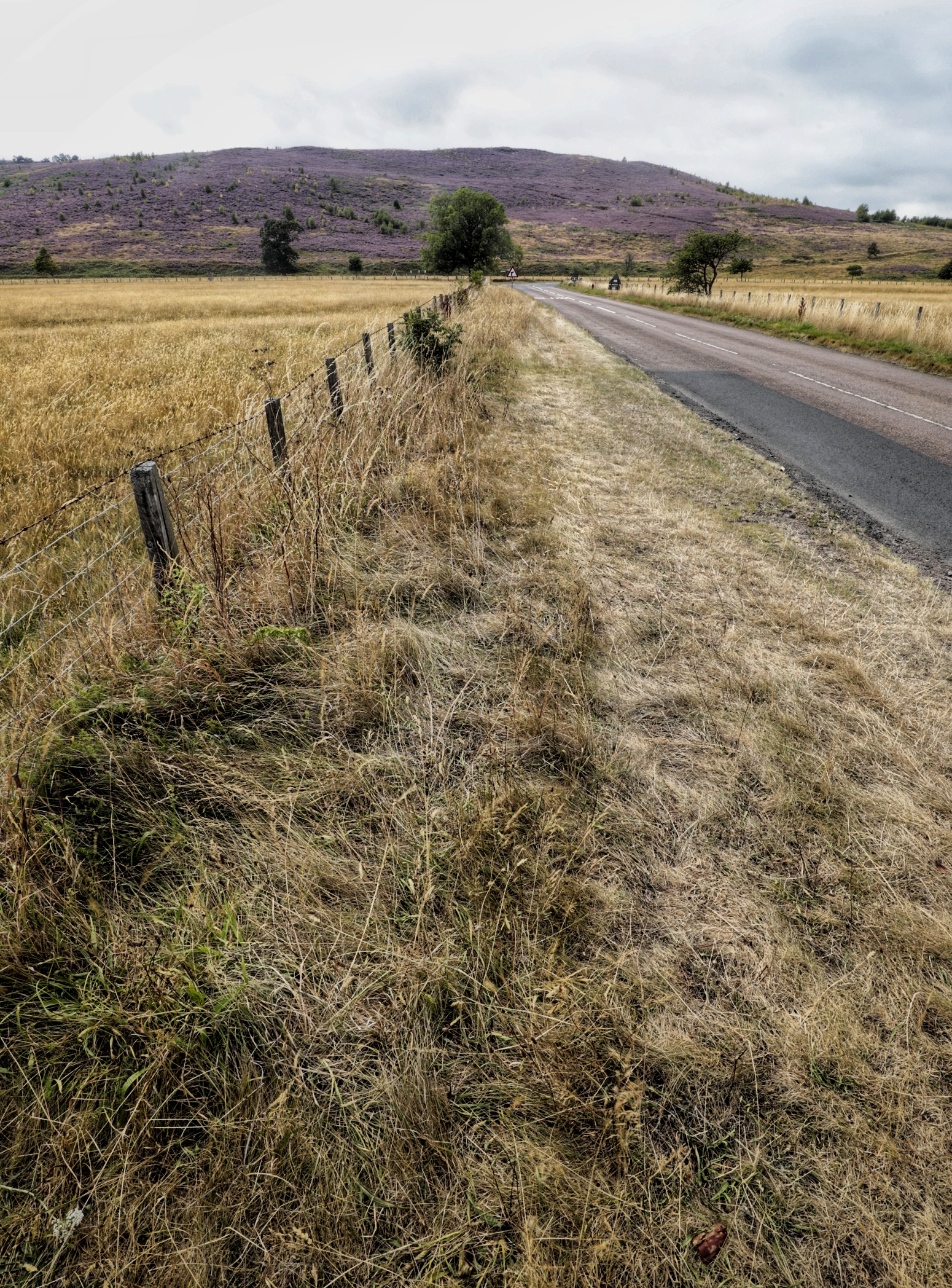
Now don’t get me wrong, I love Alnmouth but I like to get out into the country when I visit my parents. You drive into Alnwick, and then through the town past the TA base going up towards Rothbury and the on to Otterburn where the Army likes to play soldiers with live ammo and you are warned not to go onto the land otherwise you might go boom. Going boom is not a nice thing to do and should he avoided at all costs unless you really do want to go out with a bang.
You go past Cragside which as a family we have visited before, in the sun and the rain. It was one Summer and it was raining all bloody week and my mother said we should go out to Cragside and have fun going through the maze on the hills around the very stately home. It was a great idea, except for the fact that it had been raining like a cow taking a piss, and the whole place was waterlogged and we were all wearing crocs (other more suitable footwear from other brands do exist) and that other footwear would have been most welcome. We arrived back at my parents house soaked and a little pissed off. Oh the joys of family holidays during the British summer.
I digress. Je diverge, et parfois je dis bite!
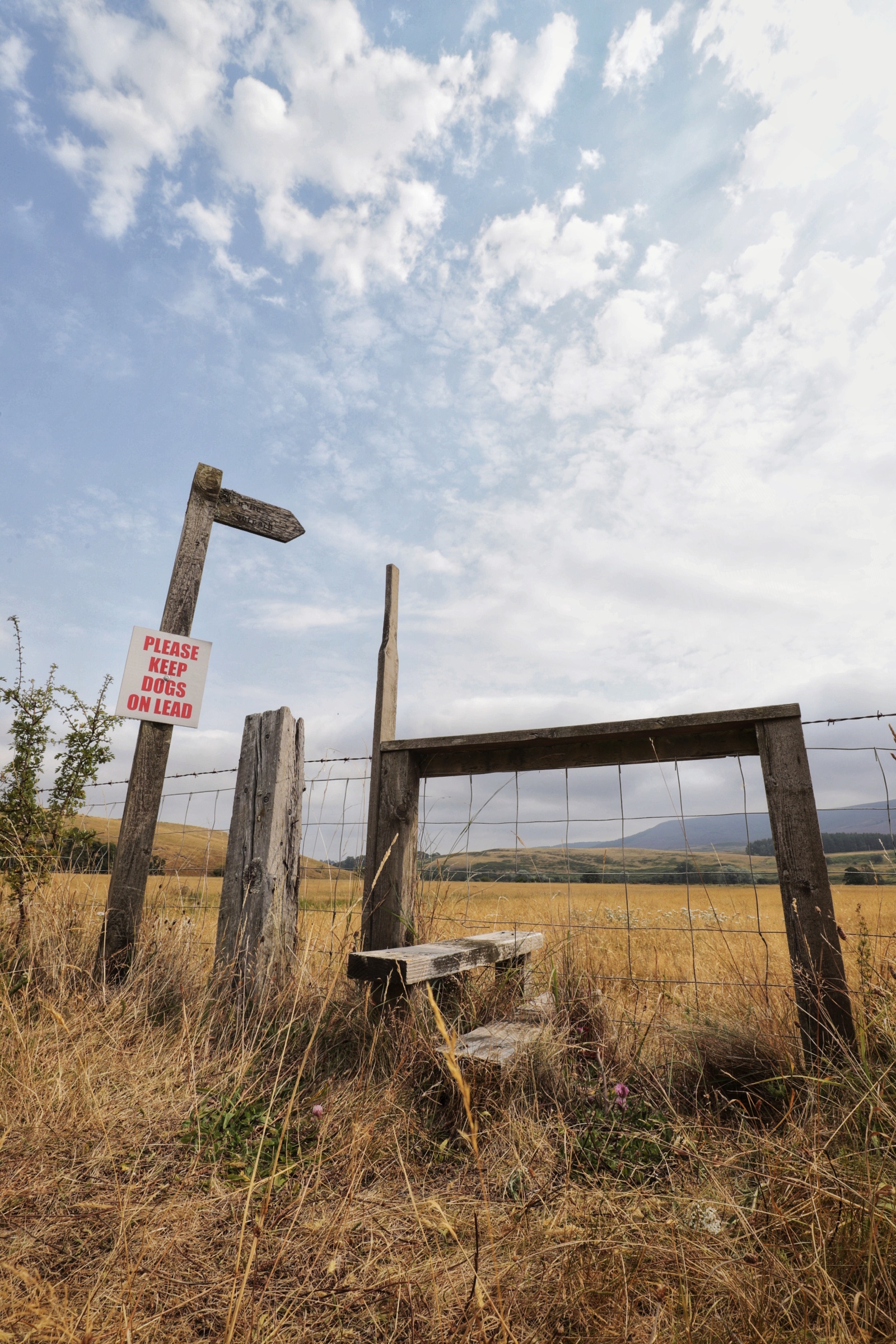
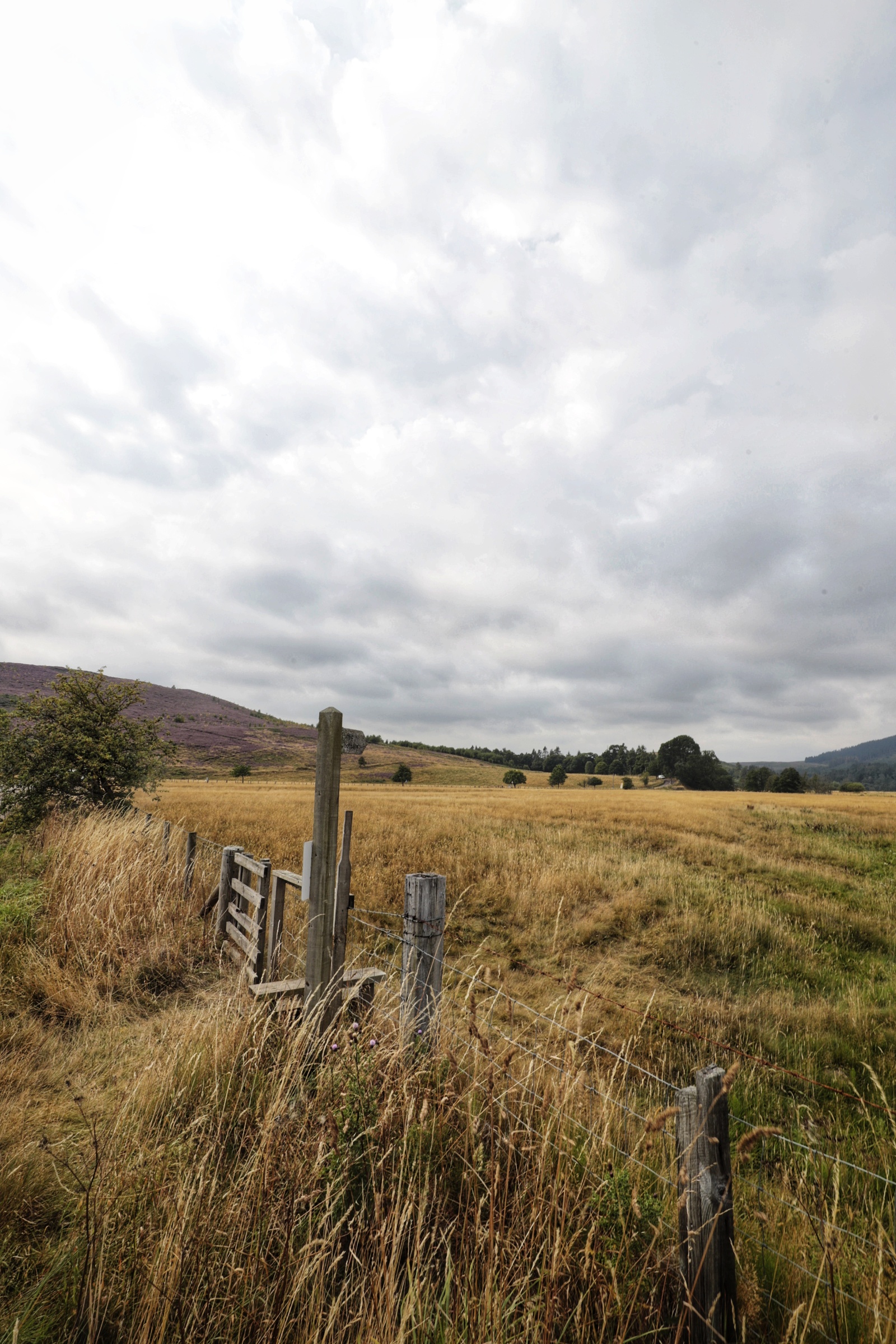
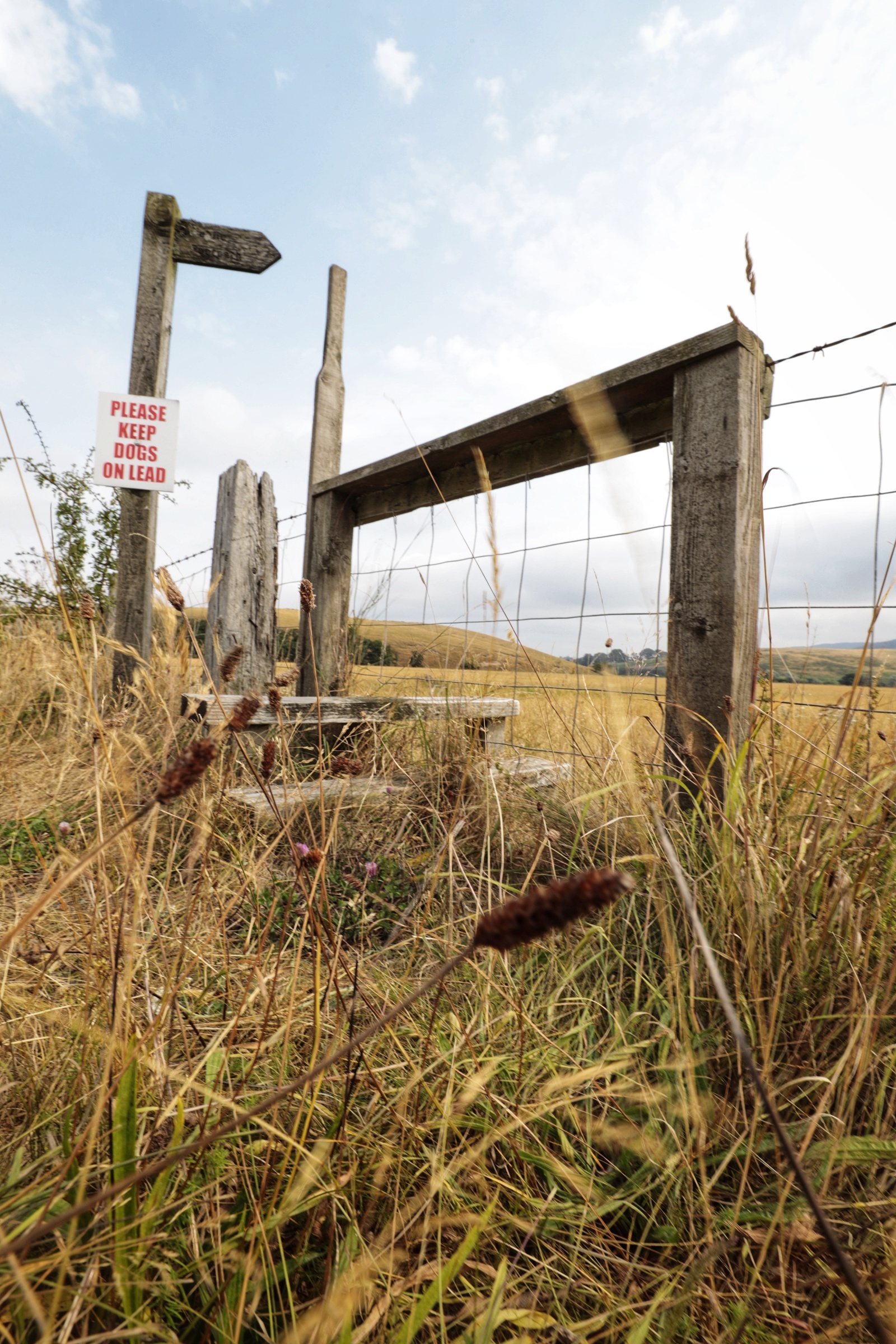
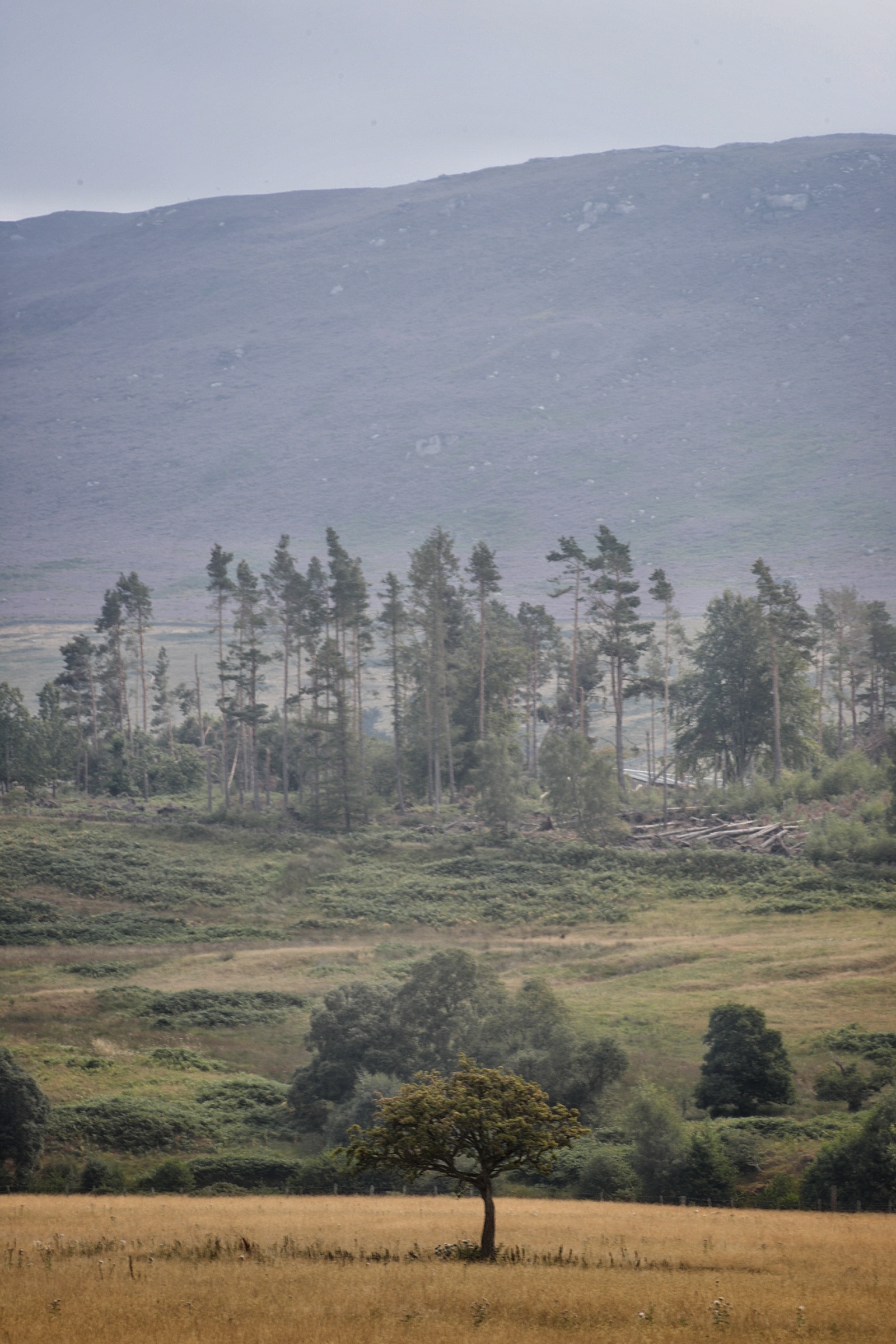
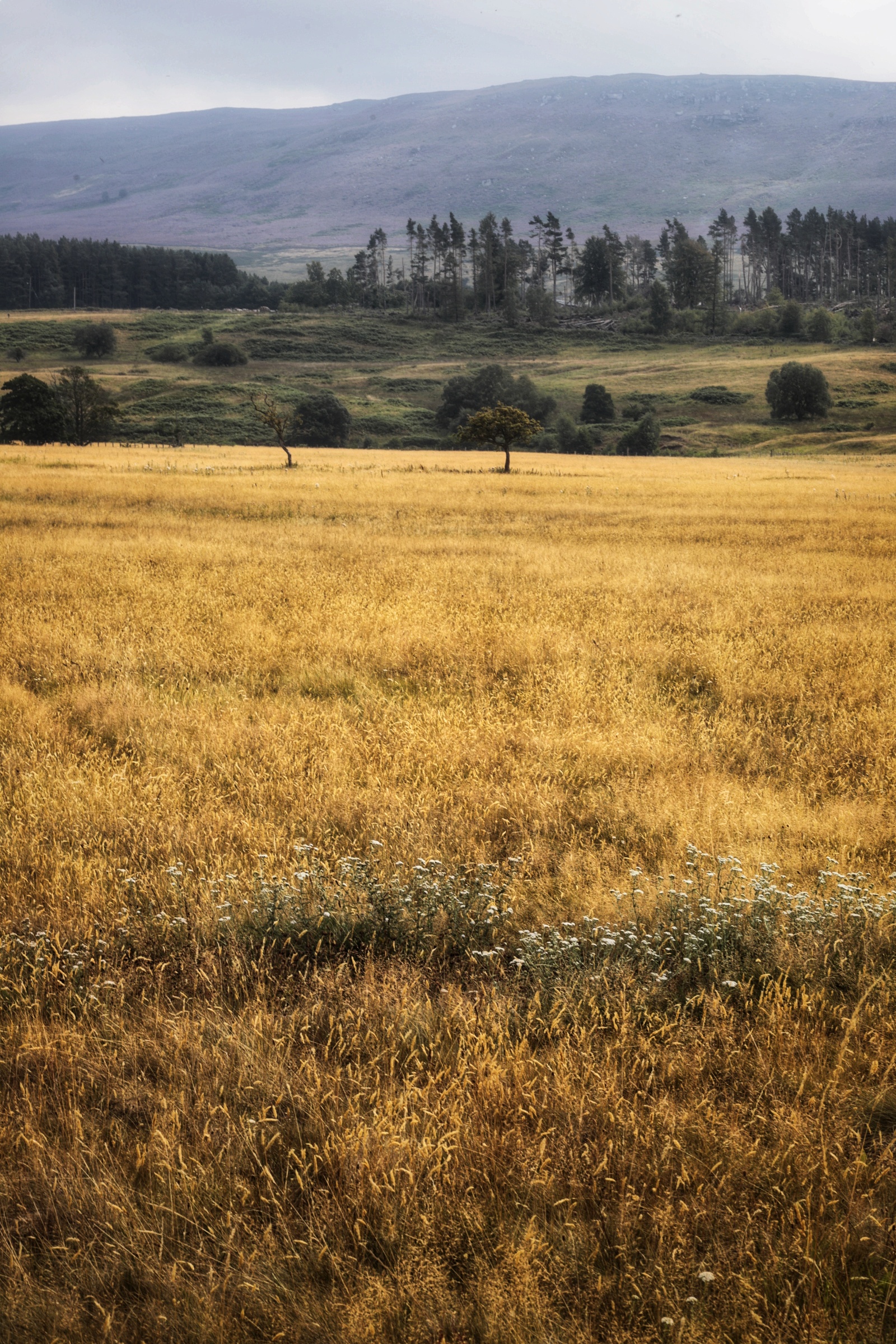
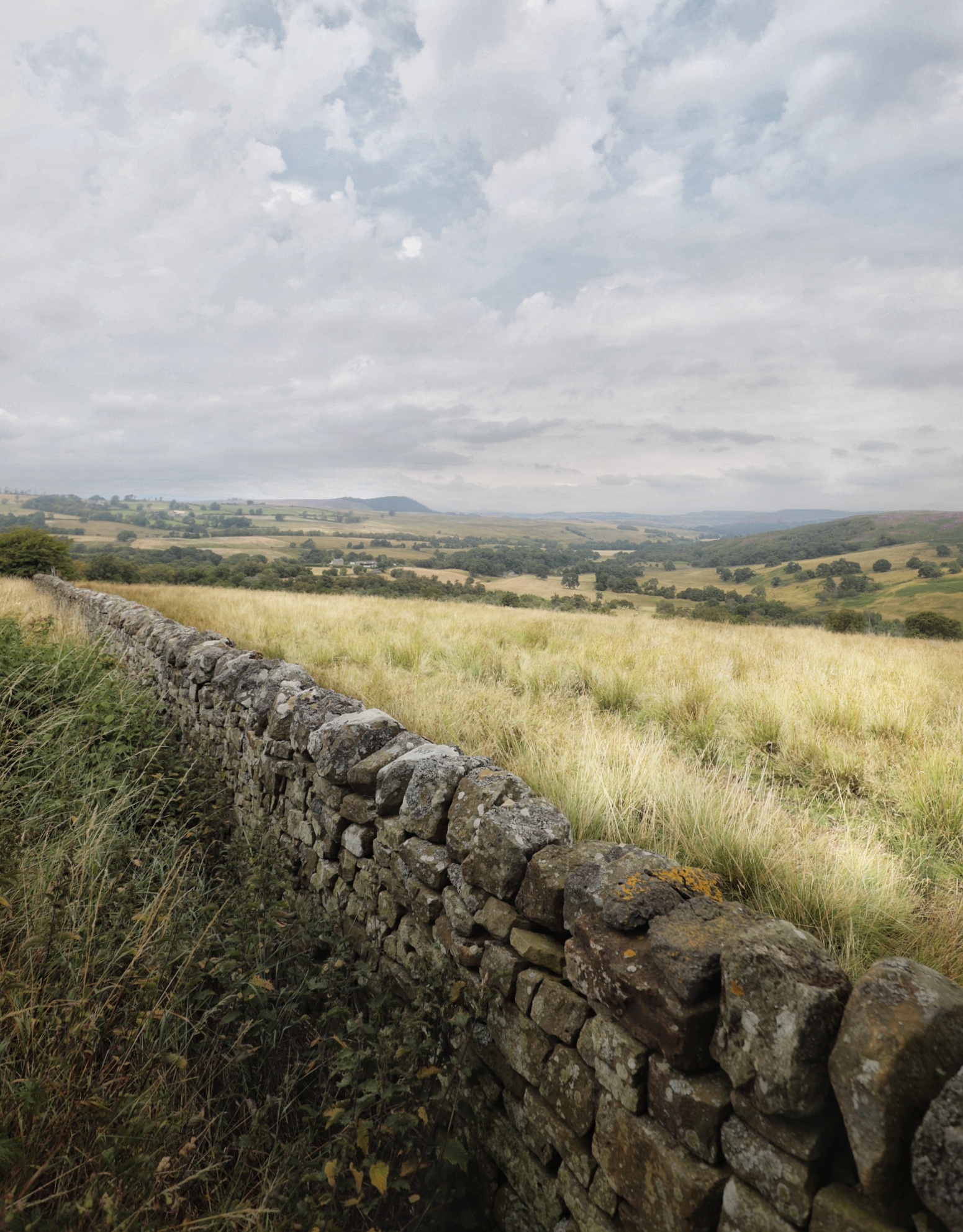
Anyway, you go past Cragside and you will eventually end up at Hepple. I tend to go through the village and park up on the verge after the bridge. You can’t miss it, and if you do miss it the you are on the wrong road.
I have this stupid idea in my head that if I watch enough YouTube and try and learn ever more about photography from the various videos watched, and learn to leave my comfort zone and try new things, then I might discover something new and find out something that I might not even suspect possible. Yes it was one of those kinds of days… I should have known.
I was in the car with my camera and my father for this trip out. For some reason or other, fate had thrown us together and I had missed having sandwiches for lunch at parent’s house and still can’t remember how and why my father was in my car. Well, I wasn’t going to miss the opportunity to spend some quality time with one of my favourite people. So we had driven off to Hepple. I promise I will get to the end of this story. Maybe not straight away, but maybe by the end of this article.
Parked up. Ready to shoot. Camera out. Lens on camera. And then I just jave to work the scene and try and get compositions and pictures together. Now one video suggested using a telephoto lens for landscape photography. I wasn’t sure about this but tried it anyway just in case. While I was out of the car taking photos my father would be quietly listening to car radio holding one of the lenses as I was doing my thing. Bless him. That man has the patience of a saint. Either that or he enjoyed seeing me doing my thing. It was sharing with him one of the ways I seem to spend a lot of time.
It’s moments like that, that will stick in my memory forever in a way that going to the kitchen to get salt for my wife will be forgotten once I arrive in the kitchen. Not that I don’t want to to get salt for my wife, I just seen to forget very quickly.
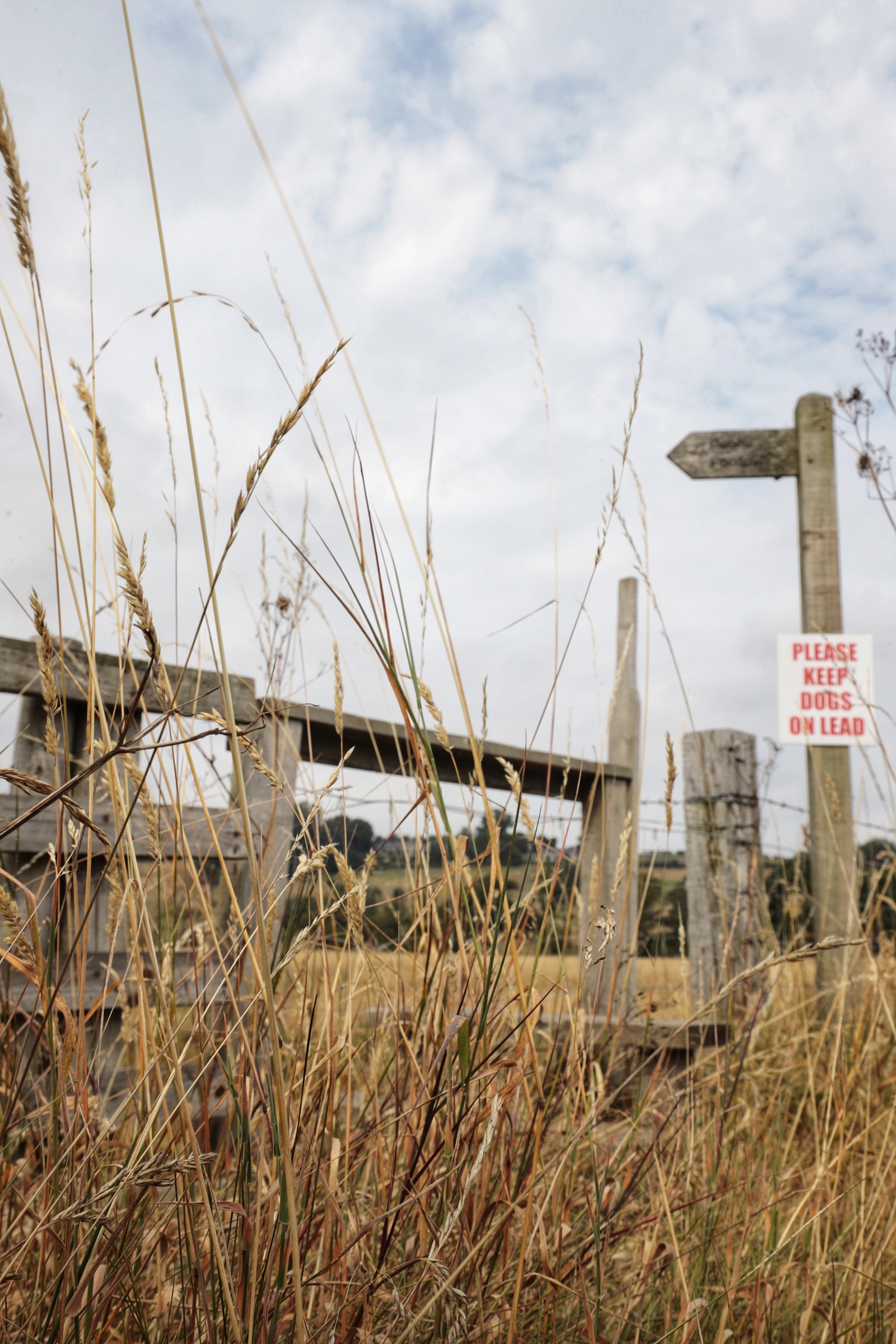
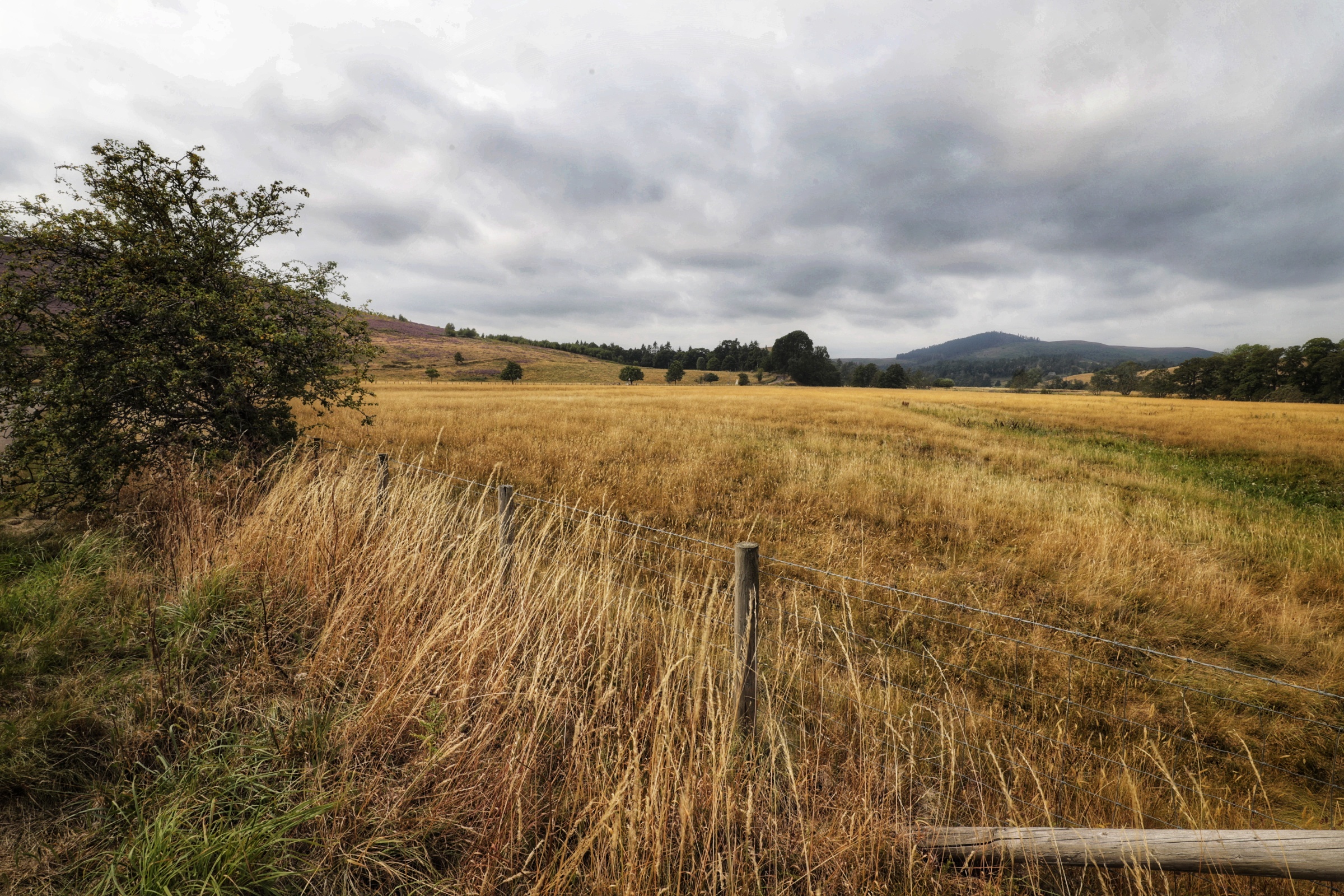
So I started of by using my wide-angle lens and the thought, why the hell not, I’ll get the 70-300mm out of the bag and see what I can do with it. A wide angled lens will give you a very wide angle of view and offer up some wonderful distortion. Hence the name wide angled lens. The originality of that name still blows my mind! A telephoto lens however will give you the impression that everything has been drawn in and the background seems to be just being the foreground. It compresses the view… However they still say telephoto lens and not compressor lens. Go figure.
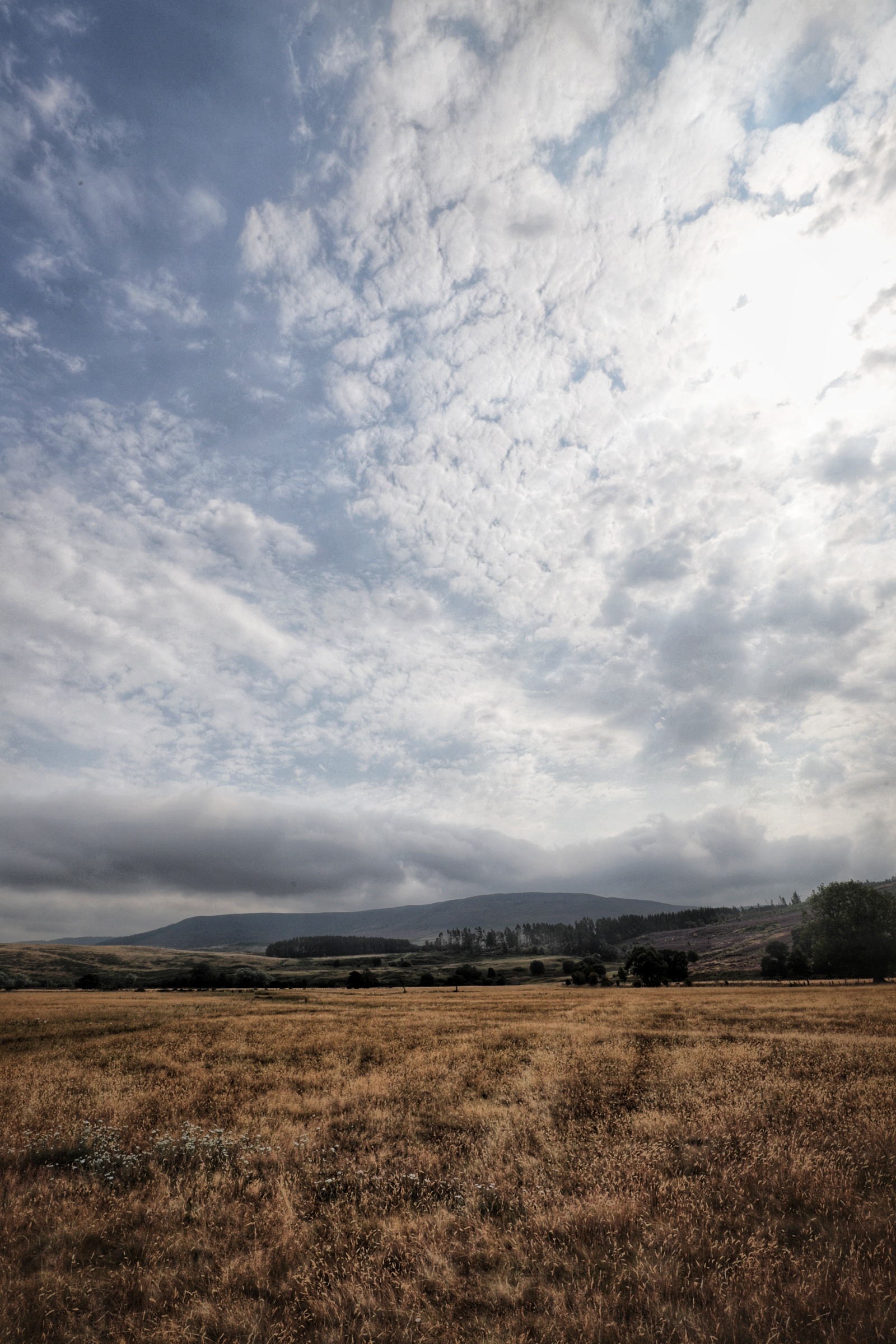
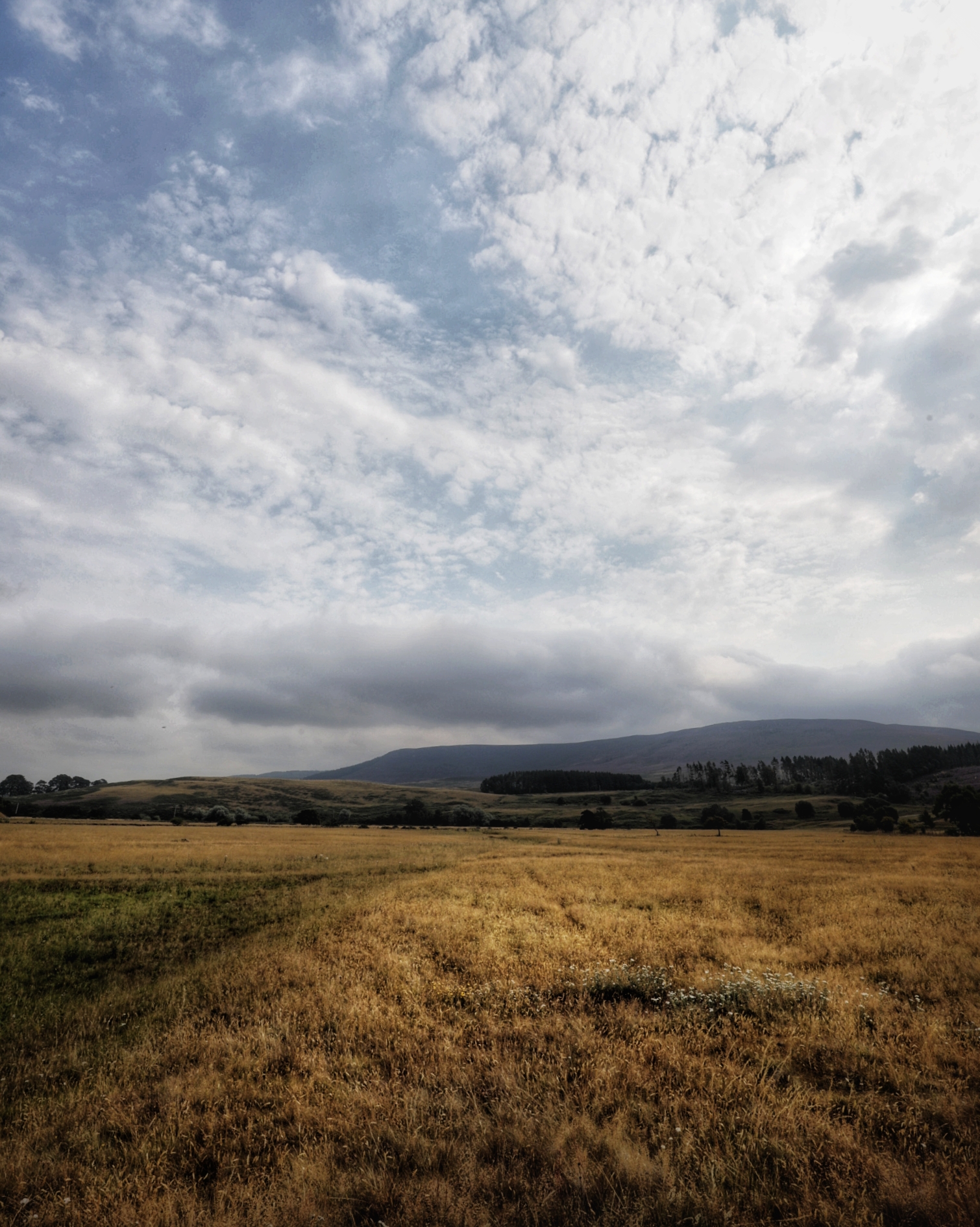
In the photos from this outing I think you’ll be able to see which photos were taken with which pens and of you click on each photos you can see the type of lens used in the description.
It’s one of my happy places and one that I keep going back to. They must think it weird that every summer a French car pulls up and this fat dude gets out with a camera and starts taking photos then gets back into said French car and drives off with souvenirs in his head that will keep him going until he comes back. It was just brilliant being able to just take in the scenery and enjoy being there with my Dad. Definitely a keeper that memory. It was just happiness. Happiness is being out with your Dad taking pictures and just being two men in a car driving across the Northumbrian countryside. These little instances of happiness that just seem to carry you through. Thanks Dad.
For my many sins, I am a musician and not just a depressive dude with a camera. I play the French horn. Some might even say that I’m a French French horn player, without being corrected by my autocorrect. So this music thing… I play the horn in a Wind Band, in Cholet, in the Anjou region of France, with good food and wine. I wonder what decided me to join them… There are a series of concerts every year with each concert having a given theme. This next concert’s theme is about the planets. The programme will be The Planets, by Gustav Holst, and the third Symphony by Johan de Meij, Planet Earth.
If you want to read Wikipedia to tell you about the Planets by Holst, then you can click here. I will now give you my version of events. Gustav Holst, a man with Swedish, German, and Latvian origins but born in England, wrote a series of pieces that made up the Planets Suite. His ancestors must have settled before Brexit! This was ground-breaking stuff, akin to Stravinsky and his Rites of Spring. However, this program is about the planets, so we’ll leave Spring to Igor, the composer and not Frankenstein’s whacky assistant. As any trailblazer will tell, they just weren’t ready for it man, and that it was ahead of its time, which to be fair, it was. He started writing the suite in 1914, and the first movement was “Mars, the bringer of War.” Quite eerie when you think about what happened in 1914. Composing finished in 1917 and the première took place at Queen’s Hall, on the 29th of September, in 1918. There were seven movements, and when I was a child, I always wondered why the planet Pluto wasn’t included. What did they have against Mickey Mouse’s dog??? Then I learnt Pluto was only discovered in 1930. The poor planet was demoted in 2006 and is no longer considered a planet but is still a heavenly body… Just like Yours Truly!
This music that first disturbed people, has, over time, and thanks to John Williams, become the music of space and the stars, wars or no wars. Some have accused John Williams of nicking everything in the first movement, Mars the bringer of War, and using it to compose the music to Star Wars. I’m not saying he nicked it, but… A nice American gentleman, Charles Cornell, has exposed his point of view in a YouTube video
When you look at it like that you can get where those people are coming from. But in a completely nonpartial way, I couldn’t give a flying fart. Both composers’ music is wonderful, and I think one could call it more homage than pilfering. Mind you, there are certain similarities.
When you look at the Planets Suite, you notice the Earth isn’t mentioned. One person that noticed this and who could do something about it, is a certain Johan de Meij, whose name is engraved on a plaque on our rehearsal room in the Cholet Conservatoire. A Dutch trombonist, he moved into composition, arranging, and conducting. In the Wind Band world, he is very well known and respected. Nearly all of us will have played some of his music at one stage in our careers.
The third Symphony takes us from the beginning of our Lonely Planet, Planet Earth, ending with Mother Earth. It isn’t as much a narrative, but a more auditory exposition of ideas in an abstract form. A soundtrack with electronic sounds helps the symphony become one musical experience as opposed to the classical three separate movements. Planet Earth really is a continuation of Holst’s Planets.
It’s a whopping significant piece and a joy to play despite a few difficulties to challenge the horn player. We were very fortunate to have Johan come and visit us, not just to say Hallo, but to explain the piece to us, conduct us and rehearse us. The poor lad was full of cold, but shared his wisdom and experience with us, which I’m sure will prove itself invaluable for our performance on the 14th of November in the Théâtre Saint Louis in Cholet. We worked on aural skills listening to the chords and listening to them to adjust the tuning and seeing where we fit into those chords. It might be an insignificant detail to you, but the seats are very comfortable and the acoustics are pretty damned good too!. Holst couldn’t make it. Must have had something else in his diary for that weekend!










 IJM Photography