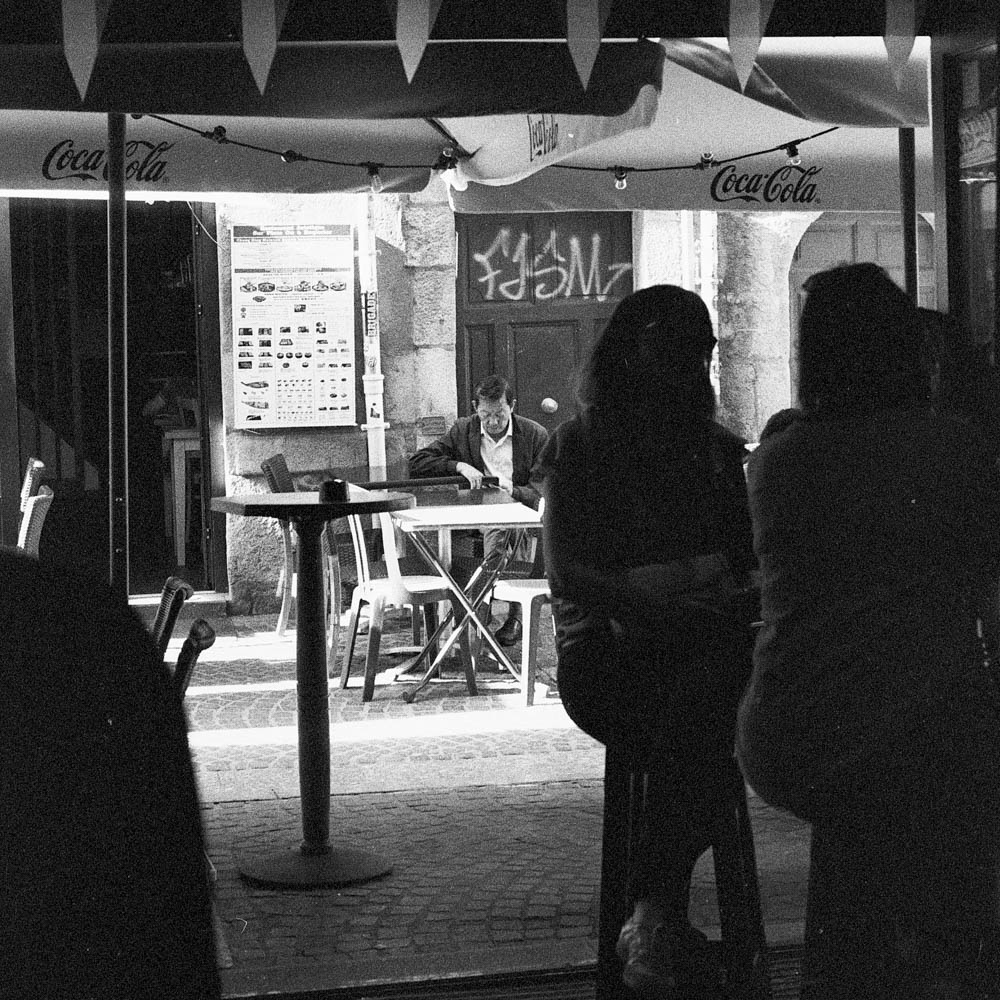
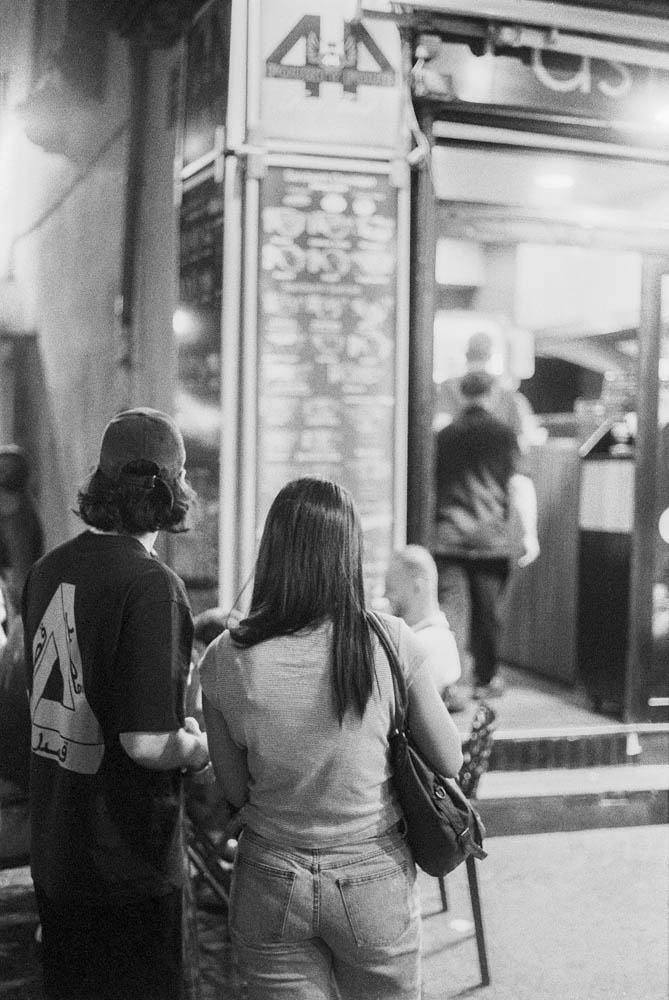
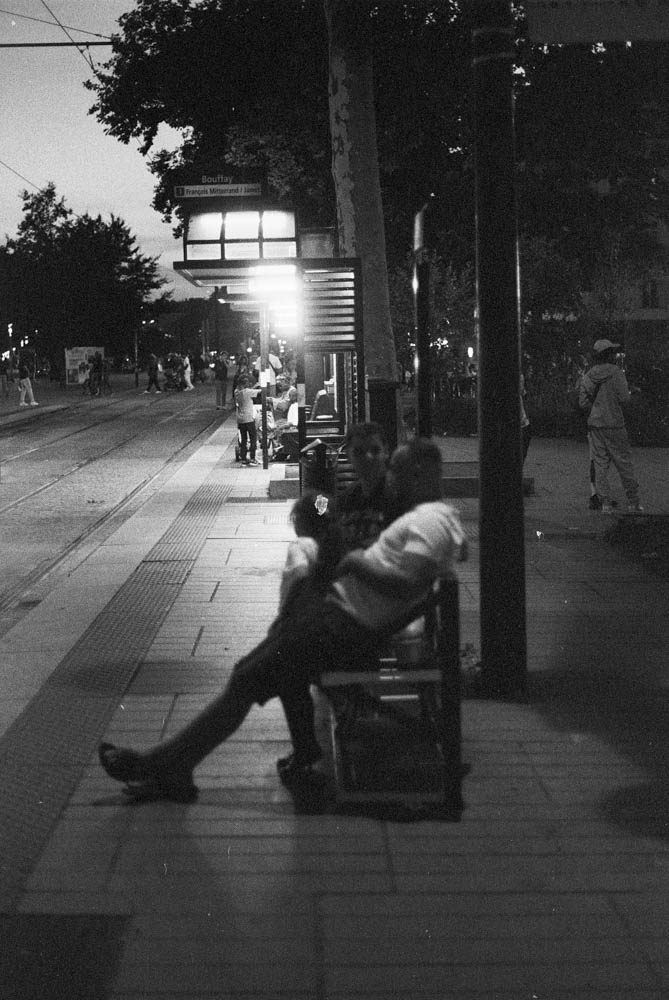
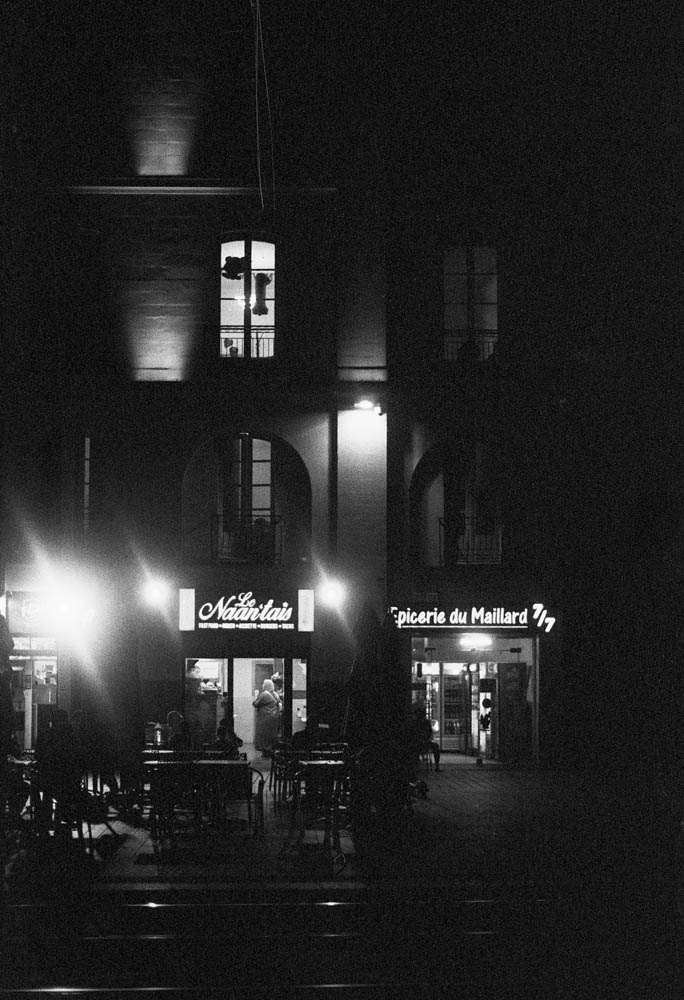
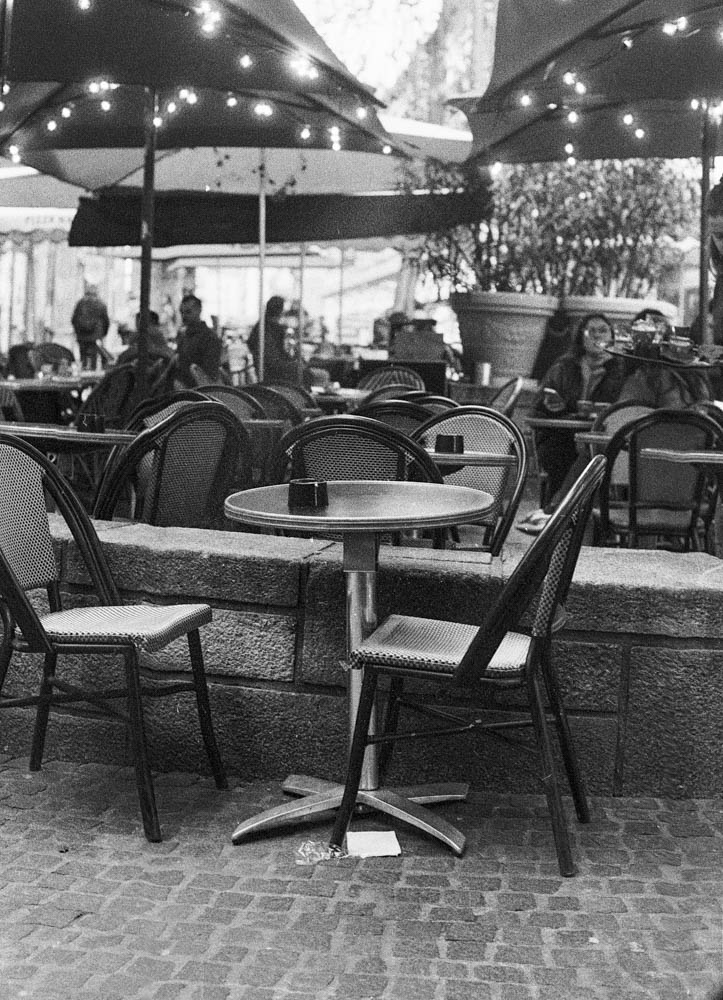
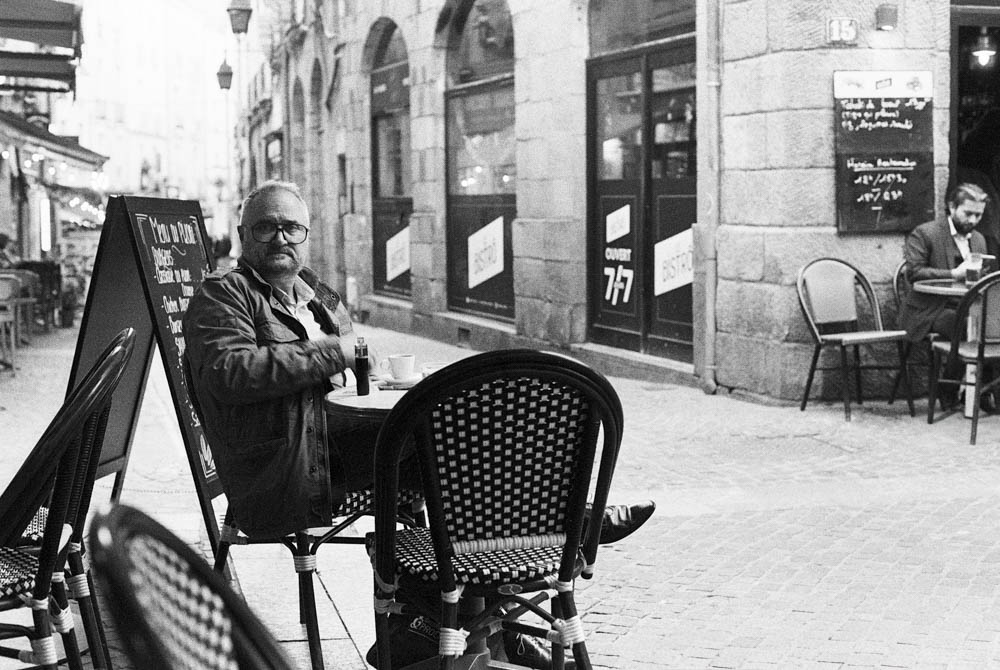
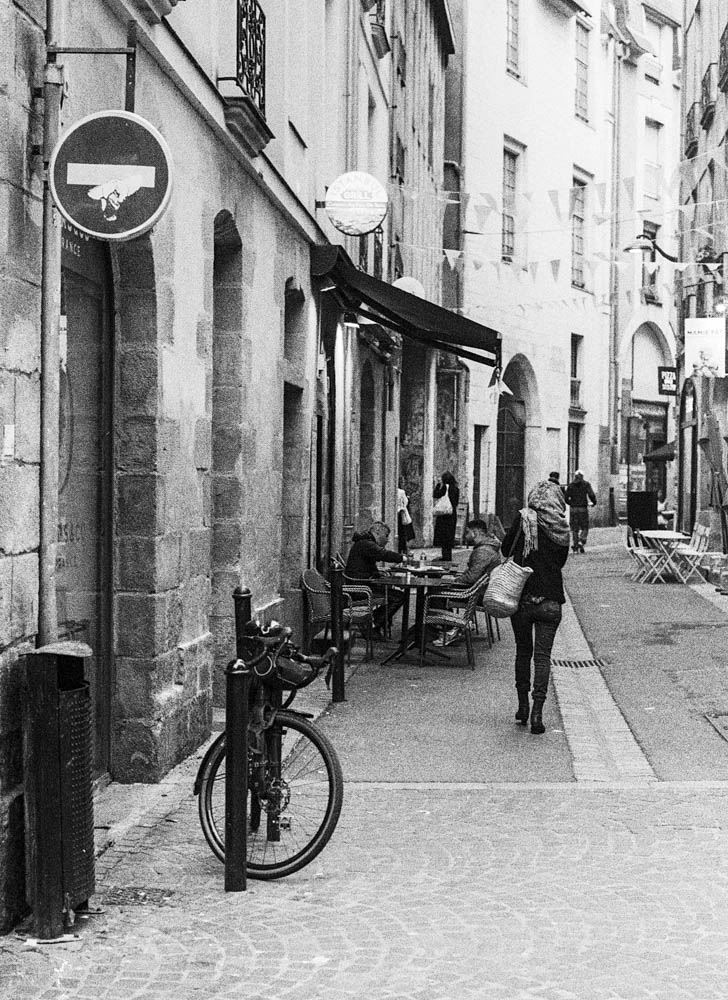
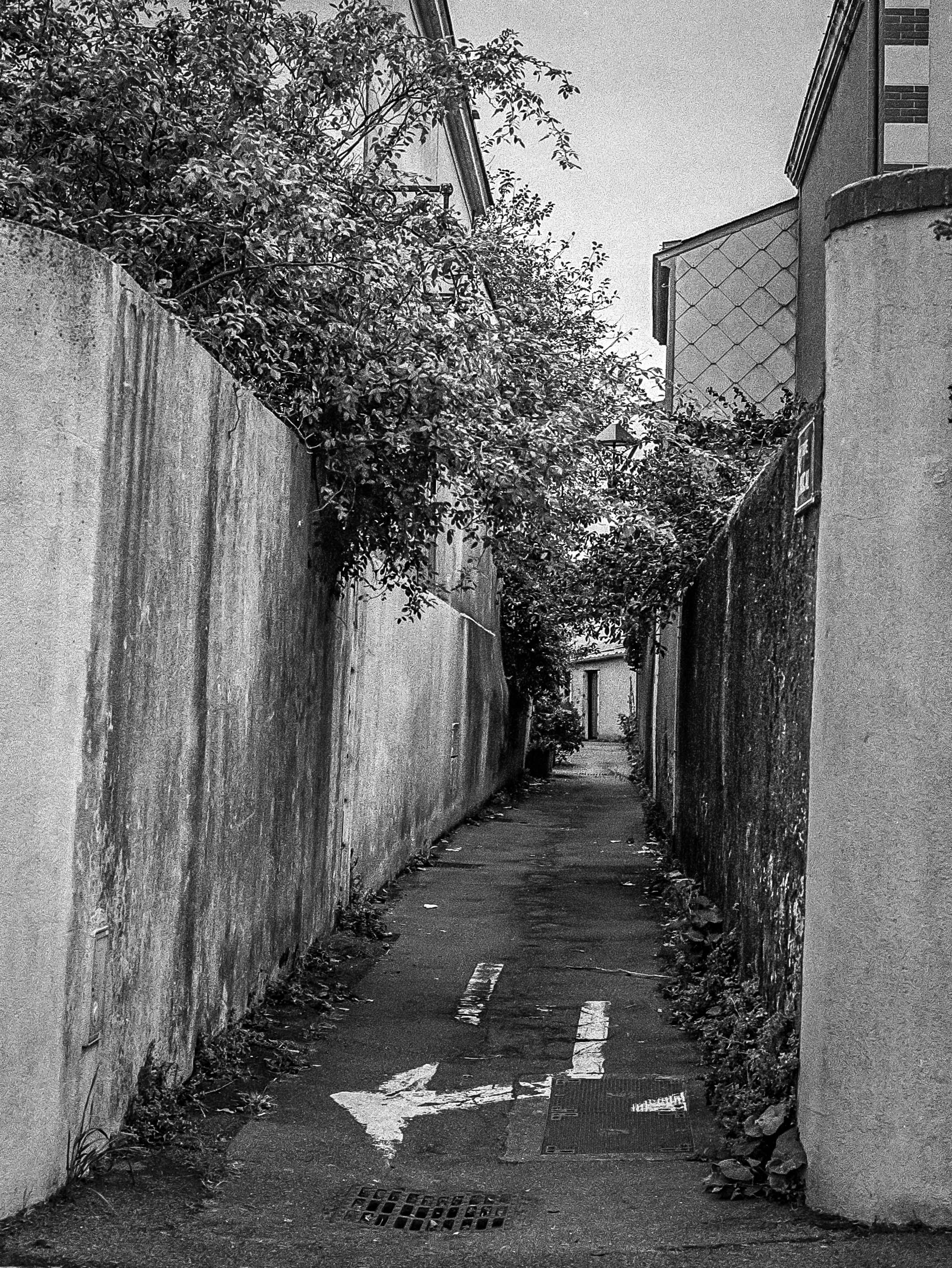
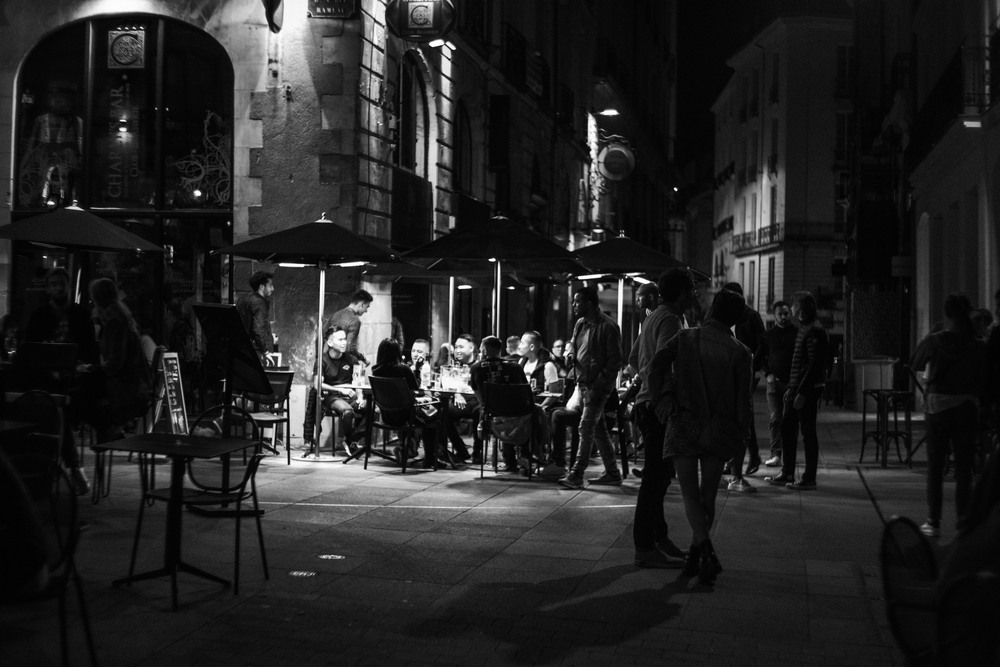
One September evening I walked between Place Bouffay and rue des Petits Écuries with the Nikon FE and a roll of HP5+. Box speed—400 ASA. No pushing. No stand development. Just me, tired eyes, and the hope the city would be kind.
It wasn’t always.
Some frames failed outright. Missed focus—my eyes couldn’t lock the split-image patch in the dim light. Others blurred from camera shake at 1/15th, handholding like a fool. I won’t pretend those shots have hidden merit. They’re gone. But the ones that landed? They held more than I expected.
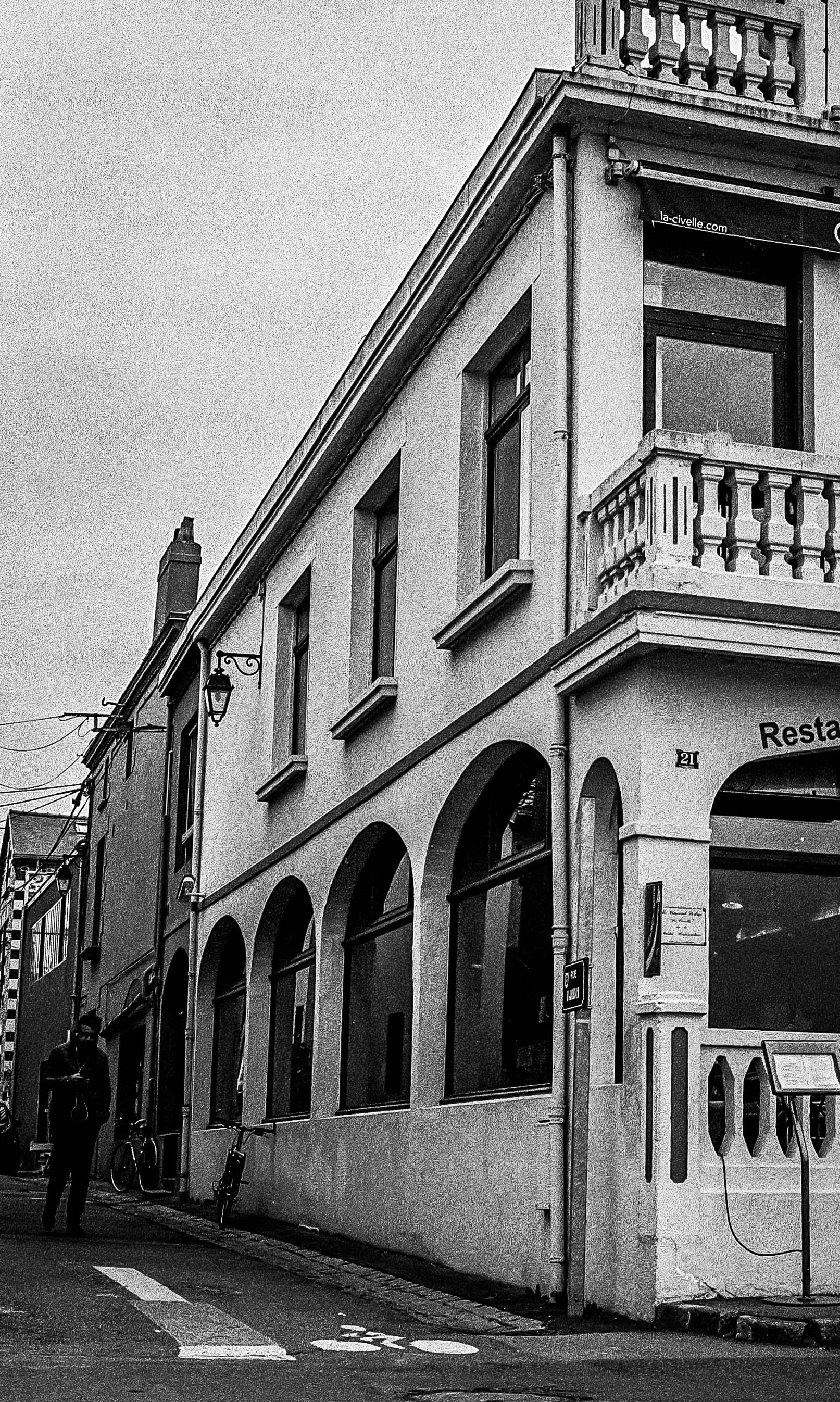
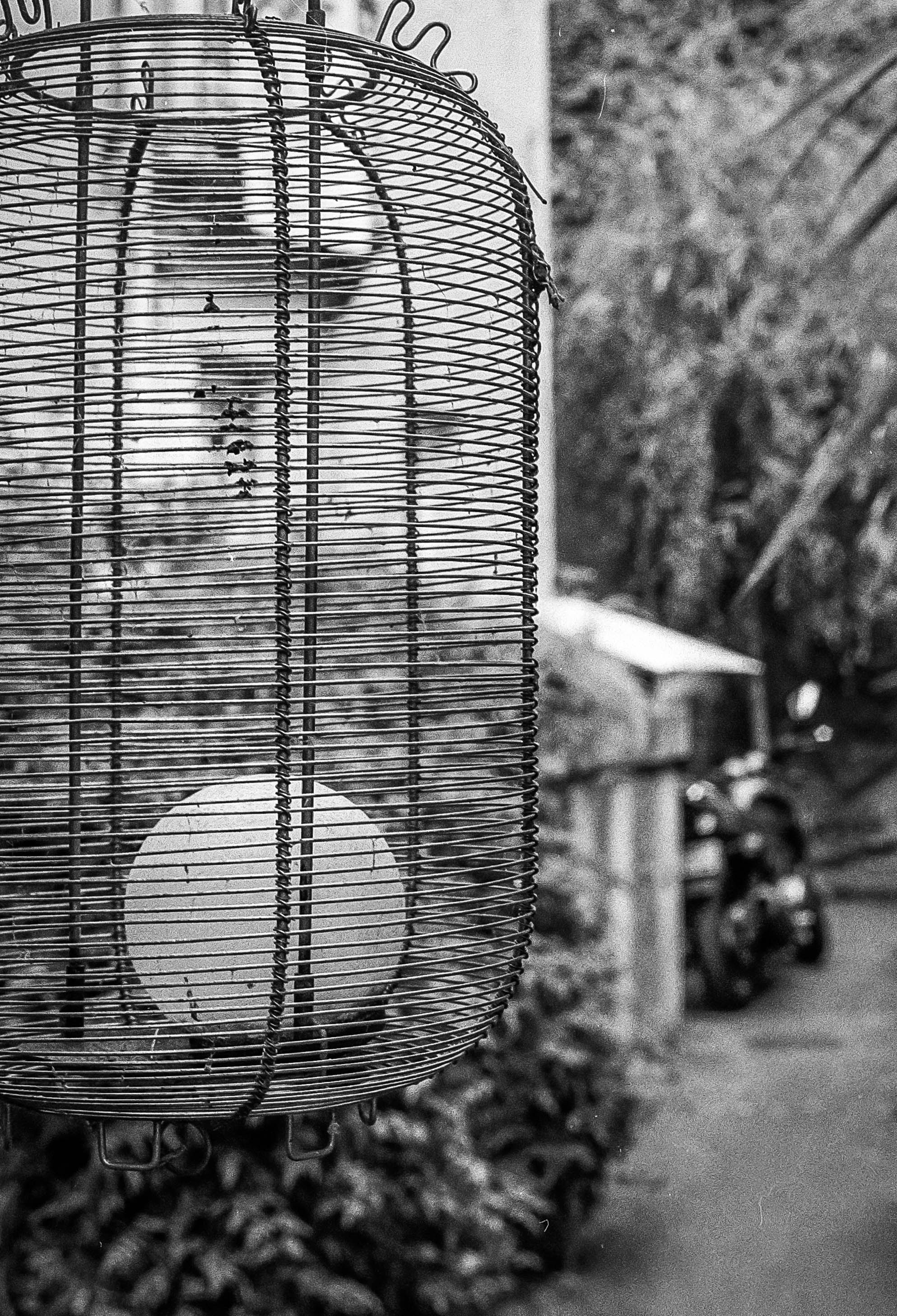
Because Nantes at night isn’t dark. Restaurants pour light onto wet cobbles. Shop signs, streetlamps, even those little menu stands outside cafés—they all feed the scene. I’d guess the focus, press the shutter, and move on. Later, scanning the roll, I found detail in shadows I thought were lost. Not because I’d exposed well—I hadn’t—but because HP5+ gathered what was there even when I fumbled.
That’s latitude in practice. Not a spec sheet promise, but the difference between a usable negative and a blank one when your hands shake and your eyes fail. I didn’t push to 1600. I didn’t need to. I just needed a film that wouldn’t punish me for being human.
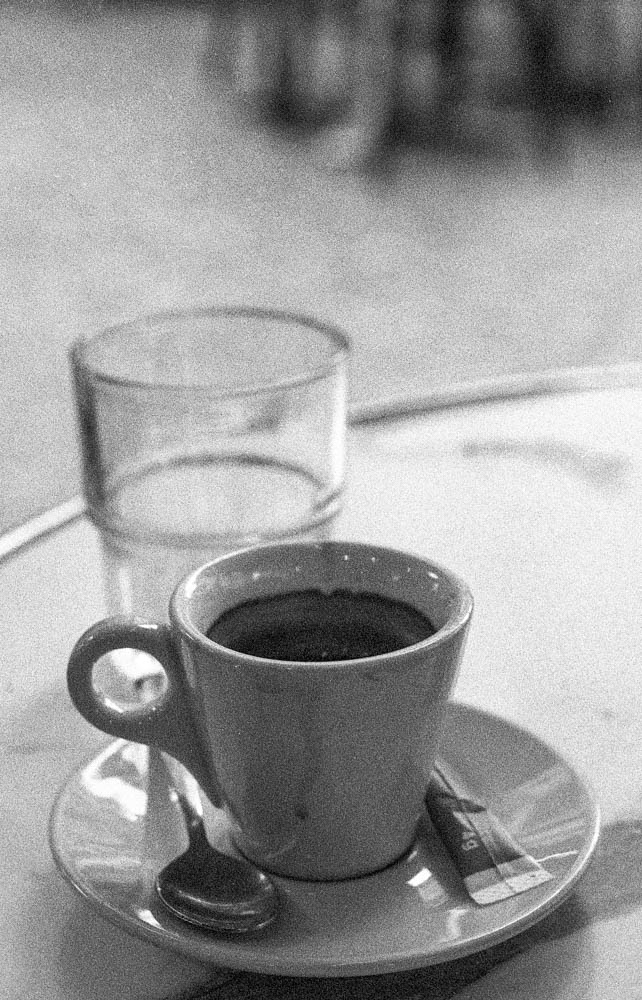
The December shots are more traditional street work—grey skies, low sun, the light you expect. Even the coffee cup photo owes something to Instagram. I won’t deny it. We absorb what we see online; it seeps into our framing without us noticing. No shame in that—it’s just how we learn now.
But the September shots that worked feel more like my own. Standing in Place Bouffay as evening deepened, watching light pool around tables and bounce off stone—I wasn’t chasing a look. I was just there, squinting, hoping. And HP5+ met that without fuss.
I’m not claiming mastery. I’m claiming a few good frames out of a roll that also held misses. That feels honest. Cities don’t go dark—they transform. And sometimes, even with bad eyesight and shaky hands, a simple roll of film gives you just enough to keep walking.
All photographs shot on Ilford HP5+ at 400 ASA, developed in standard chemistry. Nikon FE, Nantes—December 2025 and September 2025, Place Bouffay and rue des Petits Écuries.
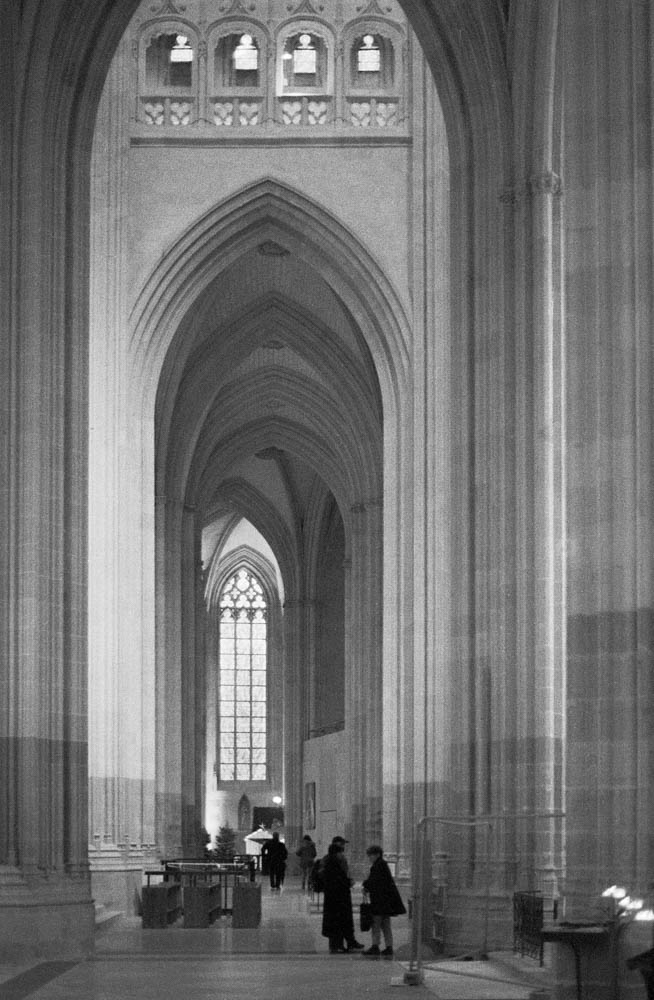
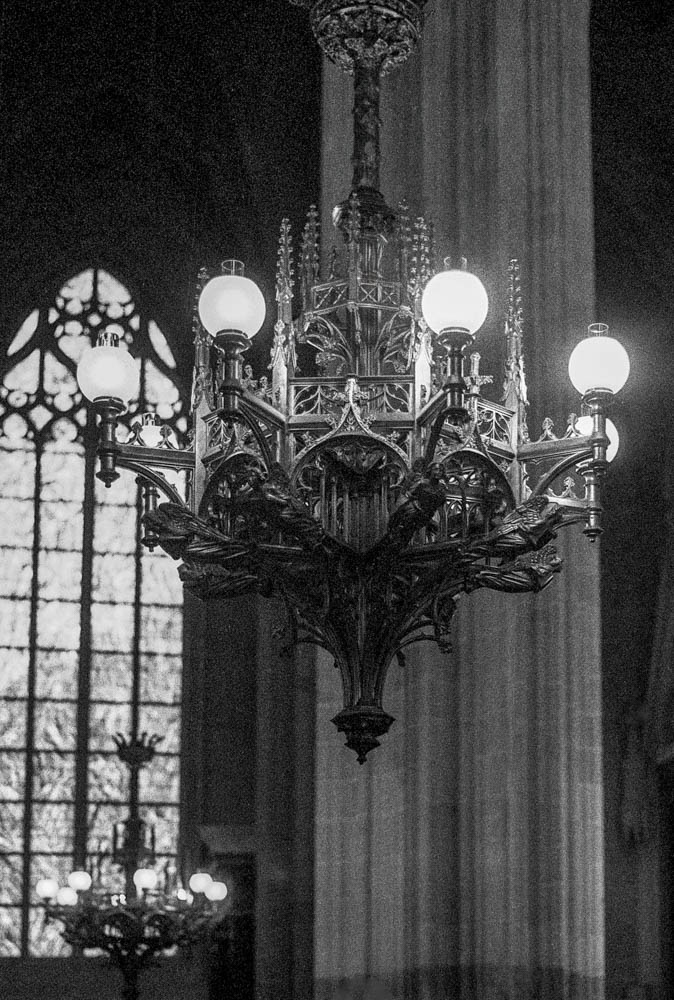
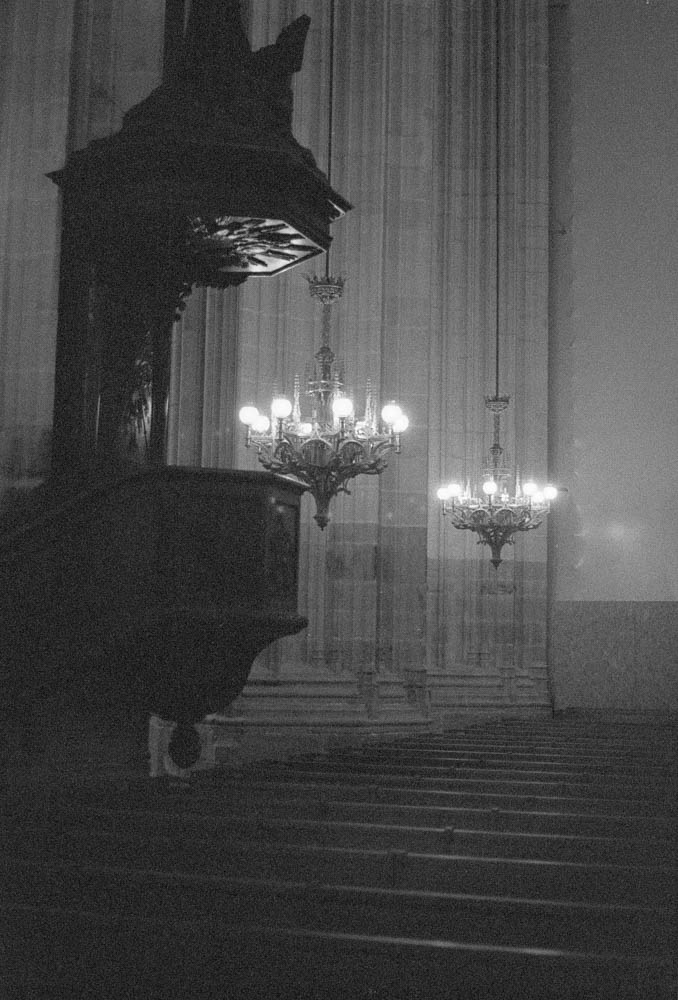
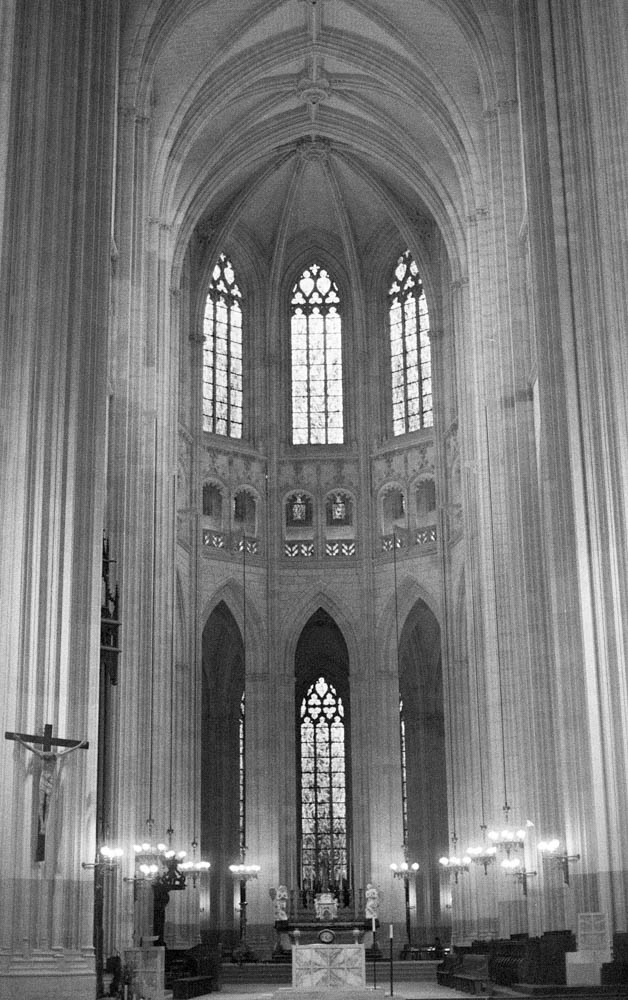
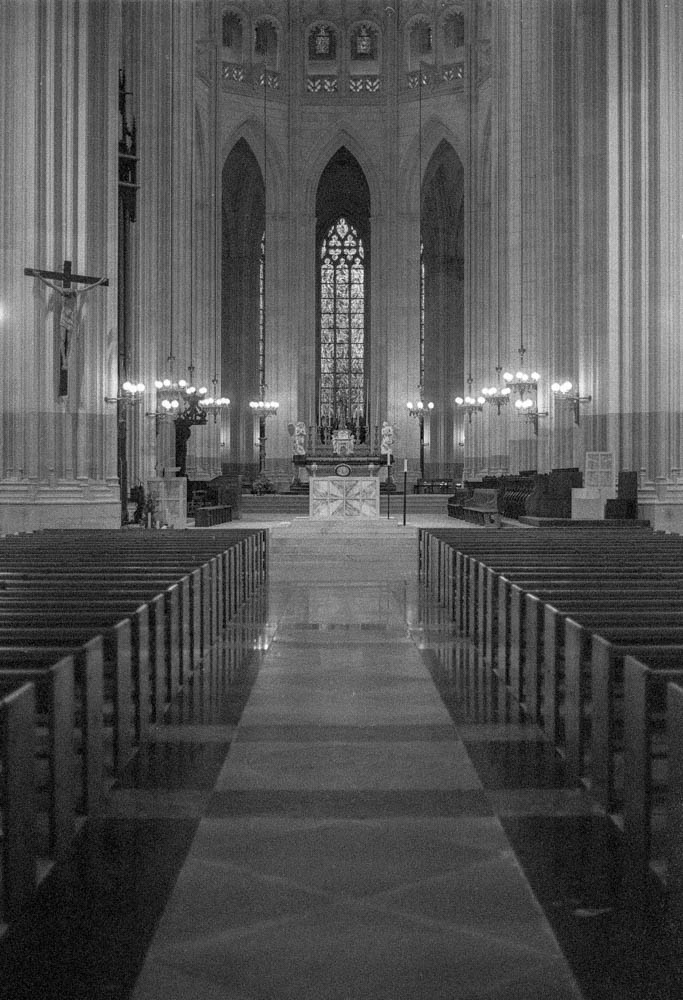
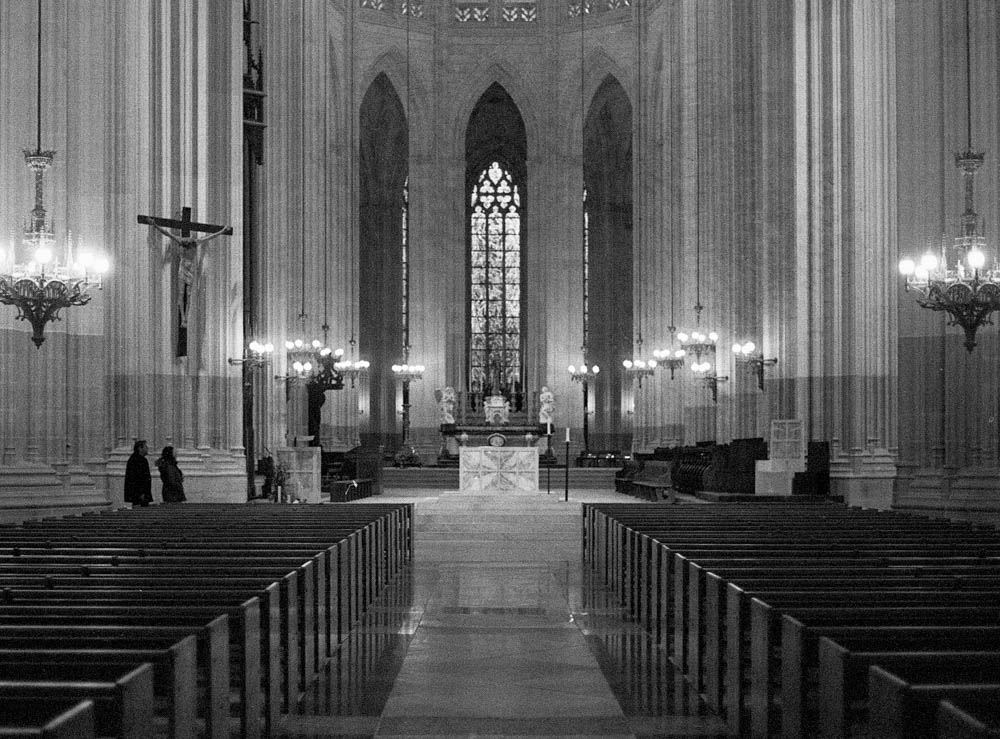
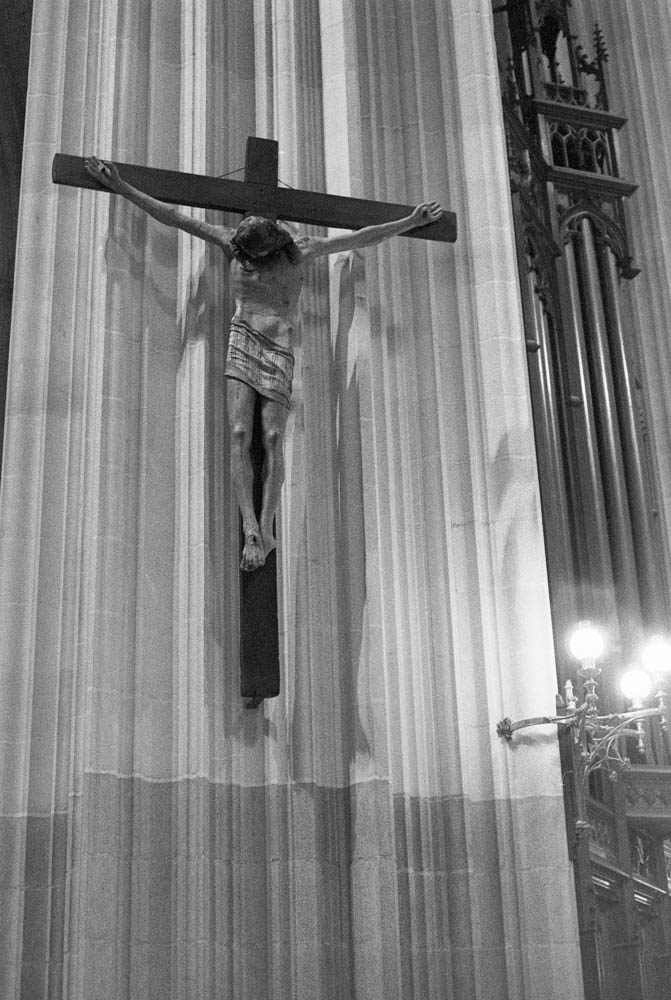
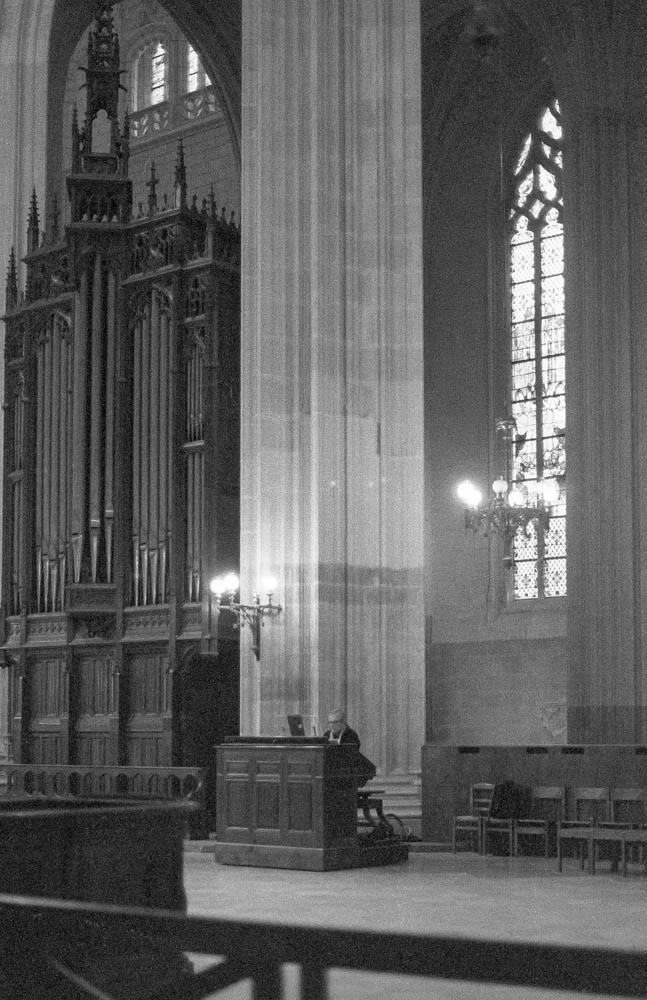
I didn’t set foot in the cathedral while Voyage en hiver draped its silence in municipal spectacle. Not out of protest—I simply couldn’t bear to see sacred space turned into a backdrop. So I waited. And when the banners finally came down in December, I loaded a roll of Ilford HP5 into my Nikon FE and walked back in—not as a tourist, not as a patient, but as someone hoping to find the light exactly where I’d left it.
I’ve always abhorred political recuperation. The Voyage en Hiver had no place in the cathedral’s reopening. This was about worship. About returning to God in a space that had been quiet for too long—not about municipal branding or winter tourism. “Give unto Caesar what belongs to Caesar, and unto God what belongs to God.” (Matthew 22:21)
That day, I chose God’s silence over their spectacle.
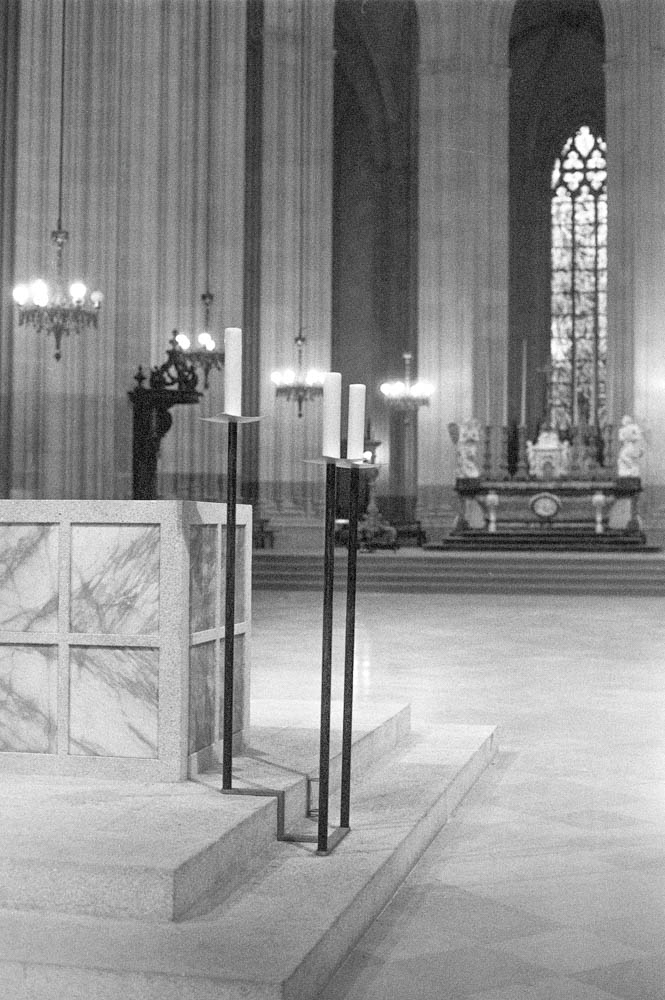
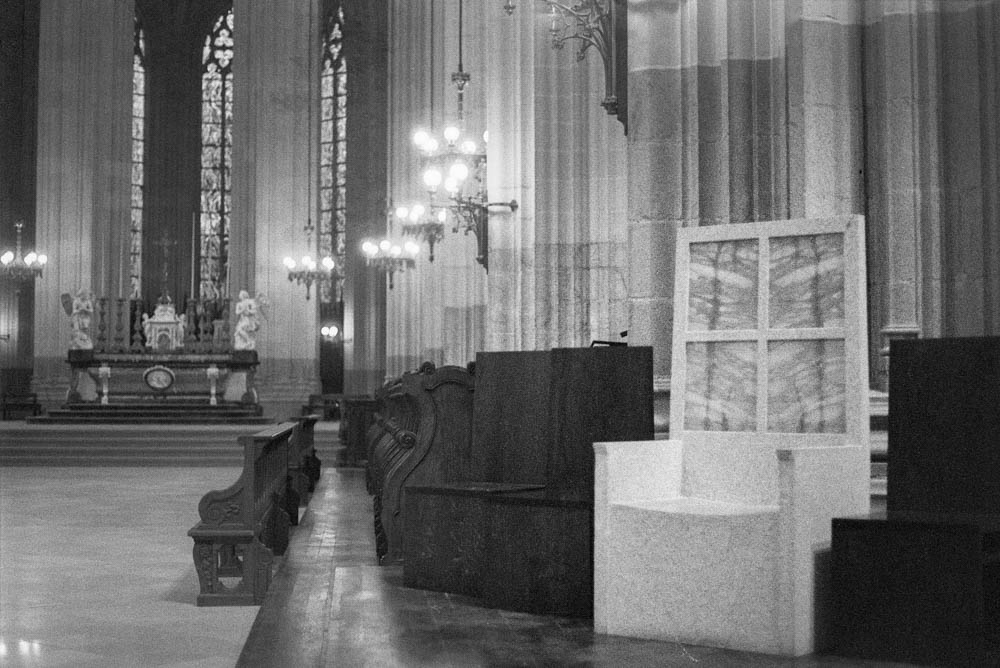
My hands were cold when I raised the camera. December light in a stone cathedral is a quiet thing—more absence than presence. I wondered, honestly, if 400 ASA would be enough. But I wanted authenticity: more grain than digital noise, more truth than polish. So I trusted the FE’s metering, opened up my aperture, and let the film do what it does best. No second-guessing. No LCD screen. Just the click of the shutter and the hope that the light would hold.
And it did.
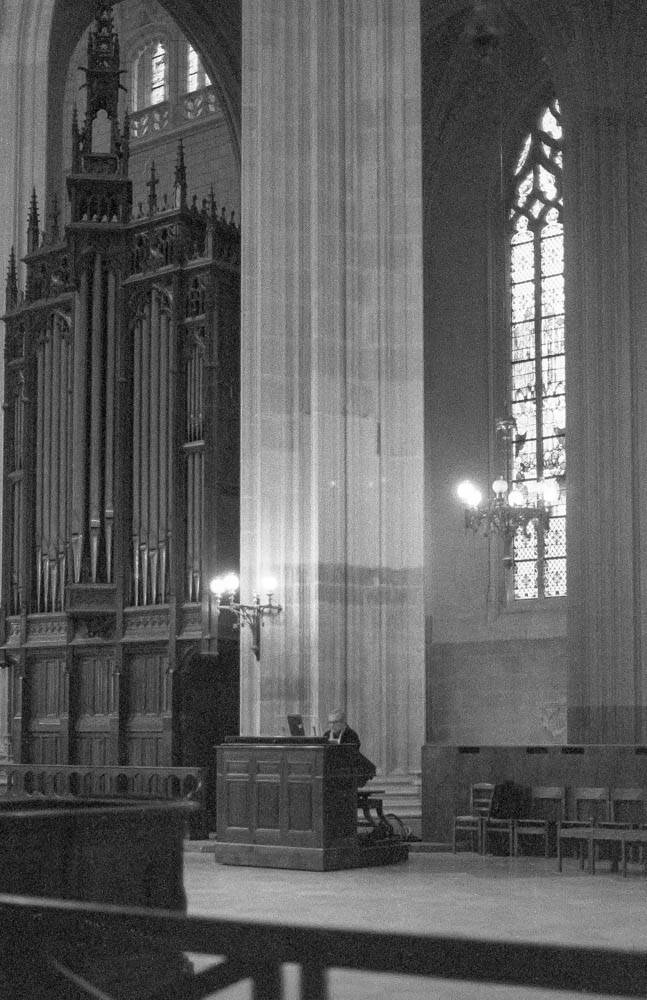
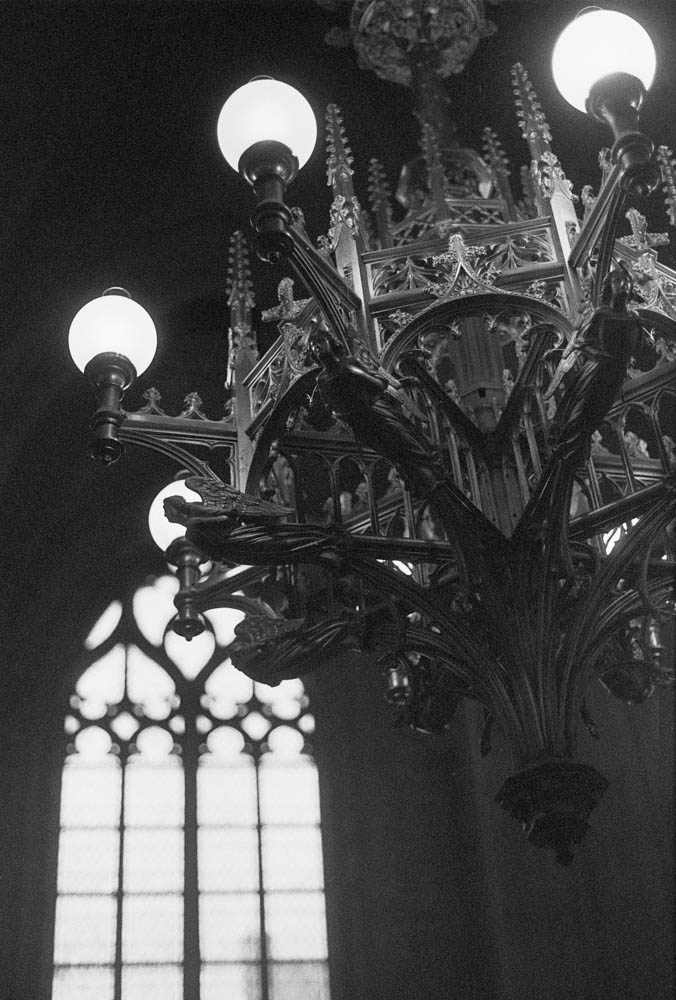
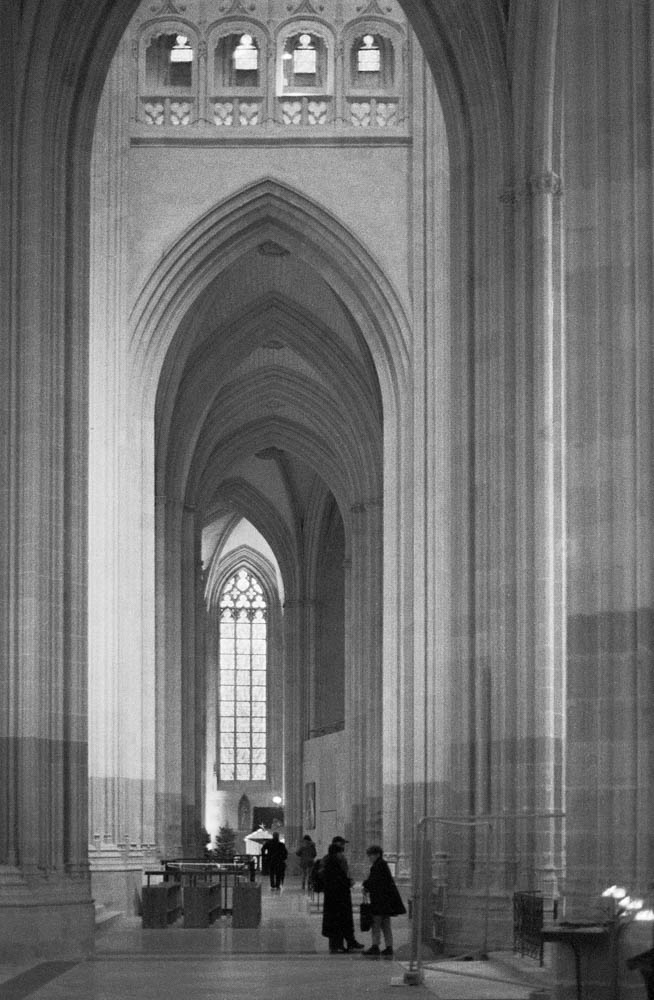
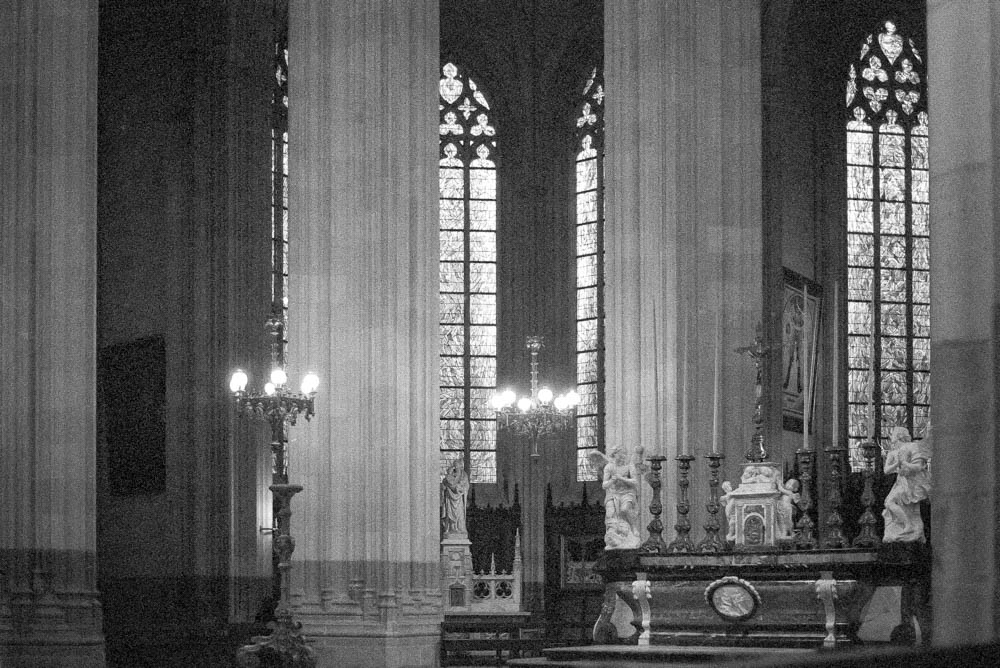
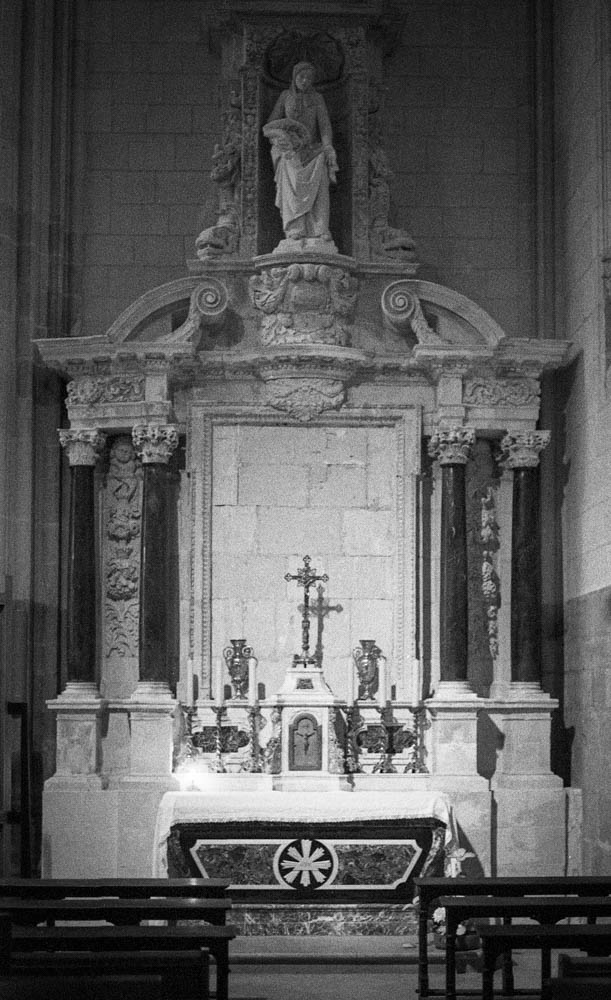
The frames that emerged are darker than summer would allow—but this was December, after all. And in that darkness, something gentle remains: the grain cradling the texture of worn wooden pews, shadows tracing the ribs of vaulted stone, candlelight bleeding softly into halos where no banner now hangs. Black and white stripped away every distraction—the logos, the seasonal clutter, the noise—until only what mattered remained: light on stone, silence between pillars, the architecture of reverence.
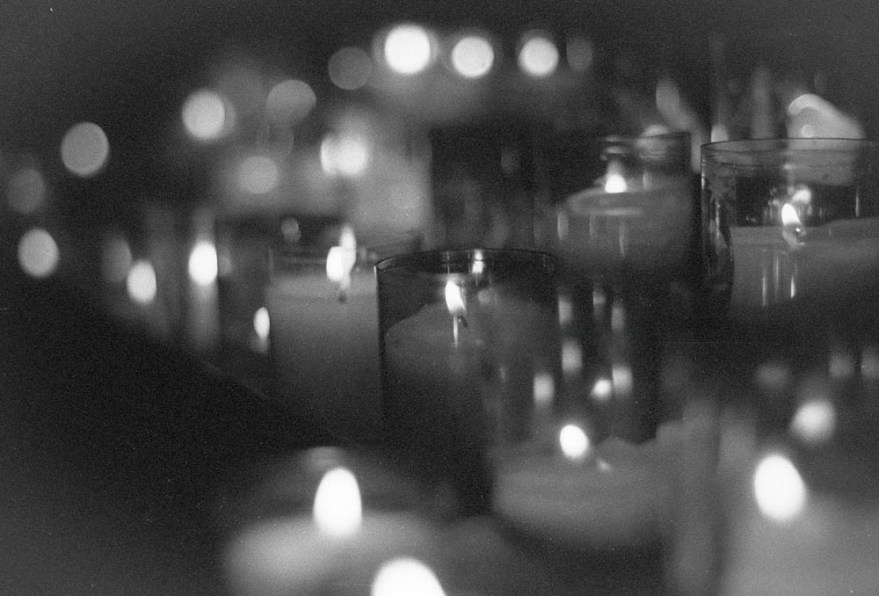
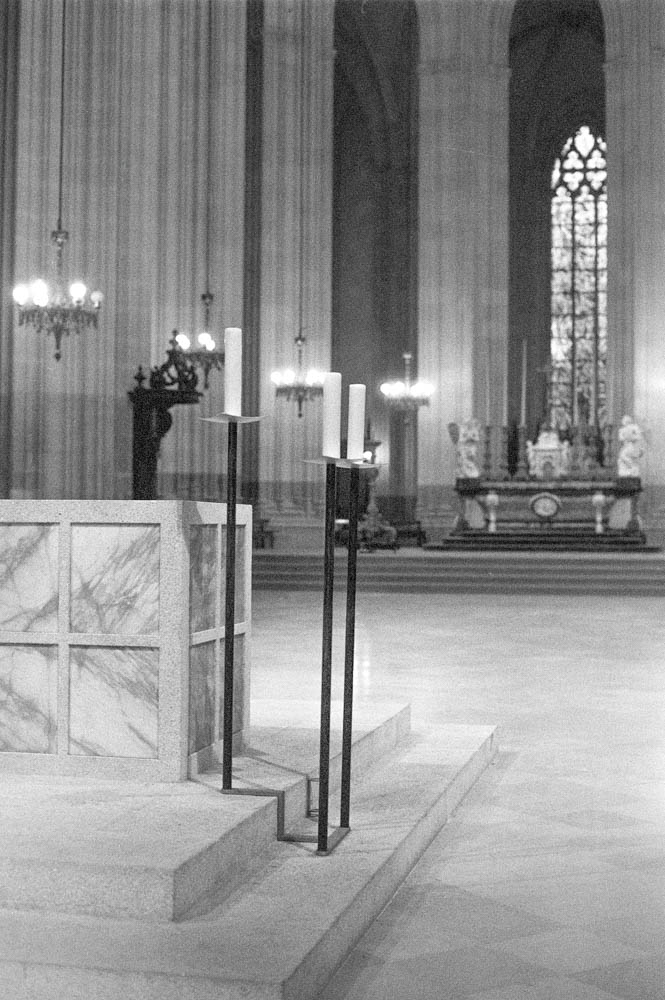
One frame in particular stays with me: the candles. Shot at 1/30s, my hands unsteady not from illness but from the simple weight of the moment. The focus slipped slightly. The flames blurred into one another. And instead of frustration, I felt a quiet relief—the film hadn’t captured perfection. It had captured presence. Grain became breath. Blur became prayer.
I didn’t go to “get out of the house.” I went because the space was clean again—just stone, silence, and the stubborn glow of candlelight. And for a few minutes, with the FE cold against my palm and the smell of incense in the air, I remembered why I love film photography: it doesn’t lie. It holds what’s there—shadows and all—and asks only that you trust the process.
They sold a spectacle. I took back the light. And the grain—warm, imperfect, alive—proved which one will last. My small act of reparation…
Good afternoon, Dear Reader. I’m writing this article thinking of you and wondering what to show you next in this ongoing series. The clue is in the title: Canon AE1 Street Photography in the streets of Nantes.
I know you have the eyes of a hawk who never miss a trick because your vision is so sharp. You might even have scrolled down to the photos already, and your eagle eyes will have noticed that this isn’t the usual area I visit on these outings. And, of course, you’d be right!
Yes, I still parked in the Feydeau car park but crossed the road to the south, heading along Baco-Lu, past the Tour Lu (sans “t”), towards the St Felix Canal, and then back into town… Some of the places no longer exist or have changed hands, but you would still recognise them even today.
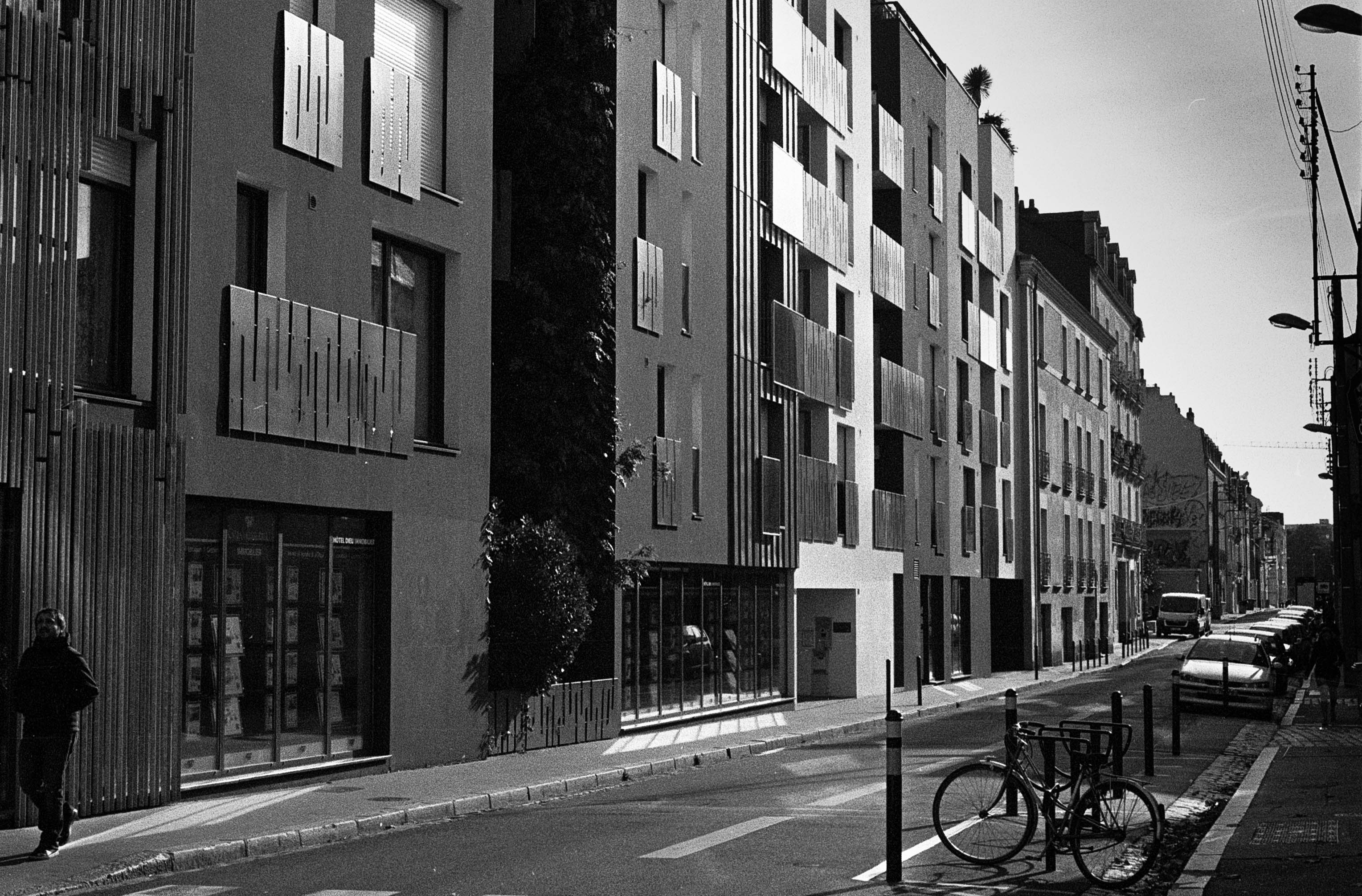
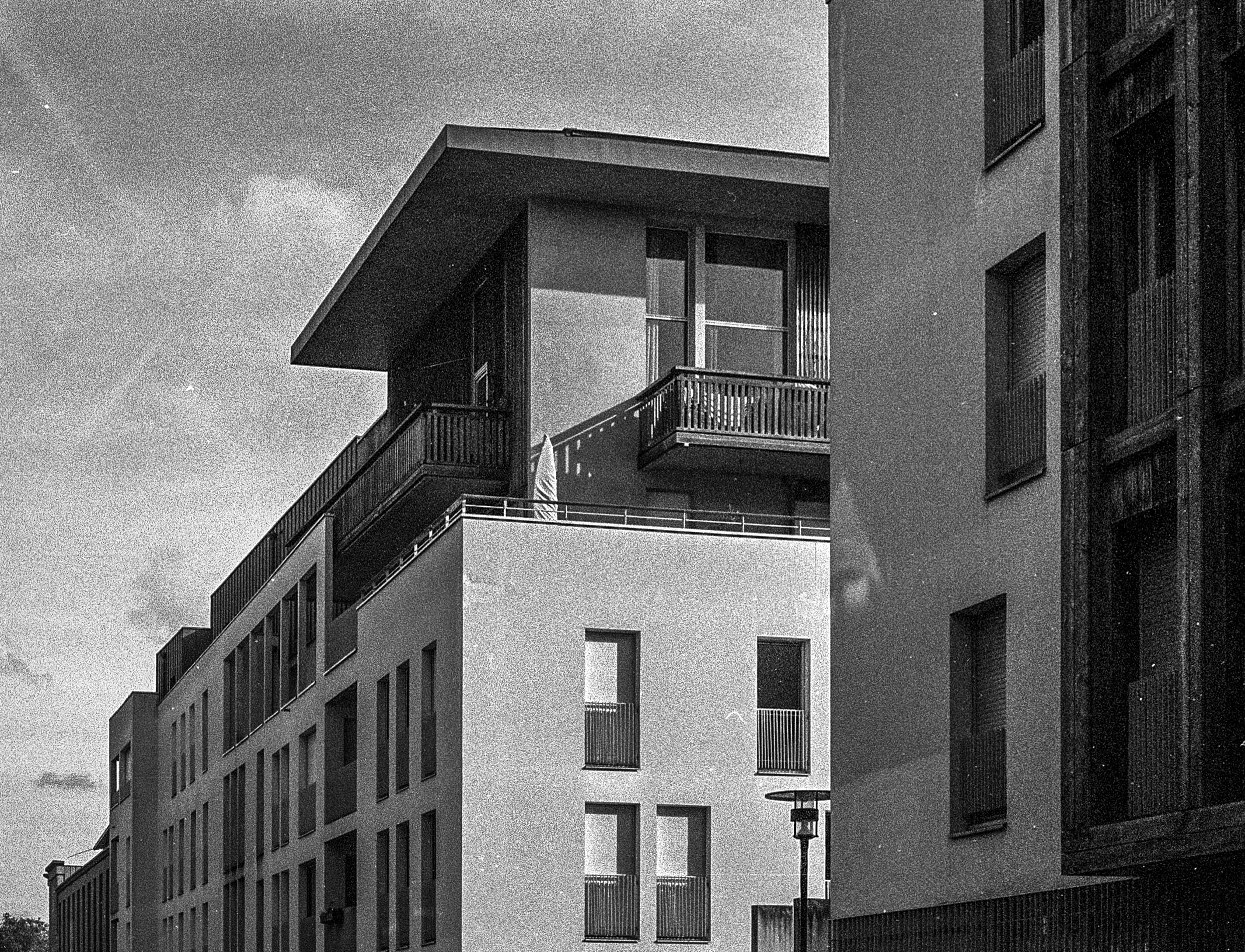
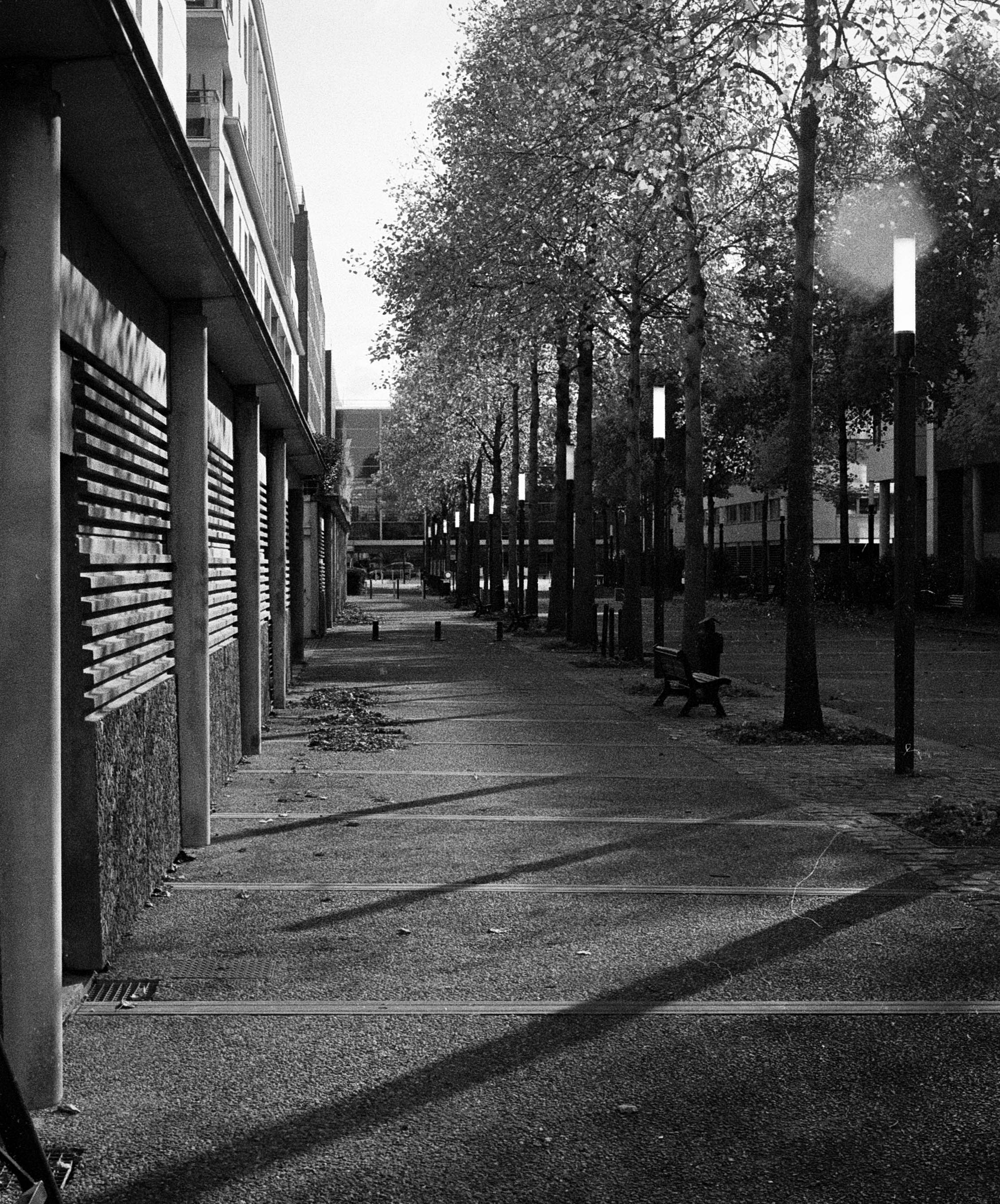
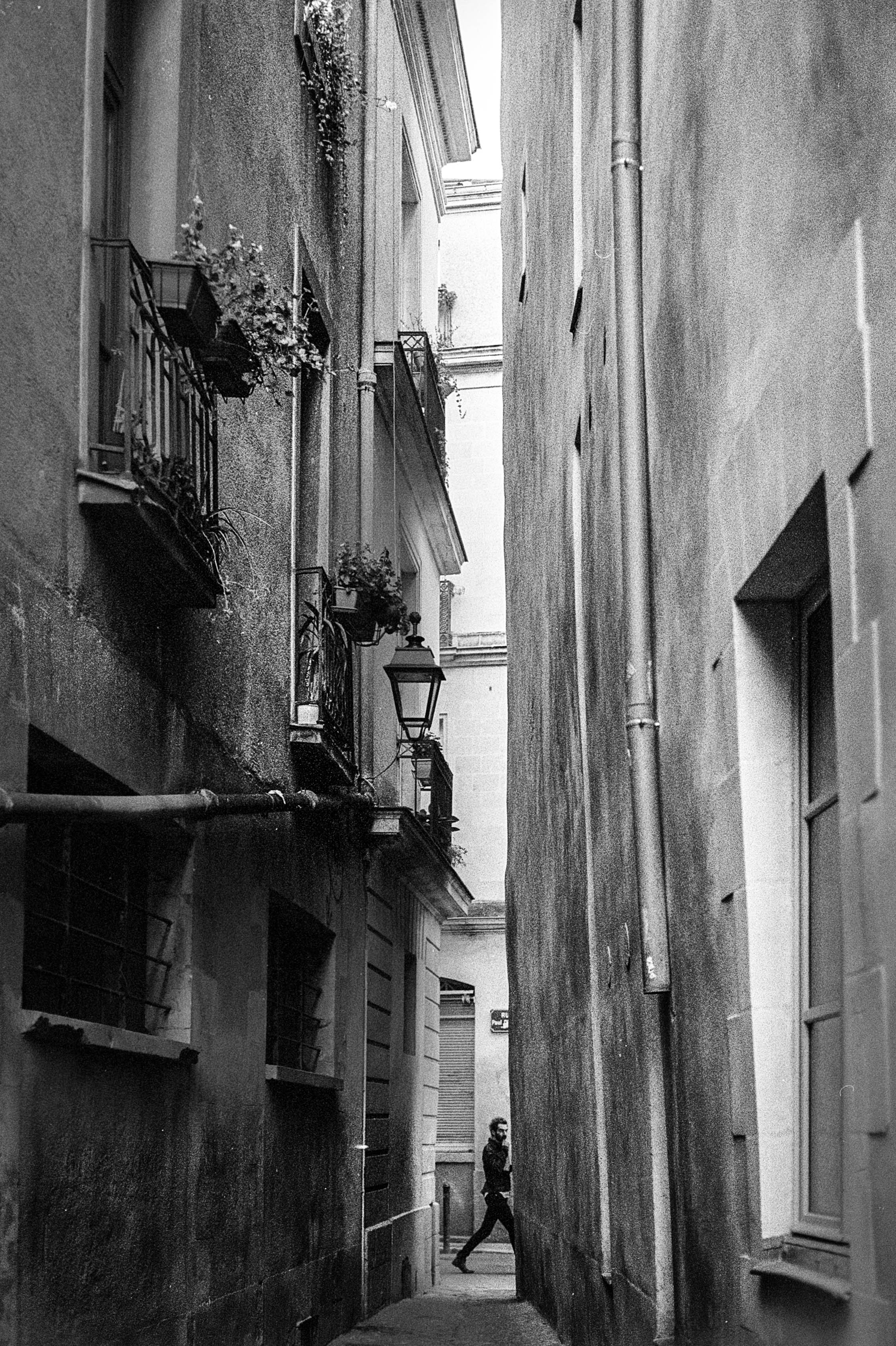
I think that with these photographs, I’m getting closer to what some might call “proper” or “traditional” street photography. The images have a certain gritty quality to them, including the people in the shots. This was something I was actively aiming for. Maybe it’s the grain—something I don’t get with the X100F—that helped bring this about. Or could it be the people, whose presence seems to reveal the stories behind them? Whatever it is, I felt that this was a very good day.
I think I may have shared with you that I’m going to China this Christmas on tour with the orchestra I play for. I’m still undecided about which camera to take and wondering if I should bring a film camera along. With the X100F, I’ve become so accustomed to the 35mm lens, while my film cameras only have 50mm lenses to work with. Reviewing these older images may help me make up my mind. It’s going to be an epic trip, and I want to be sure of the kinds of images I’ll be able to capture.
As much as I’d love the flexibility to hop in the car and retake a shot if needed, this trip to China will be different. I’ll need to trust my choices and embrace the moment as it unfolds—something that feels both exciting and a little daunting. But that’s the beauty of photography, isn’t it? The challenge of capturing fleeting moments, knowing they might never come around again. So, whatever I decide, I know the experience will be unforgettable.
While the anticipation of the China photos may be killing you, I know you’ll be patient, whatever I decide to use. Rest assured, those photos will capture the spirit of the trip. Only two and a half weeks before I start my travels…
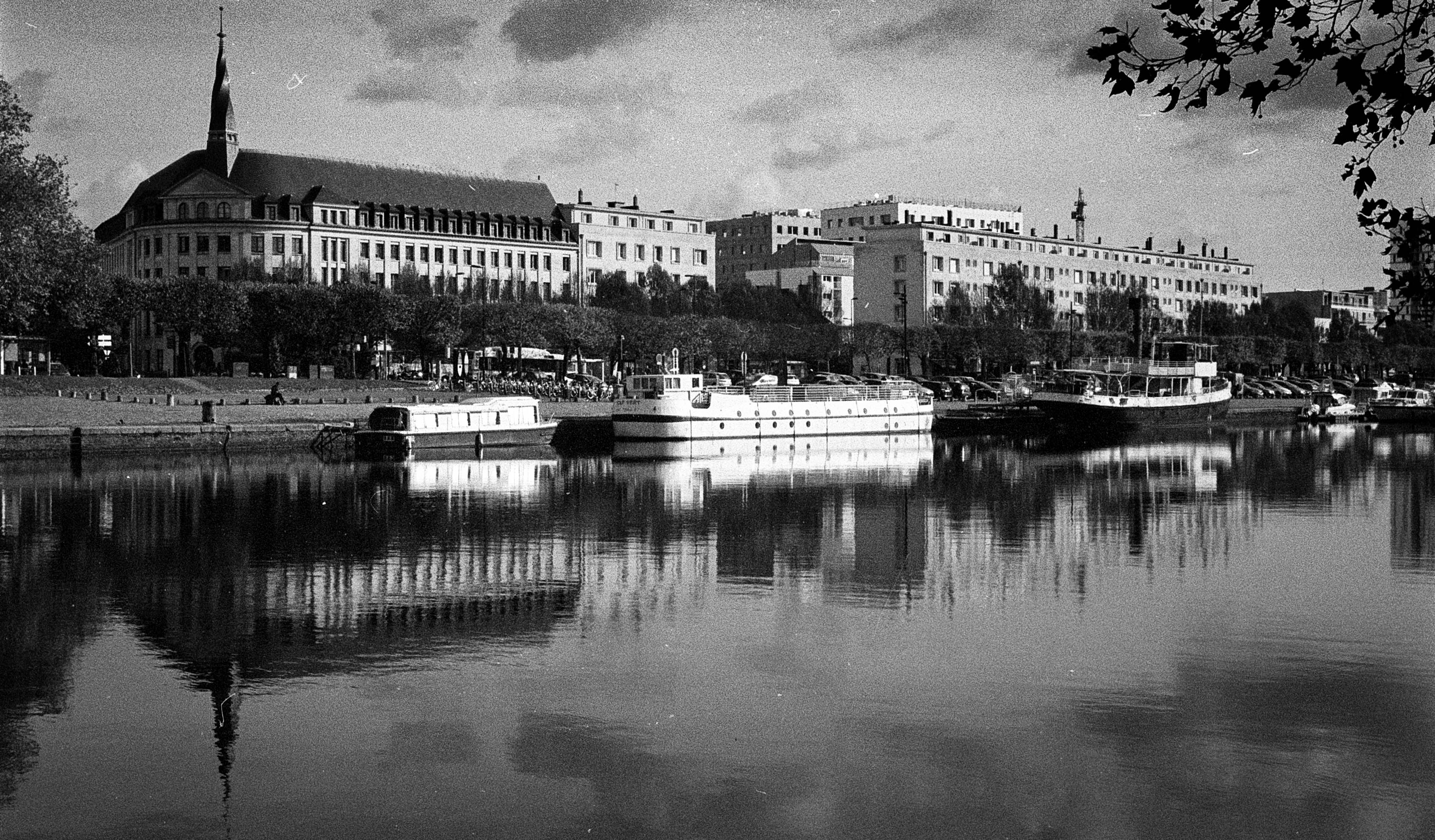
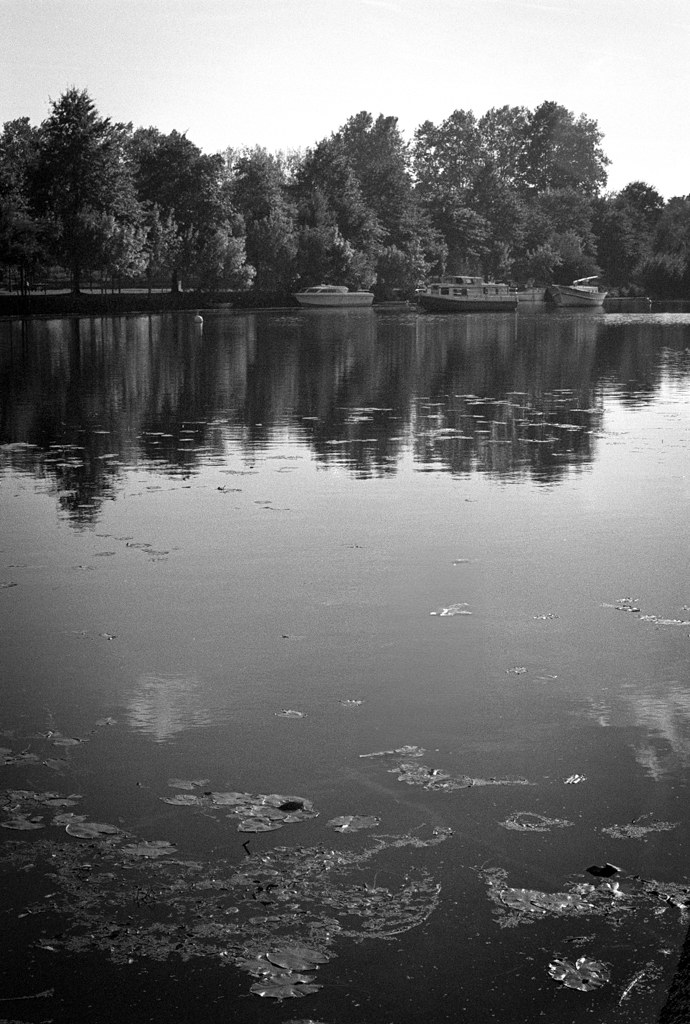
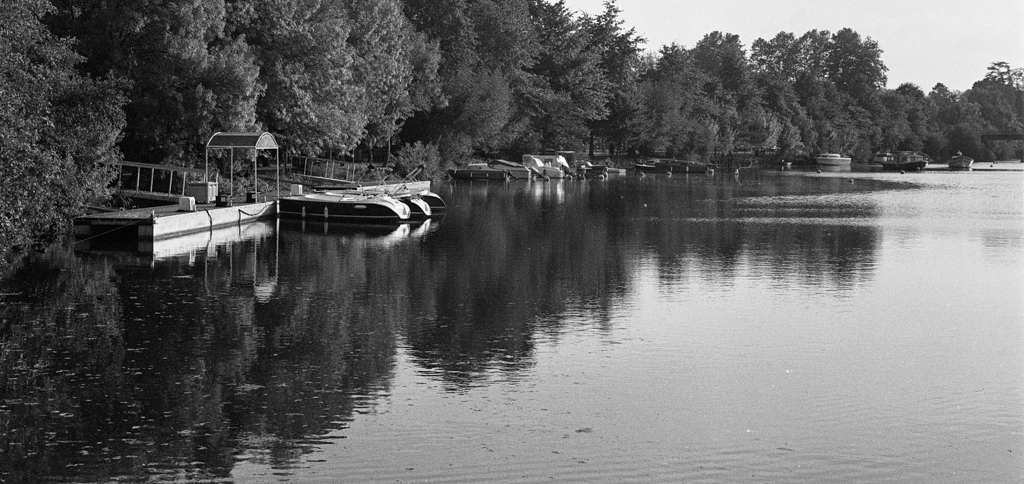
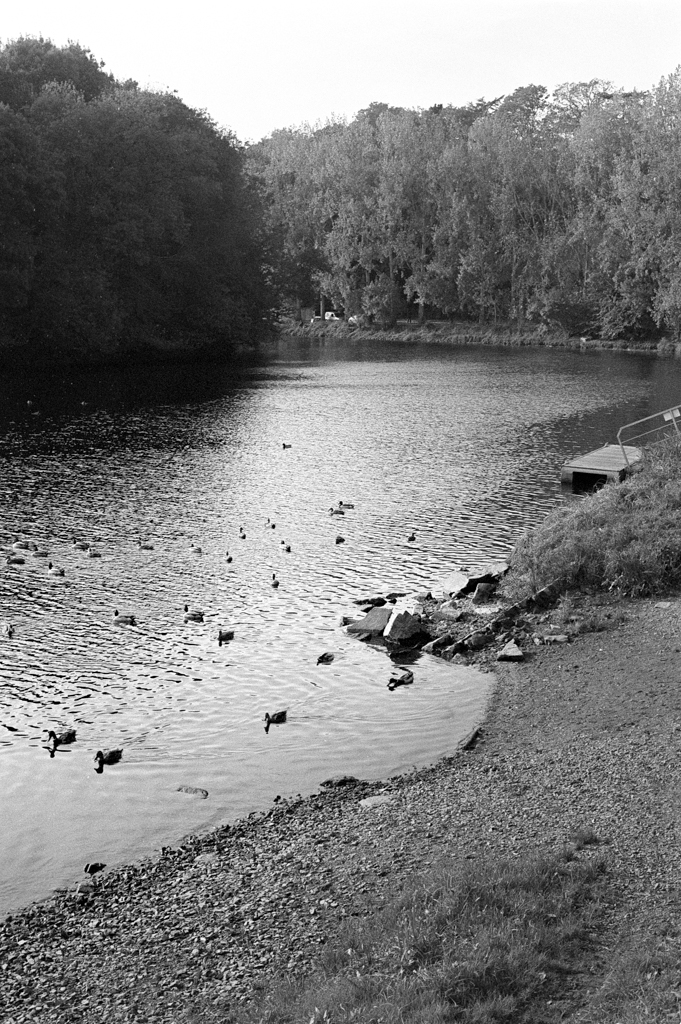
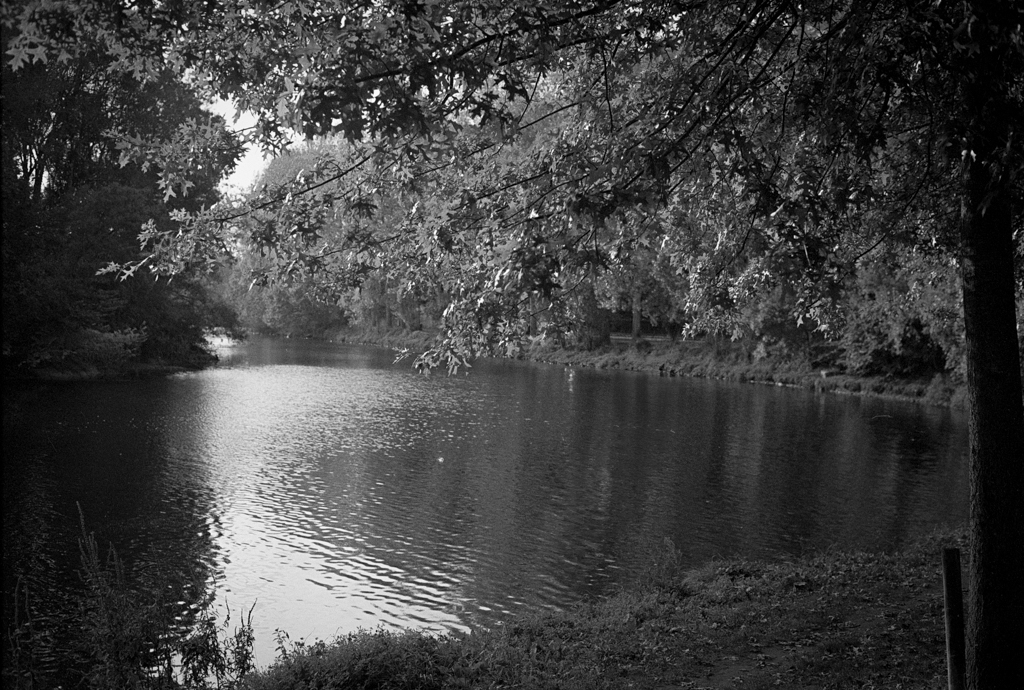
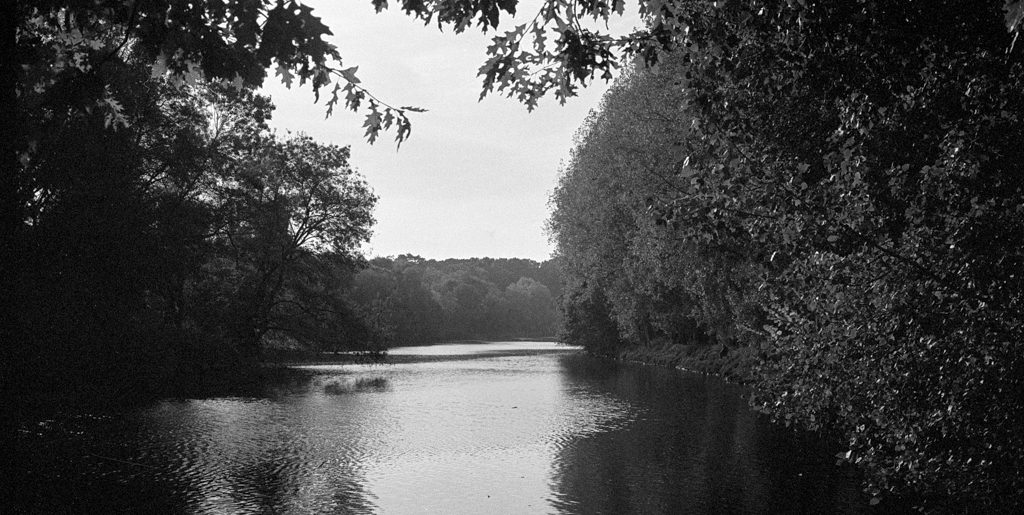
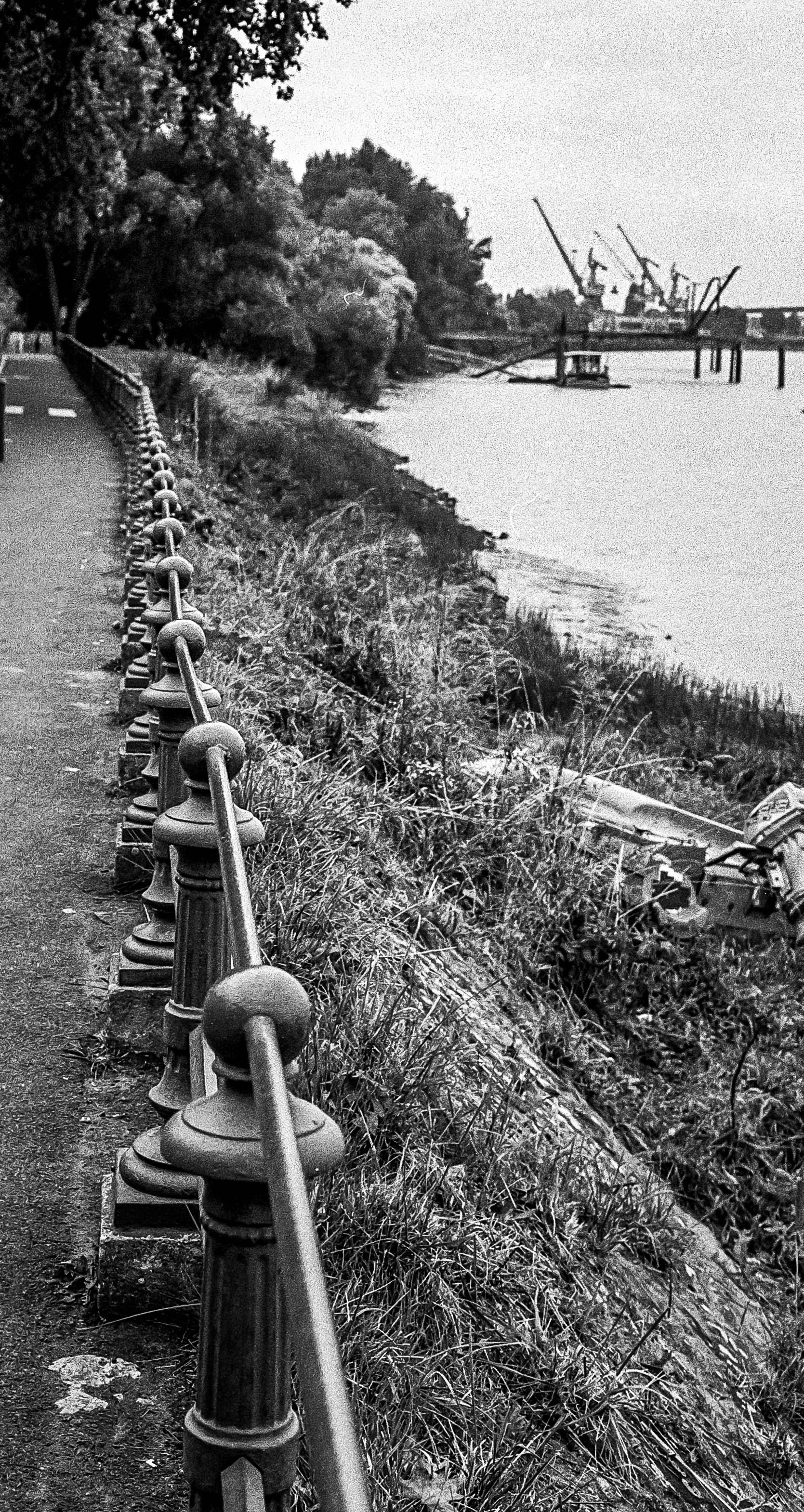
It was one of those sunny late autumn days we sometimes get here—warm, golden, and untouched by the inevitable rain, wind, and cold that would soon claim the season. This time, I wasn’t in Nantes, or exploring the Forest of Grasla like last week’s outing. Instead, I decided to take my Canon AE-1 for a walk down by the river—more precisely, along the Sèvre Nantaise—to explore the Chaussée des Moines.
Chaussée des Moines translates to “the monk’s pathway,” and no, it’s not a detour through Iowa. I always get the name wrong, thanks to the cheese Chaussée aux Moines. Freud would probably call it a slip—though even he might have struggled to find better footing on this trail.
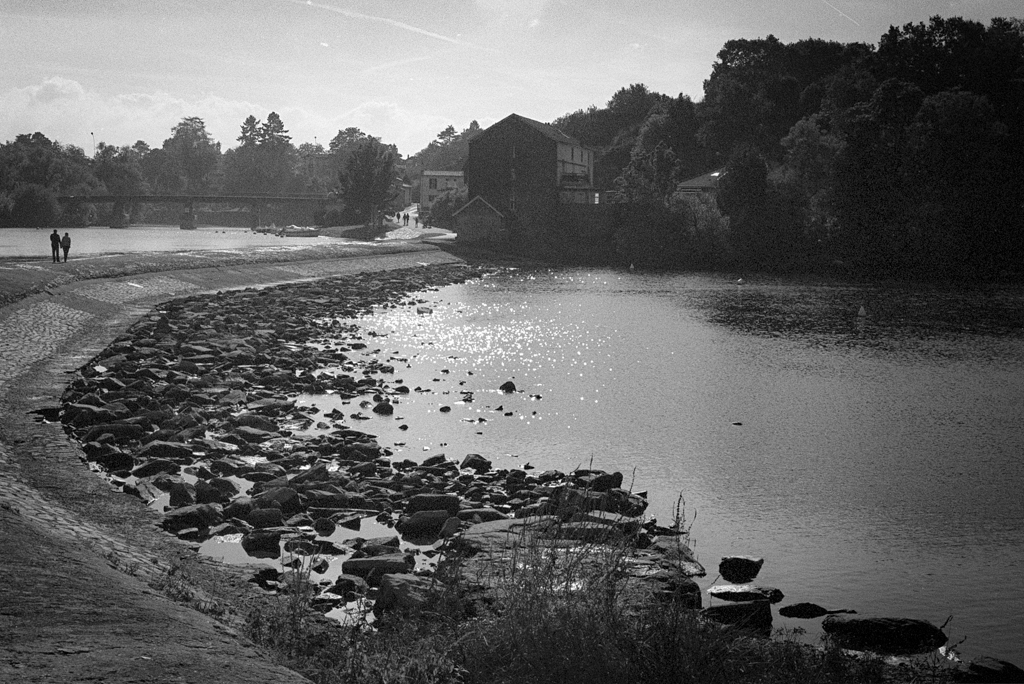
The pathway, bathed in the low autumn sun, was serene. Its golden light skimmed the water, creating shimmering reflections on the surface, while the riverbanks glowed with the last stubborn hues of the season. For those of you looking at the photos in black and white, you’ll just have to imagine the colours. The Canon AE-1 was a faithful companion that day, helping me focus on the interplay of light and shadow, the quiet stillness of the river, and the textured beauty of autumn’s final stand.
The Sèvre Nantaise is a river that flows into Nantes at the Bras de Pirmil. The Chaussée itself is a weir—a place where, weather permitting, you can walk across the river, loop over a nearby bridge, and return along the opposite bank. It’s a lovely little circuit, especially on a crisp autumn day.
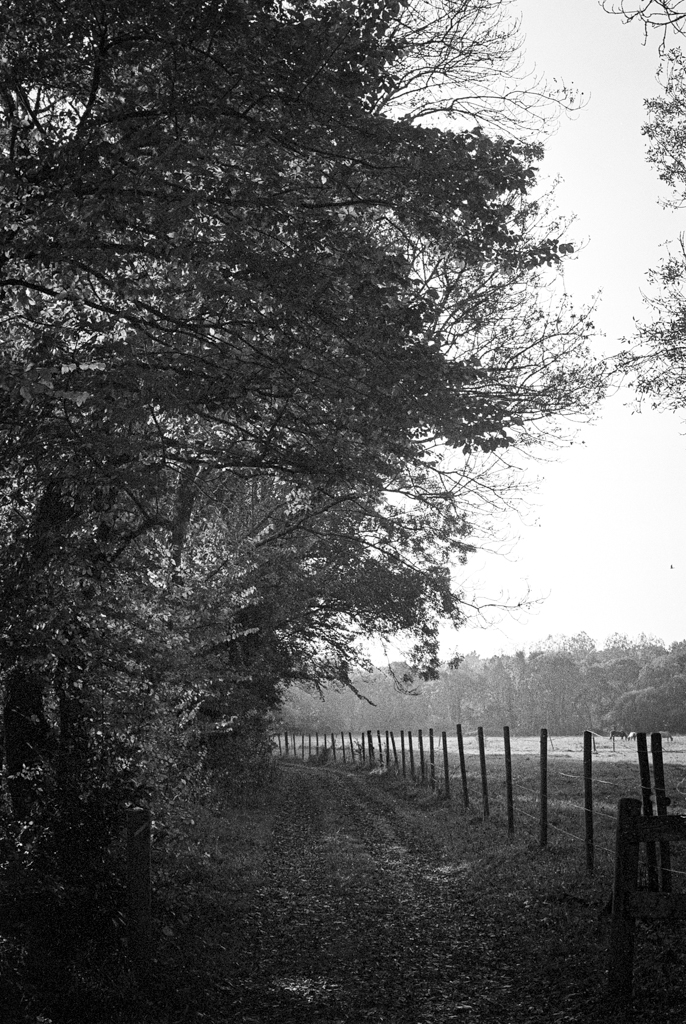
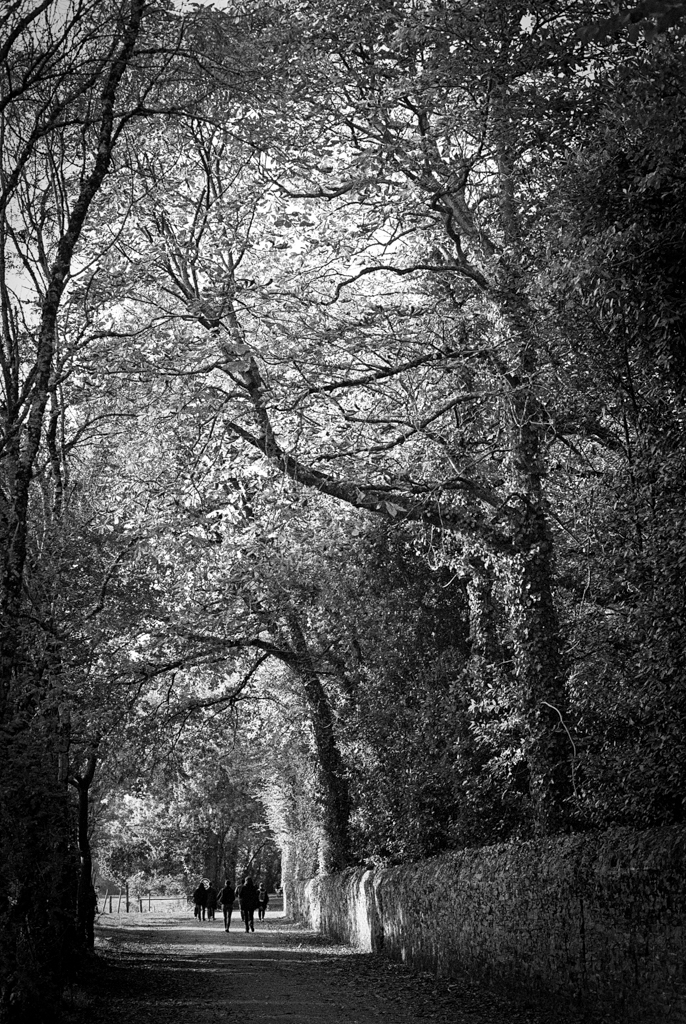
The photographs from this outing were taken with the Canon AE-1 using Ilford HP5+ film, shot at 400ASA. I later edited the images in Lightroom to bridge that gap between film and digital. Some might call me a charlatan, but even in the darkroom, we worked our magic with tools akin to what Lightroom offers today—just a bit more hands-on and aromatic.
When I was learning how to draw, I was often reminded of the importance of contrast: darker, more defined elements in the foreground and softer, lighter tones in the background. Looking back at these photos, especially the ones of trees and fields, I’m struck by how naturally this principle seems to have played out.
All in all, it was lovely being out in the autumn sun, soaking up the scenery, and enjoying every minute of it. The boat moored along the bank, the cascading weir, the solitary man fishing—it all added to the charm of a wonderful afternoon. And if you’re wondering, the slice of cake and cup of something nice at the café overlooking the river had absolutely nothing to do with how fondly I remember the day… or so I tell myself.
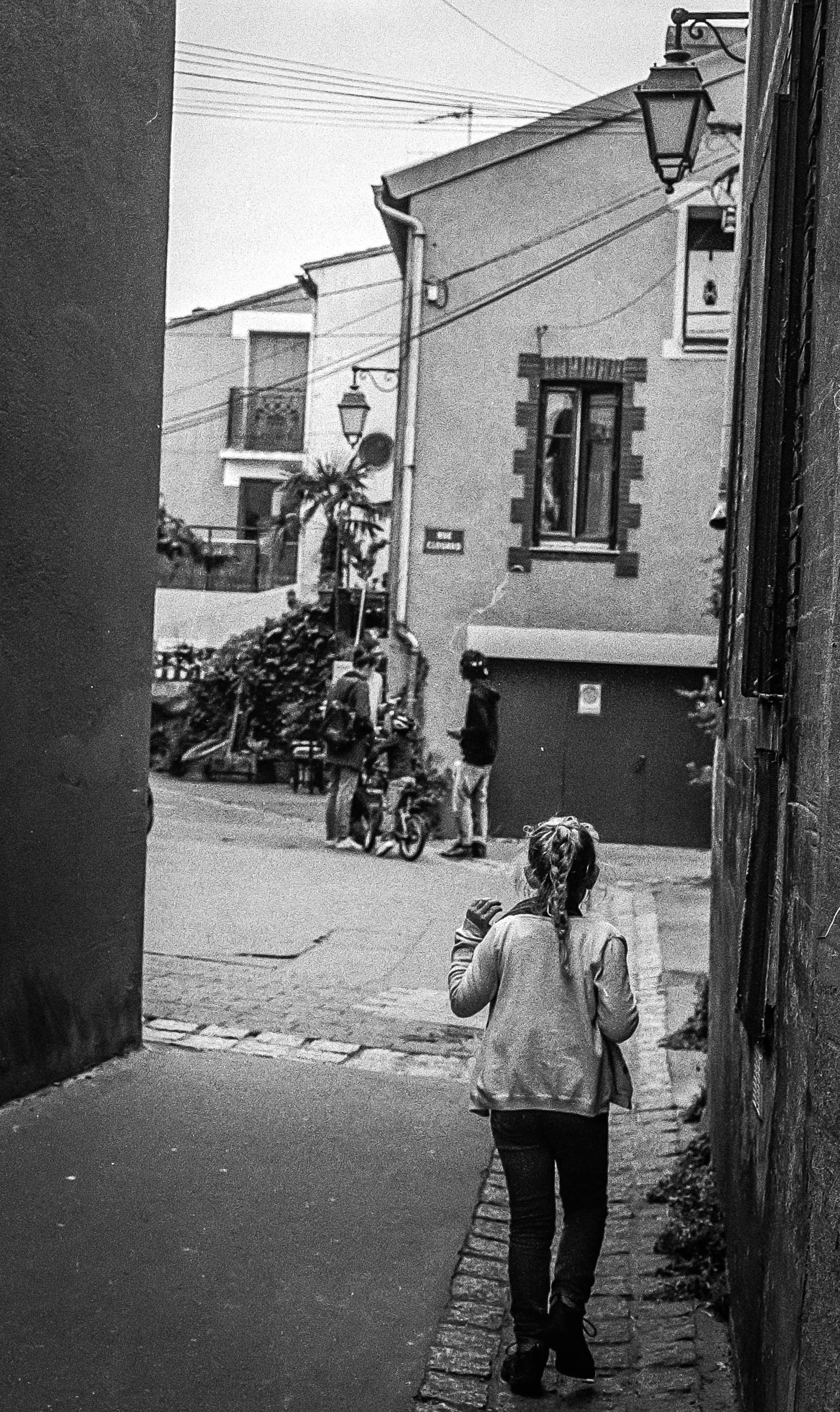
This was another Ian and Kate day. Similar in concept to the Ian and Killian day, but a day where I can dedicate myself solely to Kate. She’s fifteen now of course, but I should spend more time with her. If she’ll let me of course. At the time she was only seven—simpler times where I could make her happy with just a nice tea, a boat trip across the river, and just wandering around exploring the intricate streets of an old fishing village on the “bords de Loire.” There are no cars in the narrow streets, and the children can run wild.
This day was one spent in Trentemoult, that rather colourful village that you can see here. The colours are intense and provide a great backdrop for portrait photography. So of course I went in with a film camera and black and white film. Which only goes to show that when you photograph a location, however colourful, and take away the distraction of that colour, you have to really concentrate on composition, texture, and forms. I couldn’t rely on colour for my photos today. But I was sure that I could reveal some good photos despite that.
So what do you do? You just try and capture some moments of your daughter messing around and being a perfectly normal seven year old. I tried to capture her exploring the streets and being absorbed by the whole ambiance of the place. She became part of the scenery, and blended in perfectly.
I was just there purely to observe and record the day on film, with one eye in my camera and the other on Kate. It was a good day.
Looking back at those moments reminds me of how quickly time seems to slip by without me realising that I am getting older. She of course is slightly older, and possibly slightly less “insouciante” or carefree, but my love for that girl is still as strong as ever.
It’s no secret to the regular readers of IJM Photography that I have a great fondness, deep affection, nearing on obsession with my Fujifilm X100F. It’s a great little camera that gets me excited whenever I take it out of my camera bag. But, Dear Reader, what does this have to do with the Fujifilm X-T2? Well, they’re both manufactured by Fuji, they both have an “X” in their name, and I have a deep affection for a nice cup of tea. Not the same T? Ah well…
Similarities and Differences: A Tale of Two X’s
I’ll talk about the differences and similarities between the two cameras and why I thought the X-T2 was a useful and complementary acquisition. We’ll look at not just the specs but also the rather similar way both cameras handle.
Sensor and Image Quality: Both use the same 24-megapixel sensor with an anti-aliasing filter, and offer an ISO range from 200 to 128000.
Screen and Viewfinder: The X100F has a fixed screen, while the X-T2 boasts a tilting one. Both share the same excellent viewfinder.
Performance: The X100F shoots at 8 fps while the X-T2 goes up to 14 fps. For video, the X100F is limited to Full HD, while the X-T2 offers 4K and can shoot at 120 fps.
Connectivity: Both cameras have built-in wireless capabilities.
Weight: The X100F is lighter at 469g, while the X-T2 is slightly heavier at 507g.
The Lens Factor (and Weather Sealing, Too!)
The main difference? The lens. The X100F has a fixed 23mm (35mm equivalent) f/2.0 lens, while the X-T2 can take the entire range of X-mount lenses. Quite a big difference, indeed. The X-T2 also has the added bonus of weather sealing!
Why Buy a 4-Year-Old Camera in 2020?
Because at the time, I could. It was the logical acquisition and complement to my X100F. Did I mention it also uses the same batteries? I still have the same, beloved-by-many film simulations, and while not as numerous as later models, they are more than enough for me!
My first lens purchase was the 16mm (24mm equivalent) f/2.8 Fuji lens, the perfect complement to the 35mm equivalent on the X100F. I later discovered TTArtisan and 7 Artisans, Chinese firms that make affordable manual focus lenses for the X-mount. I now have the 35mm (50mm equivalent) f/1.2 and 58mm (85mm equivalent) f/1.4, and the fish eye 7mm F2.8 lenses from both companies, both costing a fraction of the autofocus Fuji lenses. The only concession I made to Fuji was later purchasing the 18-55mm (24-70mm equivalent) f/2.8 autofocus kit lens.
Value for Money: The X-T2’s Sweet Spot in 2024
The fact that I bought it second-hand was also a contributing factor. Does it have as many megapixels as the more modern X-T5? No. But does it have enough? Yes! Does it have the same specs as the X-T5? No. But does it have enough? Yes. Can you see a pattern developing here?
For the amount of money spent, I think I have enough cameras for my buck. And that is the crux of the argument for acquiring a now 8-year-old camera in 2024. Is it the very best money can buy? No. But if you’re an amateur like myself, you generally don’t need the specs that manufacturers and those nice men in camera shops will try to tell you you need. 24 megapixels is more than enough for printing even 20″ by 30″ (500mm x 760mm) sized images.
I have just looked at mpb.com for you and have found XT2 bodies from 487€ to 729€ depending on the condition. An X-mount lens will cost you anything from 104€ for a 35mm (50mm equivalent) F1.2 from 7 artisans to 279€ to 340€ for the 16mm (24mm equivalent) F2.8 fuji lens. So as you can see, it’s certainly cheaper than buying the latest models…
Conclusion: A Timeless Tool for the Passionate Photographer
In 2024, the Fujifilm X-T2 remains a compelling option for photographers seeking excellent image quality, classic handling, and a wealth of creative possibilities. Its compact size, weather sealing, and extensive lens selection make it a versatile companion for various genres, from street photography to landscapes.
While newer models may boast more advanced features, the X-T2’s enduring appeal lies in its combination of performance, affordability, and the unique charm of Fujifilm’s X-Trans sensor and film simulations. For photographers who prioritise the essentials of image-making and value for money, the X-T2 continues to be a worthy contender in the ever-evolving world of digital cameras.
If you’re looking for a camera that delivers exceptional results without breaking the bank, the used market might just hold the perfect X-T2 for you. And who knows, you might even discover a newfound appreciation for a slightly older camera that still has plenty to offer in 2024 and beyond.
Post Scriptum
This camera is also capable of 4K video. And I’m using it at work for making videos for training new staff. It is certainly lighter than my Canon 6D Mark II, and I seem to be able to obtain a picture style that I like. It doesn’t have in-built image stabilisation. However, I use it on a tripod so that’s not an issue. And if ever I do decide to use the 18-55mm kit lens, I have image stabilisation in the lens.
I’ll see if I can’t find you an excerpt of the latest video…


































 IJM Photography