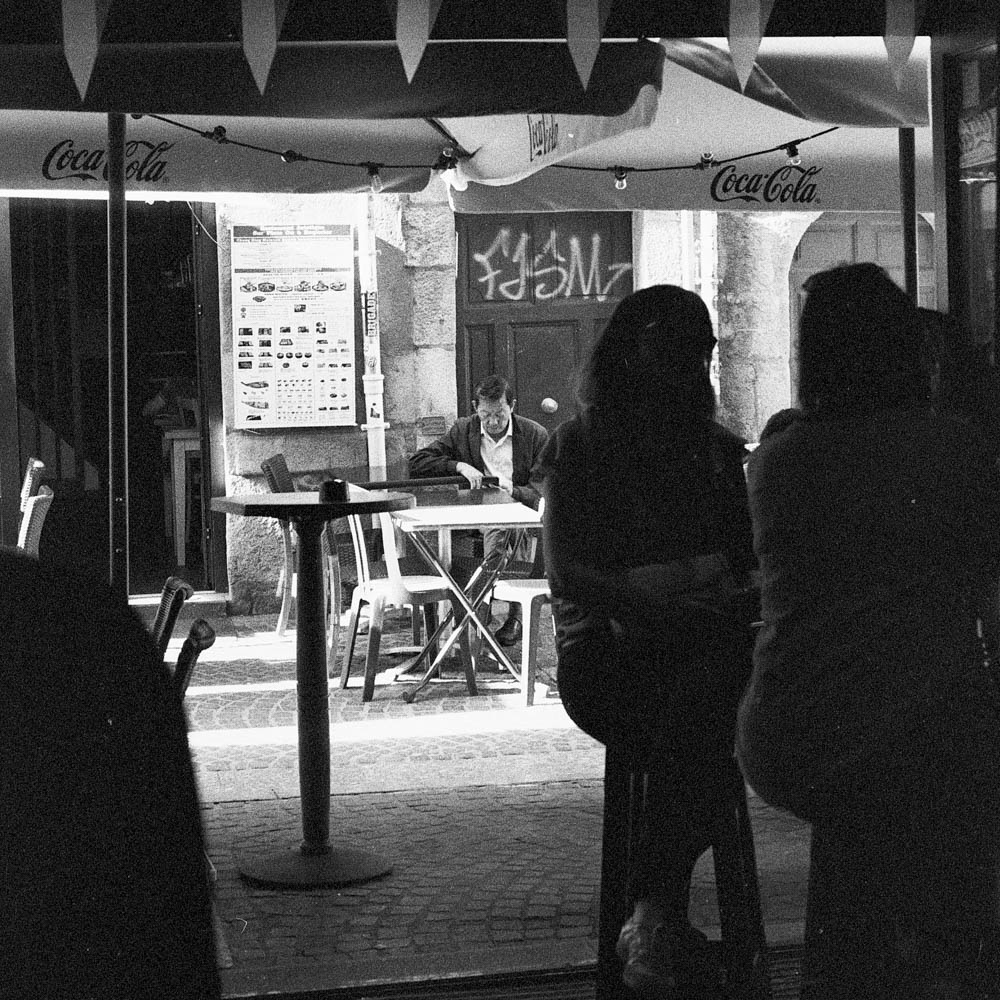
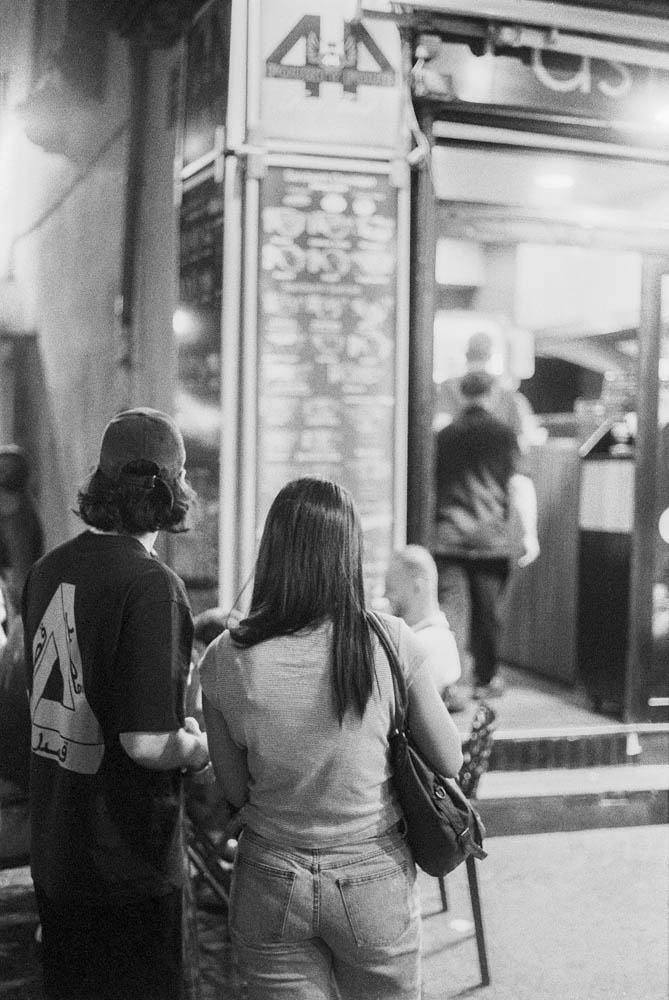
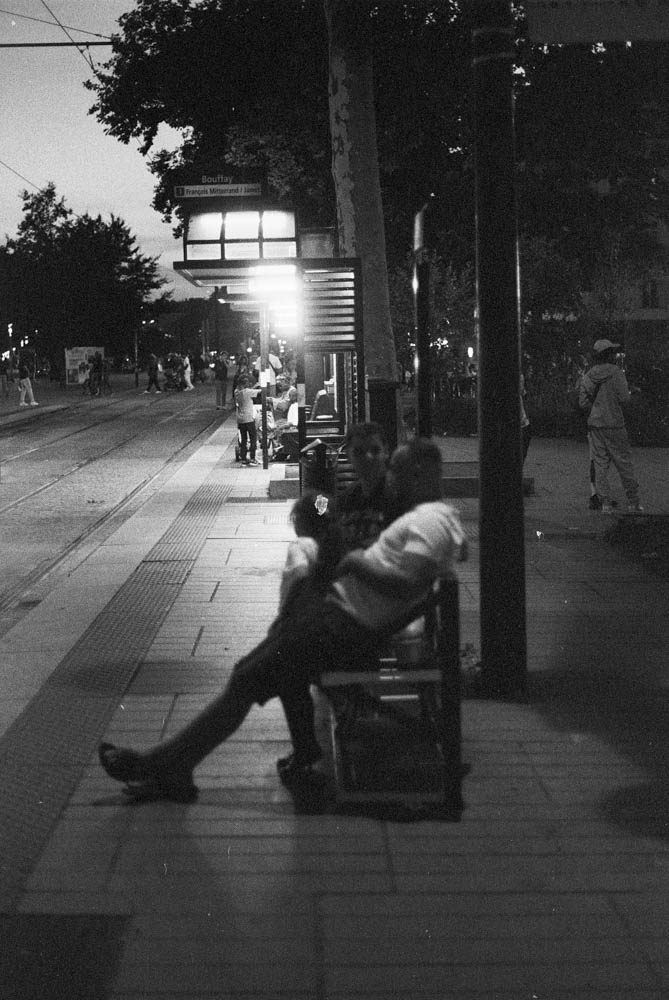
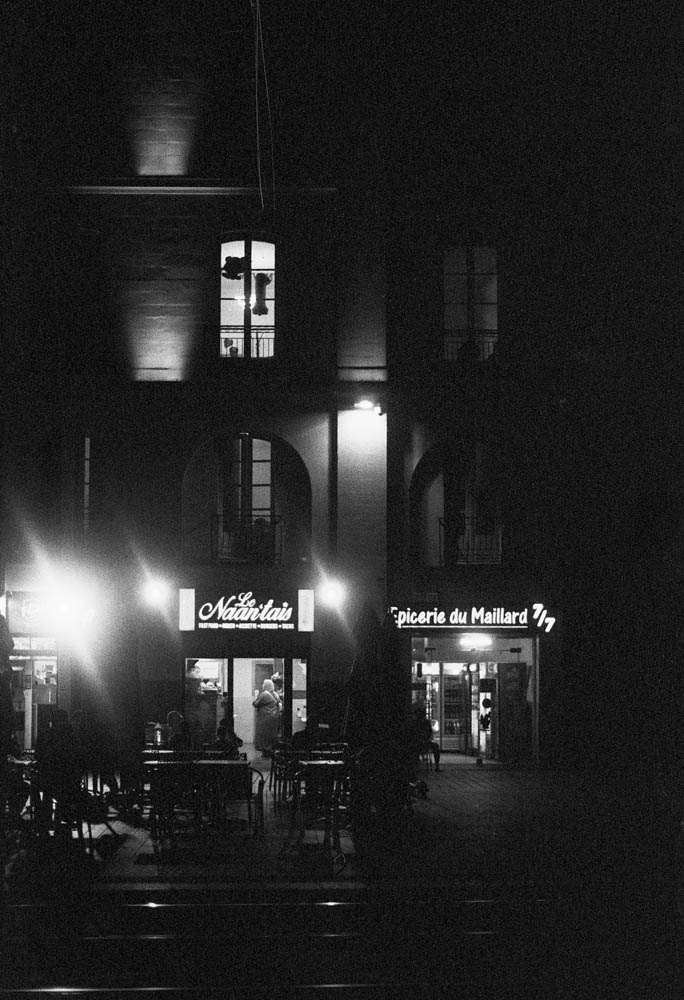
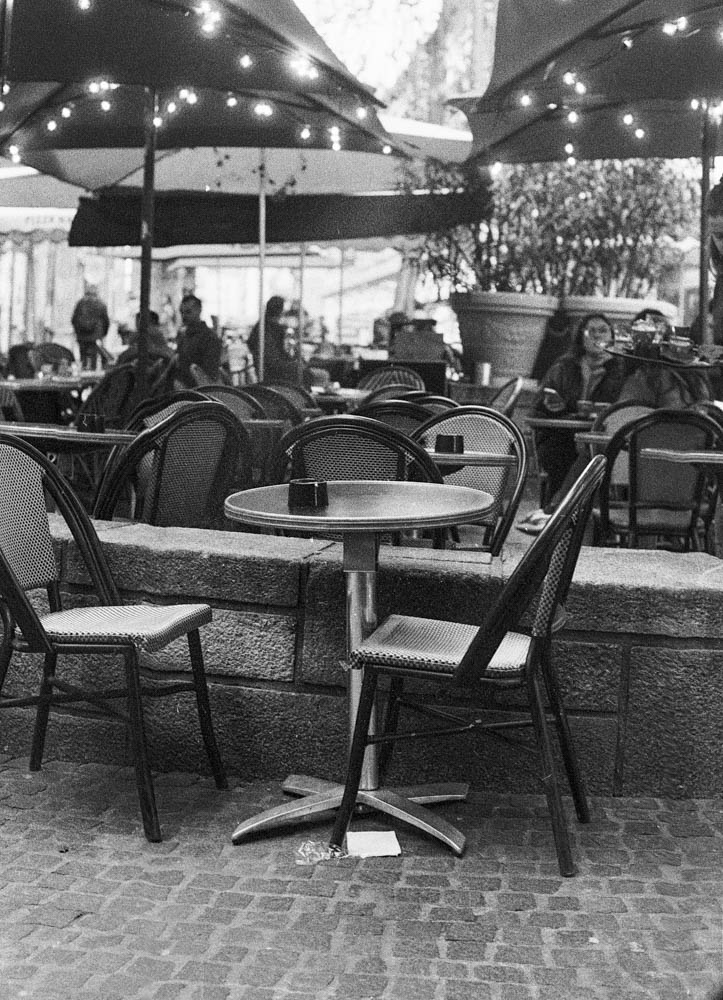
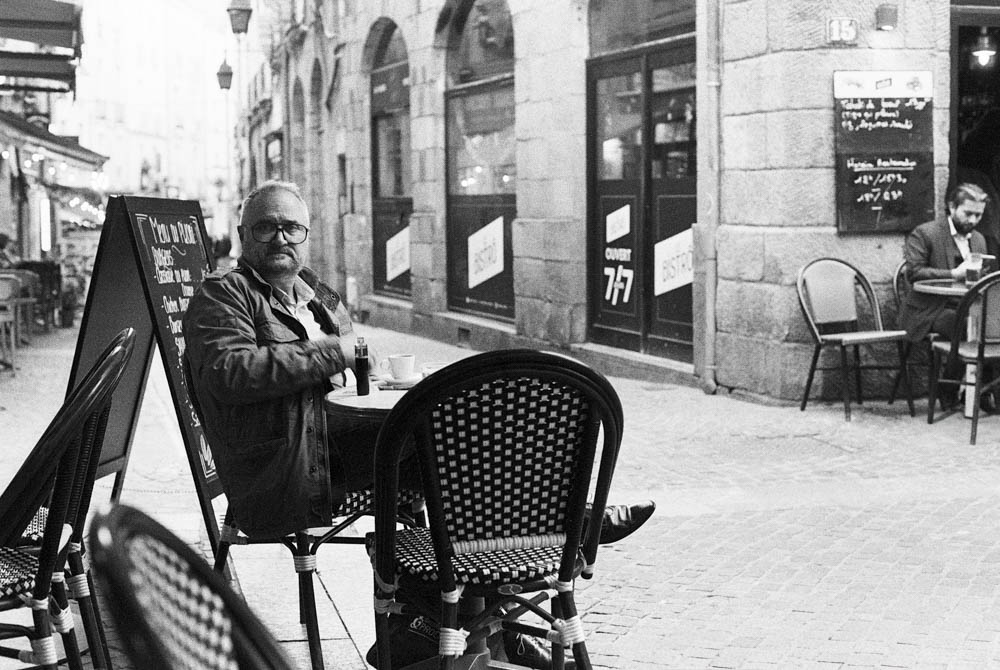
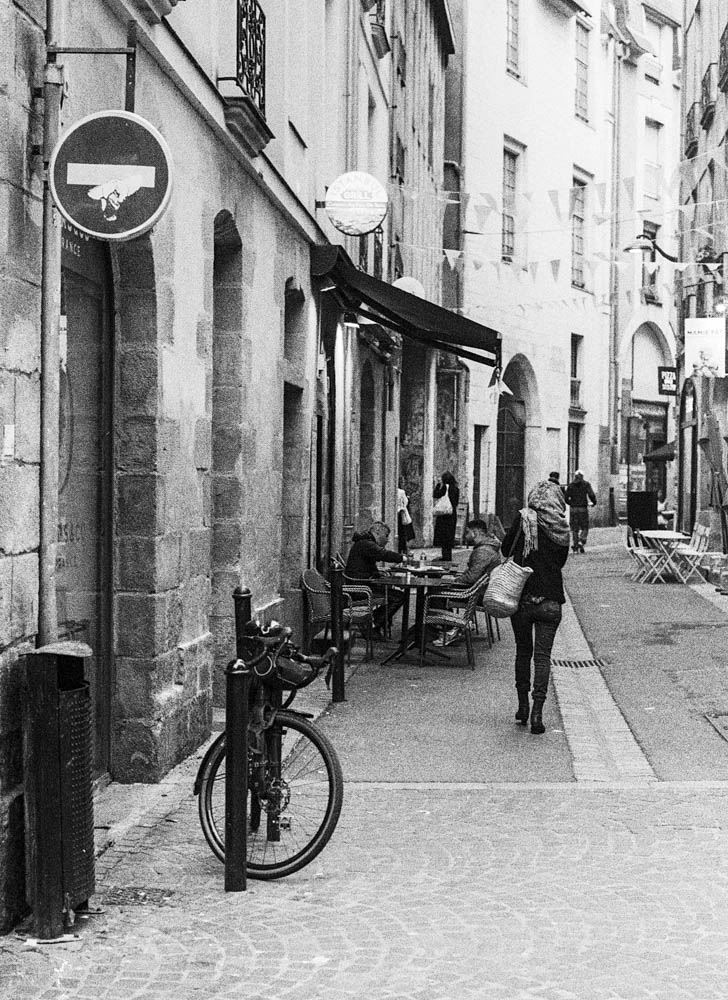
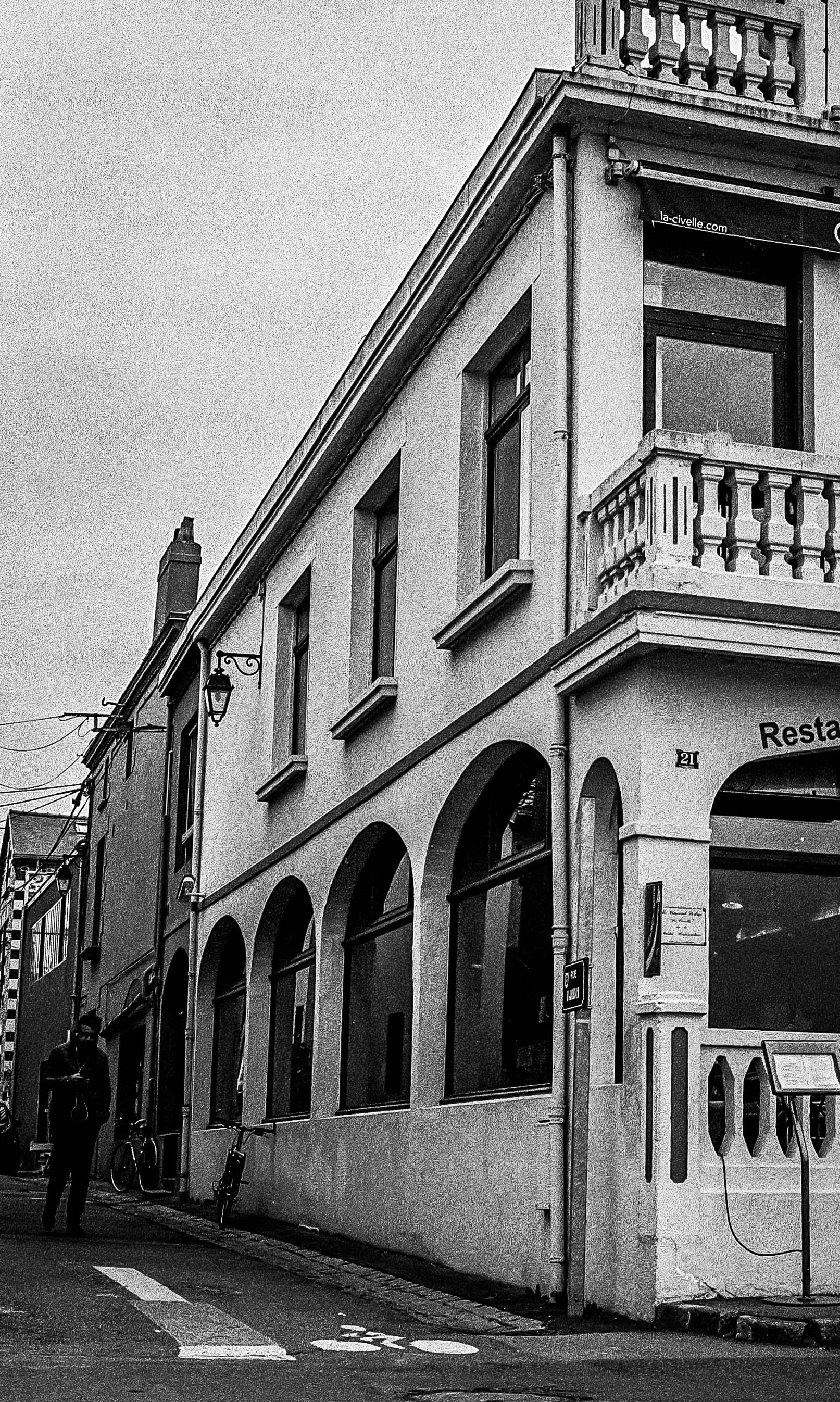
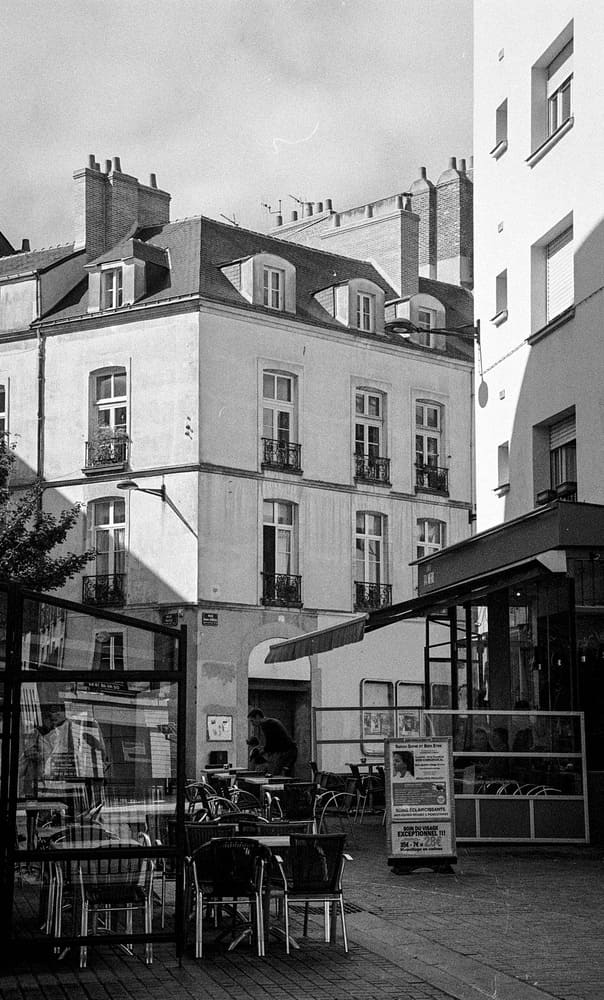
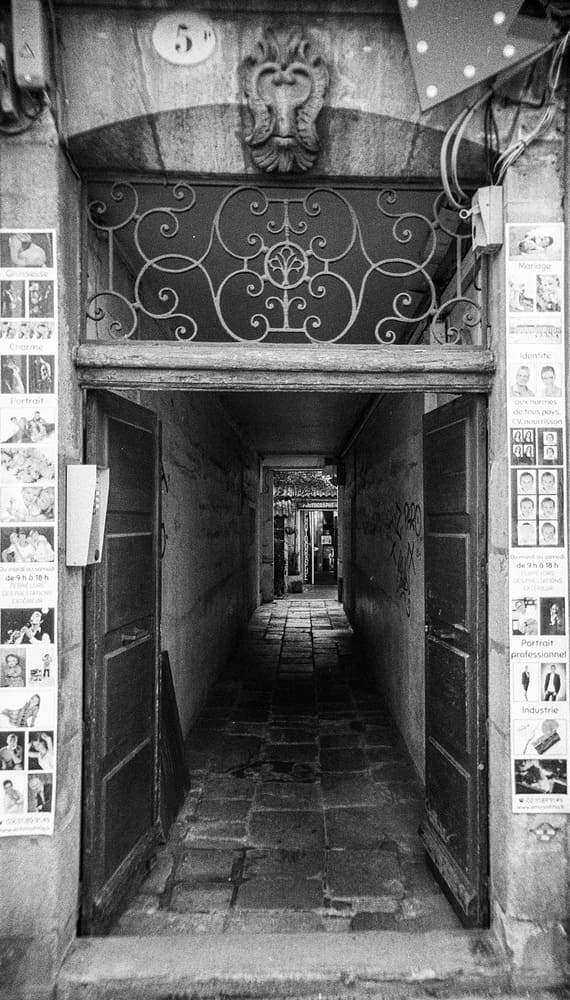
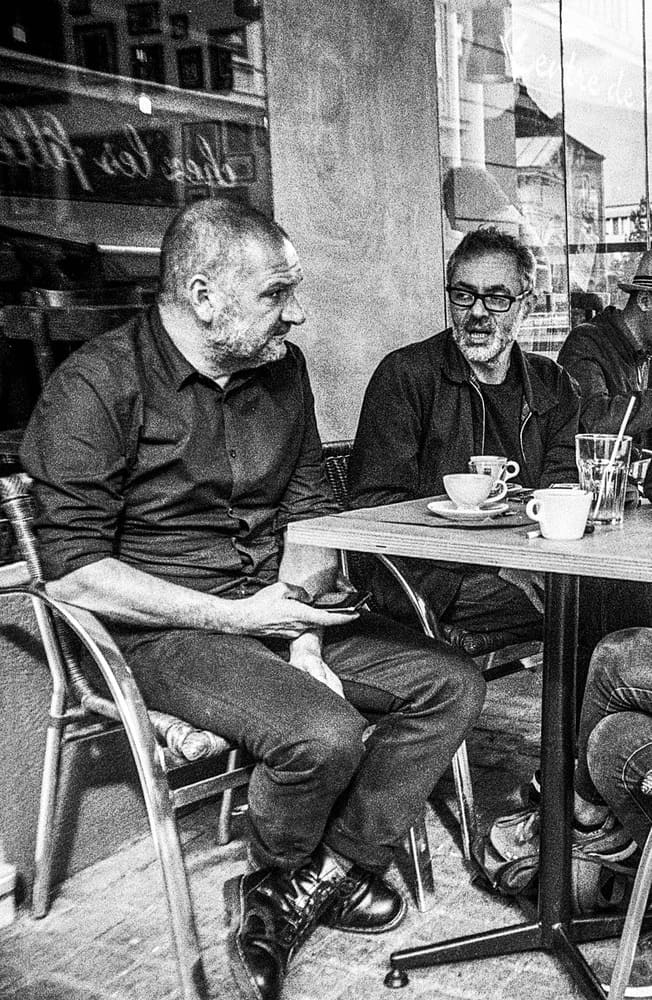
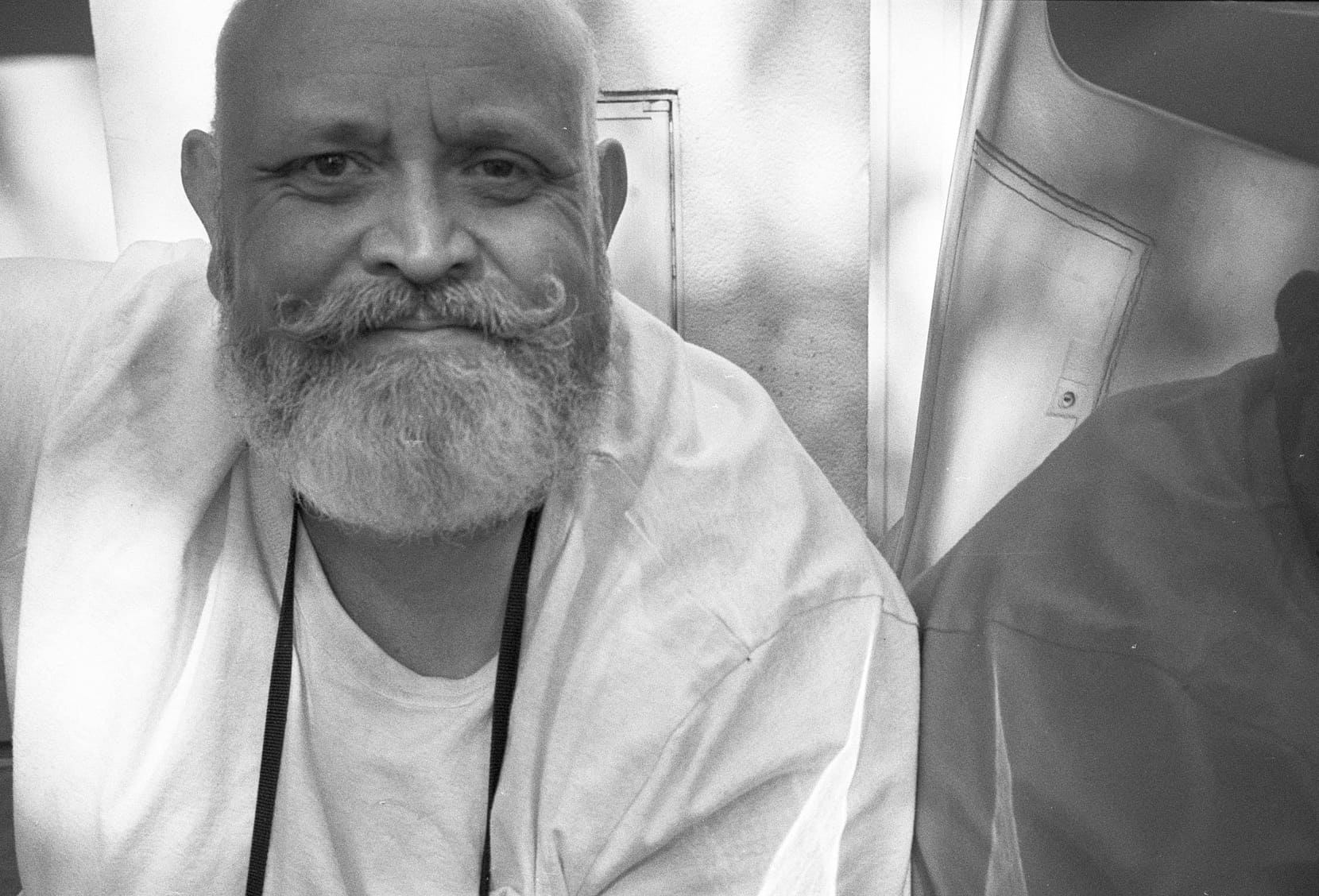
One September evening I walked between Place Bouffay and rue des Petits Écuries with the Nikon FE and a roll of HP5+. Box speed—400 ASA. No pushing. No stand development. Just me, tired eyes, and the hope the city would be kind.
It wasn’t always.
Some frames failed outright. Missed focus—my eyes couldn’t lock the split-image patch in the dim light. Others blurred from camera shake at 1/15th, handholding like a fool. I won’t pretend those shots have hidden merit. They’re gone. But the ones that landed? They held more than I expected.
Because Nantes at night isn’t dark. Restaurants pour light onto wet cobbles. Shop signs, streetlamps, even those little menu stands outside cafés—they all feed the scene. I’d guess the focus, press the shutter, and move on. Later, scanning the roll, I found detail in shadows I thought were lost. Not because I’d exposed well—I hadn’t—but because HP5+ gathered what was there even when I fumbled.
That’s latitude in practice. Not a spec sheet promise, but the difference between a usable negative and a blank one when your hands shake and your eyes fail. I didn’t push to 1600. I didn’t need to. I just needed a film that wouldn’t punish me for being human.
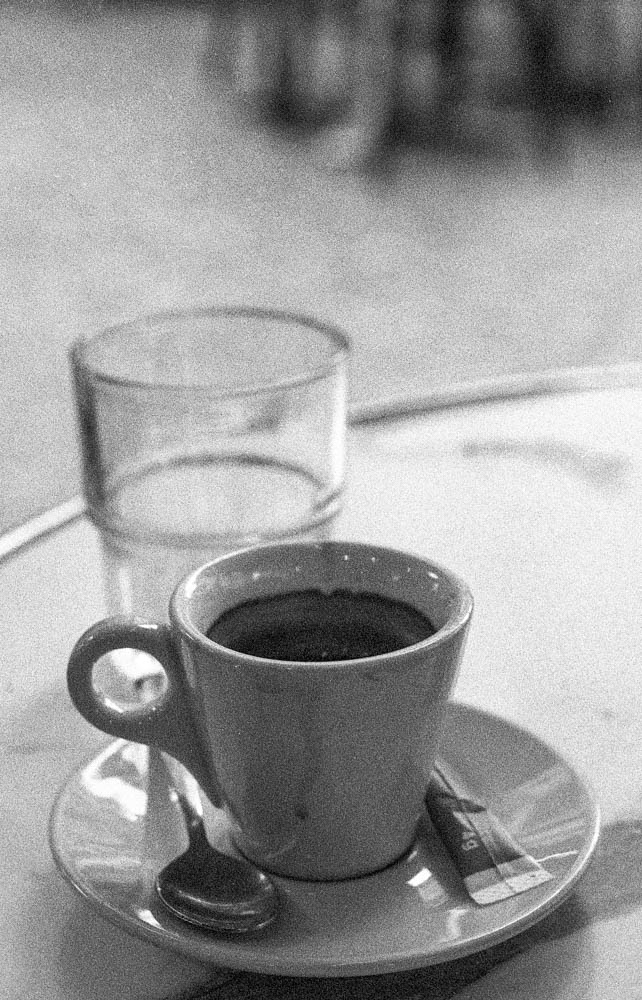
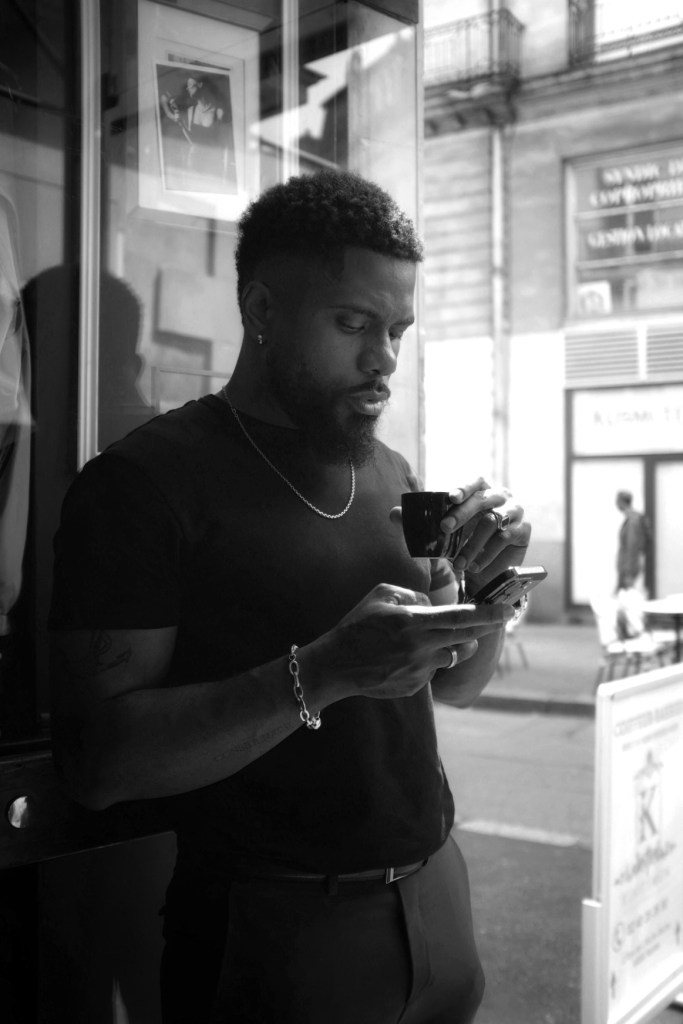
The December shots are more traditional street work—grey skies, low sun, the light you expect. Even the coffee cup photo owes something to Instagram. I won’t deny it. We absorb what we see online; it seeps into our framing without us noticing. No shame in that—it’s just how we learn now.
But the September shots that worked feel more like my own. Standing in Place Bouffay as evening deepened, watching light pool around tables and bounce off stone—I wasn’t chasing a look. I was just there, squinting, hoping. And HP5+ met that without fuss.
I’m not claiming mastery. I’m claiming a few good frames out of a roll that also held misses. That feels honest. Cities don’t go dark—they transform. And sometimes, even with bad eyesight and shaky hands, a simple roll of film gives you just enough to keep walking.
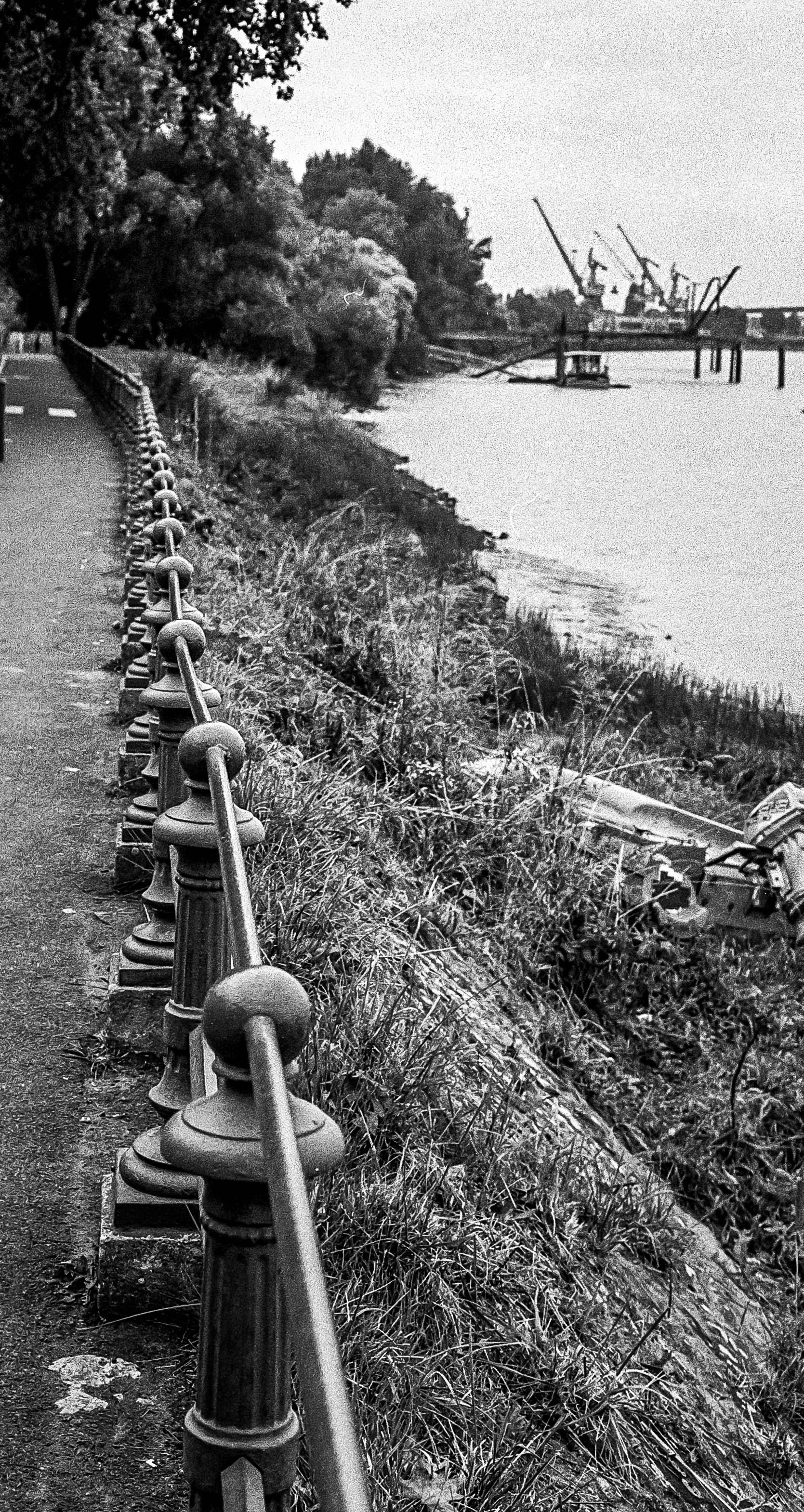
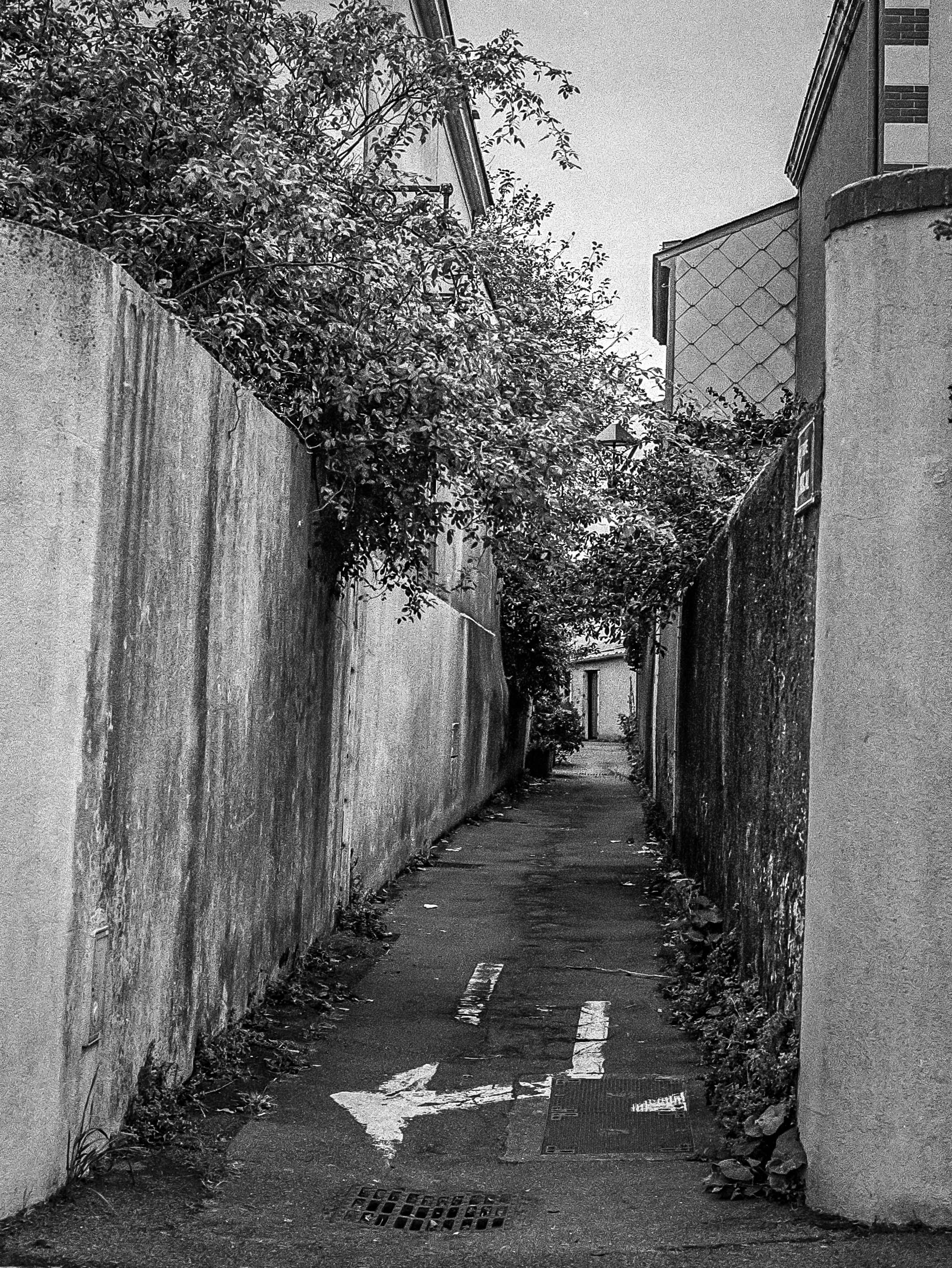
All photographs shot on Ilford HP5+ at 400 ASA, developed in standard chemistry. Nikon FE, Nantes—December 2025 and September 2025, Place Bouffay and rue des Petits Écuries.
There’s a stock phrase about the journey being more important than the destination. Another one suggests that a journey can transform a man into something new—something he didn’t even suspect. As I look back at the man who left home, went to China on tour, and the one who came home, I can’t help but wonder if there’s truth in both. I’ve previously described China as a “foreign concept,” and now, having returned, it feels far less so. I’ve peeled back a layer of the country and gained a deeper understanding of its culture—musical, culinary, and otherwise.
This tour, too, has been a “parenthesis,” a break from real life, and a chance to be me—not just “Papa” or “husband.” No longer defined by my role in the family or at work, I could just exist as I am, whoever that is. Though I still feel some anxiety about how others perceive me, age has brought a certain self-awareness, self-knowledge, and—perhaps—a bit too much overthinking. For those two weeks, I was simply a guy on a bus, surrounded by French people, walking through new experiences, and discovering everything along the way.
China as a Totally Foreign Concept
Before I left, my idea of China was that of a far-off place, so completely different from anywhere I had lived before. Those ideas were formed in childhood, shaped by the media’s portrayal of this foreign land. I won’t deny it—I was terrified of the whole trip. Researching things online only added to my worries about not being able to read or speak the language. Growing up, I saw China as a Communist regime, almost oppressive like the Soviet Union, and as the enemy we had to defend against. I remember watching the handover of Hong Kong in 1997, feeling my stomach churn as I watched truckloads of PLA soldiers occupy our old colony.
I remember, too, older members of the band, where I wore green for a living, talking about Hong Kong as the dream posting—warm, sunny, and everything a soldier could need. But what was I really afraid of? The unknown. We all knew about China’s state security apparatus, without truly understanding it. The events of Covid only deepened that sense of fear and mystery.
I even worried about something as simple as eating with chopsticks, imagining I’d have to rely on forks or my fingers. Looking back, all of these fears now seem so silly. But they were real before I experienced the country for myself—and especially before I met its people.
The People Who Changed My View
Somehow, I managed to take each day as it came, simply bathing in the new experiences. And, strangely enough, China worked its magic on me. It didn’t just change my view of the place—it changed how I saw the people. They were charming, incredibly friendly, and in a way that made them seem so much more human.
I began to see myself in them, and I realized that, despite our differences, we are more alike than we might think. We all fall in love, become parents with grace, and share the same aspirations for our children—to be happy, to find love, and to repeat the cycle.
I think back to Christmas Day, when I made new friends. The simple “Merry Christmas” was enough to endear me to them. I also reflect on how beer, it seems, transcends barriers of language, creating a connection that only men seem to understand. I’m not trying to exclude women, of course—heaven forbid—but there’s something inherently masculine about it.
My Place in the Orchestra
Another transformation came in terms of my place in the orchestra—or rather, my perception of it. As the 4th horn, a position typically reserved for the least experienced player, I have always resented the remark. But now, I know my role to be the solid foundation of the section, guiding it through the music. At 53, I no longer feel the need to prove anything. I’m here for the music, content to plod along at the bottom. It’s not humility—it’s comfort, and a willingness to let the young bucks enjoy the spotlight.
Being on tour, though, inevitably brings people closer together. Take poor Corentin, who shared a room with me for two weeks. It’s one thing to get along during rehearsals or after a concert, but living in such close quarters really gives you a new perspective on someone. I knew Corentin was a good lad, but during those two weeks, I saw him in a different light. We talked, laughed, and endured the trials of close proximity.
I remember one drive home from a concert when my birth mother FaceTimed me with the news of her cancer diagnosis. Corentin, despite his limited English, understood more than he let on. He listened as I processed the information, and in that moment, we connected in a way that most people don’t. Maybe that’s what brought us even closer.
Sharing a room with him was like being back in the army. We worked hard, played hard, and celebrated with the kind of noises only a group of men could share. If you can fart in front of someone, you’re already on the next level of friendship.
One moment that stood out for me was when I helped Clement, the other horn player. I had offered him some coaching to help him out of his funk. During the concerts, he had some delicate parts, and although I could easily play his passages for him, I didn’t want to embarrass him. So, I didn’t change seats to play his part during the performance. Instead, I stayed where I was, and when it came to his turn, I played my part to the best of my ability. It was subtle but important—I didn’t want to take his place; I just wanted to give him the support he needed without making him feel like he couldn’t do it on his own.
Afterward, Clement spoke very kindly about me to the younger players in the group. He praised me in a way that felt both generous and sincere, and it left me feeling deeply grateful. His words were not just kind—they spoke to a level of respect and camaraderie I hadn’t anticipated. I hadn’t sought recognition; I just wanted to help. But his thoughtful comments—about my support without overshadowing him—meant more than I could have expected. It’s rare to find such generosity of spirit, and I appreciate him for that.
I nearly forgot to talk about my girls from my days in Cholet. It was Eléonore that suggested that I join the orchestra, and I’m so glad she did. I was about to leave my horn in its box and let it gather dust somewhere in my house where people wouldn’t trip over it. She has been a very good friend to me over the last 13 years, and I think she’s wonderful. Then of course I mustn’t forget Titaua and Mathilde. And they certainly didn’t forget to tall every one about my “kilt” days, where as fed up of being English, I would let people know that one can be from the UK without necessarily being English. My first adoptive father was Scottish, and his brother, Uncle Joe, was Professor Regis at Edinburgh University. People came up to them saying that Ian wasn’t like how they had imagined him, and was actually a decent chap and all-round good egg! Then Eléonore just reminded them that “they” didn’t know me the way she did…
During the tour, as you’ve seen, I took some photos—some of them very odd. But I wasn’t the only one sharing them in the infamous WhatsApp group. For the first time, people saw a different side of me—the artist, not just the beer-loving horn player. I even started sharing my blog posts in the group, and maybe I’ve earned a reputation as the writer. Who would’ve thought? A beer-drinking horn player who takes decent photos and has a way with words—still knows how to play, though.
Anything Else?
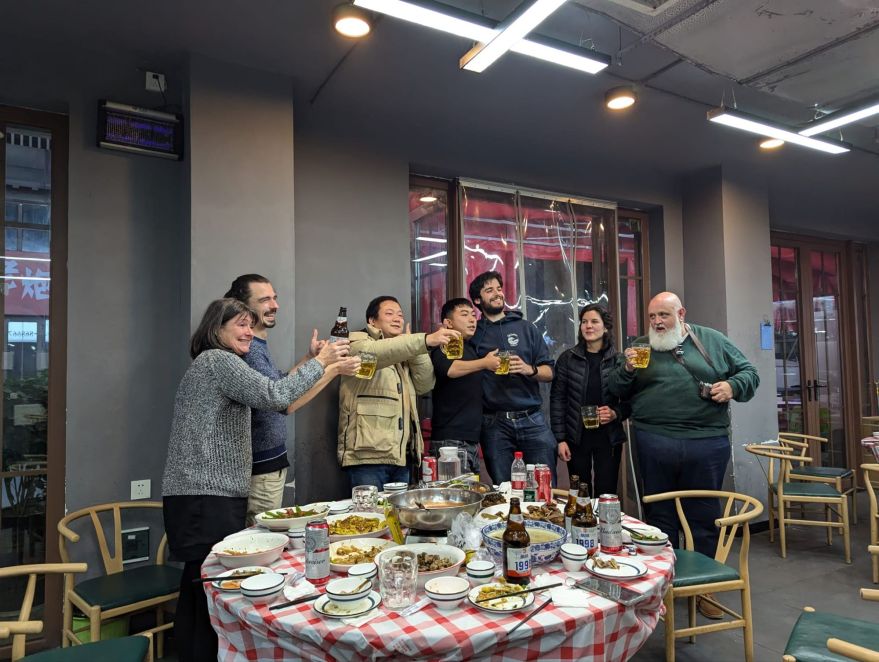
I think my approach to food has also shifted. I’ve always liked the idea of sitting around a big table with friends, and during the tour, I was reminded of that. The variety of dishes was astounding, and I saw some players more comfortable with what they knew, while others bravely ate silk worm chrysalids. Me? I just enjoyed whatever was put in front of me, from chicken and duck feet to tortoise.
I found myself stepping away from desserts, my sweet tooth growing calmer. Eating the Chinese way—deliberately, mindfully—was a revelation. Much like film photography, it slowed me down and made me more aware. I ate less, but I appreciated the variety. I even tried to emulate that at home—though, I didn’t put chillies in my dishes.
I’ve also become more accepting of my body. Despite still feeling like I have a long way to go, I’ve made peace with the body I’ve got. Corentin’s lack of judgment helped, and I’ve learned to be more at ease with the frame that carries me around.
How to Conclude?
What’s clear is that this journey, this “parenthesis,” hasn’t just been a break from the familiar—it’s been a period of quiet transformation. The familiar parts of myself have had space to evolve. And perhaps that’s the true beauty of any journey—not the destination, but the unfolding of a self you might not have fully known. In a way, I’ve returned not quite the same man who left. But then again, perhaps that’s the essence of travel: it allows us to become more fully who we truly are, even as we discover the world around us.
As the journey ended, I found myself thinking less about the places I’ve seen and more about the moments shared—those small, unexpected connections that shape an experience just as much as the landscapes we pass through. Travel isn’t only about what we take away from it; it’s also about what we bring to those we meet along the way.
Perhaps that’s what lingers most—the idea that stepping beyond our usual paths isn’t just an act of discovery but a quiet exchange. We put ourselves out there, not just as observers but as participants, leaving behind something of ourselves in the process. And in return, we find that the world, in all its vastness, feels just a little more connected.
When I first started out in photography, I would go and get my film developed by the photographer on Newland Avenue near where I lived, and the photographer would do what people called a contact sheet. Basically, the film was cut into strips, placed into a special frame to keep the negatives as flat as possible, and exposed directly onto a sheet of photographic paper. These “thumbnails” allowed us to see the photos of the outing in one place and we could decide which ones might be worthy of developing.
We have this digital contact sheet in Lightroom where we import our photos and decide which ones are worthy of being developed. It’s the same idea, just with different tools.
But what does this have to do with storytelling? Think of the contact sheet as the beginning of the story-crafting process. Just like a narrative needs a beginning, middle, and end, so too does our selection of images. With a contact sheet, we gain a bird’s-eye view of an outing—seeing not only the individual shots but how they relate to each other. Choosing which moments to develop isn’t just about technical quality; it’s about deciding which parts of the experience best tell the story.
This principle guides me when choosing photos to share here on the blog. Whether it’s capturing moments with my friend JD, the barber, or snapping a shot of my lunch before I dive in, each image plays a role in the day’s story, hoping that I don’t forget to take the photo of my dessert before eating it. Otherwise you just get a photo of the plate with some traces of cake or just some crumbs.
But lets’s get back to the idea of story telling with an arc that covers the outing. When I set out for the day, I begin with a few warm-up shots to set the scene. If I have a plan, great—but often I don’t. Instead, I focus on capturing the ambiance of my surroundings, whether it’s a café, church, or pub. Each photo builds on the last, creating a narrative of my day’s journey.
For events, especially when I’m hired to photograph, I’ll start by discussing the plan with my client. I want to know what’s important to capture, any specific conditions at the venue—lighting, mobility restrictions, etc.—and what moments they consider essential. Having this list of must-capture moments, like the classic Kodak moments that we talked about in the last article, helps me stay focused and give me structure.
For the sake of arguments, I have a wedding to photograph, and I know that I will be taking shots of the bride before the ceremony. I know that I have to be at the venue before the happy couple arrives. I’d better get a shot of the rings before they appear on the couples’ fingers, etc. I’ll want environmental portraits of the guests, etc. This planning ahead allows me to be more serene during the day itself.
Just married
Not every story requires a series of images; sometimes, a single photograph can capture an entire narrative. Think of it as a self-contained story, a moment that holds not only what’s visible but also what’s implied—emotion, context, and sometimes, a sense of mystery.
For example, take a photograph of a lone, empty café table in the soft morning light, a half-full cup of coffee, and an open notebook on the table. This image can suggest solitude, introspection, or perhaps the moment right after someone has left. The viewer might wonder: Who was sitting here? Why did they leave? What were they writing? This photograph tells a story, inviting the viewer to step in and imagine the rest.
A single image can evoke different responses based on the viewer’s own experiences and emotions. In many ways, it’s a conversation between the photographer and the viewer. We as photographers might set the scene, choose the light, and capture the moment, but it’s the viewer who fills in the blanks, completing the story in their mind.
This approach also applies when photographing people. A portrait of a person lost in thought, gazing out of a window, can evoke curiosity about what’s on their mind, where they might be going, or what they’re experiencing at that moment. In these cases, the single image captures more than just a face or place; it holds an emotional narrative that transcends words.
Am I sure about this cake?
Storytelling in photography isn’t just about taking pictures; it’s about deciding which moments matter and capturing them in a way that communicates more than what’s on the surface. Whether we’re crafting a narrative through a series of images or capturing an entire story in a single frame, each photo we take says something about how we see the world and what we want to share with others.
Next time you’re out with your camera, think about the story you’re building, whether it’s a quiet day at a café or a bustling event. What do you want your viewers to see, to feel, to wonder about? In some ways, we’re all storytellers—stringing together moments, big or small, to create something meaningful.
So, go on—look through your images as if they were frames in a film, each one a piece of a larger story. You might find that your perspective shifts, and that’s when photography becomes more than just a hobby; it becomes a way of understanding and connecting with the world.
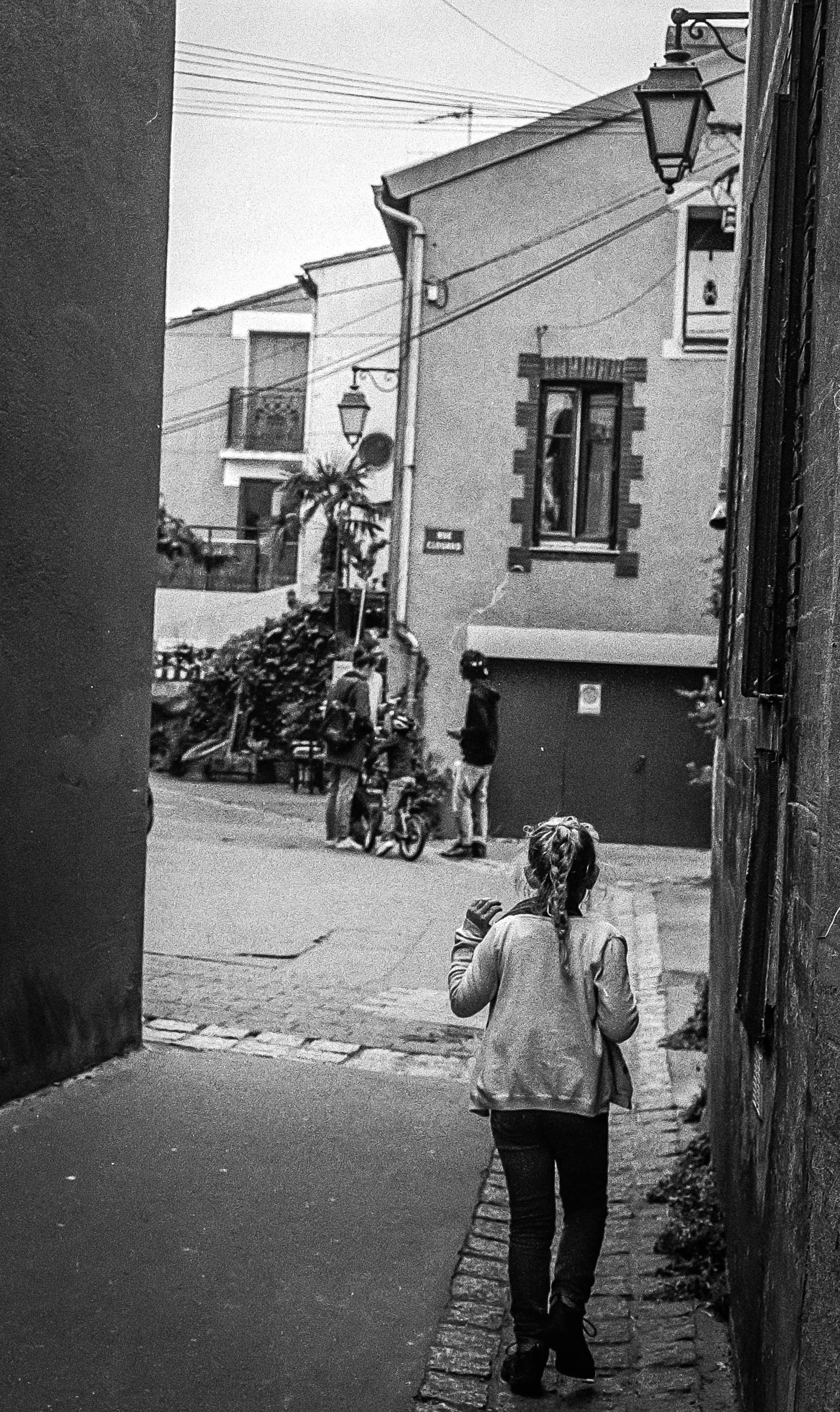
This was another Ian and Kate day. Similar in concept to the Ian and Killian day, but a day where I can dedicate myself solely to Kate. She’s fifteen now of course, but I should spend more time with her. If she’ll let me of course. At the time she was only seven—simpler times where I could make her happy with just a nice tea, a boat trip across the river, and just wandering around exploring the intricate streets of an old fishing village on the “bords de Loire.” There are no cars in the narrow streets, and the children can run wild.
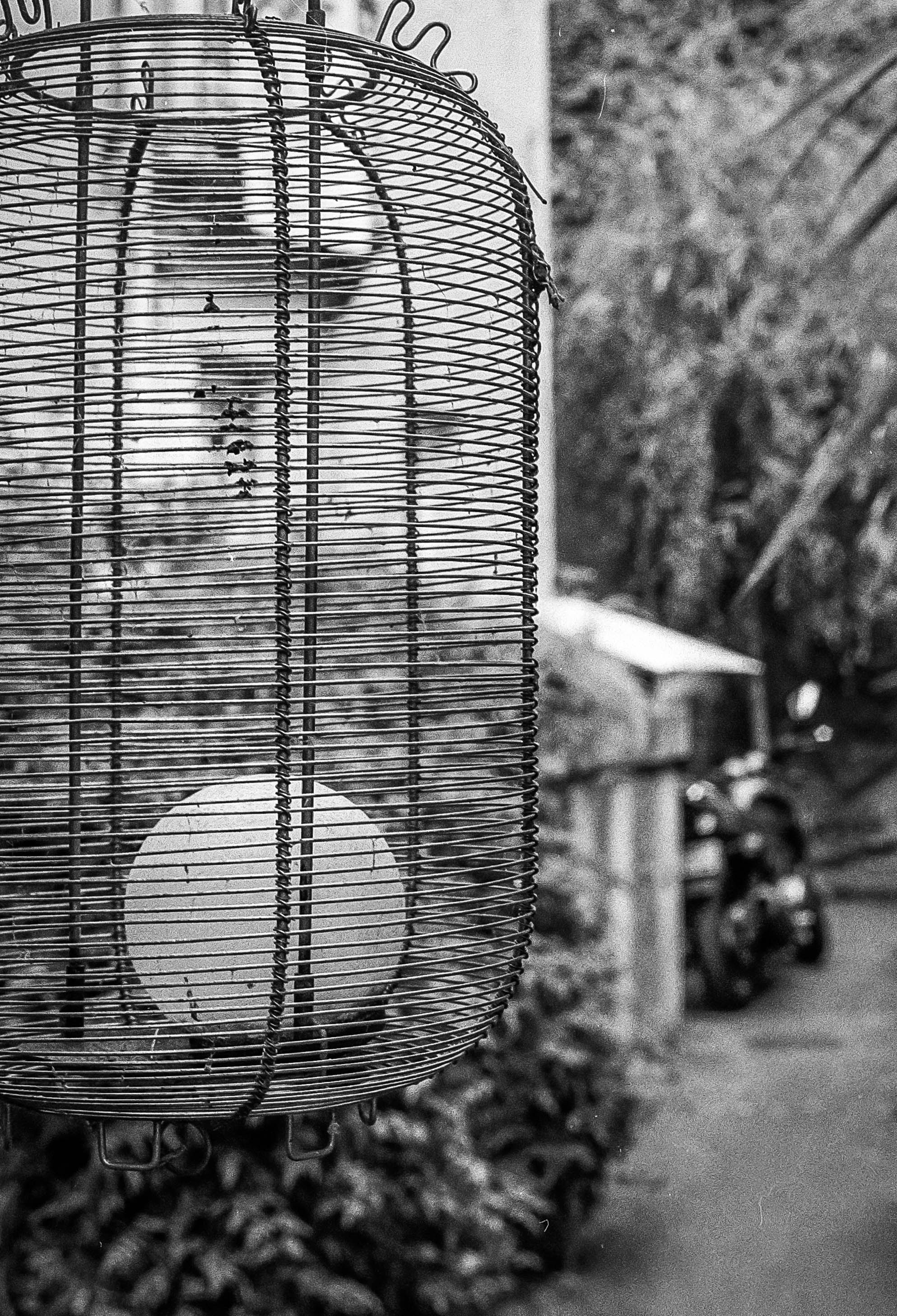
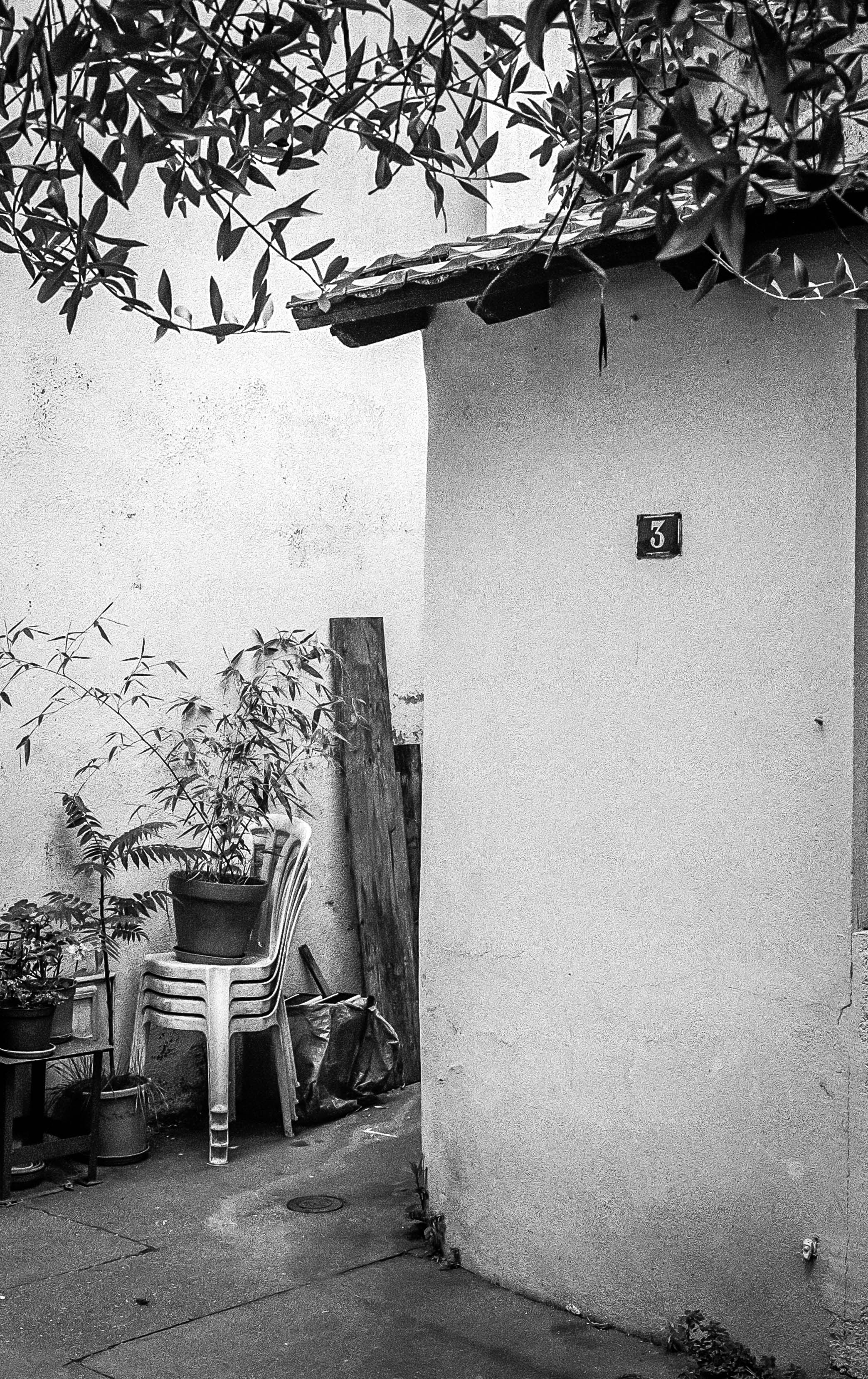
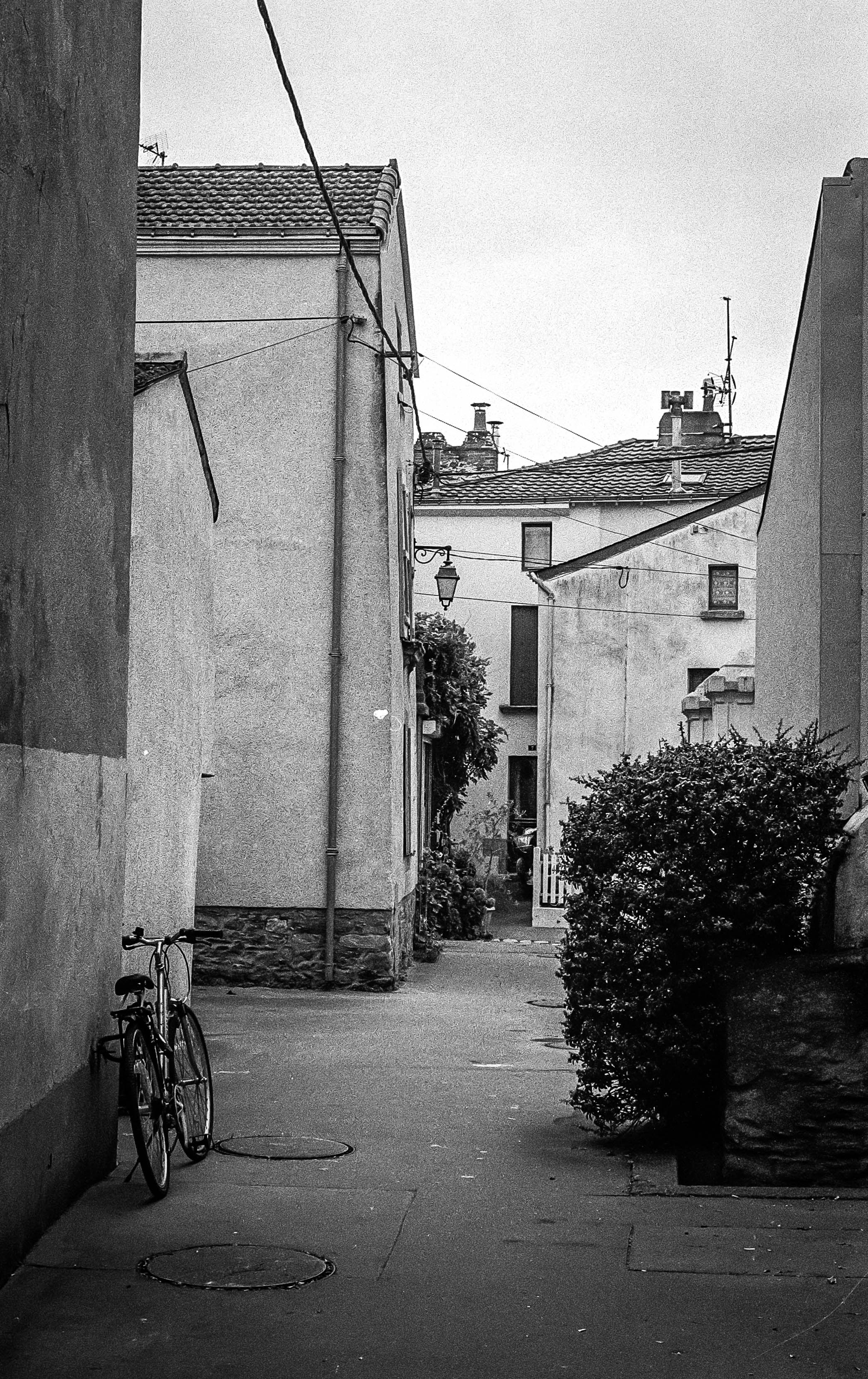
This day was one spent in Trentemoult, that rather colourful village that you can see here. The colours are intense and provide a great backdrop for portrait photography. So of course I went in with a film camera and black and white film. Which only goes to show that when you photograph a location, however colourful, and take away the distraction of that colour, you have to really concentrate on composition, texture, and forms. I couldn’t rely on colour for my photos today. But I was sure that I could reveal some good photos despite that.
So what do you do? You just try and capture some moments of your daughter messing around and being a perfectly normal seven year old. I tried to capture her exploring the streets and being absorbed by the whole ambiance of the place. She became part of the scenery, and blended in perfectly.
I was just there purely to observe and record the day on film, with one eye in my camera and the other on Kate. It was a good day.
Looking back at those moments reminds me of how quickly time seems to slip by without me realising that I am getting older. She of course is slightly older, and possibly slightly less “insouciante” or carefree, but my love for that girl is still as strong as ever.
Welcome back to another look at the film archives. This time, I’m sharing a few black-and-white street shots from an October Saturday in Nantes, likely taken with the Praktica MTL3 and HP5 Plus film. These outings with my son Killian, which we called ‘Ian and Killian days,’ became a cherished routine, a time for us to reconnect amidst the busyness of life.
He was 17 then, a weekly boarder at his lycée in La Roche sur Yon. On the weekends, we’d often head into Nantes, following the same familiar programme: a visit to the barbershop, a meal at the Sugar Blue café, and finally, a drink at the John Mc Byrne Irish Pub. In the photo, that handsome chap in the barber’s seat is Killian—a little reminder that it wasn’t always Kate joining me on these trips. These outings were a way to stay connected, despite his growing independence. Even with him being only 17, I still felt that sense of responsibility. Once a Dad, always a Dad.
As we went through our usual routine, I found myself facing the familiar challenge of capturing these moments on film. The low light inside the barbershop always made me second-guess whether I could get a decent shot without using a flash. But over time, I learned to trust the Praktica and the HP5 Plus film. There’s a rawness to film photography, especially with Ilford’s HP5. It adds a certain grit and texture to the image, something that digital just can’t replicate.
That’s what I love about film—the imperfections. The grain gives it character, a certain honesty that smooth, polished digital photos lack. It’s not about creating something flawless but about preserving the authenticity of the moment. This shot of Killian in the barbershop, for example, may not be technically perfect, but it’s real. It’s us, it’s Nantes, it’s one of those ‘Ian and Killian days.’
Looking back at these photos, I’m reminded that sometimes, it’s the imperfections that make an image truly memorable. Quite the day, right?
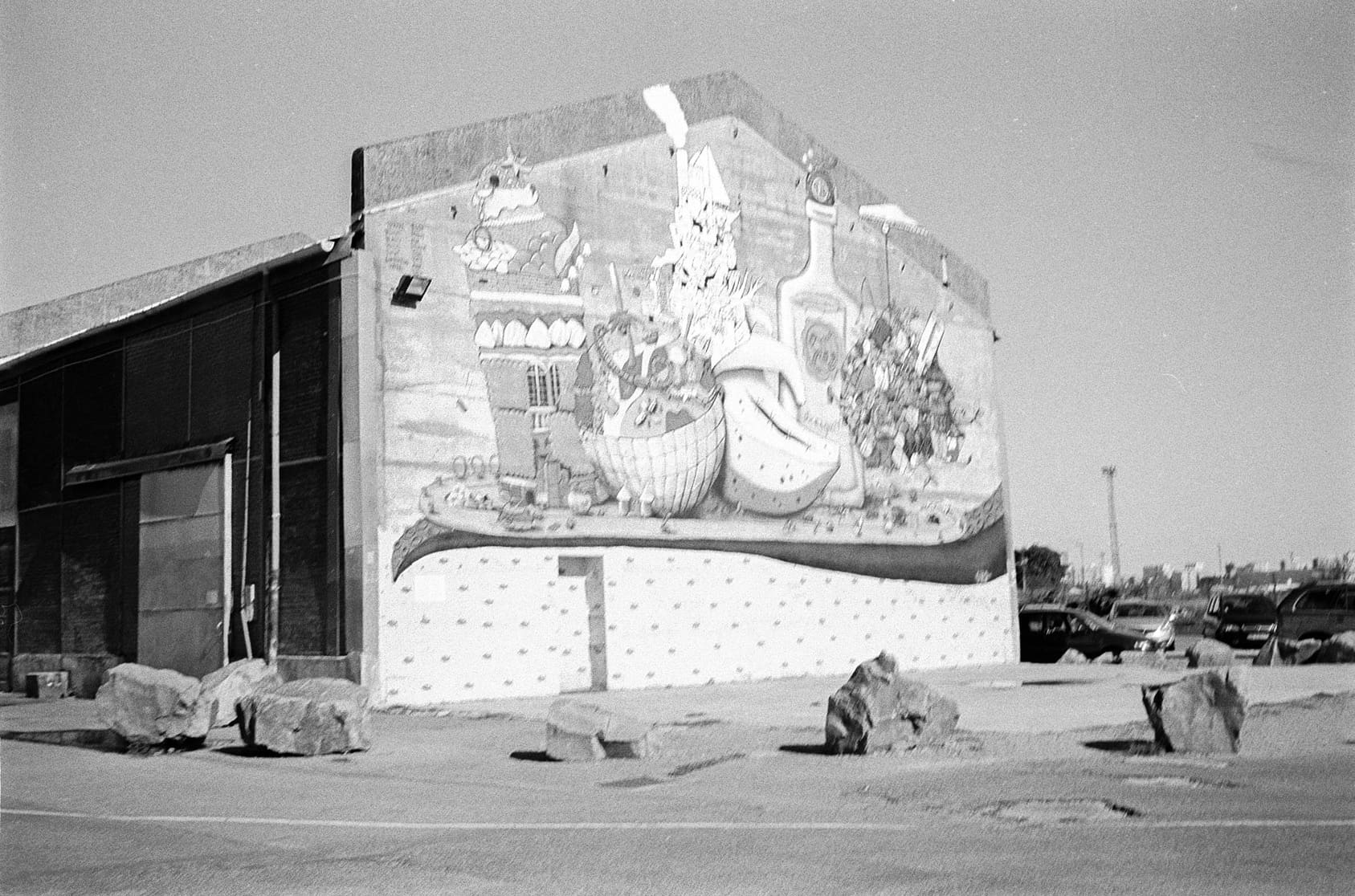
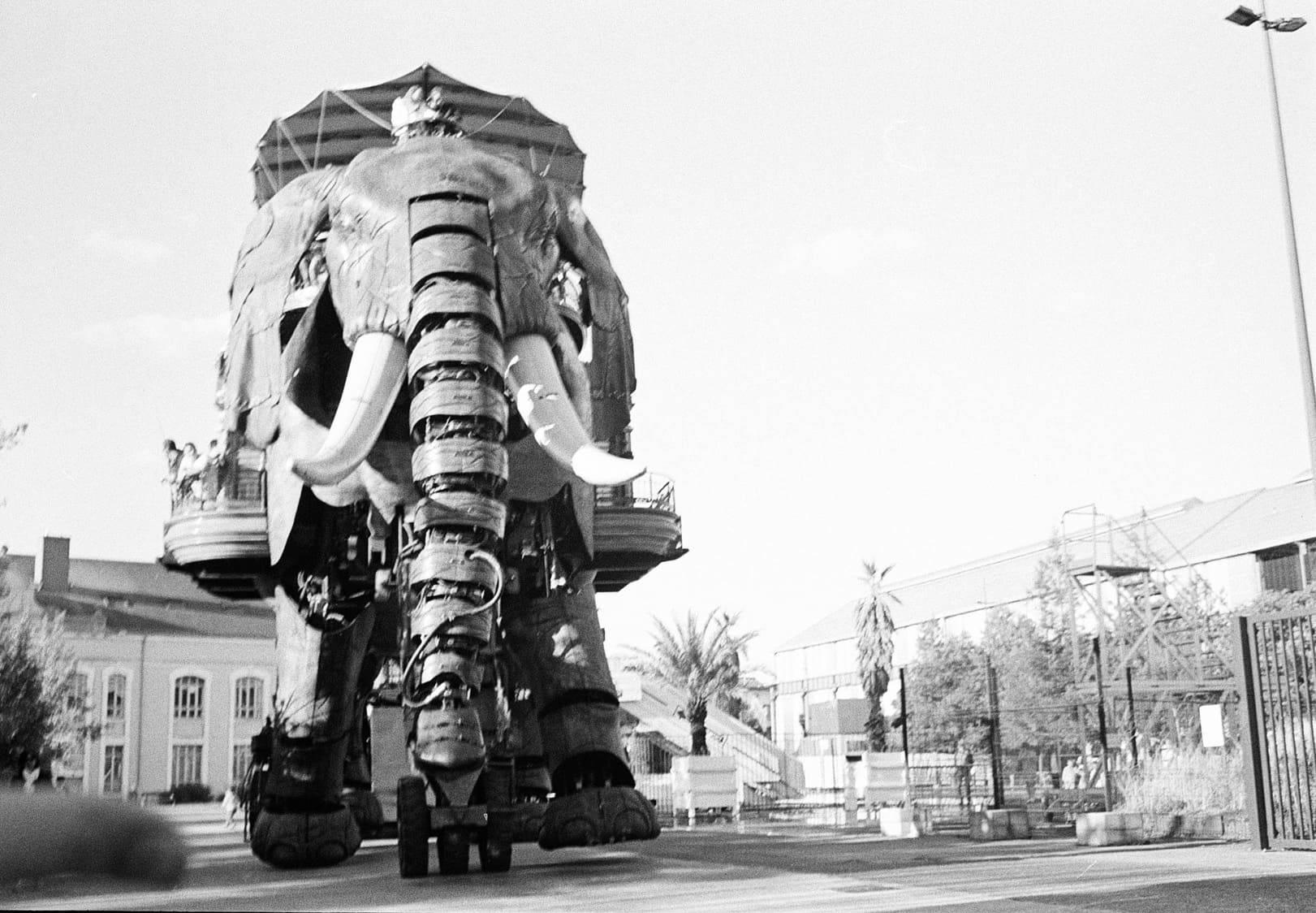
Last week’s journey through the film archives took us to Nantes, specifically the Île de Nantes. While you’ve seen my photos from that day, I’m excited to share my daughter Kate’s photos with you.
Are these images works of art deserving of a gallery? Perhaps not, but they represent a delightful exercise in spontaneity. Captured by a seven-year-old “playing” with a camera, they offer a unique glimpse into how my young daughter sees the world. There are no rigid rules of photography or composition here—just an extension of her eyes. These photos are raw yet delicate, showcasing the world as she perceived it at that moment.
These photos mean a great deal to me, particularly the one she took of me with that glorious moustache! I’ve often discussed how the journey and process of photography can sometimes be even more meaningful than the final destination. That day was a significant part of that journey, and reflecting on my own first photos from that age fills me with nostalgia.































 IJM Photography