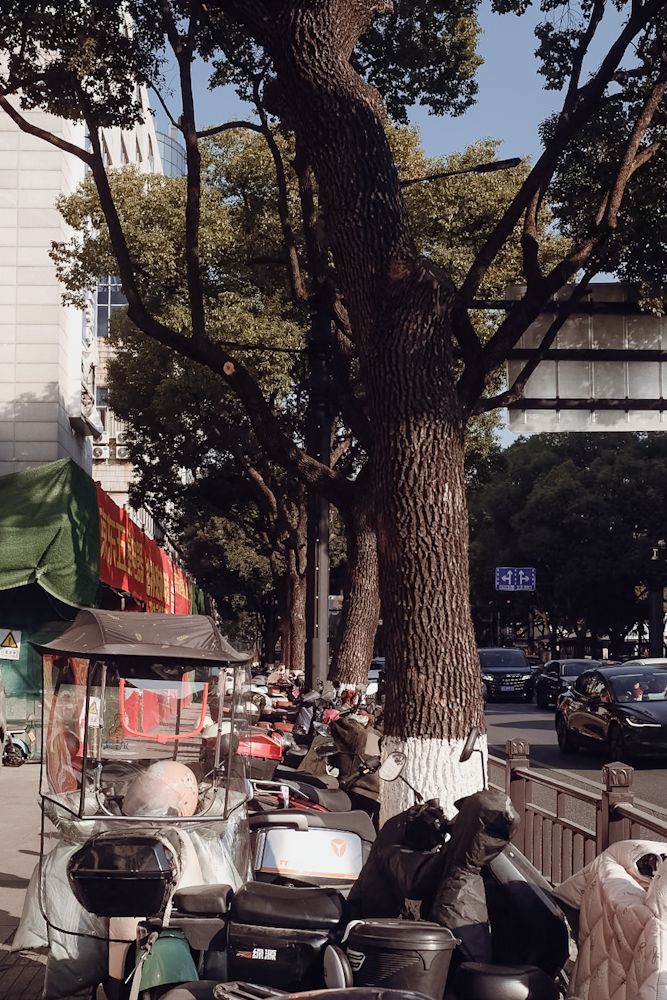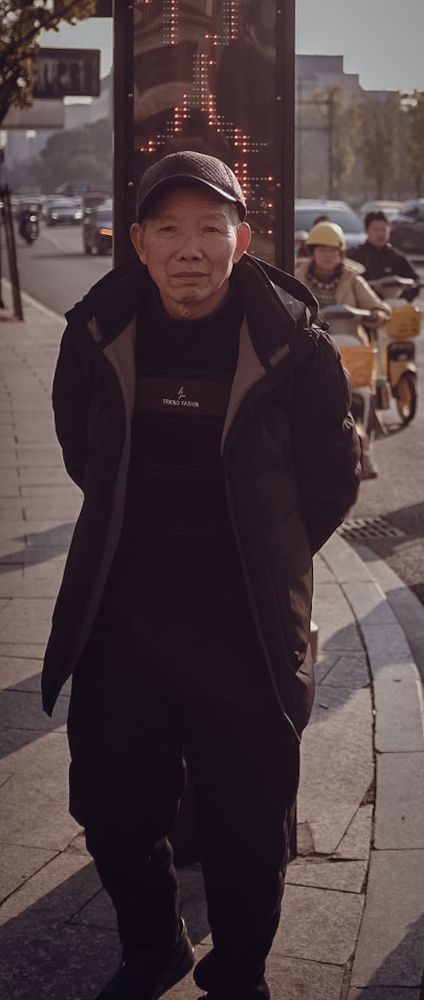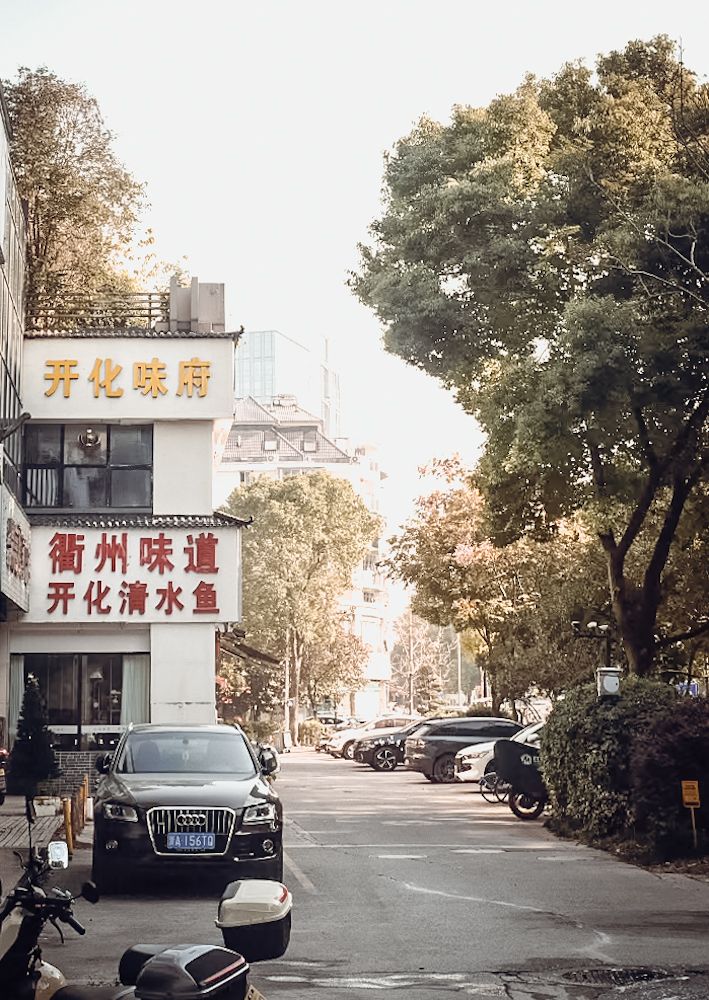
Balancing Film and Digital: A Photographer’s Journey


Introduction

Have you ever had to make a difficult decision that you really had to think long and hard about, one that would have real-world consequences for you and your creative process? I have, and I’m going to share this first-world problem with you. Now, I know first-world problems are a joke, but this problem became very real to me during the run-up to the China Orchestra Tour: film or digital?

You all know about my fondness for the analogue process and the results I’ve been able to acquire. Judging by my recent stats and pages visited, this might just interest you.

The Allure of Film Photography

I’m not saying this was causing me the traditional anxiety that I have been known to suffer from in the past. But… I had to decide how I was going to record my trip and, therefore, what to take with me. I’ll give you a list of my ideal kit, and it might help you to understand my dilemma.

  • Camera 1
    A recently acquired Nikon FE (my first ever Nikon) and black-and-white film, ranging from Fomapan 100 ASA right through to Ilford HP5 Plus, whose box speed is 400 ASA but can be pushed up to 1600 ASA and still provide great images.
  • Camera 2
    A Mamiya C220, which is a beautiful piece of kit with various 120 format black-and-white films, HP5 Plus, Portra 400, with the addition of Kodak Tri-X.
  • Camera 3 (maybe 4)
    My Olympus Trip or even the Olympus Pen EE S half-frame camera, for those informal colour shots with some Kodak Ultra and even a roll of Portra 160 for that gorgeous vintage style.

So, you have my film cameras with the film that goes with them. They provide a photographic experience unlike any other. The slowing down of the process, the reflection on each shot taken, the satisfying sound they make when you press the shutter release button. And so much more. They also look pretty damned sexy just hanging there around your neck, and people will think you are a “real” photographer, and that old-school vibe just adds tonnes to your sartorial elegance. Yes, you become a real poser, but do I care? Absolutely not!

The Practicality of Digital
  • Camera 5
    My much-loved Canon 6D Mark II, with a couple of zoom lenses – 24-70mm F4.0, and my 16-35mm F4.0 lens, and maybe even my nifty 50.
  • Camera 6
    Fujifilm X100F, the travel photographer’s ideal camera with the 35mm equivalent F2.0 lens for that sexy bokeh. It’s the Internet that said it, not me.

Now moving into the digital world. Convenience, convenience, and in case you hadn’t realised, convenience. I love them both for the variety of shots they allow me to take, and as I learnt photography “back in the day,” I have still conserved the same approach that I had in analogue photography, i.e., not spraying and praying like I have seen some colleagues do.

It is easier to use a flash, and you have an image that can be transferred to your phone, edited in Lightroom CC, and rapidly shared in the China Orchestra Tour WhatsApp group. And people can see what a great photographer you are. Couple the Canon colours and the Fuji film simulations, and you can have all the creativity fixes you might need at your fingertips.

The film cameras were there to satisfy my love of the analogue process and the nostalgic film look that only film can give. The digital cameras for their practicality, lens effects of going really wide, and having the possibility of going right up to 70mm. Choices, choices, choices.

Reality Check

Now let’s get back to reality and look at the ever-growing list of constraints. First of all, I am going on tour as a musician and not as a photographer. One really has to make this important distinction, as it gives a sense of purpose to the trip as well as the implication of priorities.

I would be flying across half the world, and therefore have to follow the demands of the air travel industry and airline rules. That meant no more than two lithium batteries, and one in the camera, and not in your suitcase but in your hand luggage, or on your person. They don’t like the idea of these batteries exploding or causing fires mid-flight. And because we are respecting the zero BS rule here, I don’t fancy that either. I would be limited by weight for my suitcase: 23kg and 20kg for flights inside China. My priority was to be a musician first and not a photographer, if ever I needed reminding…

If I were going to the UK, I would just have to annoy my family in the car with it being loaded up with camera gear, but this is China we’re talking about. Not a jaunt across the Channel.

In my suitcase, I will need my clothes for two weeks, my suit for concerts, shoes for concerts, wash bag with all my toiletries, as well as my CPAP machine for my sleep apnoea (I have to think about my quality of sleep as well as not snoring for my unsuspecting roommate Corentin). My hand luggage would be my instrument, and as we didn’t need mutes, I might be able to get away with stuffing things up the end of my horn’s bell. Please note that I didn’t try to get a cheap laugh by using the word bell-end…

So here I am back at the beginning of this article, and yet now you might better understand my dilemma.

Tell us what you decided then!

Alright then, I will.  Welcome inside my mind and my thought processes. The sheer weight of all the kit would have made tking everything completely impractical.  I knew this and had come to terms with it.  I really wanted to analogical, but then had to come to terms with the fact that airport scanners can damage undeveloped film.  Also the Mamiya weighs a tonne and would have been impractical to lug around China, despite the wonderful images it provides.  Carmer 2 out!  Now for security check I had bought a metal film box for my films so that those charming people at airport security could check my films, making sure that I would not blow up the plane.  Not really my style…

That would leave me with Camera1, 3, and 4.  Cameras 3 and 4 are particularly sexy and Carmera 4 being a half frame camera, gives you double the amount of shots for your film.  However it uses zone focussing, and the ISO setting only go up to 200ASA so you need lots of light.  Camera 3 is similar in the fact that it goes only up to 400ASA so not good for lowlight shooting.  Cameras 3 and 4 out.

That leaves me with Camera 2.  Which is of course uber sexy and Aperture priotity, which I like, and has a larger ISO range, and one that I can focus accurately with.  I had black and white film for it which I enjoy using and know how it reacts and what kind of shots I can get out of it.  Very satisfying shots.  It also doesn’t need lithium batteries to work, so that helps rule that danger out.  But I would still have to contend with the possibility of annoying security staff, and annoying Chinese security staff, and as I speak no Chinese, that would be challenging. And yet it still had a chance of staying in the race.

Now lets explore the digital realm. Camera 5: The Canon 6D Mark II is a beast of a camera and one I enjoy using.  It’s lenses are beyond compare, and it would offer me lots of choice in choosing my subjects.  However it would be heavy, especially with those lenses, and despite being able to have my images straight away, would it really be worth that added weight.  Camera 5 out.

Camera 6.  The Fujifilm X100F.  Probably my favourite digital camera, and the one I took to the UK this summer as a test for this Chinese trip.  It’s small.  Compact and silent.  And yet despite being a digital camera, it has an analogue feel to it, and is also very sexy, so I can still pose with it and it will give that serious photographer look, and make make people wonder is he using digital of analogue…  Hmmm.  Sounds like a good choice.  It’s downfall lies in its power consumption. I would need three batteries in total.  Which would mean that I would have to entrust a battery to a friend..

The two cameras left in the race are the Nikon FE analogue camera with it’s 50mm F1.8 lens which doesn’t need batteries.  50mm was the lens I learnt photography on and would allow me to get some decent portrait shots.  However with the Fujifilm, I could change ISO setting without the hassle of changing my film, create scenic shots, as well as environmental portraits, and I could transfer the photos directly to my phone and share them straight after editing.  

The X100F: Why It Was the Right Choice

The X100F became the clear winner for several reasons. It’s compact and lightweight, which was essential for travel, yet it produces sharp, detailed images. The 35mm equivalent F2.0 lens allowed me to shoot wide-open for beautiful bokeh in portraiture and environmental shots. The range of film simulations, from classic Chrome to Acros, allowed me to quickly achieve the look I desired without extra post-processing.

Its hybrid viewfinder provided both optical and electronic options, letting me choose the right method depending on the shooting conditions. The controls are direct, giving me full control over exposure and depth of field, without the need to dig through menus. And though it’s a digital camera, it retains that analogue charm that makes shooting feel personal and intentional.

The only downside was battery life, but I managed to bring a few extra batteries, which wasn’t too much of an issue for the flexibility the X100F offered.

Conclusion

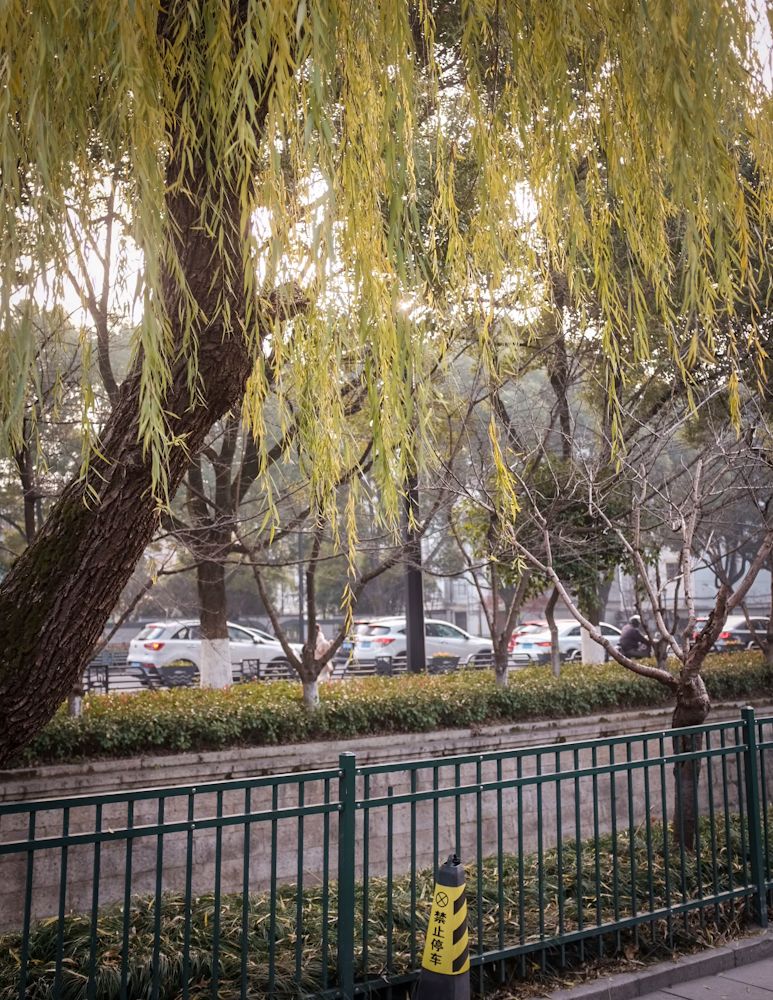
In the end, the Fujifilm X100F was the perfect balance between practicality and creativity. Its digital conveniences, combined with its classic photographic feel, made it the ideal camera for the China Orchestra Tour. The images you’ve seen in my latest China Series article were all taken with the X100F, and I’m happy with the decision I made and I hope you might be too…

China Homeward Bound – XianJu to Shanghai, Shanghai to Beijing, Beijing to Roissy, Roissy to Nantes, Nantes to St Hilaire.


It’s a “long” title, and it was also a “long” journey. We left our hotel at 7 am on the 3rd of January, and I arrived home with feet under the table at 5 pm on the 4th of January. My mind is still on strike and the memories a little vague, but I’ll try and keep going for as long as possible.

Group 1, i.e. the other group, would be leaving at Terminal 1 in Shanghai, and Group 2, i.e. my group, would be leaving from Terminal 2 in Shanghai. There was a small and very select group that were going to do the “extension,” including my friend Eléonore. We managed to get our suitcases into the “system” at the airport check-in. And then through security, which, due to my sports jacket hack, went very smoothly. All we had to do then was to find somewhere for lunch. I had been in a group for the whole tour and headed off on my own to try and find something to eat.

I did find something to eat—tofu and crab, with a bowl of greens because it’s healthy! And a cup of tea was served with my meal. I spotted a hamburger place just next door to where I was eating and alerted the group via WhatsApp. I took my time eating because I could. I don’t like being rushed. Apart from getting onto the plane on time, my only task was to find a gift for my wife that would please her and, at the same time, be very Chinese. I bought tea. Because why not? And the shop looked very luxurious, and I was sure I couldn’t mess it up.

We flew from Shanghai to Beijing, and part I of our trip home was over.

The wait in Beijing seemed to go on forever, and our flight was at 2:40 am local time, which would mean a night flight back to Roissy. Beijing airport is a rather large place where most everything seems to shut at 5 pm. This was going to be a long wait. I resisted the temptation to go and have a “couple” of pints at a bar that was still open but still felt the need to have a drink of something. That something would be a bottle of water. We had our gate and waited for our flight to leave.

As you know, I can generally fall asleep anywhere and at any time. But even for me, this was going to be a tad tricky. I managed to charge my phone thanks to my colleagues and lay down on a bench to try and get some shut-eye. The sports jacket and jumper make a rather good pillow, and I felt slightly more invigorated when boarding the plane.

Maybe that wasn’t a good thing. Anyway, I made my way to my seat, which was at the very back of the aircraft, and tried talking to my neighbour, who asked me if I spoke French. I did, and I could tell she had a plan, that girl. She wanted to be able to have two seats so she could lie down. I asked the hostess if those two empty seats were going to be available, and she took pity on me, saying that they were technically for crew and that if one of the crew asked, I would have to move back and sit with Miss Two Seats.

That sounded very fair, and Miss Two Seats seemed to be happy. I used the pillow for my back, and the blanket was just large enough to snuggle into. Did I sleep like a baby? No, he said, going for the understatement of the year award. No, he did not, but I think he at least managed to snooze, which was good enough. We had breakfast on the plane, which would be my last “Chinese” meal. Part II of our voyage was over.

We landed in Roissy and played everyone’s favourite game—go to the loo, and then on to baggage reclaim. The trombones had been put in with the suitcases and, of course, were the very last things to be put onto the conveyor belt. I have to admit to a rather tense moment when I was wondering if my suitcase would ever turn up. Eventually, it did, and we were reunited. The trombonists were soon reunited with their trombones, but it was all very stressful and a grand moment of solitude for them. We eventually found what we thought was the exit, turned around because it wasn’t the exit, and headed off to another exit to meet our colleagues in Group 1, who had arrived a wee while before us. We were herded along, with Mathilde and Titaua helping us cross the road. You’ve guessed it—we got on the bus, except this bus would be taking us back to Nantes. Part III of our voyage had begun.

My memory was still hazy, and I think we stopped off in the Perche—the place, not the fish, but maybe they had them in the local rivers. I’m not here to judge. We all traipsed into the service station and were greeted by the overpriced sandwiches. Not a chicken foot in sight. It all felt such an anticlimax after the food in China.

We arrived eventually where we had set off from in Nantes. Part III of our voyage was nearly over. Kate and Virginie were there to pick me up, and that hug was particularly tight and lasted quite a while—or so it seemed. Had I missed my family? I will say yes, of course. It will save us many arguments at home!

Part IV of the trip had begun. My wife drove us home through the rain. I entered the house that I had left two weeks earlier. I had been on tour, I had seen things that I had never seen before, I had eaten things that I had never eaten before, and I even managed to save my special Christmas chocolates from the inquisitive looks from the two women in my life. Killian wasn’t there, so Kate had first dibs on which mug she would like. The chopsticks were put away. Tea was made, and the day ended up at home. I was a little tired…

China – Shao Xing to Xian Ju


Welcome back to China. It is the morning of the 2nd of January. The whole tour seems to have flown by, and my memory is already hazy. I remember going around Shao Xing, and I remember the concert in Xian Ju, but beyond that? Not much.

I don’t usually black out, even after a drinky-poo, but it feels like I forgot to press Control+S. No saves to rely on. Bugger. Maybe it’s the thought of going home tomorrow? The dread of the parenthesis closing?

Strangely, I wasn’t even fed up with sharing a room with Corentin, and bus rides with everyone were still enjoyable. Definitely bizarre. It can’t be Blue Monday yet!

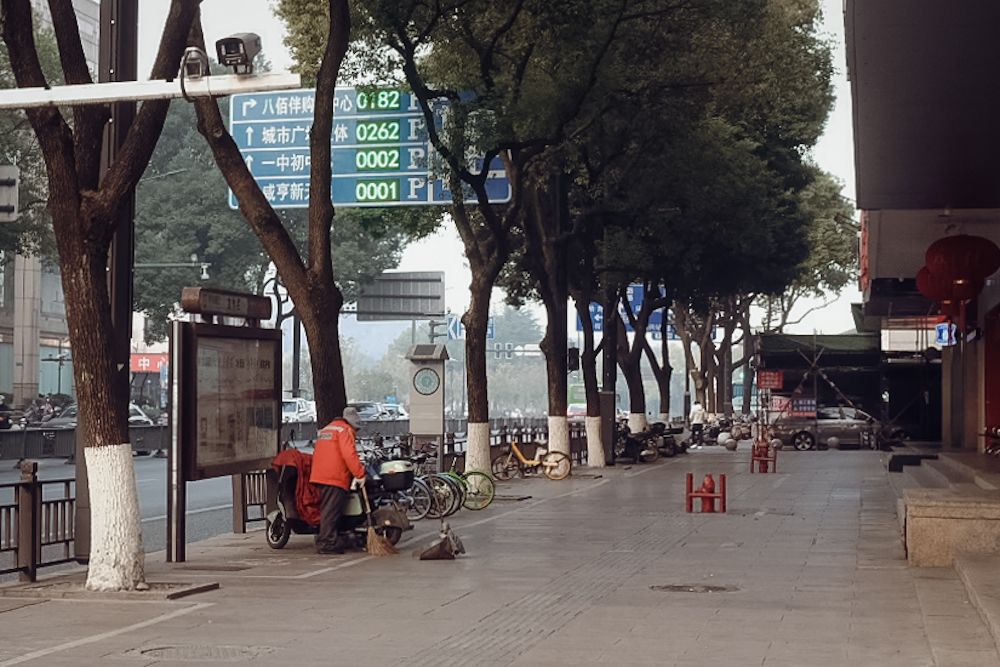
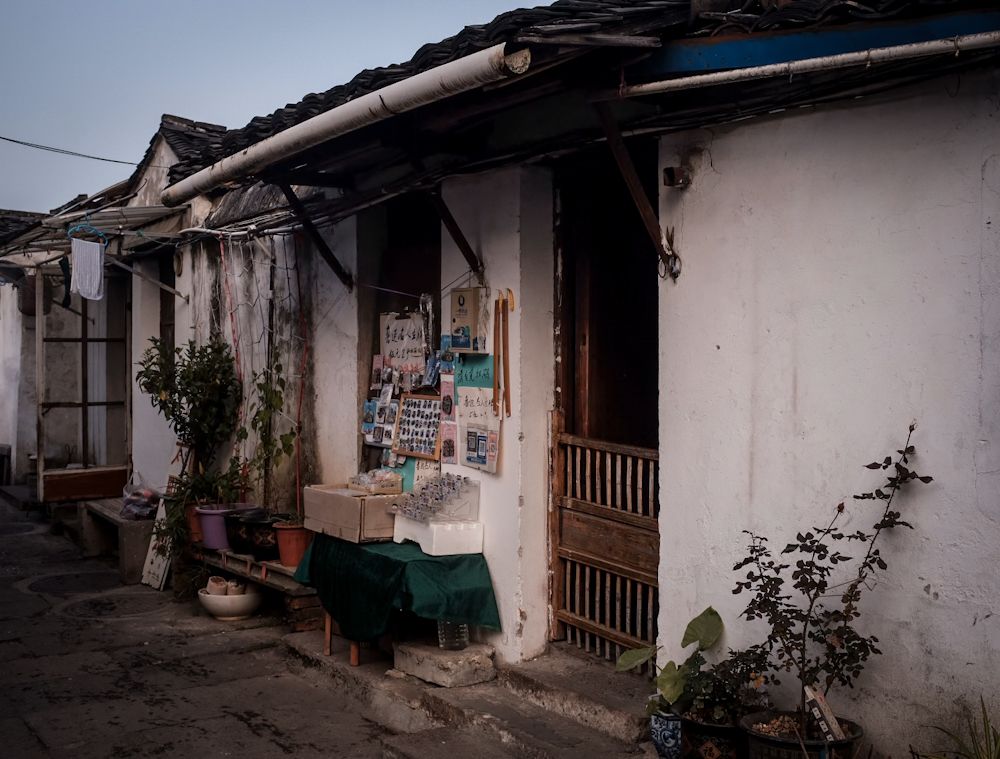
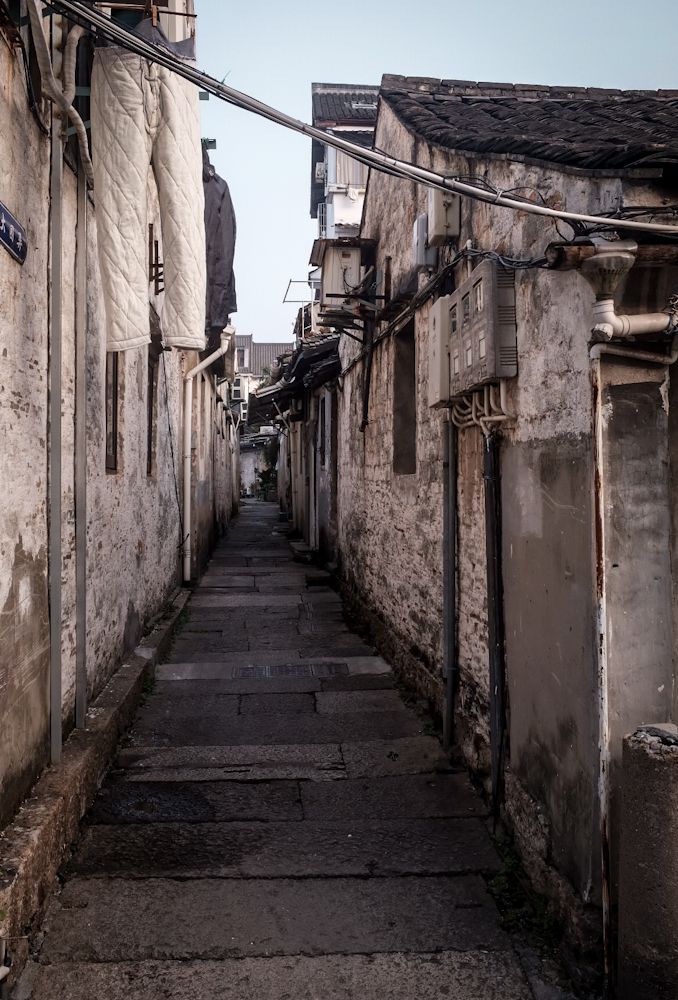
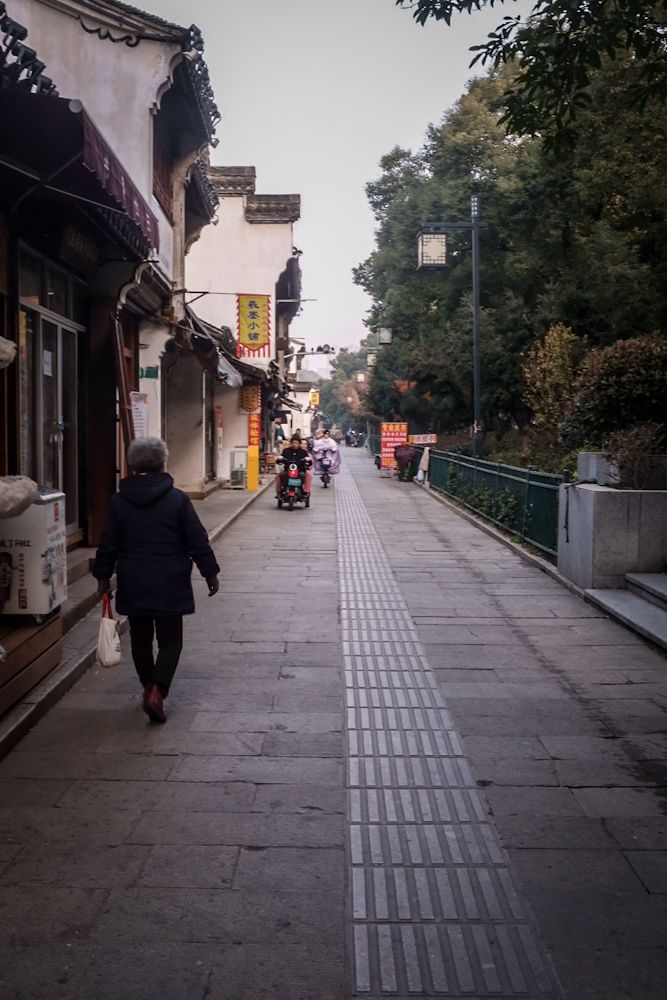
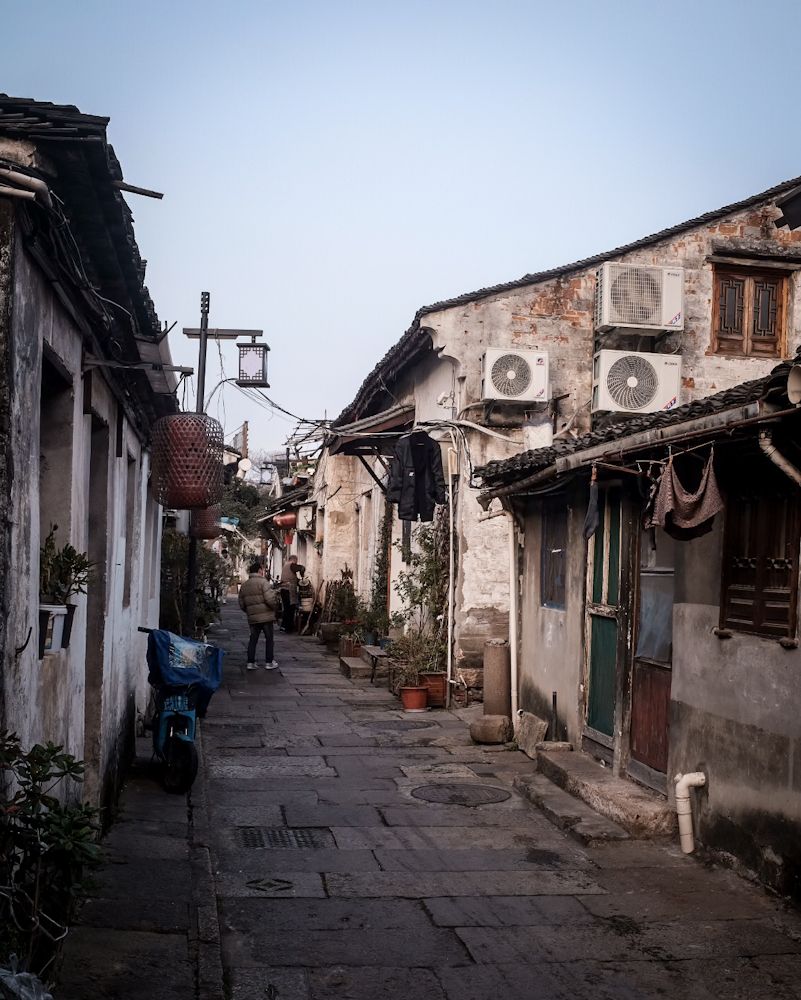
Anyway. The previous evening, while I was exploring the park, some of my colleagues had stumbled upon a scenic residential area—just the kind of place I’d love to capture in my last shots of China. This wasn’t the posh China of Shenzhen; this felt like a more “authentic” part of town.

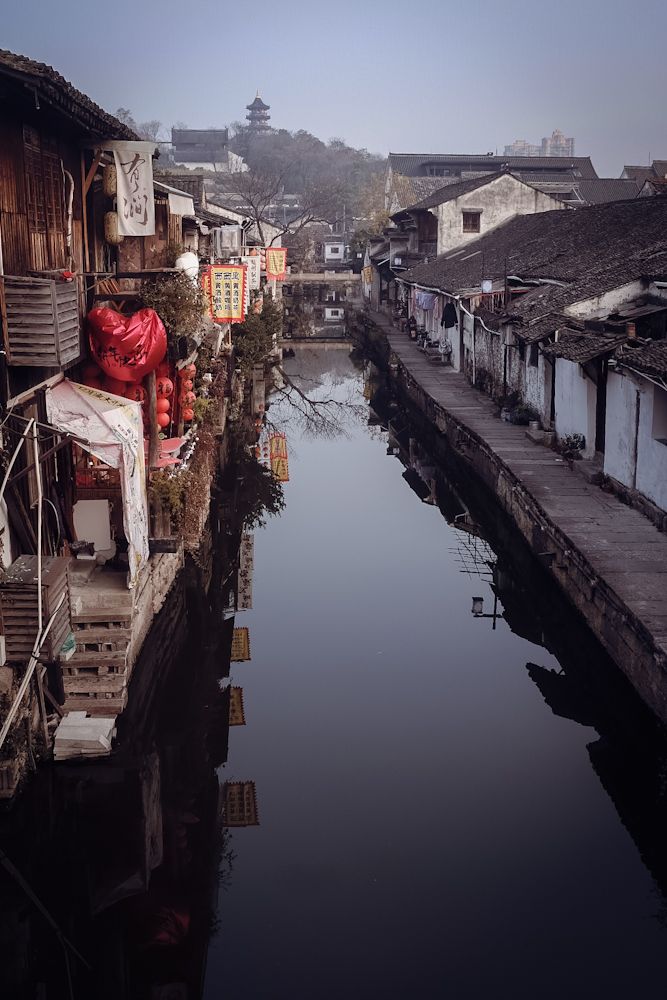
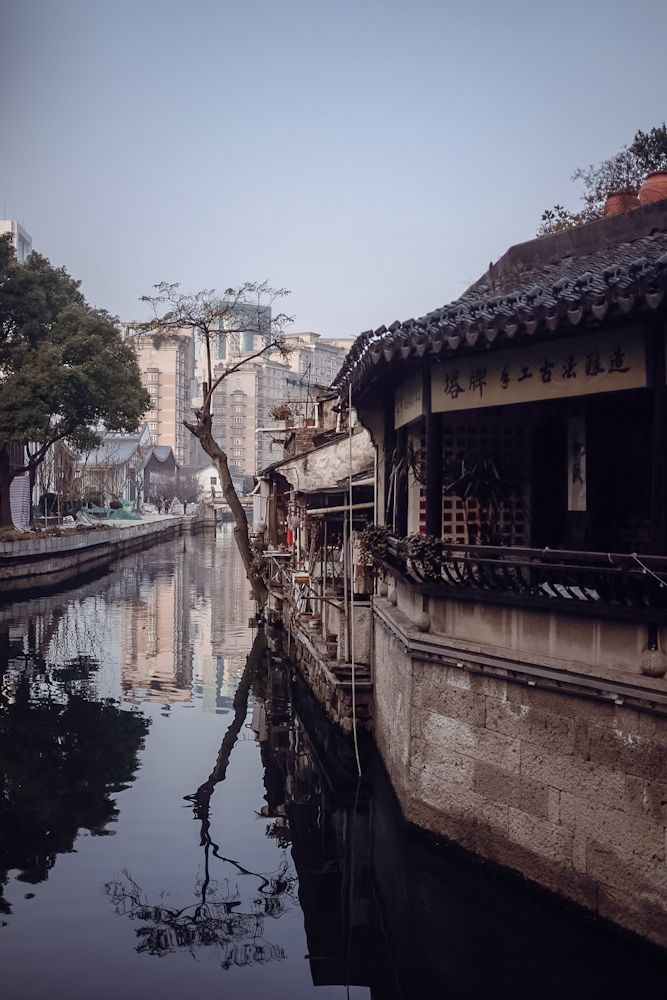
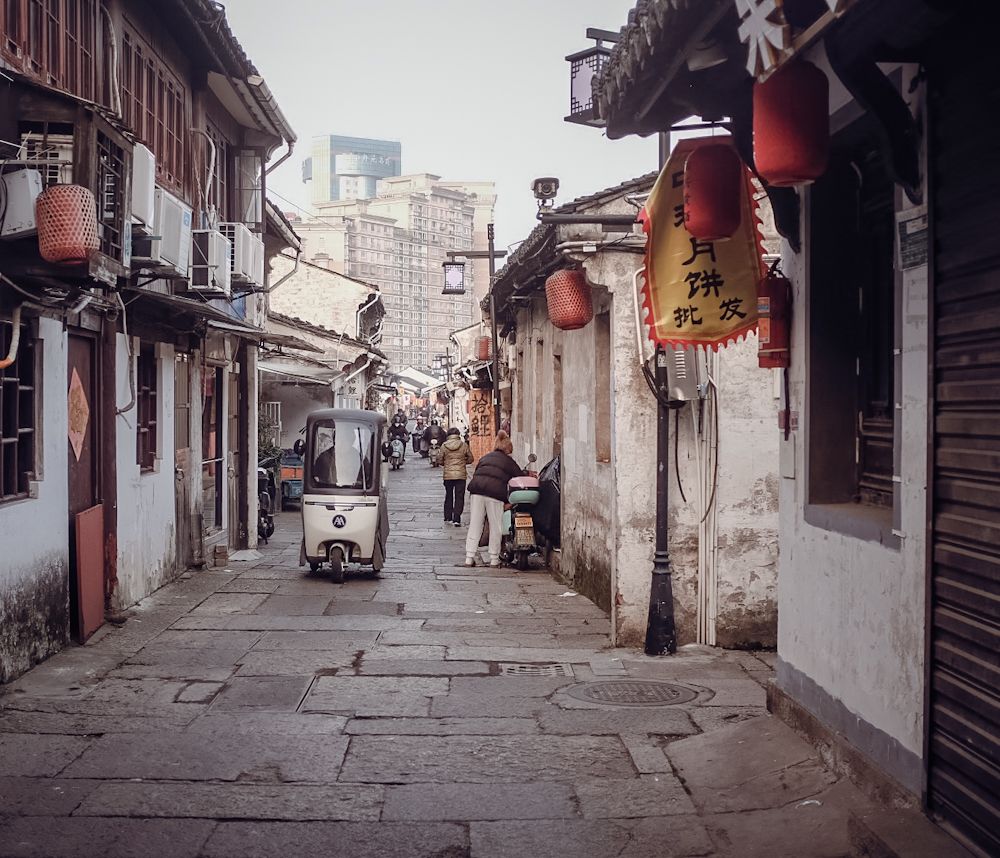
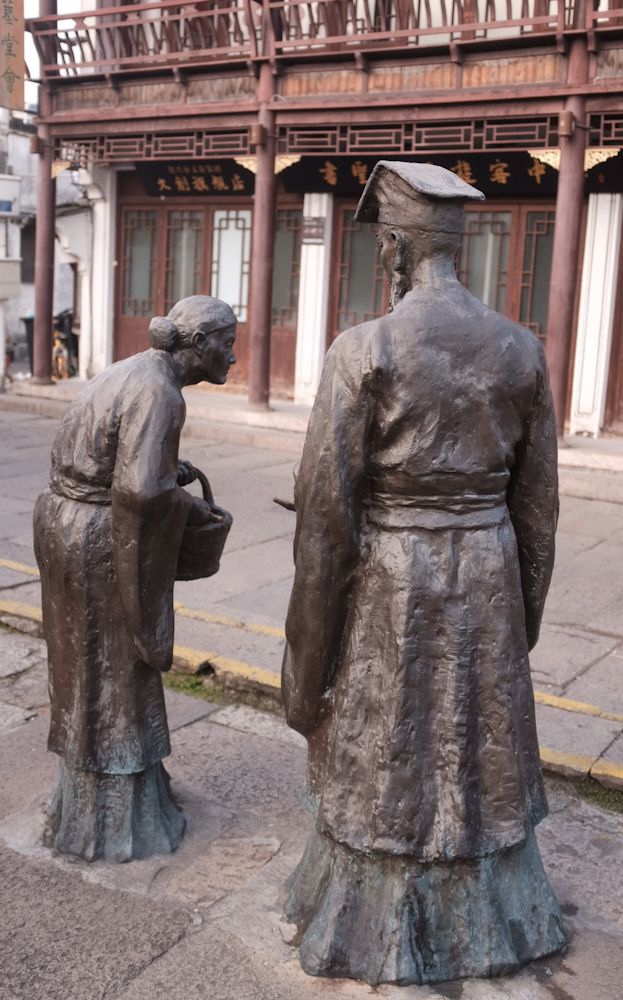
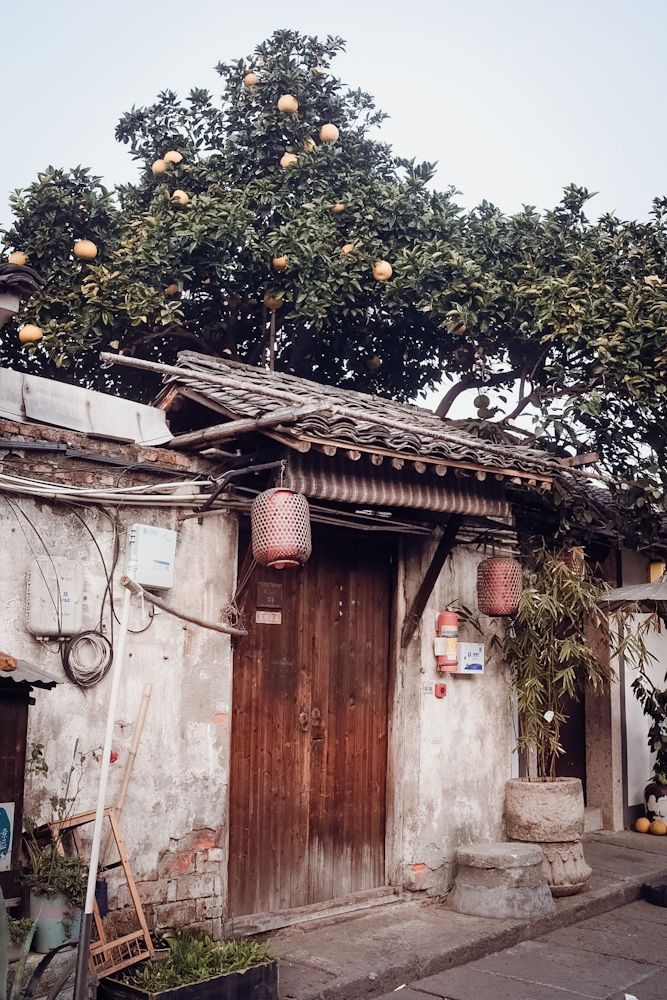
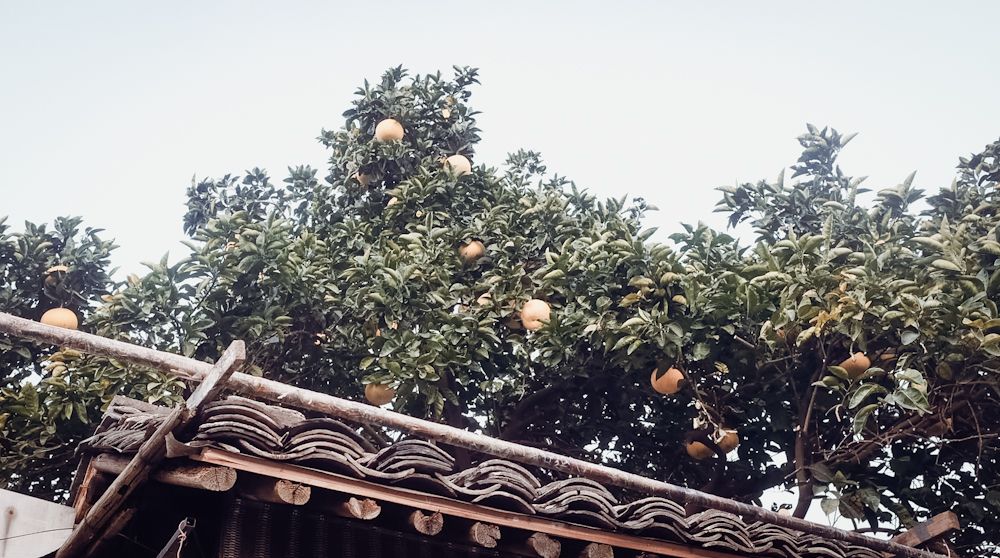
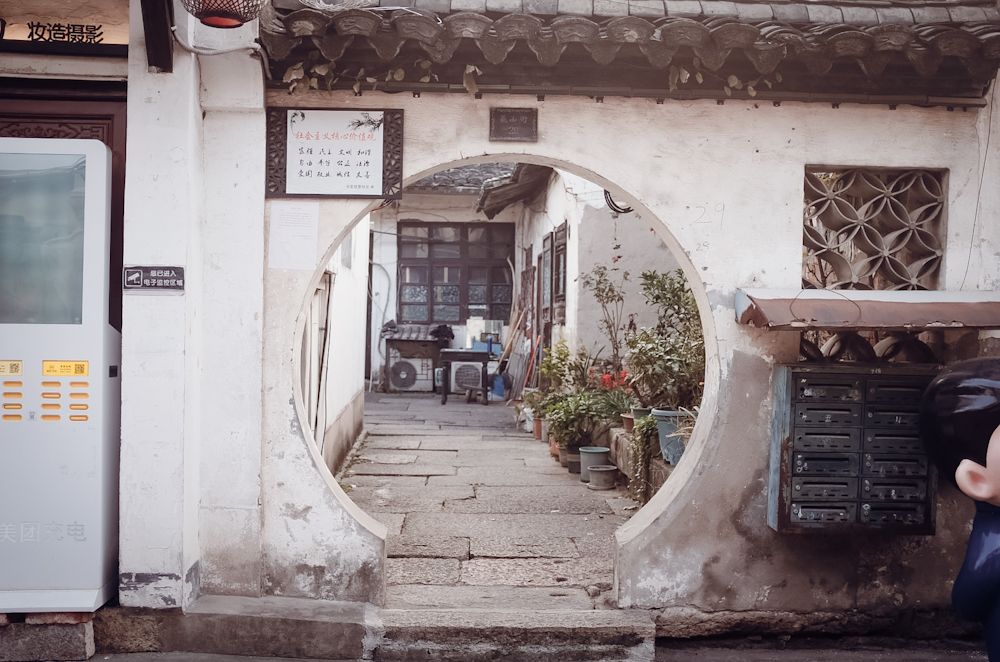
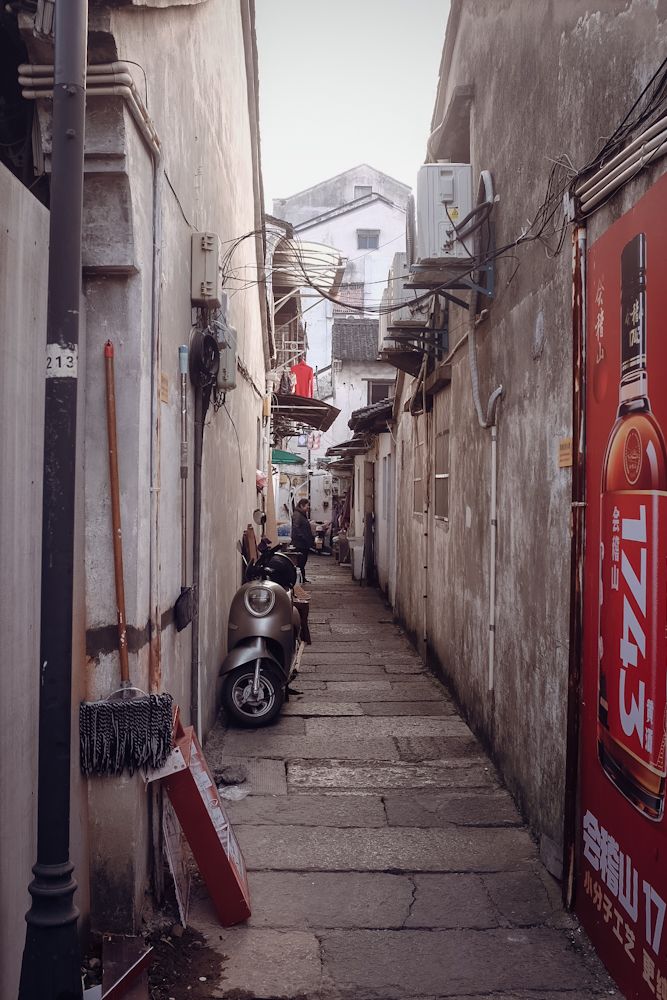
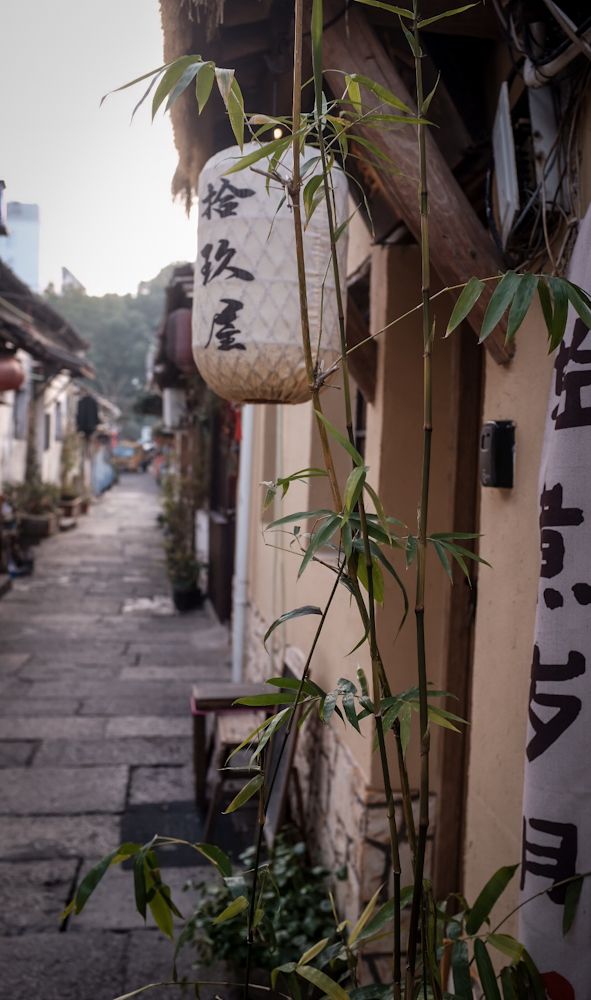
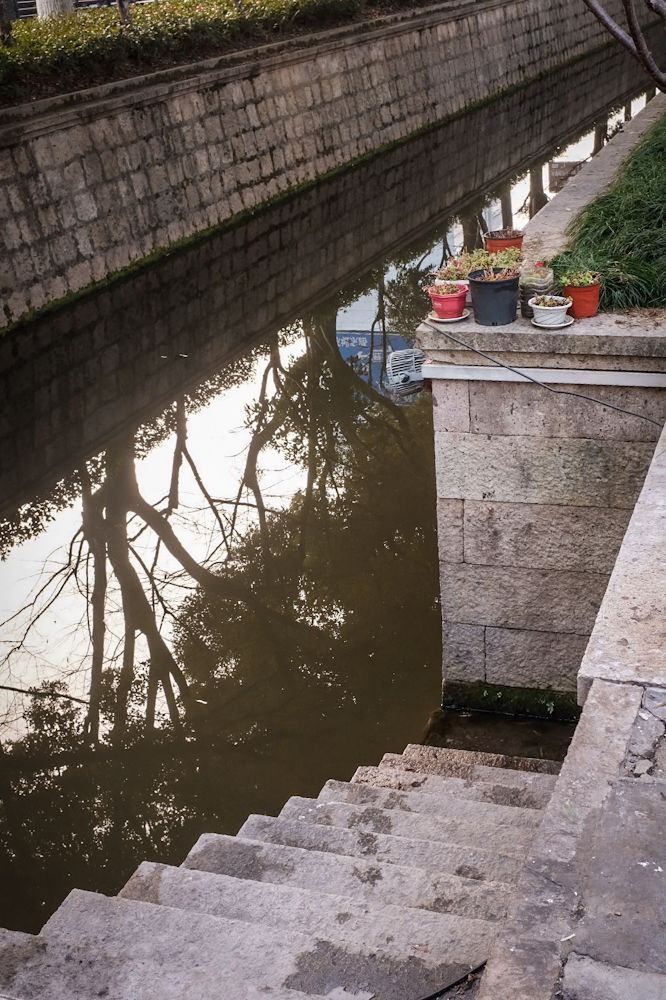
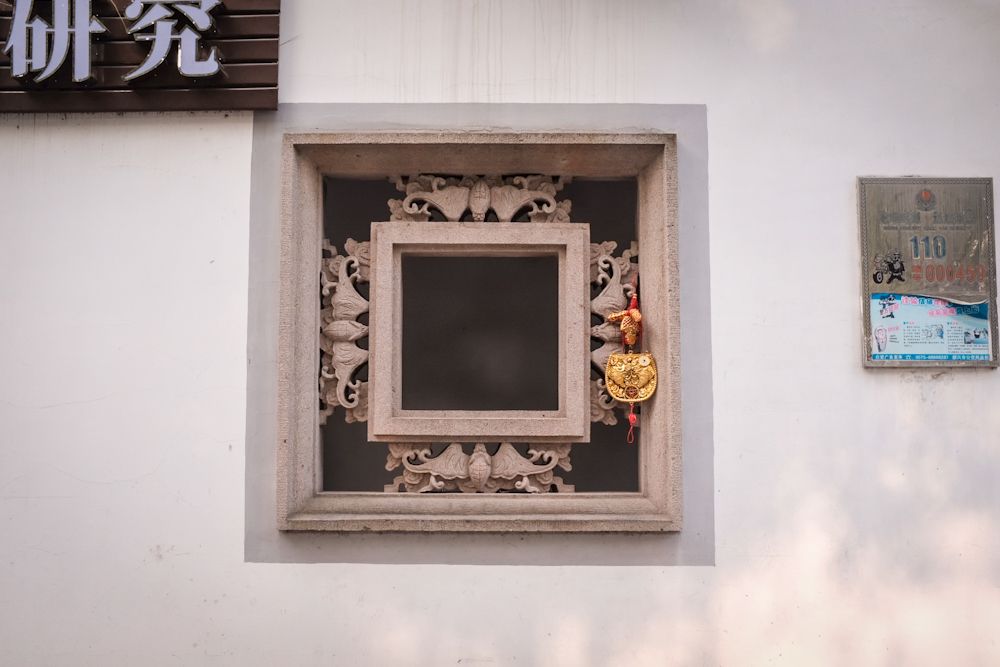
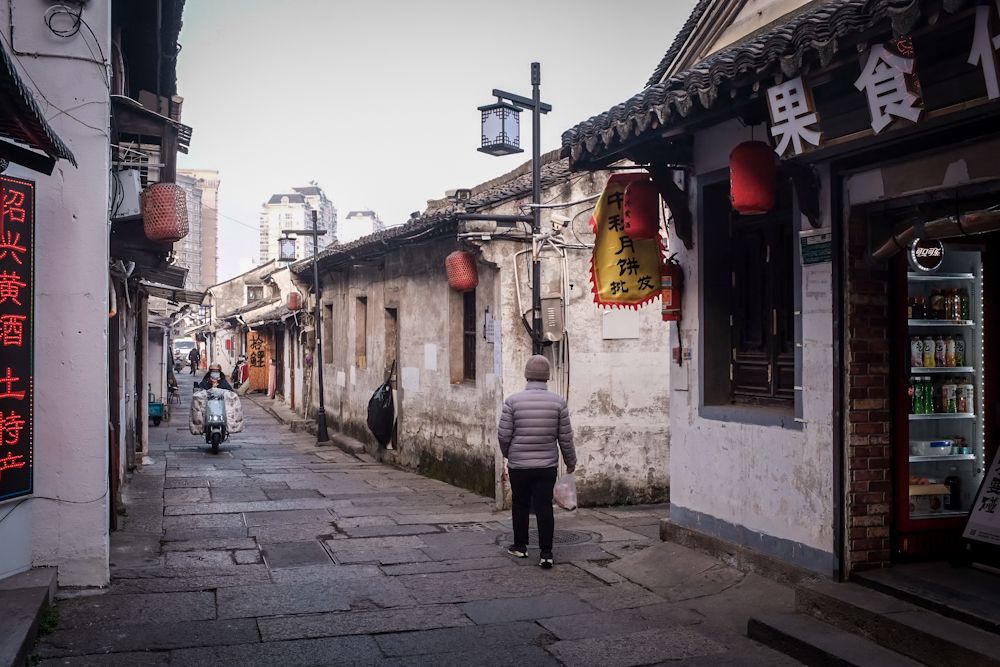
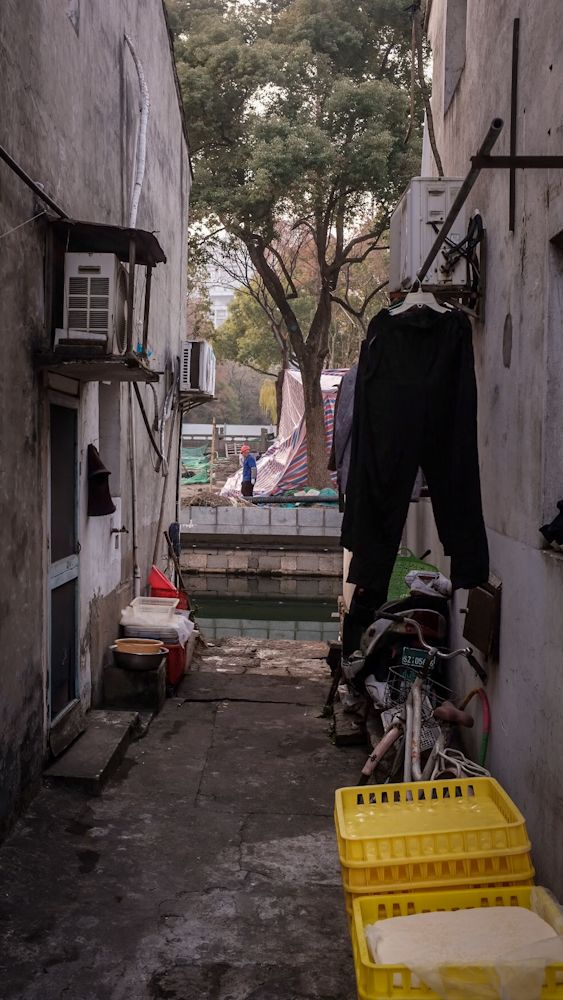
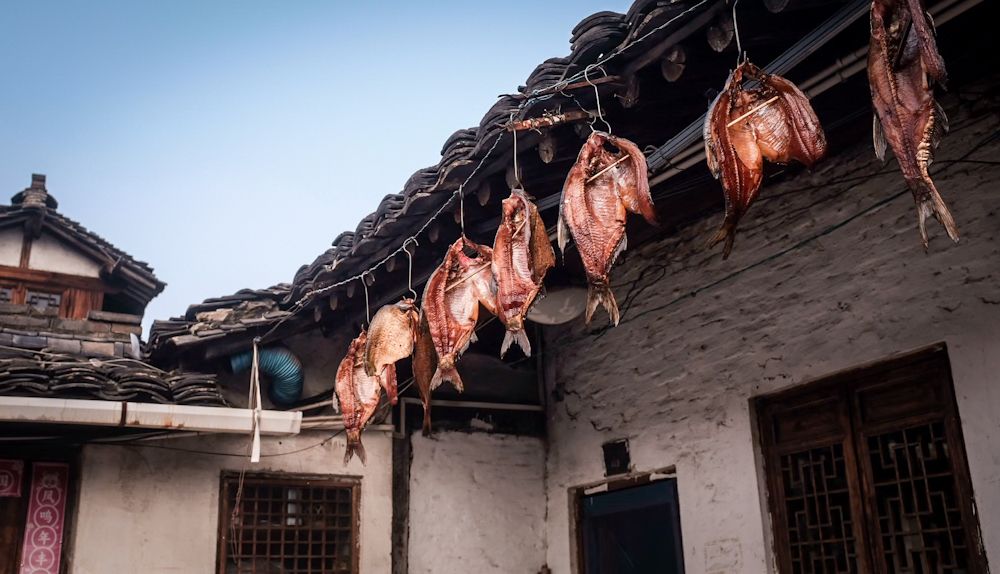
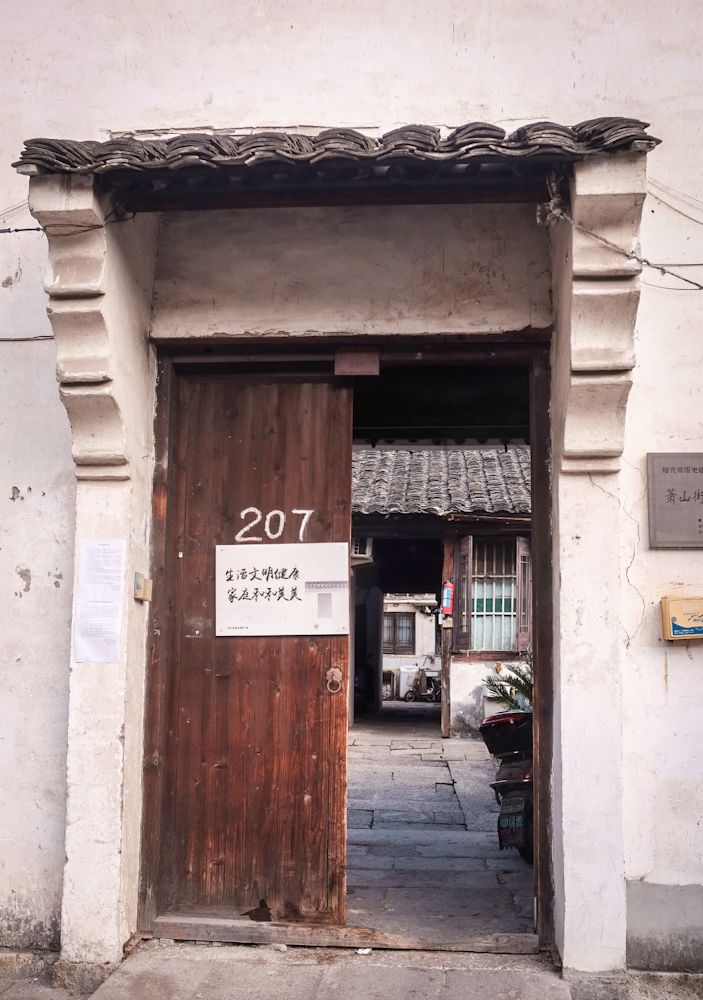
And it was stunning, as you’ll see later in the photos—filled with all the quintessential imagery of China: round entrances leading to inner courtyards, red lanterns preparing for the Chinese New Year, fish drying under the rafters, boats drifting along the canals, humpback bridges, mopeds zipping past, and an old lady eating her rice for breakfast. Even Confucius was there—his wisdom guiding us through the streets.

I had heard about this little quarter at dinner the night before. My colleagues had waxed lyrical about it, so off I went, camera in hand. Now, you know my sense of direction—getting lost, or at best, off track, is inevitable. I was told: “Turn left outside the hotel, walk about ten minutes, and you can’t miss it.” Which, of course, is exactly the kind of thing I do miss.
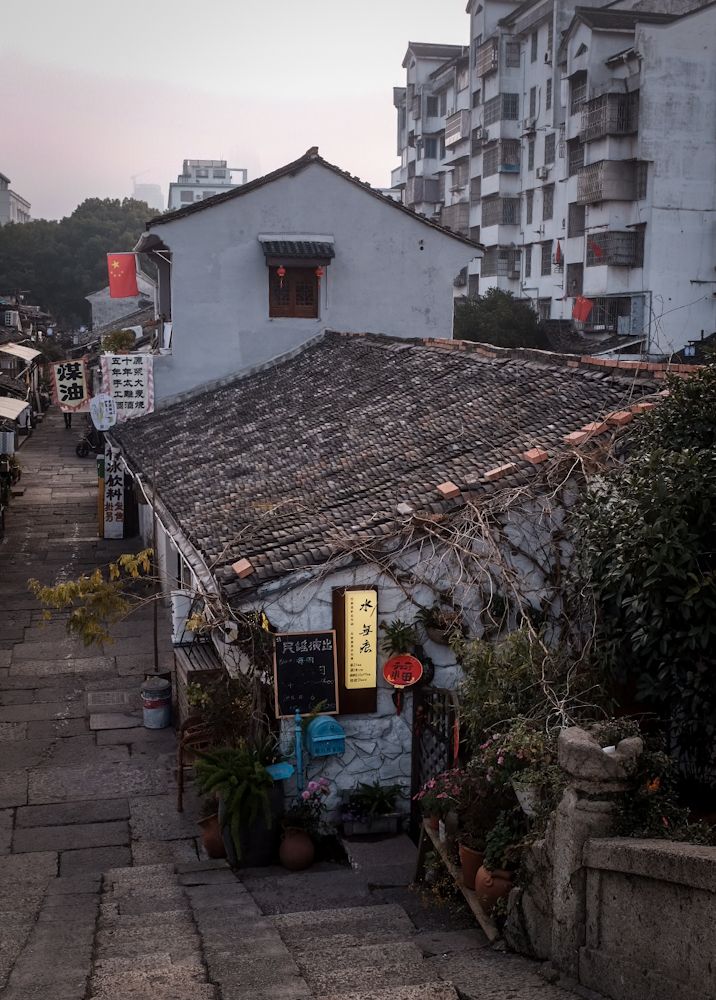
But not today. For once, my terrible sense of direction didn’t fail me—God must have been smiling on me that morning.

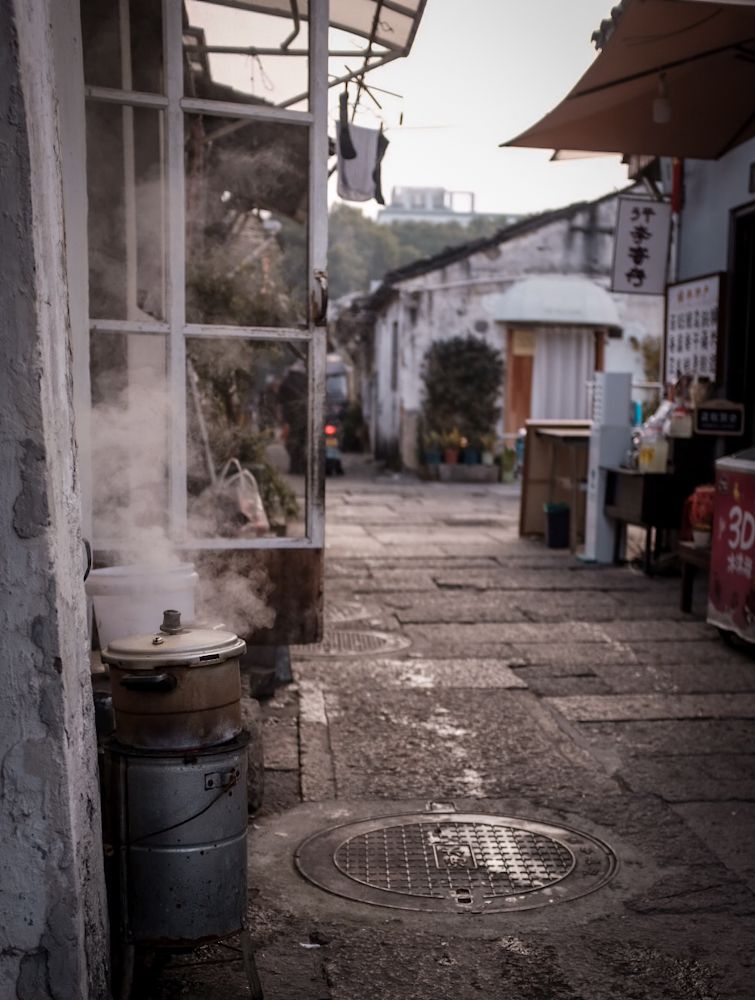
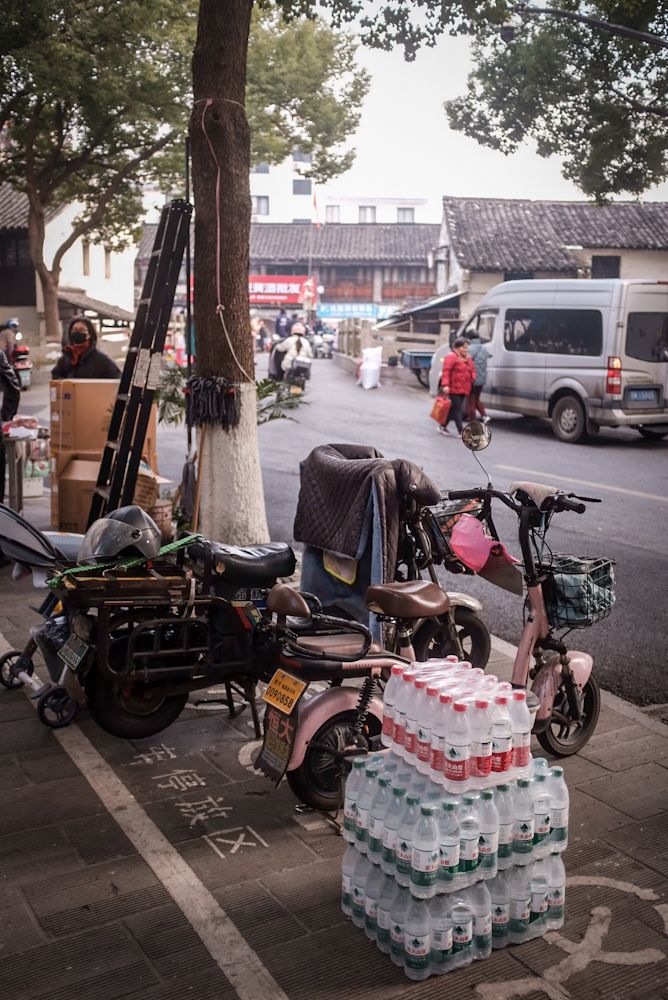
All of a sudden I was there, walking around with my camera at the ready remembering to take colour photographs because my wife had asked me to.  I meandered through the street watching the morning rituals, people clearing their throats and spitting on the ground, better out than in, people eating their rice for breakfast.  The place seemed to be waking up gently, and the mopeds taking their passengers to work and not driving too fast either.  

There was one moped that thought he could make it over the bridge in one go.  He tried a few times, but obviously it wasn’t going to happen, because it would have made a wonderful photograph.  The man got off the thing, and walked it across the bridge and seemed to appreciate my clapping him over.  Encouragement is as universal as something very universal.  

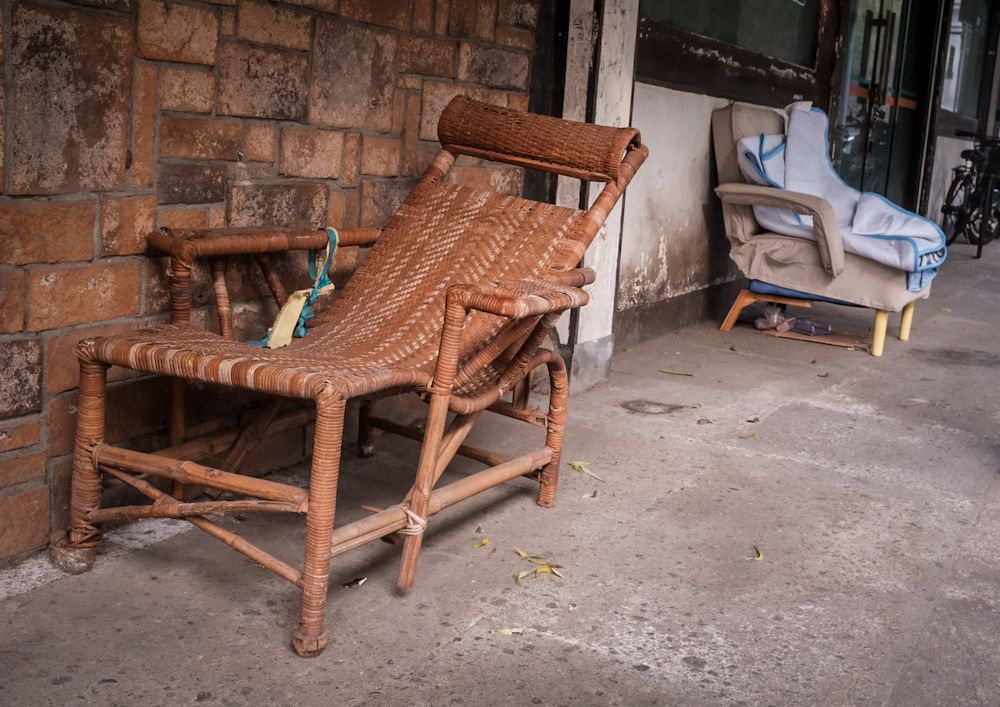
I kept wandering around with no fixed idea of what to do or see.  I could see a kettle boing for the tea, and felt a slight pang of jealousy.  I was of course, tealess.  I reached the outside of the quarter, and just headed back in at the sign.  I had seen a wicker chair which would have been perfect for my afternoon snoozes.

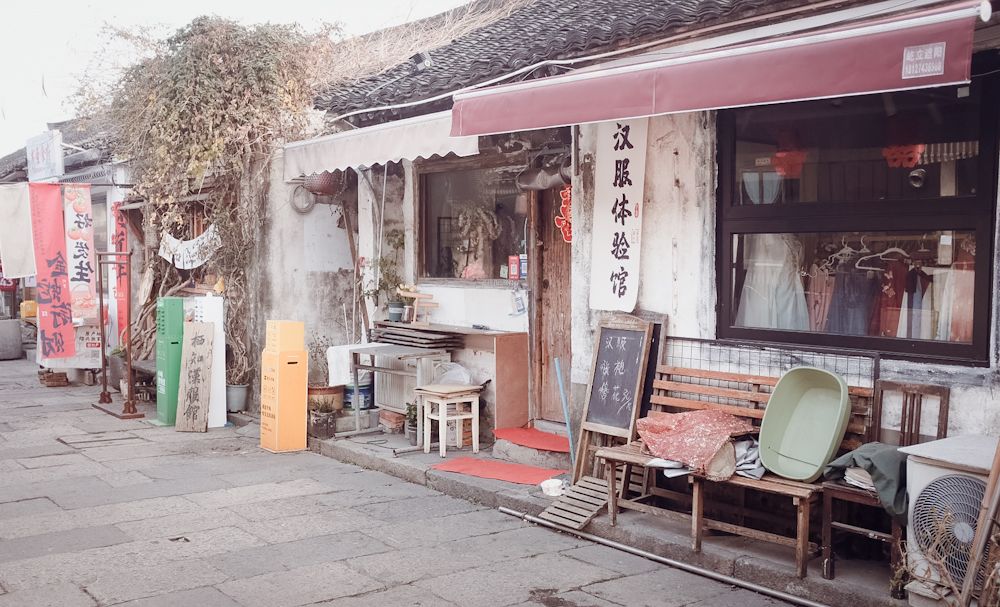
As I came back in, people seem to have awoken from their slumber, and the small shops started to open.  There were all kinds of things for sale.  Chinese New year decorations, clothes that were lovely but might have been a tad small for my more rotund frame.  There were shops selling brooms and pans.  It was definitely buy local…

As I left for the last time and having taken my phtoographs, I passed Sarah, a fellow photographer, who had obviously awoken slightly later then myself.  We of course said good morning and wished her luck with her camera.  

I mozied on down, back to the hotel to pick up my suitcase and horn, getting ready for the trip to Xian Ju.  And this is where my memory goes a little fuzzy, like my camera out of focus. I remember the concert, sure, but everything else? It’s like my mind just pressed pause. A temporary freeze-frame.

It’s strange, isn’t it? How the mind works in these moments. Maybe it’s the thought of the long journey home—the “parenthesis” closing, as it were. The feeling of something coming to an end, but not quite ready to leave. That lingering moment between chapters, when you’re not sure if you’re truly finished yet.

But then again, I’ll leave that for next time. Perhaps when I’m home, looking back on these images, I’ll see it clearer. For now, though, I can’t remember a thing—not for the life of me.

China – Shao Xing


New Year’s Day

Welcome back to China, Dear Reader. When I last left you, we were on the bus somewhere between Hangzhou and Shao Xing. I’m pleased to report that we made it safe and sound, and that Corentin and I now had two keys to our room. It was still sunny—a joy to be alive. Thank you, happy pills. Our room had all the mod cons, though there was a quirk: if one of us was on the loo, we’d slide the door across for privacy. Unfortunately, that meant the person taking a shower lost their privacy. Still, I couldn’t see anything from the loo, so my roomie’s modesty was safe.

Speaking of toilets, we encountered quite a range during our travels. In the service stations, they were the French “chiottes à la Turque,” which are nothing like the Mozart Rondo, but certainly more pungent. Then there were the “ordinary” toilets, followed by the ones whose lids lifted automatically as you passed, and finally the pièce de résistance: the Japanese-style toilet, which remained resolutely Chinese.

This marvel had a heated seat—luxury in itself. You had to lift the lid manually (slumming it in the Stone Age again), but once seated, nature took its course in unparalleled comfort. The real magic began when you pressed a button: a mechanism extended to spray water precisely where needed. There was even a function for ladies. And after the water came the air, drying everything off! I double-checked with toilet paper, of course, but it had done an impeccable job. Truly, a game-changer. As Forrest Gump said, “That’s all I have to say about that!”
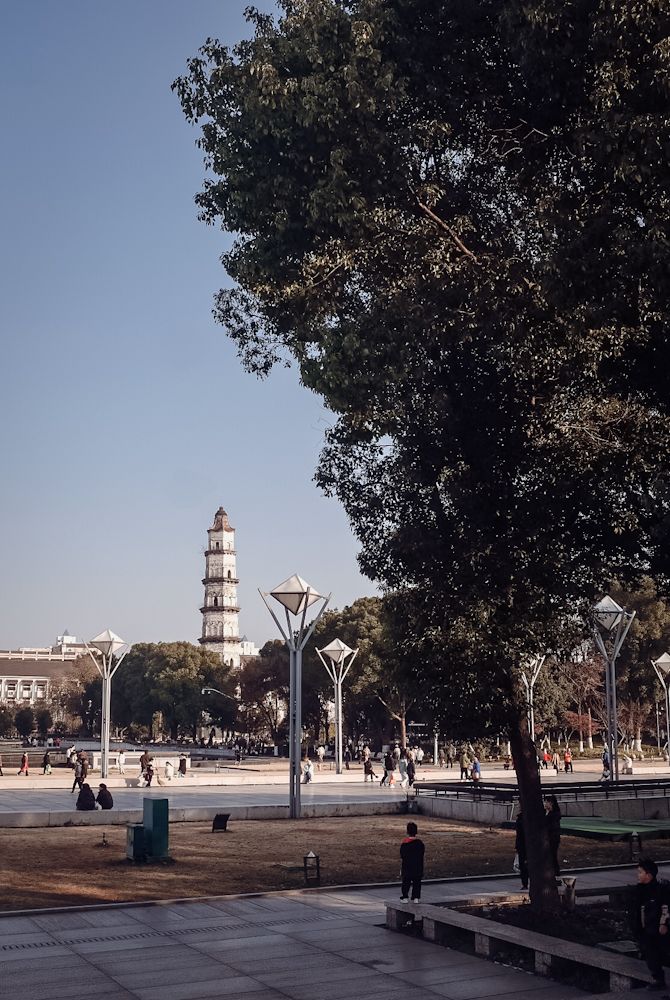
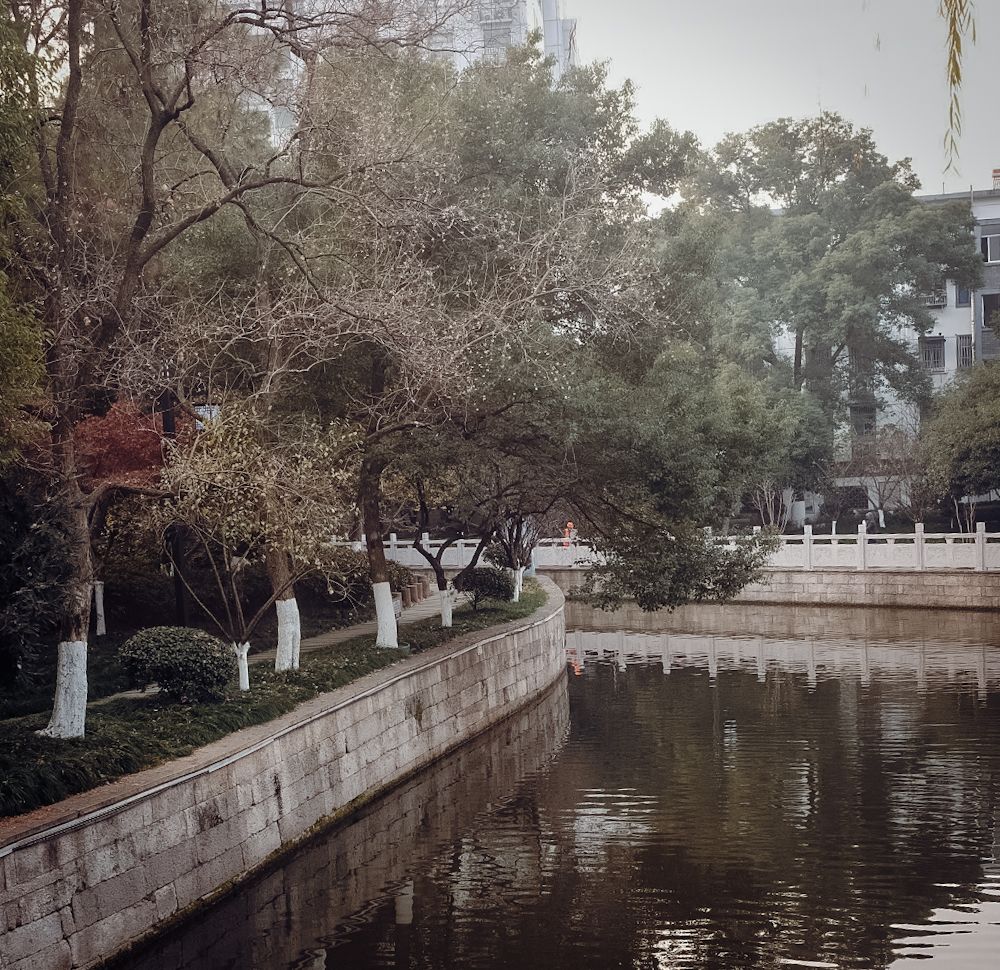
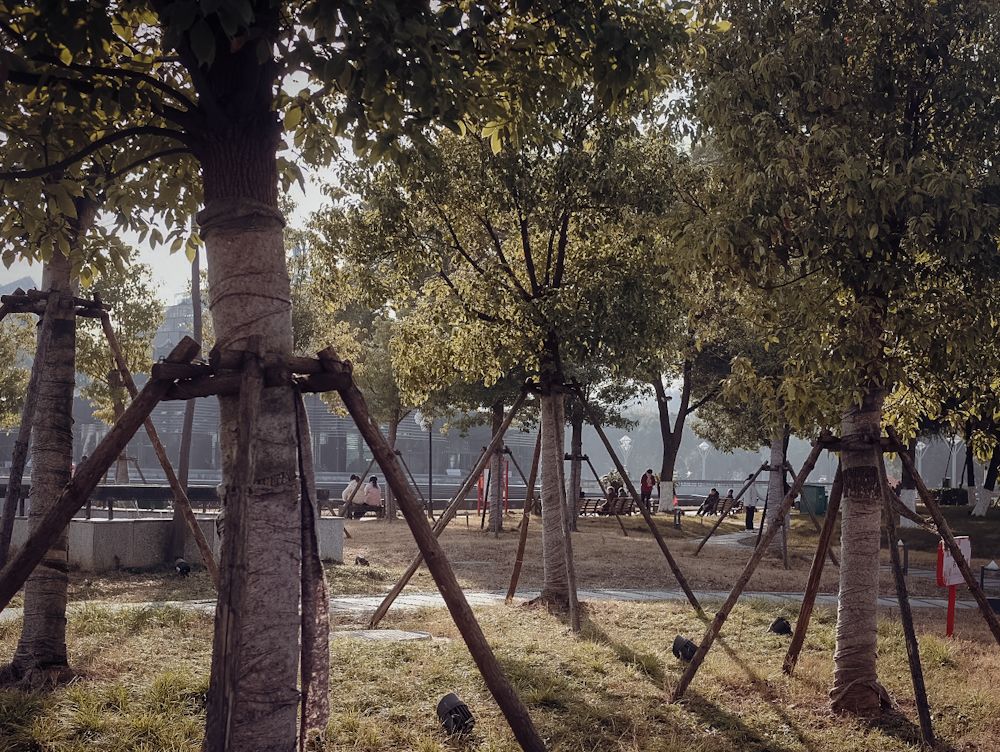
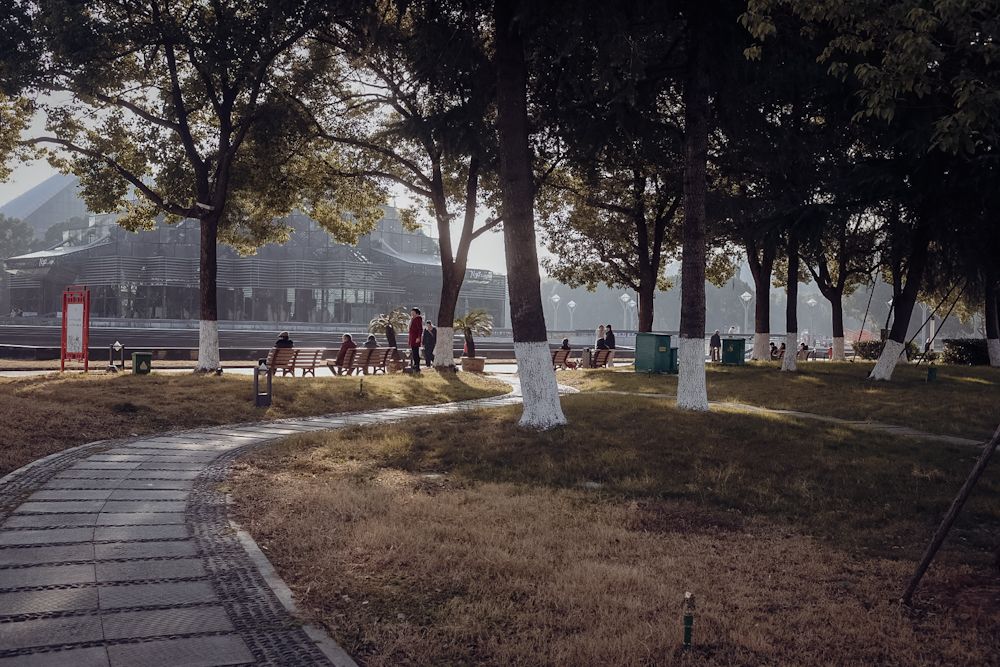
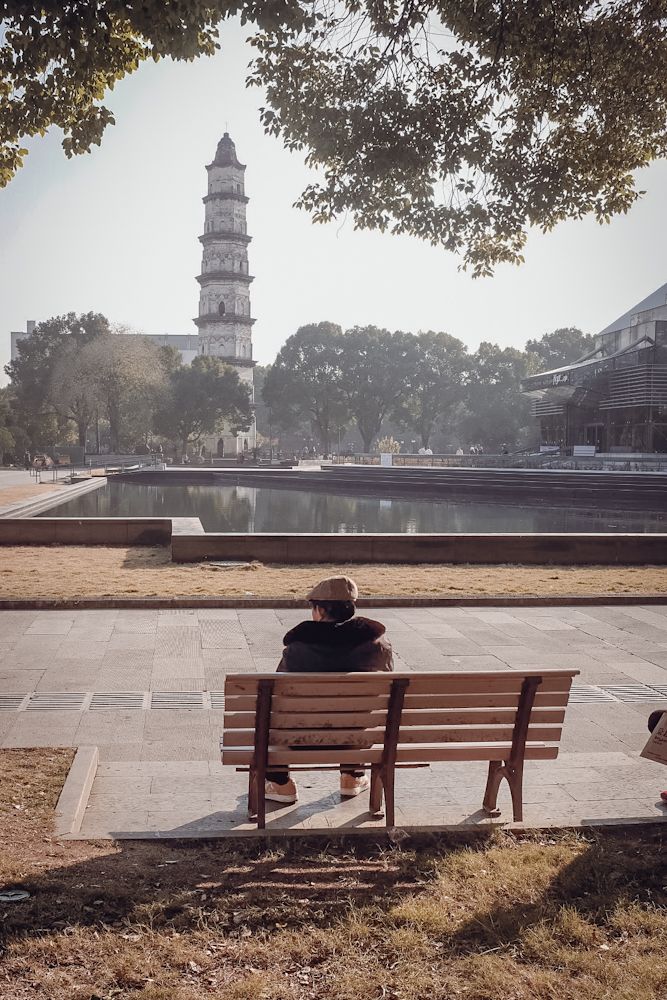
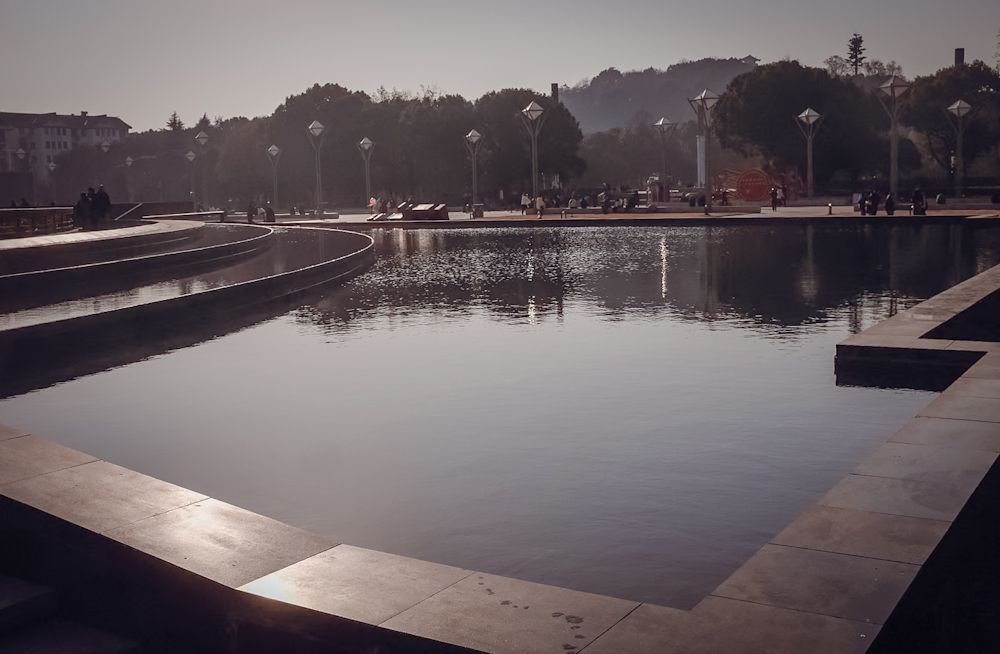
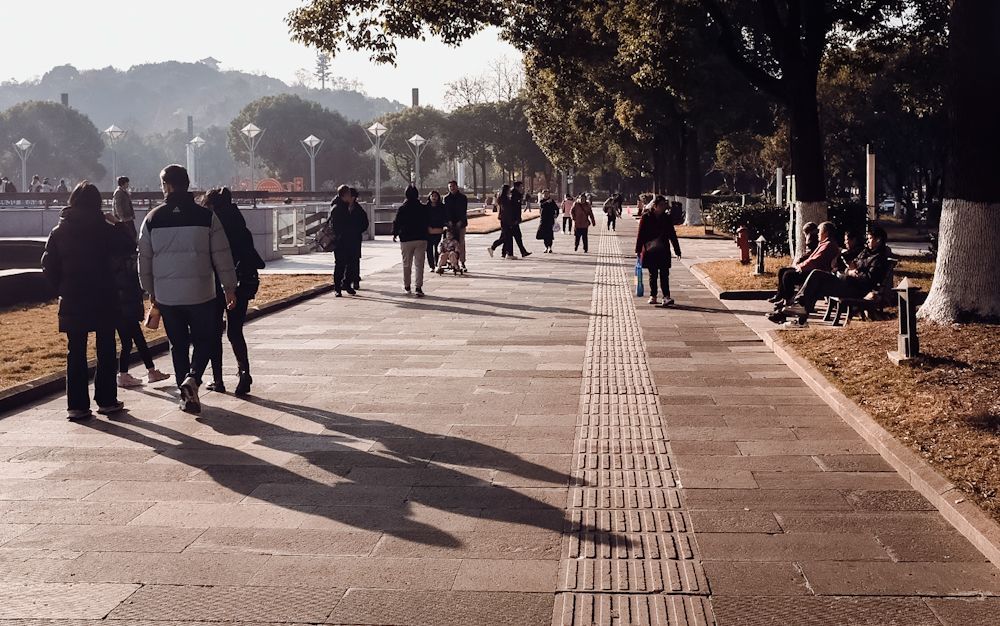
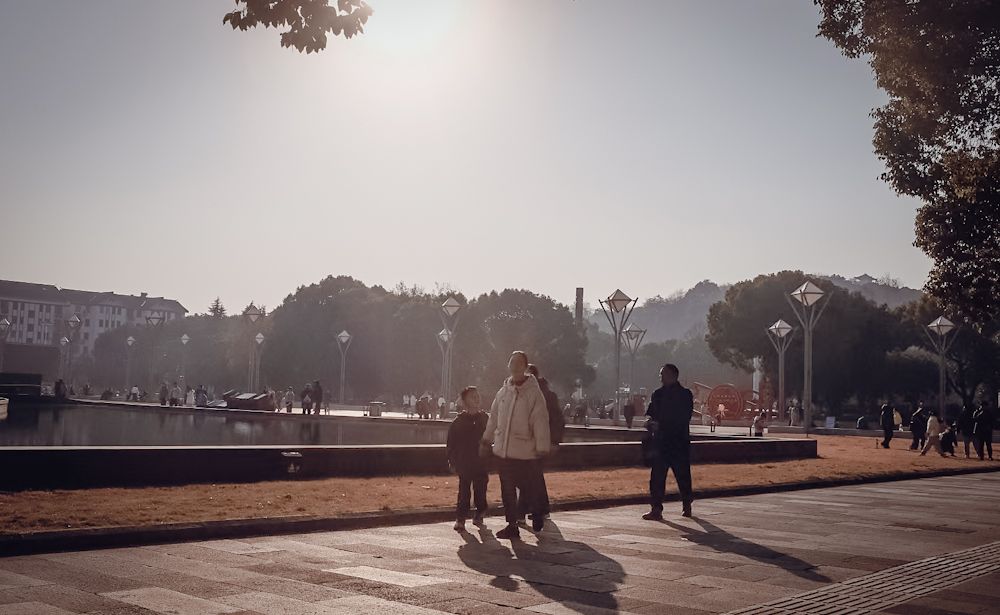
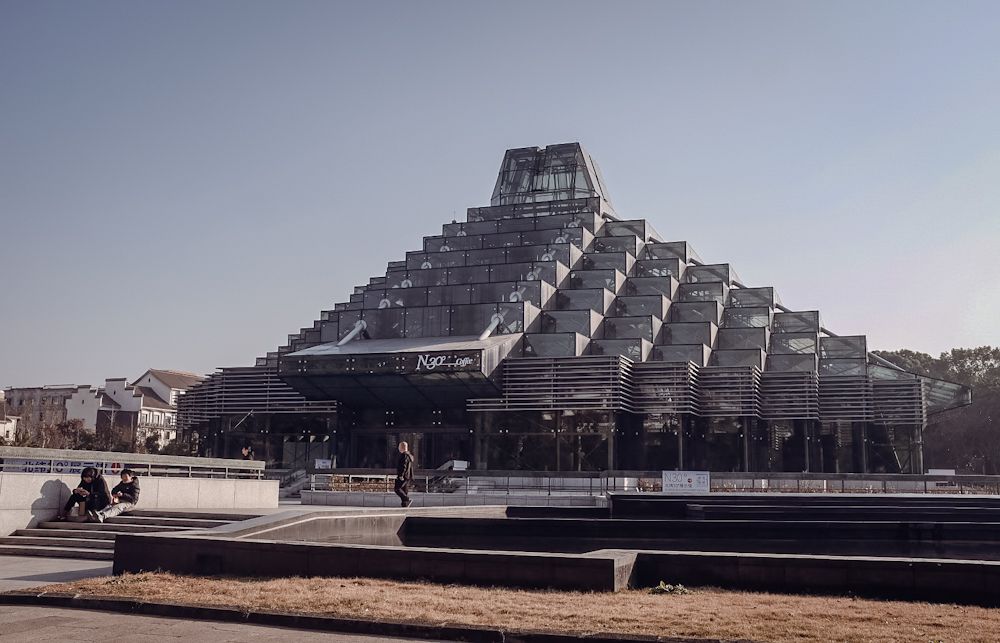
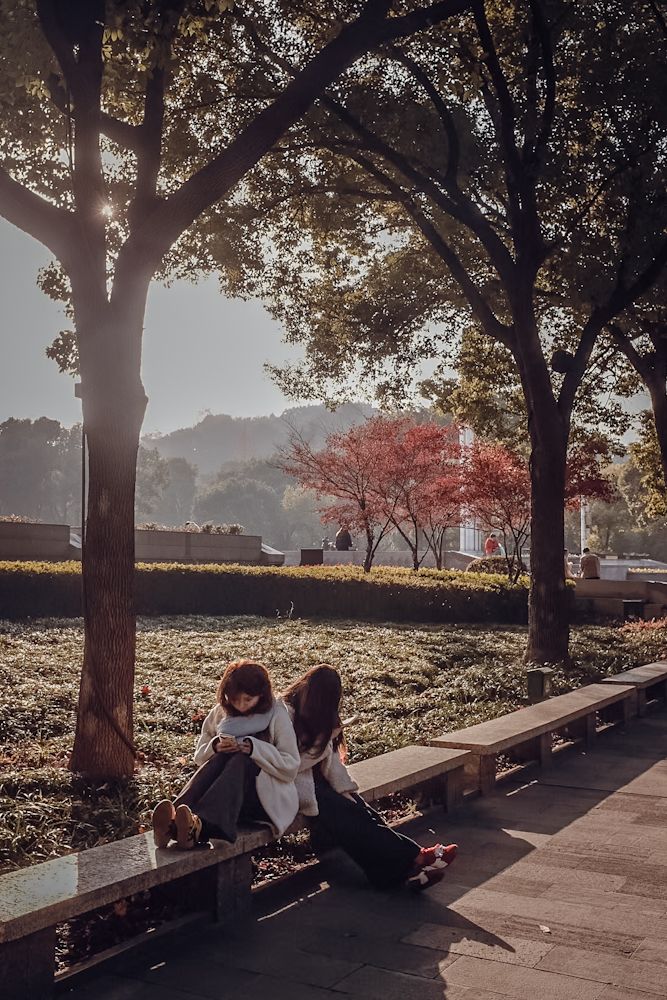
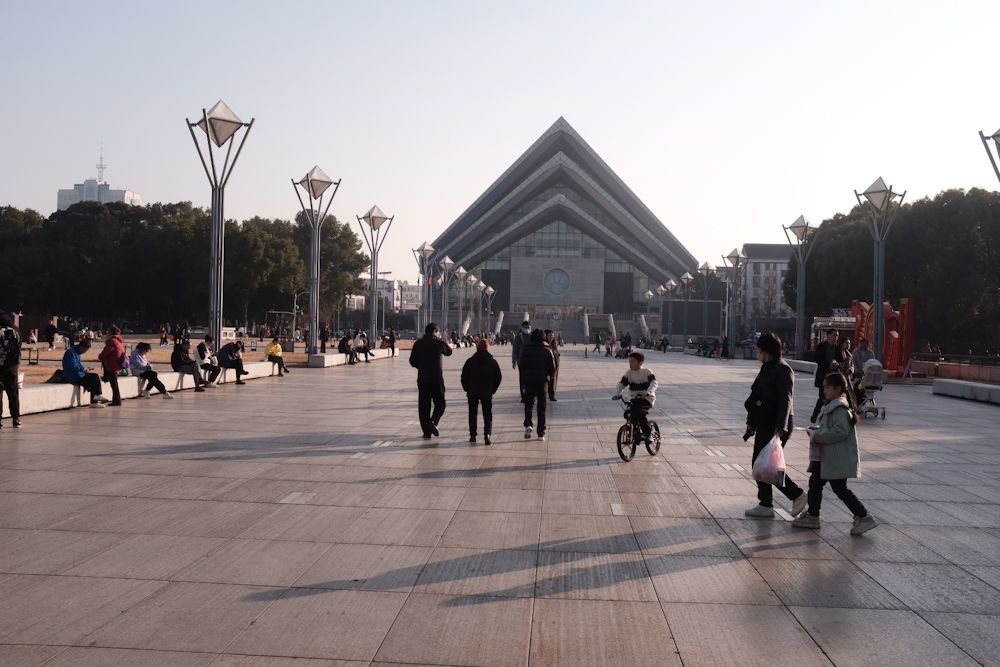
Now, let’s move quickly on from toilet humour (as universal as it may be) to the park next to our hotel. We were on the 22nd floor and had a marvellous view of the city centre. I could even see that night’s venue from our room and decided to explore the area, camera in hand. The winter sunlight was soft—bright but not blinding—perfect for photography. I wanted to capture the impression of Shao Xing, not just through candid portraits of people but through its landscapes and atmosphere. My aim was to convey the city’s essence, much like an impressionist painting, but with a camera instead of a brush.
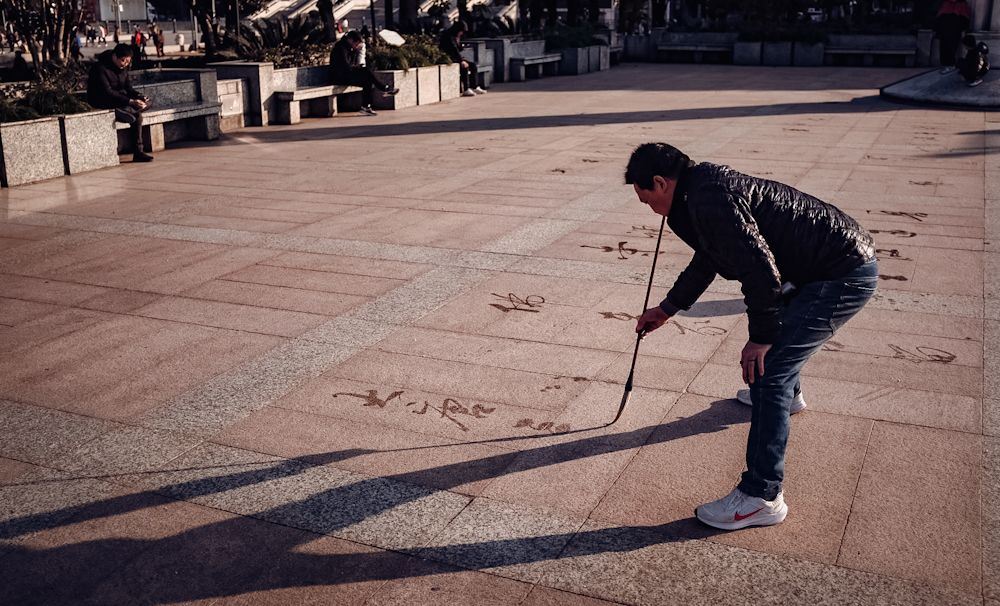
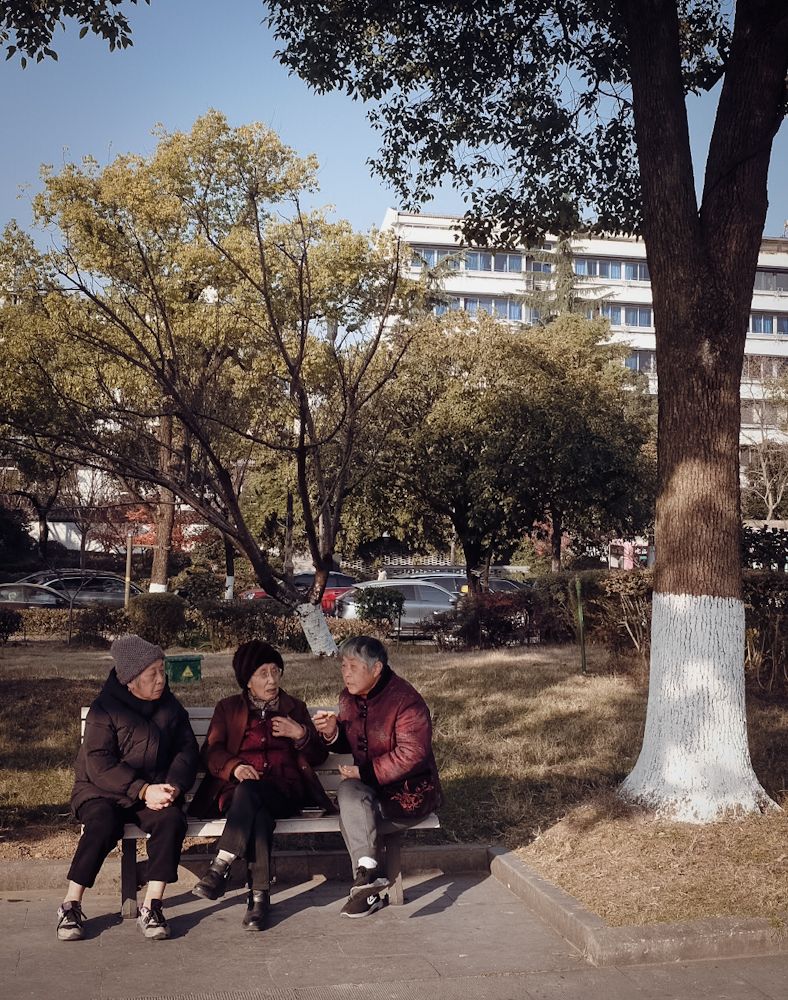
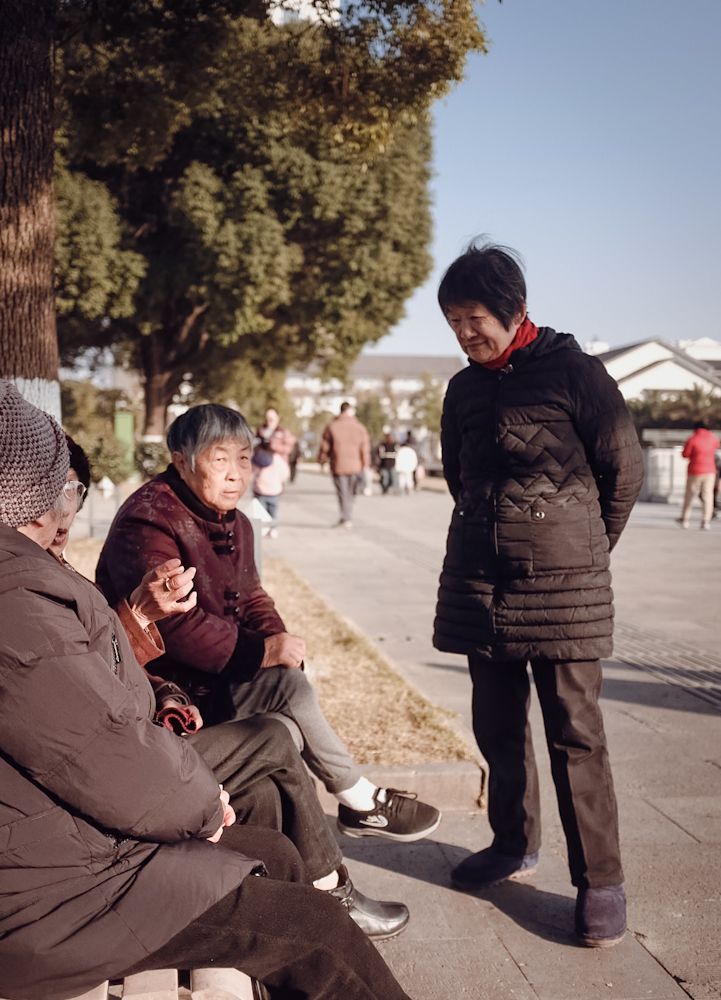
The park was alive with activity. Aunties and uncles sat on benches, chatting animatedly and observing the world go by. One Aunty beckoned me to join her, and I obliged. She greeted me with a thumbs-up—a universally positive gesture, except when hitchhiking in Greece, where it’s a faux pas. Using the translator in Alipay, I explained that I was a horn player with the visiting orchestra and would be performing that night in the concert hall across the park. This app is a godsend in China, though I briefly considered going back to study the language. My wife might not be thrilled with me disappearing for six months, though.

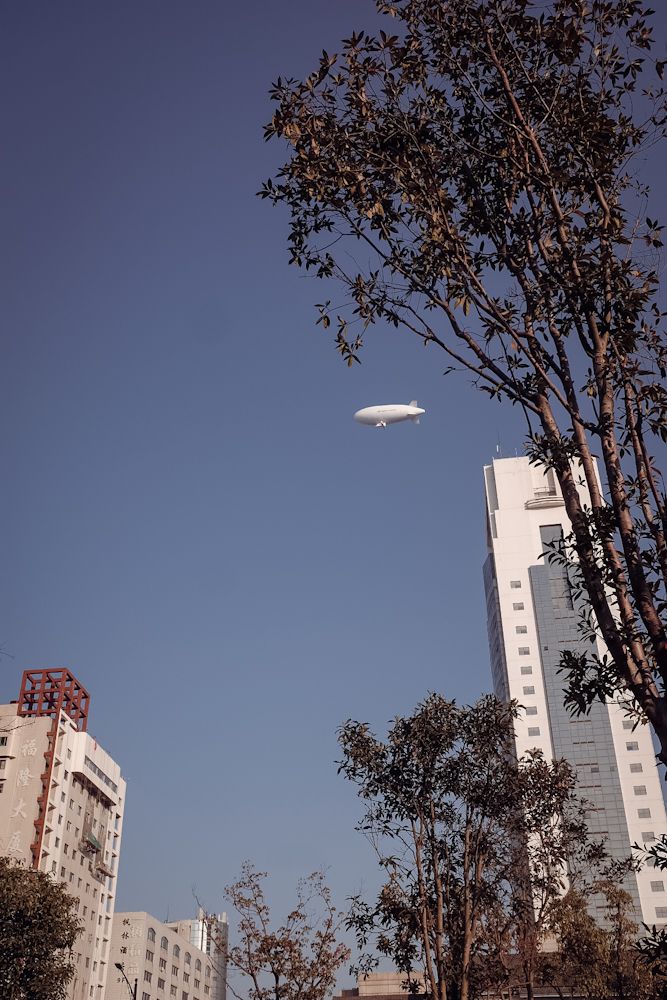
As we sat, the Aunty hummed a Chinese song. I was transported elsewhere, nearly dozing off in the sunlight—a habit I seemed to be developing. Thanking her for her company, I wandered further into the park. The sunlight filtered through the trees, highlighting the park’s serene beauty. I came across a single artist practicing calligraphy on the ground, using water instead of ink. His strokes were delicate and ephemeral—a fleeting masterpiece destined to evaporate. Children played with marbles nearby, using the sculpted floor as their playground. The juxtaposition of timeless tradition and youthful play captured the spirit of China for me. Above it all, a pagoda stood proudly, with an airship hovering in the background—a striking blend of the classic and the modern.

Reluctantly, I left the park to prepare for our penultimate concert. The thought of returning to the mundanity of home life began to weigh on me. This tour had been a gift, filled with unforgettable experiences and people. I wasn’t ready for it to end.

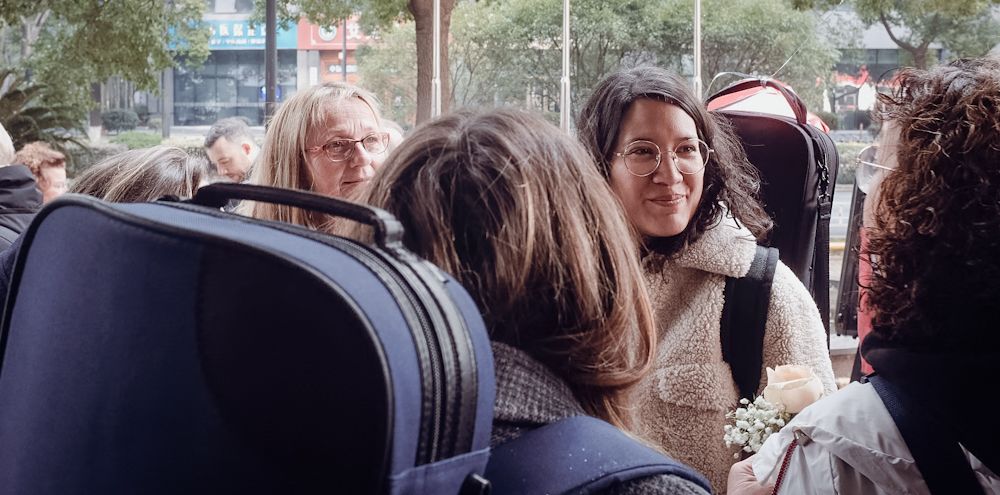
The concert hall was just across the park, and I strolled over leisurely—no need to rush; a gentleman never runs. The theatre director and his team greeted us warmly, their hospitality as magical as ever. Some brass players had prepared a fanfare to welcome the audience, and the atmosphere buzzed with excitement. Selfies were taken in abundance, and someone was even live-streaming for TikTok.

The concert itself went beautifully, with the usual audience participation adding to the magic. Afterward, the theatre manager addressed us, reminding us of the event’s purpose: celebrating Franco-Sino relations and their 60th anniversary. His French was excellent, and his enthusiasm infectious. They had prepared a spread for us—a delightful picnic with beer aplenty. As the night progressed, the manager led by example, dancing and motivating his team to let loose. Seeing their boss in this light seemed to surprise them.

I left the party early, taking a quiet stroll back to the hotel. The park, now illuminated, looked entirely different. The pagoda glowed softly and had changed character, and became the central element to the park.  Meanwhile, Corentin extended the festivities at a local bar, where the owner was treated to an impromptu rendition of Michel Sardou’s “Les Lacs du Connemara.” A night to remember, indeed.

China – Hangzhou to Shao Xing


New Year’s Day

I am glad to report that today was a lot more successful than the day before.  New Year, New Me?  Let’s not get ahead of ourselves here.  After a good night’s sleep, I was feeling almost human and Corentin explained last night’s quid pro quo.  Phones without batteries, people calling me and I must have been on “do not disturb mode.’  The girls asked why I hadn’t called them too, as they would have said where they were.  Look, it’s fine.  It doesn’t matter, except it did matter, but there was nothing I could do about it.  Can’t change the past, it’s too late, can’t change the future, it hasn’t happened yet, so live in the present moment.  Probably a better idea to try and make the best of the day as humanly possible.

Today’s trip by bus, leaving at midday, was a welcome change. The next town was only 40 miles away, which made the journey feel entirely manageable—and, more importantly, it gave me the time I needed to move my little booty and try and find something for Kilian.  He had asked me for cooking chopsticks and I thought I would bring back some nicer model like the ones we had been using in restaurants during the trip.  Corentin told me about his visit to the market just down the road, and gave me directions that even I could follow.  With my suitcase packed I was off camera in hand, and with a sense of renewed confidence.

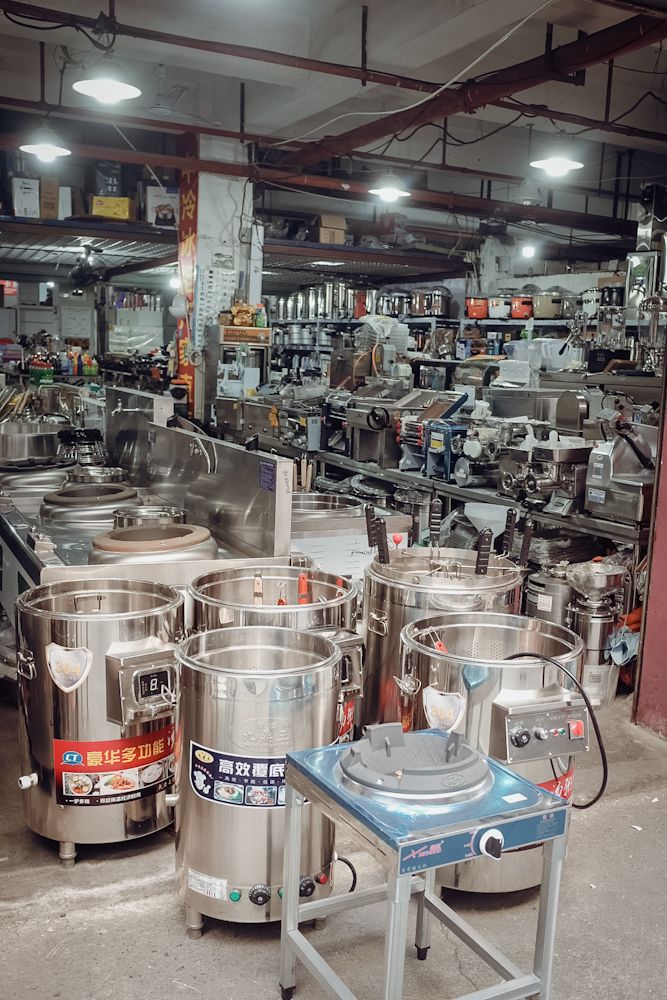
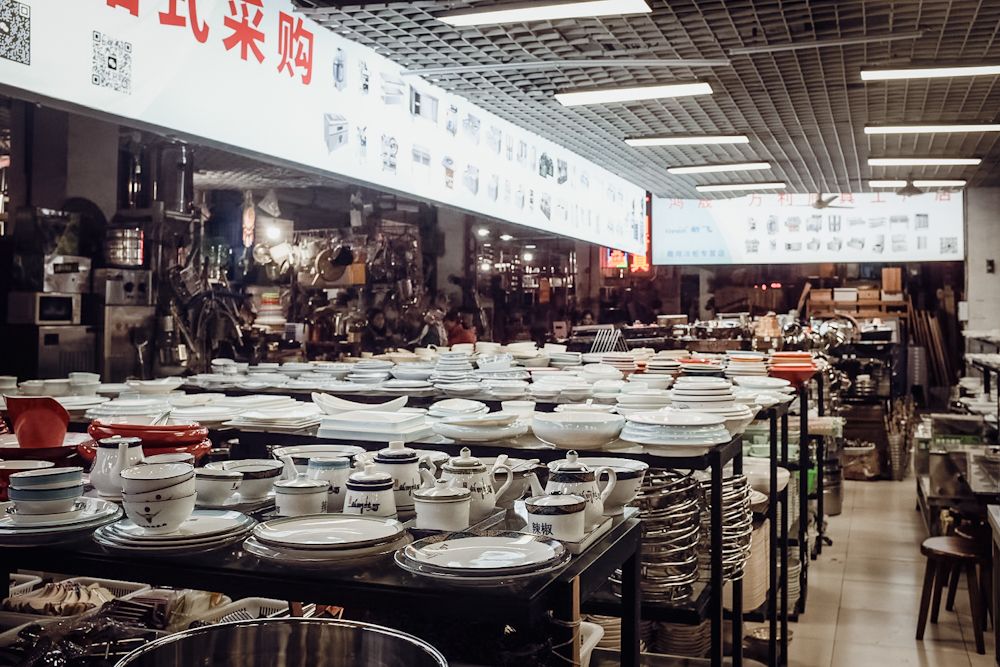
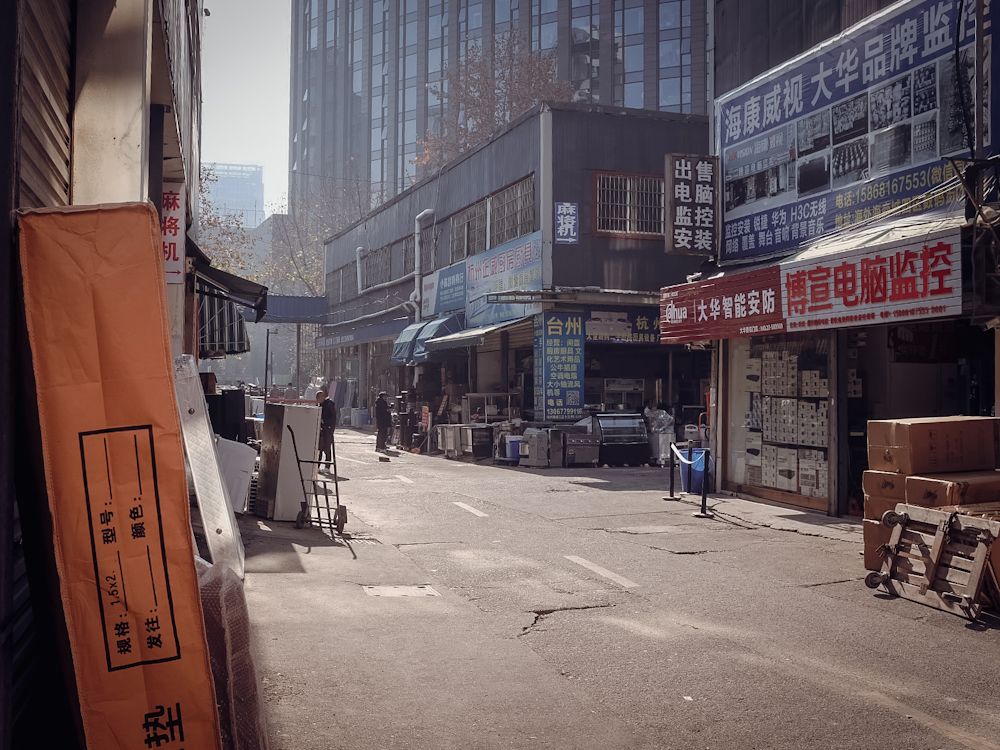
On the way I crossed paths with Anne, one of the percussionists who wanted to go and get some Chinese bowls like the ones we had been using in the restaurants but knew exactly what she was after.  So off we both went to the market.  I’m going to use a phrase that I used on Foshan.  A “joyeux bordel!”  The market was on the ground floor of a building that rose about as high as our expectations.  So pretty high.  As you will see in the photos there was stuff everywhere and each shop looked as if it morphed into the next one.  If you had ever wanted to start a restaurant business, they could cater for every single one of your needs.  They had stoves, kitchen tools, woks of all shapes and sizes, cookers designed specifically for woks.  All kinds of crockery to put said food into and serve it to your guests.  I could hardly believe my eyes.  You could buy sound systems, display cabinets, even those electric Mahjong tables that we saw in Shenzhen.  It was extraordinary, and it was full of people buying and selling.  Everyone back home always decries the made in China, but over 1billion people be wrong?  I was very impressed by the whole thing, and seeing things that we  I thought of my son straight away who, like me, is a bit of a foodie and who loves cooking.  All we really need is somebody who loves doing the washing up afterwards and we’d be onto a winner…

We both managed to find what we were looking for so all in all today was turning out much better than the previous night’s fiasco.  This success and eventual pleasing my son just put me in a positive mood for the day.  I got back to the hotel room to pick up my case and instrument and stow away my latest additions to the family cooking utensils.  And it was sunny ,and it was a relief to feel something fresh, something clear. What more could you ask for? It felt like I was exactly where I was supposed to be.

The change in mood from the night before was undeniable—subtle but meaningful. After a rough start, today was a quiet triumph. Finding the market, picking out those perfect cooking chopsticks for Kilian, and stepping into the sunshine felt like small victories, but they added up to something more significant. It wasn’t a grand transformation, but it was enough to shift my outlook for the day.

New Year, new me? Maybe. But I’m taking things one step at a time. For now, I’ll settle for the fact that, for once, things felt a little more bearable. And in a world that so often feels overwhelming, that, in itself, is enough. Sometimes it’s the smallest wins—the unexpected moments of clarity—that make the biggest difference.

As the bus carried us to the next town, I didn’t know what the rest of the day would bring. But, for once, there was a quiet sense of relief—small steps that didn’t feel like setbacks. It wasn’t a grand victory, but for today, it was enough. Sometimes, it’s the smallest wins that make all the difference.

China – Shenzhen day 4 – Shenzhen to Huizhou to Shenzhen.


Today, we were giving a concert in Huizhou (clue in the title, as always) and needed to be ready for the buses at 10 a.m.—a thoroughly civilised hour for a gentleman like myself. The journey would take us about 90 kilometres, another day of life on tour spent bussing around. Victor, the oboe player, kindly put my suit in his suiter, leaving me to carry only my instrument and camera. What a pleasant young man. As people drifted down from their respective floors, we gathered in the hotel lobby, a mix of sleepy faces and quiet anticipation. 

Off we went. Was I with the young, trendy crowd today? Not at all. Always leave them wanting more. Instead, I decided to spend the day with my “girlies” from my Cholet days—Eléonore, Titaua, and Mathilde—along with Catherine, another first violin. It was a calmer group, slightly olde9r than the twenty-somethings at the back, which suited me just fine.

Once underway, we learned our first stop would be a lake before heading to the evening’s venue. A leisurely stroll around a lake? I wasn’t thrilled at the idea. Am I coming across as a misanthrope? Moi? Really? But when we arrived, I was pleasantly surprised. The lake, surrounded by hazy sunshine, was breathtaking—quintessentially Chinese with pagodas, temples, and bamboo groves. The entrance gate itself was a work of art: a grey, ornate roof atop white columns, with traditional calligraphy adorning the sign above. It was beautiful, and I felt unexpectedly happy to be there. 

The walk would be leisurely, which was ideal for me. The trees and bamboo offered some welcome shade and acted as a diffuser for my photographs, and I knew this was definitely going to be a good day. I saw our friends’ Chinese boyfriend and Chinese girlfriend going through the same rigmarole as they had in Shenzhen’s Window on the World, which I still find amusing! 

There were groups of Aunties and Uncles, as the Chinese call older people, sitting on benches looking out across the lake at various pagodas and temples. It was one of those places that breathes calm. I like calm. 

I sat down to join the girls for lunch, but I had already eaten, yet they insisted I partake of their picnic, which I did with pleasure. They really are good to Uncle Ian. They joked about hiring a pedalo and going around the lake. Mathilde’s foot was hurting her, so we decided to take the shorter walk back to our rendezvous point, letting Eléonore and Catherine explore the long way round. We even joked about hiring one of the electric golf cart-type buggies to get around. You may have noticed that I haven’t talked about selfies yet.

 Well, at the table behind was an Uncle and Auntie who wanted to take a selfie with us—first it was the two uncles together, then everyone! I was getting a taste for all this. The attention is definitely validating and made us feel amazing. Yes, made me feel very special, especially when you see their smiles. It’s not like being adulated by adoring fans, but more like appreciating and celebrating your presence in China. It is something that will stay with me for the rest of my life. 

We crossed the lake using the walkway and going through the decorated walkway with its traditional Chinese style. Everything felt Chinese, but in a more classical way. The architecture, the building styles, the plants—even with the bamboo being a feature—as well as the white hump-backed bridges. I was having a special moment with Mathilde and Titaua as we gently made our way back to the bus, and even though it wasn’t the scenic route, you could be mistaken for believing it was. The views were amazing… 

Taking in the light coming through the trees, and sparkling on the water. It was beautiful, and I was so happy to be there amongst longtime friends. Titaua moved on ahead, and I stayed to accompany Mathilde and her bad foot. 

She had put on a brave face the day before, chasing around Shenzhen with the girls. It had gotten so bad that Titaua had to accompany her back to the hotel in a taxi. She didn’t want to put anyone out, and I found myself seeing her in a new light. Maybe that’s what this tour was really about—seeing people in a new light and discovering facets of them you’d never noticed before. When you’re on tour, the masks we all wear tend to slip, and the inner person shines through. It’s human nature to put on a front—I’m certainly guilty of it, especially with my own ongoing struggles with mental health. But during the tour, I felt I could let that mask drop. It was liberating in a way I didn’t quite expect. 

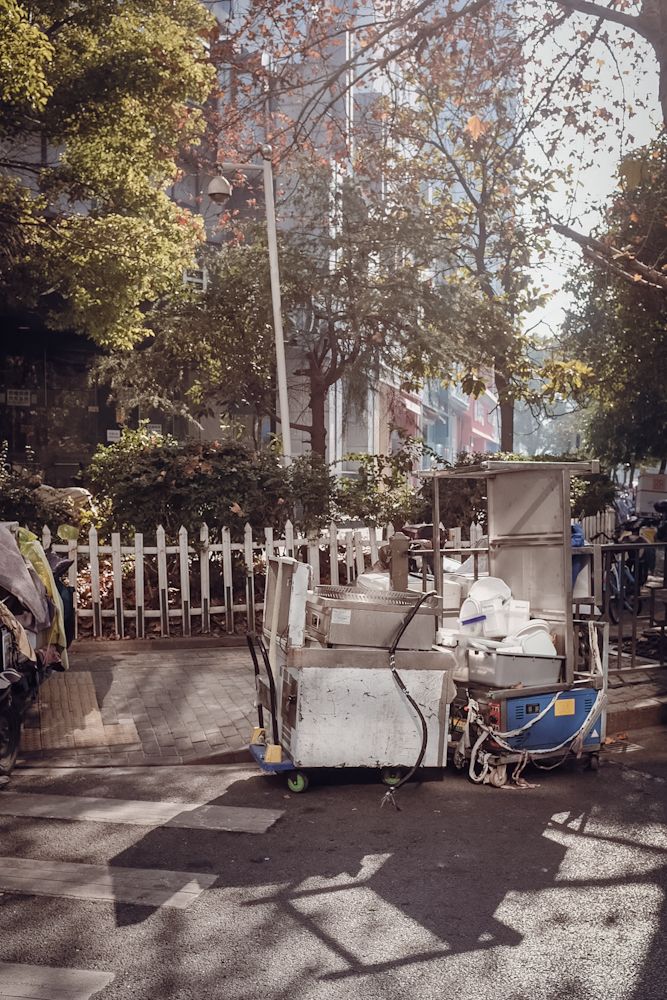
Back at the rendezvous, I was captivated by a coconut and sugarcane juice stall—a moped with a shop grafted onto its back. I didn’t partake but saw how the backlit scene looked very poetic and couldn’t resist taking a picture. I’m glad I did. 

The younger crowd soon returned, with Corentin (aka Sir Fanny Magnet) and Paul (“Duck Tongue” Trouillet) basking in their fan club’s adoration. 

Another selfie session ensued with the younger crowd having selfies with the young Chinese crowd. Corentin, aka Sir Fanny Magnet, and Paul “the Duck Tongue” Trouillet had obviously told their fan club of their imminent arrival. But unexpectedly, that same younger Chinese crowd came up to me asking very shyly if they could have photos with me. I don’t know if it was the Uncle Ian legendary charm or the Father Christmas effect; it certainly left me feeling even more wonderful!

Yes, I think you might have guessed by now, but it was back onto the buses, and off to the venue. I had certainly been inspired for this concert by the kindness and bienveillance of the local population. I would have to make this a performance to remember. And indeed, it was!