Photography Philosophy – Part VII – The Philosophy of Impermanence


Capturing Fleeting Moments

When we talk about a moment in time, that moment is no longer the present; it has become the past. We cannot repeat it, nor can we reclaim it. It has happened and will never come back. Photography is an art form that allows us to capture a specific moment and preserve it for all time. We know that it is impossible to capture exactly the same conditions in which the shot was taken. We can attempt a recreation, but it will never be identical. Time has moved on to the next moment.

As photographers, we are left with the task of capturing the present, knowing it is already slipping away. What does this mean for the way we approach our art? Will we constantly look back, regretting the passage of time, or will we, on the contrary, feel privileged to have documented it for the future?

This brings us back to the idea of preserving the decisive moment that Cartier-Bresson spoke of. Like comedy, it would appear that photography is all about timing.

When we capture that moment, we must decide how we want to portray it. Do we want to freeze the action with a very high shutter speed, or can we slow down and add a sense of movement to our image? How fleeting is the image we are trying to capture?  What will this motion add to the image?

My approach

Over time, I’ve come to appreciate these fleeting moments in time and try to document them, whether in the big city or out in the countryside with my children—especially when they play together. I want the spontaneity of it all, to capture those precious moments of complicity. As any parent knows, our children grow up before our eyes, and before we can truly realise it, they are grown up. Even when they’re not together, and I look through these past moments in time, I get an overwhelming feeling of, “Where did it all go?” My son is 25, and my daughter is 15 already.

Embracing Mistakes: A Journey to the Image

I’ll admit, I’m not one to embrace mistakes easily. I’ve always strived for precision in my photography, seeking to control every variable and meticulously plan each shot. I don’t like leaving things to chance, and so, when things don’t go as expected, there’s often a twinge of frustration. A blurred shot, an overexposed image, or a missed moment—those mistakes are a part of the process I try my hardest to avoid.

But over time, I’ve started to realise something: these mistakes, as unsettling as they may feel in the moment, are often a necessary part of the journey toward the image I’m truly after. When I reflect on the photographs I’ve captured, it’s clear that the path to the perfect shot wasn’t a straight line. It was made up of trial and error, of learning how to see the scene in front of me not just through my lens, but also through the lens of my mistakes.

It’s the misfires, the accidents, that force me to reconsider my approach, to adjust my frame or my focus. They open my eyes to perspectives I might not have considered, angles I might not have thought of, and emotions I might not have expected to capture. Each mistake teaches me something new, something that nudges me closer to that elusive, perfect image. They’re not setbacks, but rather signposts that guide me, sometimes uncomfortably, to a place where I can see the photograph with fresh eyes.

I’ve come to understand that each imperfection is part of the journey. The photograph I end up with is rarely the first shot I took, or the second, or the third. It’s the culmination of countless adjustments, failures, and moments of doubt, all leading me to the image that feels right. In the end, I realise that without those mistakes, the image I’m truly after might never have come into focus.

So while I still seek control, I’ve learned that there is value in embracing the unexpected. It’s in the mistakes, the missed moments, and the misjudgments that I find the essence of my photography. They are just as much a part of the creative process as the moments of perfection, guiding me closer to the image that speaks to me—and perhaps even to the viewer—most clearly.

Conclusion: The Beauty of the Journey

Photography, at its core, is a celebration of the fleeting moments that pass us by in the blink of an eye. The act of capturing these moments is an acknowledgement that time is forever slipping away, and in that impermanence, there is both beauty and significance. As photographers, we are tasked with documenting not just what we see, but also what we feel—the raw, unrepeatable essence of time itself.

The pursuit of the perfect image is a delicate dance between intention and spontaneity, control and surrender. It’s a journey that, more often than not, veers off the well-trodden path and into uncharted territory. Along the way, mistakes become our teachers, guiding us toward discoveries we might never have made if we had stayed within the confines of our comfort zone. These missteps, rather than being failures, are integral to the creative process, pushing us to reimagine, reframe, and reinvent our approach.

In the end, photography is about embracing the imperfection of both the world around us and our own creative efforts. It’s in the mess, the mistakes, and the fleeting nature of the moment that we often find the most powerful images. And while the perfect shot may remain elusive, it is in the journey—the trial and error, the fleeting moments, and the lessons learned—that the true beauty of photography lies.

So, as we continue to document our world, let us not only cherish the decisive moments but also embrace the imperfections that make them meaningful. For it is through the transient, the imperfect, and the unexpected that we capture not just images but stories—stories that resonate with the heart and echo the passage of time.
A Photography Philosophy Series – Part I – An Introduction


With the aim of delving deeper into the meaning behind photography, I’ve decided to launch a new series of articles. Here, I want to explore questions like why rather than just how or with what. In my Photography 101 series, we looked at the basics—technique, lenses, and so on. I’ve written extensively about gear in my camera reviews. But now, I’m searching for something beyond that.

The wheels in my mind are already beginning to turn. Not frenetically yet, but there’s a steady intellectual process underway. Answering “why” feels more challenging than “how” or “with what.” It demands more from me than simply focusing on technique or gear.

Here goes anyway!

To set the stage for this exploration, I’ll begin by sharing my own journey in photography. Understanding where I come from may help illuminate my perspective on the medium.

I was born in an age before the all-powerful image took over. Yes, we had photos, and I enjoyed looking through them in our albums. Each image was a physical object, and the idea of viewing images on a screen was foreign to us all. When we spoke of phones, we meant the ones hanging on the wall at home or in the phone boxes on the street. They certainly weren’t for taking photographs.

Back then, cameras fell into two categories: point-and-shoot cameras for the masses and “proper” cameras for photographers. Point-and-shoots were basic, easy to use, and, for me as a small child, they were an introduction to photography. Proper cameras, on the other hand, were for those who had learned the craft of photography, and using one made you feel part of a certain fraternity.

My first Form Master at prep school, Father Gerald, had a proper camera and recorded school life with it. Occasionally, a board with a selection of 6-by-4-inch photos would appear, always in black and white. Father Gerald must have had his own darkroom for developing and printing. I have no idea what kind of camera he used, but it was undoubtedly a proper one.

In 1984, a German orchestra visited Hull, and Stefan Haller from Neustadt an der Aisch stayed with us. Stefan had a proper camera, and I was fascinated by it. When I asked my father if I could have one too, he agreed—but I would have to learn how to use it first. The local YPI organized a summer school offering various activities, including proper photography. And that, Dear Reader, is how I first encountered this “proper photography” lark!

So now you know the why and how behind my beginnings in photography. Let’s look at how this journey evolved. My first proper camera was a Praktica MTL 3. It was fully manual and had a built-in light meter, which helped me get my exposure right each time—or nearly each time. With that camera, I trained my eye and explored the world around me.

Photography at the time was film photography. Although Kodak invented the digital camera in 1979, digital photography didn’t become accessible until the early 21st century. Growing up, color photography was for capturing moments with friends and having a laugh; black and white was considered more “arty” and suited for serious photography. I was deeply affected by the black-and-white images in newspapers, while color images seemed relegated to magazines.

I remember having breakfast with my father every morning as he read The Independent, a paper known for its high standard of photographic journalism. This was my daily visual inspiration. I had a subscription to National Geographic, where I encountered even more incredible photography in its pages. This was top-class photojournalism, and these images now serve as a historical reference for us all.

This is the time and place I come from. For young Gen Z readers, it might sound like ancient history, but to me, it’s deeply real and continues to influence my approach to photography in the digital age.

Now that you’ve had a glimpse into my why, let’s dive deeper. In the next article, we’ll look at why others feel compelled to pick up a camera. Throughout the series, we’ll explore the connections between images and emotions, how we tell stories through our photos, and how photography can be a form of self-expression leading to personal growth. We’ll examine how photography connects us to others, reflect on the philosophy of impermanence, and, at the end of the series, I’ll invite you, Dear Reader, to reflect on your own photographic journey…

The Opening of the Film Archives – Kate July 2016


I am a father.  I am the father of a son, and have been for the last 25 years.  I am a father.  I am the father of a daughter, and have been for the last 14 years.  I am a father.  More traditional than modern, but definitely a doting and loving father of both children.  I am a photographer.  Both children have had multiple photos taken of them over the years.  However, the subject of bedtimes has always been contentious.  They say you have to be rigid and follow an established routine.  They say that for the good of the children you have to respect this routine to the letter.   They are obviously not parents.  They are obviously completely disconnected from reality.  They obviously have their heads buried so far up where the sun don’t shine.

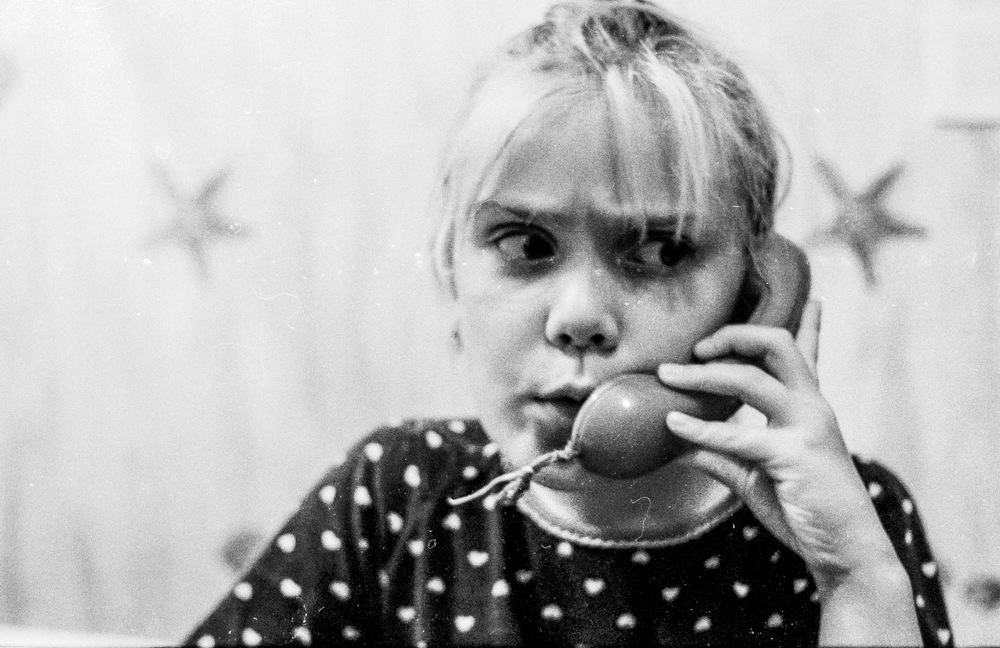
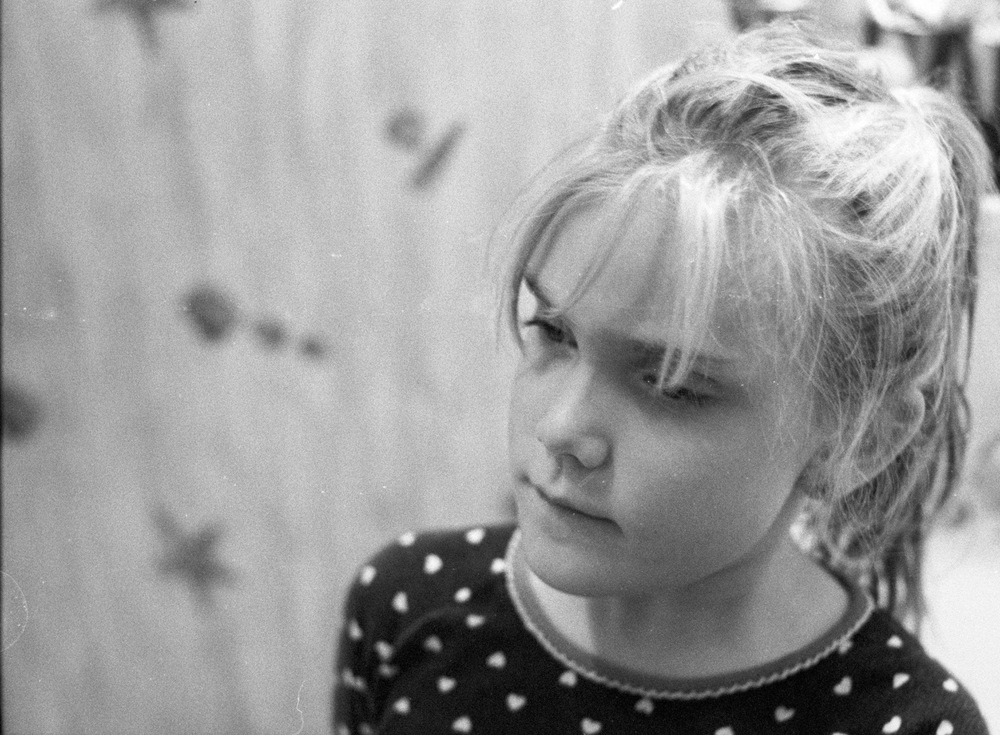
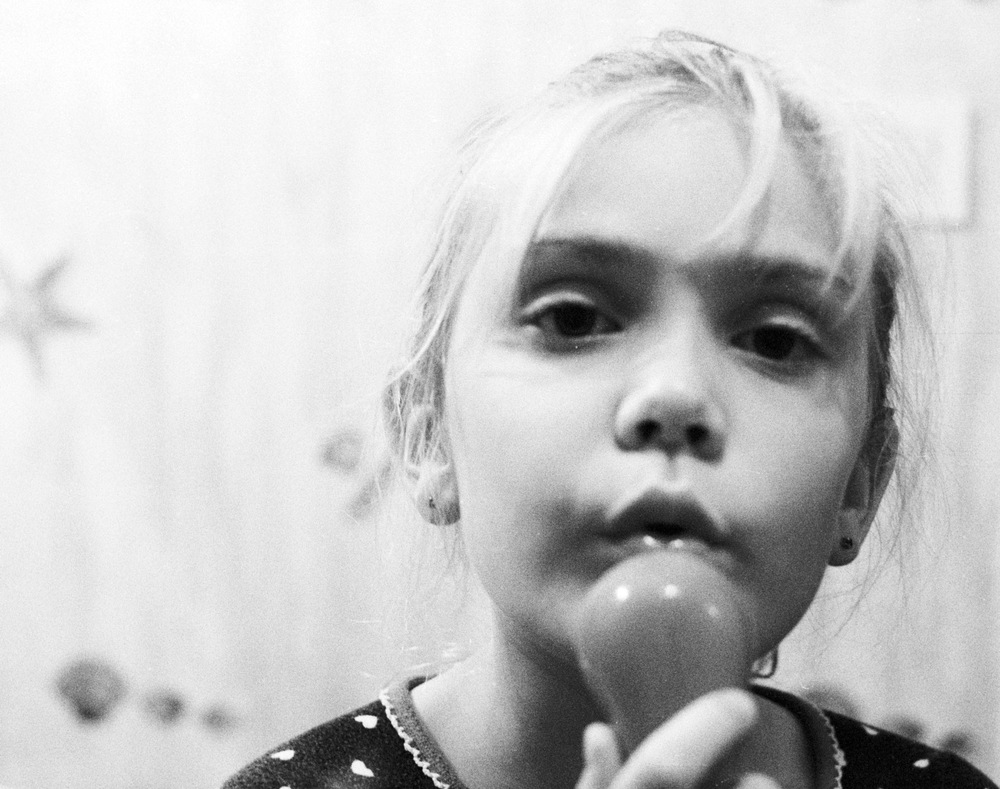
As a father, I’ve learned the importance of picking your battles, especially when it comes to bedtime routines. This particular night, with my 7-year-old daughter wide awake, a fight wasn’t the answer. So, I grabbed my Praktica MTL3, loaded some HP5 pushed to 1600, and turned a potential meltdown into an improvised photoshoot. We ended up in the bathroom – because teeth brushing was still non-negotiable – but the resulting photos captured a moment of pure magic.

Let’s talk about technical details: the Praktica MTL3 is the model that I learnt my craft on.  It’s solid.  It’s fully manual, and gets the job done admirably.  The lens is an F1.8 Pentacon 50mm, with a lovely depth of field.  I pushed the HP5 to 1600 to be able to take advantage of all the available light.  

Kate posed for me and thoroughly enjoyed herself.  Teeth brushing.  Calling somebody very important on the Fisher Price telephone.  And pulling a face to tell me off.  Some things just don’t change…

Photography is not the technique or the camera, or worse still, the settings used.  It’s about capturing that “Kodak moment” albeit with Ilford HP5.  It’s about the shared memories.  It’s about the nostalgia of looking back on family life that can never be recaptured.  It might seem mundane to you, but to me it’s priceless.  And looking back at these family photos, it just reminds me how much I love both my children, and am fortunate enough to have captured these fleeting instants.