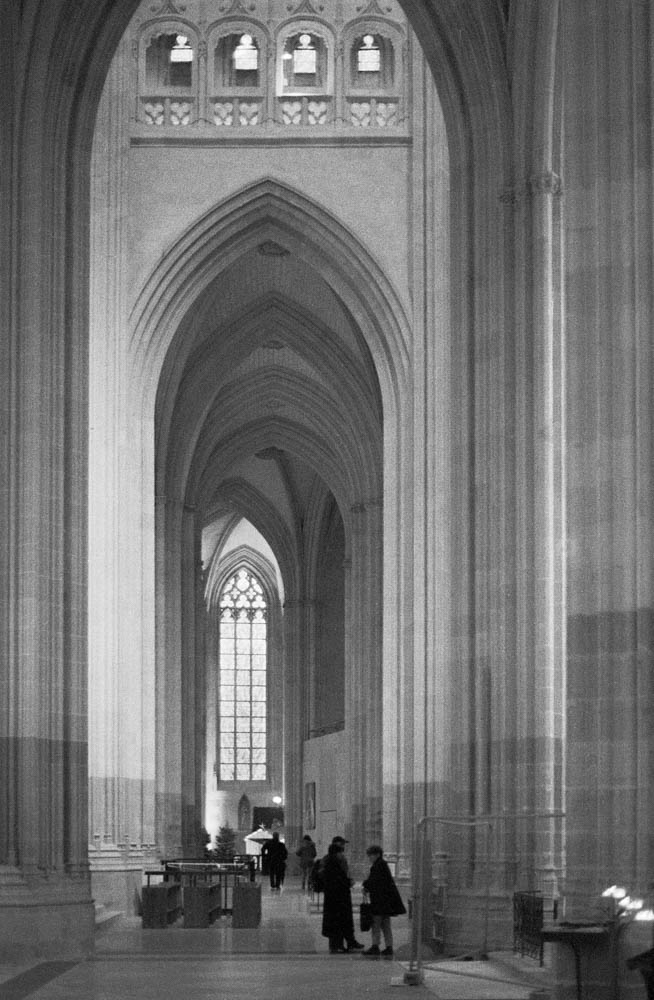
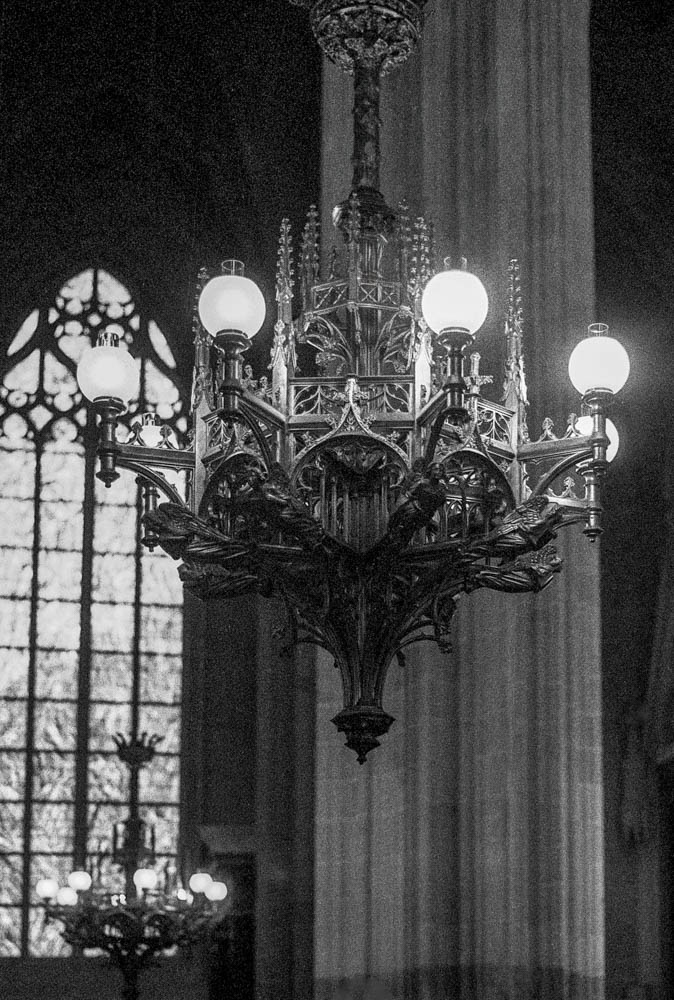
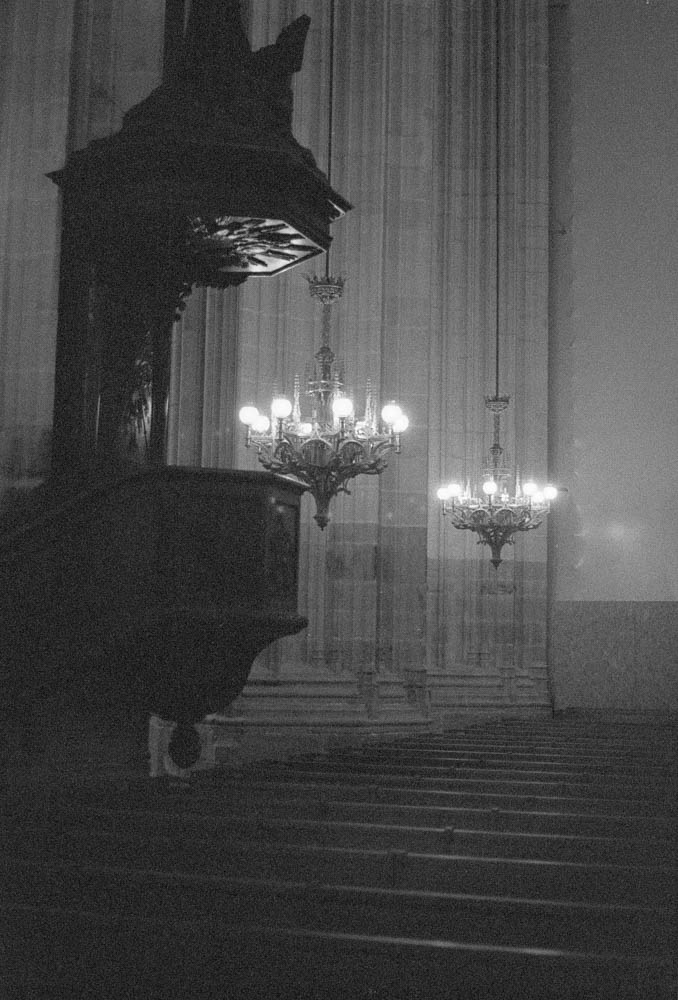
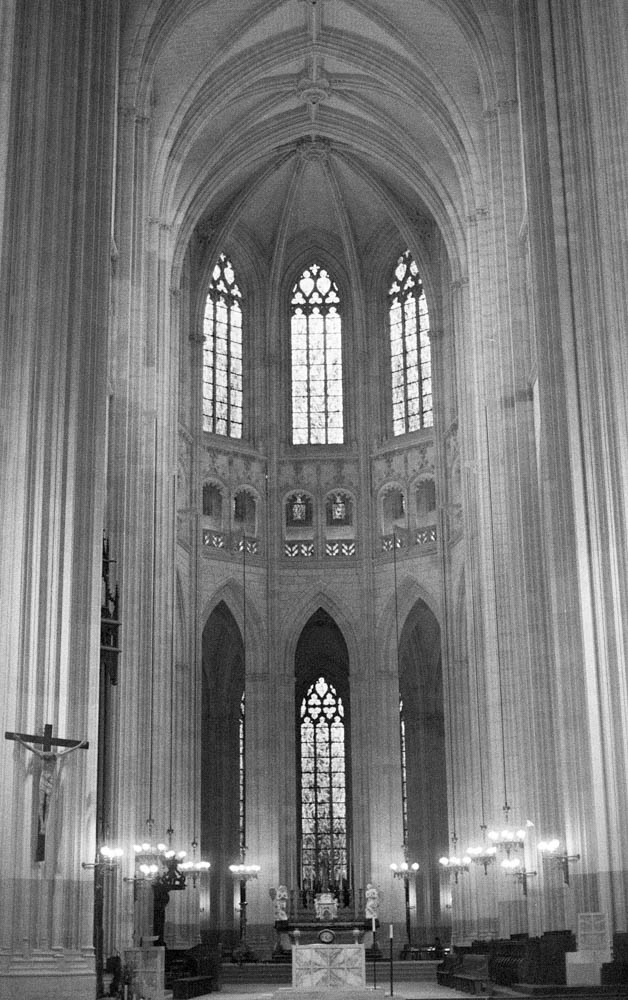
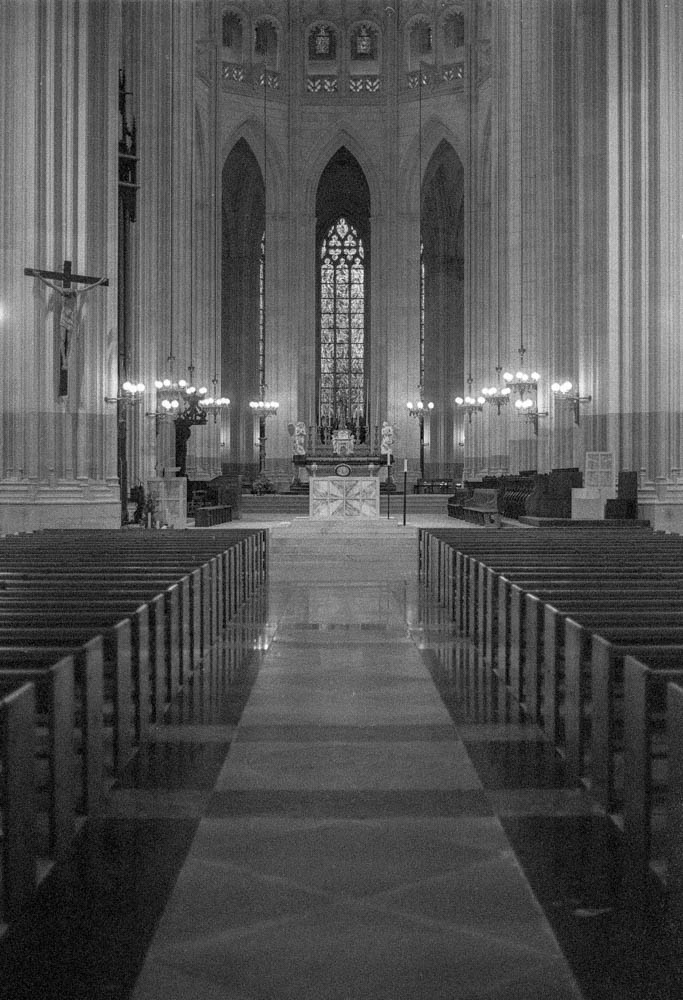
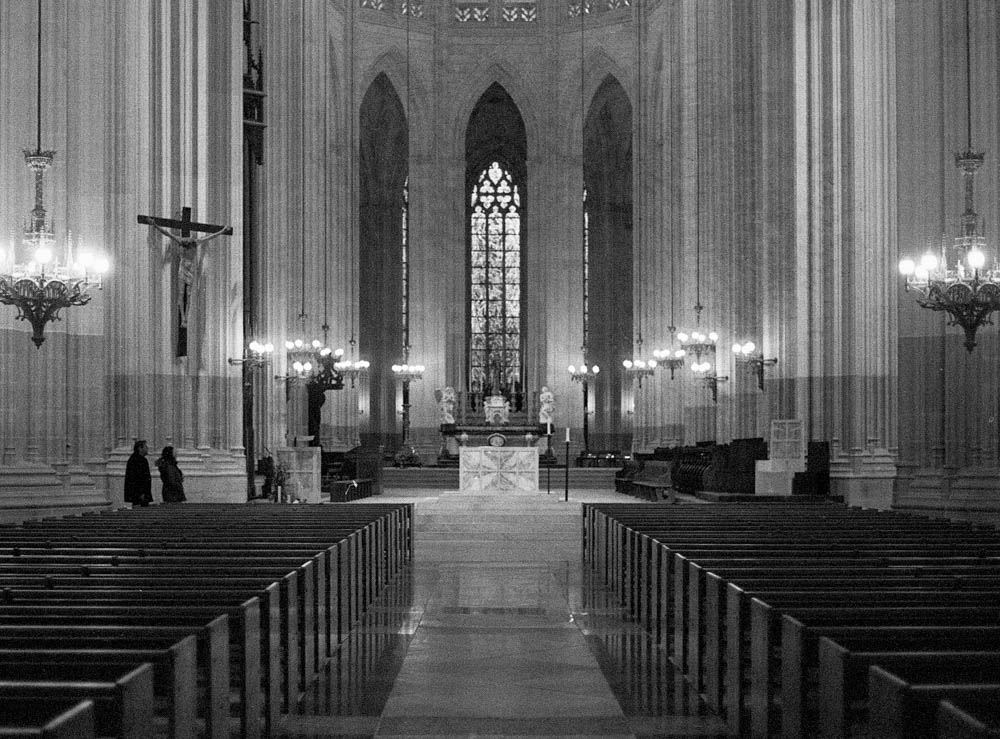
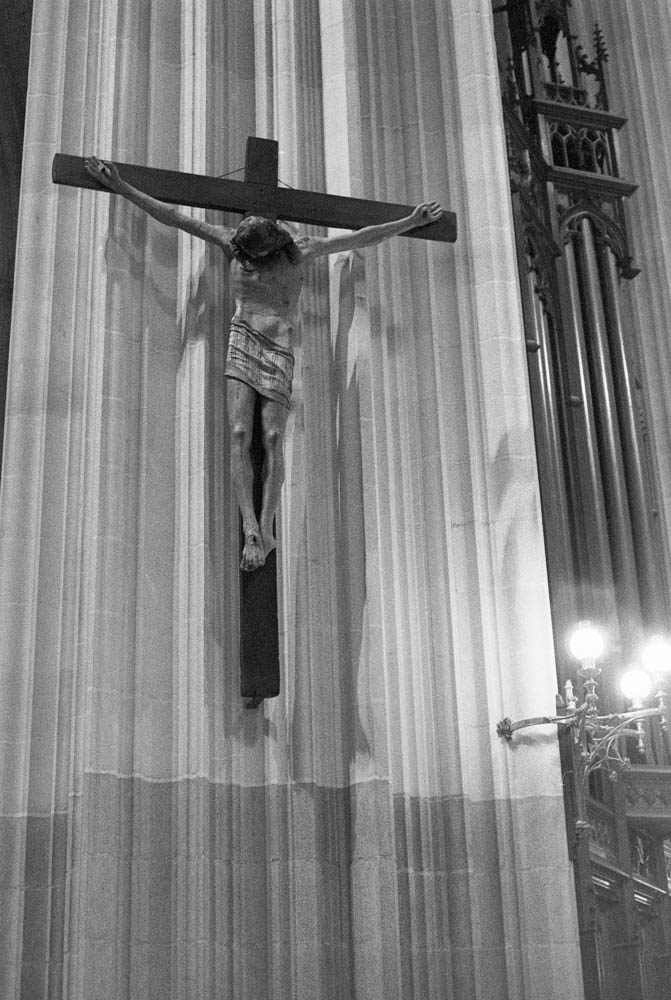
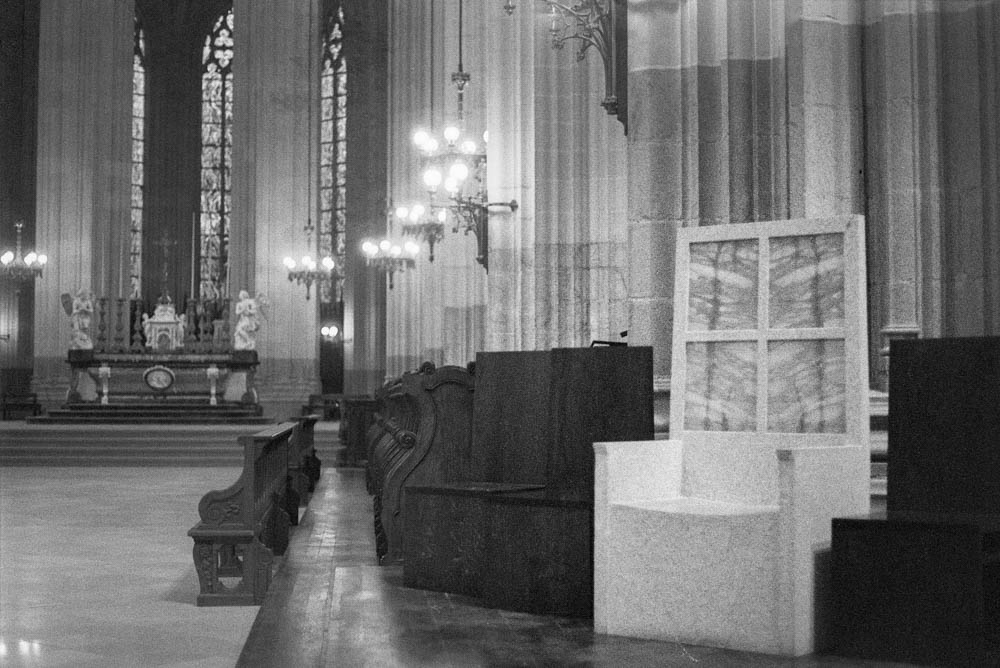
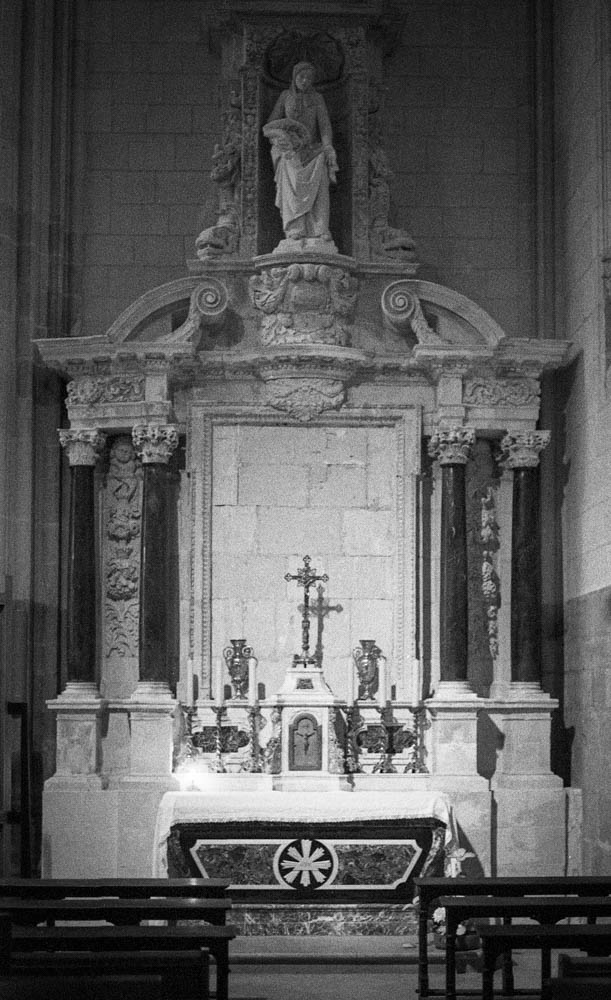
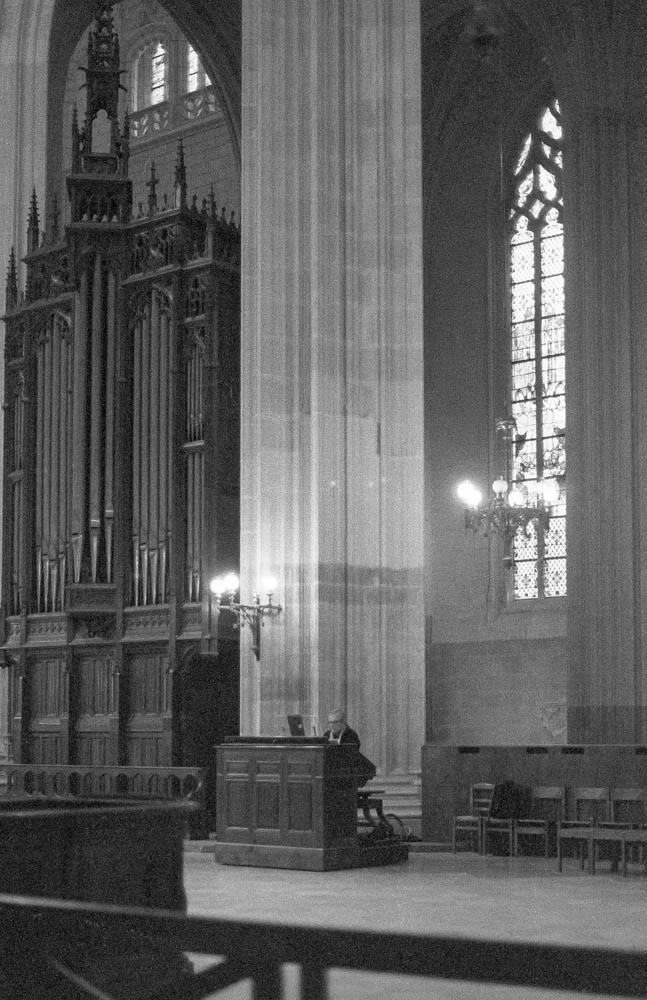
I didn’t set foot in the cathedral while Voyage en hiver draped its silence in municipal spectacle. Not out of protest—I simply couldn’t bear to see sacred space turned into a backdrop. So I waited. And when the banners finally came down in December, I loaded a roll of Ilford HP5 into my Nikon FE and walked back in—not as a tourist, not as a patient, but as someone hoping to find the light exactly where I’d left it.
I’ve always abhorred political recuperation. The Voyage en Hiver had no place in the cathedral’s reopening. This was about worship. About returning to God in a space that had been quiet for too long—not about municipal branding or winter tourism. “Give unto Caesar what belongs to Caesar, and unto God what belongs to God.” (Matthew 22:21)
That day, I chose God’s silence over their spectacle.
My hands were cold when I raised the camera. December light in a stone cathedral is a quiet thing—more absence than presence. I wondered, honestly, if 400 ASA would be enough. But I wanted authenticity: more grain than digital noise, more truth than polish. So I trusted the FE’s metering, opened up my aperture, and let the film do what it does best. No second-guessing. No LCD screen. Just the click of the shutter and the hope that the light would hold.
And it did.
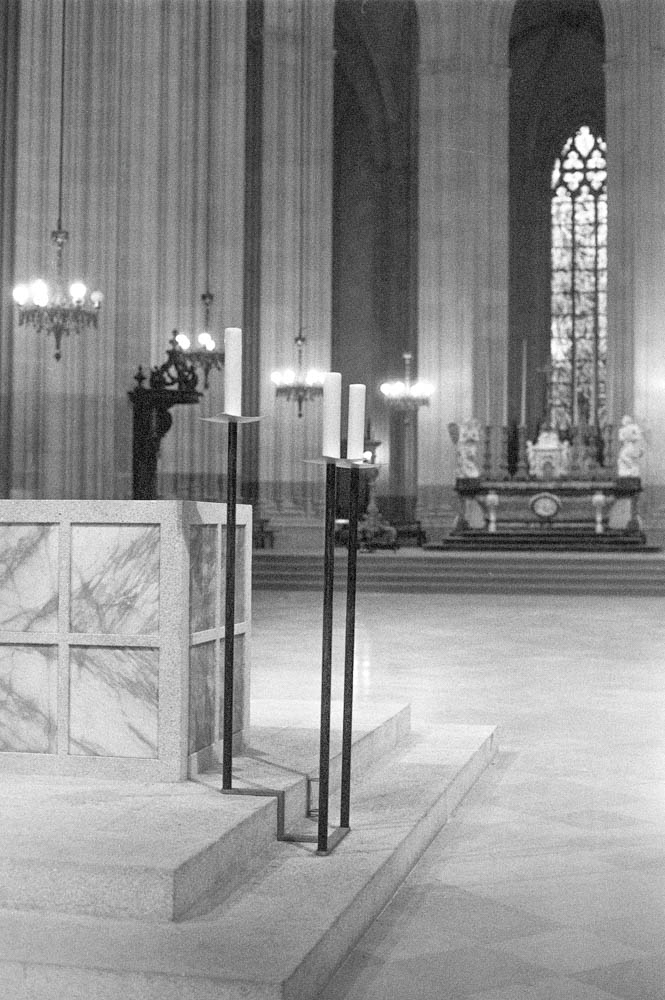
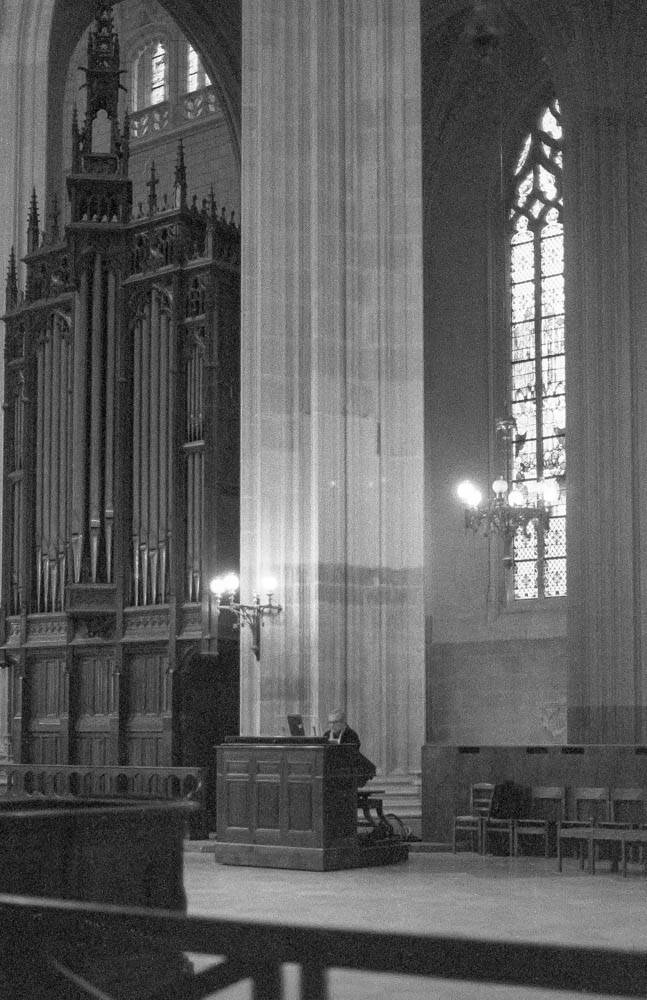
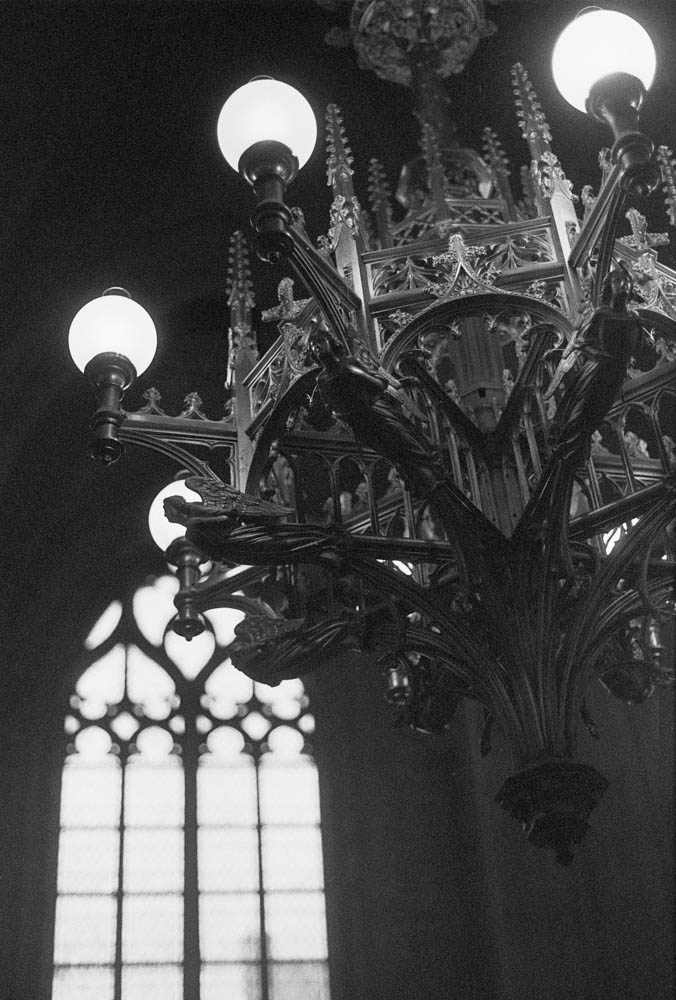
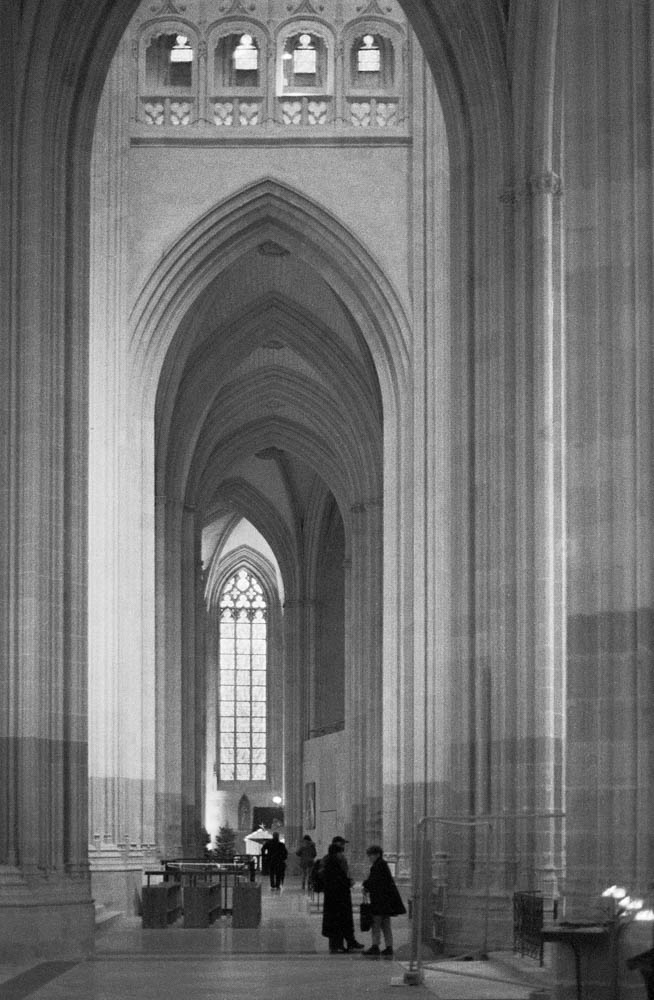
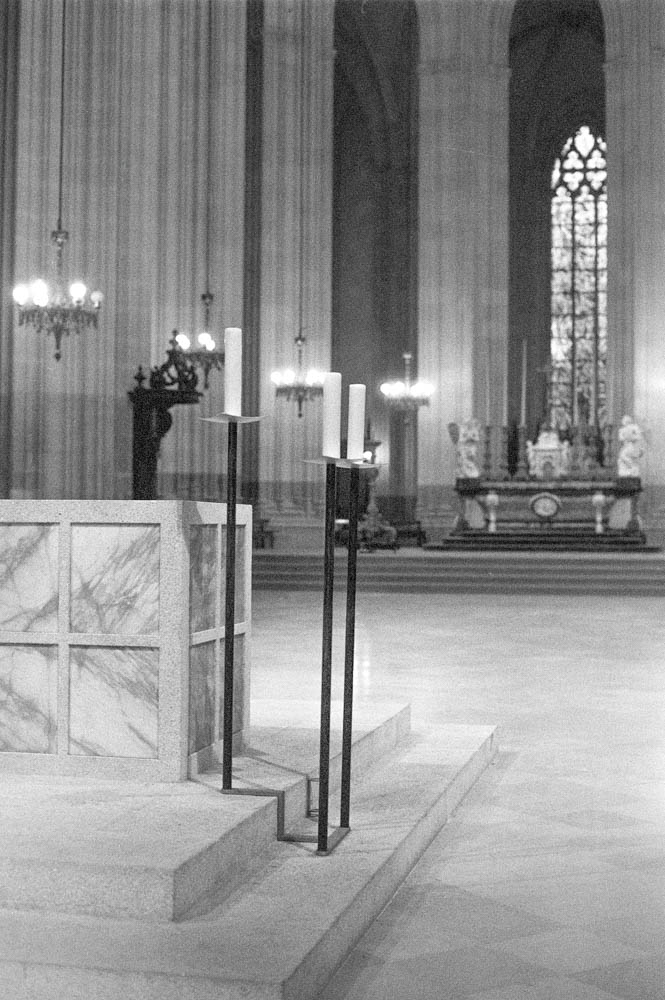
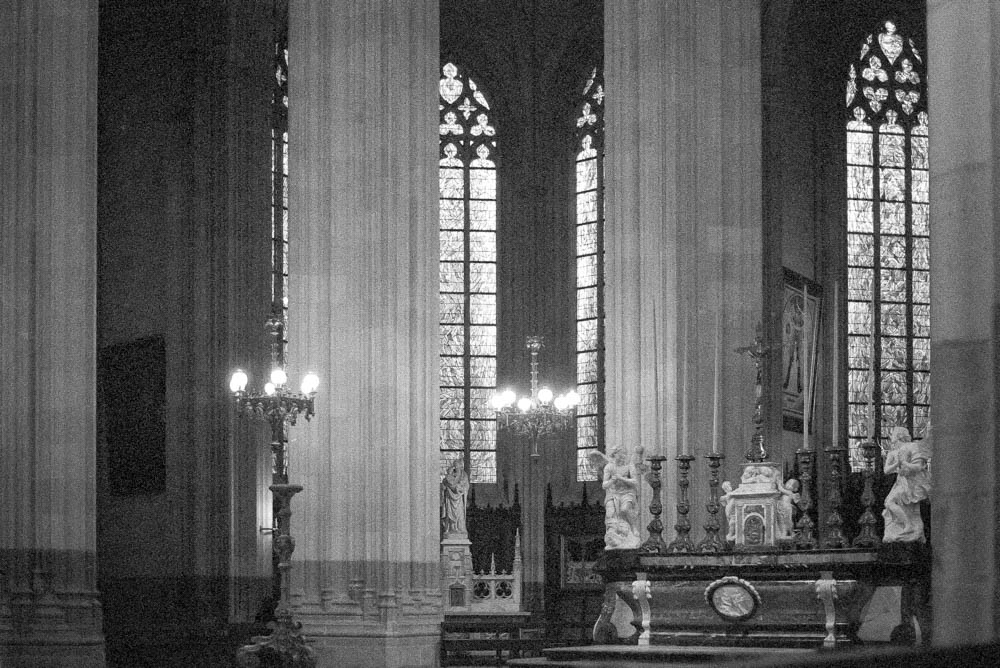
The frames that emerged are darker than summer would allow—but this was December, after all. And in that darkness, something gentle remains: the grain cradling the texture of worn wooden pews, shadows tracing the ribs of vaulted stone, candlelight bleeding softly into halos where no banner now hangs. Black and white stripped away every distraction—the logos, the seasonal clutter, the noise—until only what mattered remained: light on stone, silence between pillars, the architecture of reverence.
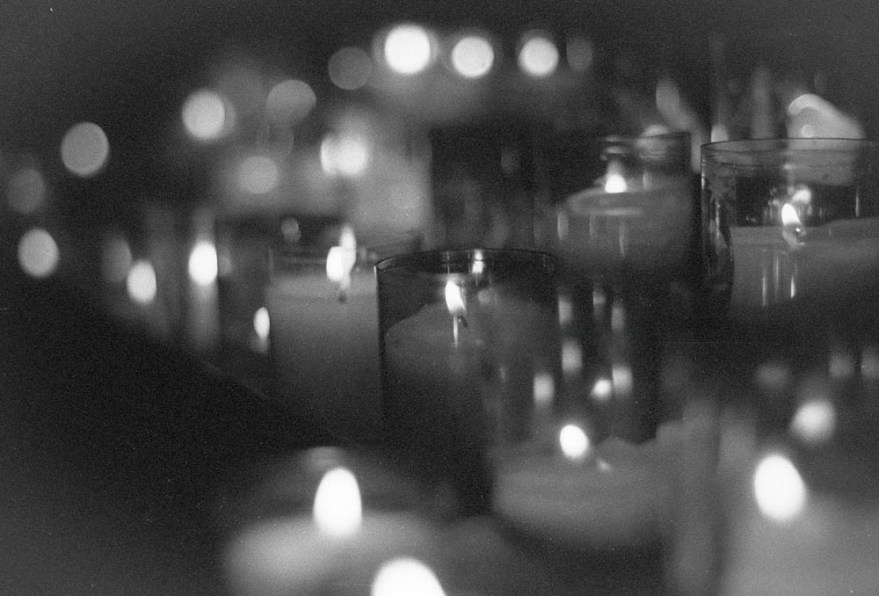
One frame in particular stays with me: the candles. Shot at 1/30s, my hands unsteady not from illness but from the simple weight of the moment. The focus slipped slightly. The flames blurred into one another. And instead of frustration, I felt a quiet relief—the film hadn’t captured perfection. It had captured presence. Grain became breath. Blur became prayer.
I didn’t go to “get out of the house.” I went because the space was clean again—just stone, silence, and the stubborn glow of candlelight. And for a few minutes, with the FE cold against my palm and the smell of incense in the air, I remembered why I love film photography: it doesn’t lie. It holds what’s there—shadows and all—and asks only that you trust the process.
They sold a spectacle. I took back the light. And the grain—warm, imperfect, alive—proved which one will last. My small act of reparation…
For years, I’ve shared images here — not because they were “good,” or “marketable,” or even finished — but because they stayed. They lingered after the shutter closed. They returned to me in dreams, in quiet hours, in the slant of afternoon sun months later.
Some moments refuse to be forgotten.
So now, carefully, tenderly, I’m offering six of them — made physical. Not mass-produced. Not disposable. Just… present. As they were meant to be.
Each print is produced through WhiteWall on museum-grade archival paper, using pigment inks rated for over 100 years. Made to order. Shipped with care — because if you’re making space for one of these in your home, I want it to feel like a conversation, not a transaction.
There’s no rush. No countdown. No pressure.
Just paper, ink, and a moment that mattered.
1.
Path to the Pavilion — Huizhou Lake, China
When they told us we were stopping at a lake before the evening concert, I wasn’t exactly thrilled. A leisurely stroll around a lake? Moi?
But China has a habit of surprising you.
When we arrived at Huizhou, surrounded by hazy sunshine and bamboo groves, pagodas rising from still water, temples half hidden in trees — I felt something I hadn’t expected. Happiness. Pure, uncomplicated, unexpected happiness.
I was walking slowly with Mathilde, one of our violinists nursing a bad foot, taking our time while the others rushed ahead. It was that unhurried pace that did it — the kind of walking that lets you actually see things. The light was filtering through the trees, sparkling on the water, and the path curved gently ahead of us toward a pavilion that felt like it had been there for centuries.
I raised the camera and didn’t think twice.
There are days on tour when the music and the place and the people all align into something you know you’ll carry for the rest of your life. This was one of them.
Shot on Fujifilm X100F — Huizhou Lake, China, 2024
2.
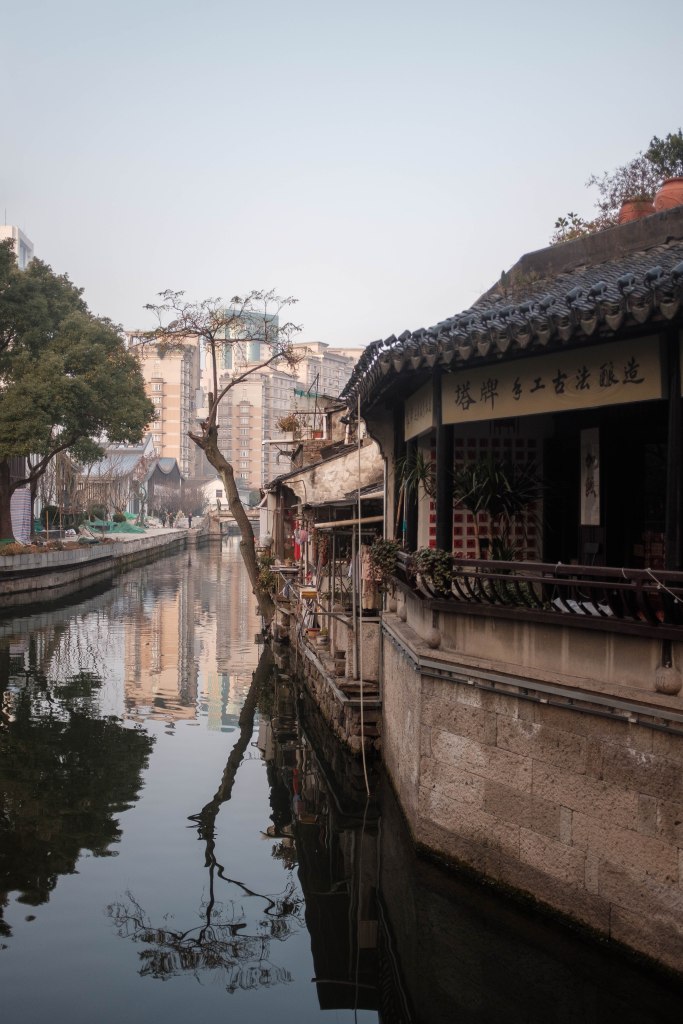
Reflections on the Canal — Shao Xing, China
It was one of the last mornings of the tour. The parenthesis, as I’d come to think of it, was beginning to close.
My colleagues had discovered a hidden residential quarter the evening before — the kind of place that doesn’t appear in guidebooks. Round entrances leading to inner courtyards. Red lanterns going up for Chinese New Year. Fish drying under the rafters. Boats drifting on ancient canals.
I was told to turn left outside the hotel, walk ten minutes, and I couldn’t miss it. Which is, of course, exactly the kind of direction I usually do miss. Not that morning.
The quarter was just waking up as I arrived, camera in hand — my wife having specifically asked me to remember to shoot in colour this time. People were clearing their throats, eating their rice for breakfast, mopeds carrying their passengers gently to work. The canals reflected the old white walls and tiled rooftops in the still morning water.
It was authentic China. Not the gleaming towers of Shenzhen. The China that has existed for centuries and quietly continues to exist, unhurried and completely itself.
I didn’t want to leave.
Shot on Fujifilm X100F — Shao Xing, China, January 2025
3.
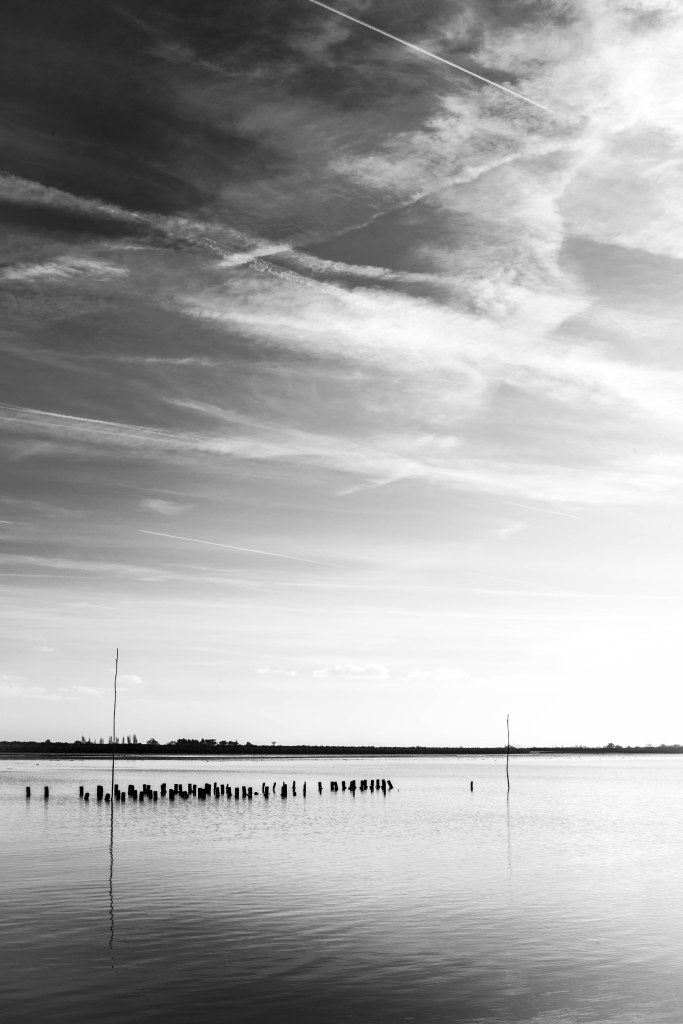
Skyline of Absence — Passage du Gois, Vendée
It started as a solo escape. A sandwich from a bakery, the Canon 6D Mark II dusted off, and a deliberate decision to go somewhere without tea shops to distract me.
The Passage du Gois is one of those places that shouldn’t exist. A road across the sea connecting the Vendée mainland to the island of Noirmoutier — but only when the tide allows it. Miss your timing and the Atlantic rolls in faster than a galloping horse. The beacons aren’t decoration. They’re for the people who got it wrong.
That January day the tide was out, the sky was vast, and Noirmoutier sat on the horizon like a quiet guardian. The blue reflected in the still water. The sea air did what sea air always does.
I stood there for a long time, just looking. The horizon was almost empty — just sky, water, and those silent beacons receding into the distance. An absence that somehow said everything.
Sometimes that’s all photography really is — permission to stand still and actually see what’s in front of you.
I like calm. I like it about as much as I like tea and cake.
Shot on Canon 6D Mark II with 50mm f1.8 — Passage du Gois, Vendée, France, January 2020
4.
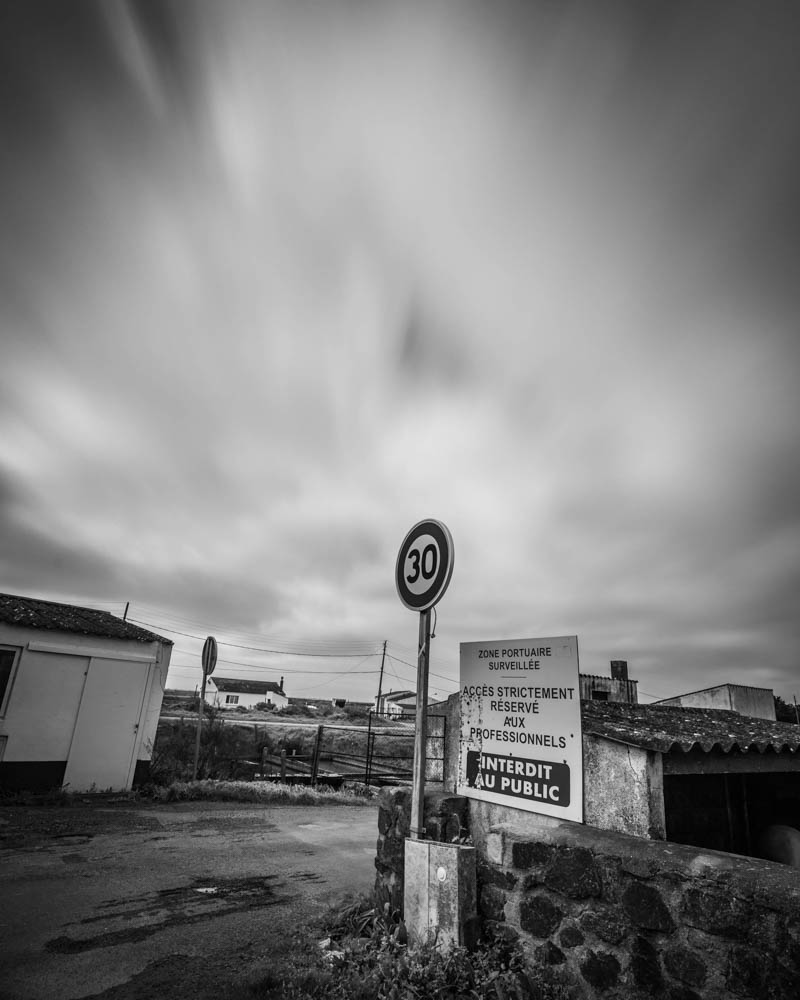
Coastal Sky, Vendée
There are days when the sky simply takes over.
Near Fromentine on the Vendée coast, I set up a long exposure and let the camera do what the eye cannot — blur time itself. The clouds became something liquid, something moving, while the sea held perfectly still beneath them. Two different versions of the same moment existing simultaneously in one frame.
This is not a dramatic sky. There is no storm here, no crisis, no golden hour showmanship. Just the coast breathing — slow and steady and completely indifferent to being photographed.
I find that deeply reassuring.
Shot on Canon 6D Mark II — Near Fromentine, Vendée, France, 2021
5. Title: Vespa & Whiskey
I’ll be honest with you. I’d spent the day doing what the Quartier Bouffay does best — supporting the local hospitality industry with some enthusiasm. Somewhere between lunch and late afternoon I’d slipped into the beautiful Église Sainte-Croix, perhaps to balance the accounts a little.
Coming back out into the afternoon light, I turned a corner and stopped dead.
There it was. A Vespa, resting against a whiskey crate as casually as if it had always been there. Vintage, unhurried, completely itself. The kind of scene you spend years hoping to stumble across.
I reached for the Praktica MTL3 — the same camera and Pentacon 50mm f1.8 lens I first learned photography on in the 1980s — and didn’t think twice. Some moments don’t ask for deliberation.
Right place. Right time. Right camera.
Shot on Praktica MTL3 with Pentacon 50mm f1.8 — Quartier Bouffay, Nantes, France
6. Steam and Sizzle, Shenzhen Night
They called it Operation Shenzhen Nights. Corentin and Paul had planned it with the enthusiasm of five-year-olds at a zoo — a night out in Shenzhen, no concert, no schedule, just the city.
We took the tube across town, red lanterns swaying overhead for Chinese New Year, and emerged into organised chaos. Street food stalls everywhere. Skewers of chicken, octopus, and things I decided not to look at too closely. Scorpions and crickets were offered. I drew the line there. Some adventures have limits.
But the steam rising from the food stalls against the neon-lit night — the sizzle and smoke and smell of a city that never quite stops — that was something else entirely. I had my camera out and I wasn’t putting it down.
Shenzhen at night is a city in perpetual motion. Young, electric, completely alive. Standing there amid the chaos — nearly 53 years old, gammy knee and all — I felt something I hadn’t expected. Completely present. Completely there.
What happens on tour stays on tour. But some images deserve a wall.
Shot on Fujifilm X100F — Shenzhen, China, December 2024
And then — because I believe in the power of the overlooked — there’s a seventh.
7.
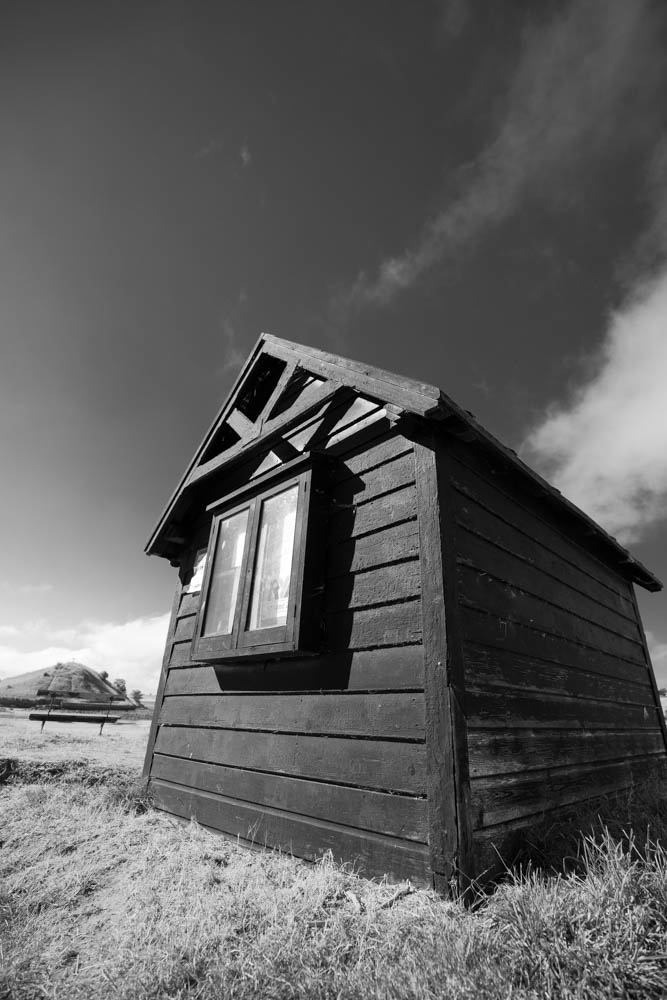
The Smallest Museum — Alnmouth, Northumberland, 2022
I’d started the morning properly — tea, toast, elevenses at Scott’s of Alnmouth, watching the sea mist lift off the Northumberland coast. When it cleared it was one of those impossibly sunny September days that makes you wonder why you ever left.
I wandered without a plan, Canon 6D Mark II in hand, letting the village reveal itself at its own pace. Alnmouth is that kind of place — it doesn’t rush, and it doesn’t need to impress you. It just is.
And then I found it. A tiny wooden shed standing quietly under an open sky. No grand entrance. No ticket booth. No gift shop. Just a modest building holding stories too small to shout and too true to ignore.
I stood there for a moment before raising the camera. Some things deserve a pause before you photograph them.
Shot on Canon 6D Mark II with 16-35mm — Alnmouth, Northumberland, UK, September 2022
I don’t make photographs to sell. I sell them because some moments refuse to be forgotten.
If one of these finds its way to your wall, I hope it does more than hang there. I hope it reminds you that some things are worth keeping — exactly as they were.
In a world that often feels unmoored, I’ve found grounding in the simple act of making and sharing photographs. I’m pleased to share that IJM Photography is now officially a registered micro-entreprise in France—a quiet but meaningful step forward.
Next month, I’ll be launching a small, carefully curated collection of print-on-demand photographs, drawn from images I’ve shared here over the years. To begin, I’m offering six 8×10 inch prints—some in rich colour, others in classic black and white—each printed on museum-grade archival paper and ready framed.
These are more than pictures. They’re fragments of light, memory, and place—moments I’ve carried with me, now offered to you.
I hope one of my images finds a home with you.
While the print collection launches next month, if you’d like to support IJM Photography today, donations of any amount are warmly welcomed.
Is film photography too expensive? Think again! Many assume that shooting film is a hobby reserved for the wealthy, but it doesn’t have to be. With the right approach, you can enjoy the unique aesthetic and creative process of film photography without breaking the bank. In this article, I’ll share my personal experiences and tips for saving money on film, developing, and gear, proving that the joy of film is accessible to everyone.
Often, even the tiniest things can spark a desire to write. In the infamous world of internet comment sections, people can have different opinions—a good thing, as it makes us reflect on our own positions. It challenges our perceived wisdom and questions us in ways that can be disarming. What’s obvious to me might not be to someone else.
I was talking to an Australian lady, likely of my generation since our photography journeys started the same way—with film. Except this lady has gone fully digital, keeping her film cameras as a reminder of her film days being over. Less hassle, less expense, less stress, and less “faffing about,” she said.
At first, I was taken aback. I love the film aesthetic in my photography. I like the predictability of film grain, as opposed to digital noise. But most of all, I’m in love with the process. I love the slower pace of film photography—none of this “spray and pray” nonsense. I appreciate how I become more mindful when shooting film, as each shot counts. I like the way an old film camera looks around my neck. And as the internet meme says, “I know about photography. I’ve been initiated into the exclusive circle of purists.”
The lady talked about the prohibitive prices of film and labs, which, let’s be honest, is a valid point.
Costs of Digital vs. Film Photography
I’ll talk about my kit and initial outlays compared to my film expenses. I bought my latest two digital cameras in late 2017 and 2018. My X100F cost around €1400, and my Canon 6D Mark II around €1200. I spent about €300 on a teleconverter for the X100F, and I probably have about €2500 worth of kit for the Canon, including speedlites, lenses, and filters. Then there’s the Fujifilm XT2, bought second hand for €400, with a couple of lenses totaling around €500.
This kit, though older, works well and is largely sufficient for my needs. As mentioned in my article “I Want It, But Do I Need It?”, I’d like a Leica, but do I need one? Would I refuse one if someone gave me one? Heck no! You can see the results throughout this site, and the images are great.
Let’s move on to film. Yes, if you love that Kodak Portra look, you’ll be spending a pretty penny. I have a certain nostalgia for the days when the prices hadn’t doubled. But—and this is important—not all film photography has to be done using Kodak Portra. There are more accessible films, especially black and white, that cost less. A roll of Fomapan 100 costs me around €5.50. So for less than the price of a pint of Guinness, I can get 36 shots. For a little more, I can go with Kentmere or even Ilford black and white film. I still have one roll of Portra left and a pack of five Tri-X medium format rolls.
Developing at Home
Ah, but then you have to send them to a lab to be developed. Again, a valid point. The cost for developing colour film where I go is less than €7 per film. I’ll share a little secret: I invested in a kit to develop my films at home. It cost about €140 initially, but now all I worry about is buying the chemistry. Yes, €30 for a developer seems steep, but I can develop 16 to 24 films with a bottle, depending on the dilution. I also invested €250 in a film scanner to produce digital files for editing.
Collecting Film Cameras
You might have noticed that I’ve talked about film but not film cameras. I started collecting a while back before hipsters raised the prices in the secondhand market. The most I paid for a film camera was just over €100, and the cheapest was €15. These film cameras are generally solid, and the lenses are great. The technology, though a little less modern (understatement of the year!), still works, and older cameras don’t even need batteries. And even those that do, the batteries last for ages. None of this “Do I have spare batteries for the X100F?” nonsense.
Each shot is taken on a brand new “sensor,” compared to shots on a digital sensor. And less dirt gets onto this sensor.
The Joy of Film
Don’t get me wrong, I love digital photography for its convenience and spontaneity. I can see my images right away and get instant feedback and gratification. With film, that gratification isn’t instant. You have to be patient and wait, but for people of my generation, that might be infuriating, it’s something we grew up with and accepted. I continue to accept it.
I enjoy using a machine sometimes older than me, knowing the image quality will be there. I know that with a certain film, I’ll get a certain result. I like the slower pace. If you visit the Film Photography page or the Film Archive page, you can decide for yourself if it’s worth the hassle, the expense, the stress, and the “faffing about.” I think it is, and I maintain that film has as much a place in photography as it ever did.
The Future of Film
Does film have a future? I think it does. Leica has relaunched the M6, Pentax has the new Pentax 17, and Kodak has the Kodak Ektar H35. The disposable cameras of yesteryear are still being produced and it has become the fashion to us them at weddings for that affordable yet classic look of film. Film photography continues to be popular with Gen Z and millennials. Case in point: my 25-year-old son nicked one of my Kodak Retinette 1B’s and a roll of film. I suspect my daughter might have her eye on one of my film cameras, too.
One thought came to mind whilst answering one of comments with the person saying that they “will never go back.” I am old enough to remember when microwaves fist came out. They were sold to us as being thoroughly modern and machines that could do everything so quickly and conveniently. Except they couldn’t. For certain tasks on the kitchen they are wonderful and far exceed the way we “used” to cook. But they can’t do everything. They have their place in the kitchen. And will always will do. But a slowly simmered boeuf bourguignon that infuses its odours through the kitchen will always have a special place in my heart. Much like using film to capture my images…






 IJM Photography