Same diagnosis as Part 1, same prescription. The opening four paragraphs are genuinely good — terse, cinematic, the rhythm earns its keep. “The sunlight was gone. The fluorescents were on. The break was over.” — that’s a real sentence. Then the Roman numerals arrive and flatten everything into a report again. “What I’d Do Differently” is still there. The sign-off prompts are still there.
The three-column table is worth keeping — it’s doing more work here because there are now three films to compare across the whole weekend. That earns its place.
Here’s the rewrite:
Part 2: The Work — Rehearsing a Double Violin Concerto on HP5+ 1600
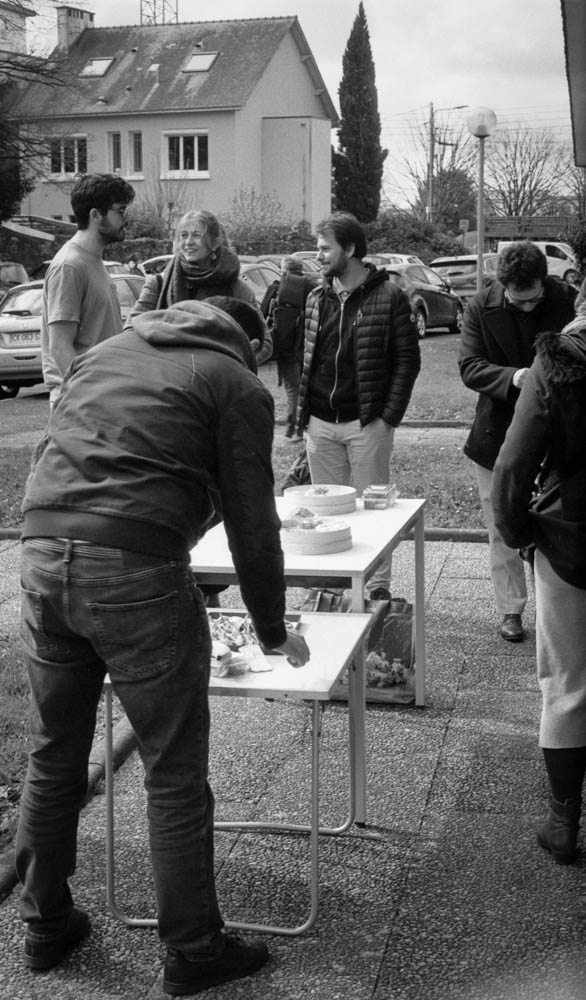
The lunch break ended. Tables were folded. Containers packed. The last crumbs brushed away.
And then they arrived.
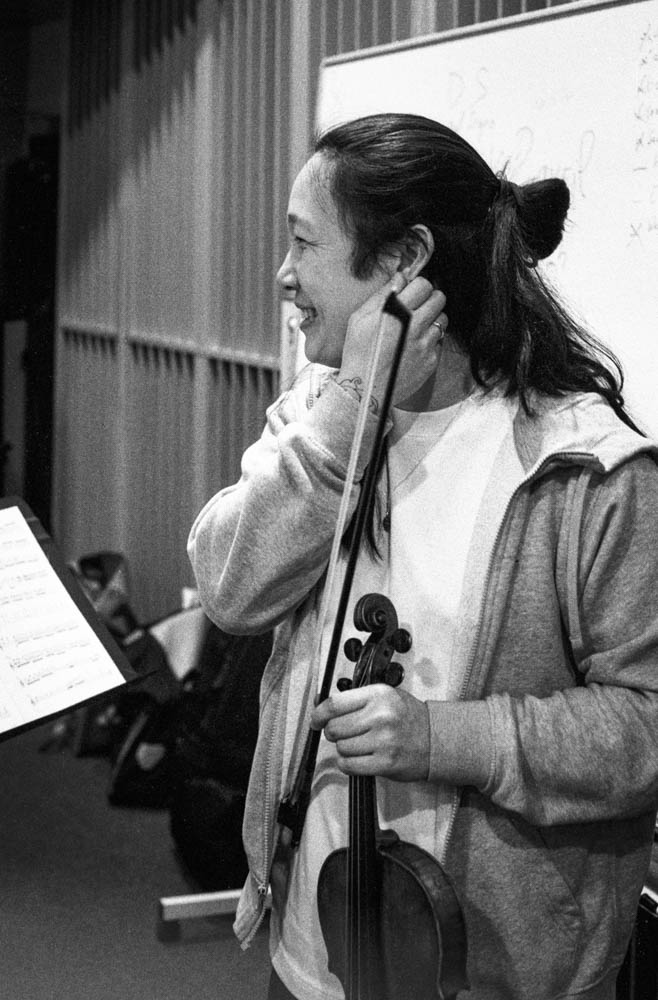
Two Chinese violin soloists — guest artists who’d travelled some distance to play a double violin concerto with our little orchestra in a French community centre. They weren’t at lunch. They weren’t part of that casual, sunlit gathering outside. They were here for work.
So were we.
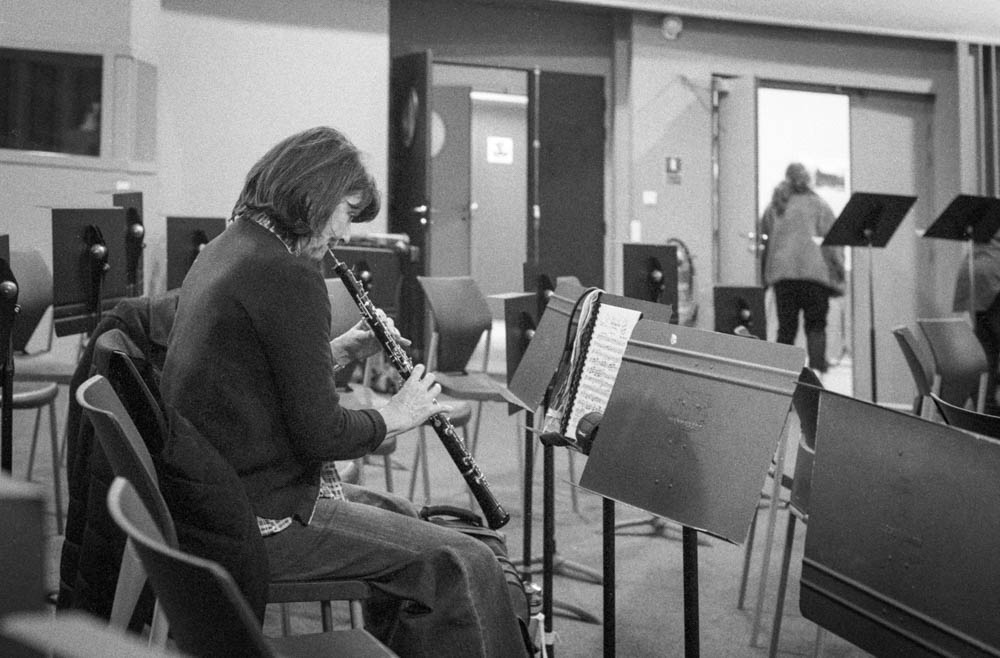
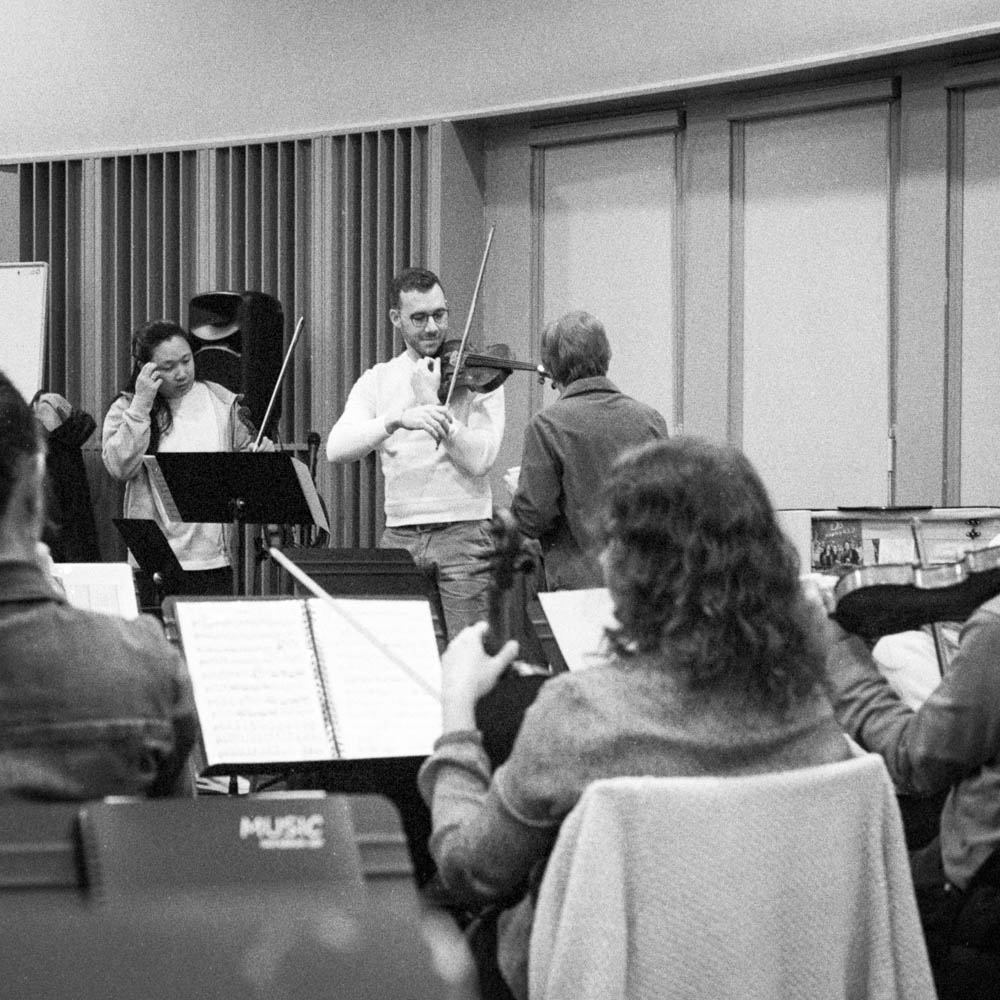
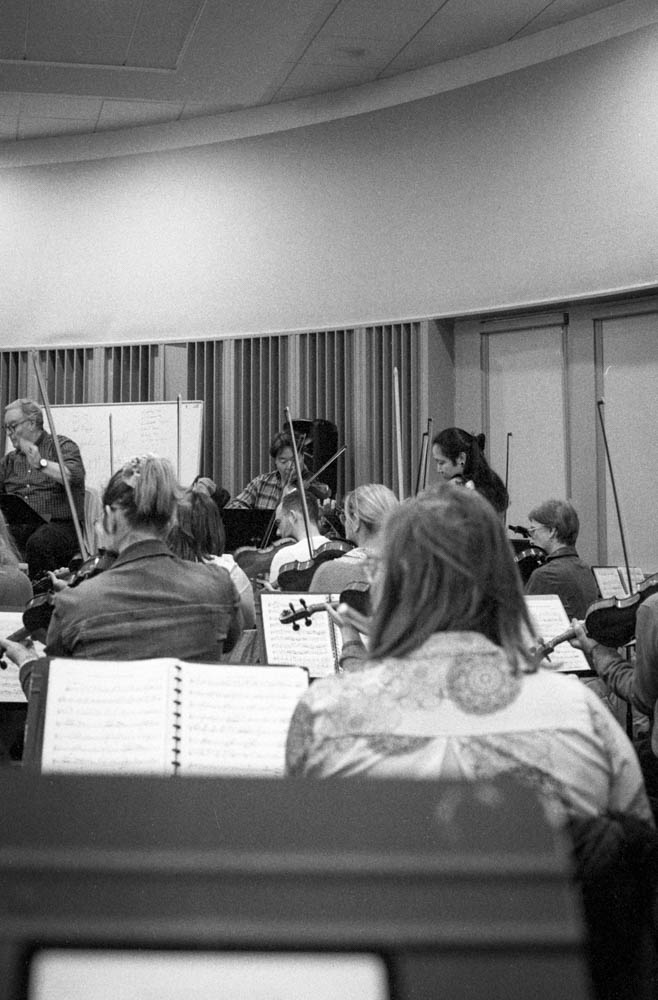
I put down the Fomapan and loaded HP5+ pushed to 1600. Swapped the Pentax for the Canon AE-1 Program. Same 50mm philosophy, different camera, different film, different mood. The sunlight was gone. The fluorescents were on. The break was over.
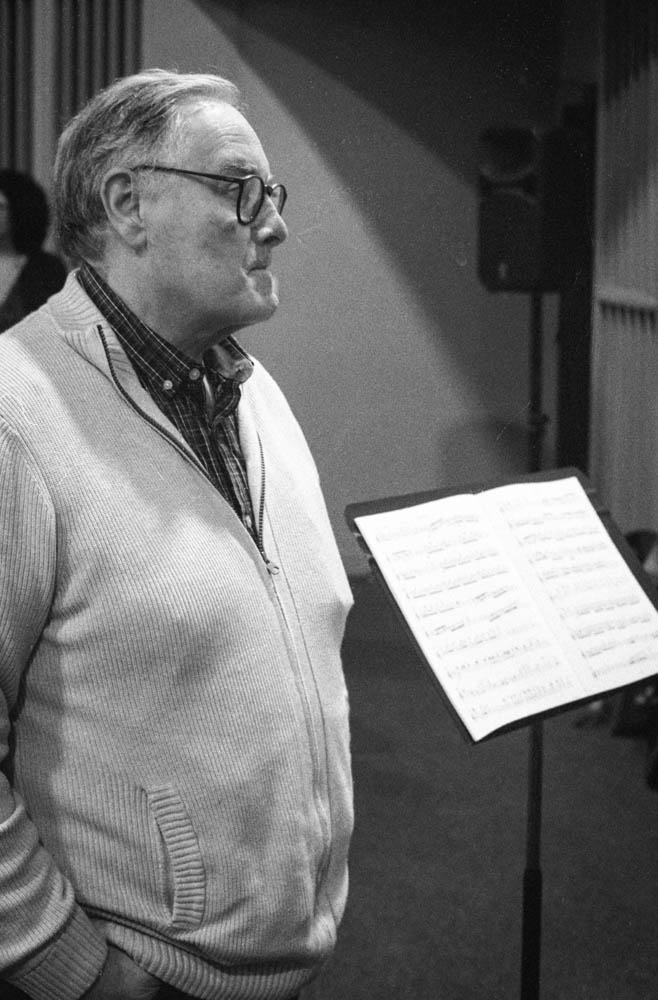
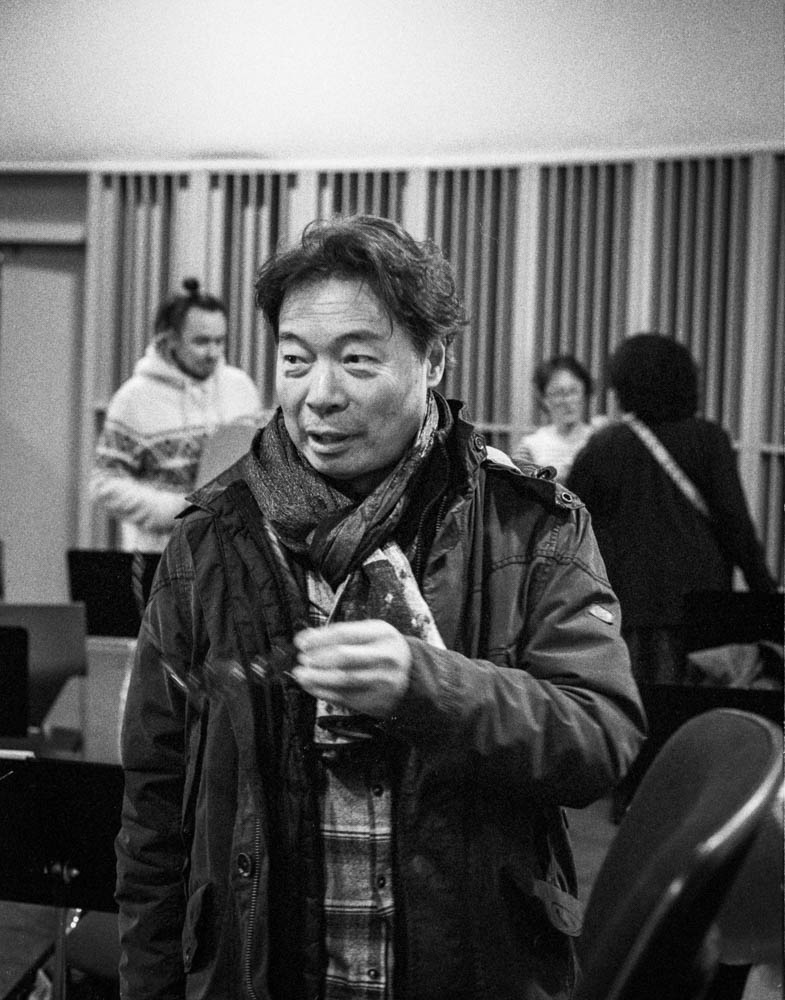
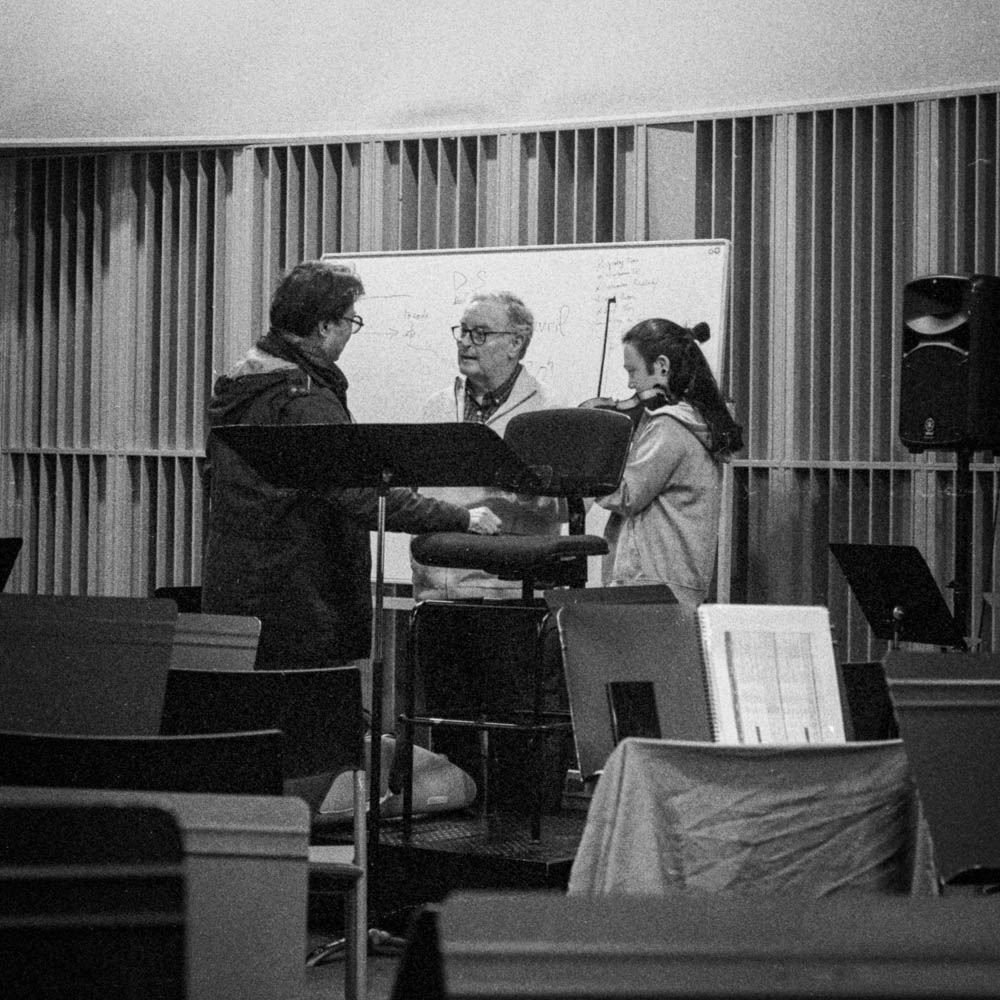
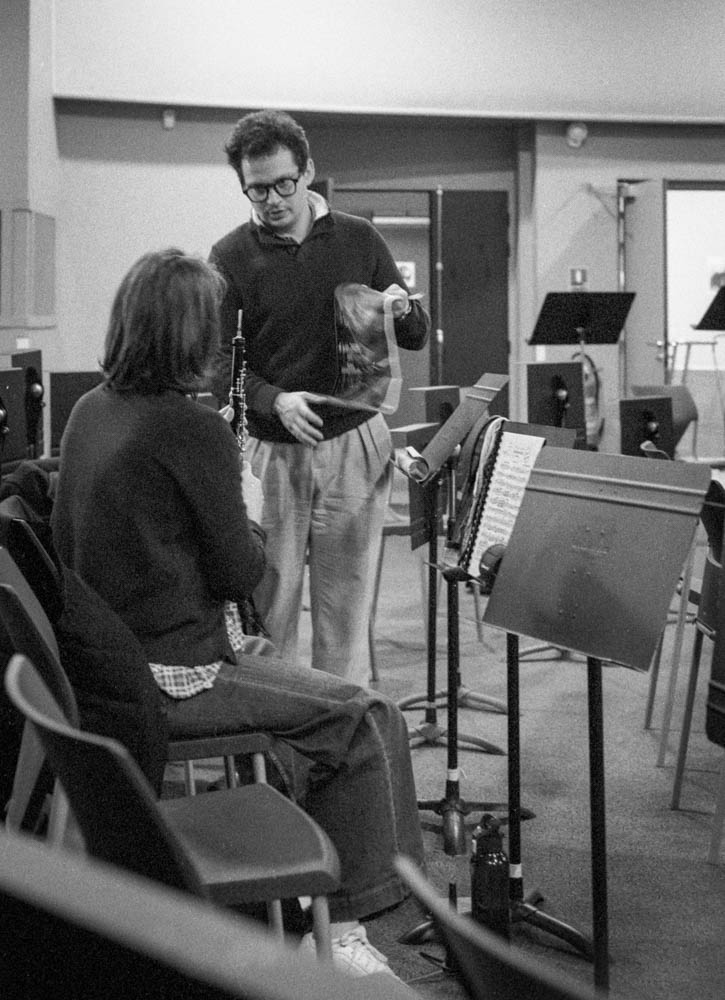
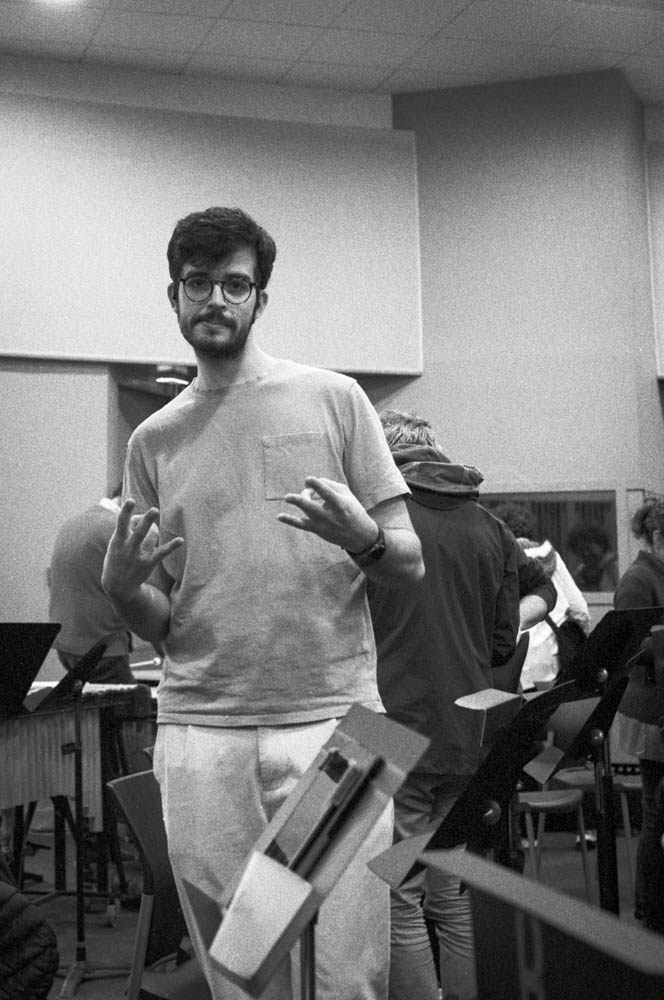
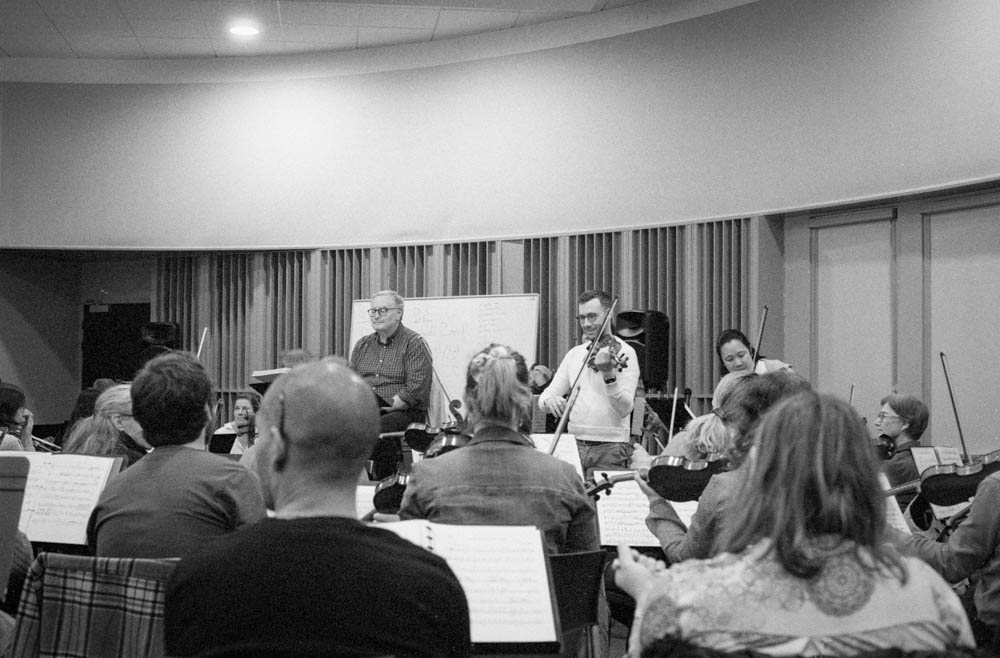
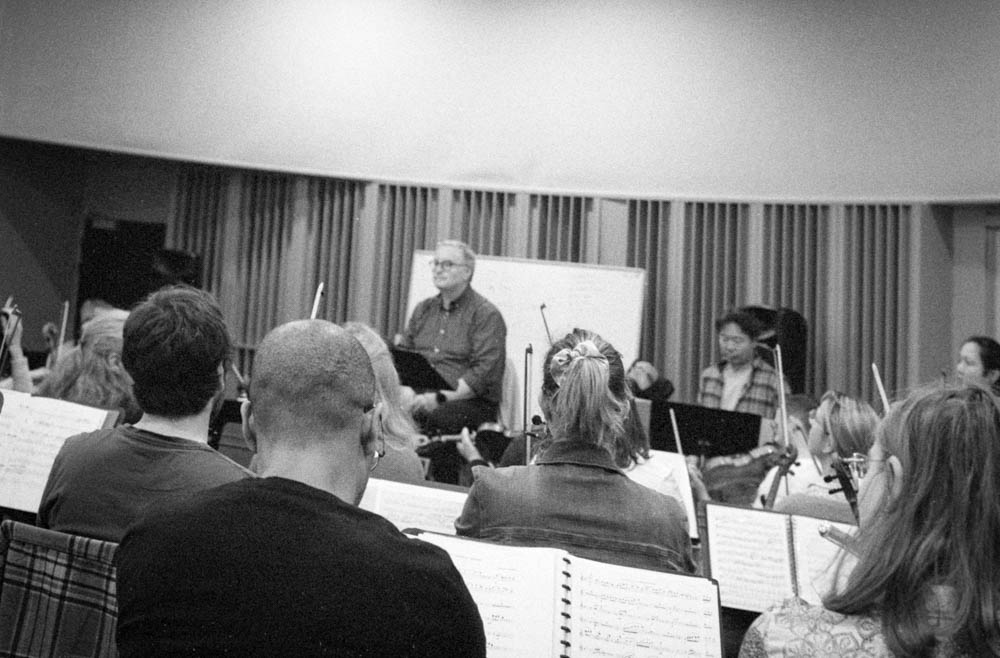
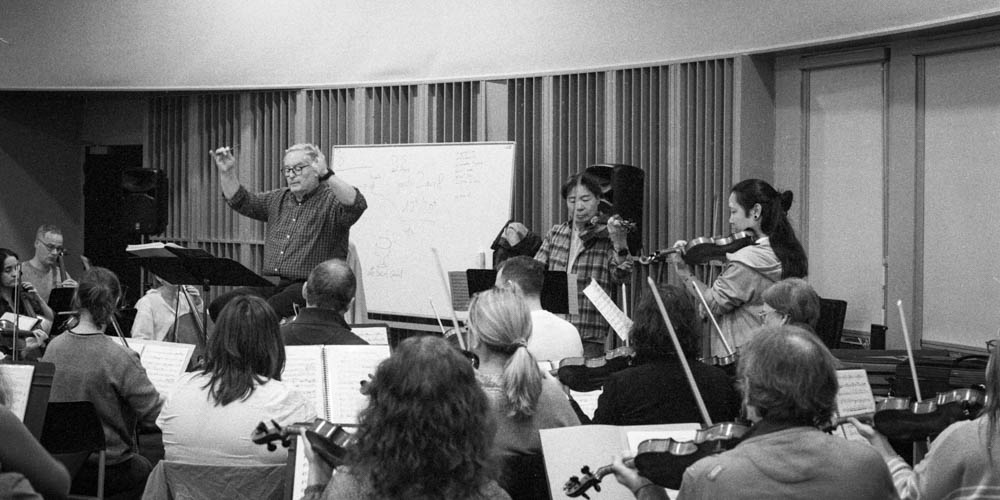
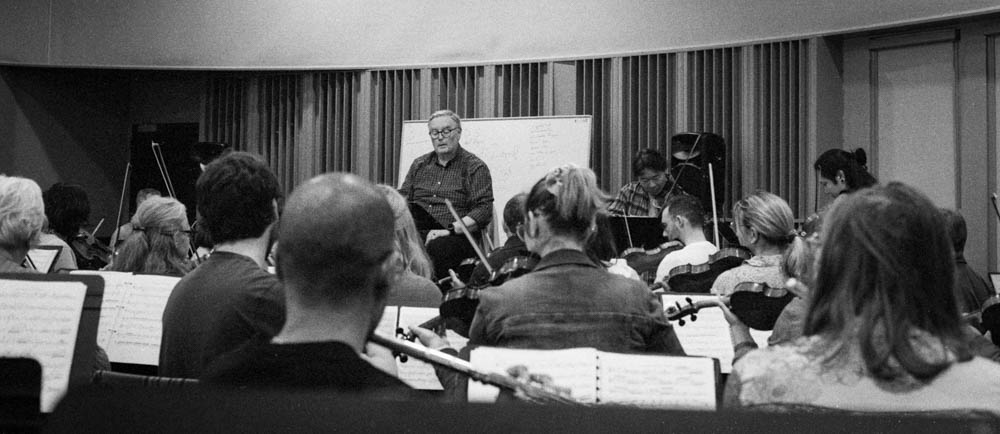
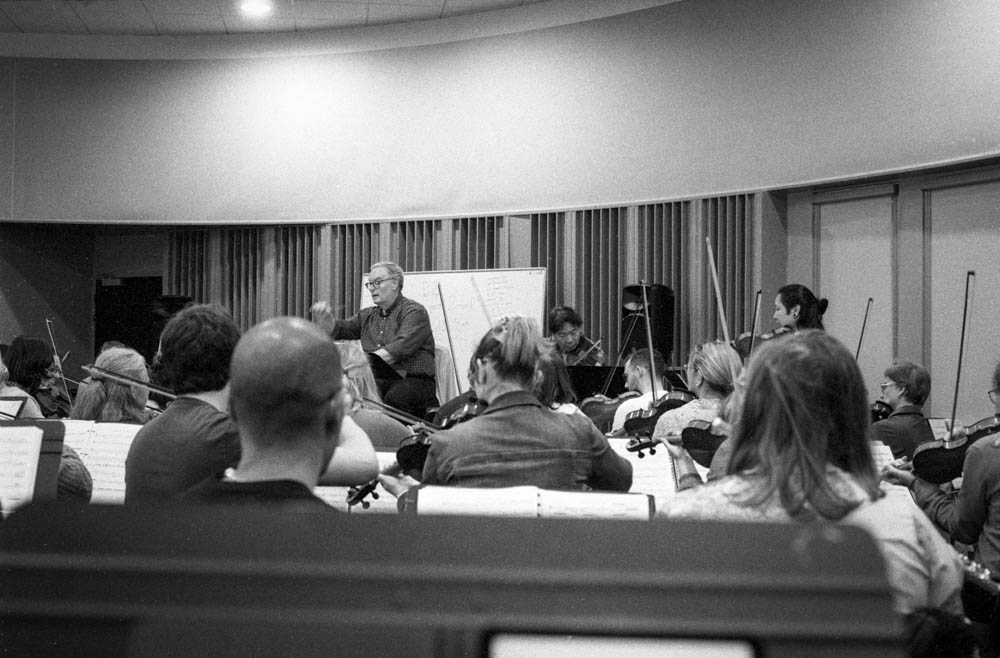
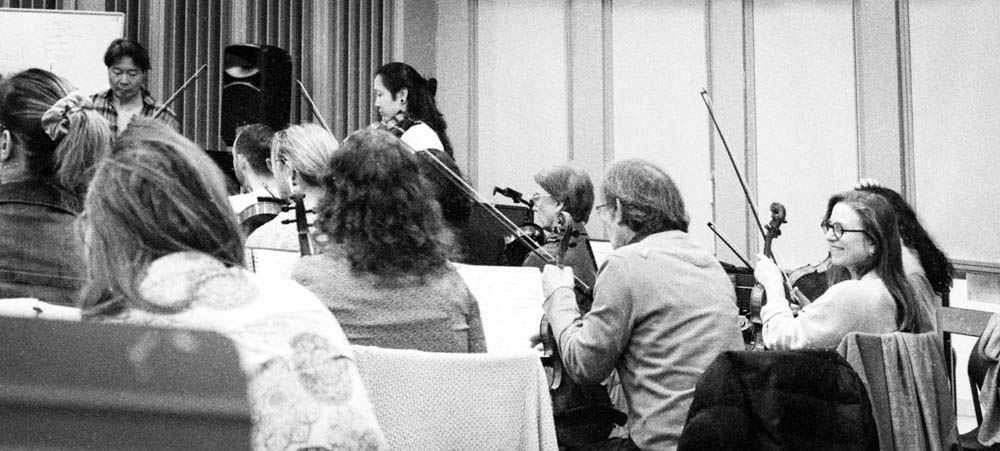
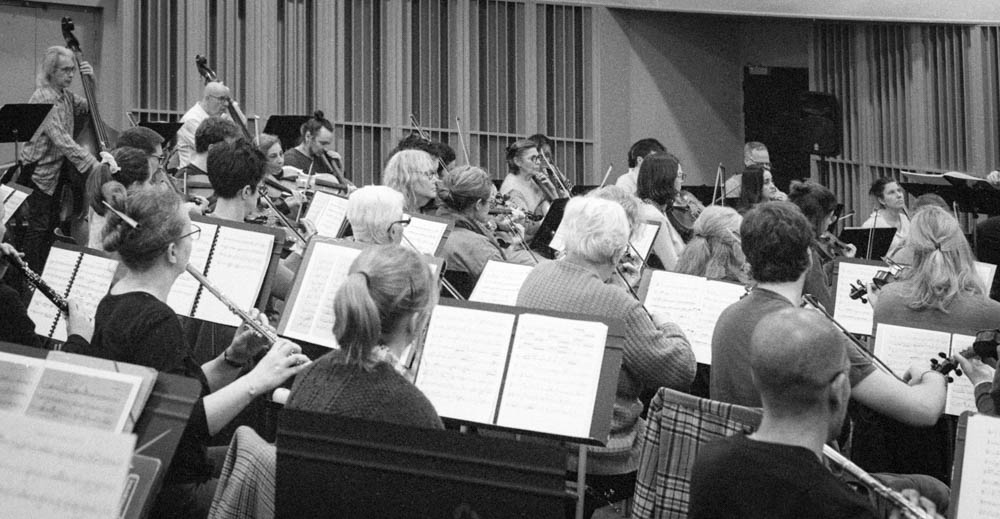
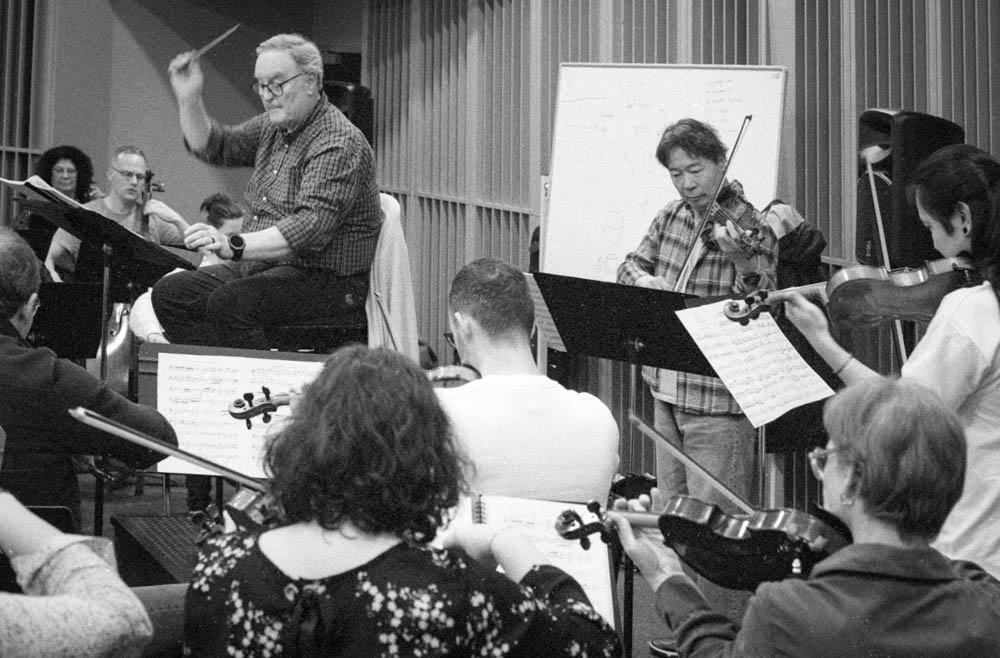
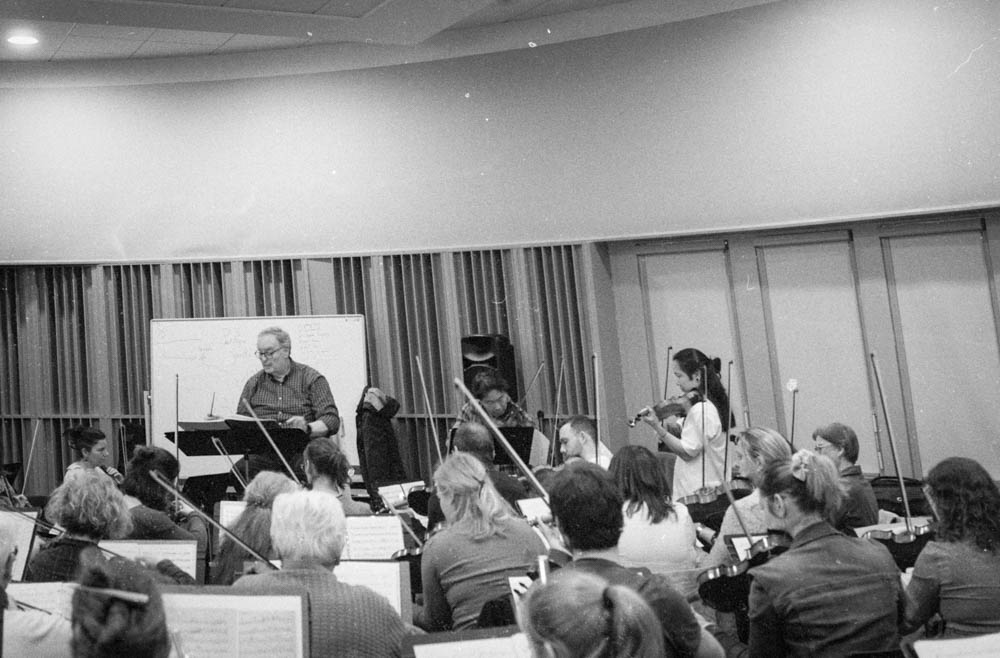
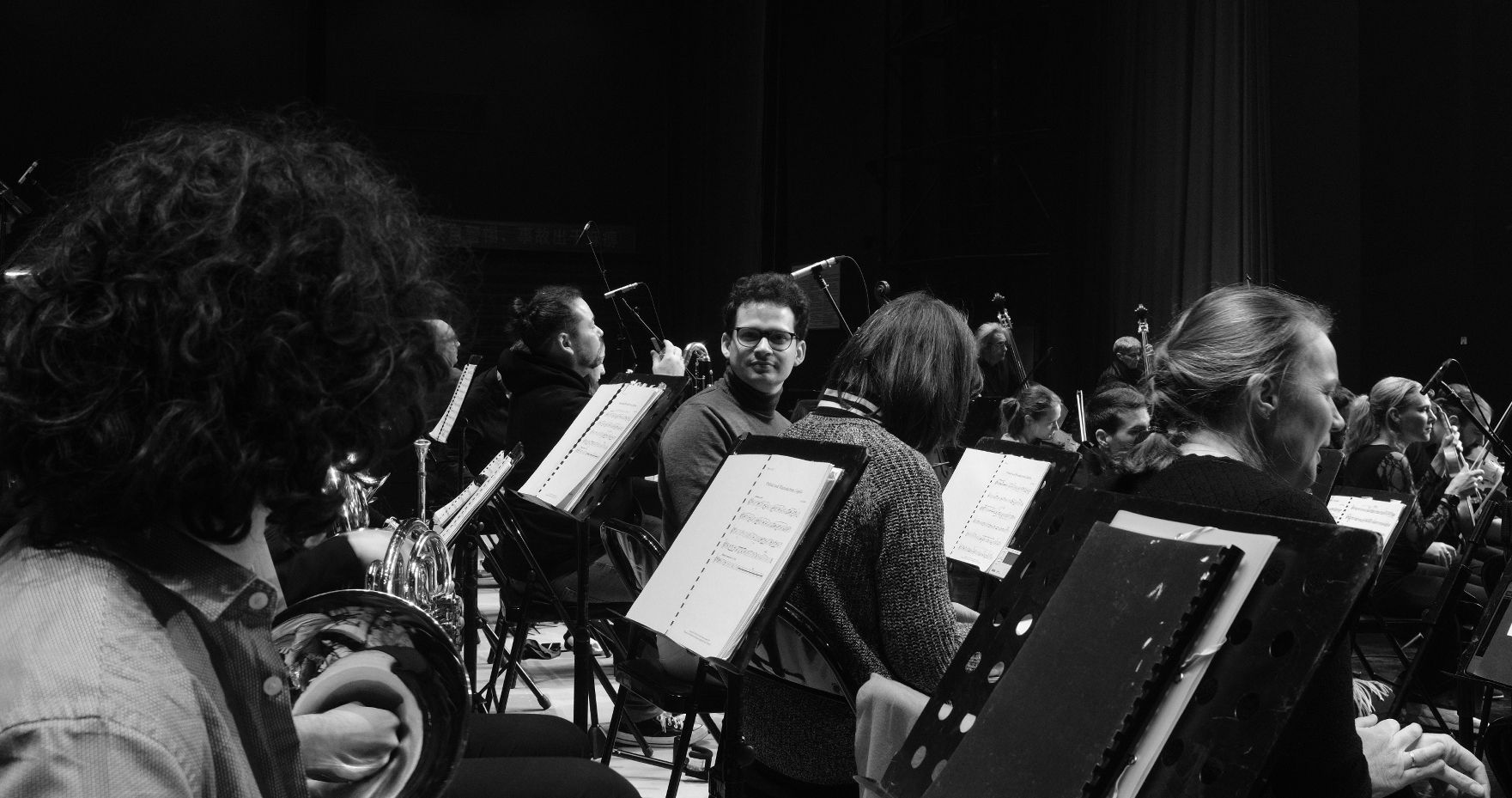
You can feel it when rehearsal starts — the shift from community to concentration. From chatting about weekends to counting measures. The conductor, same man who was smiling over a food container an hour ago, is now at the whiteboard, baton in hand, writing notes about tempo and bowing. The soloists take their places at the front. Tuning. Focused. Not quite part of our tribe yet — guests, professionals, here to do a job.
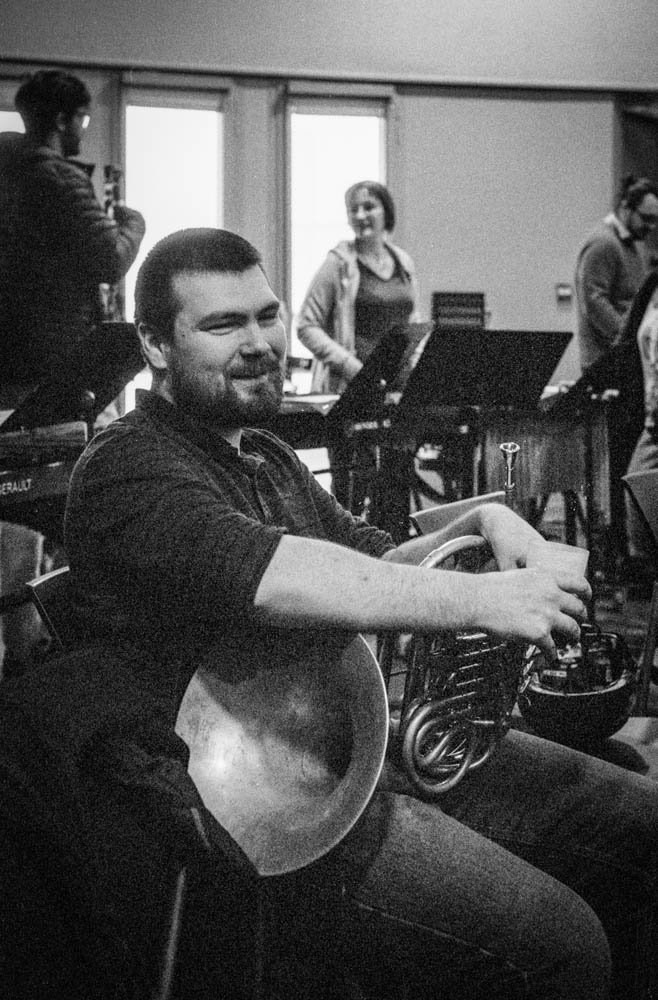
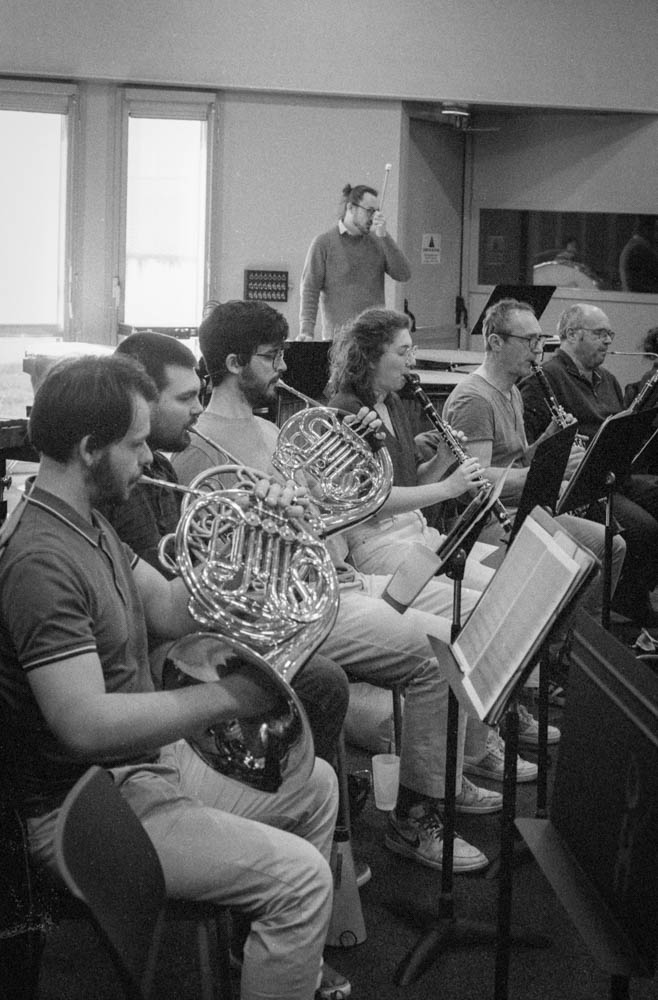
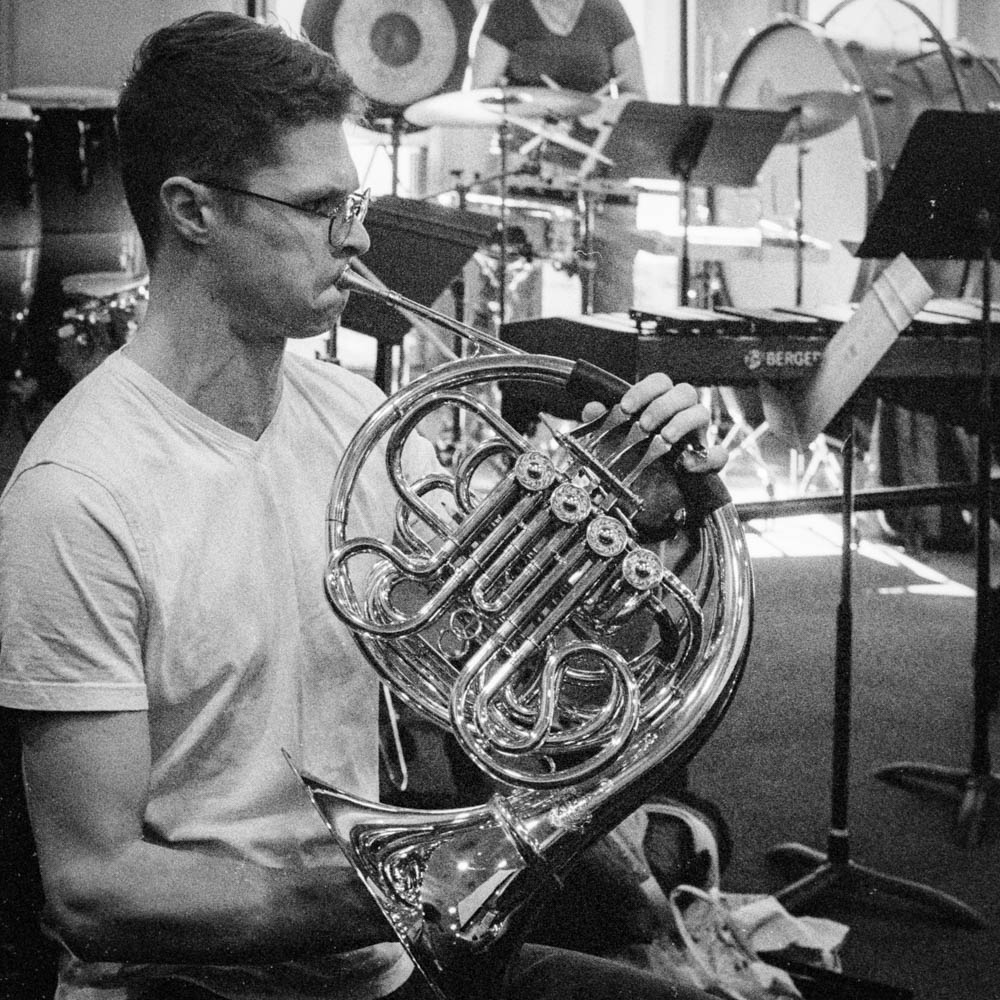
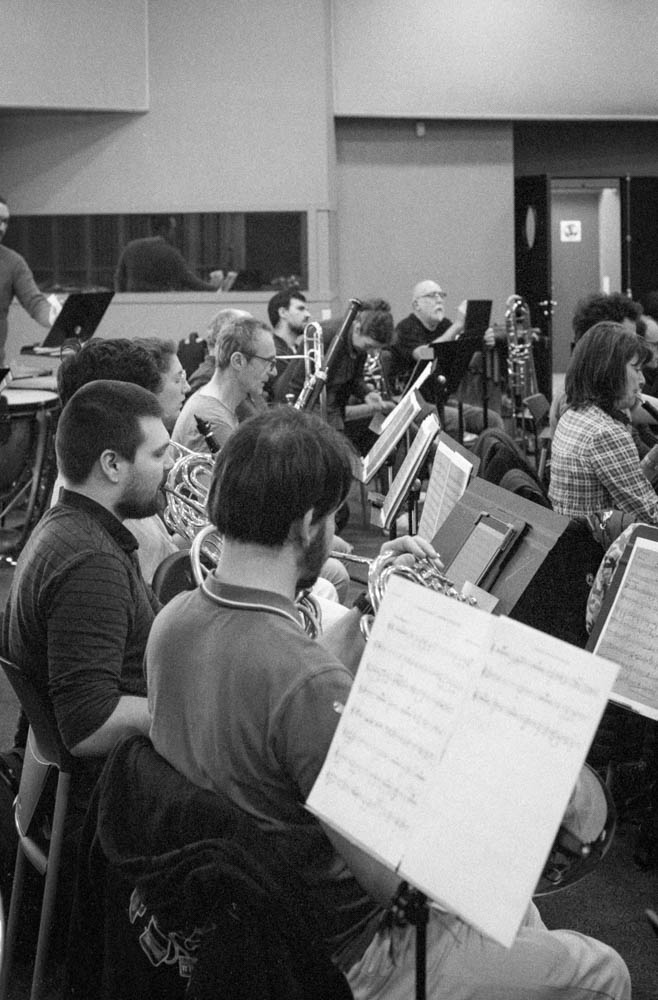
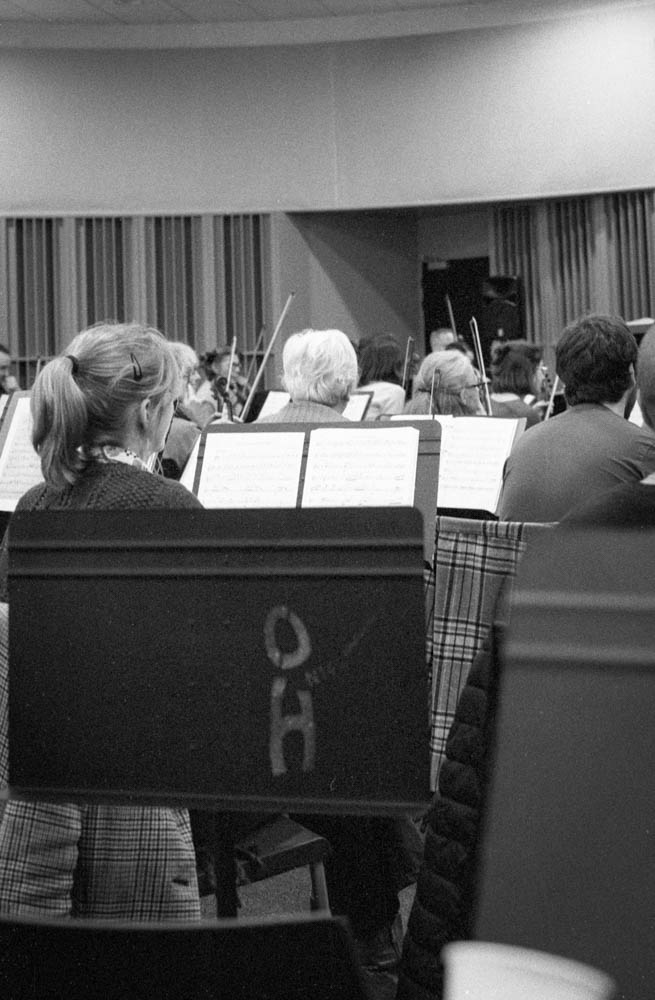
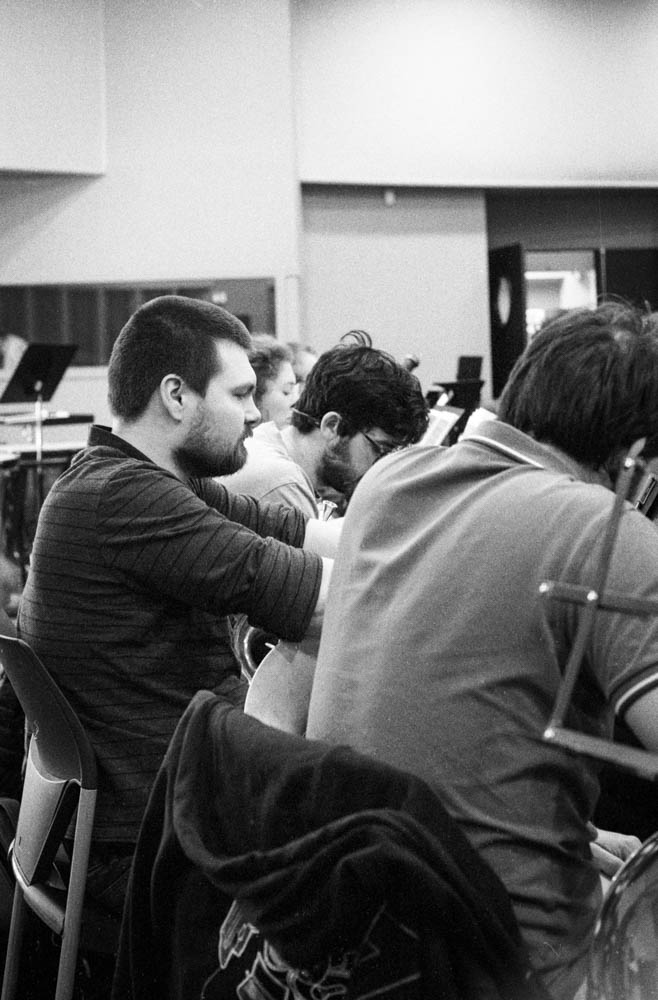
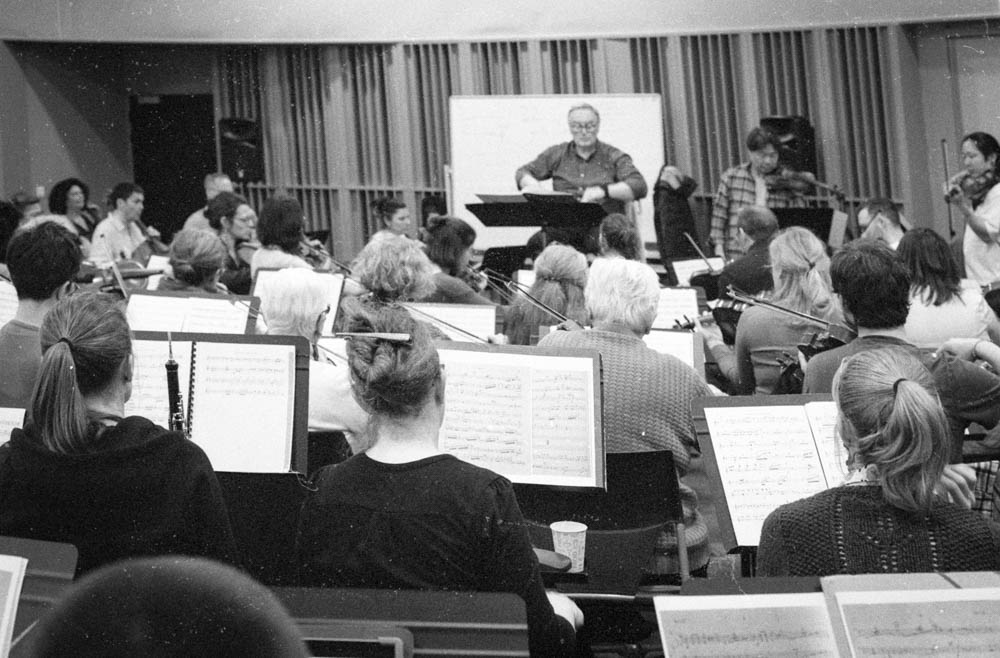
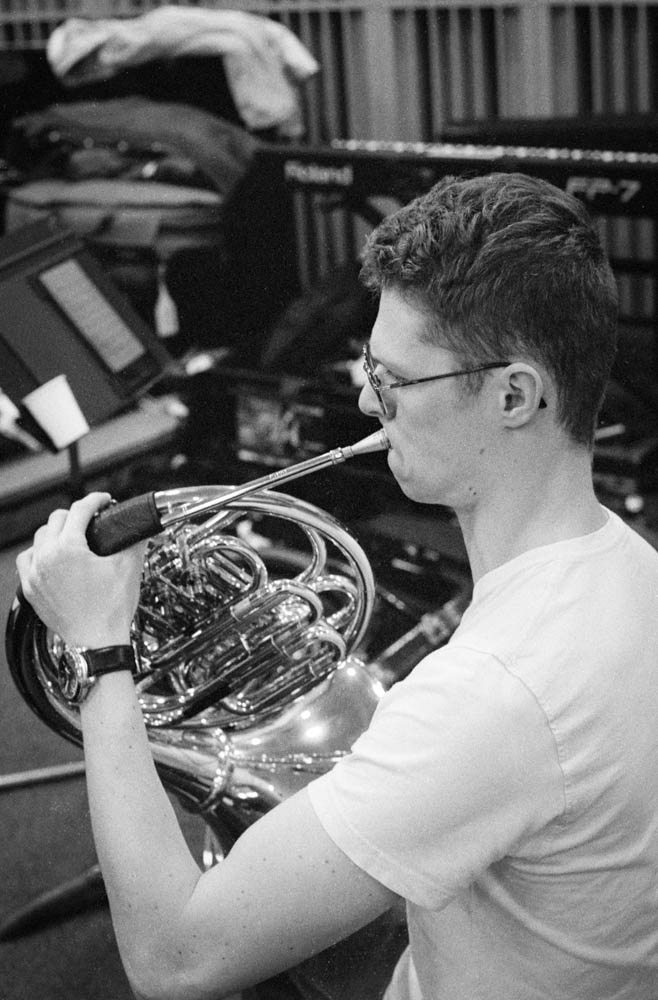
I photographed from my seat in the horn section and from the aisles during breaks. The AE-1 Program in Program mode — no thinking about shutter or aperture, just framing and timing. The camera handled exposure. I handled seeing.
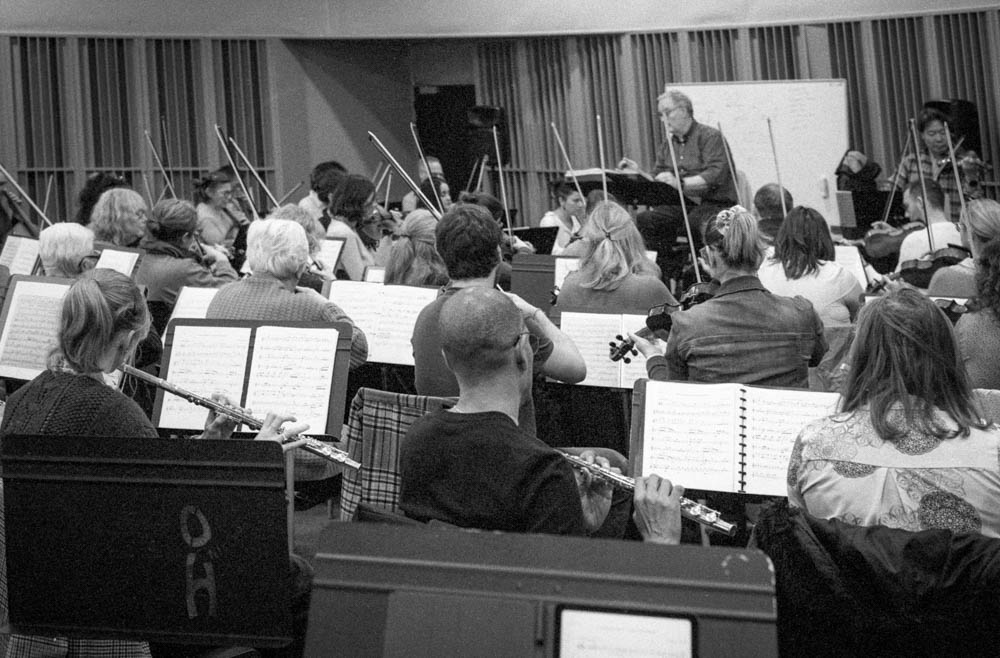
What you witness, photographing a concerto rehearsal, is translation. Not just musical ideas passing between conductor and players, but something more specific: two soloists from one tradition finding a shared language with an orchestra from another. The conductor stops us. Softer in the strings. The soloists adjust. He stops again. A touch more projection. They adjust. We play. He listens. He stops. This goes on. Not because anyone is wrong, but because everyone is finding the same musical space.
HP5+ at 1600 sits in the right place for this. Not the fine, almost invisible grain of the Fomapan lunch shots. Not the raw, declared grain of 3200. Textural, controlled, appropriate — honest about the work without dramatising it.
The three-roll arc of the weekend, laid out:
Fomapan 100 — Lunch
HP5+ 1600 — Concerto
HP5+ 3200 — General
Light
Natural daylight
Mixed indoor fluorescents
Mixed indoor fluorescents
Grain
Fine, subtle, clean
Textural, present, controlled
Pronounced, bold, raw
Contrast
Gentle, even
Moderate, balanced
Punchy, dramatic
Mood
Relaxed, communal
Focused, collaborative
Urgent, iterative
Story
Community at rest
Collaboration at work
The machine in flow
Same orchestra. Same weekend. Three worlds — and the technical choices were the point from the start.
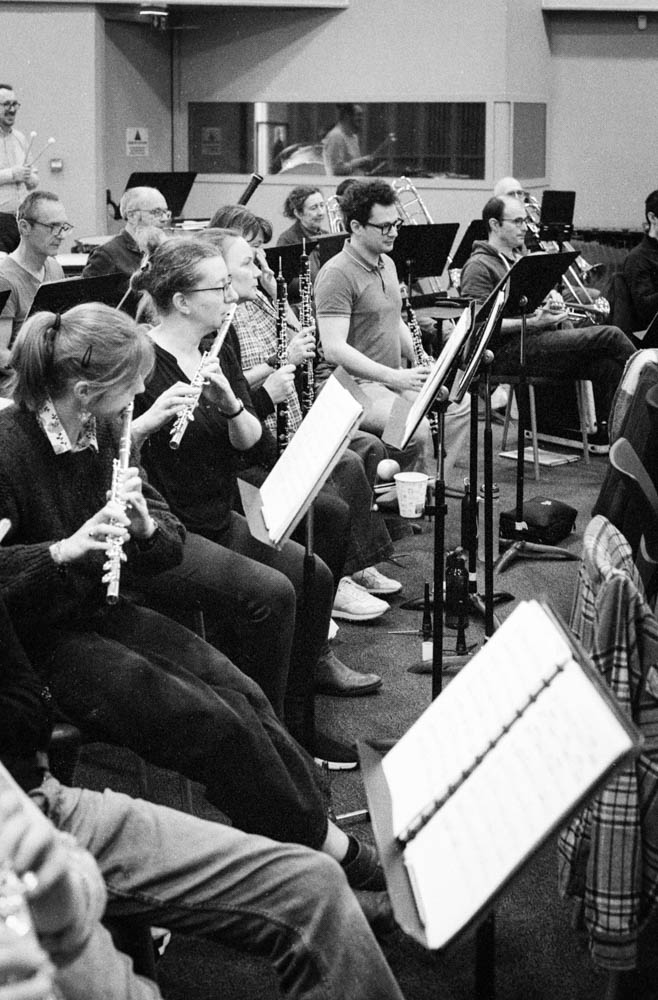
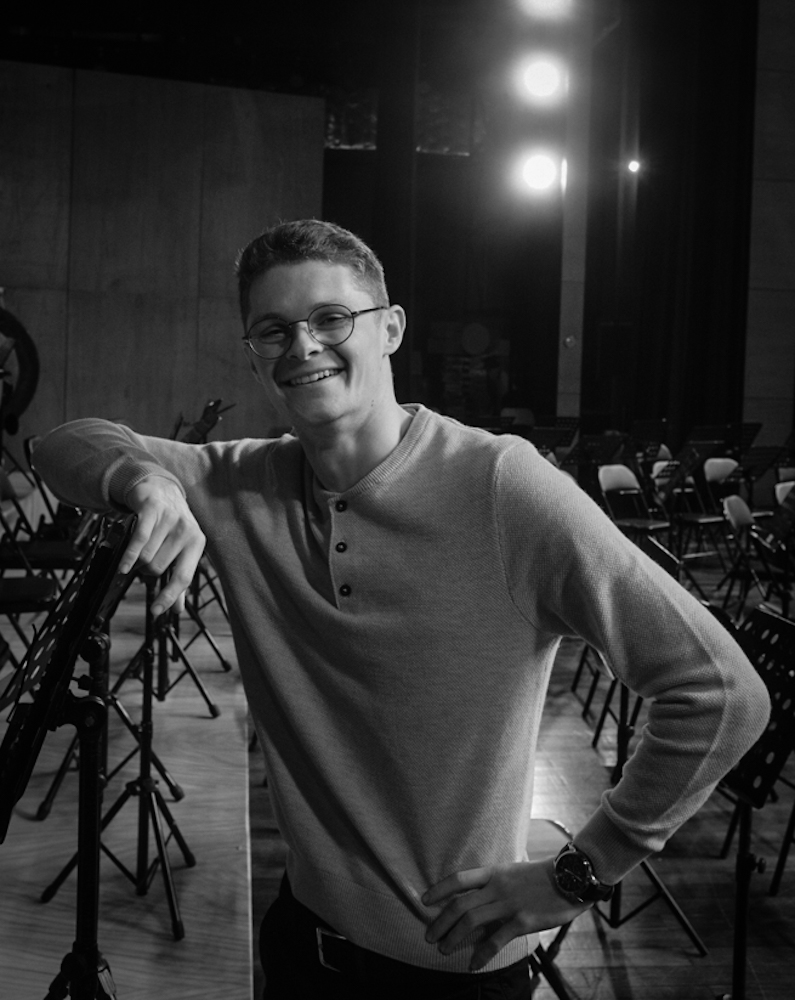
From my seat in the horns I see the whole machine differently than an outsider would. I know which passages are coming. I know which sections are struggling. I know the rhythm of this room. But through the viewfinder I see something else — the strings moving in that eerie synchronised way, the brass gleaming under the fluorescents, Viktor on oboe, Nicolas patient behind the timpani, Corentin next to me absorbed in something difficult, glasses slipping, completely gone.
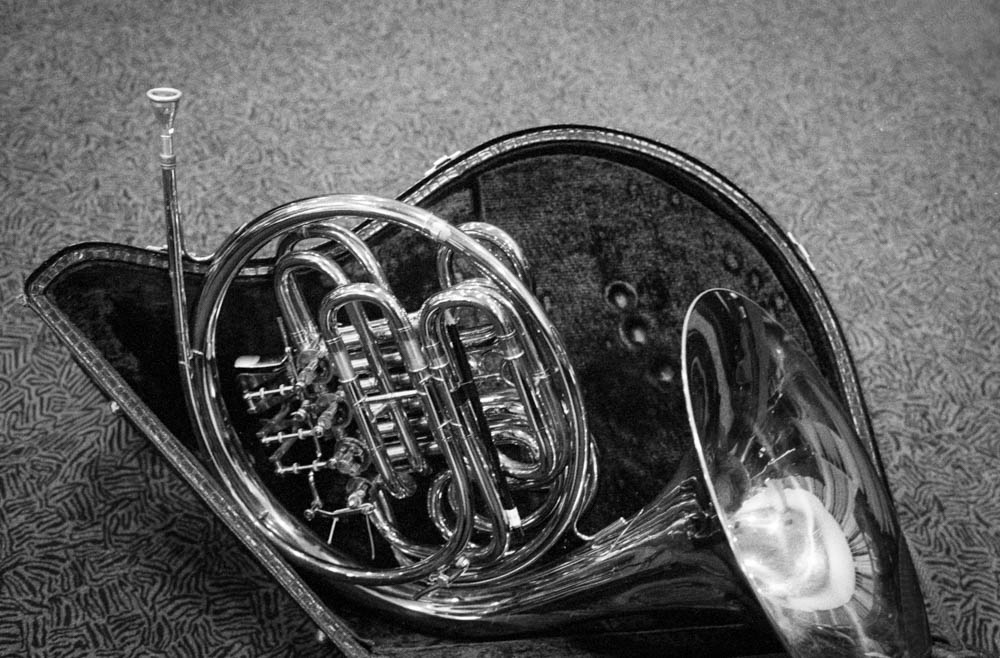
The small details tell it too. A French horn resting in its case between takes. Coffee cups on the floor near the woodwinds. Sheet music thick with pencil marks. These are the million small adjustments that add up to a rehearsal — and eventually, if everything goes right, to music.
Saturday was the concerto. The focused, collaborative work. Sunday would be the rest of the programme — no soloists, just the orchestra and the conductor and whatever needed fixing. The grind. The iteration.
Part 3 is coming.
Shot on Canon AE-1 Program, 50mm f/1.8, HP5+ pushed to 1600. Edited in Lightroom — contrast via tone curve, subtle vignettes, nothing added that wasn’t already there.+ 3200—is coming next. The grain gets heavier, the light gets harsher, and the work gets real.
Let’s be honest: orchestras run on two things. Music and food.
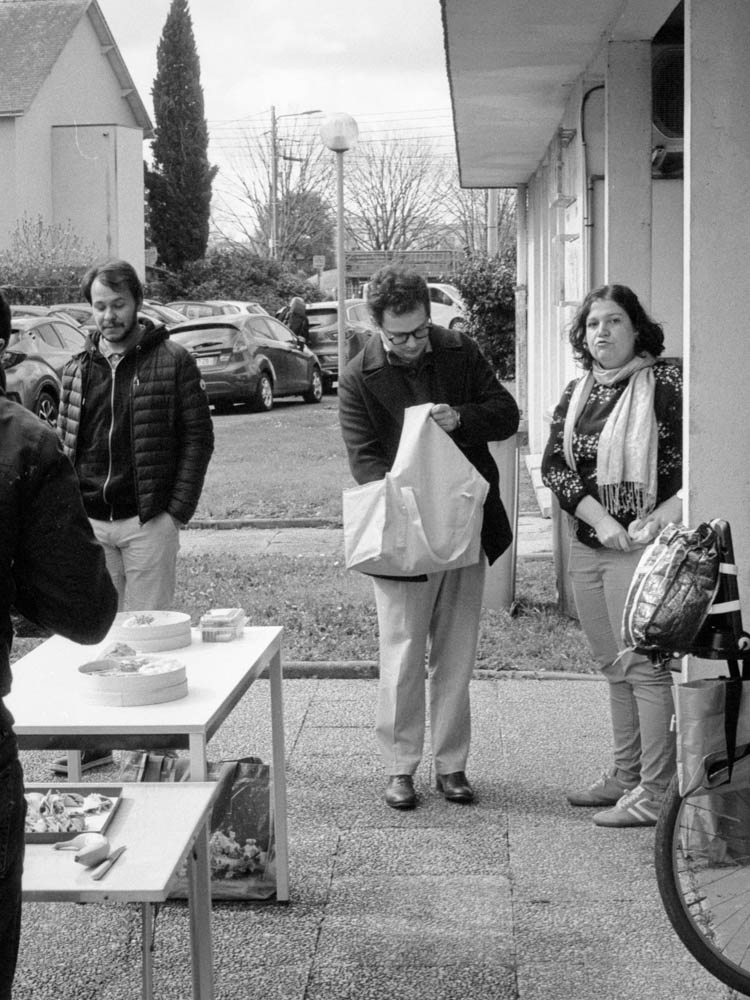
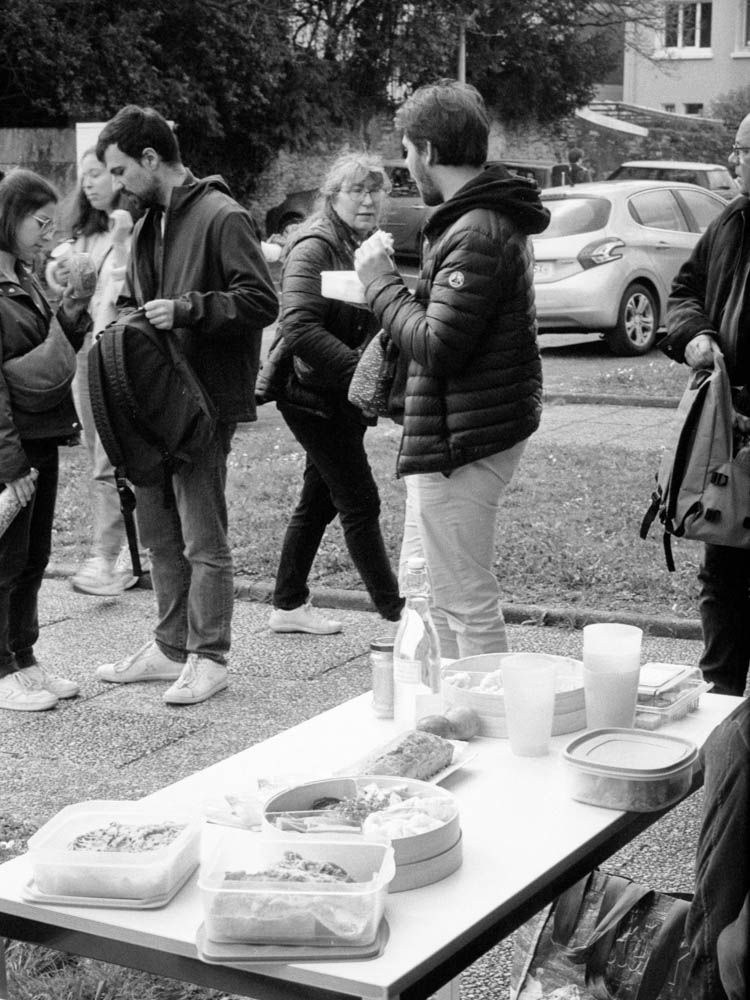
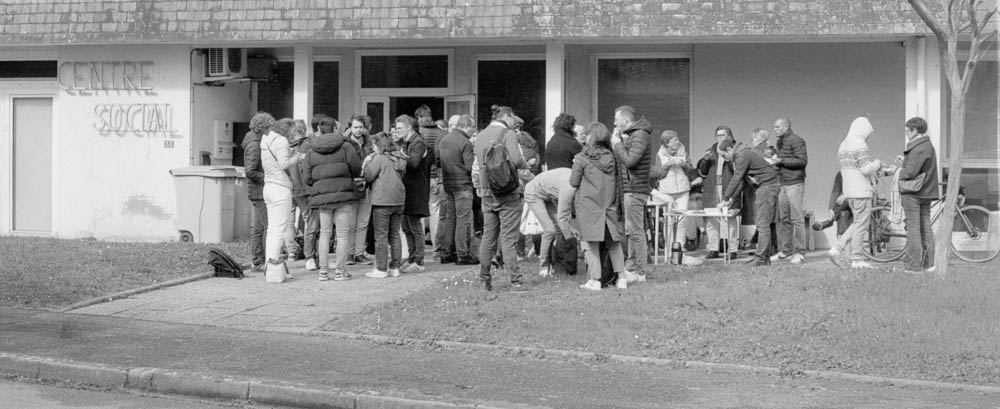
Most documentation skips the food. Concert halls, polished instruments, formal attire — that’s what ends up in the frame. But before any of that, there’s a lunch break in a car park outside a community centre, and that’s where I wanted to start.
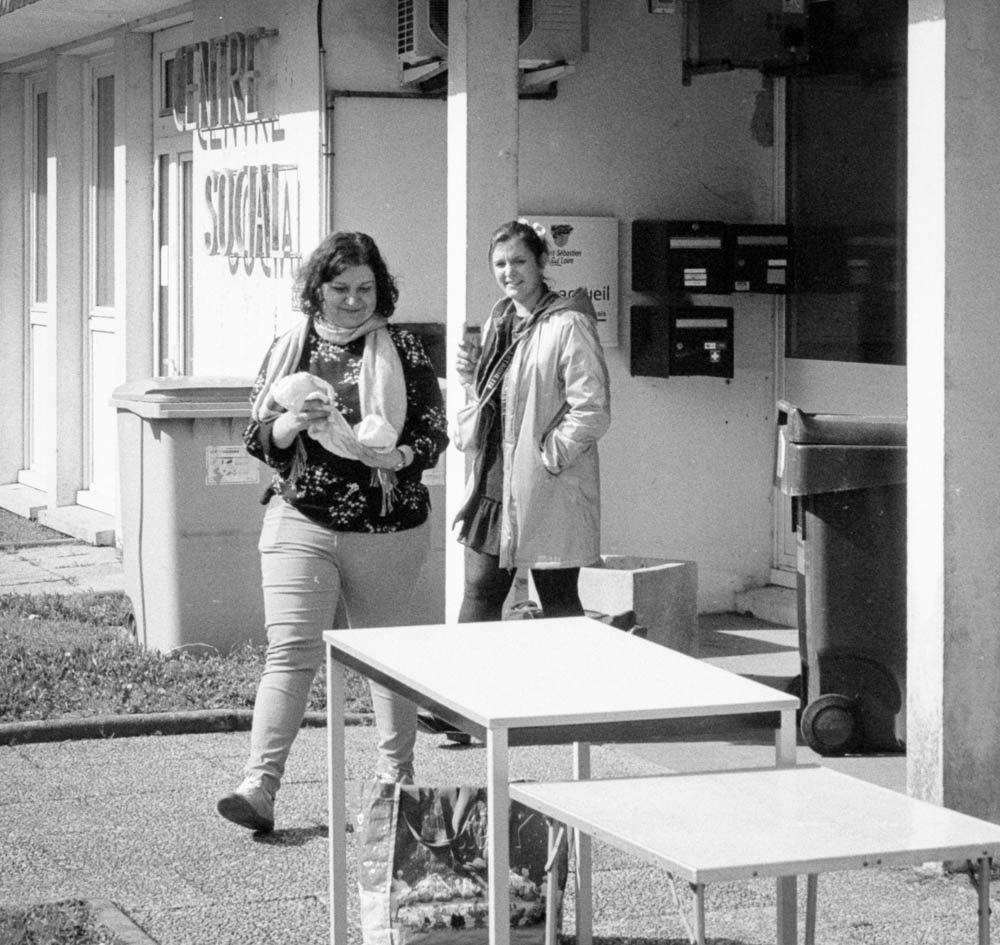
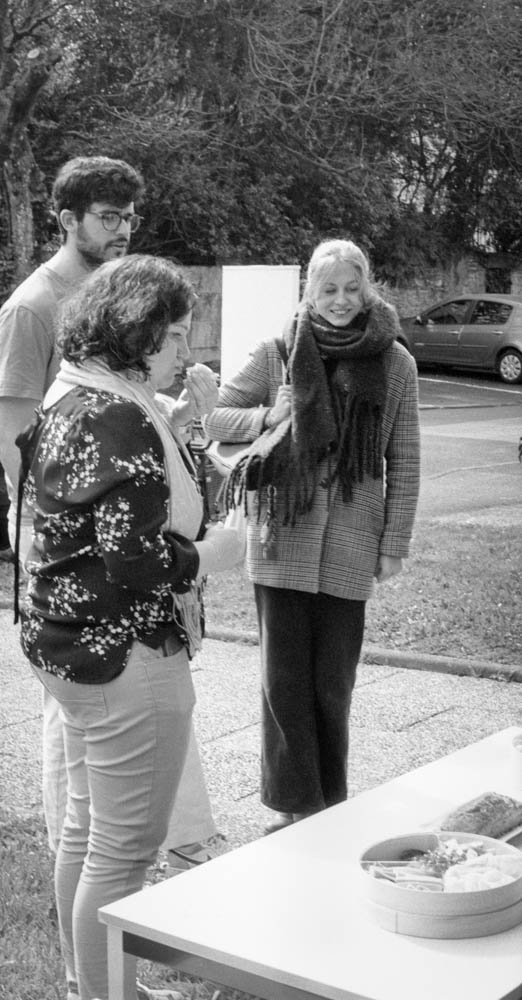
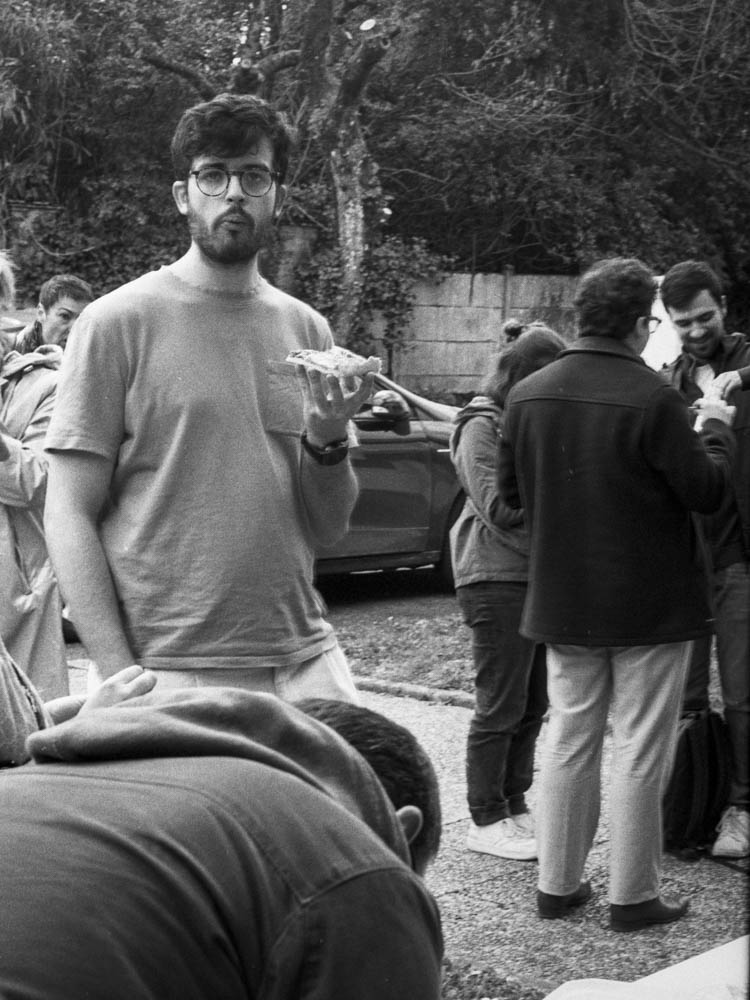
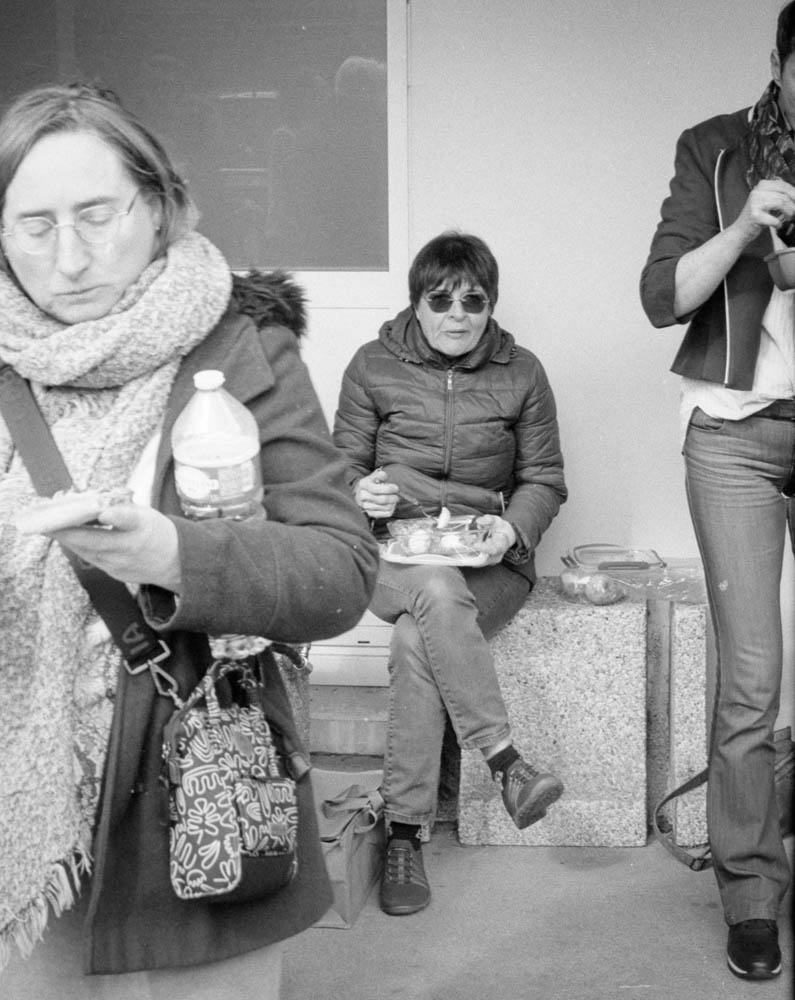
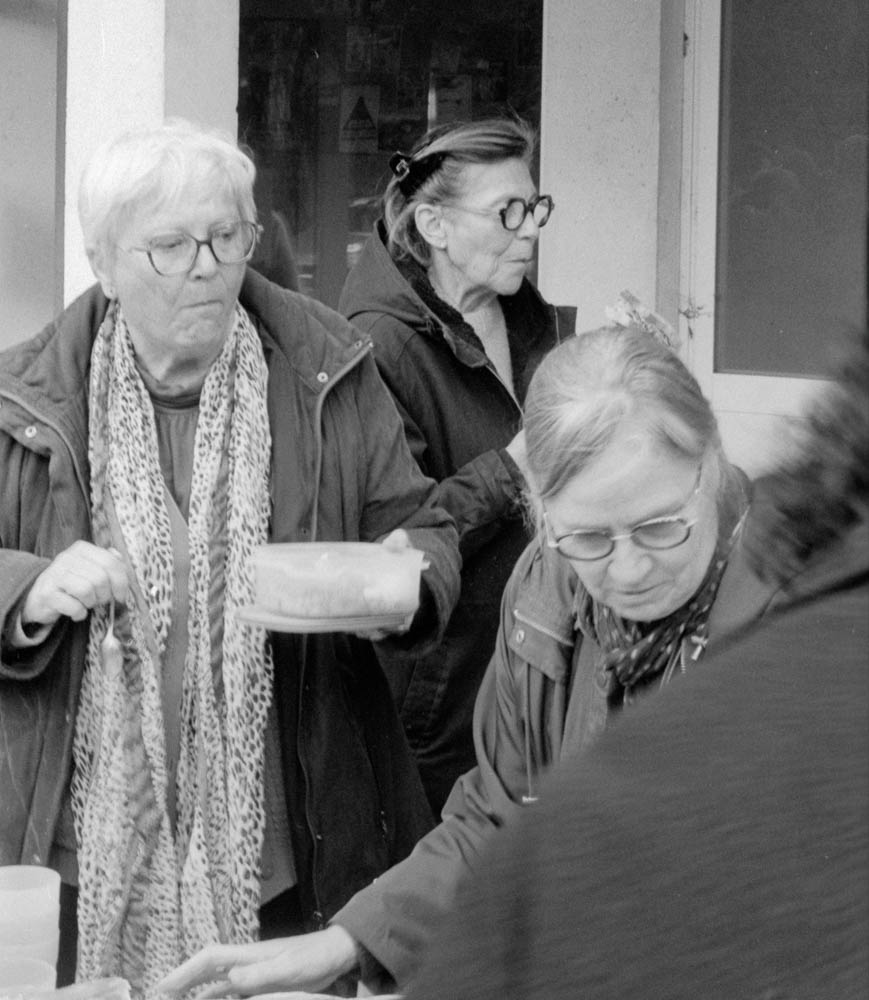
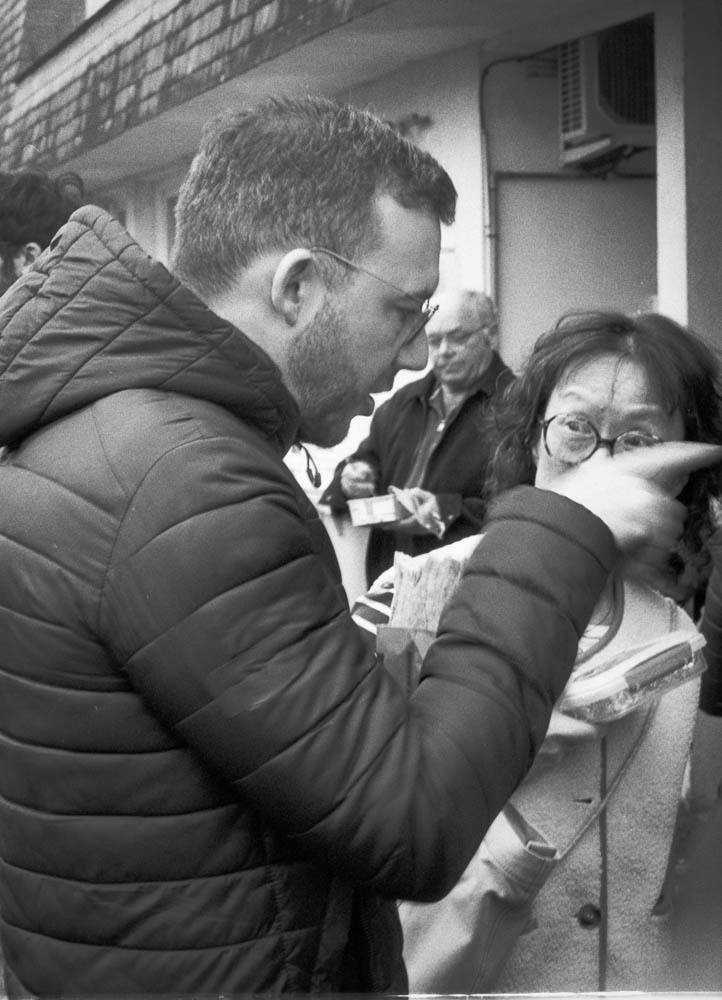
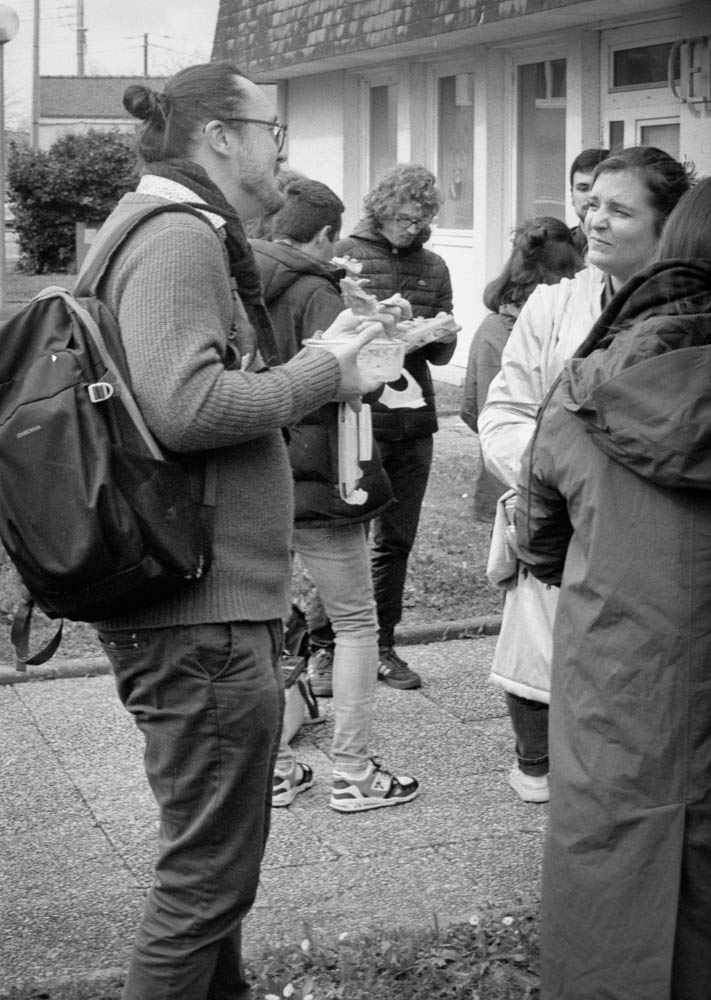
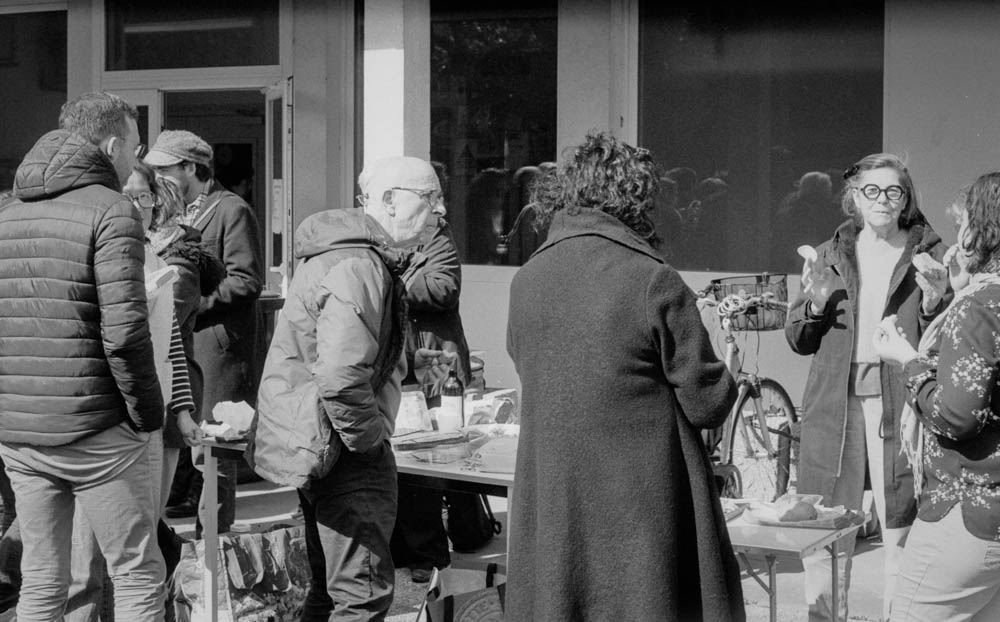
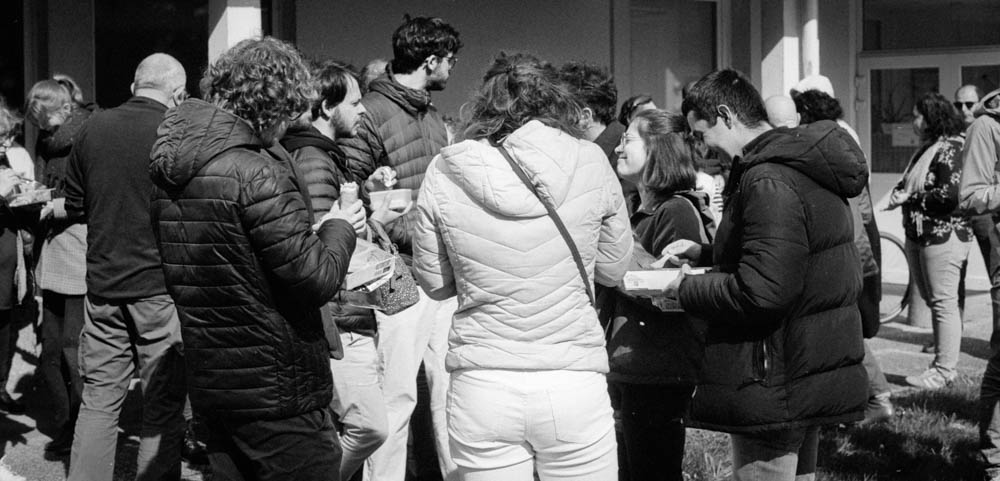
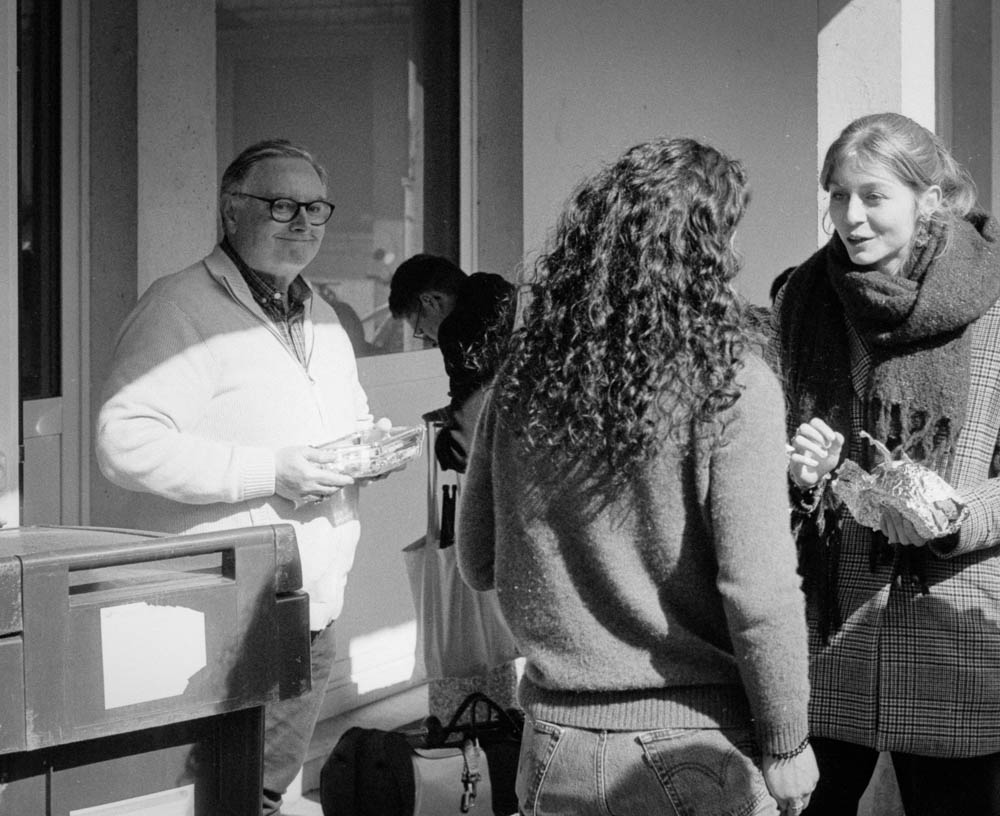
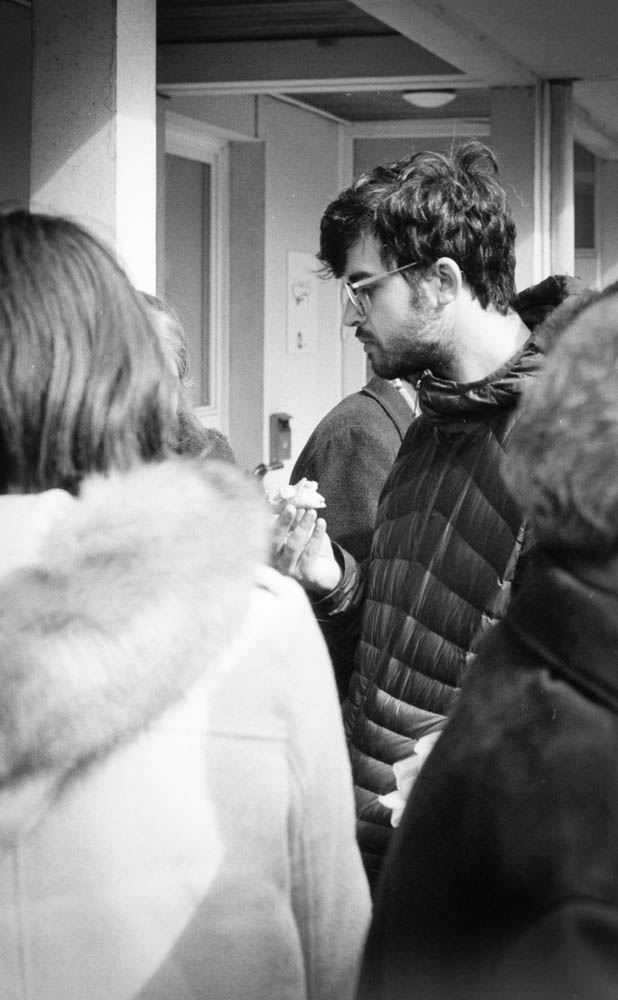
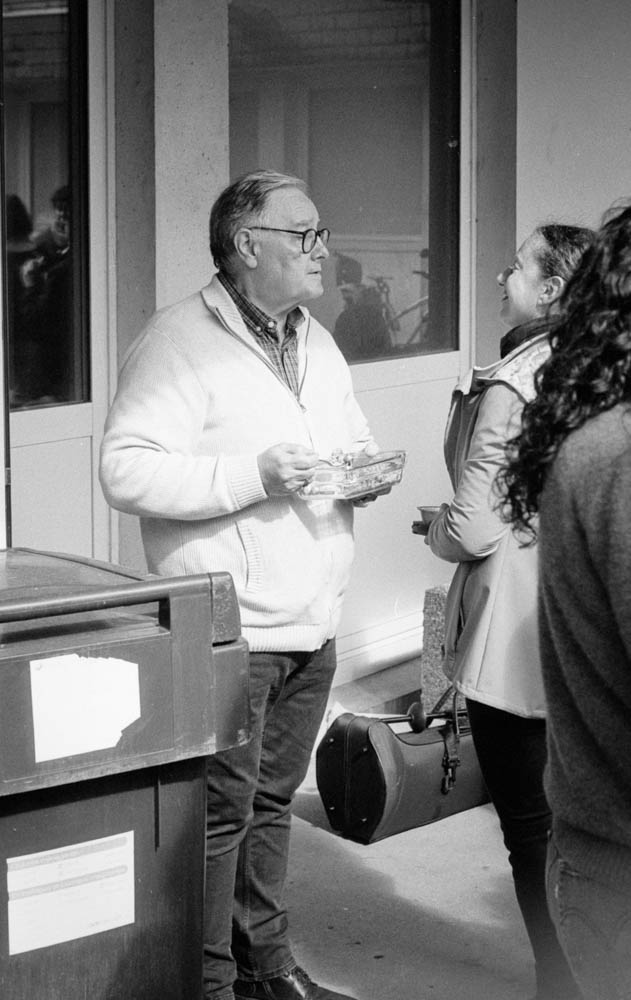
I’m the fourth horn in the Symphonique des bords de Loire. Which means I’m also inside the story, not observing it from a safe distance. I know these people. I count rests next to Corentin, our first horn. I watch Victor — oboe, cor anglais, and the man who quietly keeps the whole enterprise running — arrive with a tote bag full of provisions. I see the conductor holding a food container and chatting, no baton, no authority, just a man at lunch with his colleagues.
That’s what I wanted to photograph.
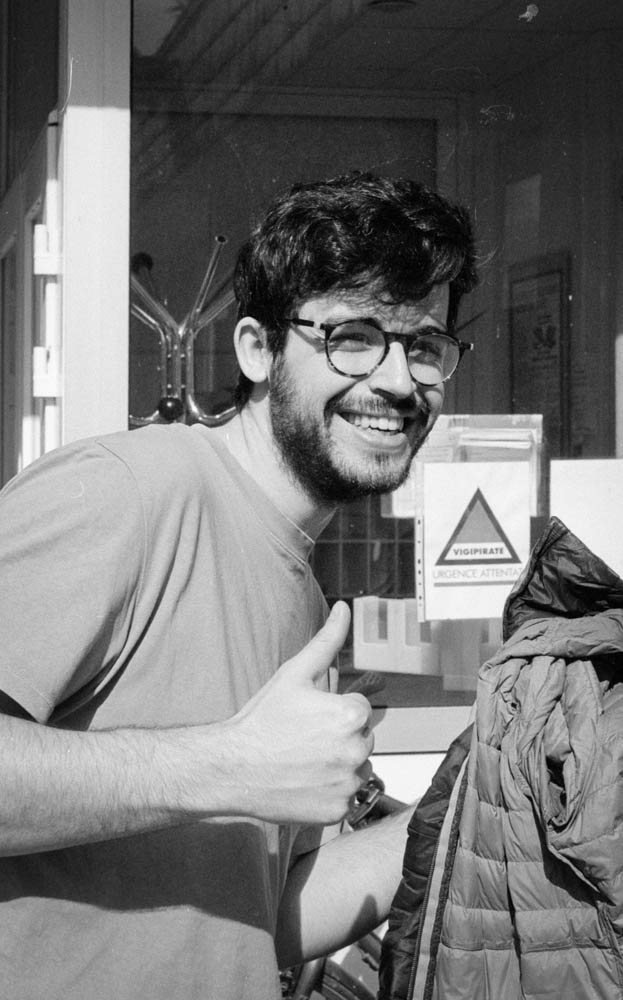
I loaded the Pentax ME Super with Fomapan 100 and spent the break outside. Aperture priority, natural light, film at box speed. No pushing, no games. The choice was deliberate — I knew I’d be shooting the rehearsal indoors on HP5+ pushed to 1600 and 3200. Those would be grainy, urgent, intense. This needed to feel different. Calmer. The breath before the dive.
The difference, when you put the two rolls side by side, is striking:
Fomapan 100 — Lunch
HP5+ 1600 — Rehearsal
Light
Natural daylight
Mixed indoor fluorescents
Grain
Fine, subtle, clean
Textural, present, moody
Contrast
Gentle, even
Punchy, dramatic
Mood
Relaxed, communal
Focused, intense
Story
Community at rest
Collaboration at work
Same orchestra. Same day. Different worlds — and that contrast was the point from the start.
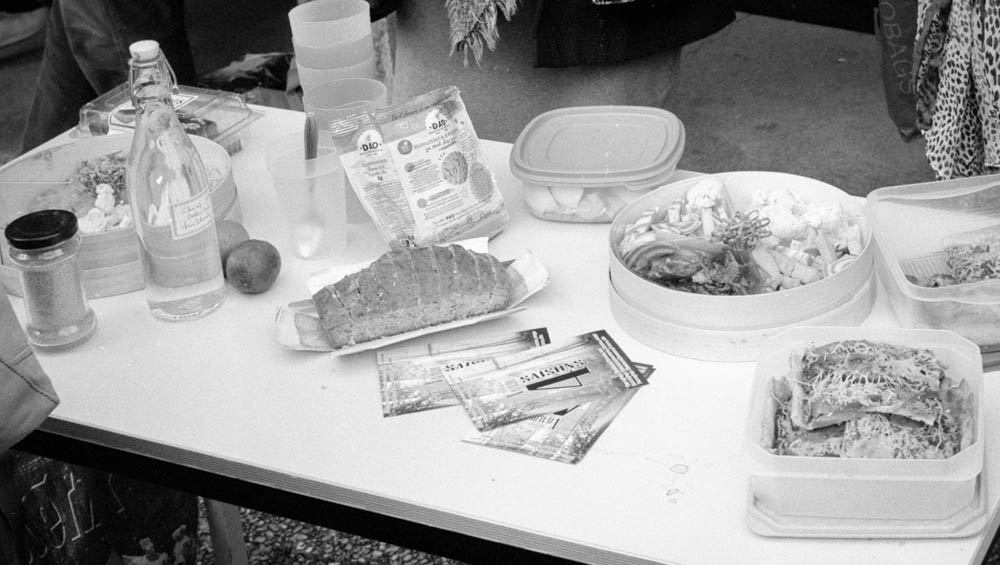
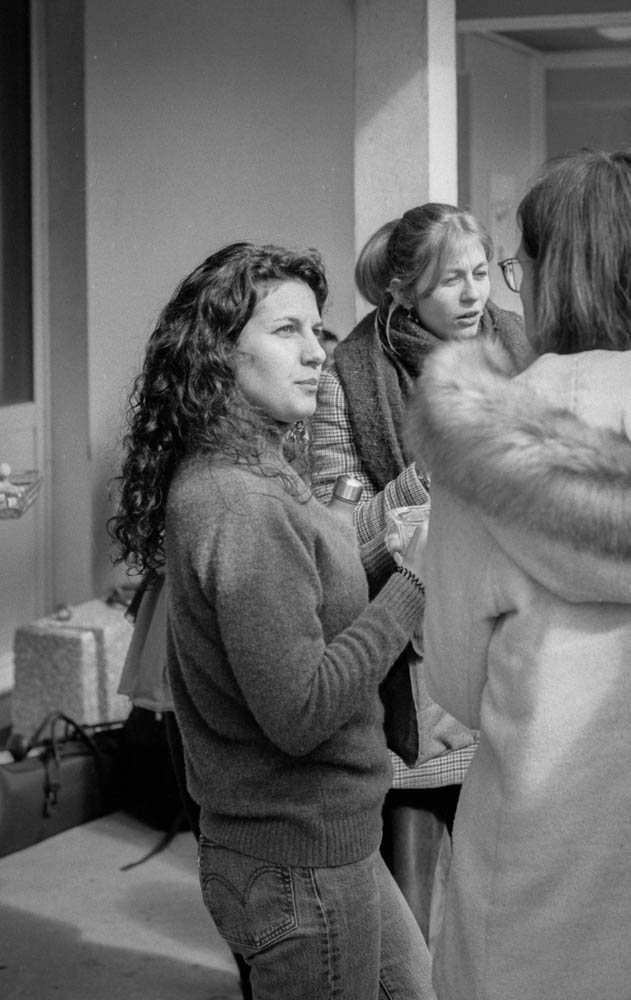
Fomapan 100 in good daylight gives you an honesty about the light that suits candid work. The faces, the bread, the containers of salad, the glass bottle catching the sun — none of it is staged, and the film doesn’t try to make it anything other than what it is.
The two Chinese violin soloists — the guest artists who’d be the focus of the afternoon — weren’t there for lunch. They’d arrive later, after the tables were packed away. For now it was just us: teachers, retirees, students, professionals, amateurs. All ages. The usual mix. Gathered outside a community centre with a faded sign, sharing food before three hours of work.
This isn’t a fancy conservatory. It never was. That’s rather the point.
After lunch, the tables come down. The last conversations finish. Someone rinses a container. And then, quietly, the same people who were just eating become musicians again. The conductor picks up his baton. Viktor picks up his oboe. Corentin finds his pitch. I put down my camera, pick up my horn, and count rests.
The soloists arrive. The work begins.
That’s Part 2.
Shot on Pentax ME Super, 50mm f/1.7, Fomapan 100 at box speed. Developed in Ilfosol 3. Edited in Lightroom
The tour is over. The bags are unpacked, and things are settling back into their usual rhythm at home. But even though I’m back, part of me is still in China—still thinking about the streets of Shao Xing, the energy of Shenzhen, or the moments shared with the orchestra. The journey may have ended, but it hasn’t really left me.
Reflecting on the Journey
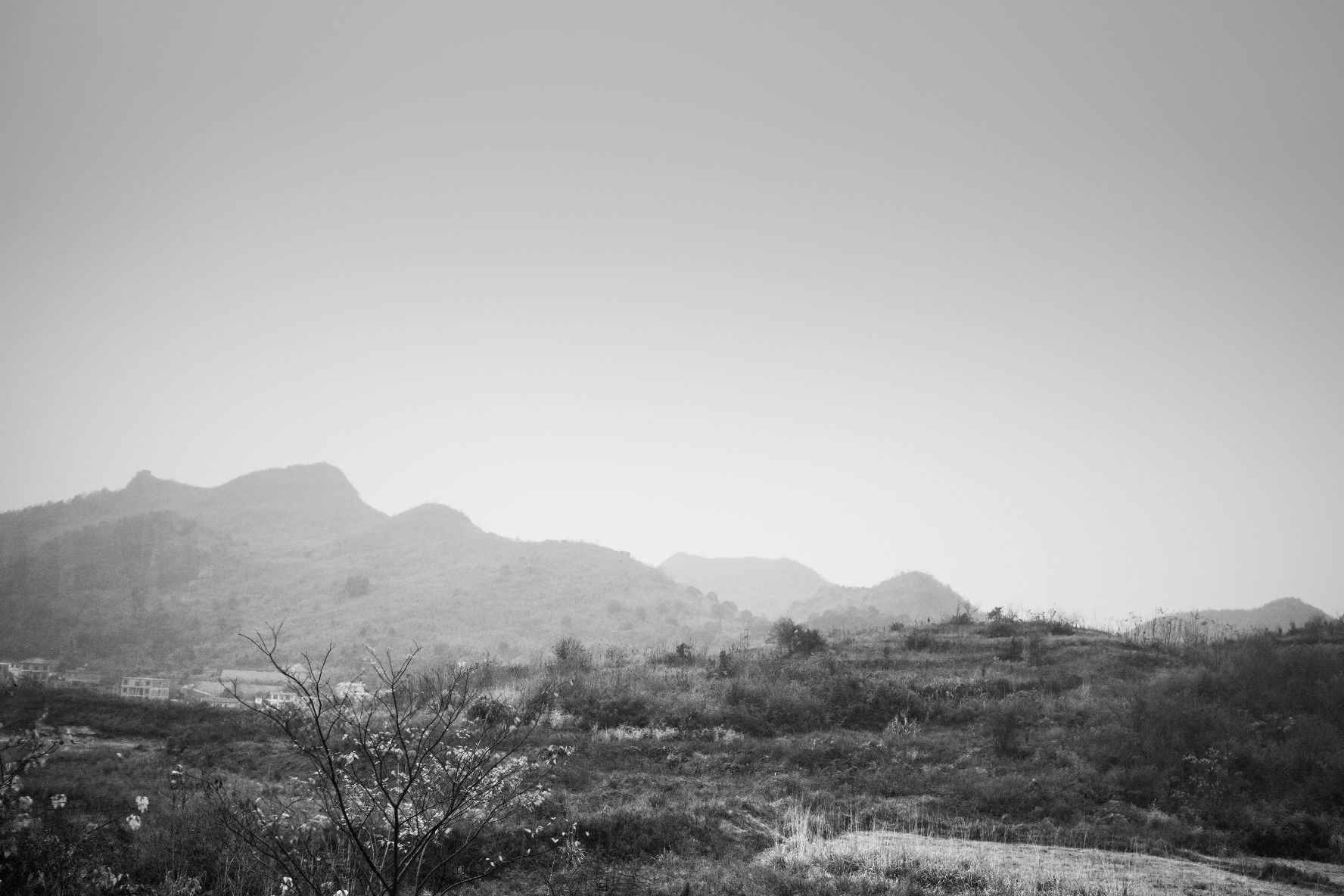
From the moment I landed in Changsha to the final farewell in Shanghai, this trip was a series of moments—some I expected, and some I didn’t. The hustle and bustle in Shenzhen, the streets of Shao Xing, the quiet hills of Xian Ju, and the meals shared with colleagues between concerts. It wasn’t just about the places. It was about the little things—a gesture of hospitality, that mutual respect between musicians, or just watching the world go by.
This trip wasn’t just about playing concerts, it was about learning and adjusting. It was about connecting with people, understanding their way of life, and how we relate to one another in those brief encounters.
The Photographer Without Film
For the first time in a long while, I didn’t travel with my usual film cameras. The Fujifilm X100F was the only camera I had with me, and while I had mixed feelings about it at first, it became a good fit. There was no hesitating over which shot was worth the price of a roll of film. It was just me, the camera, and the present moment.
Not every moment needed to be captured. I found myself slowing down and soaking things in—sometimes shooting quickly, sometimes just letting the moment pass. It wasn’t about having everything on film; it was about experiencing it fully, even without the lens in front of me.
Respect and Connection
One of the most memorable things about this trip wasn’t the landscapes or the buildings—it was the people. Everywhere I went, I felt a deep respect and sense of community. It wasn’t about being given titles like “Uncle” or anything else. It was just how people engaged, how they saw me as part of something.
The concerts themselves were a reminder of this—the public wasn’t there for rehearsals, but they were there for the concerts, offering energy and appreciation. Music, like photography, is about presence. It’s about sharing a moment with others, and that’s something I’ll never forget.
Coming Home
Returning home after a trip like this always feels a little strange. The familiar feels slightly unfamiliar at first—the quieter streets, the slower pace. But there’s comfort in returning, and yet, it’s hard not to feel that shift in perspective. Things seem different now.
The Final Frame
So, what remains from all of this? The photographs, of course. They’ll hold the moments, the details, the things I might forget over time. But beyond that, it’s not just about the photos. It’s the way travel shifts your perspective and makes you notice the small moments—the ones that don’t always get captured in a frame.
This series was meant to document a tour, but it ended up being more than that. It’s a reflection on the journey itself, on photography, on what it means to truly be somewhere, to connect with others. The tour might be over, but this story isn’t done yet. And whenever the next journey comes, I’ll be ready to pack my bags again.
I have been posting these articles in the WhatsApp group made for the people on the tour, and people’s feedback has been amazing. What came out the most was the feeling of revisiting the tour through the photographs and how that made people feel. And if you make somebody feel something with an image, then you’re off to a good start. The other comment was, “Oh, I didn’t see that!” And that is part of our role as photographers, to record what people don’t see… My reputation as a photographer seems to have surpassed my reputation as a beer drinker, which is good, because I hardly drink a drop anymore. My reputation as a writer seems to be well established too.
So not only am I seen as a hornplayer but also as a photographer, a writer, and a sensitive soul instead of the gruff bear that sits at the back of the orchestra and makes farting sounds with his instrument. Quite the step up really!
There’s a stock phrase about the journey being more important than the destination. Another one suggests that a journey can transform a man into something new—something he didn’t even suspect. As I look back at the man who left home, went to China on tour, and the one who came home, I can’t help but wonder if there’s truth in both. I’ve previously described China as a “foreign concept,” and now, having returned, it feels far less so. I’ve peeled back a layer of the country and gained a deeper understanding of its culture—musical, culinary, and otherwise.
This tour, too, has been a “parenthesis,” a break from real life, and a chance to be me—not just “Papa” or “husband.” No longer defined by my role in the family or at work, I could just exist as I am, whoever that is. Though I still feel some anxiety about how others perceive me, age has brought a certain self-awareness, self-knowledge, and—perhaps—a bit too much overthinking. For those two weeks, I was simply a guy on a bus, surrounded by French people, walking through new experiences, and discovering everything along the way.
China as a Totally Foreign Concept
Before I left, my idea of China was that of a far-off place, so completely different from anywhere I had lived before. Those ideas were formed in childhood, shaped by the media’s portrayal of this foreign land. I won’t deny it—I was terrified of the whole trip. Researching things online only added to my worries about not being able to read or speak the language. Growing up, I saw China as a Communist regime, almost oppressive like the Soviet Union, and as the enemy we had to defend against. I remember watching the handover of Hong Kong in 1997, feeling my stomach churn as I watched truckloads of PLA soldiers occupy our old colony.
I remember, too, older members of the band, where I wore green for a living, talking about Hong Kong as the dream posting—warm, sunny, and everything a soldier could need. But what was I really afraid of? The unknown. We all knew about China’s state security apparatus, without truly understanding it. The events of Covid only deepened that sense of fear and mystery.
I even worried about something as simple as eating with chopsticks, imagining I’d have to rely on forks or my fingers. Looking back, all of these fears now seem so silly. But they were real before I experienced the country for myself—and especially before I met its people.
The People Who Changed My View
Somehow, I managed to take each day as it came, simply bathing in the new experiences. And, strangely enough, China worked its magic on me. It didn’t just change my view of the place—it changed how I saw the people. They were charming, incredibly friendly, and in a way that made them seem so much more human.
I began to see myself in them, and I realized that, despite our differences, we are more alike than we might think. We all fall in love, become parents with grace, and share the same aspirations for our children—to be happy, to find love, and to repeat the cycle.
I think back to Christmas Day, when I made new friends. The simple “Merry Christmas” was enough to endear me to them. I also reflect on how beer, it seems, transcends barriers of language, creating a connection that only men seem to understand. I’m not trying to exclude women, of course—heaven forbid—but there’s something inherently masculine about it.
My Place in the Orchestra
Another transformation came in terms of my place in the orchestra—or rather, my perception of it. As the 4th horn, a position typically reserved for the least experienced player, I have always resented the remark. But now, I know my role to be the solid foundation of the section, guiding it through the music. At 53, I no longer feel the need to prove anything. I’m here for the music, content to plod along at the bottom. It’s not humility—it’s comfort, and a willingness to let the young bucks enjoy the spotlight.
Being on tour, though, inevitably brings people closer together. Take poor Corentin, who shared a room with me for two weeks. It’s one thing to get along during rehearsals or after a concert, but living in such close quarters really gives you a new perspective on someone. I knew Corentin was a good lad, but during those two weeks, I saw him in a different light. We talked, laughed, and endured the trials of close proximity.
I remember one drive home from a concert when my birth mother FaceTimed me with the news of her cancer diagnosis. Corentin, despite his limited English, understood more than he let on. He listened as I processed the information, and in that moment, we connected in a way that most people don’t. Maybe that’s what brought us even closer.
Sharing a room with him was like being back in the army. We worked hard, played hard, and celebrated with the kind of noises only a group of men could share. If you can fart in front of someone, you’re already on the next level of friendship.
One moment that stood out for me was when I helped Clement, the other horn player. I had offered him some coaching to help him out of his funk. During the concerts, he had some delicate parts, and although I could easily play his passages for him, I didn’t want to embarrass him. So, I didn’t change seats to play his part during the performance. Instead, I stayed where I was, and when it came to his turn, I played my part to the best of my ability. It was subtle but important—I didn’t want to take his place; I just wanted to give him the support he needed without making him feel like he couldn’t do it on his own.
Afterward, Clement spoke very kindly about me to the younger players in the group. He praised me in a way that felt both generous and sincere, and it left me feeling deeply grateful. His words were not just kind—they spoke to a level of respect and camaraderie I hadn’t anticipated. I hadn’t sought recognition; I just wanted to help. But his thoughtful comments—about my support without overshadowing him—meant more than I could have expected. It’s rare to find such generosity of spirit, and I appreciate him for that.
I nearly forgot to talk about my girls from my days in Cholet. It was Eléonore that suggested that I join the orchestra, and I’m so glad she did. I was about to leave my horn in its box and let it gather dust somewhere in my house where people wouldn’t trip over it. She has been a very good friend to me over the last 13 years, and I think she’s wonderful. Then of course I mustn’t forget Titaua and Mathilde. And they certainly didn’t forget to tall every one about my “kilt” days, where as fed up of being English, I would let people know that one can be from the UK without necessarily being English. My first adoptive father was Scottish, and his brother, Uncle Joe, was Professor Regis at Edinburgh University. People came up to them saying that Ian wasn’t like how they had imagined him, and was actually a decent chap and all-round good egg! Then Eléonore just reminded them that “they” didn’t know me the way she did…
During the tour, as you’ve seen, I took some photos—some of them very odd. But I wasn’t the only one sharing them in the infamous WhatsApp group. For the first time, people saw a different side of me—the artist, not just the beer-loving horn player. I even started sharing my blog posts in the group, and maybe I’ve earned a reputation as the writer. Who would’ve thought? A beer-drinking horn player who takes decent photos and has a way with words—still knows how to play, though.
Anything Else?
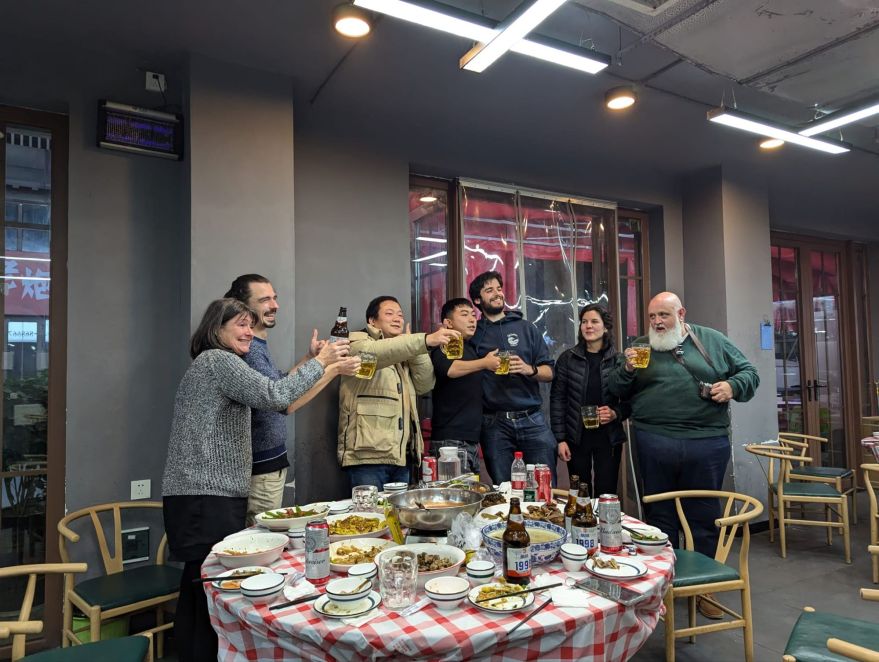
I think my approach to food has also shifted. I’ve always liked the idea of sitting around a big table with friends, and during the tour, I was reminded of that. The variety of dishes was astounding, and I saw some players more comfortable with what they knew, while others bravely ate silk worm chrysalids. Me? I just enjoyed whatever was put in front of me, from chicken and duck feet to tortoise.
I found myself stepping away from desserts, my sweet tooth growing calmer. Eating the Chinese way—deliberately, mindfully—was a revelation. Much like film photography, it slowed me down and made me more aware. I ate less, but I appreciated the variety. I even tried to emulate that at home—though, I didn’t put chillies in my dishes.
I’ve also become more accepting of my body. Despite still feeling like I have a long way to go, I’ve made peace with the body I’ve got. Corentin’s lack of judgment helped, and I’ve learned to be more at ease with the frame that carries me around.
How to Conclude?
What’s clear is that this journey, this “parenthesis,” hasn’t just been a break from the familiar—it’s been a period of quiet transformation. The familiar parts of myself have had space to evolve. And perhaps that’s the true beauty of any journey—not the destination, but the unfolding of a self you might not have fully known. In a way, I’ve returned not quite the same man who left. But then again, perhaps that’s the essence of travel: it allows us to become more fully who we truly are, even as we discover the world around us.
As the journey ended, I found myself thinking less about the places I’ve seen and more about the moments shared—those small, unexpected connections that shape an experience just as much as the landscapes we pass through. Travel isn’t only about what we take away from it; it’s also about what we bring to those we meet along the way.
Perhaps that’s what lingers most—the idea that stepping beyond our usual paths isn’t just an act of discovery but a quiet exchange. We put ourselves out there, not just as observers but as participants, leaving behind something of ourselves in the process. And in return, we find that the world, in all its vastness, feels just a little more connected.
It’s a “long” title, and it was also a “long” journey. We left our hotel at 7 am on the 3rd of January, and I arrived home with feet under the table at 5 pm on the 4th of January. My mind is still on strike and the memories a little vague, but I’ll try and keep going for as long as possible.
Group 1, i.e. the other group, would be leaving at Terminal 1 in Shanghai, and Group 2, i.e. my group, would be leaving from Terminal 2 in Shanghai. There was a small and very select group that were going to do the “extension,” including my friend Eléonore. We managed to get our suitcases into the “system” at the airport check-in. And then through security, which, due to my sports jacket hack, went very smoothly. All we had to do then was to find somewhere for lunch. I had been in a group for the whole tour and headed off on my own to try and find something to eat.
I did find something to eat—tofu and crab, with a bowl of greens because it’s healthy! And a cup of tea was served with my meal. I spotted a hamburger place just next door to where I was eating and alerted the group via WhatsApp. I took my time eating because I could. I don’t like being rushed. Apart from getting onto the plane on time, my only task was to find a gift for my wife that would please her and, at the same time, be very Chinese. I bought tea. Because why not? And the shop looked very luxurious, and I was sure I couldn’t mess it up.
We flew from Shanghai to Beijing, and part I of our trip home was over.
The wait in Beijing seemed to go on forever, and our flight was at 2:40 am local time, which would mean a night flight back to Roissy. Beijing airport is a rather large place where most everything seems to shut at 5 pm. This was going to be a long wait. I resisted the temptation to go and have a “couple” of pints at a bar that was still open but still felt the need to have a drink of something. That something would be a bottle of water. We had our gate and waited for our flight to leave.
As you know, I can generally fall asleep anywhere and at any time. But even for me, this was going to be a tad tricky. I managed to charge my phone thanks to my colleagues and lay down on a bench to try and get some shut-eye. The sports jacket and jumper make a rather good pillow, and I felt slightly more invigorated when boarding the plane.
Maybe that wasn’t a good thing. Anyway, I made my way to my seat, which was at the very back of the aircraft, and tried talking to my neighbour, who asked me if I spoke French. I did, and I could tell she had a plan, that girl. She wanted to be able to have two seats so she could lie down. I asked the hostess if those two empty seats were going to be available, and she took pity on me, saying that they were technically for crew and that if one of the crew asked, I would have to move back and sit with Miss Two Seats.
That sounded very fair, and Miss Two Seats seemed to be happy. I used the pillow for my back, and the blanket was just large enough to snuggle into. Did I sleep like a baby? No, he said, going for the understatement of the year award. No, he did not, but I think he at least managed to snooze, which was good enough. We had breakfast on the plane, which would be my last “Chinese” meal. Part II of our voyage was over.
We landed in Roissy and played everyone’s favourite game—go to the loo, and then on to baggage reclaim. The trombones had been put in with the suitcases and, of course, were the very last things to be put onto the conveyor belt. I have to admit to a rather tense moment when I was wondering if my suitcase would ever turn up. Eventually, it did, and we were reunited. The trombonists were soon reunited with their trombones, but it was all very stressful and a grand moment of solitude for them. We eventually found what we thought was the exit, turned around because it wasn’t the exit, and headed off to another exit to meet our colleagues in Group 1, who had arrived a wee while before us. We were herded along, with Mathilde and Titaua helping us cross the road. You’ve guessed it—we got on the bus, except this bus would be taking us back to Nantes. Part III of our voyage had begun.
My memory was still hazy, and I think we stopped off in the Perche—the place, not the fish, but maybe they had them in the local rivers. I’m not here to judge. We all traipsed into the service station and were greeted by the overpriced sandwiches. Not a chicken foot in sight. It all felt such an anticlimax after the food in China.
We arrived eventually where we had set off from in Nantes. Part III of our voyage was nearly over. Kate and Virginie were there to pick me up, and that hug was particularly tight and lasted quite a while—or so it seemed. Had I missed my family? I will say yes, of course. It will save us many arguments at home!
Part IV of the trip had begun. My wife drove us home through the rain. I entered the house that I had left two weeks earlier. I had been on tour, I had seen things that I had never seen before, I had eaten things that I had never eaten before, and I even managed to save my special Christmas chocolates from the inquisitive looks from the two women in my life. Killian wasn’t there, so Kate had first dibs on which mug she would like. The chopsticks were put away. Tea was made, and the day ended up at home. I was a little tired…
Welcome back to China, Dear Reader. When I last left you, we were on the bus somewhere between Hangzhou and Shao Xing. I’m pleased to report that we made it safe and sound, and that Corentin and I now had two keys to our room. It was still sunny—a joy to be alive. Thank you, happy pills. Our room had all the mod cons, though there was a quirk: if one of us was on the loo, we’d slide the door across for privacy. Unfortunately, that meant the person taking a shower lost their privacy. Still, I couldn’t see anything from the loo, so my roomie’s modesty was safe.
Speaking of toilets, we encountered quite a range during our travels. In the service stations, they were the French “chiottes à la Turque,” which are nothing like the Mozart Rondo, but certainly more pungent. Then there were the “ordinary” toilets, followed by the ones whose lids lifted automatically as you passed, and finally the pièce de résistance: the Japanese-style toilet, which remained resolutely Chinese.
This marvel had a heated seat—luxury in itself. You had to lift the lid manually (slumming it in the Stone Age again), but once seated, nature took its course in unparalleled comfort. The real magic began when you pressed a button: a mechanism extended to spray water precisely where needed. There was even a function for ladies. And after the water came the air, drying everything off! I double-checked with toilet paper, of course, but it had done an impeccable job. Truly, a game-changer. As Forrest Gump said, “That’s all I have to say about that!”
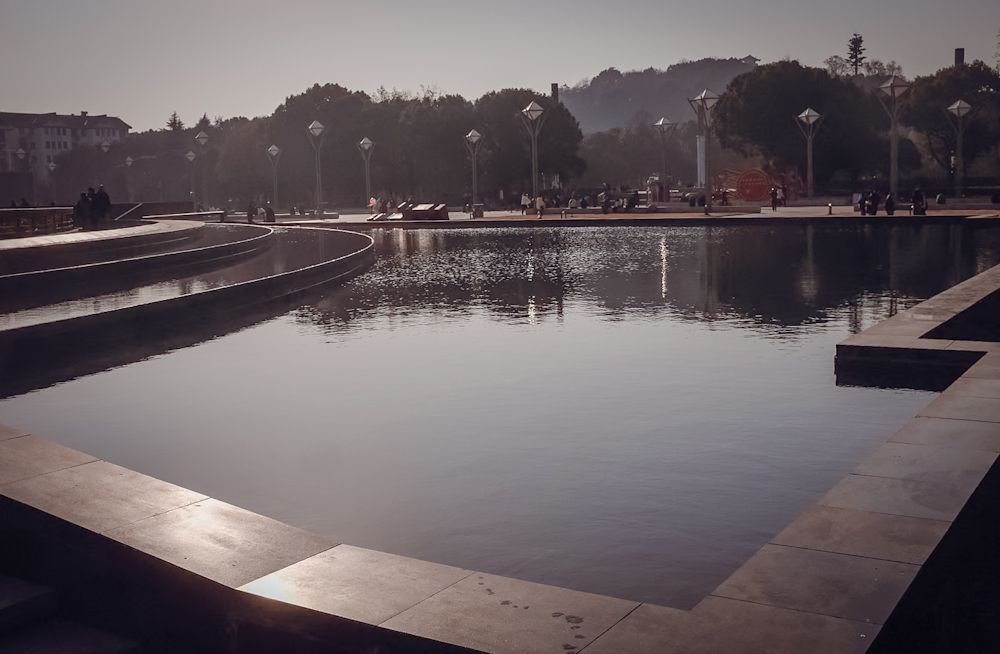
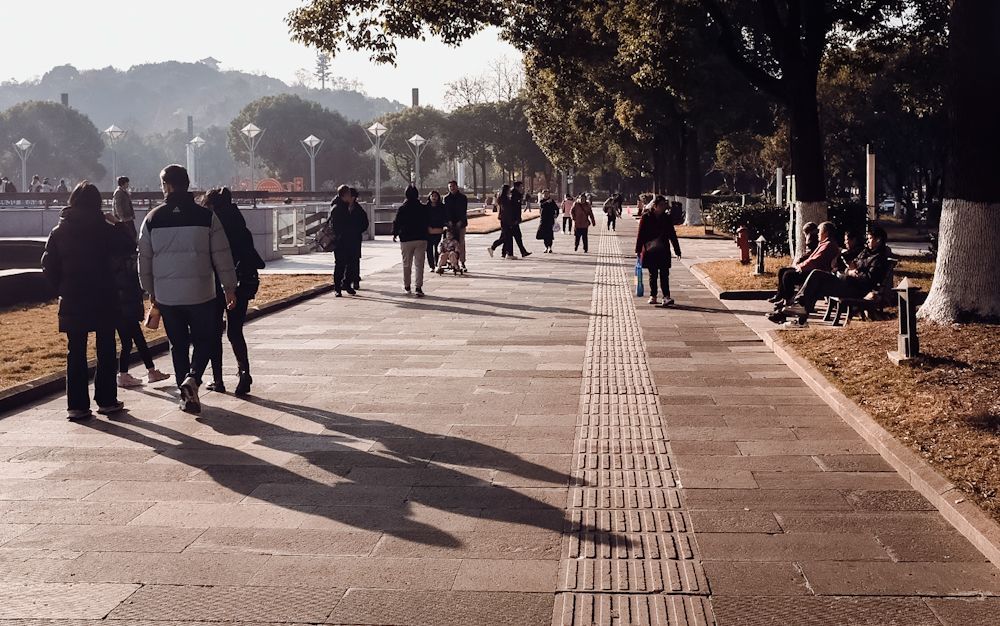
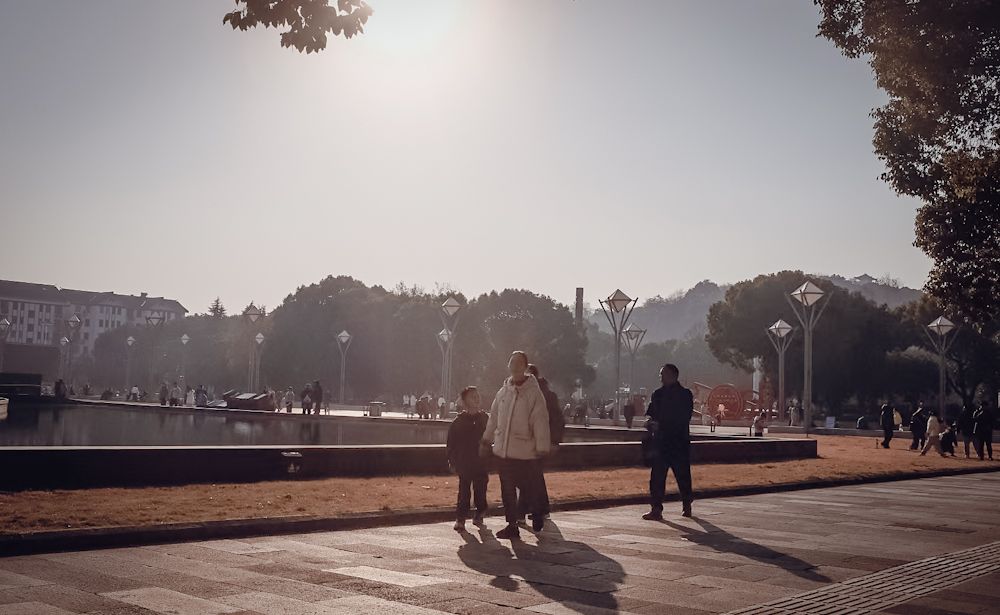
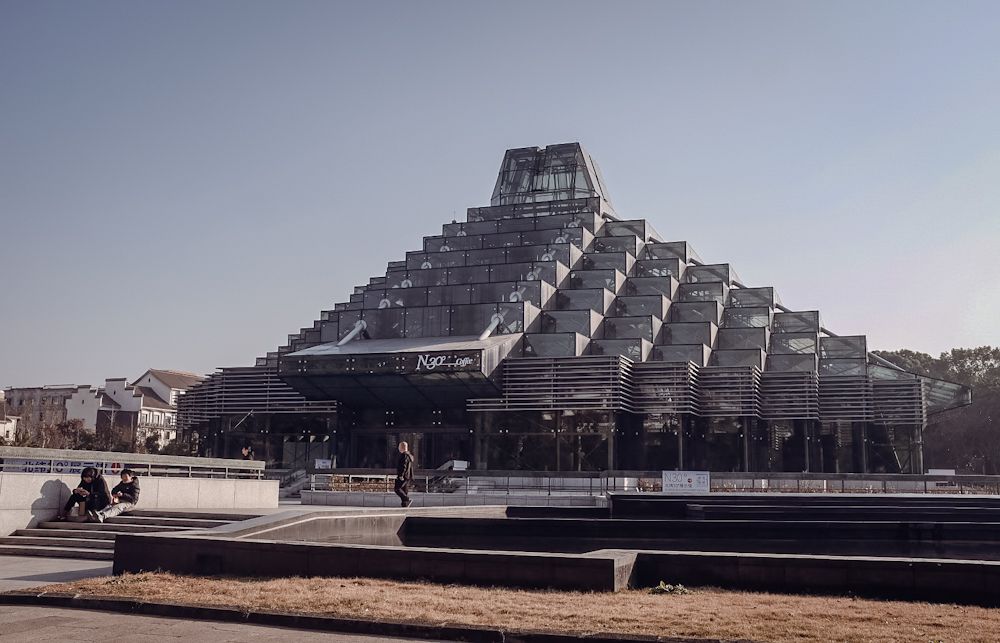
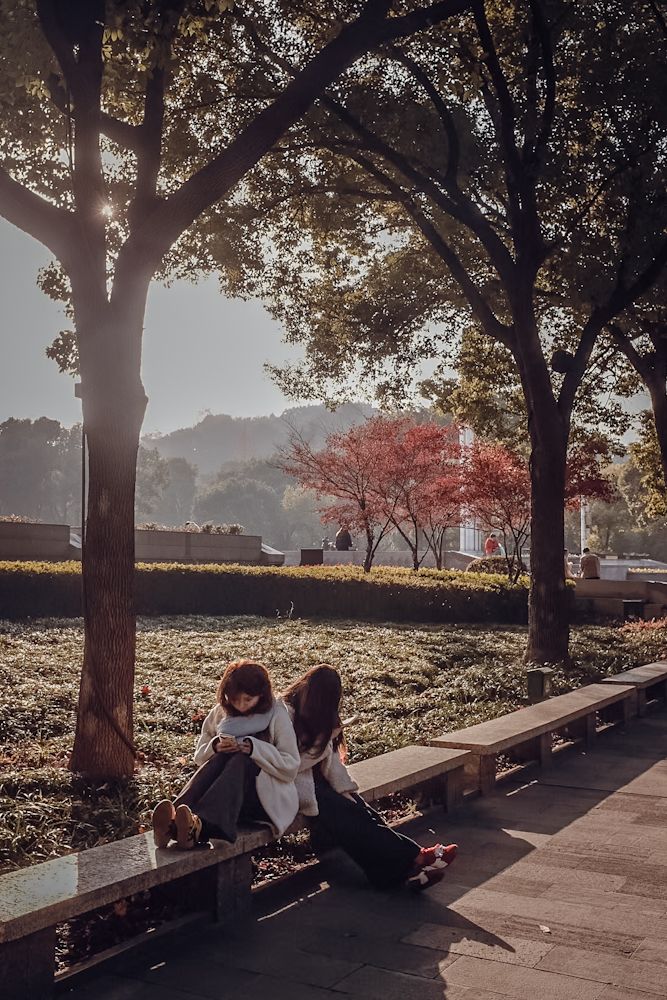
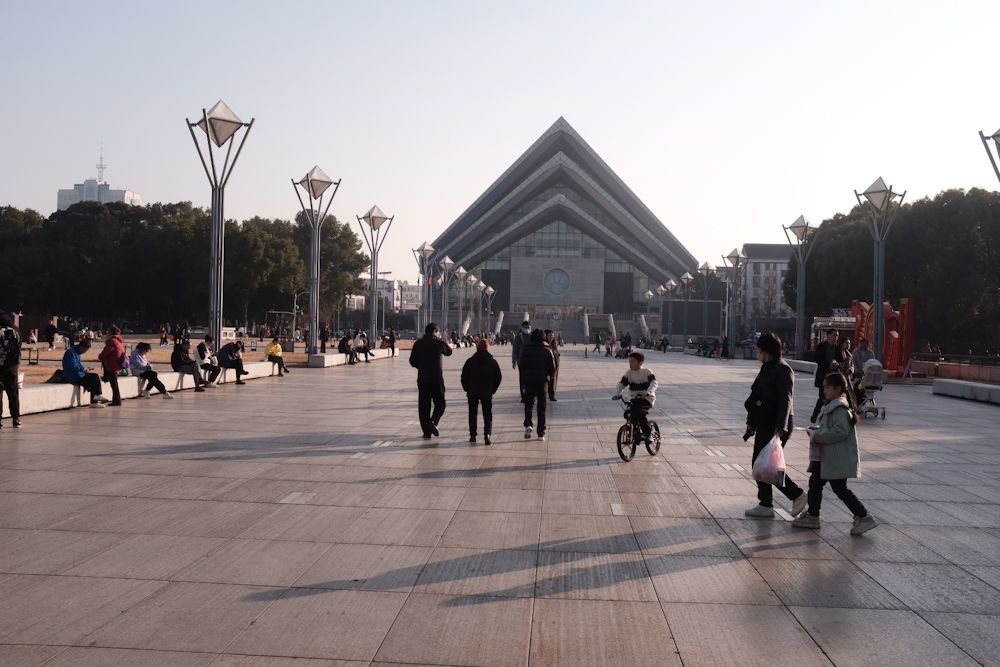
Now, let’s move quickly on from toilet humour (as universal as it may be) to the park next to our hotel. We were on the 22nd floor and had a marvellous view of the city centre. I could even see that night’s venue from our room and decided to explore the area, camera in hand. The winter sunlight was soft—bright but not blinding—perfect for photography. I wanted to capture the impression of Shao Xing, not just through candid portraits of people but through its landscapes and atmosphere. My aim was to convey the city’s essence, much like an impressionist painting, but with a camera instead of a brush.
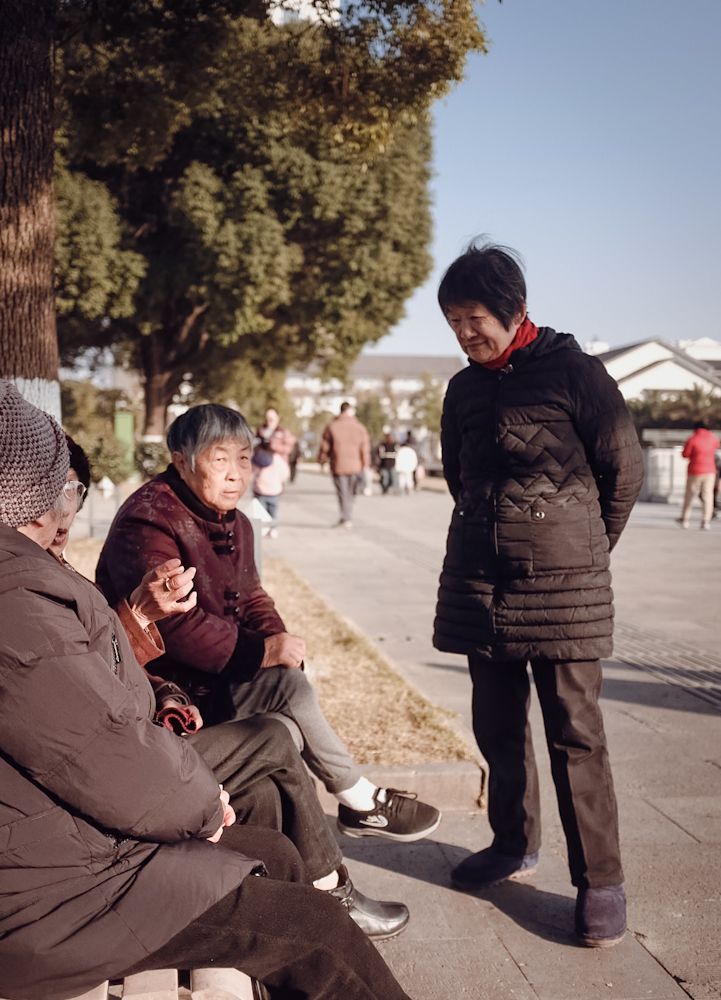
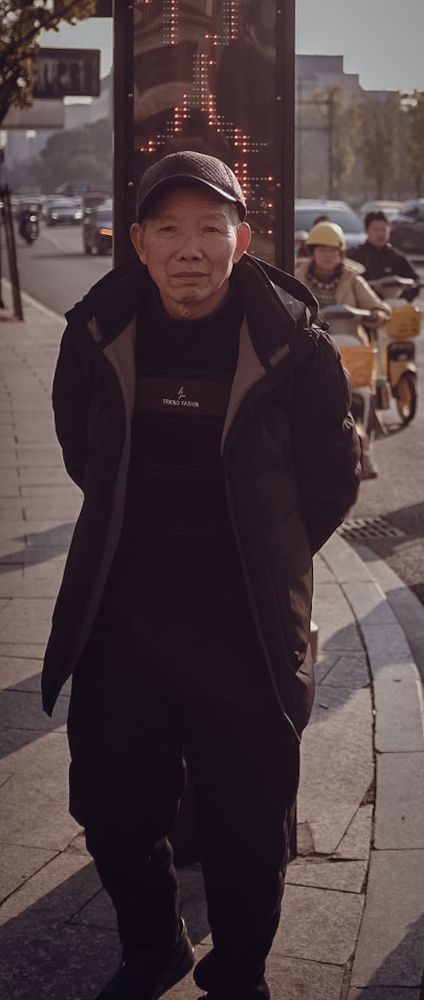
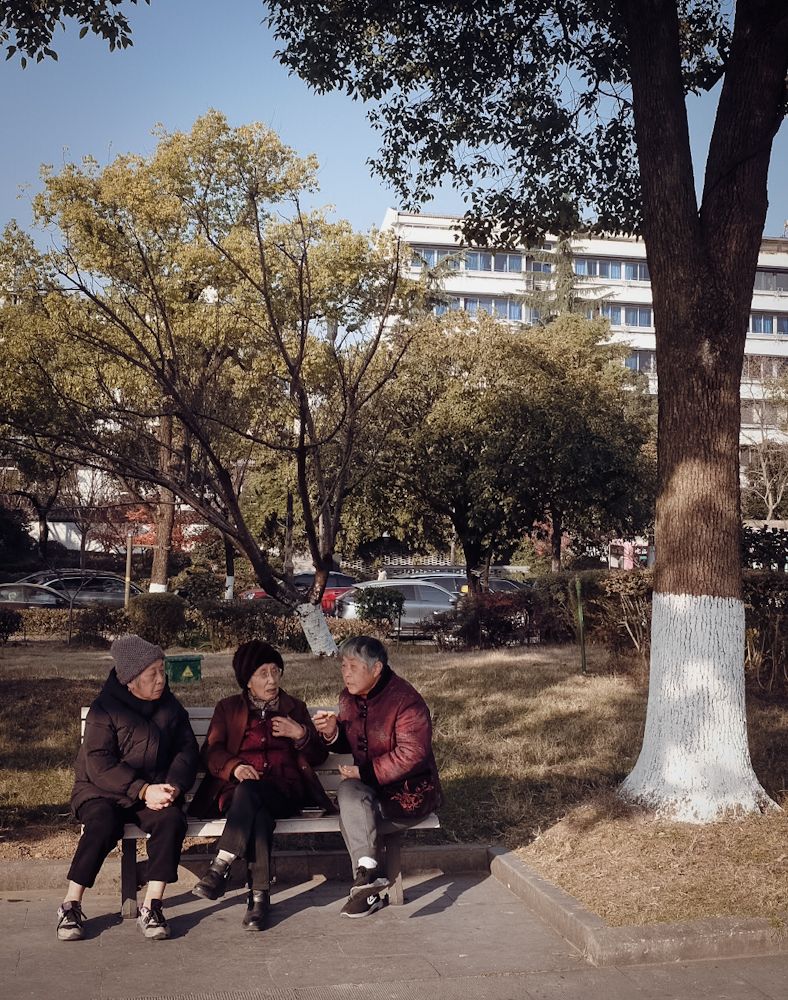
The park was alive with activity. Aunties and uncles sat on benches, chatting animatedly and observing the world go by. One Aunty beckoned me to join her, and I obliged. She greeted me with a thumbs-up—a universally positive gesture, except when hitchhiking in Greece, where it’s a faux pas. Using the translator in Alipay, I explained that I was a horn player with the visiting orchestra and would be performing that night in the concert hall across the park. This app is a godsend in China, though I briefly considered going back to study the language. My wife might not be thrilled with me disappearing for six months, though.
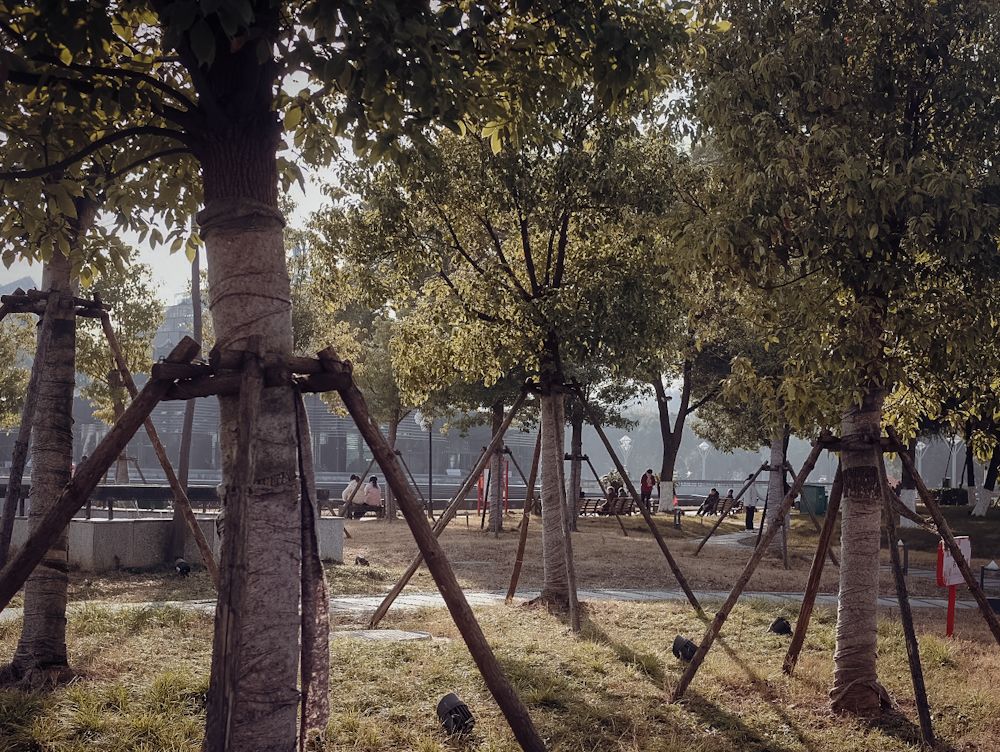
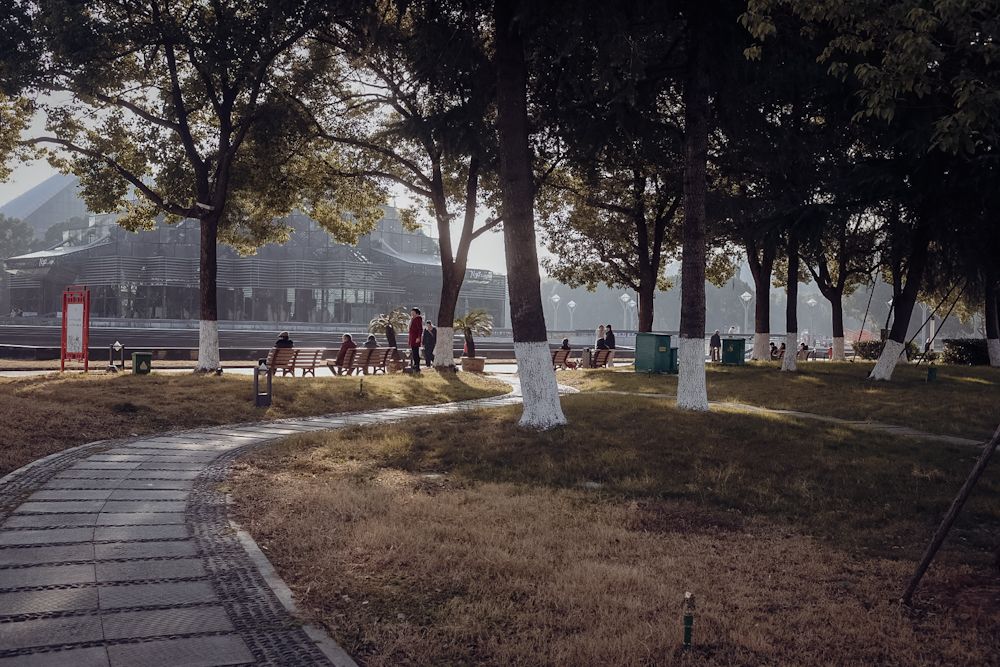
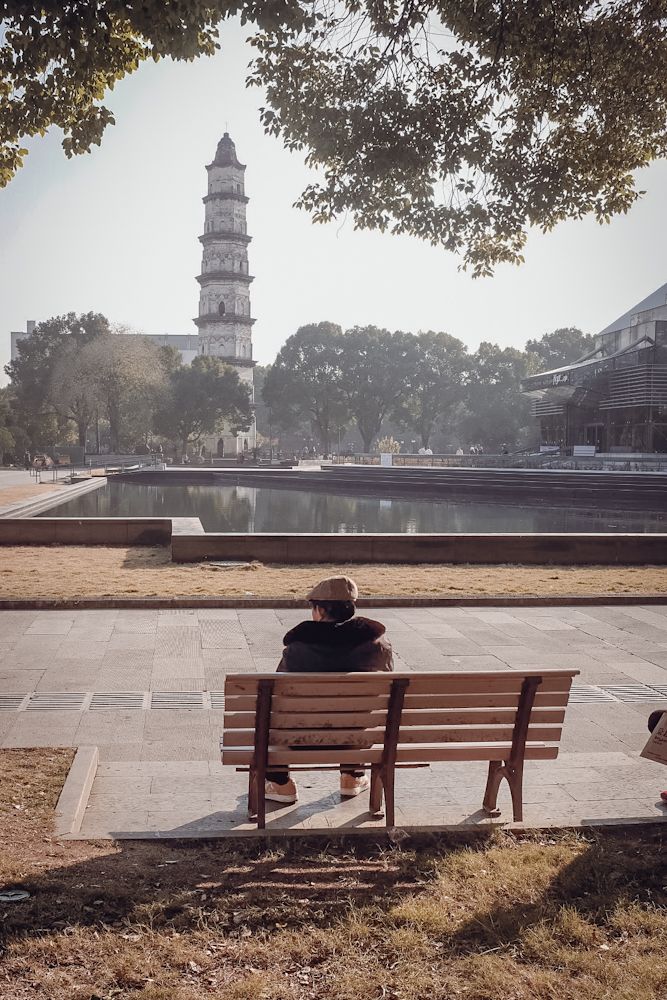
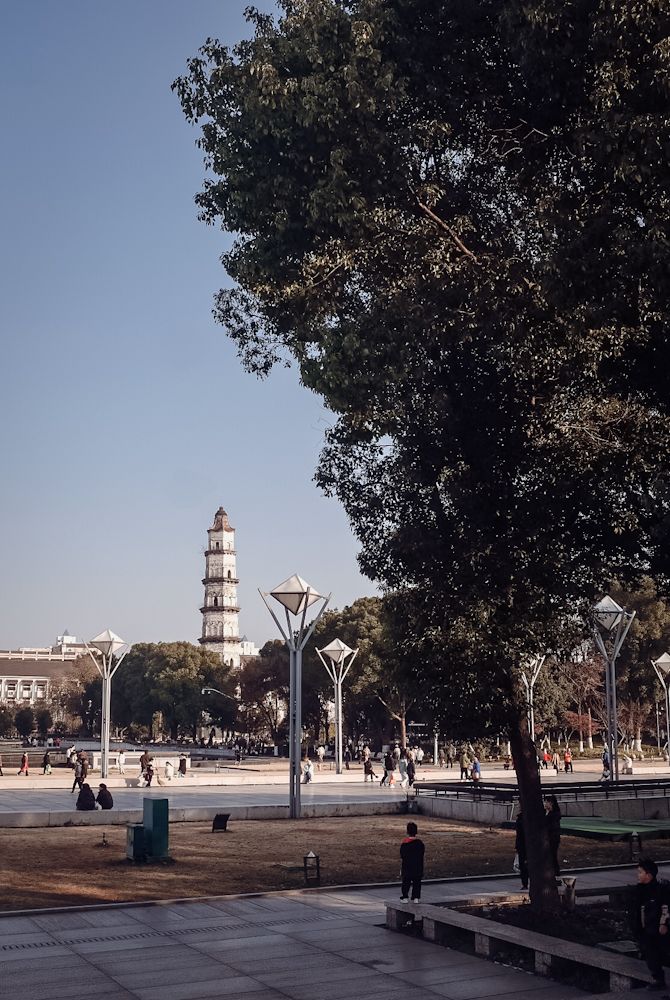
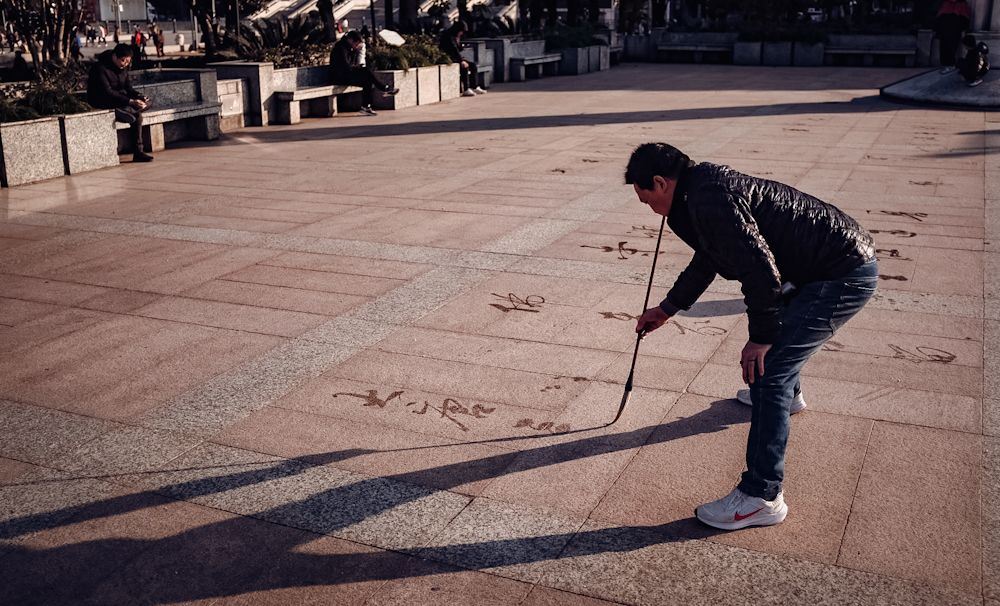
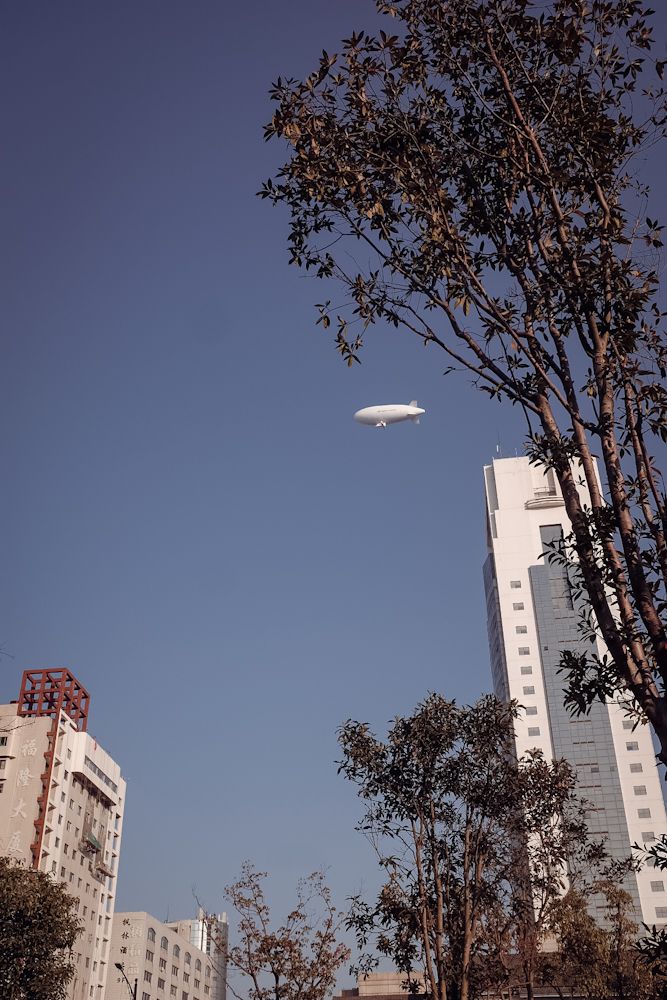
As we sat, the Aunty hummed a Chinese song. I was transported elsewhere, nearly dozing off in the sunlight—a habit I seemed to be developing. Thanking her for her company, I wandered further into the park. The sunlight filtered through the trees, highlighting the park’s serene beauty. I came across a single artist practicing calligraphy on the ground, using water instead of ink. His strokes were delicate and ephemeral—a fleeting masterpiece destined to evaporate. Children played with marbles nearby, using the sculpted floor as their playground. The juxtaposition of timeless tradition and youthful play captured the spirit of China for me. Above it all, a pagoda stood proudly, with an airship hovering in the background—a striking blend of the classic and the modern.
Reluctantly, I left the park to prepare for our penultimate concert. The thought of returning to the mundanity of home life began to weigh on me. This tour had been a gift, filled with unforgettable experiences and people. I wasn’t ready for it to end.
The concert hall was just across the park, and I strolled over leisurely—no need to rush; a gentleman never runs. The theatre director and his team greeted us warmly, their hospitality as magical as ever. Some brass players had prepared a fanfare to welcome the audience, and the atmosphere buzzed with excitement. Selfies were taken in abundance, and someone was even live-streaming for TikTok.
The concert itself went beautifully, with the usual audience participation adding to the magic. Afterward, the theatre manager addressed us, reminding us of the event’s purpose: celebrating Franco-Sino relations and their 60th anniversary. His French was excellent, and his enthusiasm infectious. They had prepared a spread for us—a delightful picnic with beer aplenty. As the night progressed, the manager led by example, dancing and motivating his team to let loose. Seeing their boss in this light seemed to surprise them.
I left the party early, taking a quiet stroll back to the hotel. The park, now illuminated, looked entirely different. The pagoda glowed softly and had changed character, and became the central element to the park. Meanwhile, Corentin extended the festivities at a local bar, where the owner was treated to an impromptu rendition of Michel Sardou’s “Les Lacs du Connemara.” A night to remember, indeed.






























 IJM Photography