
I didn’t set out to sell prints.
Not really.
For years, I’ve shared images here — not because they were “good,” or “marketable,” or even finished — but because they stayed. They lingered after the shutter closed. They returned to me in dreams, in quiet hours, in the slant of afternoon sun months later.
Some moments refuse to be forgotten.
So now, carefully, tenderly, I’m offering six of them — made physical. Not mass-produced. Not disposable. Just… present. As they were meant to be.
Each print is produced through WhiteWall on museum-grade archival paper, using pigment inks rated for over 100 years. Made to order. Shipped with care — because if you’re making space for one of these in your home, I want it to feel like a conversation, not a transaction.
There’s no rush. No countdown. No pressure.
Just paper, ink, and a moment that mattered.

1.
Path to the Pavilion — Huizhou Lake, China
When they told us we were stopping at a lake before the evening concert, I wasn’t exactly thrilled. A leisurely stroll around a lake? Moi?
But China has a habit of surprising you.
When we arrived at Huizhou, surrounded by hazy sunshine and bamboo groves, pagodas rising from still water, temples half hidden in trees — I felt something I hadn’t expected. Happiness. Pure, uncomplicated, unexpected happiness.
I was walking slowly with Mathilde, one of our violinists nursing a bad foot, taking our time while the others rushed ahead. It was that unhurried pace that did it — the kind of walking that lets you actually see things. The light was filtering through the trees, sparkling on the water, and the path curved gently ahead of us toward a pavilion that felt like it had been there for centuries.
I raised the camera and didn’t think twice.
There are days on tour when the music and the place and the people all align into something you know you’ll carry for the rest of your life. This was one of them.
Shot on Fujifilm X100F — Huizhou Lake, China, 2024
2.
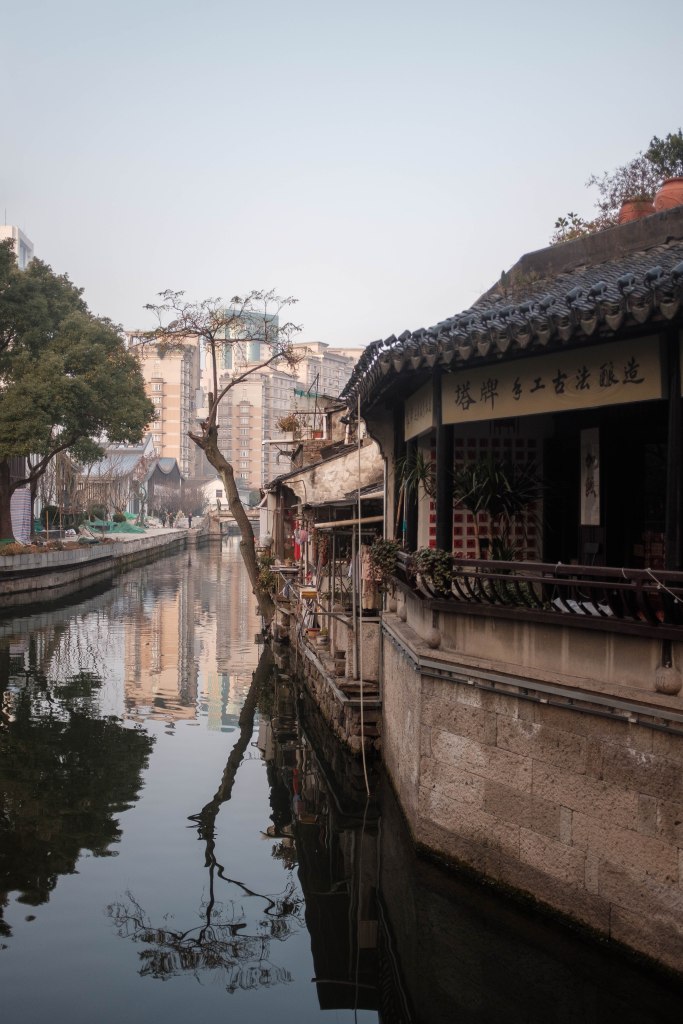
Reflections on the Canal — Shao Xing, China
It was one of the last mornings of the tour. The parenthesis, as I’d come to think of it, was beginning to close.
My colleagues had discovered a hidden residential quarter the evening before — the kind of place that doesn’t appear in guidebooks. Round entrances leading to inner courtyards. Red lanterns going up for Chinese New Year. Fish drying under the rafters. Boats drifting on ancient canals.
I was told to turn left outside the hotel, walk ten minutes, and I couldn’t miss it. Which is, of course, exactly the kind of direction I usually do miss. Not that morning.
The quarter was just waking up as I arrived, camera in hand — my wife having specifically asked me to remember to shoot in colour this time. People were clearing their throats, eating their rice for breakfast, mopeds carrying their passengers gently to work. The canals reflected the old white walls and tiled rooftops in the still morning water.
It was authentic China. Not the gleaming towers of Shenzhen. The China that has existed for centuries and quietly continues to exist, unhurried and completely itself.
I didn’t want to leave.
Shot on Fujifilm X100F — Shao Xing, China, January 2025
3.
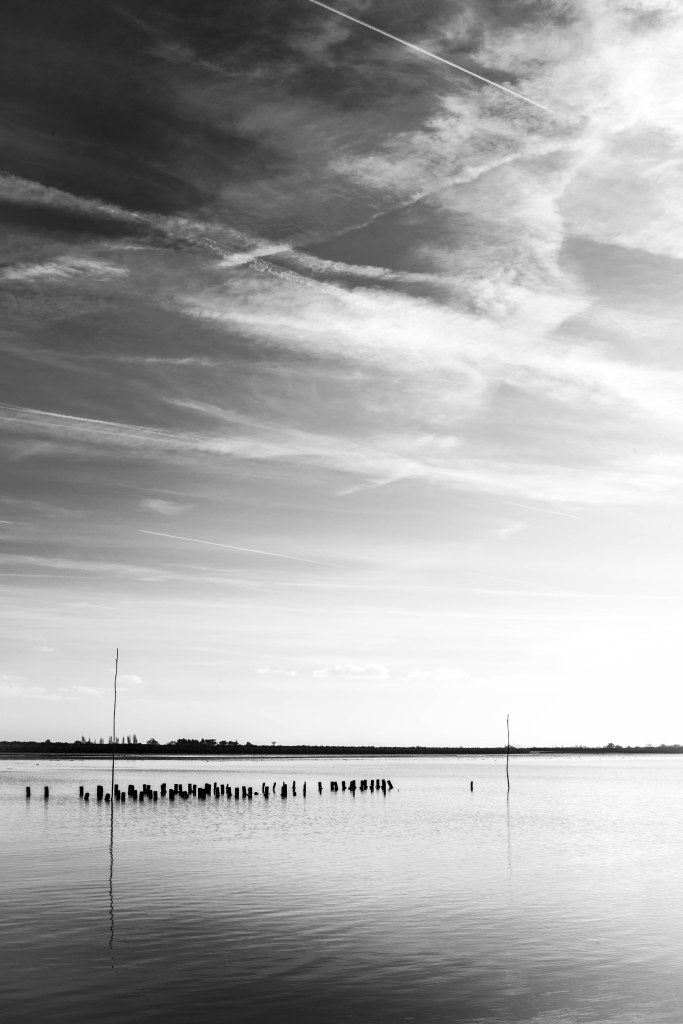
Skyline of Absence — Passage du Gois, Vendée
It started as a solo escape. A sandwich from a bakery, the Canon 6D Mark II dusted off, and a deliberate decision to go somewhere without tea shops to distract me.
The Passage du Gois is one of those places that shouldn’t exist. A road across the sea connecting the Vendée mainland to the island of Noirmoutier — but only when the tide allows it. Miss your timing and the Atlantic rolls in faster than a galloping horse. The beacons aren’t decoration. They’re for the people who got it wrong.
That January day the tide was out, the sky was vast, and Noirmoutier sat on the horizon like a quiet guardian. The blue reflected in the still water. The sea air did what sea air always does.
I stood there for a long time, just looking. The horizon was almost empty — just sky, water, and those silent beacons receding into the distance. An absence that somehow said everything.
Sometimes that’s all photography really is — permission to stand still and actually see what’s in front of you.
I like calm. I like it about as much as I like tea and cake.
Shot on Canon 6D Mark II with 50mm f1.8 — Passage du Gois, Vendée, France, January 2020
4.
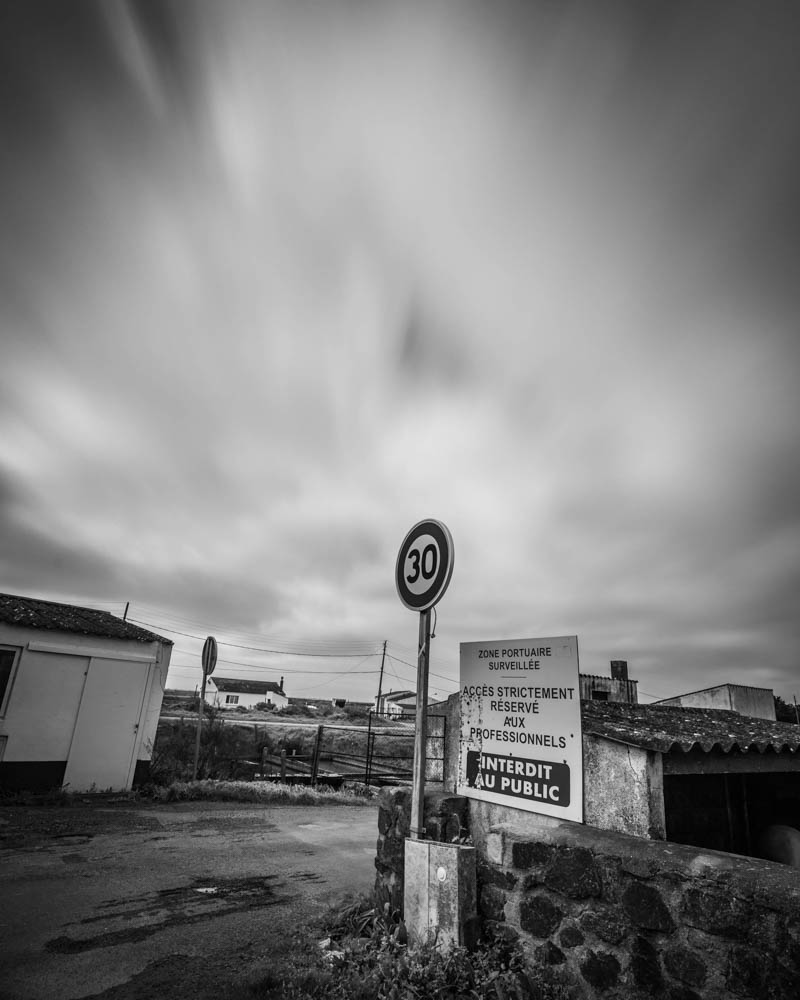
Coastal Sky, Vendée
There are days when the sky simply takes over.
Near Fromentine on the Vendée coast, I set up a long exposure and let the camera do what the eye cannot — blur time itself. The clouds became something liquid, something moving, while the sea held perfectly still beneath them. Two different versions of the same moment existing simultaneously in one frame.
This is not a dramatic sky. There is no storm here, no crisis, no golden hour showmanship. Just the coast breathing — slow and steady and completely indifferent to being photographed.
I find that deeply reassuring.
Shot on Canon 6D Mark II — Near Fromentine, Vendée, France, 2021

5.
Title: Vespa & Whiskey
I’ll be honest with you. I’d spent the day doing what the Quartier Bouffay does best — supporting the local hospitality industry with some enthusiasm. Somewhere between lunch and late afternoon I’d slipped into the beautiful Église Sainte-Croix, perhaps to balance the accounts a little.
Coming back out into the afternoon light, I turned a corner and stopped dead.
There it was. A Vespa, resting against a whiskey crate as casually as if it had always been there. Vintage, unhurried, completely itself. The kind of scene you spend years hoping to stumble across.
I reached for the Praktica MTL3 — the same camera and Pentacon 50mm f1.8 lens I first learned photography on in the 1980s — and didn’t think twice. Some moments don’t ask for deliberation.
Right place. Right time. Right camera.
Shot on Praktica MTL3 with Pentacon 50mm f1.8 — Quartier Bouffay, Nantes, France

6.
Steam and Sizzle, Shenzhen Night
They called it Operation Shenzhen Nights. Corentin and Paul had planned it with the enthusiasm of five-year-olds at a zoo — a night out in Shenzhen, no concert, no schedule, just the city.
We took the tube across town, red lanterns swaying overhead for Chinese New Year, and emerged into organised chaos. Street food stalls everywhere. Skewers of chicken, octopus, and things I decided not to look at too closely. Scorpions and crickets were offered. I drew the line there. Some adventures have limits.
But the steam rising from the food stalls against the neon-lit night — the sizzle and smoke and smell of a city that never quite stops — that was something else entirely. I had my camera out and I wasn’t putting it down.
Shenzhen at night is a city in perpetual motion. Young, electric, completely alive. Standing there amid the chaos — nearly 53 years old, gammy knee and all — I felt something I hadn’t expected. Completely present. Completely there.
What happens on tour stays on tour. But some images deserve a wall.
Shot on Fujifilm X100F — Shenzhen, China, December 2024
And then — because I believe in the power of the overlooked — there’s a seventh.
7.
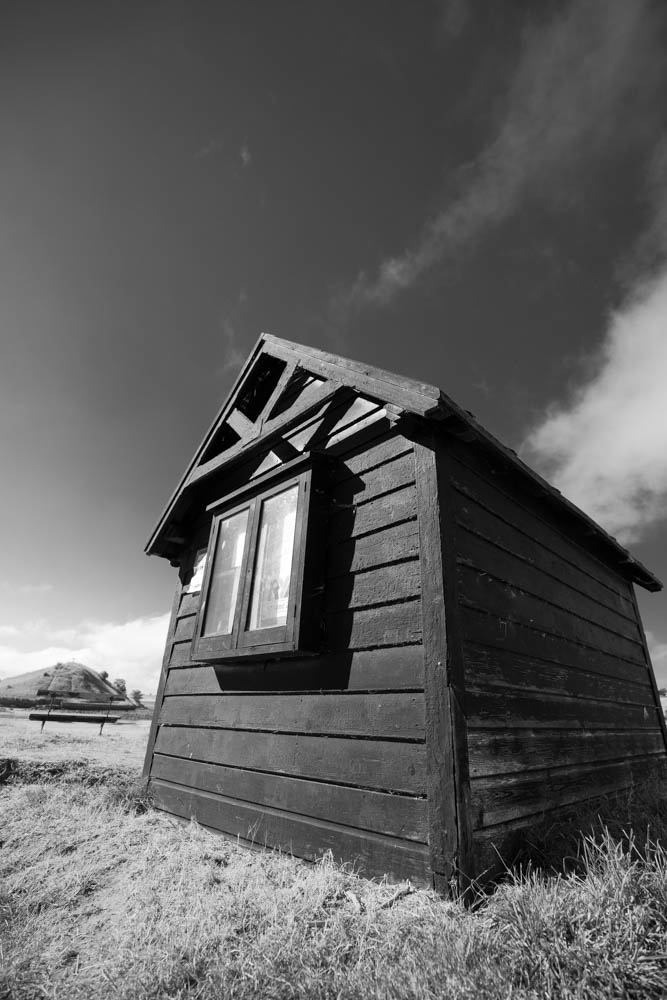
The Smallest Museum — Alnmouth, Northumberland, 2022
I’d started the morning properly — tea, toast, elevenses at Scott’s of Alnmouth, watching the sea mist lift off the Northumberland coast. When it cleared it was one of those impossibly sunny September days that makes you wonder why you ever left.
I wandered without a plan, Canon 6D Mark II in hand, letting the village reveal itself at its own pace. Alnmouth is that kind of place — it doesn’t rush, and it doesn’t need to impress you. It just is.
And then I found it. A tiny wooden shed standing quietly under an open sky. No grand entrance. No ticket booth. No gift shop. Just a modest building holding stories too small to shout and too true to ignore.
I stood there for a moment before raising the camera. Some things deserve a pause before you photograph them.
Shot on Canon 6D Mark II with 16-35mm — Alnmouth, Northumberland, UK, September 2022
I don’t make photographs to sell.
I sell them because some moments refuse to be forgotten.
If one of these finds its way to your wall, I hope it does more than hang there.
I hope it reminds you that some things are worth keeping — exactly as they were.
You can find the prints here! https://shop.ijmphotography.net/collections/the-collection
—
Take your time. These prints aren’t going anywhere.
— Ian
ijmphotography.net

















 IJM Photography