
The lunch break ended. Tables were folded. Containers were packed. The last crumbs were brushed away.
And then they arrived.
Two Chinese violin soloists—guest artists who’d traveled far to play a double violin concerto with our little orchestra in a French community center. They weren’t at lunch. They weren’t part of that casual, sunlit gathering. They were here for work.
So were we.
I put down my Fomapan 100 roll and loaded HP5+ pushed to 1600. Swapped the Pentax ME Super for the Canon AE-1 Program. Same 50mm lens philosophy, different camera, different film, different mood.
The sunlight was gone. The fluorescents were on. The break was over.
This is where the real story begins.
I. The Transition
You can feel it when rehearsal starts. The shift from community to concentration. From chatting about weekends to counting measures. From “How was your drive?” to “Again, from measure 47.”
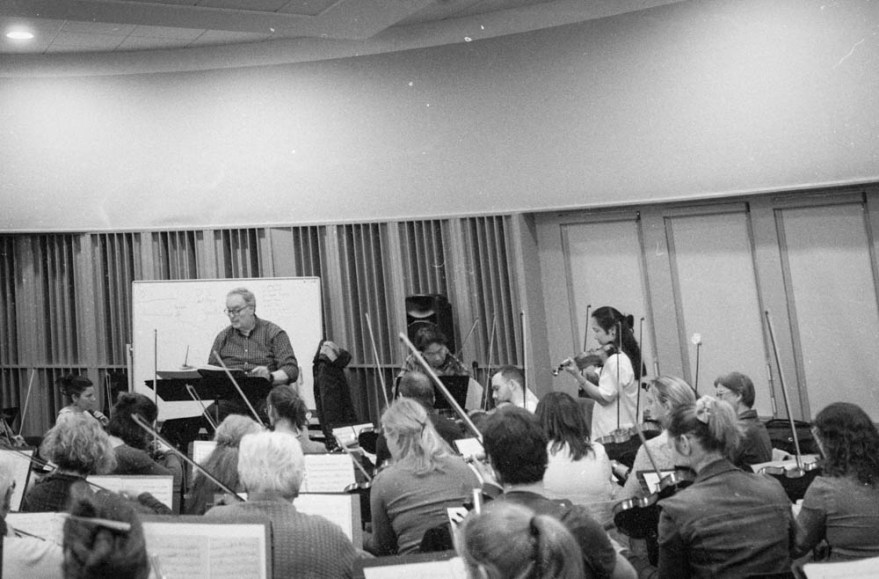
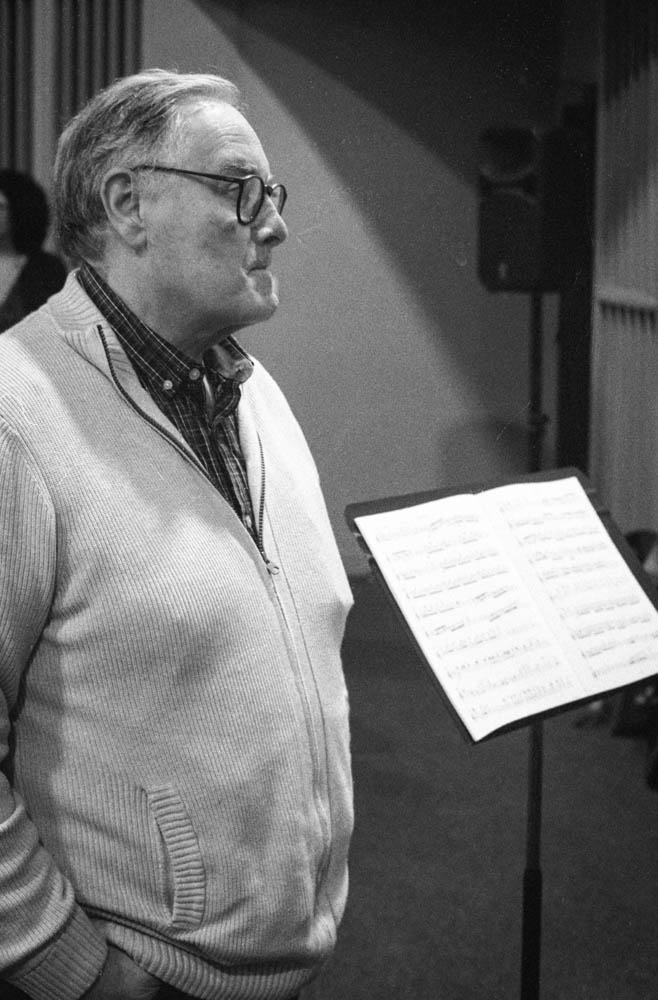
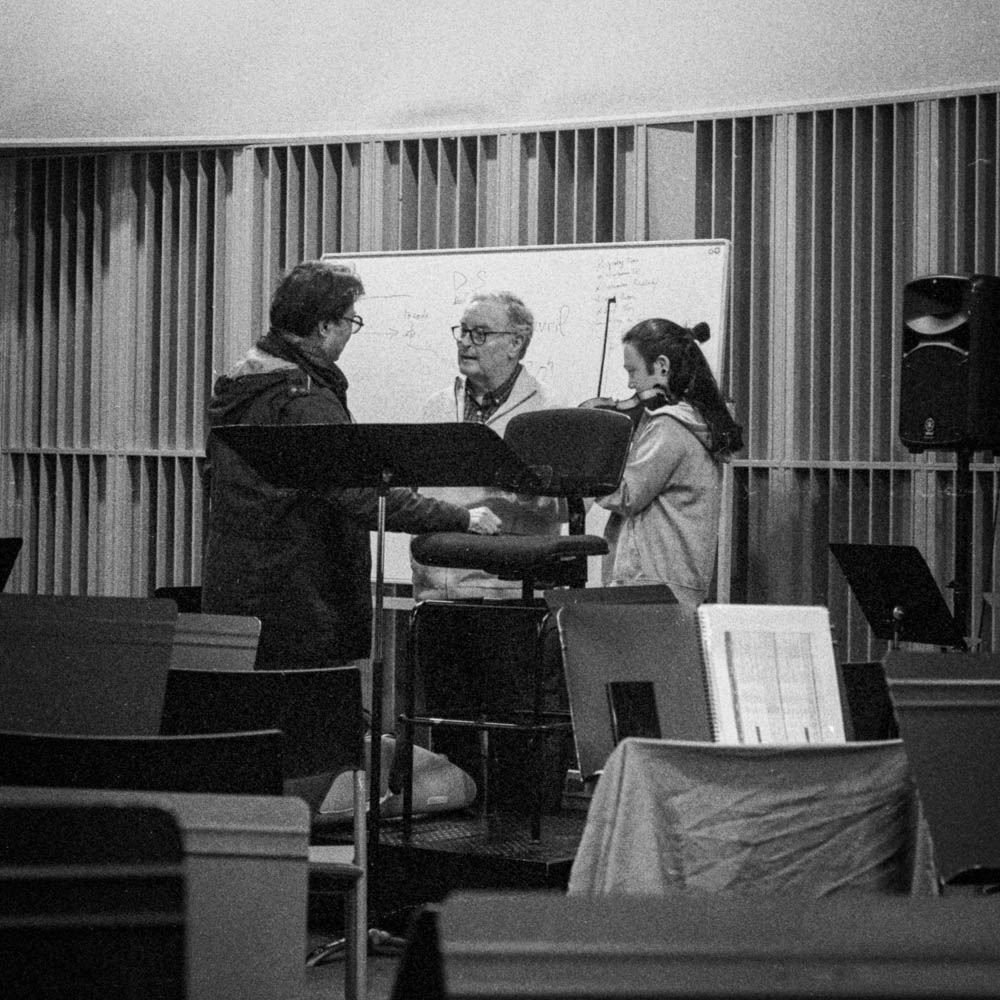
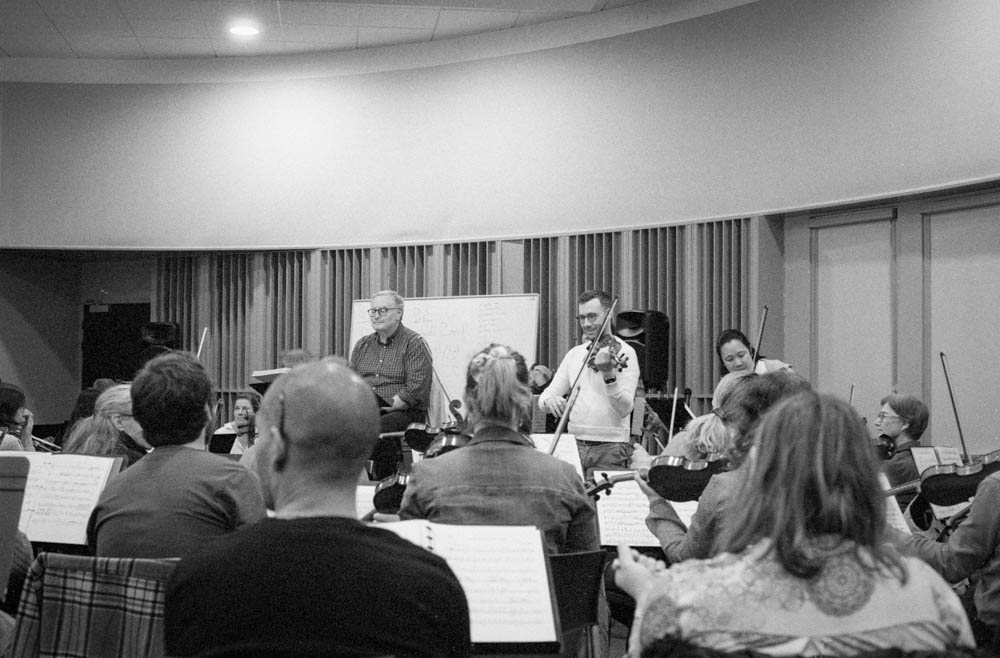
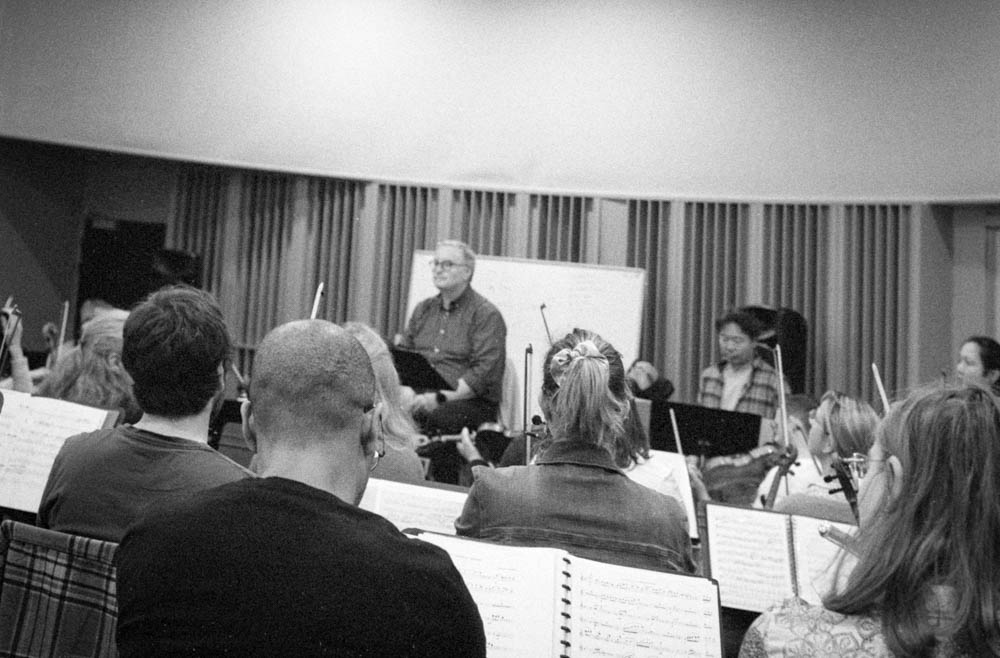
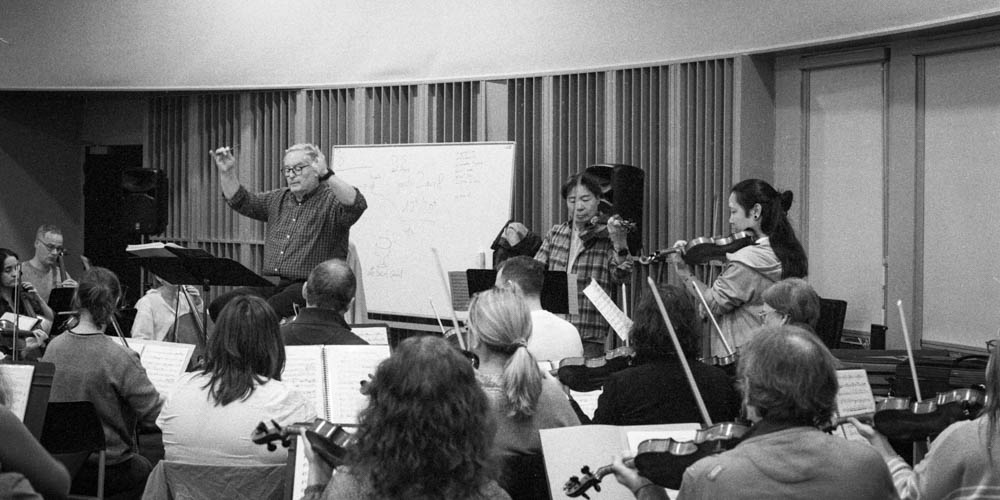
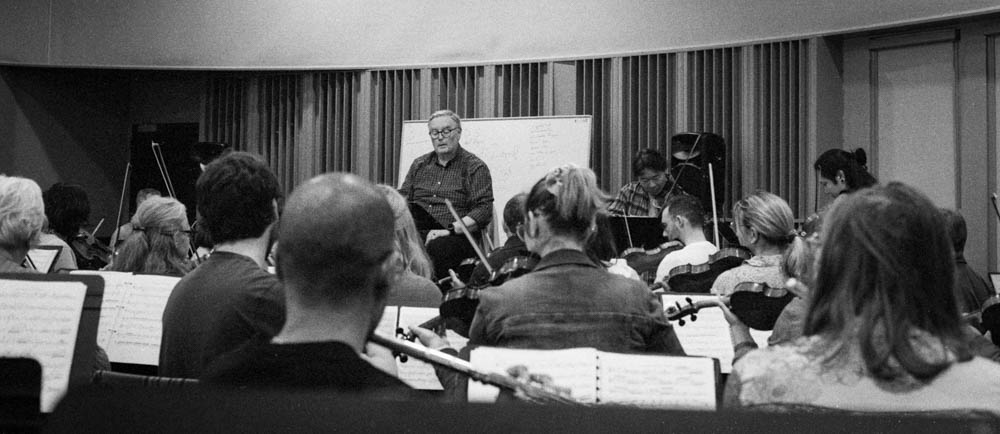
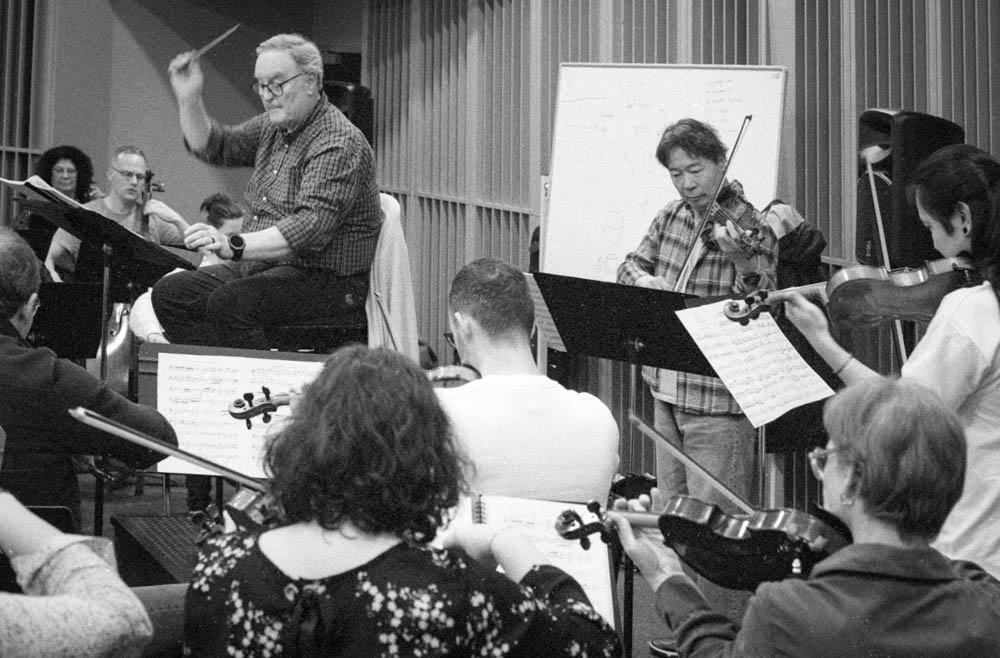
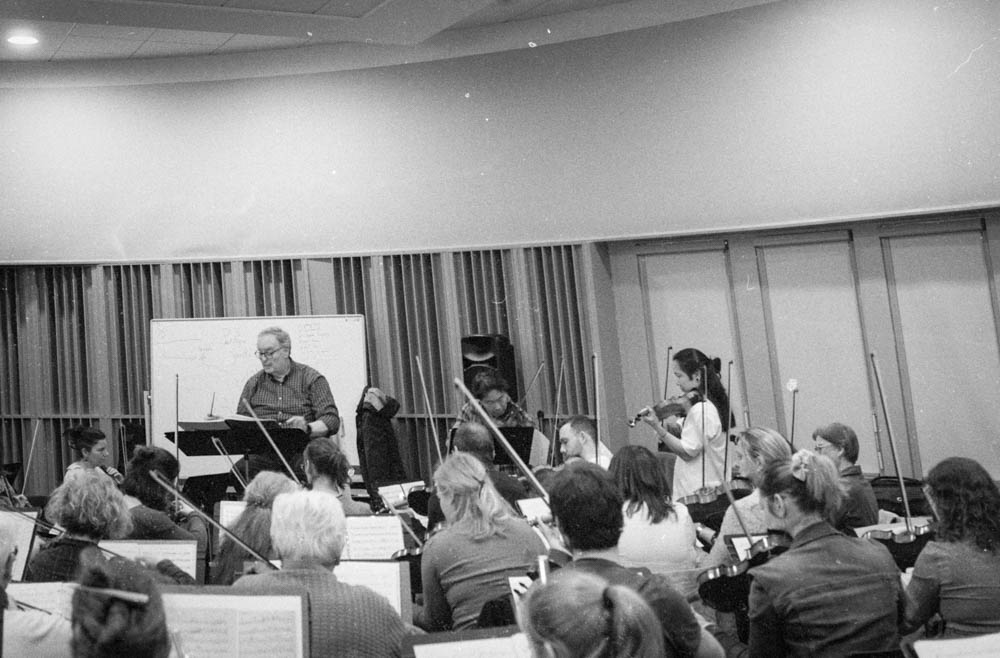
The conductor—same guy who was smiling with a food container an hour ago—is now at the whiteboard. Baton in hand. Voice projected. Notes scribbled behind him about tempo, dynamics, bowing.
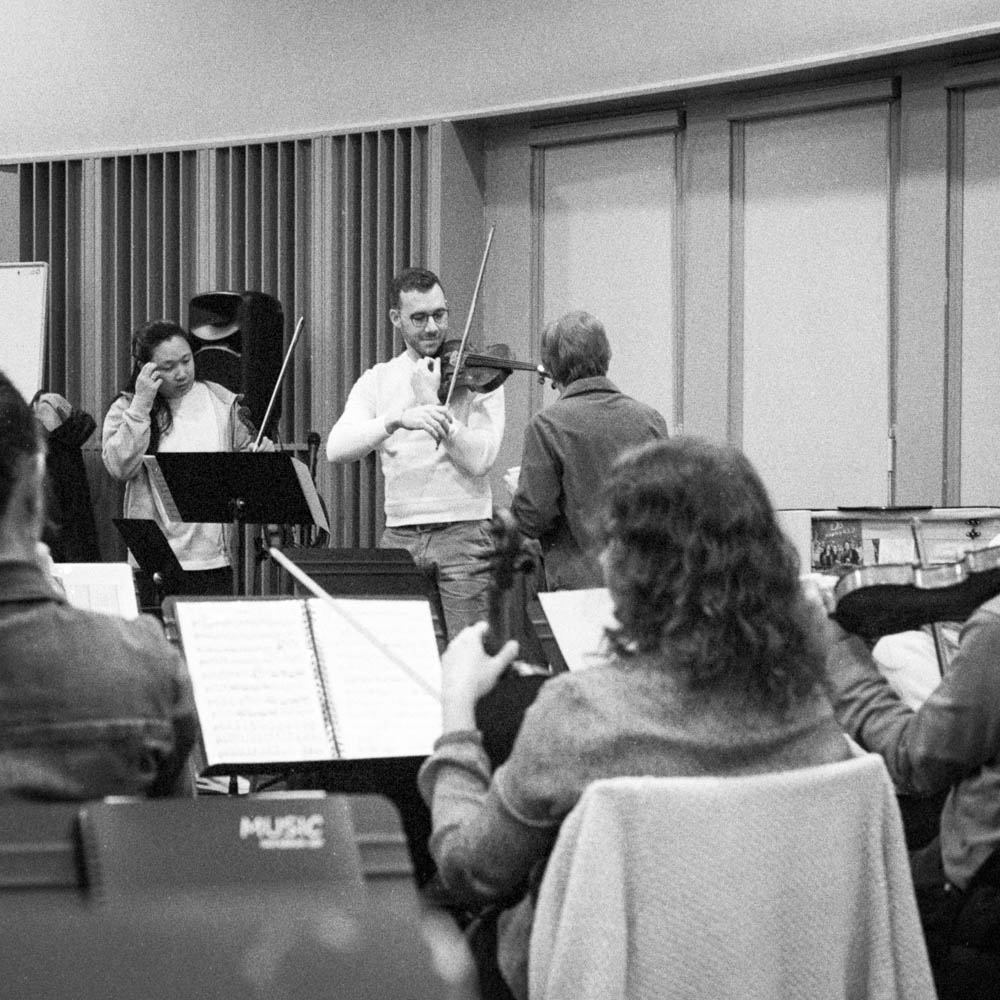
The soloists take their places at the front. Violins out. Tuning. Focused. They’re not part of our tribe yet. They’re guests. Professionals. Here to do a job.
I photographed from my seat in the horn section and from the aisles during breaks. The Canon AE-1 Program in Program mode—no thinking about shutter or aperture, just framing and timing. The camera’s brain handled exposure. My brain handled seeing.
The grain of HP5+ at 1600 is present but controlled. Not the fine, invisible grain of the Fomapan lunch shots. This is textural. Moody. Appropriate for the work ahead.
II. The Collaboration
Here’s what happens when you rehearse a concerto with guest soloists:
It’s not just the orchestra playing. It’s not just the soloists playing. It’s both, finding a shared language.
The conductor stops us. “Softer in the strings.” The soloists adjust. He stops again. “Soloists, a touch more projection.” They adjust. We play. He listens. He stops. He explains.
Over and over. Not because anyone is wrong, but because everyone is finding the same musical space.
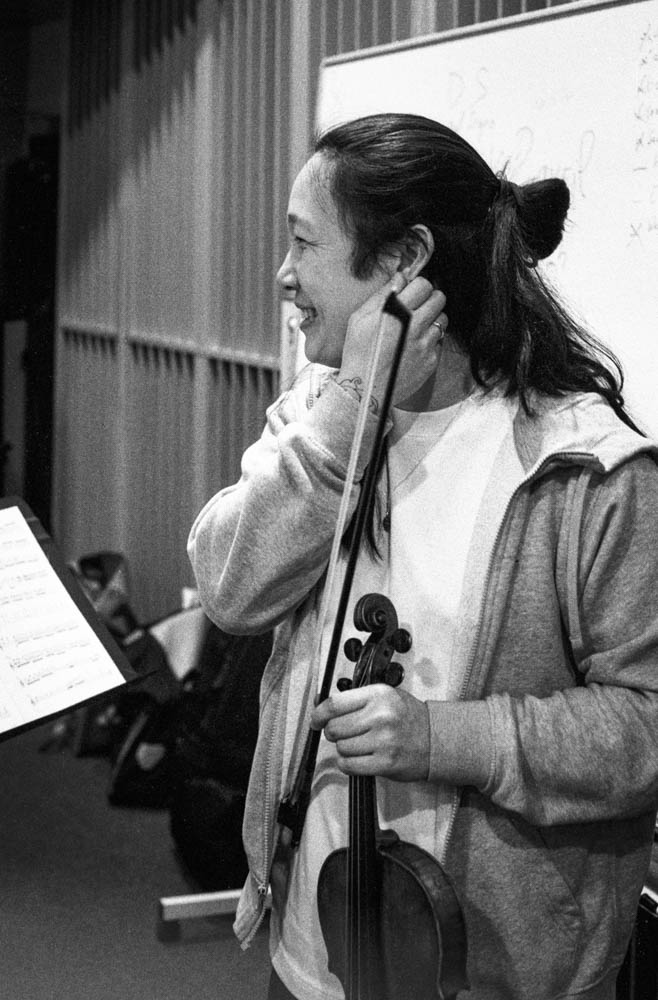
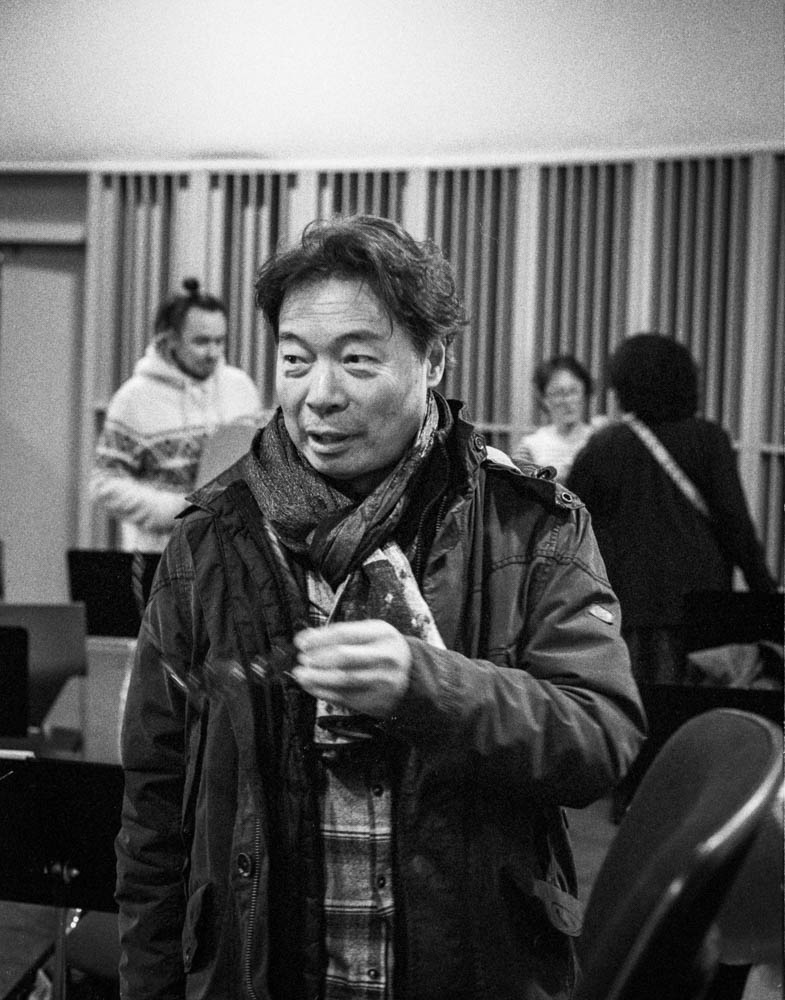
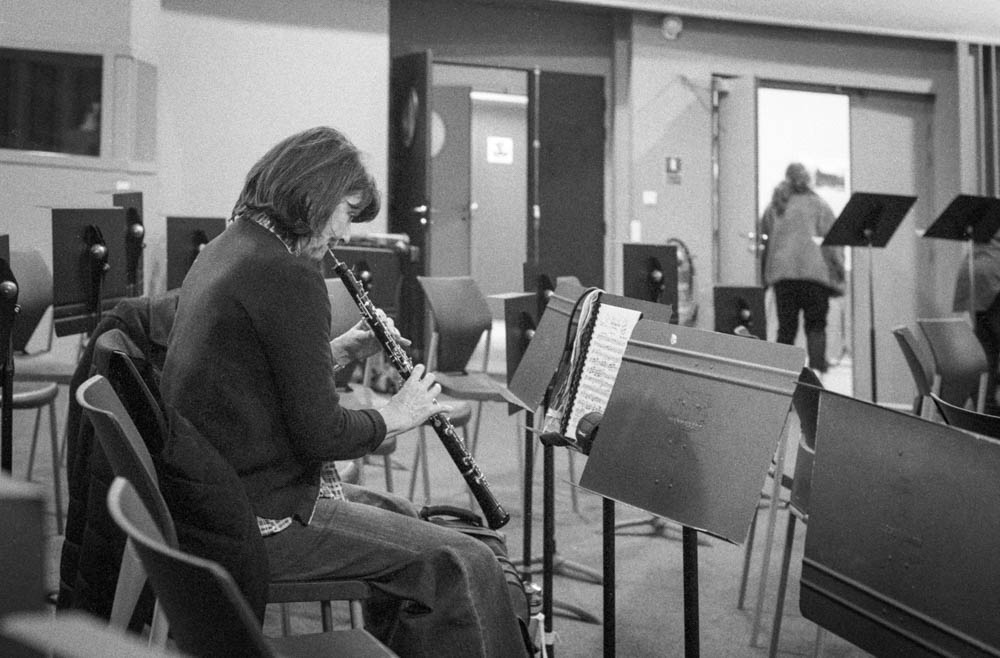
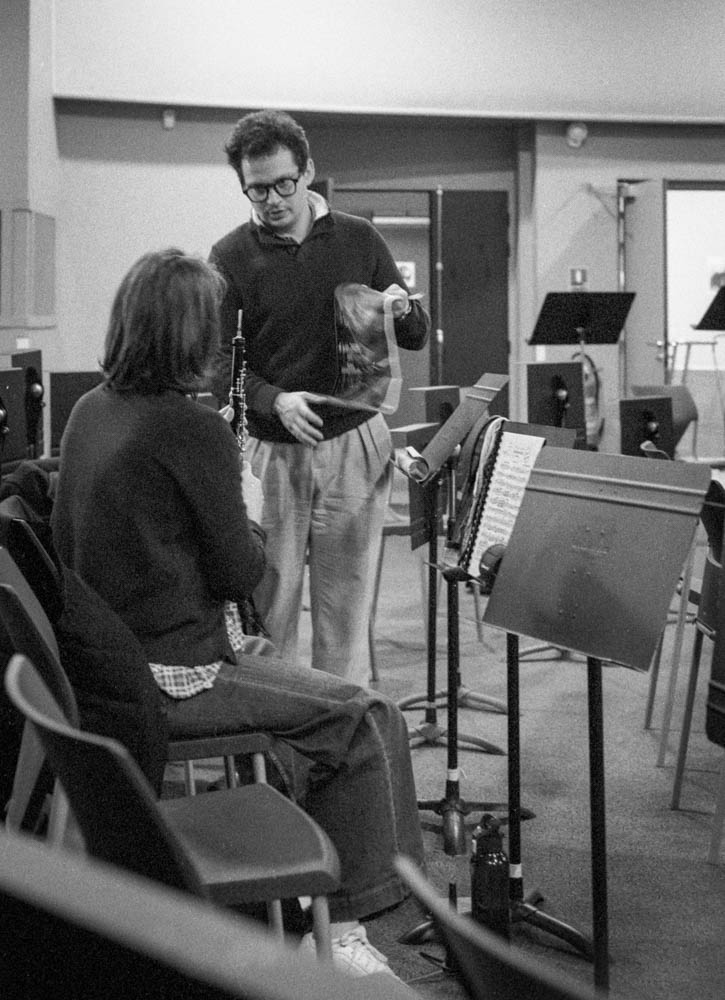
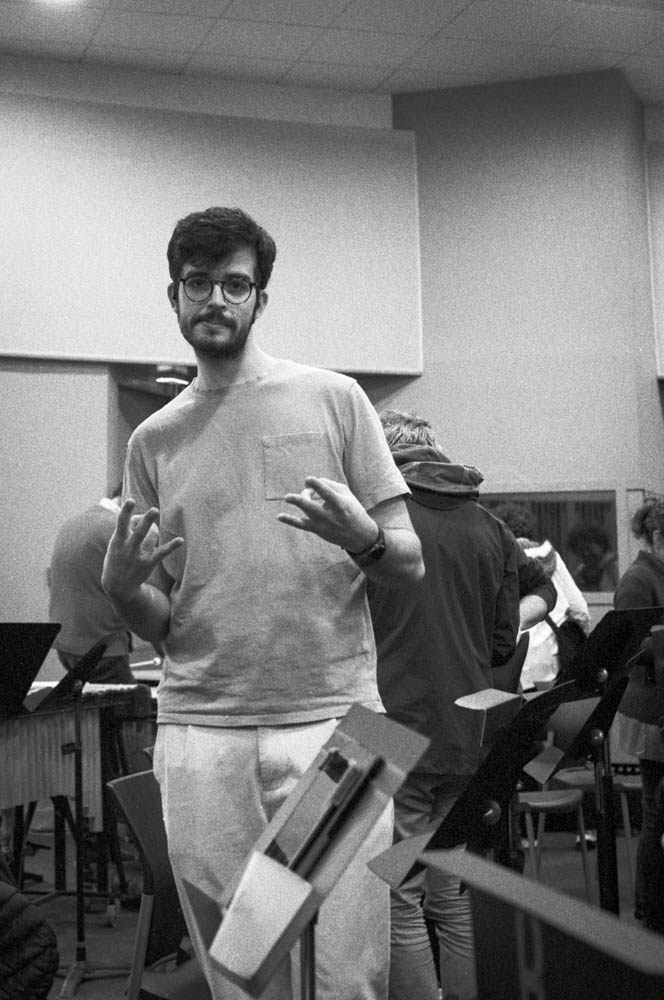
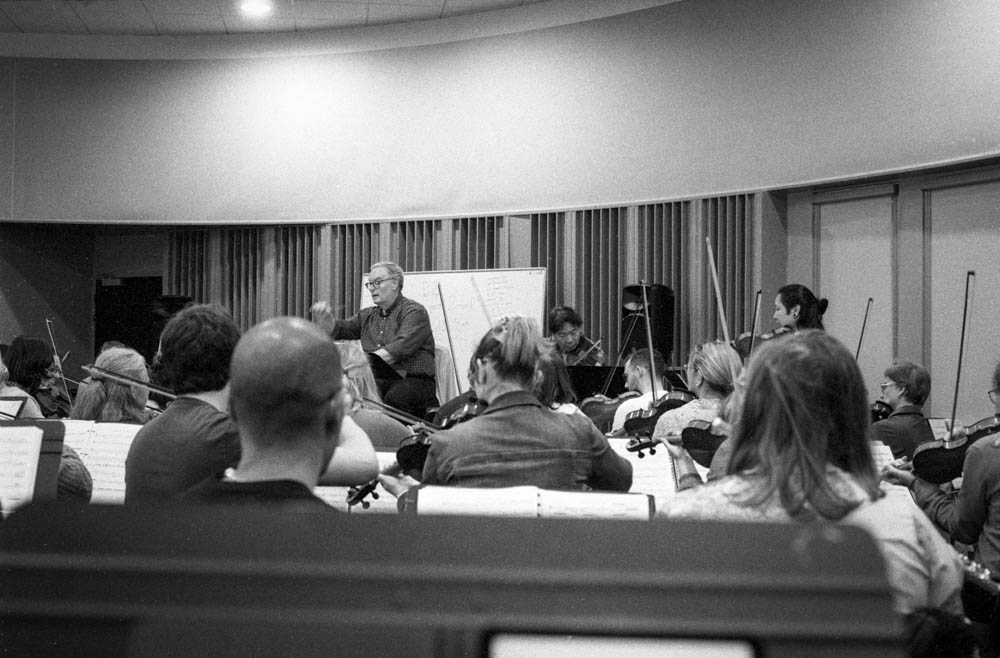
I caught moments of this dialogue. The soloists discussing a passage with the conductor (Photo 4). One adjusting her earpiece with a smile (Photo 1)—the same woman who’ll later be pouring her heart into a difficult solo. An oboist and colleague talking through a tricky section (Photo 6). Someone explaining with animated hands (Photo 7)—passion made visible.
This isn’t just rehearsal. It’s translation. Musical ideas, cultural nuances, interpretive choices—all being communicated across language and tradition.
The HP5+ 1600 handles it beautifully. The grain adds texture without overwhelming. The contrast is punchy but not crushed. Shadows hold detail. It’s the sweet spot between the clean Fomapan lunch shots and the raw 3200 images to come.
III. The Orchestra at Work
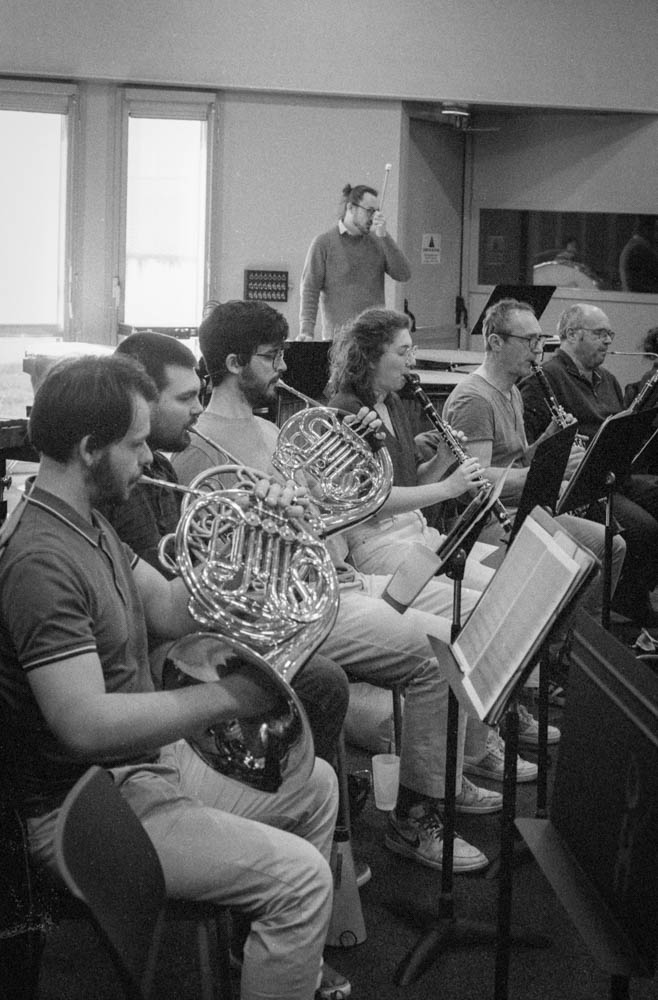
From my seat in the horn section, I see things differently than an outsider would. I know when the hard passages are coming. I know which sections are struggling. I know the rhythm of this room.
But through the viewfinder, I see something else. I see the whole machine.
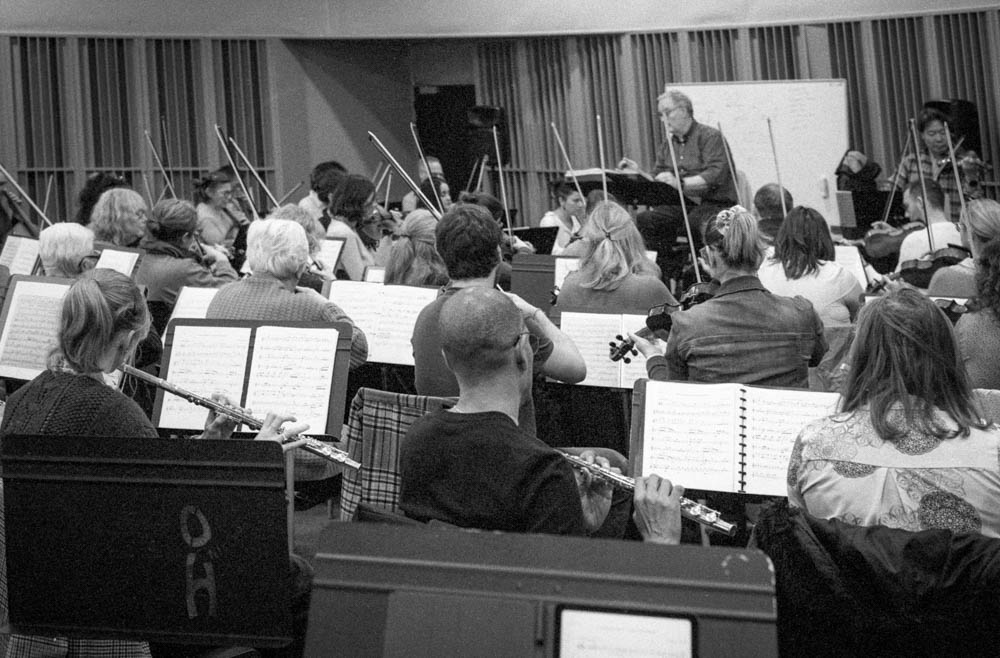
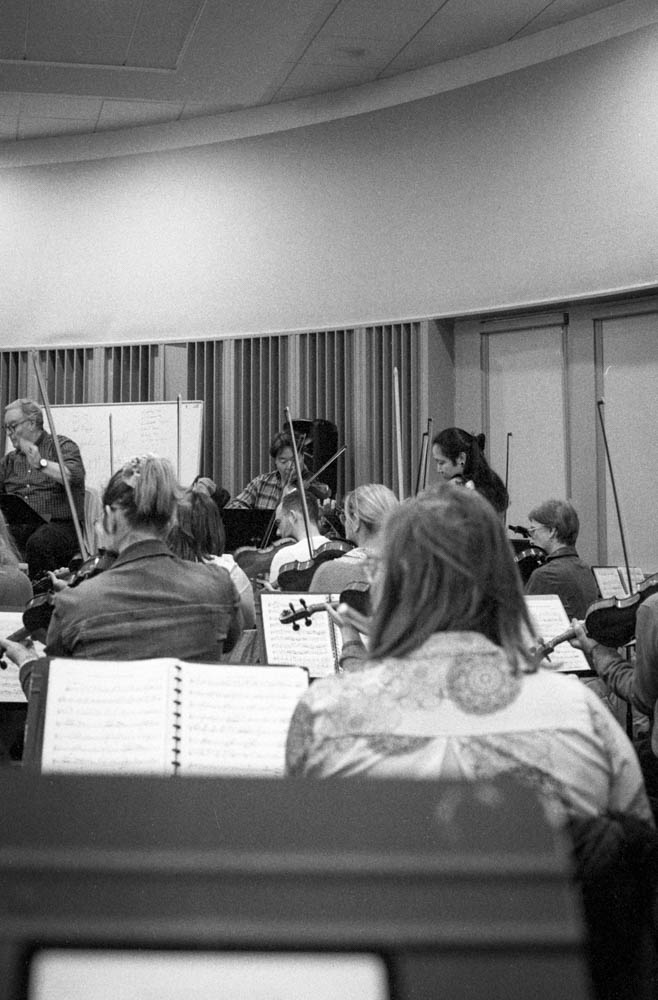
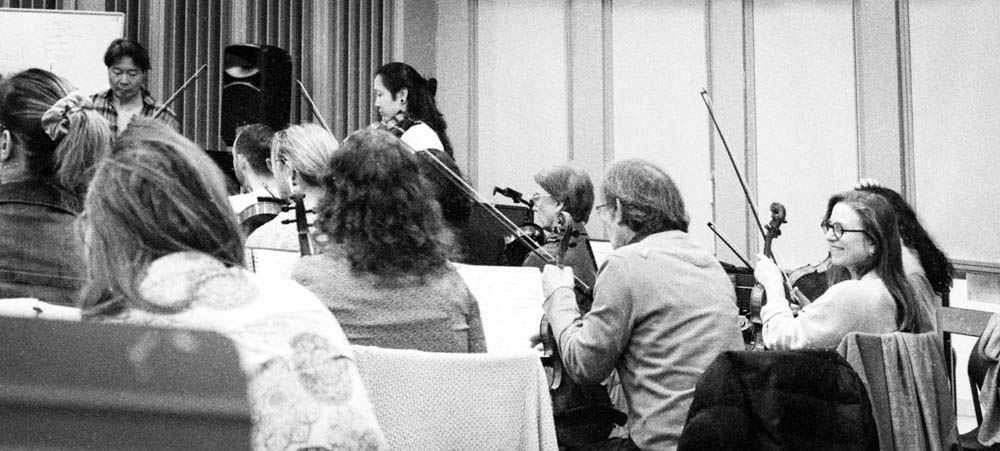
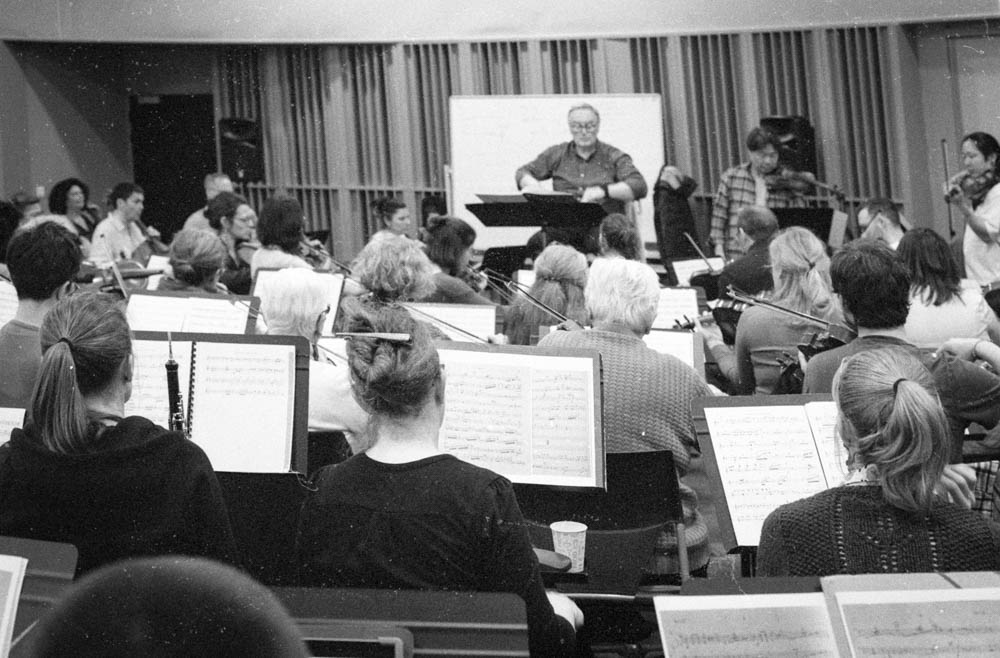
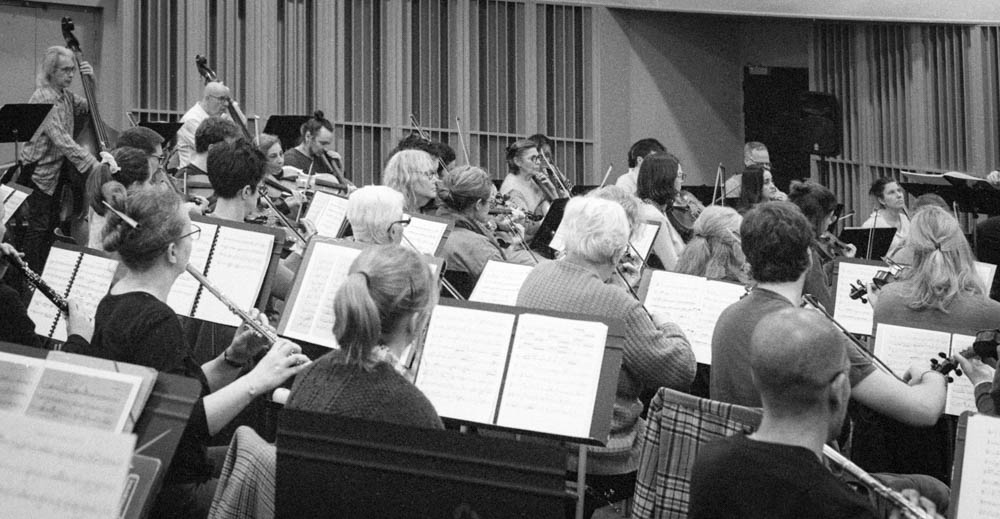
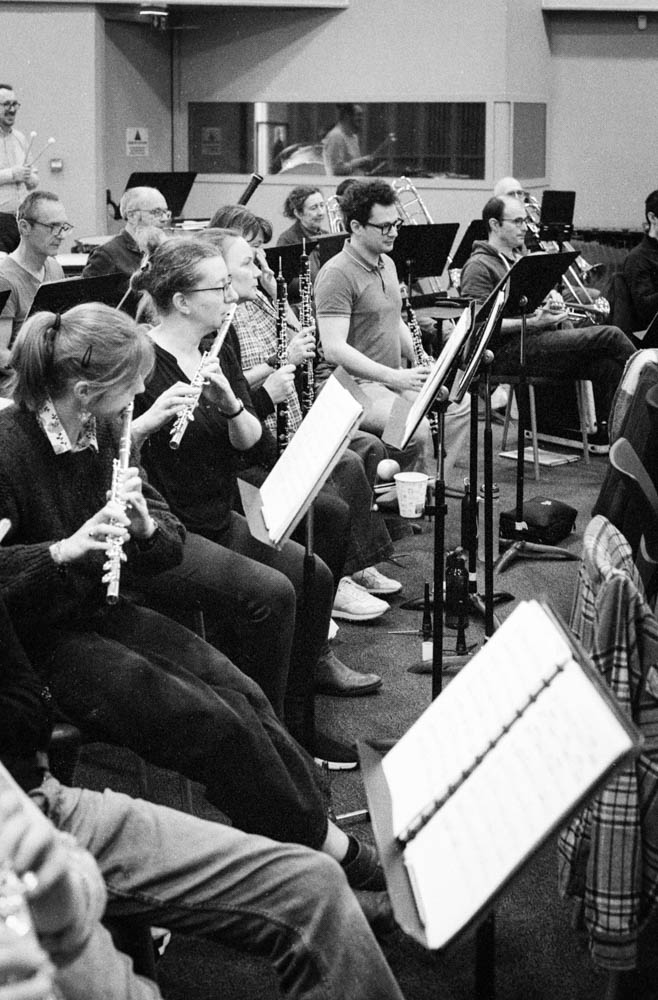
The string section, bows moving in that eerie synchronized way (Photo 8, Photo 10, Photo 13). The brass section, trombones gleaming under the fluorescents (Photo 11). The woodwinds—Viktor on oboe and cor anglais, focused, precise (Photo 14). Nicolas behind the timpani, patient, waiting for his moment (Photo 15).
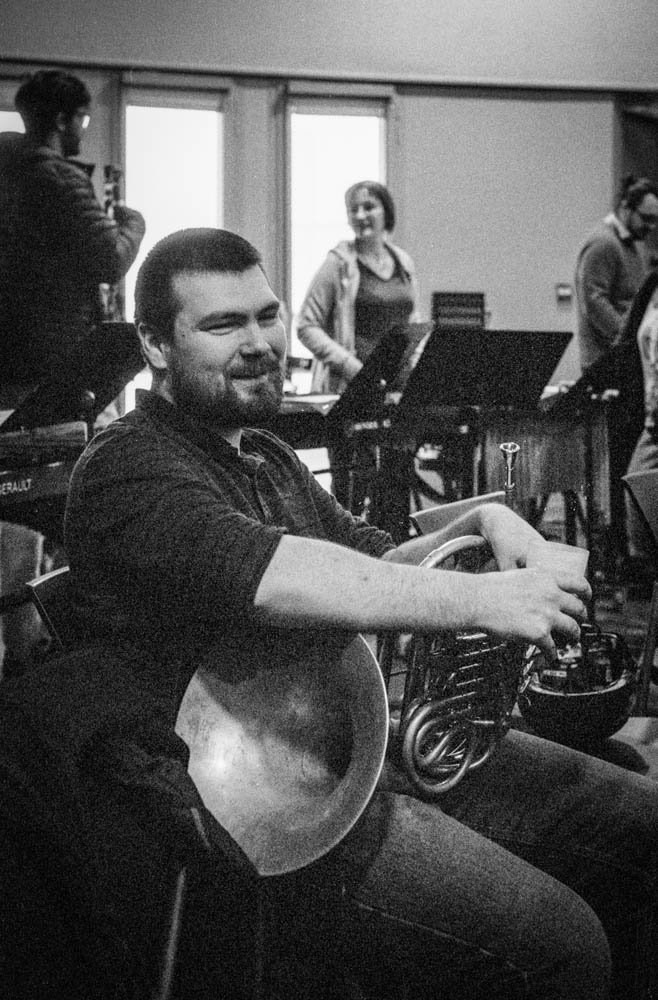
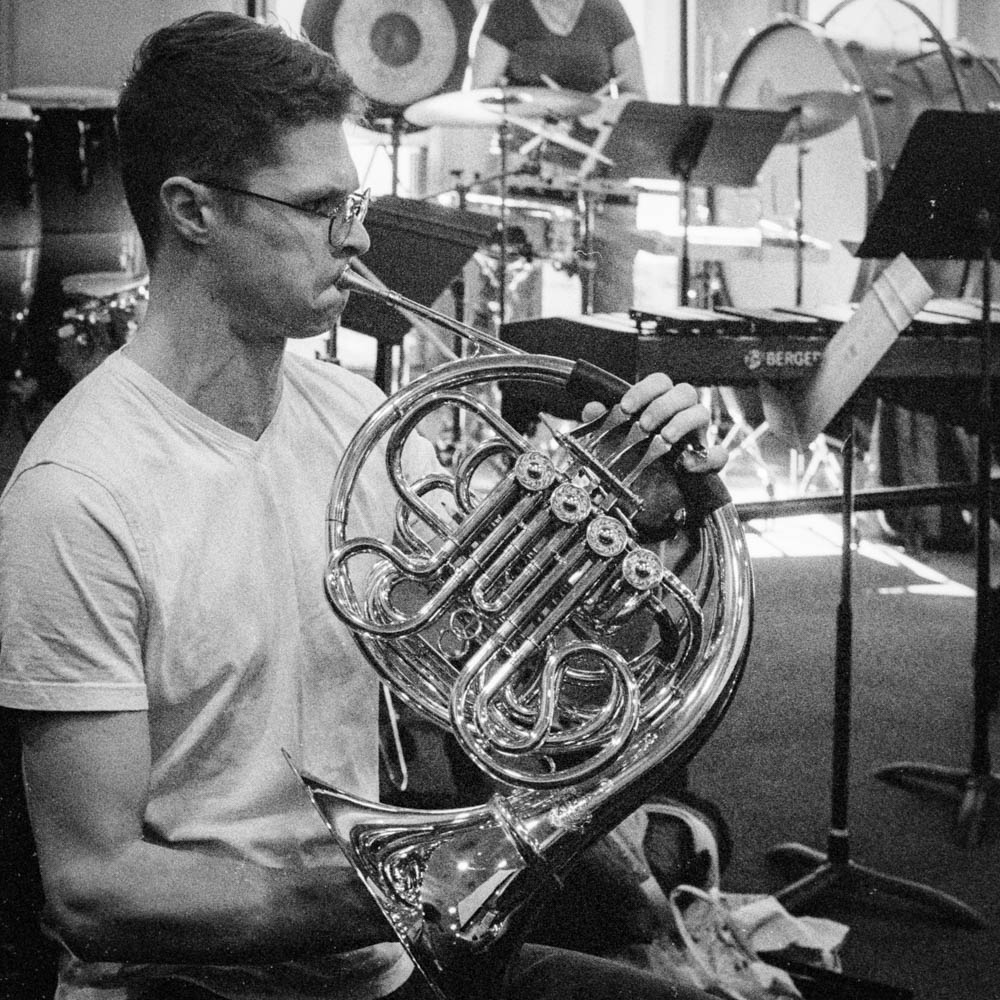
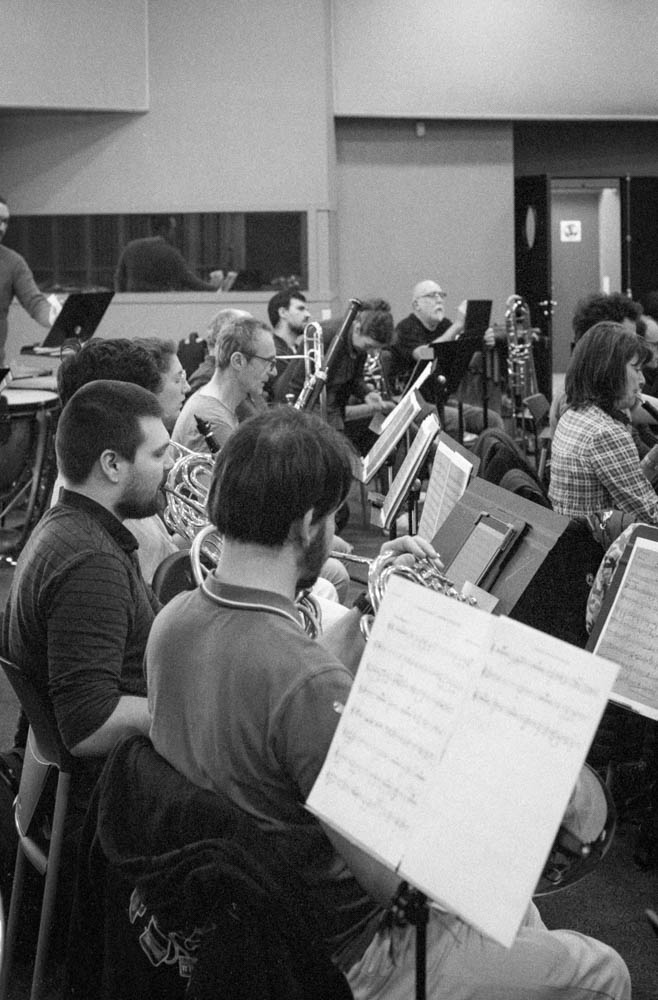
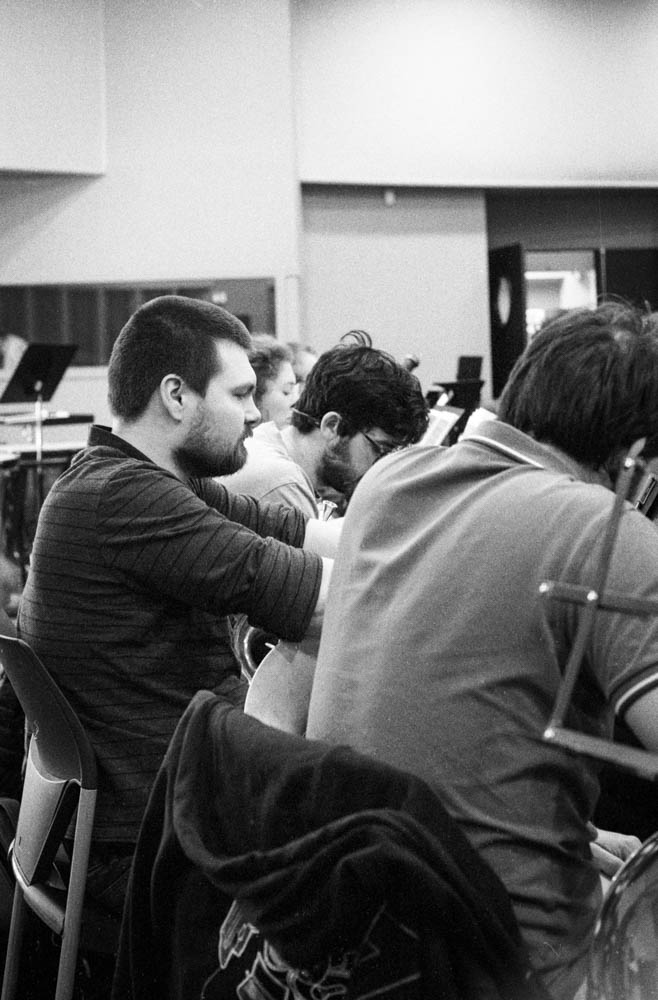
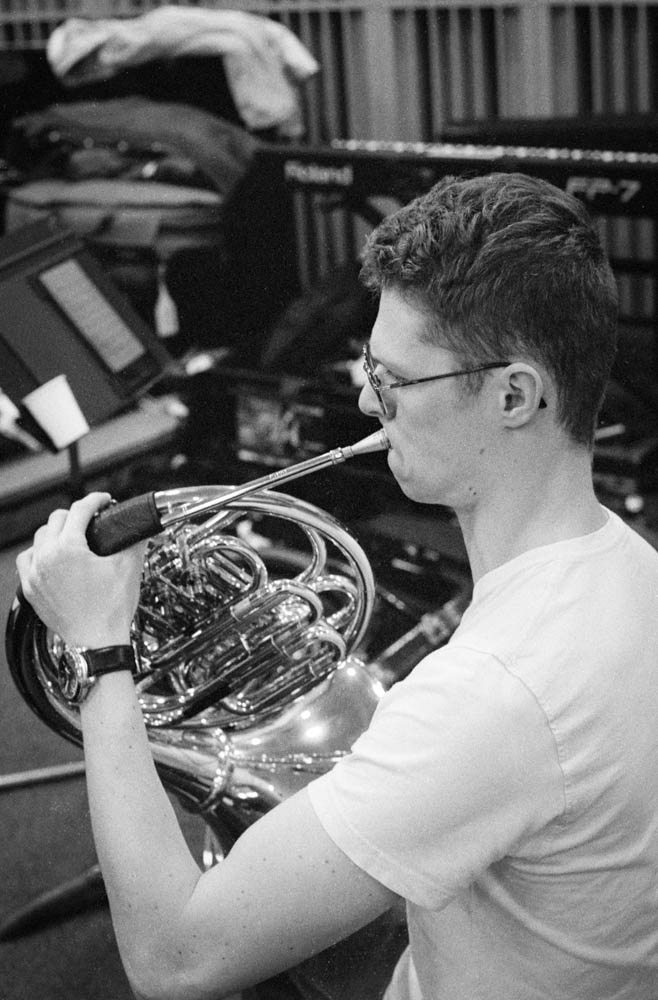
And the horn section—Corentin, our first horn, sitting next to me, fourth horn. Same guy who gave a thumbs-up at lunch. Now he’s absorbed in a difficult passage, glasses slipping down his nose, completely in the zone.
I photographed us from behind—all those hunched shoulders, heads bent over music, the conductor’s hands cutting through the air. Dozens of musicians, each with their own part, working toward a single sound.
This is the collaboration. Not just soloists and conductor. Everyone. All the time.
IV. The Details
I got obsessed with the small things.
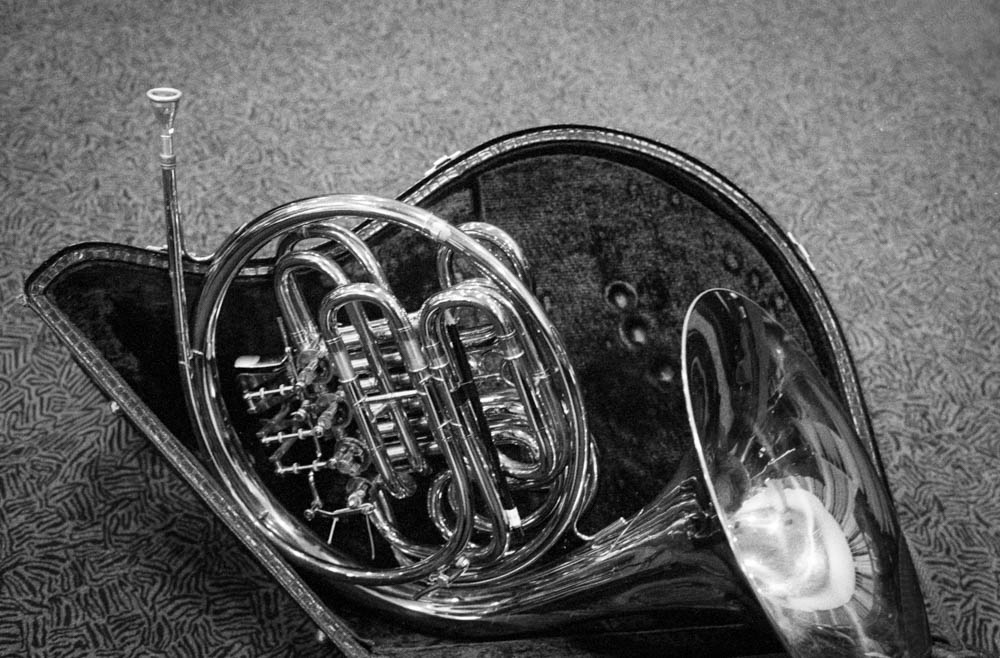
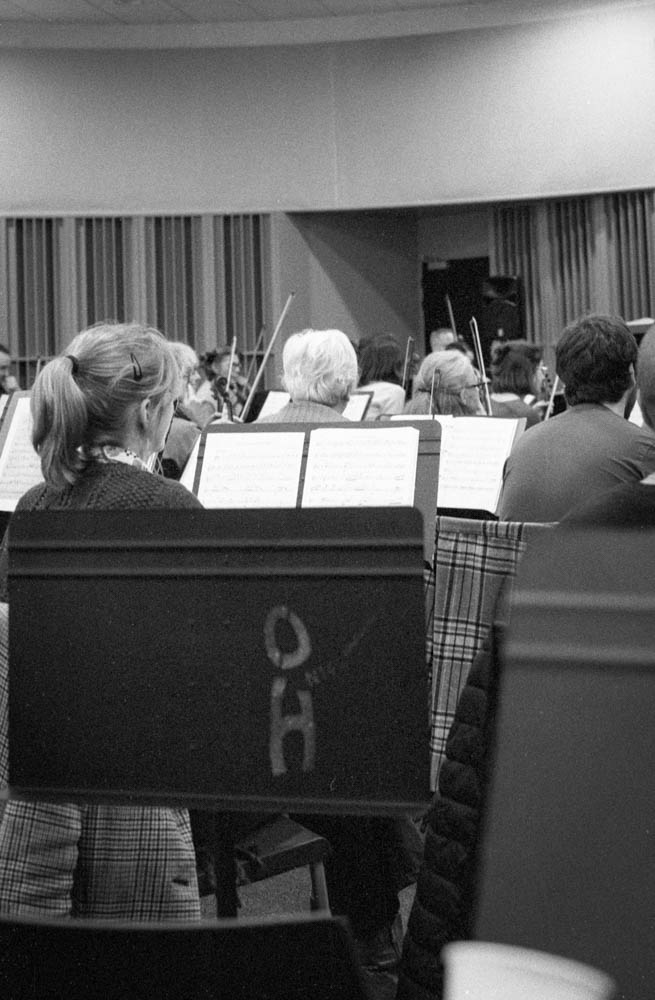
The French horn resting in its case between takes (Photo 20), valves gleaming, a moment of stillness amid the work. Coffee cups on the floor near the woodwinds (Photo 14), evidence of long hours. Sheet music covered in pencil marks, corrections, reminders. The “OH” or “HO” marking on a stand (Photo 19), worn by use.
These details tell the story as much as the wide shots. Rehearsal is a million small adjustments. A million tiny moments of focus. A million gestures—musical and human—that add up to something larger.
The HP5+ 1600 captures it all with texture and depth. The grain isn’t a flaw. It’s a feature. It says “this is real, this is work, this isn’t polished.”
The Technical Bit
Camera: Canon AE-1 Program
Lens: 50mm f/1.8 (the only lens I own for this camera)
Film: Ilford HP5+ pushed to 1600 ASA
Mode: Program autoexposure (the AE-1 Program offers Program or Manual—no aperture priority)
Editing: Lightroom—reframing, subtle vignettes, contrast via tone curve
Why HP5+ at 1600?
Because I wanted grain with control.
After the fine-grained Fomapan 100 lunch shots, I needed something different. Something that said “work” instead of “rest.” HP5+ pushed two stops gives you noticeable texture, increased contrast, better low-light performance—but it’s still forgiving.
Shadows hold detail. Highlights don’t blow out. It’s versatile enough for the mixed lighting of a rehearsal room and consistent enough to carry a whole series.
I knew I’d shoot again on Sunday at 3200 for a rawer aesthetic. Saturday at 1600 was my controlled, documentary baseline. The bridge between the calm lunch and the intense grind to come.
The Canon AE-1 Program
The AE-1 Program is a workhorse. Not fancy. Not manual control for purists. But reliable. Well-built. And its Program mode is genuinely useful.
For rehearsal photography—fast-changing light, candid moments, the need to react quickly—Program mode freed me to concentrate on seeing. The camera handled exposure. I handled composition and timing.
The metering proved accurate throughout, even with the mixed lighting and constant shifts from bright overhead lights to darker corners. I got usable exposures all afternoon without thinking about it.
Sometimes the best tool isn’t the most manual one. Sometimes it’s the one that gets out of your way and lets you work.
The 50mm f/1.8
Same lens philosophy as the lunch shoot. I own wider primes for other cameras, but for the Canon, I had one lens: 50mm f/1.8.
And it was pretty damned good.
Fast enough to handle the rehearsal room’s mixed lighting without pushing the film beyond 1600. Sharp when stopped down to f/2.8 or f/4, still usable wide open when I needed every stop of light. It gave me the flexibility to isolate individuals against the busy background or pull back and capture the ensemble.
One lens. One camera. One film speed. Constraint became creative freedom.
The Progression
Comparing these HP5+ 1600 rehearsal shots to both the Fomapan 100 lunch images and the HP5+ 3200 Sunday images shows the arc:
| Fomapan 100 (Lunch) | HP5+ 1600 (Concerto) | HP5+ 3200 (General) | |
|---|---|---|---|
| Light | Natural daylight | Mixed indoor fluorescents | Mixed indoor fluorescents |
| Grain | Fine, subtle, clean | Textural, present, controlled | Pronounced, bold, raw |
| Contrast | Gentle, even | Moderate, balanced | Punchy, dramatic |
| Mood | Relaxed, communal | Focused, collaborative | Urgent, iterative |
| Story | Community at rest | Collaboration at work | The machine in flow |
Same orchestra. Same weekend. Three worlds.
The technical choices shape the story. Fomapan says “rest.” HP5+ 1600 says “work.” HP5+ 3200 says “grind.” All true. All necessary.
What I’d Do Differently
- Shoot more close-ups of the soloists’ hands, faces, bowing technique
- Talk to the soloists during breaks (language barrier notwithstanding)
- Stay for the entire rehearsal to capture the full arc
- Try manual mode on the Canon to compare with Program mode
- Capture more of the transition moments—when the break ends, when the soloists arrive
The Point
This wasn’t just documentation. It was witness.
Rehearsing a double violin concerto with guest soloists is a specific, high-stakes kind of work. It requires collaboration, patience, translation—musical and otherwise. The grainy, high-contrast look of HP5+ at 1600 feels honest for this subject. It’s not trying to be pretty. It’s trying to be true.
Seeing my orchestra through the viewfinder, with the added dimension of guest artists, changed something for me. I saw not just the work, but the why of the work. The Symphonique des bords de Loire isn’t just playing notes together. We’re building something with people from another tradition, another language, another musical culture.
That’s beautiful. And it’s worth documenting.
But Saturday was the focused work. The concerto. The soloists. The collaboration.
Sunday would be different. No soloists. No concerto. Just the orchestra, the conductor, and the rest of the program. The grind. The iteration. The machine in flow.
The break was over. The work had begun.
And the grind was coming.
Have you shot performances or rehearsals with guest artists? I’d love to hear how you approached the collaboration visually. Drop a comment below.
P.S. Part 3—The Grind: General Rehearsal on HP5+ 3200—is coming next. The grain gets heavier, the light gets harsher, and the work gets real.
 IJM Photography