
Let’s be honest: orchestras run on two things. Music and food.
Most documentation skips the food. It’s all concert halls, polished instruments, formal attire. But the truth? We’re just a bunch of people who show up, share a meal, and then try to make something beautiful together.
I’m the fourth horn in the Symphonique des bords de Loire. And before I documented the rehearsal—the focused intensity, the collaborative work, the grainy grind—I wanted to capture what comes first. The break. The community. The quiet moment before the music starts.
So I grabbed my Pentax ME Super, loaded it with Fomapan 100, and spent the lunch break outside with my colleagues. No rehearsal room fluorescents. No conductor’s baton. Just people, food, conversation, sunlight.
This is where the story begins.
I. The Gathering
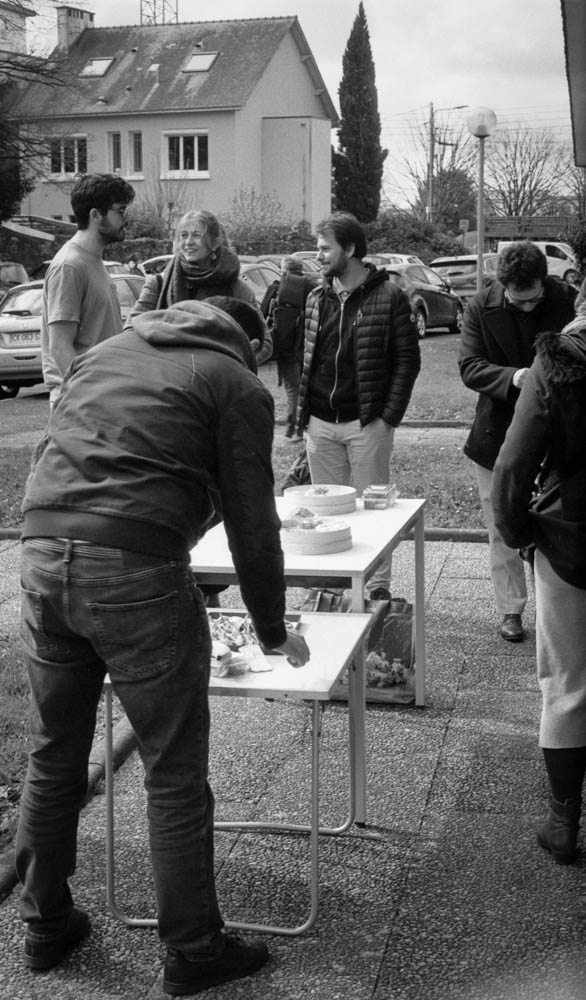
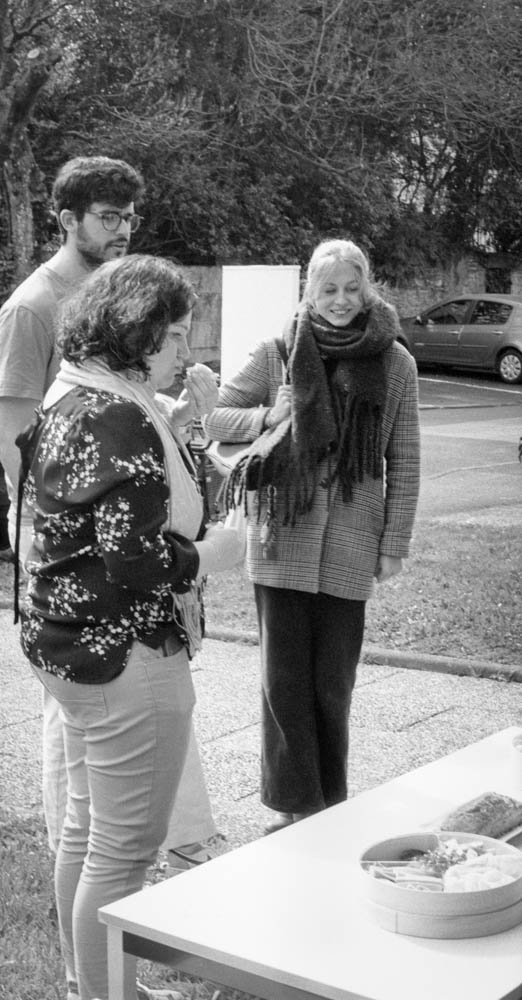
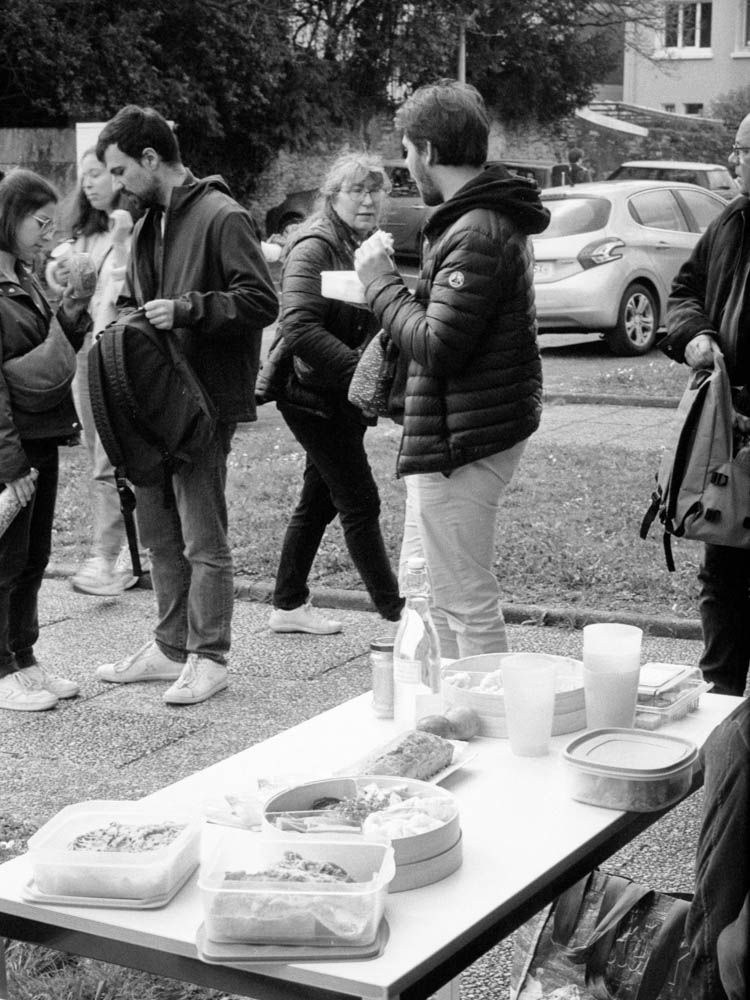
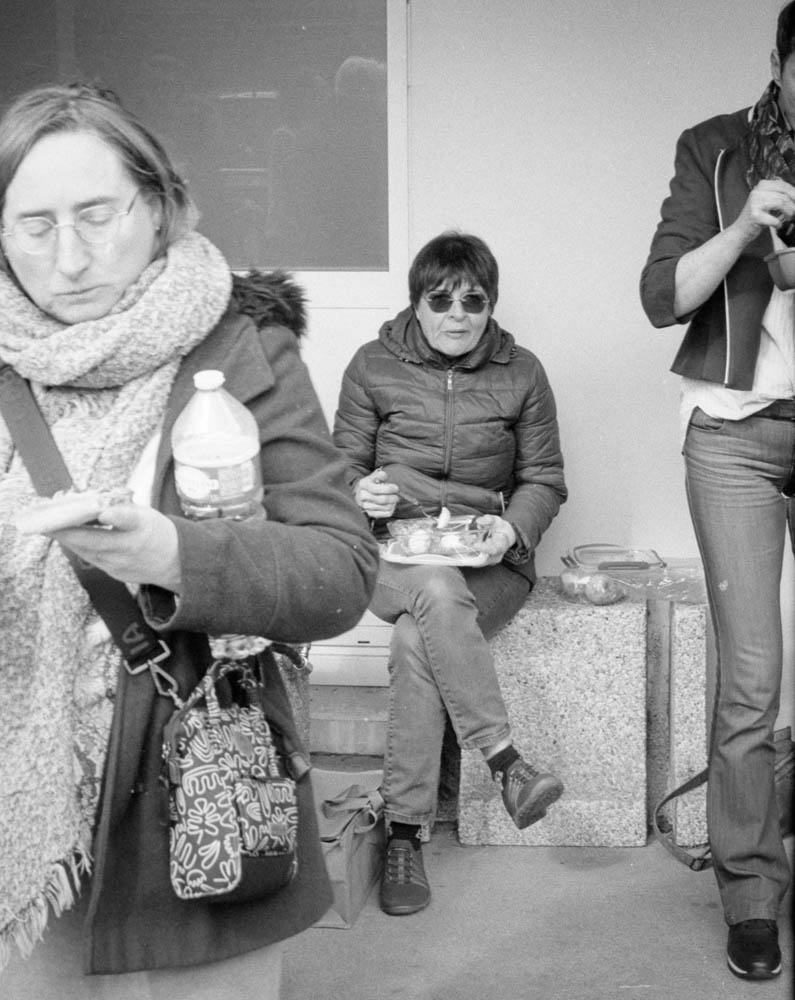
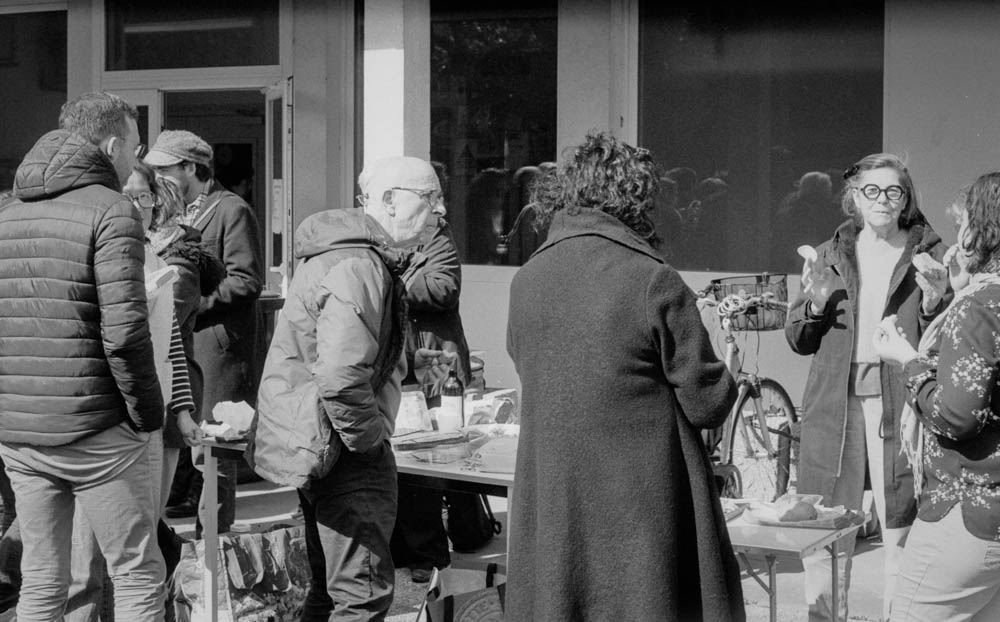
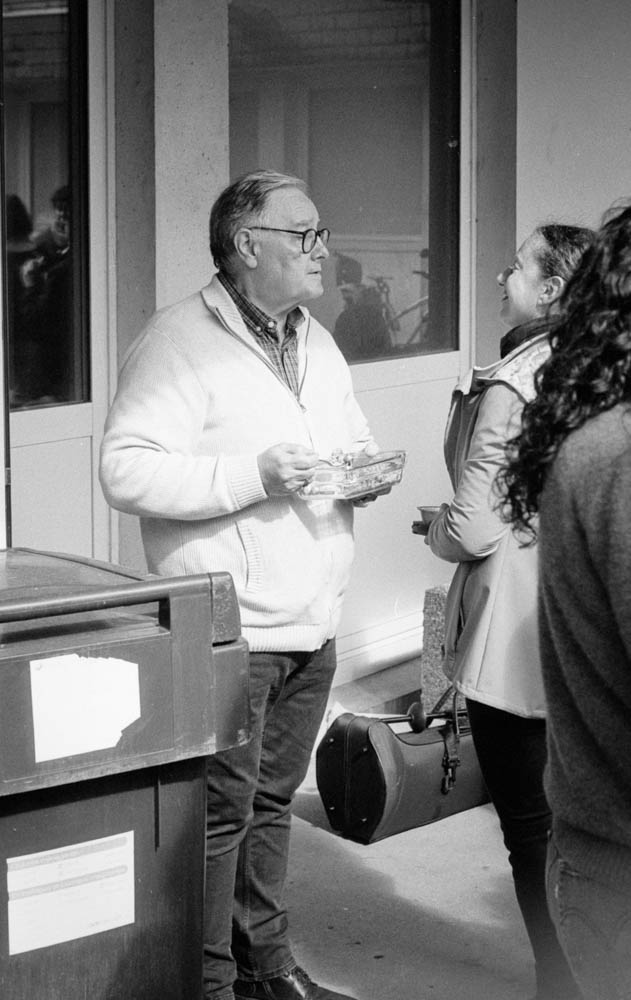
It starts simple. Tables set up outside the Centre Social. Containers unpacked. Bread unwrapped. Someone brings salad. Someone else has homemade cake. Coffee in thermoses. Water bottles. Plastic cups.
Nothing fancy. Nothing staged. Just the practical, generous act of sharing a meal before three hours of focused work.
I photographed it all with the Pentax ME Super. Aperture priority, natural light, Fomapan 100 at box speed. No pushing, no games. Just clean, crisp black and white that captures the sunlight on faces, the texture of bread, the casual posture of people at rest.
The grain is fine. Almost invisible. The contrast is gentle. The mood is calm. This isn’t the intensity to come—it’s the breath before the dive.
II. The People
Here’s what I noticed: we’re different outside.
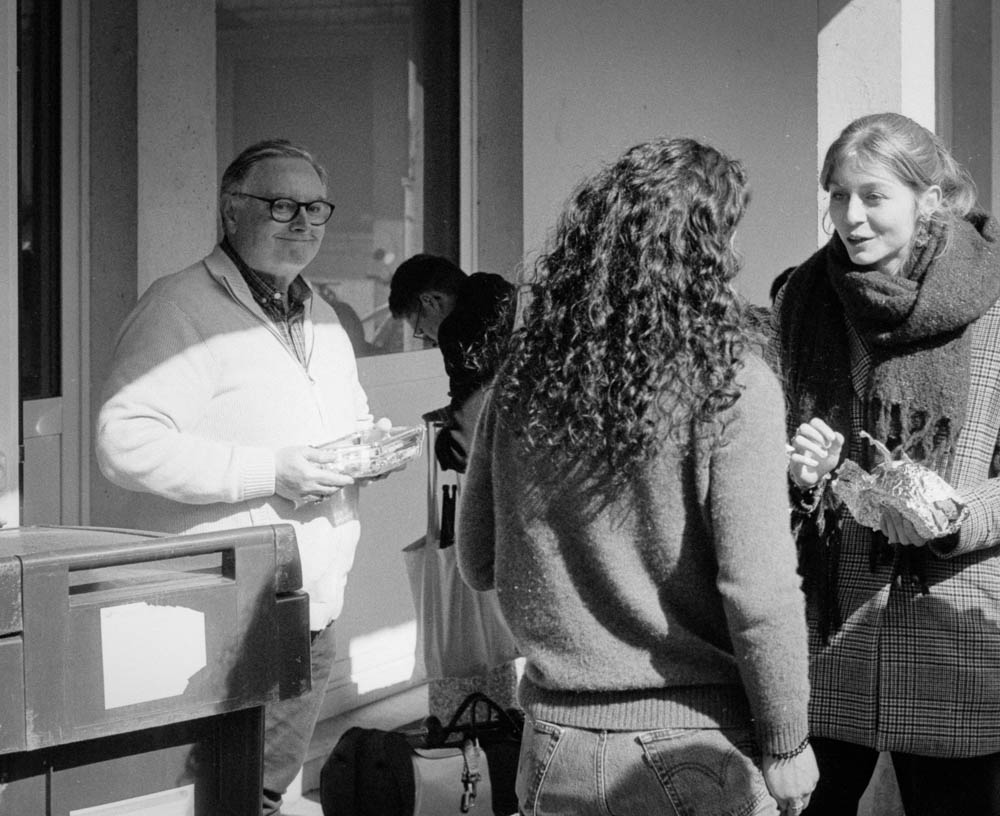
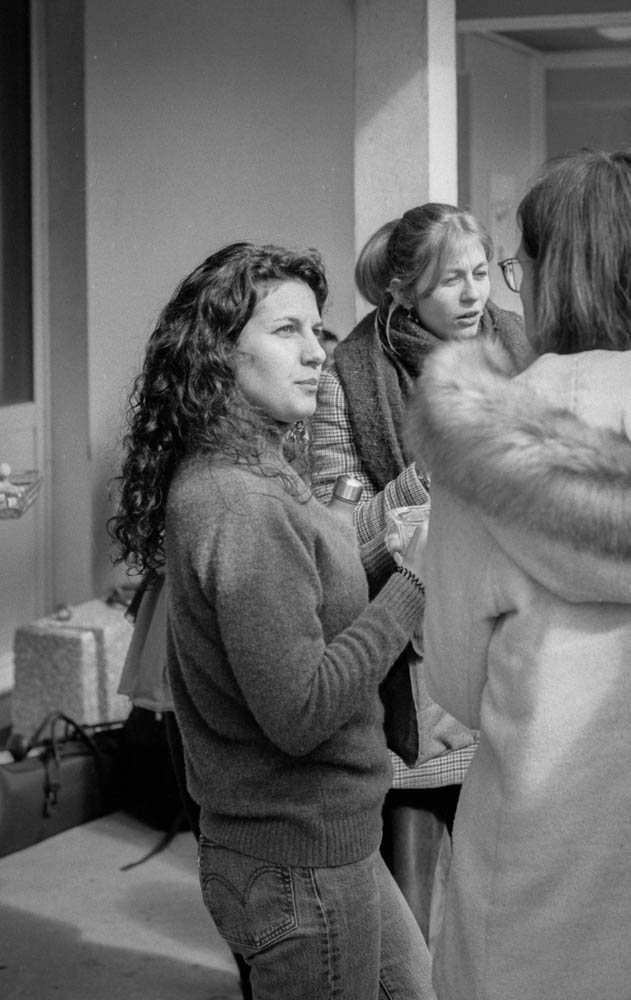
Inside the rehearsal room, we’re focused. Concentrated. Absorbed in our parts, our sections, our problems. But outside? We’re just… people.
The conductor—same man who’ll later stand at the whiteboard, gesturing, correcting, leading—is holding a food container, chatting, smiling. No baton. No authority. Just a guy at lunch with his colleagues.
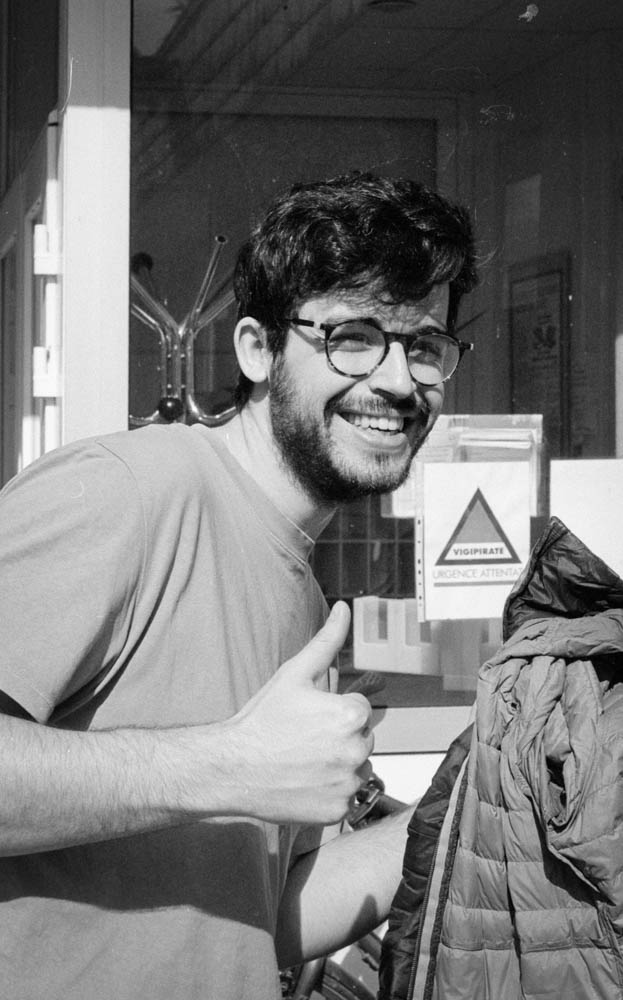
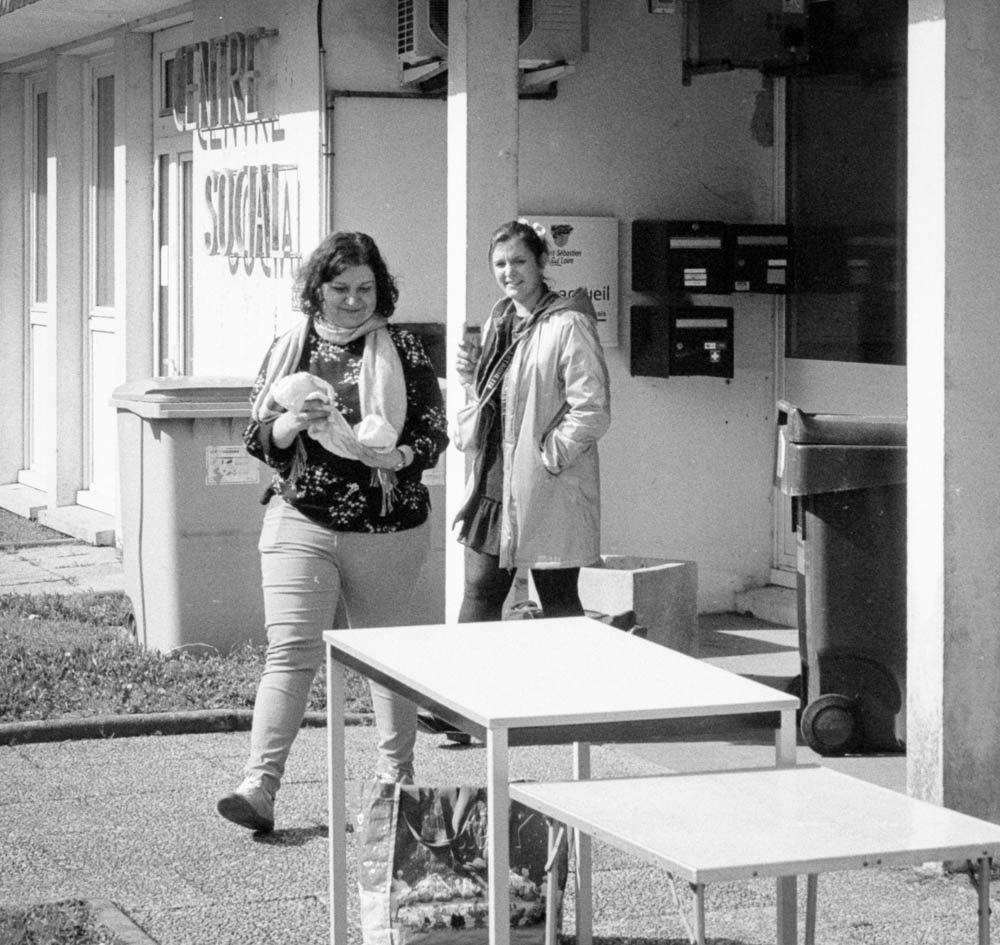
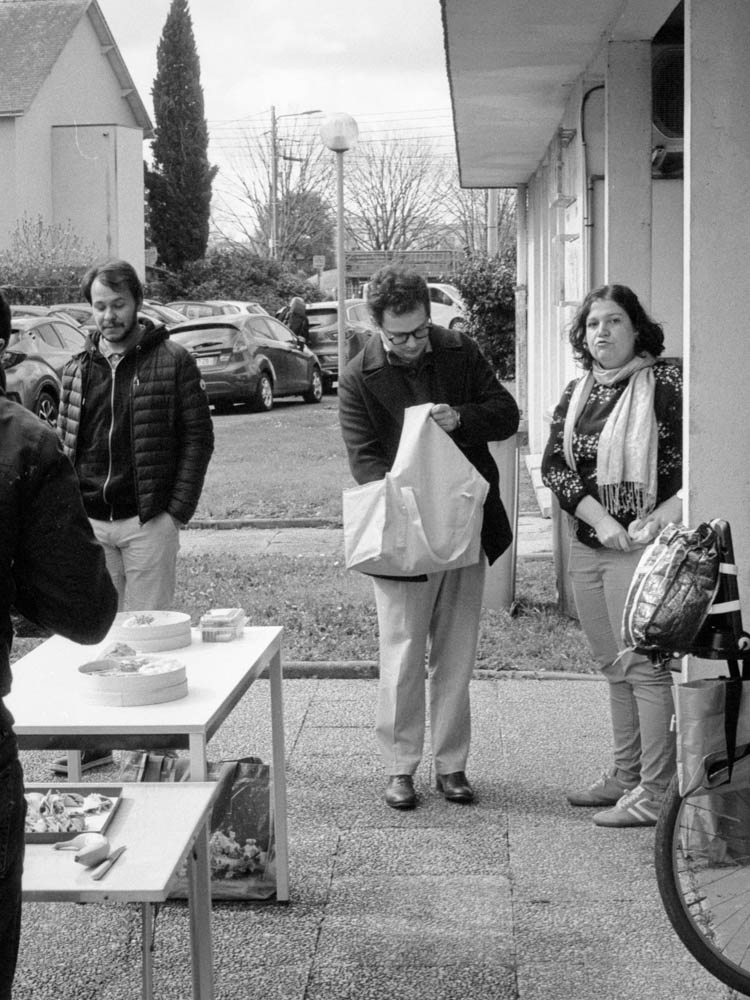
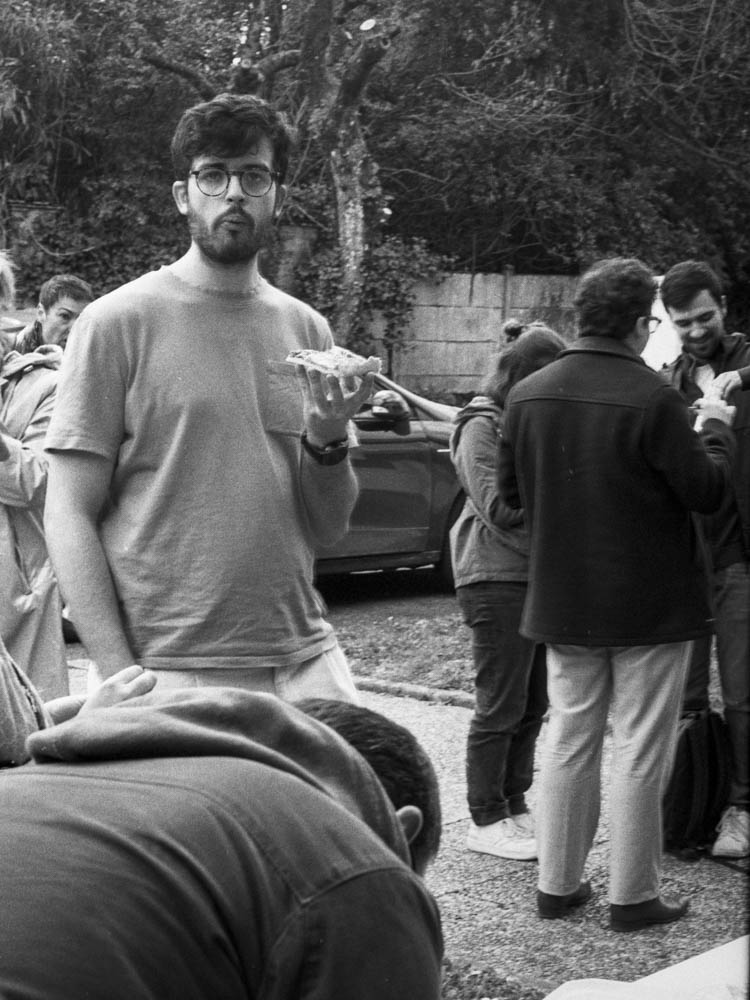
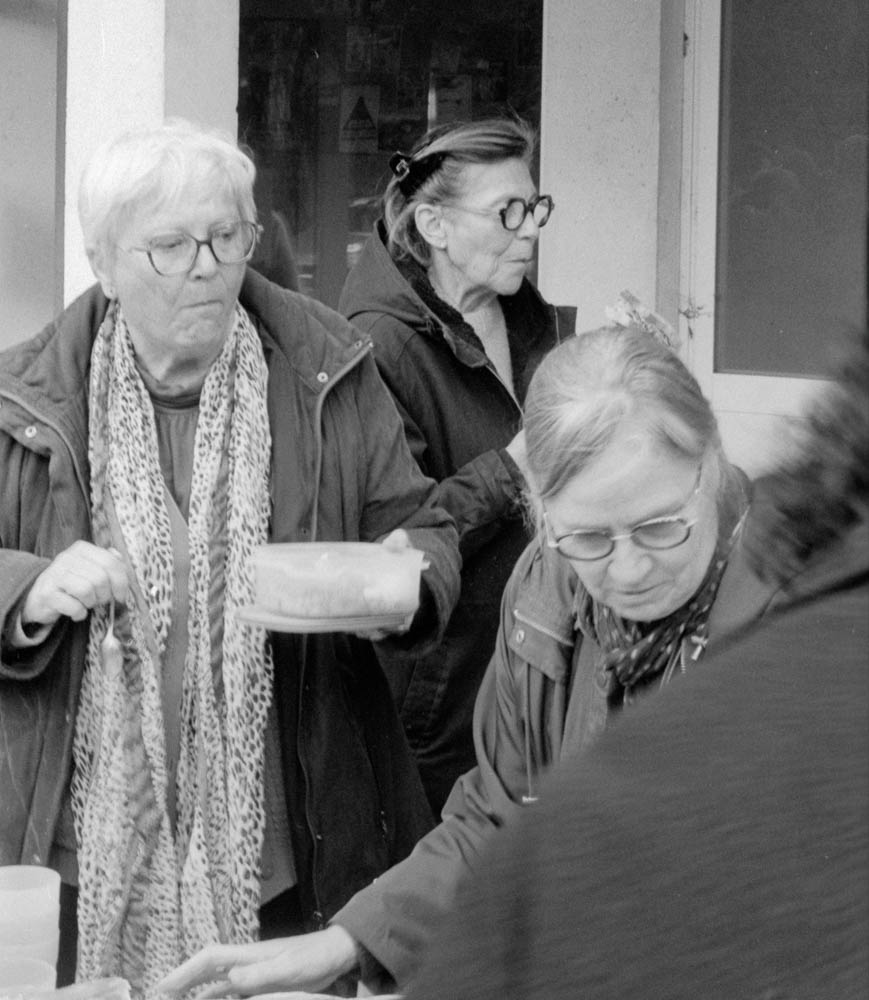
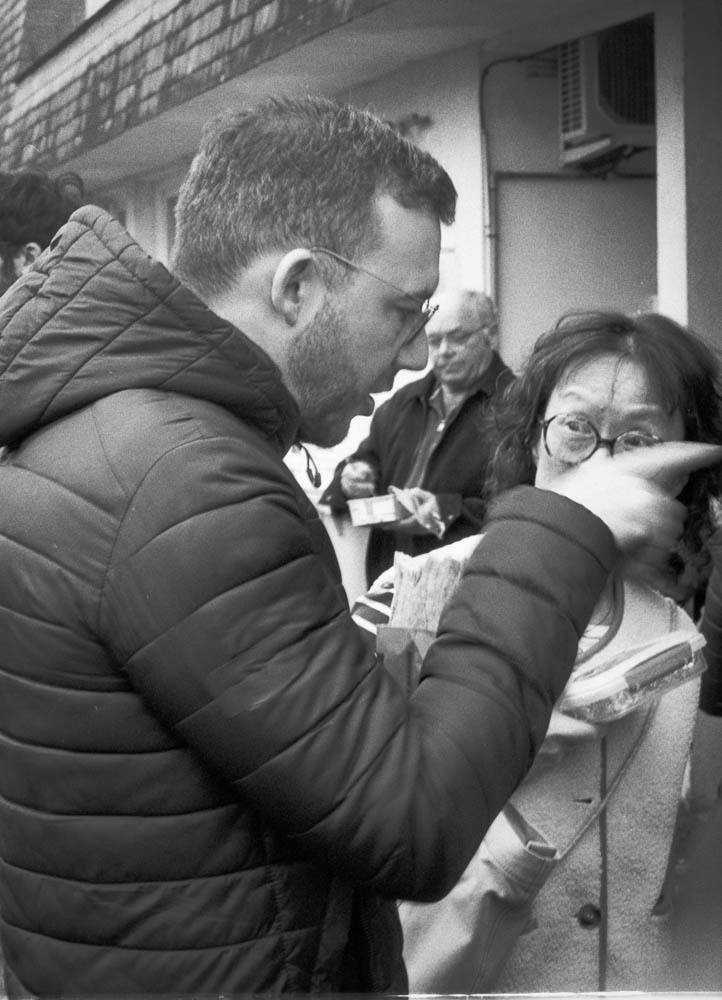
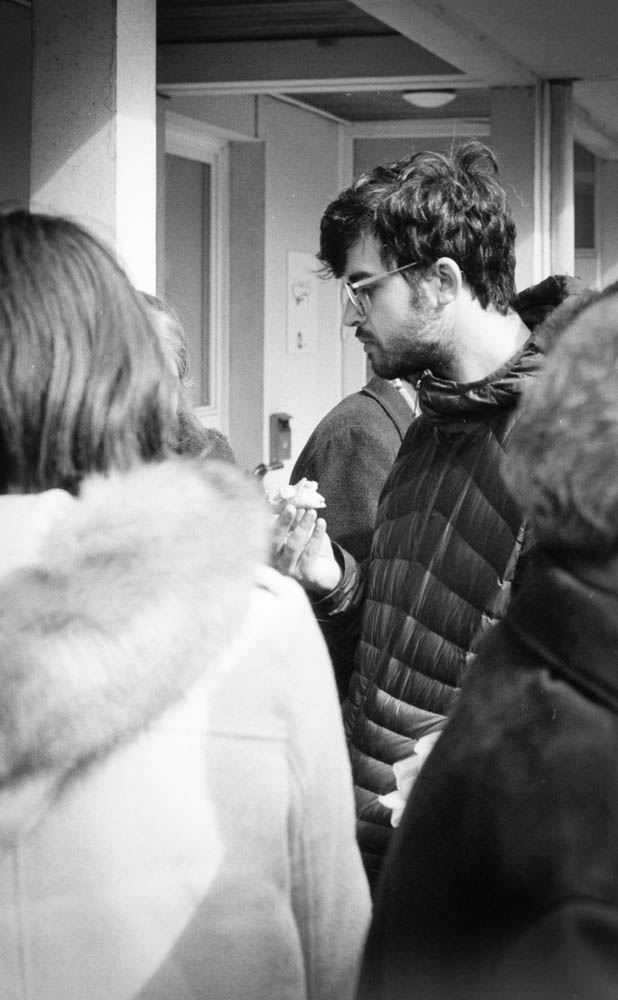
I caught Corentin, our first horn player, giving a thumbs-up and a grin (Photo 2). Same guy who’ll be sitting next to me in the horn section later, focused on difficult passages. But right now? Just a bearded dude enjoying lunch. Three women in deep conversation over containers of salad (Photo 3). And there’s Viktor, our orchestra president, unpacking a tote bag full of provisions (Photo 5)—Viktor, who plays oboe and cor anglais, the man who helps keep this whole community running, making sure we’re fed. Corentin again, mid-bite, caught in the act of living (Photo 6).
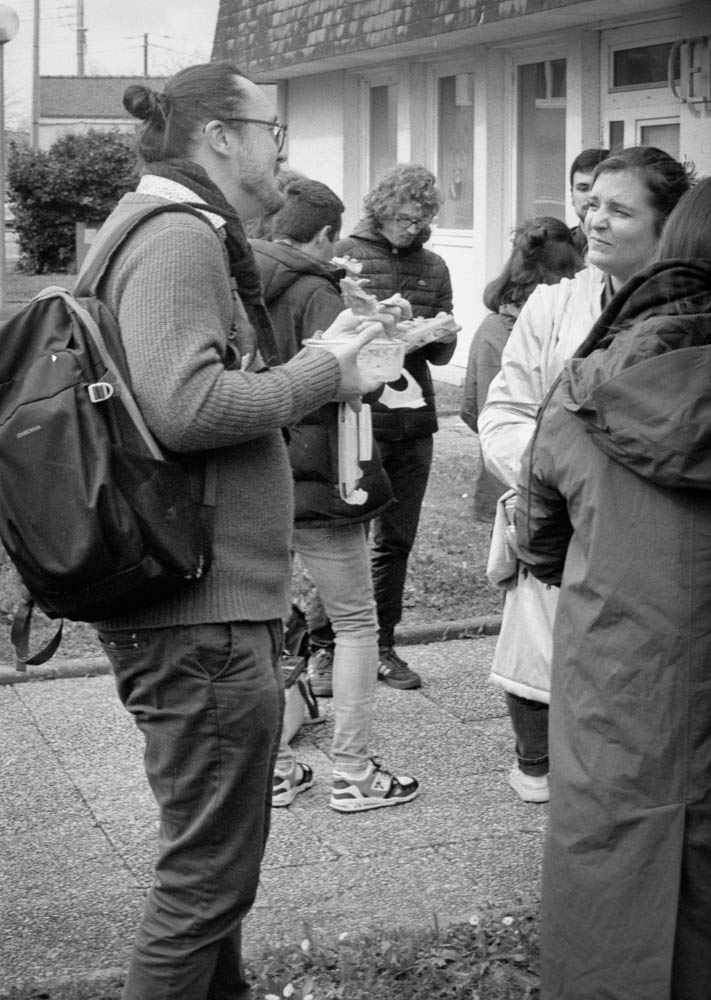
And there’s Nicolas, our timpani player, backpack slung over one shoulder, eating while chatting (Photo 15). Same guy who’ll later be behind the timpani, providing the thunder and pulse that drives the orchestra. But right now? Just another member of the tribe, refueling.
These aren’t musicians. Not yet. They’re just humans, together, before the work begins.
The two Chinese violin soloists—the guest artists who’ll be the focus of Saturday’s rehearsal—weren’t there for lunch. They’d arrive later, after we’d eaten, after the tables were packed away. For now, it was just us. The regulars. The community.
III. The Food
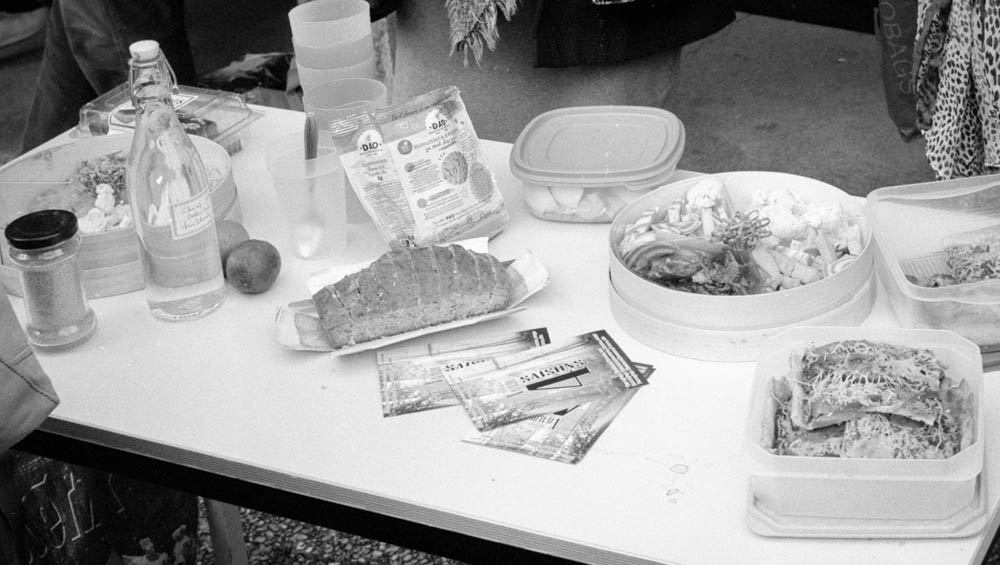
I got obsessed with the table.
Containers of every shape and size. Bread sliced and ready. Salads in round bamboo steamers. Condiments, napkins, someone’s apple rolling near the edge. A glass bottle of water catching the light.
This is the fuel. The practical, unglamorous reality of a three-hour rehearsal. You can’t make music on an empty stomach. You can’t focus when you’re hungry. So we eat. Together.
The Fomapan 100 handles it beautifully. The fine grain captures the textures—bread crust, lettuce leaves, the sheen on a plastic container. The daylight is soft, even, forgiving. No harsh shadows, no blown highlights. Just honest light on honest food.
It’s a still life. But it’s also a story: this is what sustains us.
IV. The Community
The wide shots tell the real story.
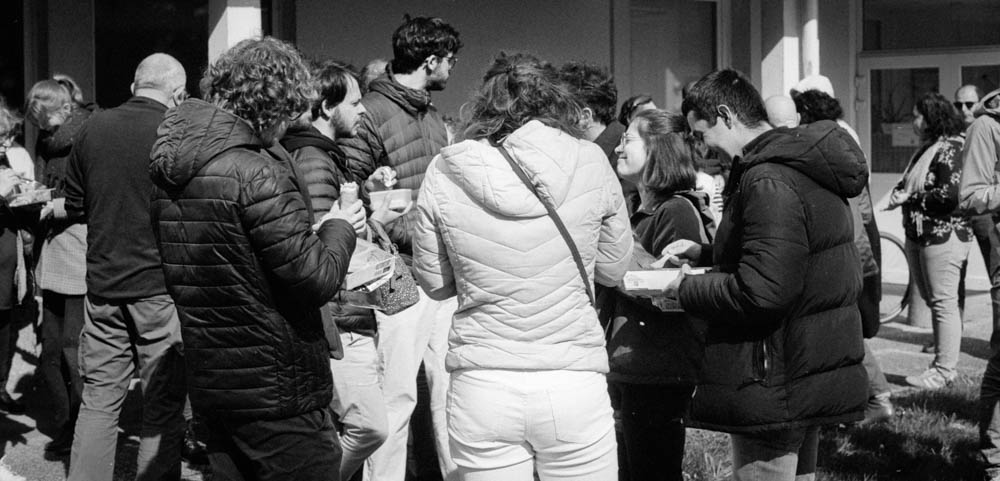
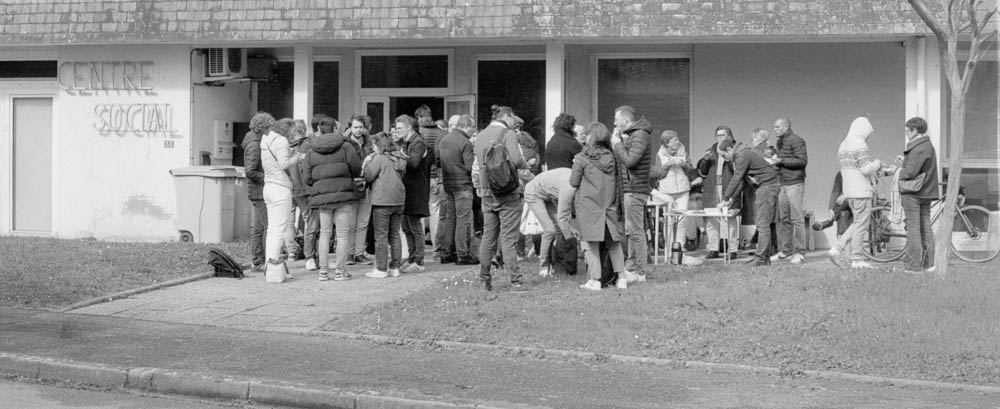
Dozens of people gathered outside the Centre Social. Some standing, some sitting on concrete blocks. Cars in the parking lot behind us. A bicycle leaning against the wall. The building’s sign—faded, weathered—reading “CENTRE SOCIAL.”
This isn’t a fancy conservatory. This isn’t a world-class concert hall. This is a community center in a French town, and the orchestra that rehearses here is made of teachers, students, retirees, professionals, amateurs. All ages. All backgrounds. One purpose.
I photographed the crowd from different angles (Photo 13, Photo 14, Photo 19). Not posed, not arranged. Just the organic chaos of people mingling, eating, talking. Some in groups, some in pairs, some alone with their thoughts.
This is the Symphonique des bords de Loire. Not the polished performance. Not the program notes. This: a community, gathered, before the music.
The Technical Bit
Camera: Pentax ME Super
Lens: 50mm f/1.7 (I also own 24mm and 28mm primes for this camera, but chose the 50mm for this shoot)
Film: Fomapan 100 ASA (shot at box speed)
Mode: Aperture priority
Editing: Lightroom—reframing, subtle contrast adjustments, no grain added
Why Fomapan 100?
Because I wanted fine grain and clean contrast.
Fomapan 100 is a budget film with a cult following. It’s not as refined as Ilford or Kodak, but it has character. At box speed in good daylight, it delivers crisp blacks, clean whites, and grain that’s present but subtle.
I knew I’d be shooting the rehearsal indoors on HP5+ pushed to 1600 and 3200. Those would be grainy, textural, urgent. This—the lunch break—needed to feel different. Calmer. Lighter. More relaxed.
Fomapan 100 delivered exactly that.
The Pentax ME Super
The ME Super is a lovely little camera. Compact, reliable, aperture-priority operation. You set the aperture, the camera selects the shutter speed. Simple, effective, fast.
For candid lunch break shots—people moving, talking, eating—I didn’t want to fiddle with full manual exposure. Aperture priority freed me to concentrate on framing and timing. Set f/2.8 or f/4 for some depth of field, let the camera handle the rest.
Why the 50mm f/1.7?
I own three primes for the Pentax ME Super: 24mm, 28mm, and 50mm f/1.7. For this shoot, I chose the 50mm.
Why? Because I wanted to isolate people within the crowd. The 24mm or 28mm would have given me more environmental context—wider views of the gathering, more of the Centre Social building, bigger group shots. And those have their place.
But for this story, I wanted intimacy. I wanted to focus on faces, gestures, small moments. The 50mm let me do that. It let me step back just enough to frame a person without intruding, while still keeping the background soft and unobtrusive.
The f/1.7 aperture was perfect for the mixed daylight—fast enough to handle shadows under the building’s overhang, sharp when stopped down to f/2.8 or f/4.
Constraint, again, became creative freedom. Not “I only have one lens,” but “I chose this lens for this story.”
The Difference Is Striking
Comparing these Fomapan 100 lunch shots to the HP5+ 1600 rehearsal images is like day and night. Literally.
| Fomapan 100 (Lunch) | HP5+ 1600 (Rehearsal) | |
|---|---|---|
| Light | Natural daylight | Mixed indoor fluorescents |
| Grain | Fine, subtle, clean | Textural, present, moody |
| Contrast | Gentle, even | Punchy, dramatic |
| Mood | Relaxed, communal | Focused, intense |
| Story | Community at rest | Collaboration at work |
Same orchestra. Same day. Different worlds.
The technical choices—film speed, camera, light, lens—shape the story. These Fomapan images say “rest.” The HP5+ images say “work.” Both are true. Both are necessary.
What I’d Do Differently
- Shoot more close-ups of individual faces and conversations
- Capture the transition from outside to inside—the moment the break ends
- Talk to more people about what they brought, why they play, what the orchestra means to them
- Try the 24mm or 28mm for wider environmental context on a future shoot
- Stay outside longer to catch the stragglers, the quiet moments
The Point
This wasn’t just documentation. It was witness.
Orchestras aren’t just the music they make. They’re the people who make it. The shared meals, the conversations, the community that forms around the work. The lunch break isn’t incidental. It’s essential.
The fine grain of Fomapan 100, the natural daylight, the casual candor of the shots—they all serve this truth. This is the foundation. The rest. The breath before the dive.
Because after this? After the food is packed away, the tables folded, the last conversation finished? The real work begins.
The conductor puts down his food container and picks up his baton. The woodwinds assemble—Viktor picking up his oboe or cor anglais. The horn section warms up—Corentin, our first horn, and me, fourth horn, finding our pitches. The timpani are prepared—Nicolas taking his place behind the drums. The strings take their seats.
And then the soloists arrive. Two Chinese violinists, guest artists, ready to collaborate on a double violin concerto. The community expands. The work intensifies.
The break is over. The rehearsal is about to start.
And that’s where Part 2 begins.
Have you shot behind-the-scenes moments like this? The quiet, human spaces between the “important” events? I’d love to hear your approach. Drop a comment below.
P.S. Part 2—Rehearsing a Double Violin Concerto on HP5+ 1600—is coming next. The grain gets heavier, the light gets harsher, and the work gets real.
 IJM Photography