
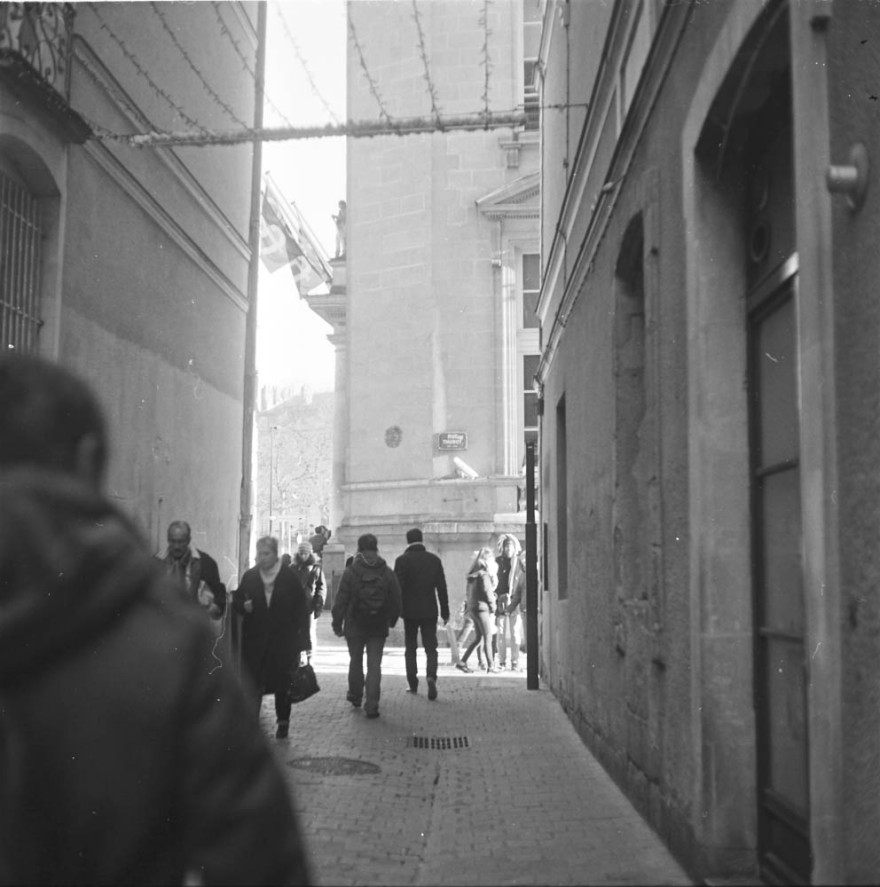
Medium format photography with the Mamiya C220 is a journey into a world that’s quite different from using “ordinary” film cameras. It’s an experience that opens up new possibilities and allows you to capture images with remarkable details and depth.
The Mamiya C220 is a beast of a camera. It’s big, heavy, and built like a tank. But it’s also a joy to use. The viewfinder is bright and clear, and the lenses are sharp. The camera is easy to use, even for beginners.
A Closer Look at the Lenses
One of the best things about the Mamiya C220 is its interchangeable lens system—a rarity among twin-lens reflex cameras. The full lineup spans seven focal lengths: the 55mm f/4.5 wide-angle, the 65mm f/3.5, the classic 80mm f/2.8 standard, the 105mm f/3.5 short telephoto (available in both 4-element Tessar-type and 5-element Heliar/Dynar optical formulas, with some variants featuring depth-of-field scales on the viewing lens), the 135mm f/4.5, the 180mm f/4.5, and the 250mm f/6.3 telephoto. All of these Sekor lenses are remarkably sharp and render beautiful, characterful images. The 80mm f/2.8 remains my favorite for the C220; it’s a versatile all-around lens that excels at portraiture, landscape, and street photography.
Metering and Focusing
The Mamiya C220 doesn’t have a built-in light meter, so you’ll need to use an external meter if you want to meter your exposures. This can be a bit of a pain, but it’s not a deal-breaker. You can use a handheld light meter, or you can use a smartphone app.
The Mamiya C220 is a manual focus camera, so you’ll need to learn how to focus manually. This can be a bit tricky at first, but it’s not too difficult to learn. The viewfinder provides a unique 3D-like experience that helps you focus with precision.
In My Experience
Now, let me share some of my personal experiences with the Mamiya C220. I found that despite its bulk, the camera feels great in the hand. The viewfinder remains bright and clear, even in low light conditions. The lenses consistently deliver sharp and beautiful images. Plus, it’s easy to use, even if you’re new to film photography.
Sample Photos and Comparisons
To help you visualize the camera’s potential, I recommend checking out some sample photos taken with the Mamiya C220. They showcase the camera’s unique aesthetic and image quality. In comparison to other TLR cameras, the Mamiya C220 stands out in terms of its lens options and build quality. You will notice that this particular model takes square format pictures so bear that in mind when thing about acquiring one.
Enhancements and Care
If you’re looking to enhance your Mamiya C220 experience, consider exploring compatible accessories like different viewfinders, focusing screens, or other accessories to improve your shooting comfort.
While there are no alternative film backs for the Mamiya C220, it’s important to note that the camera is versatile when it comes to film formats. You can use both 120 and 220 format films by simply indicating your choice when loading the film. This flexibility allows you to adapt to different shooting situations with ease.
A Unique Statement Piece
The Mamiya C220 can be best described as a statement piece. When you’re out taking photographs with this camera, you’ll undoubtedly attract curious passersby who can’t resist approaching you to ask about it. They’ll often share nostalgic stories about how their grandparents had a camera just like it, igniting a sense of shared history and fascination.
The Mamiya C220 oozes vintage appeal, making it a conversation starter wherever you go. Despite its vintage charm, it’s a resolutely modern camera, dating back to the 1980s, which, in the world of classic film photography, is considered relatively recent. For many, including myself at aged 51, this era doesn’t feel old at all.
Medium Format Magic
Medium format photography, in particular, is a game-changer. The negatives produced are significantly larger than those from “ordinary” film cameras, resulting in breathtaking details and unparalleled depth in your images. This quality is what truly sets the Mamiya C220 apart and makes it a preferred choice for photographers seeking extraordinary clarity and definition in their work.
Community and Conclusion
Lastly, join the vibrant community of Mamiya C220 enthusiasts online. You can find forums, groups, and communities where you can share experiences and get valuable tips from fellow photographers. In conclusion, if you’re in search of a classic medium format TLR that consistently produces high-quality images, the Mamiya C220 is a strong contender. Just be prepared to embrace its substantial size and weight while enjoying the fantastic results it delivers.
Tech Specs and Pricing
Here are some technical specifications of the Mamiya C220:
- Film format: 120 and 220
- Image size: 6×6 cm
- Lenses: Interchangeable, 50mm f/2.8, 80mm f/2.8, 100mm f/2.8, 135mm f/4
- Shutter speed: 1-1/1000 sec
- Metering: External
- Focus: Manual
- Weight: 1.3 kg
- Price: $500-1000
So, there you have it, the Mamiya C220—a dependable companion for your medium format film photography exploits.


 IJM Photography
Thanks for the comment about Claude, appreciated. I somehow managed to delete it though !!!!
LikeLiked by 1 person
It happens, but it’s good to know that he hs found a good home. Cats are like that. They choose wisely!
LikeLiked by 1 person
You really can’t ask for a better camera if you can find one in good condition.
Things to look at is the film advancement mechanism. For their age most are in need of a CLA to make certain frame spacing is good (an issue for many TLR’s in general. You also have to consider each lens as its own camera since all are lens – shutter combinations. Its not uncommon for the slower shutter speeds to be off requiring a CLA for the shutters.
Once you get past all of that, the cameras are wonderful to shoot with. I love mine.
I currently have the 55mm, 80mm & 180mm Super lenses. Each produce amazing images.
LikeLiked by 1 person
Thank you for such a thoughtful comment…. I have three rolls of Tri X to develop…. this one was gifted to me and it blocked once, but I was able to get it repaired. I’m so glad I did…
LikeLike
Only one of the lenses that you list is correct, the 80mm. Mamiya never made a 50mm for this camera but did make a 55mm f4.5. They never made a 100mm but did make several versions of the 105mm f3.5 (4 element Tessar formula and five element Helier/Dynar formula, with and without depth of field built into the viewing lens). The 135mm was an f4.5 and not f4. You also leave out the 65mm, 180mm, and the 250mm.
LikeLiked by 1 person
Thank you Mr Anonymous for your comment. I have acted upon it and edited my article accordingly. I strive to talk about the way a camera feels in the hand whilst, at the same time, provide decent factual information. Thank you very much for correcting me.
LikeLike